Cleaning
Chemical dilution control: getting the mix right, every bottle, every shift
A dilution control system is equipment, such as a wall-mounted proportioning dispenser, a closed cartridge system or a pre-measured pack, that mixes cleaning chemical concentrate with water at a fixed ratio so the ready-to-use solution matches the product label.
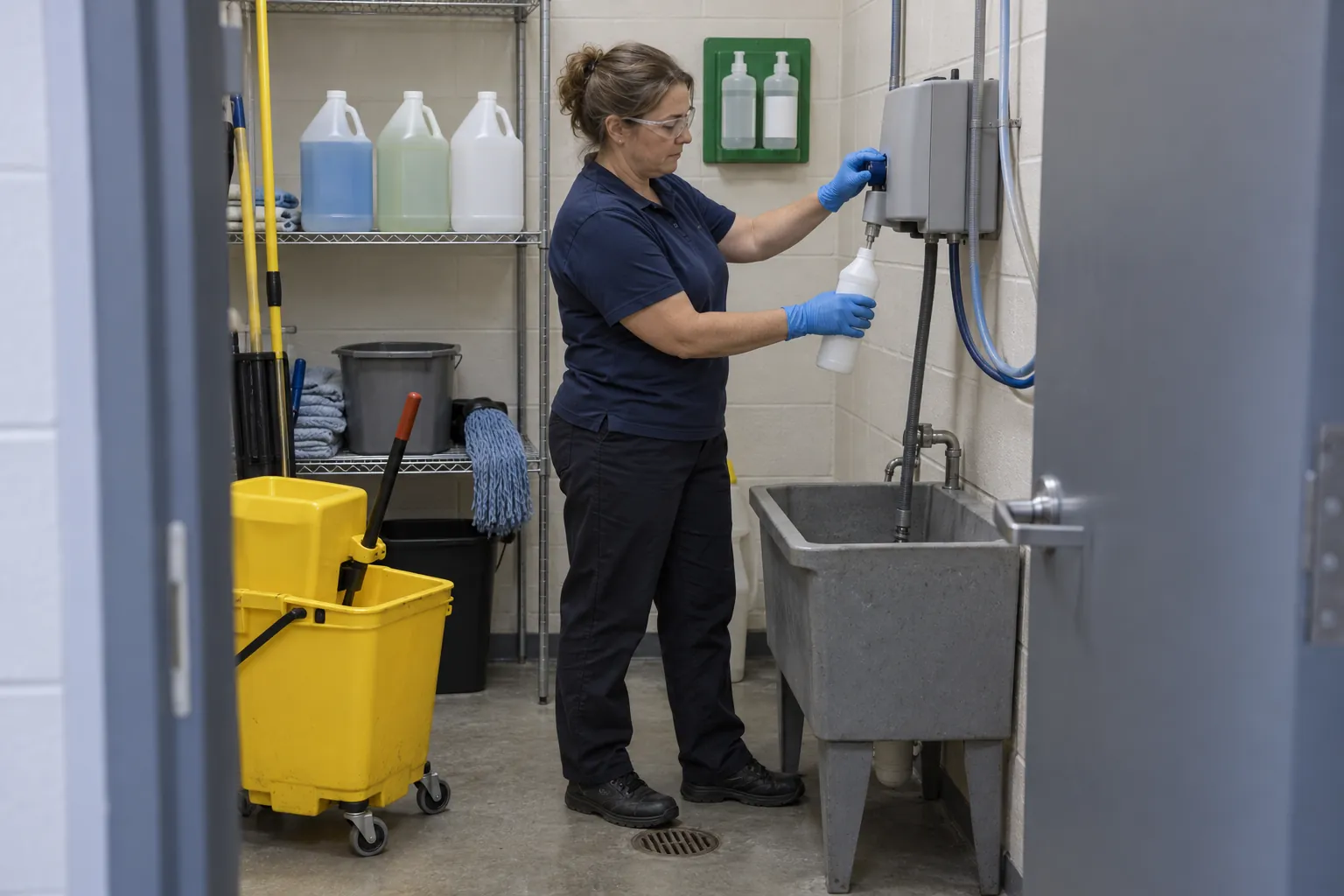
Most janitorial chemicals arrive as concentrate and are used at a fraction of that strength. Dilution control is how a building makes sure the solution in the spray bottle, the mop bucket and the auto-scrubber tank is the one the label calls for: not so weak that a disinfectant stops working, not so strong that it burns skin, damages floors and wastes money. This guide covers what OSHA's Hazard Communication standard and EPA product labels require, how dilution control systems work, how to check them, and what the record should show.
01
What the rules say about diluting cleaning chemicals
No single regulation is called dilution control. The duty comes from two federal regimes that meet in the janitor closet: OSHA's rules on hazardous chemicals, which protect the worker, and EPA's rules on registered antimicrobial products, which govern how a sanitizer or disinfectant may be used.
On the OSHA side, the Hazard Communication standard, 29 CFR 1910.1200 (HazCom) applies to most concentrated janitorial products, because most of them are hazardous chemicals in the standard's sense. It requires a written hazard communication program with a list of the hazardous chemicals present, safety data sheets (SDSs) that are readily accessible to employees during each work shift, labels on workplace containers, and training. OSHA updated the standard in 2024, effective July 19, 2024. For employers, the compliance dates are November 20, 2026 for substances and May 19, 2028 for mixtures; until then an employer may comply with either the current or the prior version.
Labeling is where dilution meets HazCom most directly. A secondary container, such as a spray bottle filled from a dispenser, needs a workplace label under paragraph (f)(6): either the full shipped label or the "product identifier and words, pictures, symbols, or combination thereof, which provide at least general information regarding the hazards of the chemicals". Paragraph (f)(10) adds that workplace labels must be "legible, in English, and prominently displayed on the container, or readily available in the work area throughout each work shift." The one exemption is narrow. Paragraph (f)(8) says the employer "is not required to label portable containers into which hazardous chemicals are transferred from labeled containers, and which are intended only for the immediate use of the employee who performs the transfer." A bottle filled at the start of a shift and left on a cart for whoever comes next is not that.
On the EPA side, sanitizers and disinfectants are pesticides registered under the Federal Insecticide, Fungicide, and Rodenticide Act, which EPA's summary of FIFRA describes as authorizing it to "regulate the distribution, sale, production, and use of pesticides". Every registered product carries the statement quoted on EPA's page Introduction to Pesticide Labels: "It is a violation of Federal law to use this product in a manner inconsistent with its labeling." The label sets how much and how the product is used, and that includes its use-dilution.
The CDC's Guideline for Disinfection and Sterilization in Healthcare Facilities, 2008 (updated June 2024) spells out what that means in practice: "Failure to follow the specified use-dilution, contact time, method of application, or any other condition of use is considered a misuse of the product and potentially subject to enforcement action under FIFRA." The label rule behind it applies in an office restroom as much as in a patient room.
02
How dilution control systems work
A dilution control system is any method that turns concentrate into a ready-to-use solution at a set ratio without the custodian guessing. In commercial buildings there are four common kinds, and many janitorial programs use more than one.
- Wall-mounted proportioning dispensers. Connected to the building's water supply, usually in the janitor closet. Water flowing through the unit draws concentrate from a jug through a metering tip, and the size of the tip sets the ratio. Most units have separate outlets for filling a spray bottle and a bucket or scrubber tank at different flow rates.
- Closed portable systems. A sealed concentrate cartridge attached to a bottle or a small hand-held dispenser, which mixes at the point of use. They suit sites with no plumbed closet, such as a satellite office or a school annex.
- Pre-measured packs. Single-dose pouches, soluble packs or tablets sized for a set volume of water, such as one pack for a quart bottle or one tablet for a gallon.
- Manual measuring. A pump, a marked cup or a graduated bottle. It is the cheapest method and the one most open to error, because it depends on the person measuring every time.
The ratio itself comes from the product label or, for a cleaner that is not a registered pesticide, the manufacturer's directions. It is written in different ways: ounces per gallon, a ratio such as 1:64, or a range for light and heavy soil. A disinfectant label may give one dilution for general disinfection and another for a specific organism, each with its own contact time. The dispenser has to be set to the dilution the building actually needs, and the setting has to be recorded, because a metering tip looks much like any other.
A proportioning dispenser also depends on the water. Its ratio is designed for a range of water pressure and flow; a closet where the pressure drops at certain times of day, or where the incoming line is partly closed, can deliver a different mix from the one on the chart. A dispenser plumbed to the potable water supply is a cross-connection, so it needs the backflow protection that the locally adopted plumbing code and the water utility require, and that protection is maintained and tested like any other.
03
What goes wrong when dilution is not controlled
Getting the mix wrong fails in both directions, and neither shows on the surface.
- Too weak. A disinfectant used below its label dilution may not achieve the kill claim the building is relying on, and a cleaner used too weak leaves soil behind. It is also misuse under the label, whichever way the error runs.
- Too strong. More concentrate means more exposure for the person using it, more residue left on floors and surfaces, sticky or hazy finishes, damaged materials and higher chemical spend. It does not mean cleaner.
- Contaminated solutions. The CDC guideline names the "common sources of extrinsic contamination of germicides" as "the water to make working dilutions, contaminated containers, and general contamination of the hospital areas where the germicides are prepared and/or used." A bottle topped up rather than emptied and cleaned, or a bucket solution used across a whole floor, is where that starts.
- Mixed products. The OSHA-NIOSH InfoSheet Protecting Workers Who Use Cleaning Chemicals (OSHA 3512, 2012) warns that "Mixing cleaning products that contain bleach and ammonia can cause severe lung damage or death." Unlabeled bottles and a crowded closet are how two products end up in one container.
- Unlabeled bottles. A spray bottle with no label, or with the label of a product it no longer holds, breaks HazCom and leaves the next person guessing what they are spraying.
For solutions that are used over a shift, the CDC guideline recommends that facilities "Prepare disinfecting (or detergent) solutions as needed and replace these with fresh solution frequently (e.g., replace floor mopping solution every three patient rooms, change no less often than at 60-minute intervals), according to the facility's policy." Outside healthcare the interval is set by the building's own policy, but the principle carries: a solution has a working life, and the program should say what it is.
04
Setting up a dilution control program
A dilution control program is the written part of the building's chemical management: which products are used, at what dilution, with which system, and who checks it. It usually sits alongside the HazCom written program and the janitor closet setup, and it works best when it is short enough to post on the closet wall.
- Cut the product list. Fewer products means fewer dilutions to get right and fewer SDSs to keep. The OSHA-NIOSH InfoSheet advises employers to "choose the least hazardous cleaning chemical that will accomplish the task at hand", and to use a cleaner rather than a sanitizer or disinfectant where disinfecting is not needed. Cleaning, sanitizing and disinfecting are different jobs.
- Set each dilution from the label. For every product, write down the use-dilution, the use it applies to, and for a disinfectant the contact time. Where a label gives a range, decide which end the building uses and why.
- Match the system to the site. Plumbed dispensers where there is a closet with water and drainage, closed portable systems or pre-measured packs where there is not. Record which metering tip or setting gives each dilution.
- Label every container. Dispensers usually come with bottle labels for each product. Every secondary container gets one, and the bottle stays with that product.
- Assess and provide PPE. Under 29 CFR 1910.132, "The employer shall assess the workplace to determine if hazards are present, or are likely to be present, which necessitate the use of personal protective equipment (PPE)" and certify that assessment in writing. Handling concentrate usually calls for gloves and eye protection; the SDS says which.
- Provide eyewash where corrosives are handled. Under 29 CFR 1910.151(c), "Where the eyes or body of any person may be exposed to injurious corrosive materials, suitable facilities for quick drenching or flushing of the eyes and body shall be provided within the work area for immediate emergency use." Some janitorial concentrates are corrosive; the SDS will say so.
- Train before first use. HazCom requires training at the time of initial assignment and whenever a new chemical hazard is introduced, covering "the measures employees can take to protect themselves from these hazards". The OSHA-NIOSH InfoSheet lists "dilution procedures when a cleaning product must be diluted before use" among the topics, and says training must be given "at a level and in a language and vocabulary that they can understand."
Any supervisor should be able to say what is in a bottle, at what dilution, and when it was filled.

05
Checking dispensers and solutions, and how often
No federal rule sets how often a dispenser should be checked. The frequency comes from the building's program, the chemical supplier's service arrangement and, in healthcare, the facility's infection prevention policy. A workable pattern for a commercial building looks like this:
- Every fill. The right product, the right outlet, a labeled bottle or bucket, and the correct PPE on.
- Every shift. Solutions in use are fresh, bottles are not topped up, and nothing unlabeled is on the cart.
- Weekly, at each dispenser. No leaks or drips, concentrate pickup tubes in the right jugs, metering tips in place, the dilution chart and SDS access posted, backflow device in place, eyewash where it is needed and unobstructed.
- Monthly or quarterly. A dilution verification: fill a known volume, measure the concentrate drawn or test the solution with the manufacturer's test strips or titration kit where the product has one, and compare with the chart. Many chemical suppliers do this as part of their service; the building should still see the result.
- After any change. A new product, a changed metering tip, plumbing work in the closet or a move to a new site.
What good evidence looks like is simple: the date, the dispenser or closet, who checked, what was found, and what was done about anything wrong. A photograph of a leaking dispenser or an empty eyewash bottle says more than a checkmark.
06
Where the dilution record fails, and what SiteClara does about it
Dilution control is usually well set up on the day the chemical supplier installs the dispensers, and poorly recorded after that. The dispenser check is a line on a closet sheet, initialed for the month in one sitting. The leak someone noticed was mentioned to whoever was passing and never fixed. When a tenant complains about a sticky floor, or an infection preventionist asks when a closet's dilution was last verified, nobody can say which day it was checked, by whom, or what was found.
SiteClara records checks at the place they happen. A printed QR code poster, with an optional NFC tag behind it, goes where a check is scheduled, such as a janitor closet or a chemical dispensing station. A custodian scans the code or taps the tag on their own phone, with no app to install, sees the checks set for that place, and marks each one done, or says what stopped them. The building writes the checks, so a closet check can ask whether the dispenser is leaking, whether the bottles are labeled and whether the eyewash is clear, and can ask for a photo of a test strip reading. The time and the named person are recorded as it happens. A problem found on the way, such as a cracked pickup tube or an empty concentrate jug, goes onto the team's list of jobs until someone closes it.
The janitorial supervisor sees what is due, done and missed, and records the reason when a check was missed. Each day they review the totals and photos and approve a report that goes the next morning to nominated managers, such as the facility manager or the client, showing what was reported, completed and still open, and how the scheduled checks went.
07
Questions people ask
What is the correct way to dilute cleaning chemicals?
Dilute a cleaning chemical exactly as its label or the manufacturer's directions say, measured by a dispenser, a pre-measured pack or a marked measure rather than by eye, into a clean, labeled container. For a sanitizer or disinfectant the use-dilution is part of the law: EPA's page Introduction to Pesticide Labels quotes the statement every registered product carries, "It is a violation of Federal law to use this product in a manner inconsistent with its labeling." The OSHA-NIOSH InfoSheet Protecting Workers Who Use Cleaning Chemicals tells employers to make sure "that workers know which cleaning chemicals must be diluted and how to correctly dilute the cleaners they are using".
What two household chemicals should you never mix?
Bleach and ammonia are the pair the OSHA-NIOSH InfoSheet Protecting Workers Who Use Cleaning Chemicals singles out: "Mixing cleaning products that contain bleach and ammonia can cause severe lung damage or death." Its training advice goes wider: "Never mix different cleaning chemicals together. Dangerous gases can be released."
08
Further reading, and a list to take away
OSHA publishes the Hazard Communication standard in full, with the 2024 update, and the OSHA-NIOSH InfoSheet Protecting Workers Who Use Cleaning Chemicals, a short guide aimed at employers of janitors and housekeepers. EPA's Introduction to Pesticide Labels explains how to read a disinfectant label. The CDC's Guideline for Disinfection and Sterilization in Healthcare Facilities covers use-dilution and contaminated solutions in depth. If your state runs an OSHA-approved State Plan, read its standard too.
Before you sign off on a building's dilution control, check that:
- the product list is as short as the work allows;
- every product has a written use-dilution taken from its label, and a contact time for each disinfectant;
- each dispenser setting or metering tip is recorded against the product it serves;
- every secondary container is labeled, and bottles stay with one product;
- SDSs are readily accessible on every shift;
- the PPE hazard assessment covers concentrate handling, and eyewash is in place where corrosives are dispensed;
- custodians are trained on dilution before first use, in a language they understand;
- solutions are made fresh and not topped up;
- dispensers are checked on a schedule, and dilution is verified and the result seen;
- a problem found at a dispenser is recorded and followed until it is fixed.
Sources
Every document this guide quotes or links to, in the order it first cites them.
- Hazard Communication standard, 29 CFR 1910.1200 osha.gov
- EPA's summary of FIFRA epa.gov
- Introduction to Pesticide Labels epa.gov
- Guideline for Disinfection and Sterilization in Healthcare Facilities, 2008 cdc.gov
- OSHA-approved State Plan osha.gov
- OSHA-NIOSH InfoSheet Protecting Workers Who Use Cleaning Chemicals osha.gov
- 29 CFR 1910.132 osha.gov
- 29 CFR 1910.151(c) osha.gov
Related guides
 CleaningCleaning, sanitizing and disinfecting: what each one does, and when a building needs itCleaning, sanitizing and disinfecting defined by the CDC, EPA and FDA Food Code: when each is needed, how to do it right, and what the record should show.
 CleaningJanitorial PPE: the hazard assessment, the kit and the daily checkJanitorial PPE under OSHA 29 CFR 1910.132: the hazard assessment, gloves, eye protection, footwear, bloodborne pathogens, training, payment and the daily check.
 CleaningJanitorial closet requirements: the sink, the chemicals and the daily checkWhat US codes and OSHA require of a janitorial closet: the service sink, chemical storage, SDS, eyewash, clear panels and housekeeping, and a routine closet check.
 CleaningColor-coded cleaning: keeping the restroom cloth out of the break roomHow a color-coded cleaning system works: choosing zones and colors, writing the chart, keeping cloths and mops apart in practice, and checking the system holds.