Cleaning
Operating room cleaning: turnover, terminal cleaning and the record behind them
Operating room terminal cleaning is the thorough cleaning and disinfection of an operating room after the last procedure of the day, covering the horizontal surfaces and fixed equipment, the sinks, the ventilation ducts and the entire floor, baseboards included.
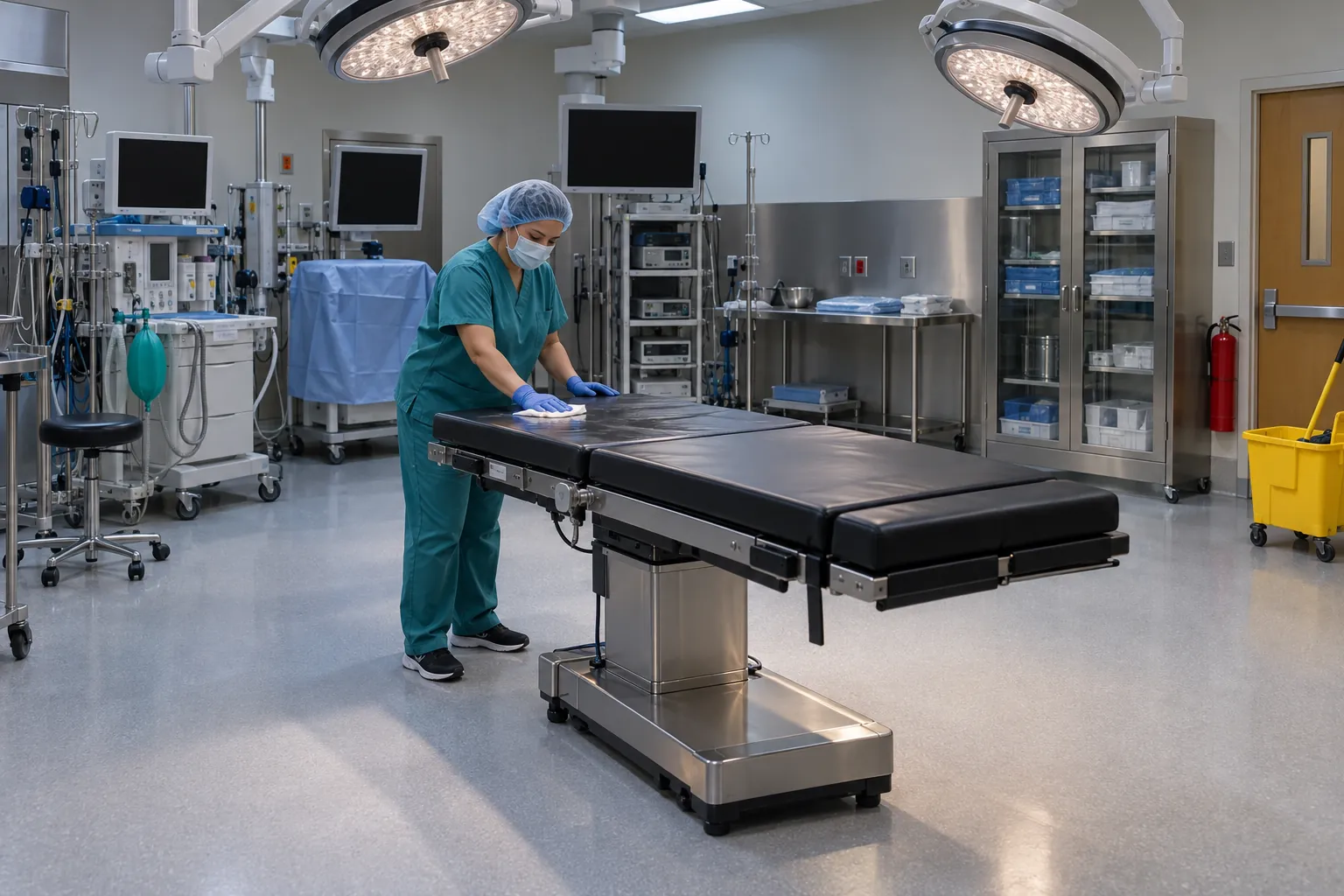
It is the last of three cleans in an OR's day: a disinfectant wipe-down before the first case, a turnover clean between patients, and the terminal clean after the last case. This guide covers the federal rules and the national guidelines behind operating room cleaning, what each clean includes, the order and the products, who does which part, and how a surgical department checks the work and keeps a record the next team can trust.
01
Operating room cleaning, and the rules behind it
Operating room cleaning is the routine cleaning and disinfection of the OR and its fixed and mobile equipment across the surgical day. It runs as a cycle: a pre-case clean before the first procedure, a turnover clean between procedures, and a terminal clean after the last. Patient room terminal cleaning follows the same idea, but an OR is cleaned with a team waiting for the room, and that pressure is what makes the record matter.
No federal rule sets an OR cleaning checklist. The duty sits in broader requirements that depend on the kind of facility:
- Hospitals. 42 CFR 482.51, the Condition of Participation for surgical services, requires that surgical services "be well organized and provided in accordance with acceptable standards of practice." 42 CFR 482.42, the Condition of Participation for infection prevention and control, requires hospital-wide programs that "demonstrate adherence to nationally recognized infection prevention and control guidelines" and include "maintaining a clean and sanitary environment to avoid sources and transmission of infection."
- Ambulatory surgery centers. 42 CFR 416.51, the Condition for Coverage on infection control, says an ASC "must provide a functional and sanitary environment for the provision of surgical services by adhering to professionally acceptable standards of practice."
- Worker protection. OSHA's Bloodborne Pathogens standard, 29 CFR 1910.1030, requires at (d)(4)(i) "an appropriate written schedule for cleaning and method of decontamination," and at (d)(4)(ii)(A) that contaminated work surfaces be decontaminated "after completion of procedures; immediately or as soon as feasible when surfaces are overtly contaminated or after any spill of blood or other potentially infectious materials; and at the end of the work shift if the surface may have become contaminated since the last cleaning." That maps closely onto the OR cycle. In the 21 states and Puerto Rico with an OSHA-approved State Plan covering private employers, the state's equivalent standard applies.
The nationally recognized guidelines are where the detail lives. The CDC and HICPAC Guidelines for Environmental Infection Control in Health-Care Facilities (2003) carry two OR cleaning recommendations: E.I.15, "After the last surgical procedure of the day or night, wet vacuum or mop operating room floors with a single-use mop and an EPA-registered hospital disinfectant," and E.I.16, "Do not use mats with tacky surfaces at the entrance to operating rooms or infection-control suites." Most perioperative departments write their procedure from AORN's Guideline for Environmental Cleaning, part of the AORN Guidelines for Perioperative Practice. It is a subscription document, as are The Joint Commission's standards, so work from your facility's current copy rather than from a summary.
02
The three cleans, and what each one covers
The clearest free description of the OR cycle is in the CDC's Environmental Cleaning Procedures. The page says its materials "were created for use in global healthcare facilities with limited resources," so read it as a well-organized baseline, not as a US rule; your policy, built on AORN and your infection prevention program, decides the detail. The cycle it describes runs like this:
- Before the first procedure. Check the records and the room to confirm that the terminal clean was completed. Then "wipe all horizontal surfaces in the room (e.g., furniture, surgical lights, operating bed, stationary equipment) with a disinfectant to remove any dust accumulated overnight," and clean and disinfect any portable patient-care equipment that is not stored in the OR before it comes in.
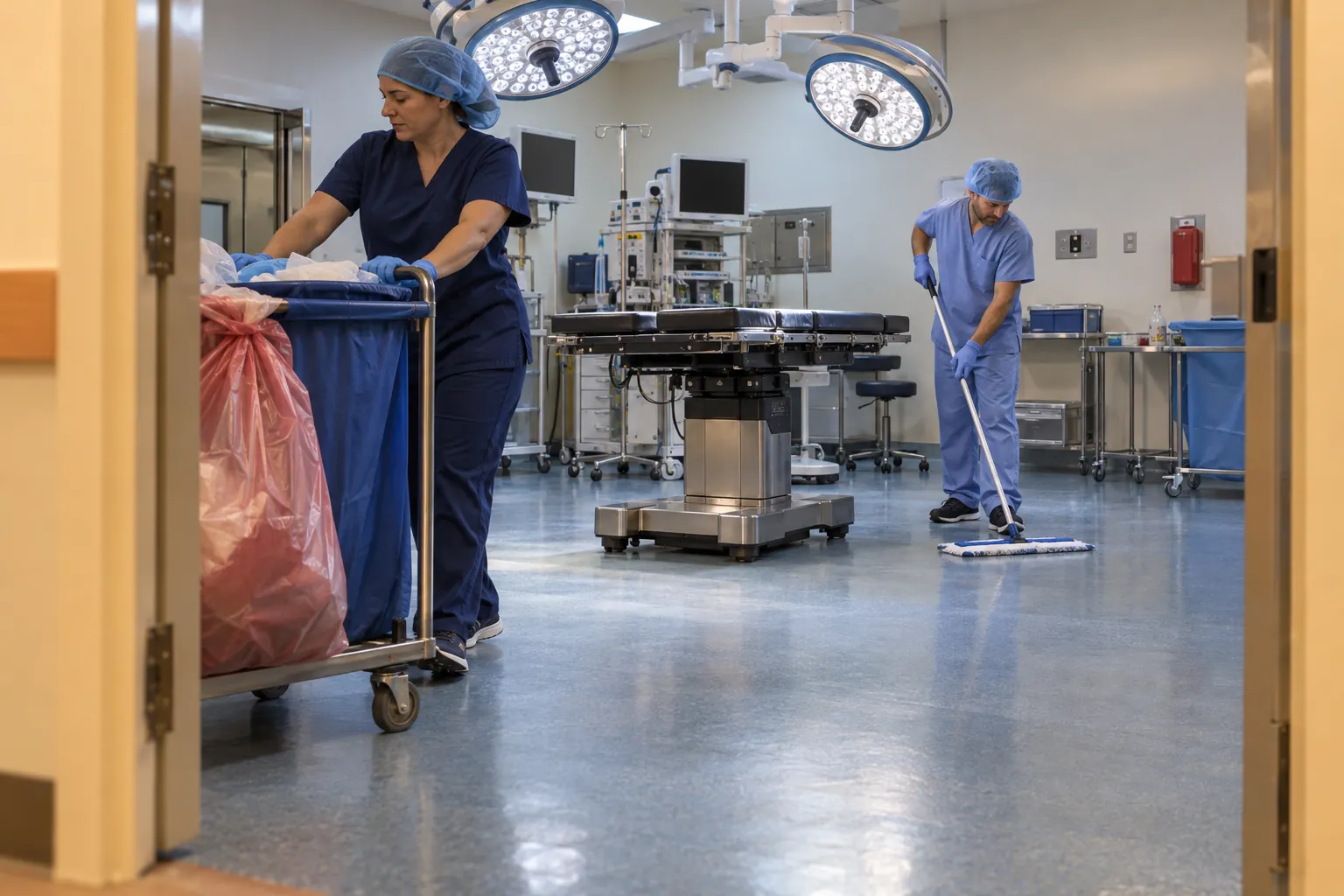
- Between procedures (turnover). Remove used linen, drapes, waste and the kick buckets for reprocessing or disposal. Clean and disinfect high-touch surfaces outside the surgical field, and any visible blood or body fluid outside it. Inside the surgical field, clean and disinfect "all surfaces (high- and low-touch) and the floor," including the surgical lights, suction canisters, tourniquet equipment, the anesthesia cart and the operating table, top to bottom.
- After the final procedure (terminal clean). Clean and disinfect horizontal surfaces and fixed equipment, including booms and the wheels of equipment; vertical surfaces such as walls and windows where they are visibly soiled; "ventilation (ducts)"; handwashing and scrub sinks and utility areas; and the "entire floor, including baseboards," moving the table and mobile equipment to reach underneath. Portable equipment not stored in the OR is cleaned and disinfected before it leaves.
- On a schedule, weekly or monthly. Low-touch surfaces that the daily cleans do not reach, such as "ceilings," walls and the inside of cabinets.
Your policy should also say what happens to a room that was not used that day: whether it still gets a terminal clean or a lighter clean, and how that is recorded.
The areas around the room count too: scrub sink alcoves, substerile rooms, the sterile core, semi-restricted corridors, soiled utility rooms, pre-op and PACU. The CDC's Cleaning Programs page says schedules should specify "the frequency, method, and staff responsible" for every patient care area, built on facility-specific risk assessments. An area with no owner is the one that gets missed.
03
Order, products and supplies
Two principles from the CDC procedures hold for every clean. Work top to bottom, "from high to low to prevent dirt and microorganisms from dripping or falling and contaminating already cleaned areas," and clean to dirty, "from cleaner to dirtier areas to avoid spreading dirt and microorganisms."
A terminal clean usually runs like this:
- Put on PPE and bring in fresh supplies. Remove trash, regulated medical waste, linen and kick buckets. Contaminated broken glass is never picked up by hand: OSHA's standard at (d)(4)(ii)(D) requires a brush and dust pan, tongs or forceps.
- Clean and disinfect the surgical lights and booms, then the walls and doors where visibly soiled, then fixed equipment and wall-mounted items.
- Clean and disinfect mobile equipment and the operating table, including its base, pads, straps and wheels, then the sinks, and restock.
- Wet vacuum or mop the entire floor, baseboards included, with a single-use mop and an EPA-registered hospital disinfectant, as E.I.15 recommends.
- Put the equipment back, check the room, and record the clean.
Products. Use the disinfectant your infection prevention program has chosen, and use it as its label says. The EPA's Selected EPA-Registered Disinfectants page is blunt: "Before applying any EPA-registered disinfectant product, users must read and understand the label," and "the surface should be visibly wet for the entire contact time. This may mean the product needs to be reapplied." During turnover, contact time is where corners get cut. Where a case involved a patient with a particular organism, such as C. difficile or Candida auris, the EPA publishes lists of products registered against them (List K and List P); your policy says when to switch.
Supplies. The CDC procedures recommend supplies and equipment dedicated to the OR, and fresh mops and solutions for every cleaning session and between procedures. Buckets, bins and kick buckets that may be contaminated fall under the OSHA requirement at (d)(4)(ii)(C) that reusable receptacles be "inspected and decontaminated on a regularly scheduled basis."
What not to do. The CDC environmental guideline recommends against tacky mats at OR entrances (E.I.16) and says that "disinfectant fogging is not recommended for general infection control in routine patient-care areas" (recommendation E.I.9: "Do not perform disinfectant fogging in patient-care areas"). The same guideline, at C.V.1.f, says OR doors should be kept "closed except for the passage of equipment, personnel, and patients," so wedging them open to speed a turnover works against the room's positive-pressure air. If you keep the room's conditions on a temperature and humidity log, the terminal clean is a natural moment to note any reading out of range.
04
Who does what: the OR team and EVS
Turnover is a shared job, and the split between clinical staff and environmental services varies by hospital. A common division looks like this, but only your written policy counts:
- Surgical technologist and circulating nurse. Break down the back table and Mayo stand, send instruments to sterile processing, discard sharps, and bag linen and waste.
- Anesthesia staff or an anesthesia technician. Often own the anesthesia machine, monitors, cables and cart, because they know which parts can take which product.
- EVS technician (OR attendant). Removes waste and linen, cleans and disinfects the table, lights, booms, surfaces and floor, and restocks; on nights, usually the terminal cleans of the whole suite.
- OR charge nurse or manager. Decides when a room is ready for the next patient, and whose sign-off releases it.
The CDC's Cleaning Programs page calls for "defined lines of accountability and functional reporting lines and responsibilities for all implicated staff," and says staff should "perform duties only for which they were trained," noting that cleaning staff should not be asked to clean an operating room "unless they have received specific training for that patient care area." The practical form is a responsibility grid naming one owner for turnover and one for terminal cleaning for every item in the room, from the table and booms to the computer on wheels, the warming cabinet and the phones. Items with two owners get cleaned twice or not at all.
Everyone who cleans in the OR is covered by the employer's exposure control plan under 29 CFR 1910.1030, with training and PPE. If EVS is contracted out, agree in writing who trains, who supplies PPE and who holds which records. Training should be specific to the OR: a tech who cleans patient rooms well may not know that the table pads come off or that the floor under the table is part of every turnover.
05
Checking an OR clean, and the evidence that counts
A room that looks clean may not be. The CDC's Options for Evaluating Environmental Cleaning toolkit, and its Cleaning Programs page, describe methods that go beyond looking:
- Performance observations by cleaning supervisors "at least weekly," watching whether the procedure is followed step by step and whether contact times are met.
- Visual assessments by supervisors, the program manager or the infection prevention team.
- Fluorescent markers, a small invisible mark placed on high-touch surfaces before the clean and checked under UV light afterward to see whether it was removed.
- ATP bioluminescence, a swab read by a meter that measures organic residue on a surface; see the guide to ATP testing for how to use it fairly.
None of these tells you whether every scheduled clean happened, in every room, every night. That is what the cleaning log is for.
The CDC's Cleaning Programs page describes logs as "job aids that can help guide the daily workflow for cleaning staff and ultimately become records," recording the location, the cleaning session, the date and the name or signature of the cleaning staff. For an OR suite, a useful log shows, per room and per day:
- that the terminal clean was done, by whom and when, and whether it was a used or unused room;
- that the pre-case wipe was done before the first patient;
- turnover cleans after a case with a known organism, with the product used;
- the scheduled weekly and monthly tasks, such as ceilings, vents and cabinet interiors;
- anything found that needs a repair: a torn table pad, a damaged kick bucket, a leaking scrub sink, a scuffed wall that can no longer be cleaned properly.
The first item matters most: the CDC's pre-case step starts with inspecting the records, and a sheet signed for every room at once at the end of the shift proves nothing.
Feed the results back: the CDC recommends real-time feedback and coaching for staff, and summary reports to management that show trends.
06
Where the OR cleaning record fails, and what SiteClara does about it
The OR cleaning record fails in predictable ways. The terminal clean sheet on the suite door is signed for every room at once, at the end of the shift. The turnover shows only as the room going "ready" on the board, which proves someone released the room, not that the floor under the table was mopped. The monthly ceiling and vent clean slips with nothing to show it. And the torn table pad noticed at 2 a.m. is mentioned to whoever was passing and forgotten by morning.
SiteClara records checks at the place they happen. A printed QR code poster, with an optional NFC tag behind it, goes at each operating room or area where a check is scheduled. An EVS technician or OR staff member scans the code or taps the tag on their own phone, with no app to install, sees the checks set for that room, and marks each one done, or records what stopped them, such as a case running late. The hospital decides what each check asks, such as which product was used, with a photo when one is asked for, and the named person and time are recorded as it happens. A problem found on the way, such as a damaged pad or a leaking sink, goes onto the team's list of open jobs until someone closes it.
The EVS supervisor sees what is due, done and missed across the suite, and gives the reason when a check was missed. Each day they review the totals and photos and approve a report that goes the next morning to nominated managers, such as the EVS director, showing what was reported, completed and still open, and how the scheduled checks went.
07
Questions people ask
What are the CDC guidelines for terminal cleaning of an operating room?
The CDC and HICPAC Guidelines for Environmental Infection Control in Health-Care Facilities carry two operating room recommendations, both rated Category IB. E.I.15 says: "After the last surgical procedure of the day or night, wet vacuum or mop operating room floors with a single-use mop and an EPA-registered hospital disinfectant." E.I.16 says: "Do not use mats with tacky surfaces at the entrance to operating rooms or infection-control suites." The CDC's Environmental Cleaning Procedures add the detail of the terminal clean, written for facilities with limited resources, so treat them as a baseline rather than a US rule.
How should terminal cleaning be performed in an operating room?
The CDC's Environmental Cleaning Procedures list what the terminal clean after the final procedure covers: "horizontal surfaces (high- and low-touch) and fixed equipment in the room," "vertical surfaces such as walls and windows as needed to remove visible soiling," "ventilation (ducts)," "handwashing sinks, scrub and utility areas/sinks," and the "entire floor, including baseboards," with equipment moved to reach underneath. Portable patient-care equipment not stored in the OR is cleaned and disinfected before it leaves. Work "from high to low" and "from cleaner to dirtier areas," and finish with the floor.
What is the cleaning protocol for an operating room?
The CDC's Environmental Cleaning Procedures describe a cycle of three cleans. Before the first procedure, staff "inspect records and assess the operating space to ensure that the terminal clean was completed the previous evening," then wipe horizontal surfaces with a disinfectant to remove dust that settled overnight. Between procedures, they remove used linen and waste, then disinfect high-touch surfaces outside the surgical field and all surfaces inside it. After the final procedure comes the terminal clean. Your written policy, built on AORN and your infection prevention program, sets the detail.
08
Where to read more, and an OR cleaning checklist to take away
Start with the CDC's Environmental Cleaning Procedures for the cycle, the CDC and HICPAC Guidelines for Environmental Infection Control in Health-Care Facilities for E.I.15, E.I.16 and the OR door recommendation, C.V.1.f, and AORN's Guideline for Environmental Cleaning in the AORN Guidelines for Perioperative Practice. For the rules, read 42 CFR 482.51 and 482.42 for hospitals, 416.51 for ASCs, OSHA's 29 CFR 1910.1030 paragraph (d)(4) with your State Plan if you have one, and the label of the disinfectant you use.
Sources
Every document this guide quotes or links to, in the order it first cites them.
- 42 CFR 482.51, the Condition of Participation for surgical services ecfr.gov
- 42 CFR 482.42, the Condition of Participation for infection prevention and control ecfr.gov
- 42 CFR 416.51, the Condition for Coverage on infection control ecfr.gov
- Bloodborne Pathogens standard, 29 CFR 1910.1030 osha.gov
- OSHA-approved State Plan osha.gov
- Guidelines for Environmental Infection Control in Health-Care Facilities cdc.gov
- AORN Guidelines for Perioperative Practice aorn.org
- Environmental Cleaning Procedures cdc.gov
- Cleaning Programs cdc.gov
- Selected EPA-Registered Disinfectants epa.gov
- Options for Evaluating Environmental Cleaning cdc.gov
Related guides
 CleaningTerminal cleaning: how to do it, and how to show it was doneWhat terminal cleaning is, when it is done, the CDC steps in order, the products for C. diff and C. auris rooms, and how a hospital checks the clean was thorough.
 CleaningHospital environmental services: what EVS does, and how to show it was doneWhat hospital environmental services (EVS) does, the CDC, CMS and OSHA rules behind it, cleaning frequencies, who cleans what, and how cleaning is checked.
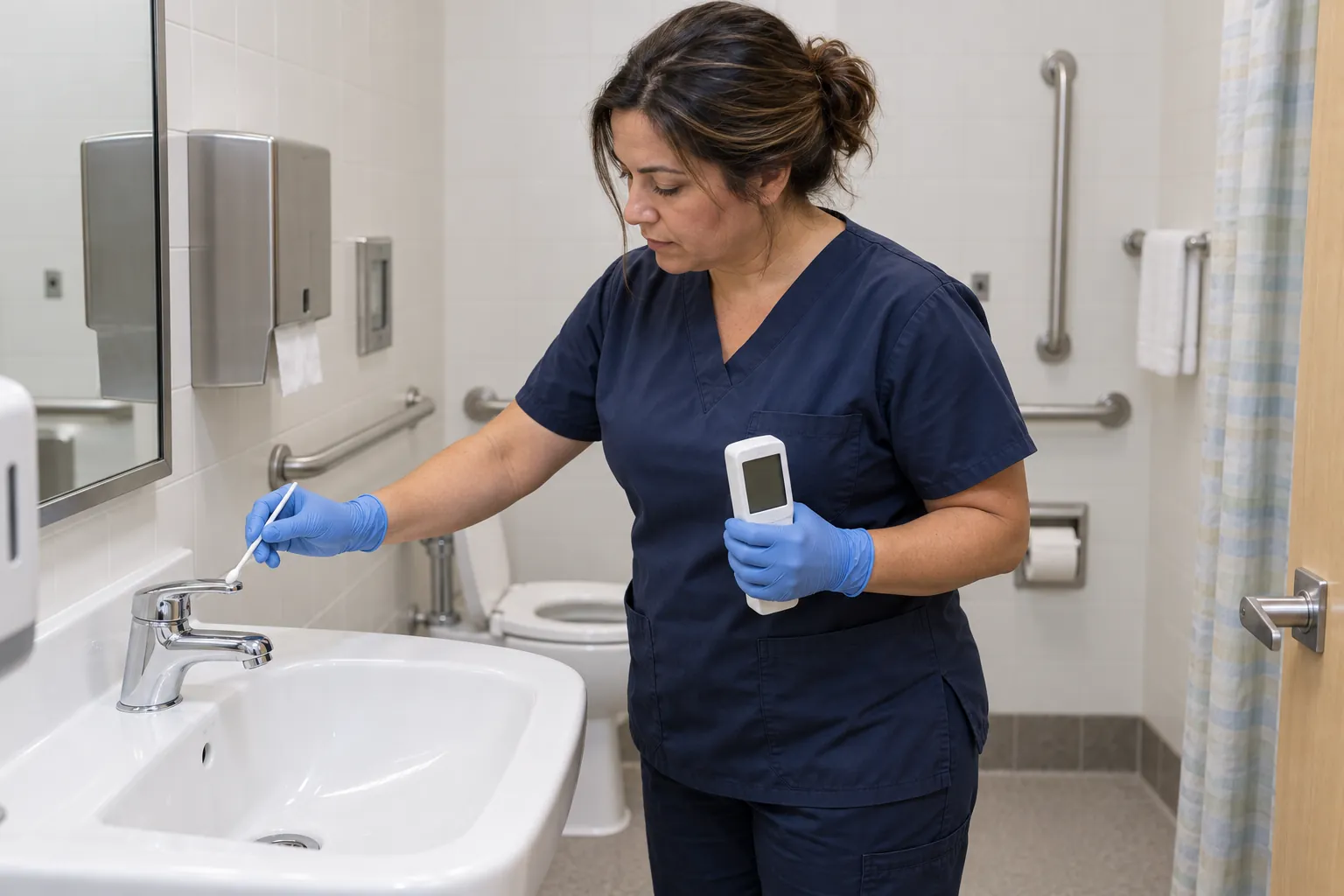 CleaningATP testing: what the reading tells you, and how to run a program that means somethingHow ATP testing works, what a reading in RLU does and does not tell you, what the CDC says about using it, and how to run and record an ATP program that holds up.
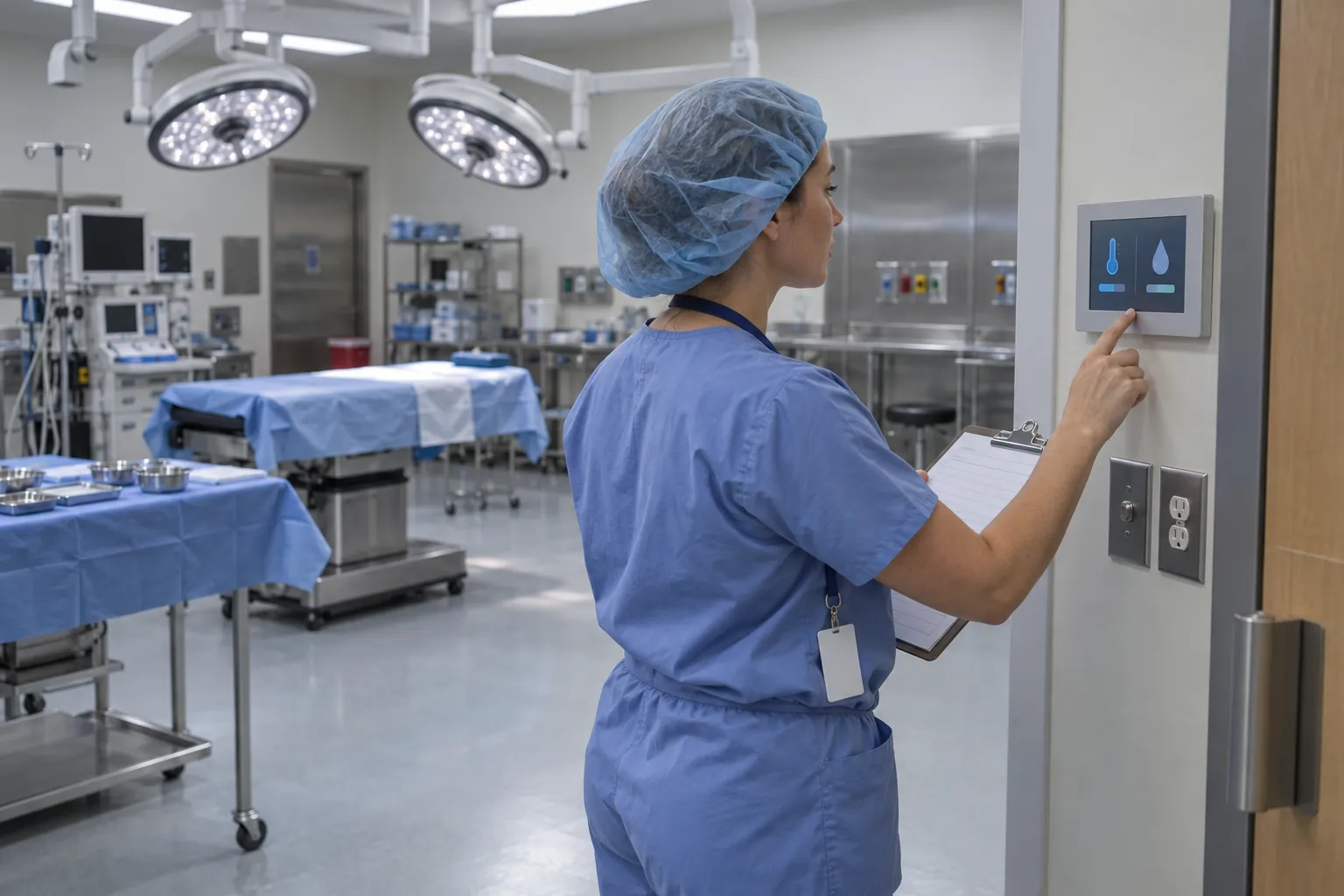 Premises and facilities managementOperating room temperature and humidity log: the requirements, and a record that holds upOperating room humidity and temperature requirements: what CMS and ASHRAE 170 say, how to keep the log, and what to do when a reading is out of range.