Premises and facilities management
Body corporate maintenance: what the law requires, and how to show it was done
A body corporate is the legal entity made up of all the owners of units in a South African sectional title scheme, and under section 3(1)(l) of the Sectional Titles Schemes Management Act 8 of 2011 it must maintain all the common property and keep it in a state of good and serviceable repair.
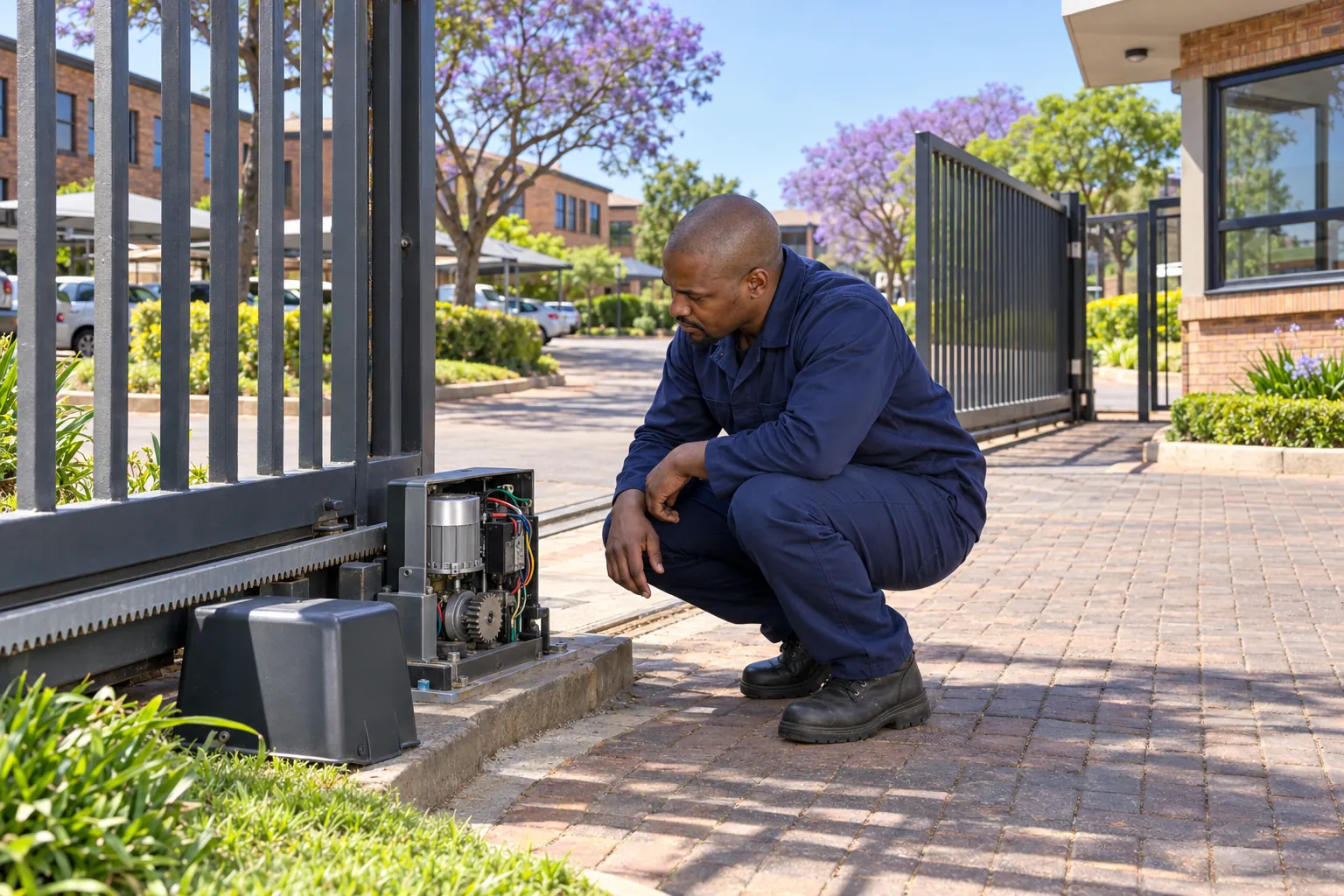
The Act and the Prescribed Management Rules then say how: a written 10-year maintenance, repair and replacement plan, a reserve fund to pay for it, and trustees who report on it at every annual general meeting. This guide covers who maintains what, how the plan and the reserve fund work, who does the day-to-day work and the records that show it was done. It is written for trustees, managing agents, caretakers and contractors, and it is not legal advice on a dispute, which is the Community Schemes Ombud Service's work.
01
What the Act says a body corporate must maintain
Under section 2(1) of the Sectional Titles Schemes Management Act 8 of 2011 (the STSMA, in force since 7 October 2016), a body corporate is deemed to be established as soon as anyone other than the developer owns a unit, and every later owner becomes a member. It has perpetual succession, can sue and be sued in its own name (section 2(7)), and is responsible for "the control, administration and management of the common property for the benefit of all owners" (section 2(5)).
Section 3(1) lists its functions. Four are maintenance duties in plain words:
- Section 3(1)(l): "to maintain all the common property and to keep it in a state of good and serviceable repair".
- Section 3(1)(q): to maintain any plant, machinery, fixtures and fittings used in connection with the common property and sections, and keep them in good and serviceable repair.
- Section 3(1)(r): subject to the municipality's rights, to maintain and repair, "including renewal where reasonably necessary", the pipes, wires, cables and ducts that serve more than one section or the common property.
- Section 3(1)(m) and (p): to comply with any notice or order by a competent authority requiring repairs to the land or building, and to ensure compliance with any law relating to the common property.
The money follows the duty. The administrative fund must be reasonably sufficient for the repair, maintenance, management and administration of the common property, "including reasonable provision for future maintenance and repairs" (section 3(1)(a)); the reserve fund must be reasonably sufficient to cover future maintenance and repair of common property, and not below the prescribed minimum (section 3(1)(b)).
Owners pay for all of this through levies. Section 3(1)(f) requires the body corporate to raise the amounts it has determined by levying contributions on the owners in proportion to the quotas of their sections, and under PMR 21(3)(a) the body corporate may, on the authority of a written trustee resolution, levy a special contribution for a necessary expense that cannot reasonably wait for the next year's budget.
The body corporate acts through its trustees (section 7(1)), under management and conduct rules (section 10). The prescribed versions are Annexures 1 and 2 of the Sectional Titles Schemes Management Regulations (Government Notice R. 1231 of 7 October 2016), usually called the Prescribed Management Rules (PMR) and the Prescribed Conduct Rules. A scheme may amend its rules within limits, so check your own registered rules before relying on a rule number quoted here.
02
Common property, sections and exclusive use areas: who maintains what
Most arguments about maintenance responsibilities start at the boundary. The Act defines common property as the land in the scheme and "such parts of the building or buildings as are not included in a section". The sectional plan draws the line, and the division usually falls like this:
- The body corporate: the land, roofs, external walls and structure, gardens, paving and driveways that are not exclusive use areas, boundary walls and palisade fencing, gates and gate motors, lifts, stairwells and passages, the pool, shared bin areas, and the shared pipes, wires, cables and ducts.
- The owner: the section itself. Section 13(1)(c) requires an owner to "repair and maintain his or her section in a state of good repair" and to keep an exclusive use area "in a clean and neat condition".
- Exclusive use areas: a garden, parking bay or patio that one owner has the right to use stays common property, but section 3(1)(c) makes the body corporate charge that owner an additional contribution for its rates, insurance and maintenance, unless the rules make the owner responsible for those costs.
- Geysers: PMR 31(1) says that although a water-heating installation forms part of the common property and is insured by the body corporate, the member whose section it serves must maintain, repair and, when necessary, replace it. Where one geyser serves several owners, they share the cost pro rata.
The boundary works both ways. Section 13(1)(a) requires an owner to let a person authorised in writing by the body corporate into the section, during reasonable hours and on notice (none in an emergency), to inspect and maintain shared pipes, wires, cables and ducts. And under PMR 31(2), where an owner fails, despite written demand, to repair the section, and the failure threatens the stability of the common property or the safety of the building, the body corporate must remedy it and recover the reasonable cost from that owner.
03
The 10-year maintenance, repair and replacement plan and the reserve fund
PMR 22(1) requires the body corporate or its trustees to prepare a written maintenance, repair and replacement plan for the common property, setting out the major capital items expected to need maintenance, repair or replacement within the next 10 years, their present condition, when the work will be needed, its estimated cost, and the expected life of each item once the work is done.
PMR 1 defines major capital items broadly: wiring, lighting and electrical systems; plumbing, drainage and storm-water systems; heating and cooling systems; lifts; carpeting and furnishings; roofing; interior and exterior painting and waterproofing; communication and service supply systems; parking facilities, roadways and paved areas; security systems; and community and recreational facilities.
The plan takes effect when members approve it in general meeting (PMR 22(3)), and the trustees must report to each annual general meeting on how far it has been implemented (PMR 22(4)).
The plan drives the reserve fund. PMR 22(2) sets the annual reserve contribution for each major capital item as (estimated cost minus past contribution) divided by expected life, and PMR 24(2) says the reserve fund must be used to implement the plan. Regulation 2 sets a floor, measured against the reserve balance at the end of the previous financial year:
- below 25 per cent of the previous year's administrative fund contributions: the reserve contribution must be at least 15 per cent of the budgeted administrative fund contribution;
- between 25 and 100 per cent: at least the amount budgeted from the administrative fund for repairs and maintenance to the common property;
- 100 per cent or more: no minimum.
Under PMR 24(5), money leaves the reserve fund in line with the approved plan, or when the trustees resolve that an urgent expense is needed, for example to ensure safety or prevent significant loss or damage, or for a repair that could not reasonably have been foreseen. The trustees must report any urgent spending to members as soon as possible.
04
Day-to-day maintenance: trustees, managing agents, caretakers and contractors
Most of what owners notice is routine: a stairwell light out, a blocked drain, a gate that will not close, a pool pump that trips. That work is paid from the administrative fund in line with the approved budget (PMR 24(4)) and is delivered by:
- Trustees, who apply the funds according to approved budgets (PMR 9(c)) and appoint any agent or employee "in terms of a duly signed written contract" (PMR 9(d)).
- A managing agent, providing specified management services under the trustees' supervision, on an agreement of no more than three years (PMR 28(5) and (7)). An executive managing agent, who takes over the trustees' functions, must arrange an inspection of the common property at least every six months and report to members at least every four months, including proposed repairs for the next four months (PMR 28(3) and (4)).
- A caretaker or estate manager for small repairs and contractor access.
- Contractors for gardening, cleaning, security, pest control, pool care, lifts, electrical and plumbing work.
Once the body corporate employs anyone or brings contractors onto the common property, the Occupational Health and Safety Act 85 of 1993 applies too. Section 8(1) requires every employer to provide and maintain, as far as is reasonably practicable, a working environment that is safe and without risk to health; section 9(1) extends the duty to other people directly affected, which in a scheme can include residents and visitors. Under section 37(2), unless employer and contractor agree in writing the arrangements for the contractor's compliance, the employer can be presumed to have done what its contractor did or failed to do.
Lifts have their own regime. The Lift, Escalator and Passenger Conveyor Regulations, 2009 (Government Notice R. 828 of 17 September 2010) bind the "user", the person with the right of control over the plant, which in a scheme is usually the body corporate. A competent lift service provider must examine and maintain each lift at least monthly, or at a longer interval the manufacturer sets (regulation 7(1)); an inspection service provider must inspect and test it at intervals not exceeding 24 months (regulation 6(1)(e)); and the records stay in the machine compartment for at least 10 years (regulation 8(2)).
Fire safety is set by each municipality's by-law, so the detail differs. As one example, the City of Cape Town's Community Fire Safety By-law requires fire extinguishers to be maintained in accordance with the OHS regulations and listed standards including SABS 1475 Part 1 (section 17(2)), a fire protection system to be tested and maintained regularly with a detailed record kept (section 18(1)), and escape routes to be kept free of obstruction (section 15(1)). Check your own municipality's by-law.

05
The records that show the duty was done
An owner, an insurer, a municipal inspector or an adjudicator may ask a body corporate to show its maintenance. The rules create part of the trail:
- Minutes of general and trustee meetings, with the text of every resolution (PMR 27(2)), distributed within 7 days (PMR 9(e)).
- Annual financial statements showing, for each major capital item, the amount in the reserve fund available for its maintenance, repair and replacement as a percentage of the accrued estimated cost, and the rand value of any shortfall (PMR 26(1)(c)(iv)).
- Handover documents: the developer must supply warranties, manuals, operating instructions and service guides for the common property (PMR 16(4)(e)).
- Contracts and correspondence: the body corporate may keep copies of its written contracts and of correspondence sent or received (PMR 27(3)), and every rule 27 record must be in writing or "in a form that can be easily converted to writing" (PMR 27(8)).
On a written request, the body corporate must let a member or registered bondholder inspect and copy the governance records kept under rule 27, such as minutes, the rules, contracts and correspondence, within 10 days, or five days for the rules (PMR 27(4) and (5)); its books of account and records must also be made available for inspection and copying on the application of a member, registered bondholder or the managing agent (PMR 26(2)). A managing agent or employee whose contract ends must hand back the rule 27 records they hold within 10 days (PMR 27(7)).
The rules say little about the evidence beneath a trustee's report that the common property was maintained. A sound working record adds:
- a list of recurring checks on the common property: gates and gate motors, perimeter and stairwell lighting, the pool, the bin area, fire hose reels and extinguishers, drains and gutters, the electric fence, the jojo tank or borehole, and the standby generator where there is one;
- for each check, who did it, when and what they found, written at the time, with a photograph where the condition matters;
- a fault list: what was reported, by whom, when it was fixed and by which contractor;
- contractor service reports and certificates filed against the item they relate to.
When an owner takes a maintenance dispute to the Community Schemes Ombud Service (CSOS), section 39(6) of the Community Schemes Ombud Service Act 9 of 2011 lets the adjudicator order repairs and maintenance, or specified works to the common areas within a specified time. A dated record of what was checked and repaired is what lets trustees answer with facts.
06
Where the record fails, and what SiteClara does about it
In many schemes the maintenance record is thin where it matters. The plan is tabled at the AGM, but the evidence underneath is a caretaker's notebook, a chat group where faults are mentioned and forgotten, and an undated monthly invoice. When an owner asks whether the stairwell lights were checked last month, or when the gate motor fault was first reported, the trustees have to reconstruct it.
SiteClara records routine checks at the place they happen. A printed QR poster, with an optional NFC tag behind it, is fixed at each location on the common property where a check is scheduled: a pool pump room, a bin area, a gatehouse, a stairwell. The caretaker or the contractor's staff scan or tap with their own phone, with no app to install, see the checks due there, and mark each one done or say what stopped them. The time and the named person are recorded as it happens, with a photo when one is asked for, and a fault reported there goes onto a list of open jobs until someone closes it.
A supervisor sees what is due, done and missed, gives the reason when a check was missed, and each day reviews and approves a short report that goes to the nominated contacts, such as the managing agent or a trustee, the next morning. The trustees then have a dated record of routine checks, made at the time, to draw on when they report to the AGM.
07
Questions people ask
What is a body corporate in South Africa?
It is the legal entity made up of every owner of a unit in a sectional title scheme. Under section 2(1) of the Sectional Titles Schemes Management Act 8 of 2011 it comes into being when anyone other than the developer first owns a unit, every later owner becomes a member, and under section 2(5) it controls, administers and manages the common property for the benefit of all owners.
Does a body corporate need to be registered?
It does not need to be registered to exist: section 2(1) of the Sectional Titles Schemes Management Act 8 of 2011 deems the body corporate to be established from the date the first unit passes to someone other than the developer. It takes the name and number of the scheme under section 2(4), and section 2(6) says the Companies Act does not apply to it. Every year, though, it must pay a levy to CSOS and file an annual return with its annual financial statements under section 59 of the Community Schemes Ombud Service Act 9 of 2011.
What is covered under the body corporate?
The body corporate maintains the common property, meaning the land and every part of the building not in a section, with the plant, fixtures and fittings used with it and the pipes, wires, cables and ducts that serve more than one section (section 3(1)(l), (q) and (r) of the Sectional Titles Schemes Management Act 8 of 2011). Owners maintain their own sections, and under PMR 31(1) of the Sectional Titles Schemes Management Regulations an owner maintains, repairs and, when necessary, replaces the geyser serving their section even though it forms part of the common property.
Who pays for maintenance of an exclusive use area?
The owner who holds the right: section 3(1)(c) of the Sectional Titles Schemes Management Act 8 of 2011 requires the body corporate to charge that owner an additional contribution for the area's rates, insurance and maintenance, unless the scheme's rules make the owner responsible for those costs.
What can an owner do if the body corporate does not maintain the common property?
An owner can apply to CSOS, whose adjudicator may order the scheme to have repairs and maintenance carried out under section 39(6) of the Community Schemes Ombud Service Act 9 of 2011. Owners can also ask in writing to inspect and copy the minutes and other governance records under PMR 27(4) of the Sectional Titles Schemes Management Regulations, and apply to inspect and copy the books of account and records under PMR 26(2); the maintenance plan itself must be prepared for the annual general meeting (PMR 26(1)(d)).
08
Where to read the official guidance
- The Sectional Titles Schemes Management Act 8 of 2011: sections 2, 3, 7 and 13.
- The Sectional Titles Schemes Management Regulations (Government Notice R. 1231 of 7 October 2016): regulation 2 on the reserve minimum, and PMR 22, 24, 26, 27, 28 and 31.
- The Community Schemes Ombud Service's legislation page, which carries the STSMA, its regulations, the CSOS Act and the code of conduct for executive managing agents.
- Your municipality's fire safety by-law, and your scheme's own registered rules.
A short list to take away:
- Read the sectional plan and the rules before deciding who pays for a repair.
- Keep a written 10-year plan based on a real condition survey, and report on it at every AGM.
- Check the reserve contribution against the PMR 22(2) formula and the regulation 2 minimum each budget year.
- Put every agent, employee and contractor on a signed written contract, with section 37(2) arrangements for contractors.
- Keep statutory records, such as the lift record and fire equipment certificates, where the law requires them.
- Record routine checks and faults on the common property at the time, by name and date.
Sources
Every document this guide quotes or links to, in the order it first cites them.
- Sectional Titles Schemes Management Act 8 of 2011 gov.za
- Sectional Titles Schemes Management Regulations (Government Notice R. 1231 of 7 October 2016) gov.za
- Occupational Health and Safety Act 85 of 1993 labour.gov.za
- Lift, Escalator and Passenger Conveyor Regulations, 2009 (Government Notice R. 828 of 17 September 2010) labour.gov.za
- Community Fire Safety By-law openbylaws.org.za
- Community Schemes Ombud Service Act 9 of 2011 csos.org.za
- Sectional Titles Schemes Management Act 8 of 2011 gov.za
- Community Schemes Ombud Service's legislation page csos.org.za
Related guides
 Premises and facilities managementDuties of a trustee in a body corporate: the law, the meetings and the recordWhat a body corporate trustee must do under the Sectional Titles Schemes Management Act and the Prescribed Management Rules, and the records that show it was done.
 Premises and facilities managementManaging agent duties in a sectional title schemeWhat a sectional title managing agent does under the Prescribed Management Rules and the Property Practitioners Act: the agreement, funds, records and maintenance.
 Premises and facilities managementPreventative maintenance for buildings: how to plan it and show it was donePreventative maintenance for South African buildings: the OHS Act duty, the asset register and schedule, lift, electrical and fire tasks, and records that hold up.
 Premises and facilities managementCaretaker duties: what the job involves in South Africa, and how to show it was doneCaretaker duties in South African sectional title schemes, estates, schools, offices and churches: the law behind the job, daily checks, repairs and the record.