Premises and facilities management
Preventative maintenance for buildings: how to plan it and show it was done
Preventative maintenance is work done on a schedule, before anything breaks, to keep a building's plant, equipment, services and fabric safe and in working order.
In South Africa it is how an employer meets section 8(2)(a) of the Occupational Health and Safety Act 85 of 1993, which requires the provision and maintenance of systems of work, plant and machinery that are, as far as is reasonably practicable, safe and without risks to health. The phrase is also used for factory machines and for computer systems; this guide is about buildings. It covers what a preventative maintenance programme includes, how to build the asset register and schedule, which tasks the regulations fix and which are a choice, and what a record of the work should show.
01
What preventative maintenance is, and the duty behind it
Preventative maintenance, also called preventive maintenance or planned maintenance, is servicing, inspection and testing done to a calendar or to hours run, so that equipment is looked after before it fails. It is the opposite of reactive or breakdown maintenance, where someone is called out after the lift has stopped or the geyser has burst. A monthly lift examination, a six-monthly generator service, clearing gutters before the summer storms and testing the fire alarm are all preventative maintenance. Most tasks are time-based, done monthly, six-monthly or yearly; others are usage-based, triggered by hours run or cycles, and routine inspections find wear before it becomes a fault. Done well, it means fewer breakdowns and emergency repairs, less downtime, lower costs over the life of the plant, better reliability, a longer lifespan for plant and fewer hazards for the people using the building.
No South African law uses the phrase, but the duty to maintain is plain. Section 8(1) of the Occupational Health and Safety Act 85 of 1993 requires every employer to "provide and maintain, as far as is reasonably practicable, a working environment that is safe and without risk to the health of his employees". Section 8(2)(a) says that includes "the provision and maintenance of systems of work, plant and machinery that, as far as is reasonably practicable, are safe and without risks to health". The Act defines plant widely: it "includes fixtures, fittings, implements, equipment, tools and appliances", which in a building covers most of what a maintenance programme looks after.
Section 9(1) adds a duty to people who are not employees: every employer must conduct its undertaking so that, as far as is reasonably practicable, people who may be directly affected by its activities, such as visitors, tenants' staff and the public, are not exposed to hazards to their health or safety. "Reasonably practicable" is defined in section 1, having regard to the severity and scope of the hazard, what is known about it, the means available to remove or mitigate it, and their cost in relation to the benefits. A written schedule showing what is checked, how often and why is the clearest way to show that you weighed those things and acted on them.
02
What a preventative maintenance programme covers
In a typical South African office block, school, shopping centre, clinic or sectional title scheme, a preventative maintenance programme usually includes:
- Lifts and escalators: monthly examination and maintenance by a lift service provider, and the periodic inspection by an accredited inspection service provider that the lift regulations require.
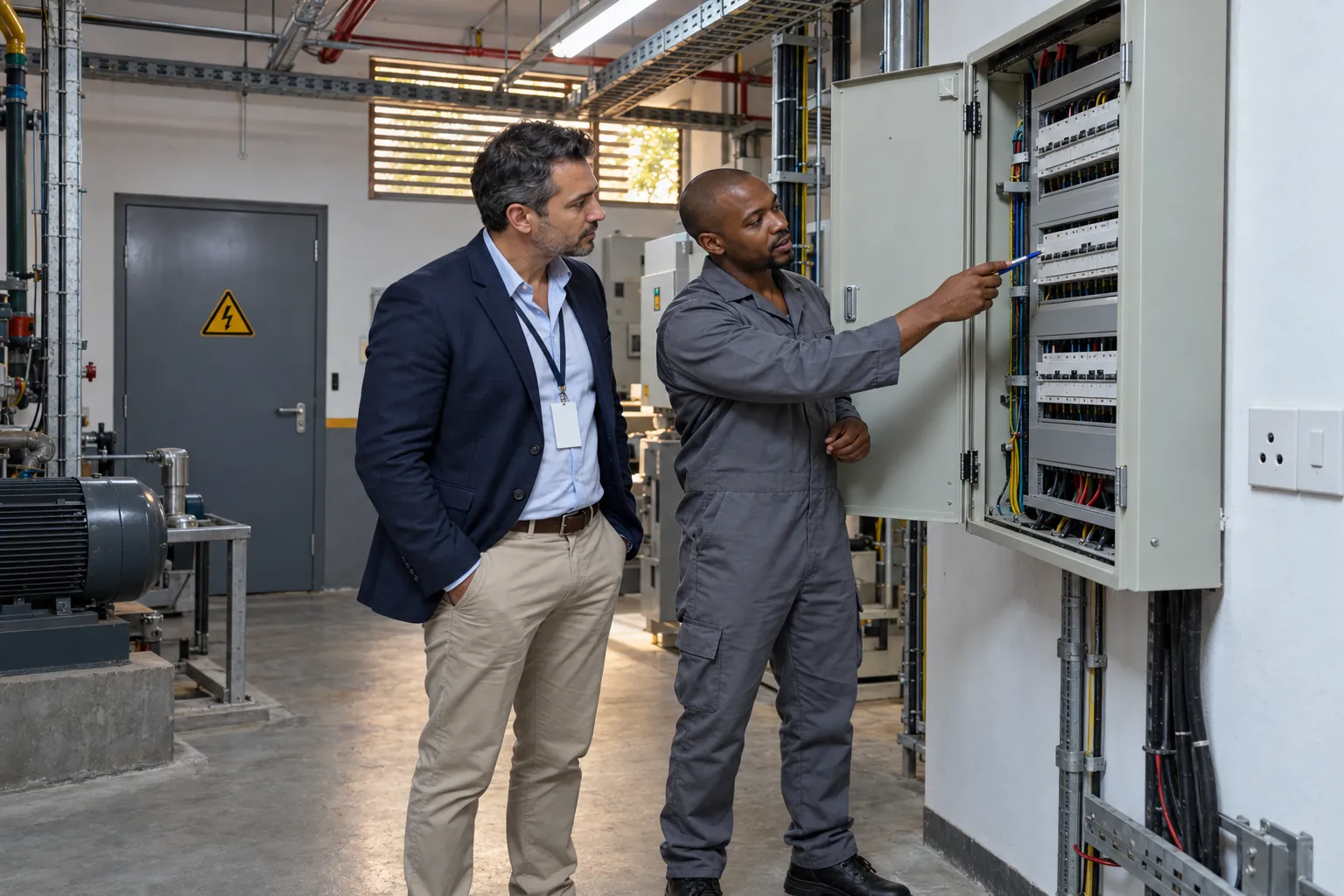
- Electrical installation: distribution boards, earth leakage units, lighting and emergency lighting, and the certificate of compliance for the installation.
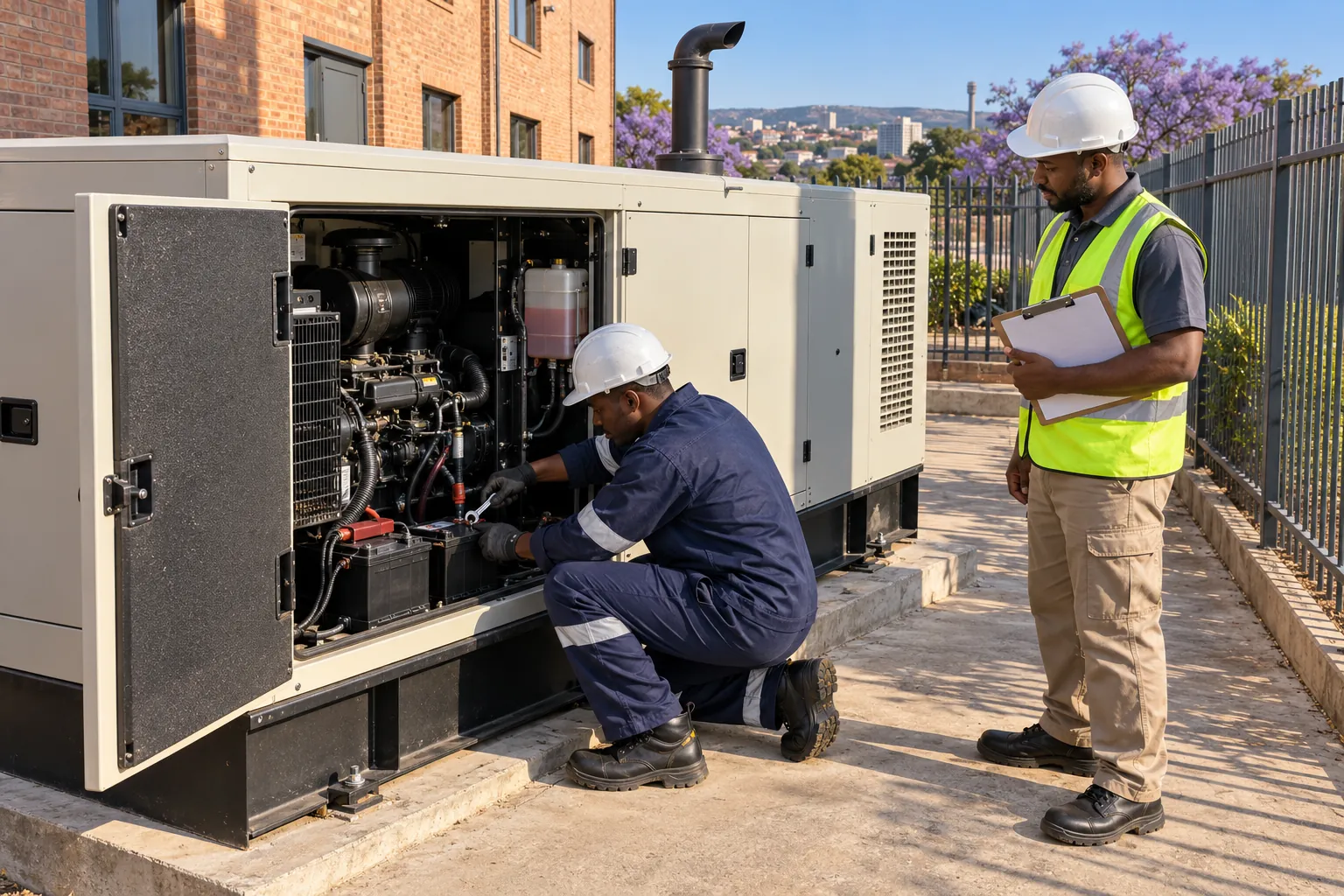
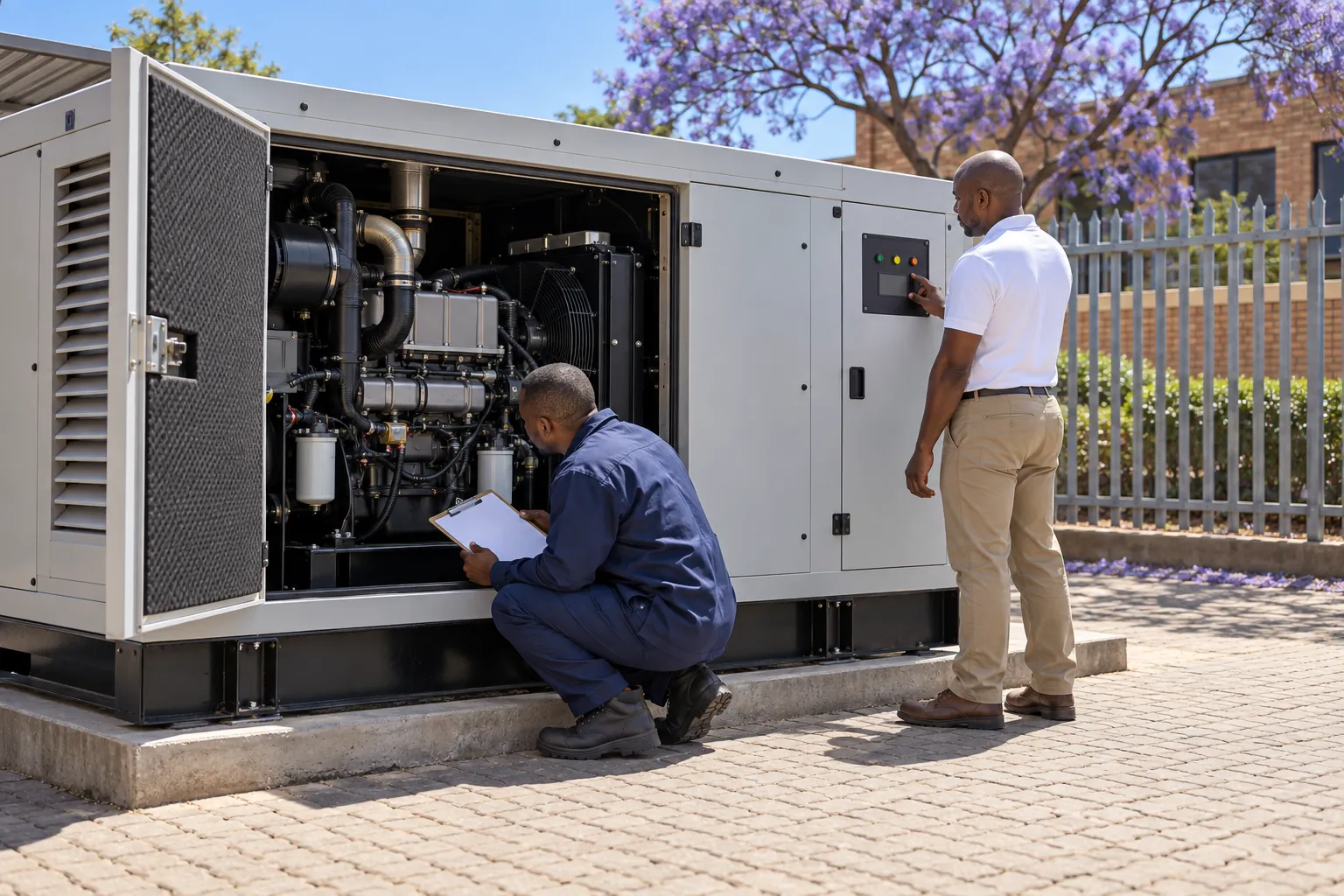
- Standby power: the standby generator, its fuel, batteries and changeover switch, and UPS and inverter systems, which matter more on a site that has lived through load shedding.
- Fire protection: fire detection and alarm systems, extinguishers, hose reels, hydrants and any sprinkler system, and escape routes and emergency doors kept clear.
- Water: pumps, booster sets, geysers and hot water cylinders, plastic water storage tanks, and borehole pumps where a site has one.
- Heating, ventilation and air conditioning: filter changes, coil and drain tray cleaning, and checks on extraction fans and kitchen canopies.
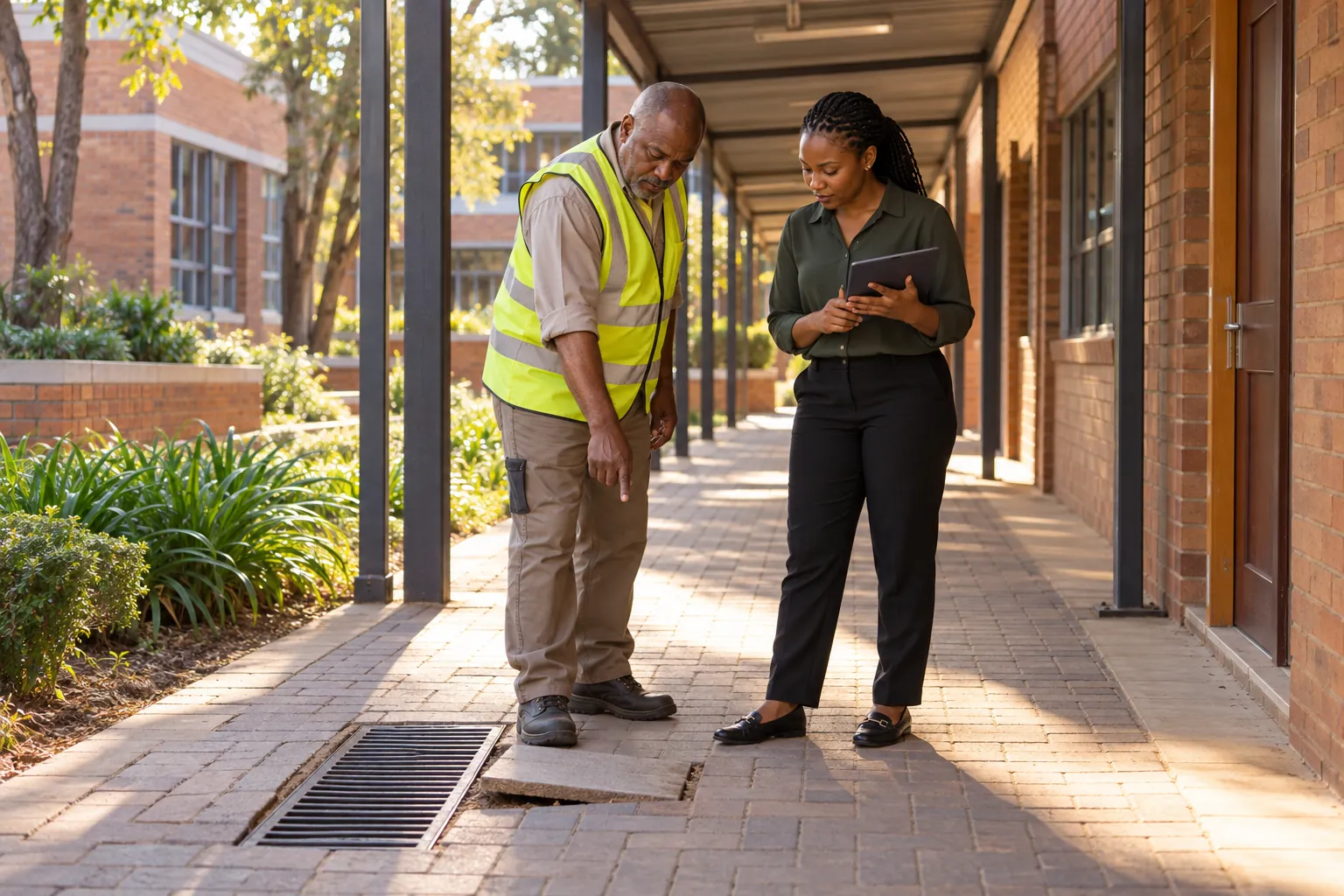
- Building fabric: roofs, gutters and downpipes, stormwater drains, windows, doors, ceilings, floors and external walls, often timed around the rainy season for the region.
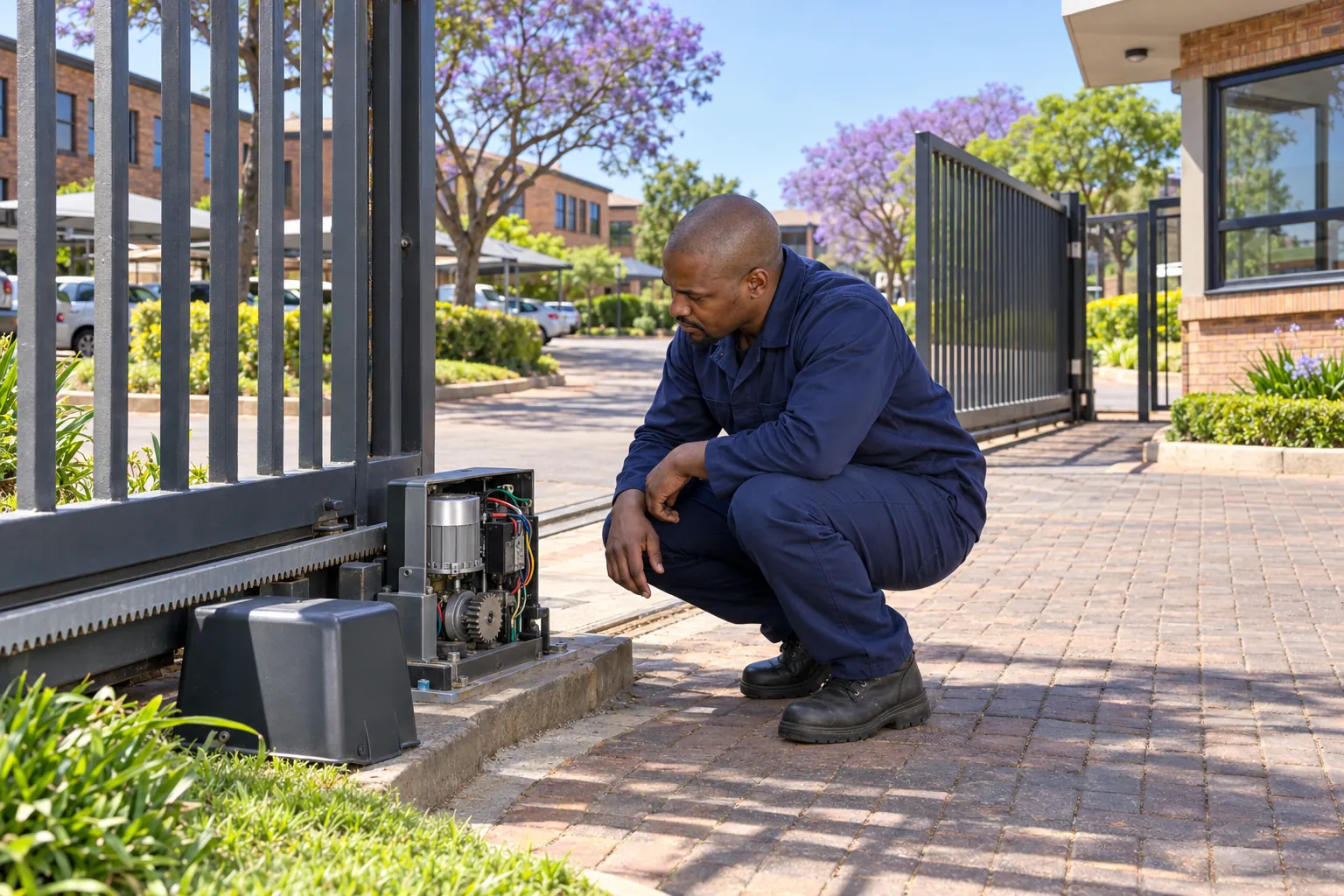
- Security systems: gates, boom barriers, access control, CCTV, alarms and electric fences.
- Ablutions and kitchens: taps, cisterns, urinals, hand dryers and drains.
The list for any particular building comes from what is actually in it, which is why every good programme starts with an asset register rather than a generic checklist.
03
Building the asset register and the schedule
A preventative maintenance schedule answers four questions for every asset: what it is, where it is, what it needs and how often. Building one is careful, methodical work:
- Walk the building and list the assets. Every floor, plant room, roof and basement: type, make and model, serial or asset number, location, age and condition. A list inherited from the previous contractor is a starting point, not a register.
- Mark the statutory tasks. For each asset, note what the regulations, the municipal by-law or the incorporated SANS standard requires, and how often.
- Follow the manufacturer. Service intervals, consumables and warranty conditions. A missed service can void a warranty on a generator or an air-conditioning plant.
- Choose the discretionary tasks. Decide which non-statutory work you will do, and how often, based on how critical the asset is and how often it has failed.
- Name who does each task. The in-house maintenance team, the lift company, the fire contractor, the electrician. Check that each is competent, and registered where the law requires it.
- Put it in a calendar. Group tasks by building, trade and season, and plan disruptive work, such as a generator load test, for quiet hours.
Who owns the programme depends on the building. In a multi-tenant office or retail building, the owner or its managing agent usually maintains the common areas and central plant, and the lease decides what each tenant looks after inside its own premises. The Electrical Installation Regulations, 2009 show how that can shift: under regulation 2(3), where a written undertaking transfers responsibility for an electrical installation to a lessee, the lessee is responsible for it as if it were the user or lessor. Read the lease before assuming.
In a sectional title scheme the body corporate maintains the common property. Rule 22 of the prescribed management rules in the Sectional Titles Schemes Management Regulations, 2016 requires a written maintenance, repair and replacement plan setting out the major capital items expected to need maintenance, repair and replacement within the next ten years, their present condition, when the work will be needed, the estimated cost and the expected life. That ten-year plan and the reserve fund behind it are for major items; the routine servicing between them still needs its own schedule.
For national and provincial departments, section 13(1)(d) of the Government Immovable Asset Management Act 19 of 2007 requires the accounting officer of the custodian department to ensure that the condition of each immovable asset is assessed at least every fifth year, and that the maintenance it needs and the cost of that maintenance are determined.
A small site can keep the register and schedule in a well-kept spreadsheet, provided someone owns it and updates it when assets change; larger portfolios usually use maintenance management software.
04
Statutory and discretionary tasks
The most useful distinction in any schedule is between tasks the law fixes and tasks you choose. Statutory tasks are not negotiable when the budget is tight; discretionary tasks are where judgement comes in. In a South African non-domestic building the statutory ones usually include:
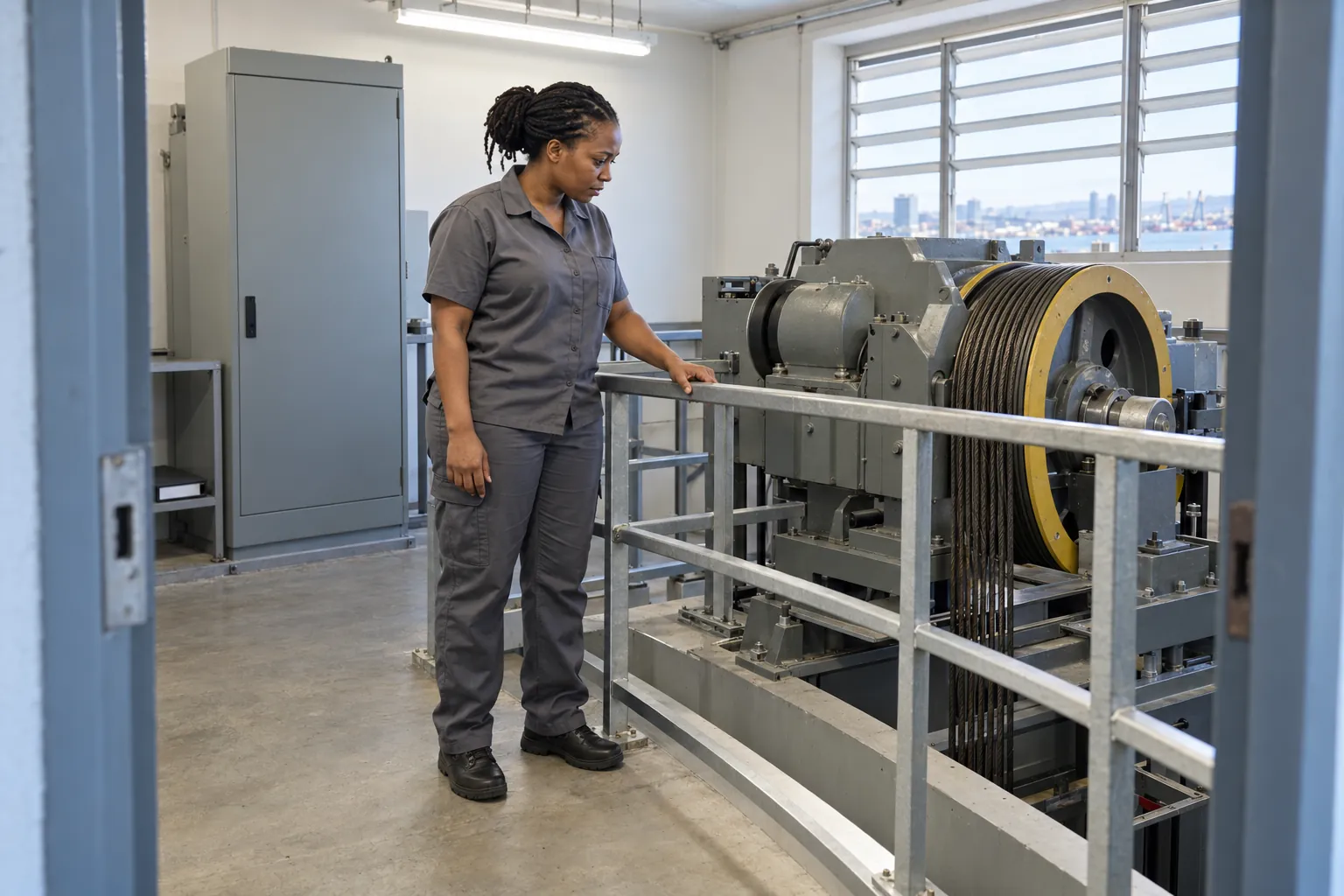
- Lifts, escalators and passenger conveyors. Under regulation 7(1) of the Lift, Escalator and Passenger Conveyor Regulations, 2010, the user must designate a competent lift service provider to examine and maintain each installation at least once a month, or at the longer interval the manufacturer prescribes. Regulation 7(2) requires lift gates and door locks to be tested at every examination, suspension ropes examined every six months, and the safety gear, overspeed governor and buffers tested at intervals not exceeding 12 months. Regulation 6 requires an inspection and test by an accredited inspection service provider at intervals not exceeding 24 months, with a comprehensive report for each installation.
- The electrical installation. Regulation 2(1) of the Electrical Installation Regulations, 2009 makes the user or lessor "responsible for the safety, safe use and maintenance of the electrical installation he or she uses or leases". Regulation 7 requires a valid certificate of compliance, and one covering at least any addition or alteration; under regulation 9 only a registered person may issue one. The wiring standard is SANS 10142-1, The wiring of premises Part 1: Low-voltage installations.
- Fire protection. Fire safety in use is set by each municipality's by-law, so the rules differ between cities. In Cape Town, section 18(1) of the City of Cape Town Community Fire Safety By-law requires the owner or person in charge to ensure that a fire protection system is tested and maintained on a regular basis and that a detailed record of the tests and maintenance is kept, and section 17(2) requires extinguishers to be maintained in line with the OHS regulations and the SABS (now SANS) standards it names. Fire detection and alarm maintenance is usually done to SANS 10139:2021, and extinguisher servicing to SANS 1475-1.
Discretionary tasks make up most of the calendar, and choosing them is the real maintenance strategy: generator services and load tests, air-conditioning filter changes, gutter clearing, pump and valve checks, lubricating gates and booms, touching up paint and sealing leaks. None is required by name, but skipping them is how minor wear turns into a failure, and a failure that hurts someone becomes a question under section 8(2)(a) of the Act.
Frequencies are a starting point: a generator that runs for hours every week during load shedding needs servicing on hours run, not on the calendar.
05
How the work is recorded and checked
A preventative maintenance programme is only as credible as its records. When an inspector of the Department of Employment and Labour, an insurer, a fire safety officer or a client asks whether a task was done, the answer needs to be more than a tick on a planner. Good evidence usually includes:
- The job record: the asset, the task, the date, who did it, what they found and what they did about it.
- Statutory records: for lifts, regulation 8 of the lift regulations requires the user to keep, in the machine room, a record of every monthly examination and test, the latest comprehensive report and the rope certificates, for at least ten years. For the electrical installation, the certificate of compliance and its test report. For fire systems, the service certificates and the maintenance record the by-law requires.
- Defects and follow-up: faults found on a service visit, the repair raised and when it was closed. Under regulation 7(3) of the lift regulations, a defect that endangers people must be reported to the user and the provincial director, and nobody may use the lift until it has been put right to the satisfaction of an inspection service provider.
- Completion against plan: tasks due, done and overdue, by month and by building, with statutory tasks shown separately.
A completion percentage on its own tells you little. Ask every month which tasks were missed, whether any were statutory, and what happened to the defects found. Review the whole schedule at least once a year, because assets are replaced and buildings change use.
06
Where the record fails, and what SiteClara does about it
Maintenance records are usually strongest for the contractor's visit, which comes with a service report or a certificate, and weakest for the small, frequent checks in between: the caretaker's weekly walk of the plant room, the generator's fuel level and battery, the fire escape doors and hose reels, the gutters after a storm. Those end up on a sheet on a clipboard, if they are written down at all, and a fault found on one is passed on to whoever happened to be passing.
SiteClara records those routine checks where they happen. A printed QR poster, with an optional NFC tag behind it, sits at each location, such as a plant room door, the generator enclosure, a fire escape or an ablution block. The caretaker, maintenance staff or a contractor's technician scans or taps on their own phone, with no app to install, sees the checks due there, and marks each one done or says what stopped them, with a photo when one is asked for. The time and the named person are recorded as it happens. A fault reported there goes onto the team's list of open jobs until someone closes it.
The supervisor sees what was due, done and missed, gives the reason a check was missed, and approves a daily report that goes to the facilities manager, managing agent or other nominated contacts at 8am the next morning.
07
Questions people ask
What are some examples of preventative maintenance in a building?
Lifts give the clearest examples, because the Lift, Escalator and Passenger Conveyor Regulations, 2010 set the intervals: an examination at least once a month, the suspension ropes examined every six months, the safety gear, overspeed governor and buffers tested at least every 12 months, and an inspection, test and comprehensive report by an accredited inspection service provider at intervals not exceeding 24 months. Others are fire alarm tests, generator services and clearing gutters before the rains.
Is preventative maintenance required by law in South Africa?
Not by that name, but section 8(2)(a) of the Occupational Health and Safety Act 85 of 1993 requires an employer to provide and maintain systems of work, plant and machinery that are, as far as is reasonably practicable, safe and without risks to health. Regulations under the Act then fix specific tasks, such as monthly lift maintenance and the electrical certificate of compliance, and municipal fire by-laws add their own: section 18(1) of the City of Cape Town Community Fire Safety By-law requires a fire protection system to be tested and maintained on a regular basis, with a detailed record kept.
Who is responsible for maintaining the electrical installation in a leased building?
The user or lessor, under regulation 2(1) of the Electrical Installation Regulations, 2009, unless a written undertaking has transferred that responsibility to the lessee, in which case regulation 2(3) makes the lessee responsible as if it were the user or lessor.
08
Where to read the official text, and a list to take away
The Act is on gov.za (Occupational Health and Safety Act 85 of 1993). The Department of Employment and Labour publishes the Lift, Escalator and Passenger Conveyor Regulations, 2010 and the Electrical Installation Regulations, 2009. Your municipality publishes its fire safety by-law. Regulations are amended by notice in the Government Gazette, so check for the current text before relying on an old copy. To check your preventative maintenance is in order:
- every asset is on a register, verified on site, with its location;
- every statutory task is identified, with its frequency and the regulation, by-law or standard it comes from;
- each task has a named owner who is competent, and registered where the law requires it;
- the lift record is in the machine room, with the latest comprehensive report no more than 24 months old;
- the electrical certificate of compliance is on file and covers every addition or alteration;
- fire protection systems are tested and maintained, with the record your by-law requires;
- defects found on service visits are raised, tracked and closed;
- overdue statutory tasks are reported by name, not buried in a percentage;
- the schedule is reviewed at least once a year.
Sources
Every document this guide quotes or links to, in the order it first cites them.
- Occupational Health and Safety Act 85 of 1993 gov.za
- Electrical Installation Regulations, 2009 labour.gov.za
- Sectional Titles Schemes Management Regulations, 2016 gov.za
- Government Immovable Asset Management Act 19 of 2007 gov.za
- Lift, Escalator and Passenger Conveyor Regulations, 2010 labour.gov.za
- SANS 10142-1, The wiring of premises Part 1: Low-voltage installations store.sabs.co.za
- City of Cape Town Community Fire Safety By-law openbylaws.org.za
- SANS 10139:2021 store.sabs.co.za
- SANS 1475-1 store.sabs.co.za
Related guides
 Premises and facilities managementFacilities manager duties: what the job covers under South African law, and how to show it is doneA facilities manager's duties in South Africa: the OHS Act duties they carry, contractors, lifts, electrics, fire and ablutions, and the records that show it.
 Premises and facilities managementBody corporate maintenance: what the law requires, and how to show it was doneWhat a body corporate must maintain under the Sectional Titles Schemes Management Act, the 10-year plan, the reserve fund, who does the work and the records to keep.
 Fire and water checksStandby generator checks: the checklist, the law and the logA standby generator checklist for South African buildings: weekly and monthly checks, the test run on load, load shedding, the law, servicing and the generator log.
 Premises and facilities managementHealth and safety inspection checklist: what to look at, and what to do nextWhat a workplace health and safety inspection should cover in South Africa, how often, who inspects, and how to record and close findings under the OHS Act.