Premises and facilities management
Caretaker duties: what the job involves in South Africa, and how to show it was done
A caretaker's duties are to keep a building and its grounds secure, clean and in good repair on behalf of whoever owns or runs it: opening and locking up, walking the common areas every day, cleaning, doing minor repairs and calling in contractors for everything else.
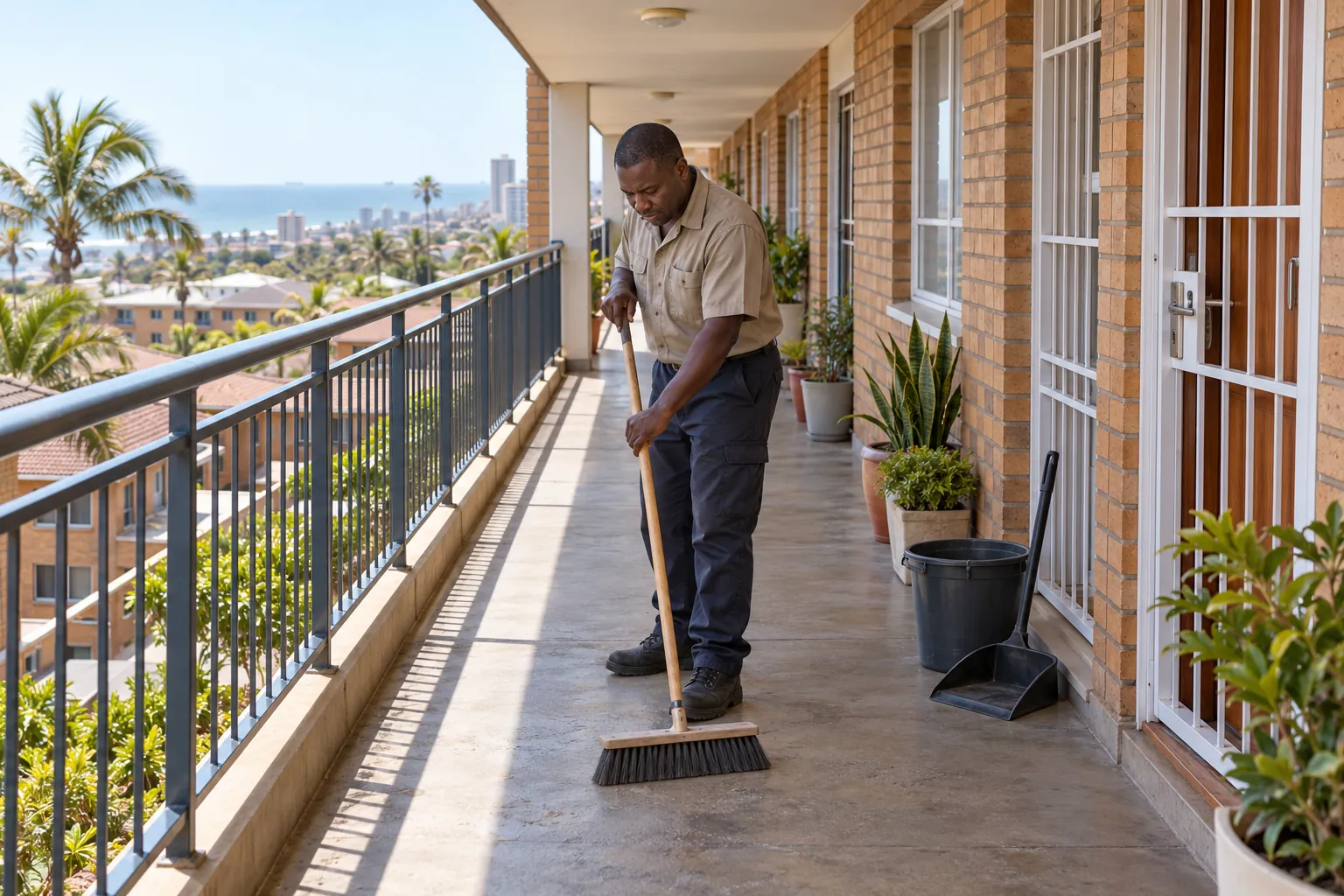
In a South African sectional title scheme the caretaker is usually employed by the body corporate, which under section 3(1)(l) of the Sectional Titles Schemes Management Act 8 of 2011 must maintain all the common property and keep it in a state of good and serviceable repair; the caretaker is how that duty gets done from day to day. This guide covers the law behind the job, the duties themselves, how the work differs in a block of flats, an estate, a school, an office or a church, the routine checks, what a caretaker should leave to a registered contractor, and how the work can be recorded.
01
What a caretaker is, and the duties behind the job
A caretaker looks after a building and its grounds for whoever owns or controls it. The title varies: caretaker, resident caretaker, building supervisor, maintenance handyman, general assistant or groundsman in a school, and estate caretaker in a residential estate. In South Africa the post is most common in sectional title schemes, where many blocks of flats and townhouse complexes employ a caretaker who lives on site, but offices, schools, churches, community halls and estates employ caretakers too.
Most of the legal duties a caretaker carries out belong to the employer, or to whoever controls the property, not to the caretaker personally. The main ones are:
- the Sectional Titles Schemes Management Act 8 of 2011, under which a body corporate must maintain all the common property and keep it in a state of good and serviceable repair (section 3(1)(l)), maintain any plant, machinery, fixtures and fittings used in connection with the common property and sections and keep them in a state of good and serviceable repair (section 3(1)(q)), and may appoint such agents and employees as it considers fit (section 4(a));
- the Sectional Titles Schemes Management Regulations (Government Notice R. 1231 of 7 October 2016), whose Prescribed Management Rules require the trustees to appoint any employee in terms of a duly signed written contract (rule 9(d)) and let them delegate a power or duty to an employee only if they specify it in writing, with a maximum amount that may be spent and any conditions (rule 21(3)(g));
- the Occupational Health and Safety Act 85 of 1993, under which every employer must provide and maintain, as far as is reasonably practicable, a working environment that is safe and without risk to the health of its employees (section 8(1)), and must conduct its undertaking so that other people, such as residents, learners and visitors, are not exposed to hazards (section 9(1));
- for a public school, the South African Schools Act 84 of 1996, under which the school governing body must administer and control the school's property, buildings and grounds (section 20(1)(g)) and may apply to be allocated the function of maintaining and improving them (section 21(1)(a)).
The caretaker has duties of their own too. Section 14 of the OHS Act requires every employee to take reasonable care of their own health and safety and that of other people, to obey the health and safety rules laid down by the employer, and to report any unsafe or unhealthy situation to the employer or the health and safety representative as soon as practicable. For a caretaker, that last duty is most of the job: noticing what is wrong and making sure the right person hears about it.
02
Caretaker duties and responsibilities in practice
A caretaker's job description in South Africa usually includes most of these:
- Opening, locking up and security: opening the building or gates in the morning, locking up at night, checking that doors, windows and pedestrian and vehicle gates close and lock, holding keys and remotes securely, and knowing who has access.
- Walking the common property: stairwells, passages, lobbies, parking areas, gardens, the pool area and the bin area, looking for damage, leaks, broken lights, trip hazards and anything left where it should not be.
- Cleaning: in smaller schemes the caretaker is the cleaner; in larger ones they deal with spills, bins and the ablution facilities between visits, supervising the contract cleaners who do the rest.
- Minor repairs and general maintenance: changing a globe, fixing a loose handle, clearing a blocked drain, touching up paint, oiling a gate runner, and reporting anything bigger.
- Contractors: letting in the plumber, the lift technician, the pest controller and the fire equipment servicer, and checking the job was done before they leave.
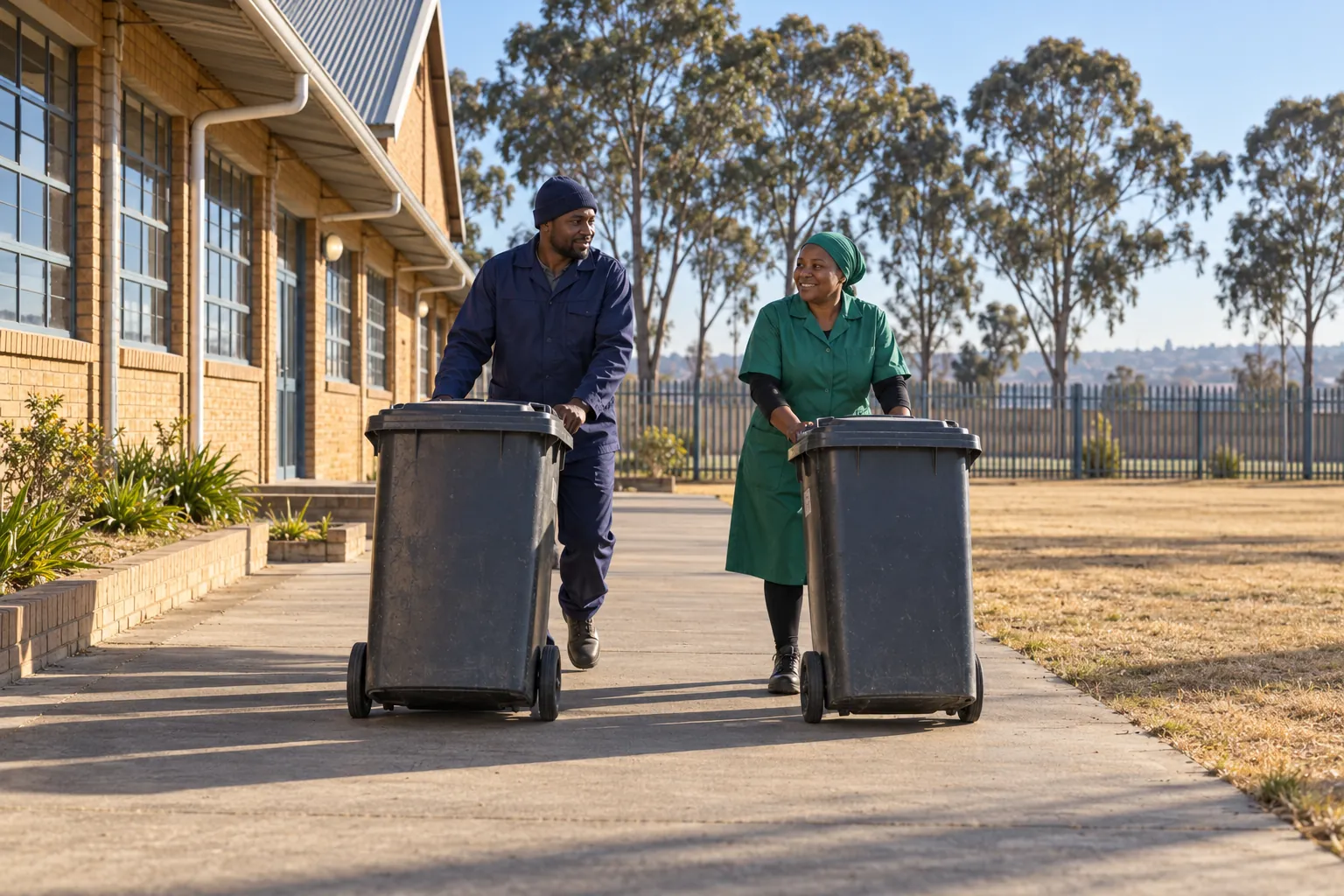
- Refuse: putting the bins out on the municipal collection day, keeping the refuse area clean, and reporting dumped rubbish.
- Power and water: during load shedding or an outage, checking that the standby generator, gate motors, borehole or booster pumps and emergency lights have done what they should, and restarting anything that needs a person once the power returns.
The skills the job needs are mostly practical: basic handyman work, the experience to tell a small fault from one that needs a contractor, and clear communication with residents, tenants, contractors and whoever manages the building.
In a sectional title scheme the line between common property and a section matters. Section 13(1)(c) of the Sectional Titles Schemes Management Act requires each owner to repair and maintain their own section in a state of good repair, so a caretaker employed by the body corporate works on the common property unless the trustees have agreed otherwise. Private jobs inside units should be done on terms the trustees know about.
03
How the job differs from building to building
The core of caretaking is the same everywhere, but each kind of building adds its own work.
- Sectional title blocks and complexes: the resident caretaker lives in a caretaker's flat or room on the property, which means being available after hours for a burst geyser in the common area, a gate motor stuck open or a lift that has stopped. The trustees, or a managing agent acting for them, give the instructions. The caretaker's daily observations are the first warning of what the body corporate must maintain on the common property.
- Schools: school caretakers and general assistants open and close the grounds, clean, look after the sports fields and do minor repairs, working around the school day, exams and hall bookings. The governing body may allow the reasonable use of school facilities for community, social and fundraising purposes (section 20(2) of the Schools Act), and every booking means setting up, checking and locking up afterwards.
- Offices: the caretaker, sometimes called a building supervisor or handyman, opens the building, sets up boardrooms, handles deliveries and is the first person tenants call when something breaks.
- Churches and community halls: the day follows the services and bookings, with the hall, kitchen, ablutions and grounds checked before and after each use, and a church council or committee responsible for the property.
A resident caretaker in a scheme is often on call, which belongs in the contract along with how call-outs are paid. The contract and the trustees' written delegation should also say which repairs the caretaker may authorise, up to what amount.
04
The routine checks a caretaker carries out
The frequency is set by the employer's risk assessment, the scheme's maintenance plan and the servicing agreements, but a typical pattern is:
- Every day: escape routes, stairwells and passages clear; exit doors unlocked from the inside while the building is occupied; common area lights working; gates and doors closing; ablutions clean and stocked; no spills, leaks or trip hazards; the bin area tidy.
- Weekly: a walk round the perimeter, roof access points and parking areas; the pool chemistry and pump where the caretaker looks after the pool; the ladders and tools in the store; a run of the standby generator where the servicing agreement asks for one.
- Monthly: a visual check that each fire extinguisher and hose reel is in place, sealed and unobstructed; emergency lights; the first aid box; little-used taps and showers flushed where the building's water management plan asks for it, as part of Legionella control.
- After load shedding, a storm or an outage: gate motors, pumps, lifts, alarm panels and the electric fence energiser back on and working, and anything that tripped reported.
Several of these checks follow directly from the regulations. The General Safety Regulations as amended in March 2025 (Government Notice 5954 of 6 March 2025) require an employer to keep floors, walkways, stairs and passages in a good state of repair, skid-free and free of obstructions, waste or materials (regulation 13H(2)(d)), and to keep every door serving as a means of exit clear and capable of being easily and rapidly opened from inside (regulation 13J(1)(b)). The same notice requires an adequate supply of suitable fire-fighting equipment, maintained in good working order (regulation 13J(2)). See also workplace housekeeping.
The Facilities Regulations, 2004 (Government Notice R. 924 of 3 August 2004) require an employer to make toilet paper and soap or a similar cleansing agent available free of charge to employees (regulation 2(3)) and to maintain the prescribed rooms and facilities in a clean, hygienic, safe, whole and leak-free condition and in a good state of repair (regulation 9). Where the caretaker looks after the ablution facilities, those are their checks.
Fire safety in a building in use is mostly municipal. The City of Cape Town's Community Fire Safety By-law, 2002 is one example: section 15(1) says a component of an escape route, such as an access door, emergency route or escape door, must not be obstructed or rendered less effective in any way; section 14(3) forbids wedging, blocking or obstructing a fire door so that it cannot close; and section 18(1) requires the owner or person in charge to ensure that a fire protection system is tested and maintained on a regular basis and that a detailed record of the tests and maintenance is kept. Other municipalities have their own by-laws, so check the one where the building is.
05
What to leave to others, working alone, and a good record
What a caretaker should not do matters as much as what they should. Changing a globe is caretaking; electrical installation work is not. Under the Electrical Installation Regulations, 2009 (Government Notice R. 242 of 6 March 2009), no person may do electrical installation work as an electrical contractor unless registered as one (regulation 6(1)), and only a registered person may issue a certificate of compliance (regulation 9(1)). The same regulations make the user or lessor of an electrical installation responsible for its safety, safe use and maintenance (regulation 2(1)), which is why the caretaker's job is to report the fault, not to fix it.
Work at height, cleaning chemicals and heavy lifting need training and the right equipment. The OHS Act requires the employer to establish the hazards attached to any work and the precautions to take (section 8(2)(d)), to provide the information, instructions, training and supervision needed (section 8(2)(e)), and not to permit an employee to do the work until those precautions are in place (section 8(2)(f)).
Caretakers often work alone, early, late or on a large property. South Africa has no separate lone working regulation, but the same section 8 duties apply: the employer should decide which jobs wait until someone else is there and how the caretaker keeps in touch. An injury at work is an injury on duty under COIDA.
A good caretaking record shows three things: that the routine checks were done, when and by whom; what was found and reported; and what happened to each report. In a sectional title scheme it also feeds the trustees' report to each annual general meeting on how far the maintenance, repair and replacement plan has been implemented (Prescribed Management Rule 22(4)). The rules require the body corporate's records to be in writing or in a form that can easily be converted to writing (rule 27(8)), and if the body corporate terminates an employee's contract, that person must within 10 days deliver to the body corporate all the records referred to in rule 27 that are in their possession or under their control (rule 27(7)). A caretaker's notebook in a drawer of the caretaker's flat is a weak basis for either.
06
Where the record fails, and what SiteClara does about it
Caretakers are often the most reliable people on a property and the worst recorded. The checks happen, but they are ticked on a sheet behind the storeroom door, mentioned in a residents' chat group, or not written down at all, and a fault reported in the parking area may never reach the managing agent. When a trustee asks when the gate fault was first reported, the caretaker's word is all there is.
SiteClara gives each check a place. A printed QR poster at each location, such as the main entrance, a stairwell, the pool pump room, the generator room or the bin area, with an optional NFC tag behind it, lets the caretaker scan the code or tap the tag with their own phone, with no app to install. They see the checks due there and mark each one done, or say what stopped them, with a photo when one is asked for. A fault reported there goes onto the team's list of open jobs until someone closes it.
Whoever supervises the caretaker sees what is due, done and missed, gives the reason when a check was missed, and can escalate a job to the building manager, who can answer it. Each day the supervisor reviews and approves a short report, which goes to nominated contacts, such as the managing agent, a trustee or the facilities manager, the next morning, showing what was reported, what was completed, what is still open and how the scheduled checks went.
07
Questions people ask
What is the role of a caretaker?
A caretaker carries out, day to day, the maintenance duties that belong to whoever owns or runs the building. In a sectional title scheme that is the body corporate, which under section 3(1)(l) of the Sectional Titles Schemes Management Act 8 of 2011 must maintain all the common property and keep it in a state of good and serviceable repair, and under section 4(a) may appoint such agents and employees as it considers fit.
What are some basic duties of a caretaker?
Opening and locking up, walking the common areas, cleaning, minor repairs, letting in contractors and putting out the refuse. Behind all of them sits section 14 of the Occupational Health and Safety Act 85 of 1993: every employee must take reasonable care for their own health and safety and that of other people, obey the employer's health and safety rules, and report any unsafe or unhealthy situation to the employer or the health and safety representative as soon as practicable.
What does a resident caretaker do in a sectional title scheme?
A resident caretaker lives on the property and looks after the common property for the body corporate, often on call after hours. The Sectional Titles Schemes Management Regulations require the trustees to appoint any employee in terms of a duly signed written contract (Prescribed Management Rule 9(d)), which should set out the duties, the hours, after-hours call-outs and how much the caretaker may spend on repairs without asking.
What are a school caretaker's duties and responsibilities?
At a public school, the governing body must administer and control the school's property, buildings and grounds under section 20(1)(g) of the South African Schools Act 84 of 1996, and may apply to be allocated the function of maintaining and improving them under section 21(1)(a). The school caretaker or general assistant does much of that work day to day: opening and closing the grounds, cleaning, looking after the sports fields and doing minor repairs.
08
Further reading, and a list to take away
For sectional title schemes, read the Act and the Prescribed Management and Conduct Rules in Annexures 1 and 2 to its regulations. The Community Schemes Ombud Service regulates the conduct of parties within community schemes and resolves disputes, which this guide does not advise on. The Department of Employment and Labour publishes the OHS Act and its regulations, and your municipality its fire safety by-law.
If you are writing a caretaker's job description, or starting as a caretaker, check that you know:
- who your employer is, who gives you instructions, and who you report problems to;
- which buildings, grounds and plant you look after, your hours, and how after-hours call-outs work;
- which routine checks are yours, how often, and where each is recorded;
- which repairs you may do yourself, up to what amount, and which go to a registered contractor;
- what to check after load shedding or an outage, and who to call if something has not come back;
- the arrangements when you work alone, and which tasks wait until someone else is present;
- how you show, at the end of each day, what you did and what is still outstanding.
Sources
Every document this guide quotes or links to, in the order it first cites them.
- Sectional Titles Schemes Management Act 8 of 2011 csos.org.za
- Sectional Titles Schemes Management Regulations gov.za
- Occupational Health and Safety Act 85 of 1993 labour.gov.za
- South African Schools Act 84 of 1996 gov.za
- General Safety Regulations as amended in March 2025 gov.za
- Facilities Regulations, 2004 gov.za
- Community Fire Safety By-law, 2002 openbylaws.org.za
- Electrical Installation Regulations, 2009 labour.gov.za
- Community Schemes Ombud Service csos.org.za
Related guides
 Premises and facilities managementBody corporate maintenance: what the law requires, and how to show it was doneWhat a body corporate must maintain under the Sectional Titles Schemes Management Act, the 10-year plan, the reserve fund, who does the work and the records to keep.
 Premises and facilities managementManaging agent duties in a sectional title schemeWhat a sectional title managing agent does under the Prescribed Management Rules and the Property Practitioners Act: the agreement, funds, records and maintenance.
 Premises and facilities managementPreventative maintenance for buildings: how to plan it and show it was donePreventative maintenance for South African buildings: the OHS Act duty, the asset register and schedule, lift, electrical and fire tasks, and records that hold up.
 CleaningHousekeeping in the workplace: what the law requires, and how to keep it upWhat regulation 13H of the General Safety Regulations requires of housekeeping at work in South Africa, how to prevent slips and trips, and how to check it daily.