Premises and facilities management
Body corporate caretaker: the duties, the agreement and a record of the work
A building caretaker keeps the common property of a strata building clean, safe and maintained, and in a Queensland unit complex is usually not an employee at all, but a contractor engaged by the body corporate, often the same person who runs the letting business from a lot in the building.

This guide covers what the law says a caretaking service contractor is, the duties a caretaking agreement usually sets out, the code of conduct, the safety law that touches the job, how the body corporate deals with poor performance, and what a good record of the work looks like.
01
What a body corporate caretaker is, and the law behind the role
In Queensland, most apartment buildings, townhouse complexes and resort developments are community titles schemes under the Body Corporate and Community Management Act 1997 (Qld), the BCCM Act. Under section 94 of that Act the body corporate must administer the common property and body corporate assets for the benefit of the lot owners, and it must act reasonably in doing so. The committee and the owners rarely do the physical work themselves. They engage people to do it, and the building caretaker is the most visible of them.
The Act gives the role precise names:
- a service contractor (section 15) is a person engaged by the body corporate, other than as an employee, for a term of at least one year, to supply services other than administrative services for the benefit of the common property or the lots. The Act's own examples are caretaking services and pool cleaning services;
- a letting agent (section 16) is a person the body corporate authorises to conduct a letting agent business for the scheme, acting for the owners who choose to use them in letting their lots, subject to the Property Occupations Act 2014;
- a caretaking service contractor (schedule 6) is a service contractor for the scheme who is also a letting agent for the scheme, or an associate of the letting agent.
The combination of a caretaking agreement, a letting authorisation and a lot to live and work in is what the industry calls management rights, and it is bought and sold as a business. The Queensland Government's page on the role of a service contractor and letting agent notes that a caretaking service contractor typically owns or leases a lot and runs the letting business from it. A building can also have a caretaker who does no letting: a service contractor engaged purely for cleaning, gardens and minor maintenance.
Other states use other words. In New South Wales the on-site role is usually a building manager, appointed by the owners corporation at a general meeting; the NSW Government's Who's who in strata describes building managers as looking after the buildings in a strata scheme. This guide follows Queensland, where the word caretaker is written into the law.
02
Building caretaker duties in practice
The law does not list a caretaker's day-to-day tasks. The caretaking agreement does, usually in a schedule of duties, and what the caretaker must perform is what that schedule says. Most schedules for a residential complex include most of these:
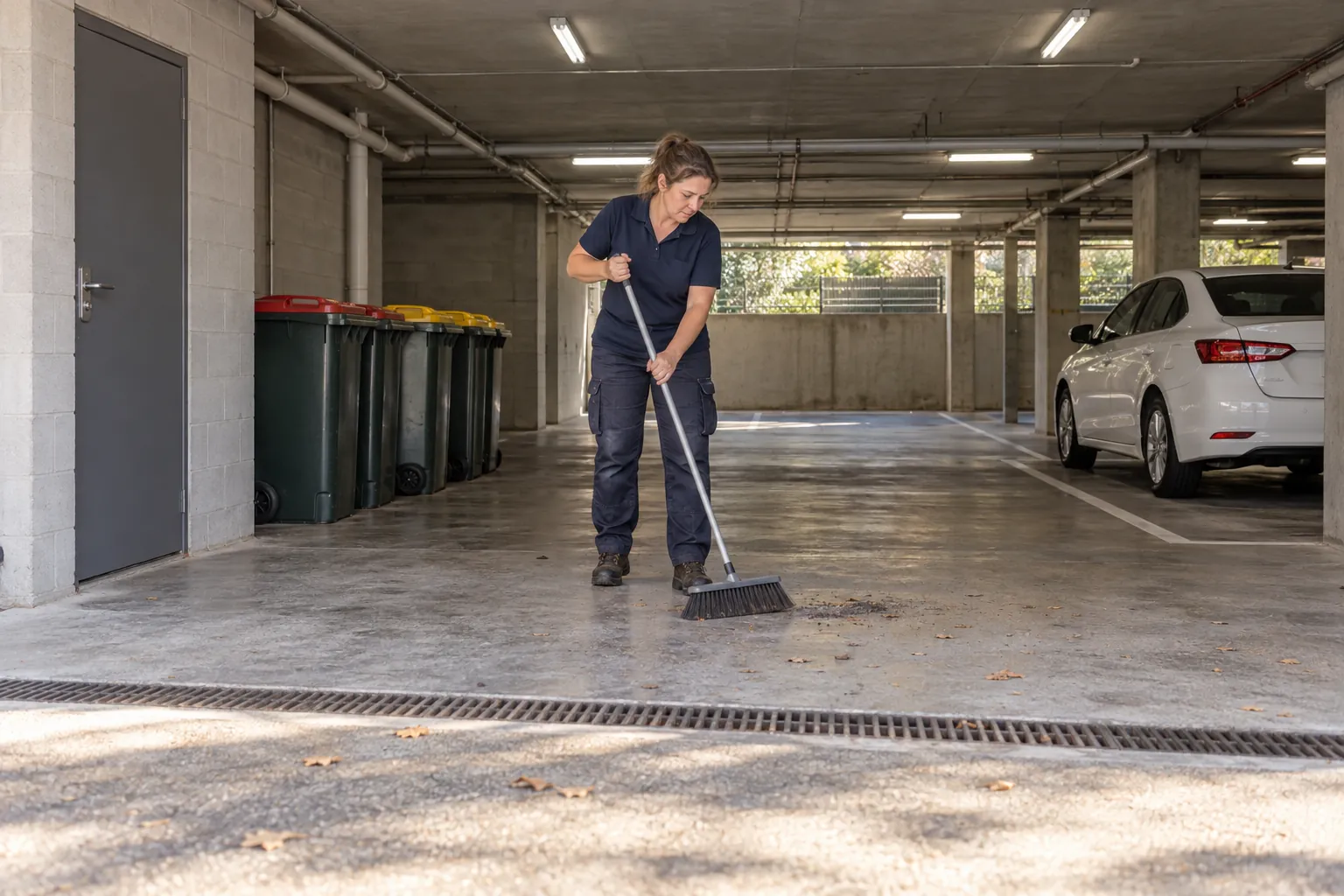
- Cleaning the common property: foyers, lifts, stairwells, corridors, the car park, bin rooms and the barbecue area, with a set frequency for each.
- Grounds and gardens: mowing, pruning, weeding, watering, sweeping paths and driveways, and clearing drains and gutters within reach from the ground.
- The pool and spa: water testing and chemical dosing, skimming and vacuuming, cleaning the surrounds and furniture, and checking that the pool gate closes and latches.
- Waste: bins out and back on collection days, bin rooms washed down, and dumped rubbish removed or reported.
- Lighting and minor repairs: replacing globes in common areas, adjusting door closers, fixing loose handles and reporting anything larger.
- Contractors and access: letting in trades, showing them where they are working, supervising routine contractors such as pest controllers, and keeping keys and access cards secure.
- Security and safety: walking the building, checking gates and doors, keeping evacuation routes and final exits clear, and reporting damage, graffiti, trip hazards and faults with lifts, lights or gates.
- Reporting to the committee: telling the committee, or the body corporate manager, about significant issues, repairs needed and what has been done.
What a caretaker should not do matters as much. Electrical work beyond changing a globe, gas work, plumbing, lifts and fire safety installations belong to licensed contractors. A good schedule of duties says which items are the caretaker's, which the caretaker arranges for the body corporate, and which belong to someone else. A vague schedule breeds disputes.
Because the schedule, not a job description, sets the work, the hours and skills a complex needs vary with its size and facilities. A small complex may need one person a few mornings a week; a large resort may have a caretaking team on site seven days a week, with the pool, gym and gardens each maintained to a set routine.
03
The caretaking agreement, the code of conduct and the committee
The regulation module in the scheme's community management statement governs the engagement. For a scheme under the Body Corporate and Community Management (Standard Module) Regulation 2020, section 137 says the engagement of a service contractor is void unless it is in writing and states:
- the term of the engagement, including when it begins and ends, and any right or option to extend or renew it;
- the functions the service contractor is required or authorised to carry out;
- the basis for working out payment for the contractor's services.
The Queensland Government's guide to engaging a service contractor explains that the body corporate decides the engagement by ordinary resolution at a general meeting. The maximum term depends on the module: 10 years, including options, under the Standard Module; 25 years under the Accommodation and Commercial Modules; and one year under the Small Schemes and Specified Two-lot Schemes Modules, which cannot engage a caretaking service contractor at all. The minimum is one year, because a shorter engagement does not make someone a service contractor.
A caretaking service contractor must comply with the code of conduct for body corporate managers and caretaking service contractors in schedule 2 of the BCCM Act, and a letting agent with the code for letting agents in schedule 3; under the Standard Module, breaching either code can ground the termination of a caretaking service contractor's engagement. Among other things, schedule 2 says the caretaker must:
- have a good working knowledge of the Act and the code relevant to their functions;
- act honestly, fairly and professionally, and not unfairly influence committee elections or motions;
- exercise reasonable skill, care and diligence in performing their functions;
- act in the best interests of the body corporate unless it is unlawful to do so;
- keep the body corporate informed of any significant development or issue about an activity performed for it;
- take reasonable steps to ensure their employees comply with the Act and the code.
The caretaker also has a formal place in the scheme's governance. The Queensland Government's guidance explains that a caretaking service contractor is automatically a non-voting member of the committee and cannot be a voting member, although a caretaker who owns a lot keeps their vote at general meetings. If the caretaker receives a commission, payment or other benefit, they must disclose it to the body corporate.
04
Safety law: WHS, fire, pools and working alone
Several other laws reach the caretaker's day.
Work health and safety. The Work Health and Safety Act 2011 (Qld) places duties on a person conducting a business or undertaking (PCBU). Section 5 makes clear that a business can be conducted alone and need not be for profit, so a caretaker running a caretaking business is a PCBU with duties to their own workers and to others affected by the work. The body corporate's position depends on the building. Section 7 of the Work Health and Safety Regulation 2011 (Qld) says a strata title body corporate responsible for common areas used only for residential purposes may be taken not to be a PCBU for those premises, but that exclusion does not apply if the body corporate engages any worker as an employee. A mixed-use building is a different case, and the committee should take advice.
Fire safety. The Queensland Government's page on body corporate maintenance responsibilities says a body corporate must maintain the common property in good and structurally sound condition, and notes its fire safety duties as an occupier under the Fire Services Act 1990. The Building Fire Safety Regulation 2008 (Qld) makes it an offence to place a thing within 2 metres of a final exit outside a building, or anywhere on an evacuation route where it would be likely to unduly restrict, hinder or delay someone escaping, or otherwise to obstruct an evacuation route. The caretaker is often the person who walks those routes daily. Maintenance of prescribed fire safety installations is different: an appropriately qualified person does it, section 55 requires the occupier to keep a record of maintenance naming the installation, the person, their licence number and the date, and section 55A requires a periodic occupier statement. The Queensland Fire Department's page for Building occupiers, owners, lessees and bodies corporate explains the occupier's side.
Pools. The Queensland Building and Construction Commission's page on buying, selling or leasing a property with a pool says pool safety certificates for shared pools are valid for one year, that obtaining them is usually the body corporate's job, and that the pool owner, body corporate or manager must make sure the pool complies with the pool safety standard at all times. A certificate is a snapshot; the gate that stops latching next week is found by whoever checks it next week.
Working alone. Caretakers often work early, late and alone. Section 48 of the WHS Regulation requires a PCBU to manage the risks of remote or isolated work, meaning work isolated from the assistance of others because of location, time or the nature of the work, and to provide a system of work that includes effective communication with the worker. A caretaker who employs a groundsperson or cleaner must plan for this, and should decide which jobs, such as ladders or heavy lifting, wait until someone else is there.
05
When performance is questioned, and what good evidence looks like
Most disputes between a committee and a caretaker are about whether the duties were done: the pool was cloudy, the bins were left out, the gardens slipped, the foyer was not cleaned on the day the schedule said. The Standard Module sets a formal path. Under section 152 the body corporate may terminate a service contractor's engagement if the contractor engages in misconduct or is grossly negligent, fails to carry out duties under the engagement, or contravenes the relevant code of conduct, but only after giving a remedial action notice that the contractor fails to comply with.
The notice must say what the body corporate believes has happened, with details sufficient to identify, for example, the duties it believes have not been carried out, and it must give the contractor a period of not less than 14 days to remedy it. The Queensland Government's page on terminating an engagement explains that the committee may decide to issue the notice, but termination needs an ordinary resolution at a general meeting. For a caretaking service contractor, the Standard Module requires the motion to approve termination to be decided by secret ballot.
A record serves both sides better than recollection. A committee that issues a remedial action notice has to identify the duties not done; a caretaker answering one has to show that they were. A good record of caretaking work holds:
- the duty and where: which item of the schedule of duties, at which part of the common property;
- who and when: the person who did it, the date and the time, written when the work was done rather than filled in at the end of the week;
- what was found: a pool reading, a broken light, a blocked exit, with a photograph where one helps;
- what could not be done, and why: the garden bed left because the irrigation contractor was on site, the car park wash postponed for rain;
- what was reported, and to whom: each defect passed to the committee or the body corporate manager, and what happened to it.
A regular written report to the committee, drawn from that record, is the easiest way to meet the code's duty to keep the body corporate informed, and gives the committee a basis for praise as well as complaint.
06
Where the record fails, and what SiteClara does about it
Caretakers are often the hardest-working people in a complex and the worst recorded. The pool readings are on a clipboard in the plant room, the cleaning is ticked on a sheet behind the bin room door, and a fault mentioned by a resident at the letterboxes may never reach the committee. When an owner complains at the annual general meeting that the gardens are neglected, the caretaker's word and the owner's word are all there is, and a remedial action notice built on impressions is hard to write and hard to answer.
SiteClara gives each check a place. A printed QR poster at each location, such as the pool gate, the bin room, a fire stair, the car park or the foyer, with an optional NFC tag behind it, lets the caretaker or their staff scan the code or tap the tag on their own phone, with no app to install. They see the checks due there and mark each one done, or explain what stopped them, with a photo when one is asked for. A problem reported there goes onto the team's list of open jobs until someone closes it, and a supervisor can escalate a job to the person named as the building manager in SiteClara, such as the committee chairperson, who can answer it.
Each day the supervisor, who in a small complex may be the caretaker, approves a short report, which goes to nominated contacts such as the committee chairperson or the body corporate manager at 8am the next morning: what was reported, what was completed, what is still open and how the scheduled checks went, with the reason given for any check that was missed or held up.
07
Questions people ask
What is a building caretaker called?
In Queensland law, a service contractor or, where they are also the scheme's letting agent or an associate of the letting agent, a caretaking service contractor. The Queensland Government's page on the role of a service contractor and letting agent defines a service contractor as someone engaged by a body corporate to supply services other than administrative services for at least a year, and a caretaking service contractor as a service contractor who is also authorised as a letting agent for the scheme, or an associate of one.
What are the responsibilities of a building caretaker?
Whatever the written engagement says. The Queensland Government's guide to engaging a service contractor says the engagement must be in writing, state its term, state the duties and include the payment arrangements. Its page on the role of a service contractor and letting agent gives cleaning the pool, lawn mowing and gardening as examples of the services involved.
08
Where to read more, and a list to take away
Start with the Queensland Government's body corporate pages on service contractors, linked above, then the BCCM Act, with its code of conduct in schedule 2, and the regulation module named in the scheme's community management statement. For the wider duty, see strata common property maintenance and building fire safety in Queensland.
Whether you are a committee member reviewing a caretaking agreement or a caretaker starting in a new complex, check that you know:
- which regulation module applies to the scheme, and what it says about the term and termination of the engagement;
- what the schedule of duties says, item by item, and how often each item is due;
- which work is the caretaker's, which is arranged by the caretaker for the body corporate, and which belongs to a licensed contractor;
- who walks the evacuation routes and checks the pool gate, and where that is written down;
- how defects are reported to the committee or the body corporate manager, and how the reporter learns what happened;
- what the working-alone arrangements are, and which tasks wait until someone else is present;
- how the caretaker shows, week by week, what was done, what could not be done and why.
Sources
Every document this guide quotes or links to, in the order it first cites them.
- Body Corporate and Community Management Act 1997 (Qld) legislation.qld.gov.au
- The role of a service contractor and letting agent qld.gov.au
- Who's who in strata nsw.gov.au
- Body Corporate and Community Management (Standard Module) Regulation 2020 legislation.qld.gov.au
- Engaging a service contractor qld.gov.au
- Work Health and Safety Act 2011 (Qld) legislation.qld.gov.au
- Work Health and Safety Regulation 2011 (Qld) legislation.qld.gov.au
- Body corporate maintenance responsibilities qld.gov.au
- Building Fire Safety Regulation 2008 (Qld) legislation.qld.gov.au
- Building occupiers, owners, lessees and bodies corporate fire.qld.gov.au
- Buying, selling or leasing a property with a pool qbcc.qld.gov.au
- Terminating an engagement qld.gov.au
Related guides
 Premises and facilities managementStrata maintenance: keeping common property in repair, and showing that you haveStrata maintenance in Australia: the duty to repair common property in NSW, Victoria and Queensland, the plans a scheme needs, who does what and the records to keep.
 Premises and facilities managementStrata manager responsibilities: what the role covers, state by stateWhat a strata manager does in Australia: licensing and registration by state, delegated functions, disclosure, maintenance and safety, contracts and records.
 Premises and facilities managementBuilding manager duties in Australia: the law, the daily work and the recordWhat a building manager does in Australian offices, shopping centres and strata buildings: the WHS duties, strata rules, fire safety upkeep and the records to keep.
 Premises and facilities managementBuilding maintenance checklist: what to check, how often, and who byA building maintenance checklist for Australian commercial and strata buildings: daily to annual tasks, the WHS and fire safety law behind them, and who does each.