Premises and facilities management
Building maintenance checklist: what to check, how often, and who by
A building maintenance checklist is a list of the inspections, tests and routine tasks that keep a building's structure, services, fire safety systems and grounds safe and in good repair, set out by how often each is due and who does it.
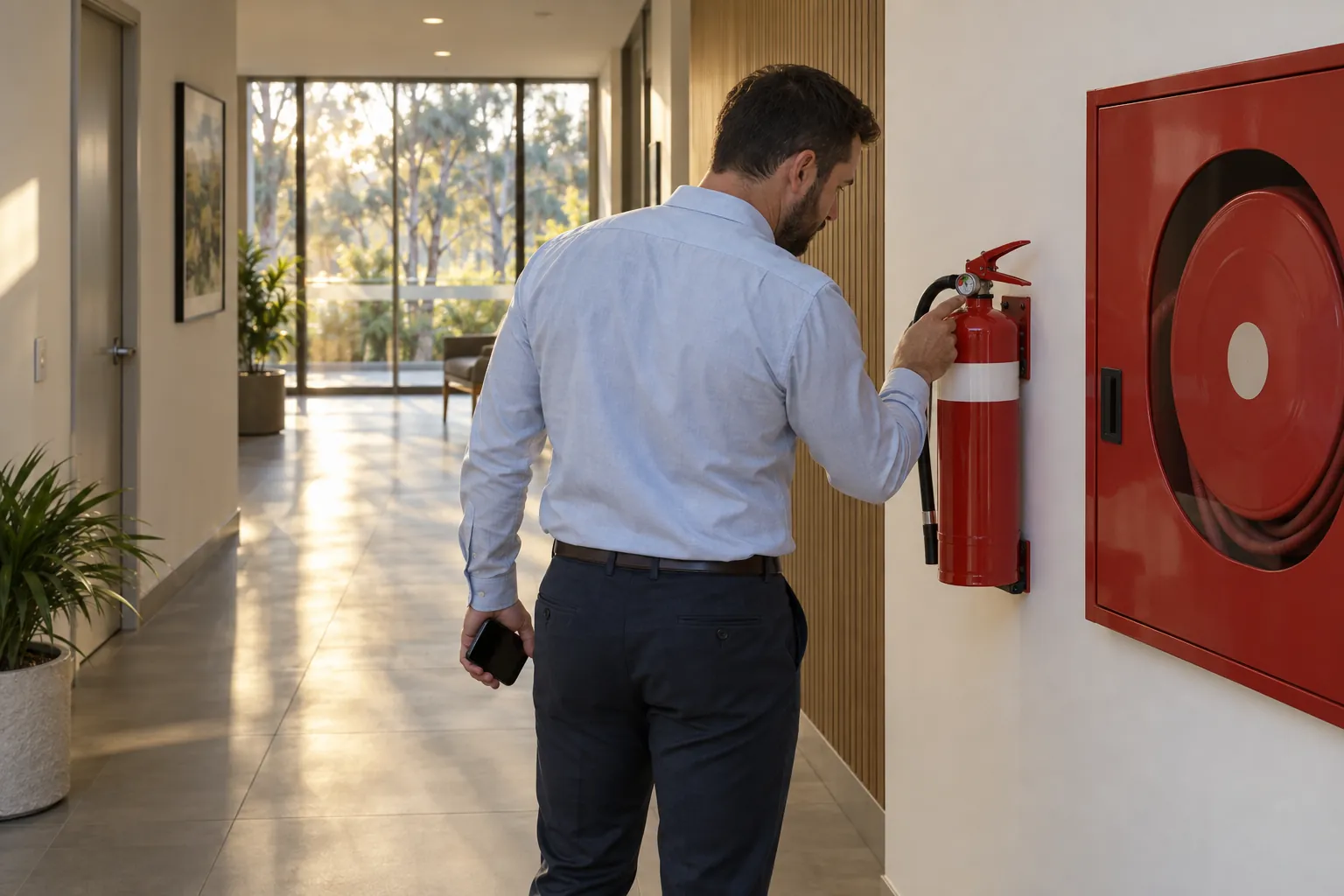
It turns a general duty into specific tasks on specific days. This one is written for Australian offices, shopping centres, schools, community buildings and strata common property, from the daily walk-through to the yearly fire safety sign-off, and it marks the items that need a licensed or competent contractor rather than the building manager or caretaker.
01
The duty behind a building maintenance checklist
No Australian law asks for a document called a building maintenance checklist, but three layers of law ask for the work it organises: work health and safety, state building and fire safety law, and strata law.
Work health and safety. Every state and territory except Victoria has adopted the model WHS laws; Queensland's version shows the wording. Section 20 of the Work Health and Safety Act 2011 (Qld) requires the person conducting a business or undertaking (PCBU) with management or control of a workplace to ensure, so far as is reasonably practicable, that "the workplace, the means of entering and exiting the workplace and anything arising from the workplace are without risks to the health and safety of any person". The Work Health and Safety Regulation 2011 (Qld) makes it specific: section 40 requires floors and other surfaces to be "designed, installed and maintained" so work can be done safely; section 41 requires toilets, drinking water, washing and eating facilities to be kept "in good working order" and "clean, safe and accessible"; and section 213 requires the maintenance, inspection and, if necessary, testing of plant to be "carried out by a competent person". Check your own state's WHS regulation, which follows the same model.
Victoria has its own Occupational Health and Safety Act 2004 (Vic). Section 26 requires anyone who manages or controls a workplace, "whether as an owner or otherwise", to ensure so far as is reasonably practicable that the workplace and the means of entering and leaving it are safe and without risks to health.
Building and fire safety. The National Construction Code (NCC) sets the standard a building is designed and built to, and NCC 2025, Part A6 classifies it: an office is Class 5, a shop Class 6, a school or hospital Class 9, a block of apartments Class 2. Keeping its fire safety measures working afterwards is state business; the Australian Building Codes Board's general FAQ says "enforcement and administration of the NCC is managed by the state and territory governments", including maintenance. That is why the fire safety part of your checklist differs between Melbourne, Sydney and Brisbane.
Strata. The NSW Government's page on strata repairs and maintenance says "the owners corporation or strata committee must repair and maintain common property", including roofs and gutters. Queensland's body corporate and Victoria's owners corporation carry similar duties under their own state laws.
Who owns the checklist depends on the building: in an owner-occupied building, the facility manager or property manager; in a multi-tenanted building, usually the landlord for the base building, common areas and central plant, and each tenant for its fit-out, as the lease sets out; in strata, the strata manager for contractors and a building manager or caretaker for the day-to-day checks. The checklist should name them.
02
What a building maintenance checklist covers
A comprehensive checklist for a commercial, public or strata building covers five areas, interior and exterior, from the structural fabric to the electrical and mechanical systems:
- Building fabric: roofs and roof sheeting, box gutters, eaves gutters and downpipes, facades and cladding, windows and doors, balconies and balustrades, floors, ceilings, stairs and handrails.
- Building services: air conditioning and ventilation, hot and cold water, plumbing and drainage, pumps, switchboards and lighting, lifts and escalators, and any building management system.
- Fire safety measures: fire detection and alarm systems, sprinklers, hydrants and hose reels, portable fire extinguishers and fire blankets, emergency lighting and exit signs, fire doors, smoke doors and paths of travel to exits.
- Grounds and car parks: paths, ramps, car parks, line marking, external lighting, fences and gates, stormwater pits, landscaping and trees, bin rooms, and pest activity.
- Welfare and amenities: toilets, showers and end of trip facilities, kitchens and tea rooms, drinking water, first aid equipment, and the cleaning that keeps them usable.
The tasks split into two kinds. Site checks are visual checks and simple tests a building manager, caretaker, cleaner or trained staff member can do: walking the exits, checking the fire indicator panel, flushing a little-used outlet. Contractor work is inspection, testing, servicing and certification that needs a licence, accreditation or specific competence. Items marked (CP) below need a competent person, and for fire safety measures often a licensed or accredited one under state law.
Most of the list is preventive maintenance: planned inspections, tests and servicing that find wear and damage before it becomes a breakdown. The faults those checks turn up become reactive jobs, and the checklist should say who they go to.
Use the lists as a template, not a finished document. The building's own records decide the final version: the essential safety measures maintenance schedule in Victoria, the fire safety schedule in NSW, the prescribed fire safety installations in Queensland, the asbestos register, any cooling tower risk management plan, the manufacturers' instructions and the service contracts. Where they differ from this list, follow them.
03
Daily and weekly checks
Daily, usually as a walk-through at opening:
- exits, corridors, stairs and paths of travel clear, and exit doors unlocked and opening freely from the inside;
- the fire indicator panel showing normal, with no faults or isolations left on;
- fire doors and smoke doors closed or on working hold-open devices, and not wedged or chocked;
- entries, floors and walkways free of slip and trip hazards, including wet entries after rain;
- lighting working in stairwells, car parks and common areas;
- toilets and amenities working, stocked and clean, with no leaks or blockages;
- external doors, roller shutters, gates and windows secure at close;
- bin rooms tidy, with nothing stored against the building or in a path of travel.
State fire safety law makes part of this specific. The Building Fire Safety Regulation 2008 (Qld) says a person must not place a thing "within 2m of a final exit outside a building", or elsewhere on an evacuation route where it would hinder someone leaving. Regulation 228 of the Building Regulations 2018 (Vic) requires occupiers to keep exits and paths of travel "readily accessible, functional and clear of obstructions".
Weekly:
- fire doors on exit routes checked for closing, latching and damage;
- fire extinguishers, fire blankets and hose reels in place, unobstructed and with a current maintenance tag;
- little-used hot and cold outlets flushed, where the building's water management plan calls for it;
- plant rooms and pump rooms walked for leaks, noises, smells and alarms, and kept free of storage;
- external areas checked: paths, car park, external lighting, fences, gates and stormwater pits;
- first aid kits checked and restocked, and eyewash stations checked where fitted;
SafeWork NSW's version of the model code of practice, Managing the work environment and facilities (August 2019), says the work environment "must be maintained so that it remains in a clean and safe condition", with broken fixtures and fittings "replaced or repaired promptly"; its Appendix B is a checklist for reviewing them. These daily and weekly checks catch most of what occupants complain about, and they are the ones most often done without a record. A walk-through that finds nothing wrong is still worth recording, because it shows the check happened.
04
Monthly and quarterly checks
Monthly:
- the fire services contractor's routine service visit attended, with any defects it lists passed to someone to fix (CP);
- emergency lighting and exit signs looked over between the contractor's tests, with failed lamps or damaged signs reported;
- doors, closers, locks and door hardware checked on main routes and in amenities;
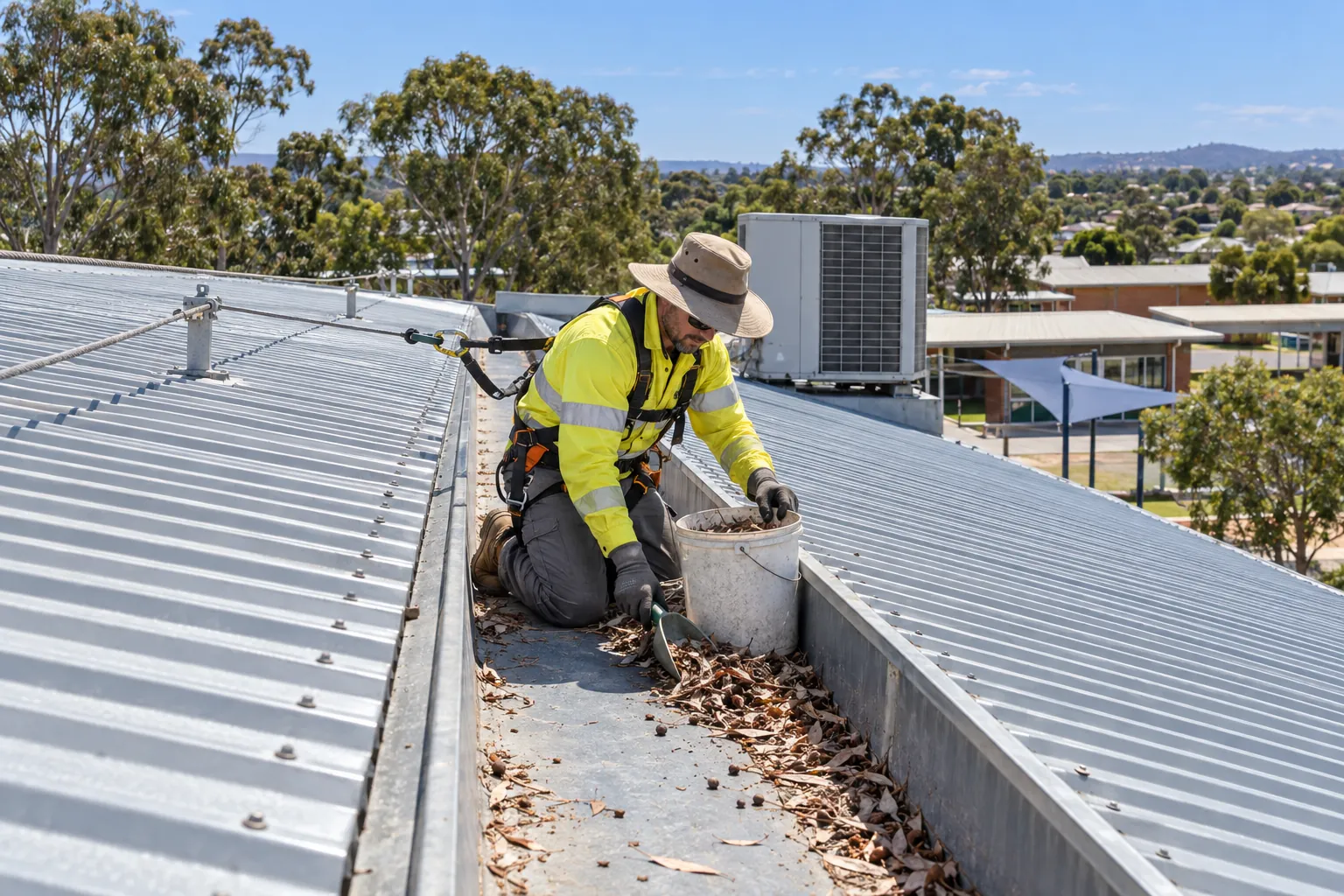
- roofs, box gutters, eaves gutters and downpipes looked at from a safe viewpoint, and more often before storms;
- safety signage, including exit and hazard signs, in place and legible;
- balustrades, handrails and stair nosings secure;
- any water temperature checks the building's hot water or thermostatic mixing valve arrangements require.
The monthly list is also the point to look ahead and book the annual contractor visits before they fall due.
Quarterly:
- air conditioning filters checked and changed to the maintenance contract (CP where the plant needs it);
- external fabric walked: walls, cladding, sealants, windows, balconies and awnings;
- internal fabric: ceilings for stains that suggest a roof or plumbing leak, floors for lifting or damage, and stairs;
- grounds: trees overhanging roofs, paths and car parks, drainage pits and grates, fences and gates;
- signs of pests, such as droppings, nests, or mud tubes and damaged timber that can mean termites, passed to a licensed pest manager (CP);
- a review of open reactive maintenance jobs and repeat faults, to decide what needs a planned repair.
Add the seasonal jobs for your climate: gutters cleared and roof fixings checked before the wet season and cyclone season in the north, gutters cleared of leaves before bushfire season in the south and east, and air conditioning serviced before the first hot days. Roof and height work needs a safe system of work: sections 78 and 79 of the Queensland WHS Regulation require the risk of a fall to be managed, with fall prevention, work positioning or fall arrest where it cannot be eliminated.
05
Annual and contractor items, and the fire safety records
Most of this part of the checklist is contractor work, usually six-monthly, annual or longer. The building manager makes sure it is booked, attended, recorded and, where defects are found, put right.
- Fire protection systems and equipment (CP): routine service to AS 1851-2012 Routine service of fire protection systems and equipment, at the intervals it sets for each system, or as the building's maintenance schedule requires.
- Emergency lighting and exit signs (CP): maintained to AS/NZS 2293, the standard the CFA's guidance on exit signs and emergency lighting names.
- Plant, lifts and escalators (CP): maintained, inspected and tested under section 213 of the WHS regulation, following the manufacturer's recommendations, or a competent person's where there are none; where neither is reasonably practicable, inspection is annual.
- Cooling towers (CP), where fitted: in Victoria, the Department of Health's page on cooling tower systems says each system must be registered, with a risk management plan that "must be audited annually by an independent auditor". Other states have their own rules.
- Warm water systems and thermostatic mixing valves (CP): serviced as your state requires; NSW Health's page on Legionella control in warm water systems sets out the occupier's responsibilities there.
- Backflow prevention devices (CP): where fitted, tested by a licensed plumber at the interval the water authority or council sets.
- Asbestos (CP): section 430 of the Queensland WHS Regulation requires an asbestos management plan to be reviewed "at least once every 5 years", and sooner if asbestos is removed, disturbed, sealed or enclosed.
- Electrical (CP): switchboards, residual current devices and portable equipment inspected and tested at intervals your state's rules and the risk set.
- Roof (CP where access needs it): a close inspection of sheeting, flashings, fixings, box gutters, sumps and overflows.
The fire safety measures are the part of the checklist the law watches most closely, and each state asks for its own yearly record. Three examples show the range.
- Victoria: under the Building Regulations 2018 the owner must keep each essential safety measure "maintained in a state which enables the essential safety measure to fulfil its purpose" (regulation 226), prepare an annual essential safety measures report (regulation 223), and produce within 24 hours of a request the reports for the last 10 years, the maintenance schedules and "the records of all inspections, testing and maintenance (including repairs)" (regulation 225). The CFA's guidance on essential safety measures for businesses notes the records often sit in a red box or logbook in the entry. See essential safety measures.
- New South Wales: the owner issues an annual fire safety statement under the Environmental Planning and Assessment (Development Certification and Fire Safety) Regulation 2021. The NSW Government's page on fire safety certification says it confirms an accredited practitioner (fire safety) "has assessed, inspected and verified the performance of each fire safety measure". See the annual fire safety statement.
- Queensland: under the Building Fire Safety Regulation 2008, the occupier must have each prescribed fire safety installation maintained "by an appropriately qualified person" and tested at the intervals in the Queensland Development Code, part MP6.1, and must have a repair the maintenance record calls for carried out "no later than 1 month" after, unless there is a reasonable excuse. The occupier keeps a record of maintenance: the installation, who did the work and their licence number, the date, what was done and the result.
South Australia differs again: the Metropolitan Fire Service's page on the maintenance of fire safety systems says owners submit a Form 3 (ESP Maintenance Verification) to the council at the start of each calendar year. Elsewhere, ask the council or fire authority.
These statutory records belong to the contractor, the accredited practitioner and the owner. The site checks between visits do not replace them, but they are often where a defect is first seen.
Over the longer term, a condition assessment every few years feeds a plan for the large items: roof replacement, repainting, facade repairs, lifts and major plant; in strata, the 10-year capital works plan. For the statutory side in more detail, see our building compliance checklist; for planning contractor work, preventative maintenance.
06
Where the checklist fails, and what SiteClara does about it
The contractor items usually have good records, because the contractor leaves a report, a tag or a logbook entry. It is the daily, weekly and monthly checks that fail: a sheet printed at the start of the year, ticked in a batch on Friday afternoon, and a leaking box gutter spotted on Tuesday mentioned to whoever was passing and forgotten. When something goes wrong, nobody can say when the exits were last walked, or by whom.
SiteClara records those routine checks where they happen. A printed QR poster at each location, such as a plant room, a fire exit, a bin room or an amenities block, with an NFC tag behind it if you want staff to tap, lets staff scan or tap on their own phone, with no app to install, to see the checks due there and mark them done or say what stopped them. They can report a fault with a photo, and it goes onto the team's list of jobs until someone closes it. The supervisor sees what was due, done and missed, and each day an approved report goes to nominated management or client contacts at 8 am the next morning, showing how the scheduled checks went, for example 12 of 12 completed.
07
Questions people ask
What is included in a maintenance checklist?
Each task, how often it is due, who does it and what happens to anything it finds. SafeWork NSW's Code of Practice: Managing the work environment and facilities shows the format in Appendix B, its work environment and facilities checklist: each question is answered yes or no, with a column for the action to be taken, under headings that include managing facilities, floors, lighting, ventilation, drinking water, toilets, hand washing, eating facilities and change rooms. Its managing facilities questions ask whether broken or damaged infrastructure, "such as plumbing, air-conditioning or lighting", is "repaired promptly", and whether facilities are "cleaned regularly".
What does building maintenance consist of?
Routine checks and minor repairs, planned inspection and servicing of the building's systems, and a longer plan for the major repairs. The NSW Government's page on strata repairs and maintenance draws the same line for strata: minor repairs to common property "can be managed by the strata committee, strata manager or building manager without the need for a meeting", while "the owners corporation must make a 10-year capital works plan" for the major ones. It adds that strata schemes "should use their capital works plan to inform a detailed maintenance schedule for the property".
08
Further reading, and a list to take away
Safe Work Australia publishes the model WHS laws and codes of practice, and each state regulator publishes its own versions. For fire safety, read your own state's guidance and regulation, linked above.
Before you adopt a building maintenance checklist, check that:
- it covers fabric, services, fire safety measures, grounds and amenities;
- each task has a frequency, and the frequency comes from the maintenance schedule, a standard, the manufacturer or a risk assessment;
- contractor items are marked, booked and tracked, with their reports filed where your state requires;
- each task names who is responsible: owner, tenant, strata manager, building manager or contractor;
- faults found on a check go to someone who will fix them, and are followed until closed;
- the daily and weekly checks are recorded, not only the annual ones;
- it is reviewed when the building, its use, its tenants or its equipment change.
Sources
Every document this guide quotes or links to, in the order it first cites them.
- Work Health and Safety Act 2011 (Qld) legislation.qld.gov.au
- Work Health and Safety Regulation 2011 (Qld) legislation.qld.gov.au
- Occupational Health and Safety Act 2004 (Vic) legislation.vic.gov.au
- NCC 2025, Part A6 ncc.abcb.gov.au
- General FAQ ncc.abcb.gov.au
- Strata repairs and maintenance nsw.gov.au
- Building Fire Safety Regulation 2008 (Qld) legislation.qld.gov.au
- Building Regulations 2018 (Vic) legislation.vic.gov.au
- Managing the work environment and facilities (August 2019) safework.nsw.gov.au
- AS 1851-2012 Routine service of fire protection systems and equipment store.standards.org.au
- Exit signs and emergency lighting cfa.vic.gov.au
- Cooling tower systems health.vic.gov.au
- Legionella control in warm water systems health.nsw.gov.au
- Essential safety measures for businesses cfa.vic.gov.au
- Fire safety certification planning.nsw.gov.au
- Maintenance of fire safety systems mfs.sa.gov.au
Related guides
 Premises and facilities managementPreventative maintenance: how to plan it for a building and prove it was donePreventative maintenance for Australian buildings: the WHS duty, the asset register and schedule, statutory and discretionary tasks, and keeping good records.
 Premises and facilities managementBuilding compliance checklist: the duties that come with an Australian buildingA building compliance checklist for Australian commercial buildings: WHS duties, fire safety maintenance by state, asbestos, plant, water, access and the records.
 Premises and facilities managementReactive maintenance: how to run it well in an Australian buildingReactive maintenance in Australian buildings: the WHS and strata duties, priorities and response times, make-safes, contractors, asbestos and closing the loop.
 Premises and facilities managementRoof inspection checklist: getting up safely, checking the right things, and keeping the recordA roof inspection checklist for Australian commercial buildings: the WHS falls duties, safe access, what to check, how often, and the records that prove it.