Premises and facilities management
Strata maintenance: keeping common property in repair, and showing that you have
Strata maintenance is the upkeep and repair of a strata scheme's common property, such as the roof, lifts, car park, fire systems, gardens and shared services, and in every Australian state the law makes it the responsibility of the owners corporation.
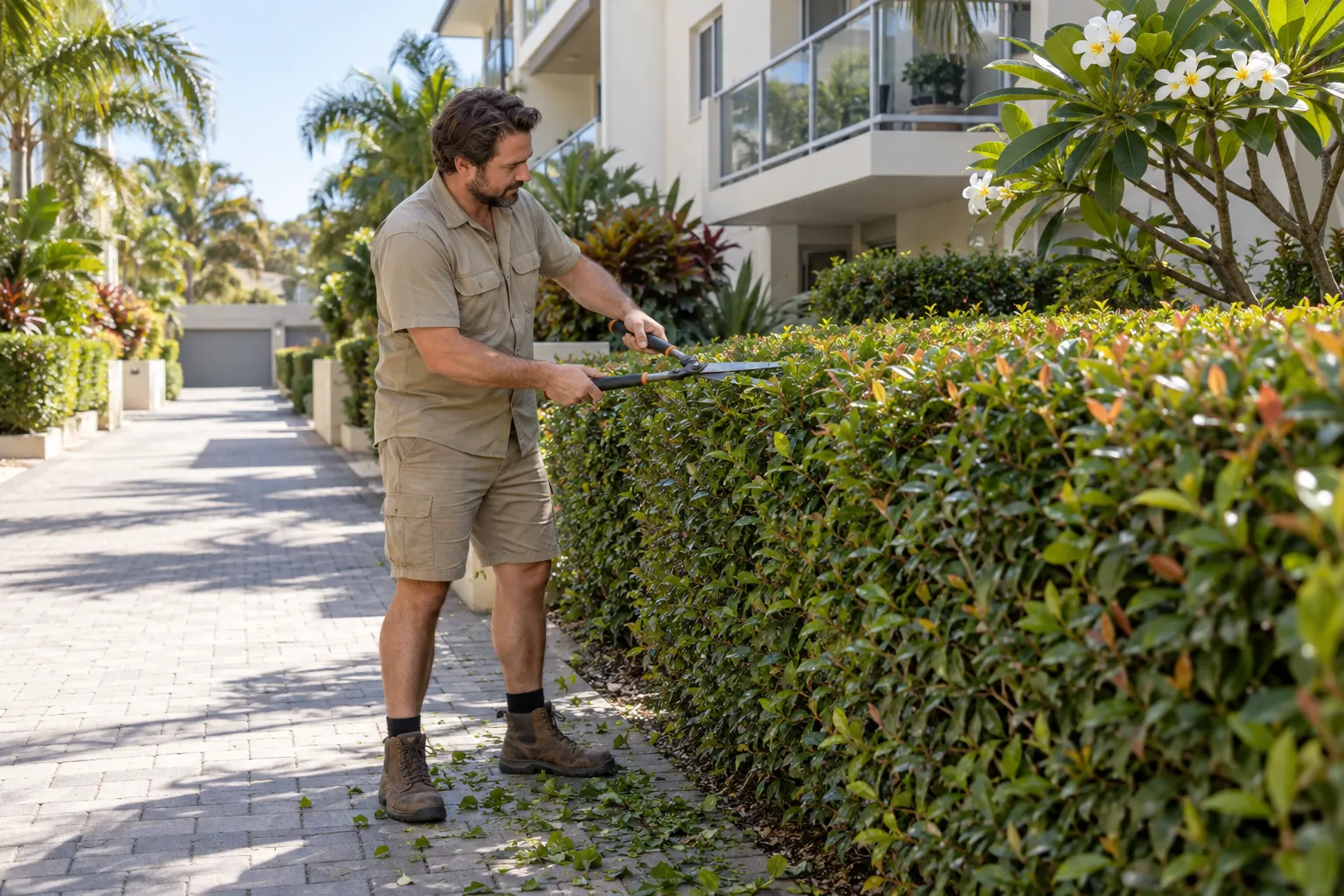
The owners corporation is called a body corporate in Queensland and a strata company in Western Australia, and strata is state law, so the words and the details change at each border. This guide covers what the duty says in New South Wales, Victoria and Queensland, what common property maintenance includes, the long-term plans a scheme needs, who does the work, and what a good record of it looks like.
01
The duty to maintain common property, state by state
Common property is the part of a strata scheme outside the lots: usually the structure, roof, foyers, lifts, car park, shared services and grounds. The owners own it together through the owners corporation, which must keep it in repair. Strata is state and territory law, so the wording and the enforcement differ in each place.
New South Wales. The duty is in section 106 of the Strata Schemes Management Act 2015. NSW Fair Trading's Common Property Repairs and Maintenance Compliance and Enforcement Policy (version 1.0, October 2025) describes it as "a statutory duty on owners corporations and community scheme associations to properly maintain and repair common property". The only way out is a special resolution that maintaining, renewing, replacing or repairing the property is inappropriate, and even then only where the decision "will not affect the safety of any building, structure or common property in the scheme or detract from the appearance of any property in the scheme". An owner who suffers loss from a breach can be awarded damages by the NSW Civil and Administrative Tribunal under section 106(5). The policy also makes a point that matters in newer buildings: even while an owners corporation is pursuing a defect claim against a developer, "it remains legally obligated to maintain and repair common property".
Since the Strata Schemes Legislation Amendment Act 2025, NSW Fair Trading can enforce the duty itself, with compliance notices, penalty notices and enforceable undertakings. The NSW Government's guide to strata repairs and maintenance puts the division simply: "The owners corporation is responsible for maintenance and repair of common property – owners repair anything in their own property."
Victoria. Section 46 of the Owners Corporations Act 2006 (Vic) reads: "An owners corporation must repair and maintain– (a) the common property; and (b) the chattels, fixtures, fittings and services related to the common property or its enjoyment." Section 47 adds that it must also repair and maintain "a service in or relating to a lot that is for the benefit of more than one lot and the common property", such as a shared pipe running through an apartment.
Queensland. Body corporate law applies through the regulation module named in the scheme's community management statement. The Queensland Government's page on maintenance responsibilities in a body corporate summarises the duty: "A body corporate must maintain the common property in a good and structurally sound condition", while "The owner of a lot must maintain their lot in good condition."
The other states and territories have strata or unit titles laws of the same shape. Check the Act, the registered plan and the by-laws where the building is before deciding who is responsible for an item.
02
What common property maintenance covers in practice
Where the boundary between lot and common property falls depends on the strata plan, and it is the first thing to settle in any argument about responsibility for a leak or a crack. The NSW Government's repairs guide gives typical examples: the owners corporation usually repairs the roof and gutters, boundary walls, the concrete slab, balconies, windows and the plumbing in boundary walls and under the floor, while owners usually look after internal walls, carpet in their property, internal painting and the plumbing in internal walls and fixtures. In practice, strata maintenance on a typical apartment or mixed-use building falls into four kinds of work:
- Routine upkeep of the common areas: cleaning of foyers, lift cars, corridors, stairwells and car parks; bin rooms; gardens and irrigation; lighting; window cleaning; pest control. Residents notice this work first, and a caretaker, building manager or cleaning contractor usually does it.
- Essential services: fire detection and alarm systems, sprinklers, hydrants and hose reels, fire doors, exit and emergency lighting, and the smoke control that goes with them; lifts; pumps; ventilation; the shared hot water system where there is one. Most of these are inspected and serviced by licensed or accredited contractors on set frequencies.
- Safety items: pool and spa fencing and gates, window safety devices, balustrades, trip hazards on paths and stairs, car park lighting, access control and gates.
- The building fabric and capital items: roofs and gutters, waterproofing of balconies and podiums, facades and sealants, concrete, painting cycles, the shared electrical, plumbing and drainage services, plant replacement, lifts at the end of their life.
Two distinctions keep the work organised. The Queensland Government notes that "maintaining lots and common property is different to making an improvement", and improvements need their own approvals. And reactive repairs fix what has failed, while planned maintenance stops it failing; the same page says maintenance "can include work that is needed to prevent damage". A scheme that only reacts pays for water damage, call-outs and special levies.
03
The long-term plan: capital works, maintenance plans and funds
Routine maintenance keeps the common property working this year; the capital plan makes sure there is money for the roof, lifts and facade when they wear out, so that a major repair is not an unexpected bill.
New South Wales: the NSW Government's strata repairs and maintenance guide says: "The owners corporation must make a 10-year capital works plan. The plan predicts what major repairs might be needed and forecasts their costs." The strata building repairs health check adds that the plan must be "reviewed at least every five years", that this applies to all schemes except some duplexes, and suggests putting repairs and maintenance on meeting agendas as a matter of course. New and revised plans must be in the standard form.
Victoria: under section 36 of the Owners Corporations Act 2006, a tier one owners corporation (more than 100 occupiable lots) or a tier two owners corporation (51 to 100) must prepare and approve a maintenance plan; smaller ones may. Section 37 says what the plan must set out: "the major capital items anticipated to require repair and replacement within the next 10 years", their present condition or state of repair, when they will need repair or replacement, the estimated cost, and their expected life once repaired or replaced. A lift, an air conditioning plant and a heating plant are named as major capital items. Consumer Affairs Victoria's page on the owners corporation maintenance plan adds that an owners corporation with a plan "must have a maintenance fund to cover the cost of works in the plan" and must report on the plan at each annual general meeting.
Every scheme benefits from a regular walk-round, whether or not the law requires a plan. Consumer Affairs Victoria's guidance on maintenance surveys, inspections and reviews says: "Every year, your owners corporation (formerly body corporate) or its delegate should inspect the common property and must review the maintenance plan." It also suggests that the owners corporation "should also review and report on whether maintenance was effective": whether the work was needed, what it cost, and whether it was done on time.
04
Who does what in strata maintenance
The owners corporation holds the duty, but it acts through people, and most maintenance failures happen in the gaps between them. The NSW Government's guide Who's who in strata sets out the usual cast:
- The owners corporation: all the owners together, holding the duty and deciding the larger questions at general meetings.
- The strata committee: people elected by the owners corporation at each annual general meeting, who handle day-to-day spending "for the day-to-day running of the scheme (e.g. hiring repairers, arranging insurance)", within the limits the Act and the owners corporation set.
- The strata managing agent, usually just called the strata manager: helps with meetings, levies, insurance and records, and advises on asset management; often arranges quotes and contractors for the committee. See strata manager responsibilities.
- The building manager, where the scheme hires one: looks after the building on site, including "maintaining and repairing common property" and access for tradespeople, and must "bring the owners corporation's attention to any maintenance, repair or safety issue with the common property that the manager is aware of". See building manager duties.
- The caretaker, in Queensland schemes under a caretaking agreement, and on-site managers elsewhere: cleaning, gardening, pool and common area upkeep to a duties schedule. See the body corporate caretaker.
- Contractors: cleaners, gardeners, fire services technicians, lift maintainers, trades and pool technicians, each on their own contract.
The size of the job decides who can act on it. The NSW Government's guide to strata repairs and maintenance says "Minor repairs to common property can be managed by the strata committee, strata manager or building manager without the need for a meeting", and that most are paid for from the administrative fund. A major repair may need a strata committee meeting, for example to approve the contractor or costs above a spending limit, and the by-laws may set such a limit.
Several bodies of law apply on top of strata law. The NSW Government's page on safety rules for strata common property says "The owners corporation must make sure that common property is kept safe and working" and must obey window, pool and spa, fire safety and pesticide laws, and that work health and safety laws apply to mixed-use schemes and schemes with direct employees. It also notes that "From 13 February 2026, all apartment buildings in NSW must have their essential fire safety systems inspected and tested regularly under the Australian standard called AS 1851", which is covered in AS 1851 routine service. In Queensland, the government's page on body corporate maintenance under other Acts notes that bodies corporate "have fire safety and maintenance obligations, as occupiers under the Fire Services Act 1990". In Victoria, fire and other safety installations fall under the essential safety measures regime.
Write down who holds each piece of the work, and who tells whom when something is found. A duties schedule that says "common areas" without naming the car park, the bin room or the roof access will leave one of them out.
05
A routine schedule, and what good evidence looks like
No strata Act prescribes a daily or weekly routine; the frequencies come from the scheme's contracts, the manufacturers' and standards' service intervals, and what the building needs. A practical ongoing routine for a mid-sized residential or mixed-use scheme often looks like this:
- Daily or each visit: foyer and lift cars clean; lighting working; bins presented and bin room clean; exits and fire stairs clear; pool gate self-closing and latching.
- Weekly: a full walk of the common property; car park sweep; gardens; fire door closers; roof and plant room access secured.
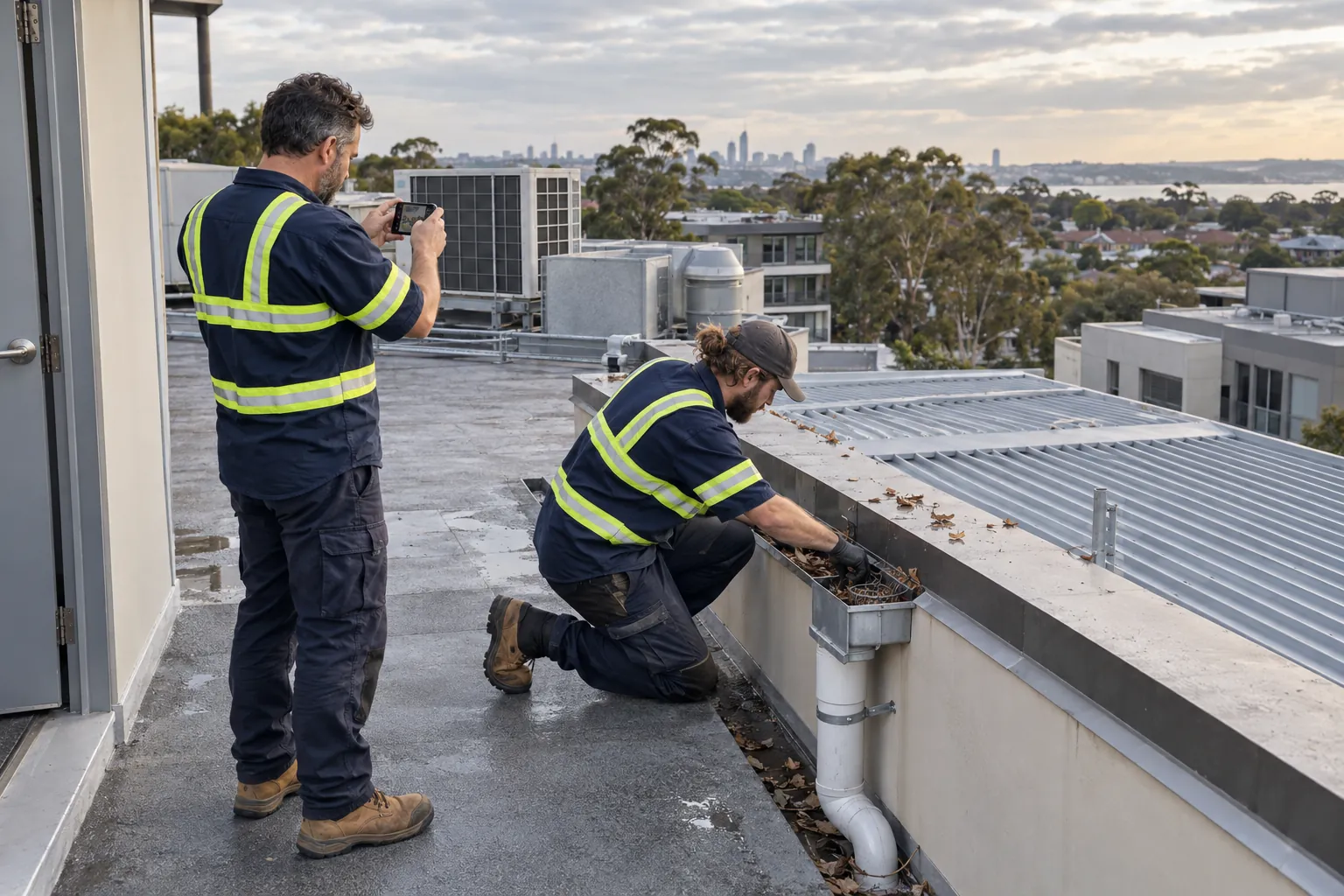
- Monthly or quarterly: gutters and drains; window safety devices; pest control; the contractors' service visits.
- Yearly: the common property inspection and plan review; the fire safety certification the state requires; the report to the annual general meeting.
Good evidence answers the same questions every time: what was checked, where, by whom, when, what was found, and what happened next. For a fault, it shows when it was reported, who was told and when it was fixed. A photograph settles more arguments than a paragraph.
That evidence matters when things go wrong. Under NSW Fair Trading's enforcement policy, an owner with an unresolved common property issue raises it in writing with the committee or strata manager first, then by motion at a general meeting, then through mediation, and only then by complaint. If Fair Trading finds a breach, it will ask the owners corporation for an action plan "outlining proposed actions and timeframes for completion", and the owners corporation "will be expected to provide evidence of progress or completion by agreed timeframes". Fire safety systems, lifts and waterproofing are named as areas where escalated enforcement may be appropriate. Failing to comply with a compliance notice issued to an owners corporation (section 188ZB) carries a maximum court-imposed penalty of $22,000, plus $2,200 for each day the offence continues, or a $2,200 penalty notice.
NSW schemes must also keep their records, and in a particular way. The NSW Government's page on record keeping requirements for strata says most records, including correspondence, meeting papers and signed contracts with strata agents and building managers, must be kept for seven years, and that "From 11 June 2024, records which strata schemes are required to keep must be kept electronically." That applies to records created from that date, so where a maintenance record is one the scheme must keep, it has to be kept electronically; paper copies can be kept as well, but not instead.
06
Where the record fails, and what SiteClara does about it
Most strata schemes have good records of the big things, because contractors certify them. The weak record is the everyday one. The cleaning sheet is signed for the week on Monday. The caretaker's walk-round lives in their head. A resident mentions a broken car park light to whoever is passing, and nobody writes it down. When an owner complains, nobody can say when the light was reported, who knew, or when it was fixed.
SiteClara puts a printed QR poster at each location, such as a lobby, a lift landing, a bin room, a car park level, a pool gate or a plant room door, with an optional NFC tag behind it. The caretaker, the building manager or the cleaning contractor's staff scan it on their own phone, with no app to install, see the scheduled checks due there, and mark them done or explain what stopped them, with a photo when one is asked for. An issue reported at a location goes onto the team's list of open jobs until someone closes it. A supervisor can escalate a job to the building manager, who can answer it.
Each day the supervisor reviews and approves a report of what was reported, completed and still open, and how the scheduled checks went, which goes to the nominated contacts the next morning. Where a cleaning contractor and a gardening or security contractor work in the same building, each runs its own staff, forms and approval.
07
Questions people ask
In a strata building, who is responsible for repairs?
The owners corporation repairs the common property and each owner repairs their own lot. The NSW Government's guide to strata repairs and maintenance lists the owners corporation's items as including the roof and gutters, boundary walls, the concrete slab, balconies and balcony doors, windows and window locks, lights on common property, and plumbing in boundary walls and under the floor; the owner's include internal walls, carpet, internal painting, broken appliances and plumbing in internal walls and fixtures. The same guide says "Different strata schemes will have different areas classified as common property", and that the strata plan and by-laws are where to check who should make a repair.
What is the 10-year maintenance plan for strata in NSW?
It is the 10-year capital works fund plan, which forecasts the major repairs and replacements the common property will need and what they are likely to cost, so the owners corporation can set levies to pay for them. The NSW Government's strata building repairs health check says: "Your strata scheme must have 10-year capital works fund plan which is reviewed at least every five years", and "All new or revised 10-year plans must be in the standard form."
Is strata responsible for gutter cleaning?
In New South Wales, generally yes: the NSW Government's guide to strata repairs and maintenance puts the roof and gutters on the owners corporation's side of the list, so keeping them clear falls to the owners corporation unless the strata plan or by-laws say otherwise. Where a gutter sits on part of a lot, the strata plan decides.
Are shower leaks covered by strata?
It depends on where the water comes from. The NSW Government's guide to strata repairs and maintenance makes the owner responsible for "Plumbing in internal walls and fixtures (such as baths, toilets, sinks and showers)" and for "Water damage coming from inside your property", and the owners corporation for "Plumbing in boundary walls and under the floor" and "Water damage coming from common property". Its own example is a leak from an upstairs neighbour's bathroom running down a wall, which the strata manager arranged to fix because the owners corporation is responsible for plumbing in boundary walls and floors.
08
Where to read more, and a list to take away
The official sources are short and worth reading for the state where the building is:
- New South Wales: the NSW Government's strata repairs and maintenance guide, the strata building repairs health check, safety rules for strata common property and NSW Fair Trading's Common Property Repairs and Maintenance Compliance and Enforcement Policy.
- Victoria: the Owners Corporations Act 2006, sections 36 to 47A, and Consumer Affairs Victoria's pages on the maintenance plan and maintenance surveys, inspections and reviews.
- Queensland: the Queensland Government's pages on maintenance responsibilities and maintenance under other Acts, and the regulation module named in the scheme's community management statement.
A short list for a committee, strata manager or building manager:
- Settle from the strata plan and by-laws which items are common property.
- Keep the long-term plan the state requires in date, and report on it at the annual general meeting.
- Write a routine schedule naming every area, with a frequency and an owner for each.
- Keep fire systems, lifts and pools on their contracted service frequencies, certificates filed.
- Give residents and staff one place to report a fault, and track each one to the fix.
- Walk the common property at least yearly and feed the findings into the plan.
- Keep records as long as the law requires, and be able to show who did each routine check and when.
Sources
Every document this guide quotes or links to, in the order it first cites them.
- Common Property Repairs and Maintenance Compliance and Enforcement Policy nsw.gov.au
- Strata repairs and maintenance nsw.gov.au
- Owners Corporations Act 2006 (Vic) legislation.vic.gov.au
- Maintenance responsibilities in a body corporate qld.gov.au
- Strata building repairs health check nsw.gov.au
- Owners corporation maintenance plan consumer.vic.gov.au
- Maintenance surveys, inspections and reviews consumer.vic.gov.au
- Who's who in strata nsw.gov.au
- Safety rules for strata common property nsw.gov.au
- Body corporate maintenance under other Acts qld.gov.au
- Record keeping requirements nsw.gov.au
Related guides
 Premises and facilities managementStrata manager responsibilities: what the role covers, state by stateWhat a strata manager does in Australia: licensing and registration by state, delegated functions, disclosure, maintenance and safety, contracts and records.
 Premises and facilities managementBuilding manager duties in Australia: the law, the daily work and the recordWhat a building manager does in Australian offices, shopping centres and strata buildings: the WHS duties, strata rules, fire safety upkeep and the records to keep.
 Premises and facilities managementBody corporate caretaker: the duties, the agreement and a record of the workWhat a body corporate caretaker does in Queensland: the caretaking agreement, the code of conduct, safety duties, remedial action notices and a record of the work.
 Premises and facilities managementBuilding maintenance checklist: what to check, how often, and who byA building maintenance checklist for Australian commercial and strata buildings: daily to annual tasks, the WHS and fire safety law behind them, and who does each.