Fire and water checks
Queensland building fire safety: the occupier statement and the duties behind it
In Queensland, the occupier statement is the yearly statement the occupier of a building gives the Queensland Fire Department, within 10 business days of it falling due, about the maintenance of each prescribed fire safety installation in the building.

The occupier also carries the other fire safety duties: keeping exits clear, having the installations maintained by licensed people, keeping a fire and evacuation plan, instructing workers and running an evacuation each year. This guide explains what the Fire Services Act 1990 and the Building Fire Safety Regulation 2008 ask of an occupier, what the occupier statement is, which records sit behind it, and how to keep them honest between the contractor's visits.
01
Who the occupier is, and what the law asks of them
Queensland puts building fire safety on the occupier. Chapter 4A, part 4 (building fire safety) of the Fire Services Act 1990 (Qld) sets the broad duties, and the Building Fire Safety Regulation 2008 (Qld) sets out the detail. This guide reads both as in force on the Queensland legislation site on 28 September 2026.
The Act defines the occupier of premises as "the owner, lessee or person apparently in charge of the premises", or "a person who has the care, management or supervision of the premises or who is conducting a business at the premises". In practice that can be a tenant, an owner who occupies, a body corporate, or a centre manager. The Queensland Fire Department's page for building owners and occupiers says occupiers have "the important legal responsibility of ensuring the safety of anyone in the building in case of a fire or other hazardous material emergency."
Three duties in the Act frame everything else. Section 146L requires the occupier to "maintain at all times free from obstruction adequate means of escape in the event of fire". Section 146M requires the occupier to "maintain at all times every prescribed fire safety installation to a standard of safety and reliability in the event of fire". Section 146O requires a fire and evacuation plan and adequate instructions to prescribed persons, meaning those who work, live or visit in the building for more than a time set by regulation. The top penalties for these duties reach imprisonment where a breach causes death or harm, and sections 146L and 146M are executive liability provisions.
02
The occupier statement: what it is and when it is due
Section 55A of the Regulation requires the occupier of a building to prepare, "at intervals in compliance with QDC, part MP6.1", a statement called an occupier statement about the maintenance of each prescribed fire safety installation for the building. QDC MP 6.1 is the Queensland Development Code's mandatory part on the commissioning and maintenance of fire safety installations. Business Queensland calls it the occupier's statement; it is the same document.
Section 55A then sets two further duties:
- keep a copy of each occupier statement with the record of maintenance for two years after it is prepared; and
- "within 10 business days after the occupier is required to prepare an occupier statement, give the commissioner a copy of the statement."
Business Queensland's page on fire safety installations in buildings describes it as a yearly statement to the Commissioner of the Queensland Fire Department (QFD) that "confirms that the building's fire safety installations have been maintained in accordance with a relevant standard or recommendation." It links the statement form and says a statement can go to the regional QFD office or by email to occupier.statements@fire.qld.gov.au.
Who signs depends on who occupies. Business Queensland puts it plainly: if a tenant occupies the building, the tenant must ensure the installations are maintained; if the owner occupies it, the owner must; and "if there is no occupier, the building owner must sign the statement." For Class 2 and 3 buildings under a body corporate, the body corporate should decide who is authorised to sign on its behalf.
The QFD's Fire Safety Management Tool with Advisory Notes (effective September 2025) adds two practical points. A modified form, with a company heading for example, is acceptable "as long as all of the relevant information is contained". And "any Critical Defect Notices received during the year must be attached to the occupier statement."
03
Maintenance of prescribed fire safety installations, and its record
A prescribed fire safety installation is, in short, one that has at any time been required to be maintained for the building by or under an Act, including as a condition of an approval. Typical examples are the fire detection and alarm system, sprinklers, hydrants, hose reels, extinguishers, exit signs and emergency lighting, and fire and smoke doors. The building's approval documents and the fire services contractor's asset list say which a particular building has.
Section 54 of the Regulation gives the occupier three maintenance duties:
- maintenance must be "carried out by an appropriately qualified person", which the Regulation defines by reference to licence classes, so the individual doing the work needs the licence for that type of installation;
- each installation must be "inspected and tested at intervals in compliance with QDC, part MP6.1"; and
- where the record of maintenance shows a repair or other corrective action is needed, it must be done "no later than 1 month after the maintenance of the installation was carried out, unless the occupier has a reasonable excuse". The Regulation's examples of a reasonable excuse are a remote building with no qualified person able to attend, and work too complex or parts too slow to finish in time.
If a technician finds a critical defect, one likely to render the installation inoperable and reasonably likely to have a significant adverse impact on occupants' safety in a fire or hazardous materials emergency (section 49), section 53 requires them to give the occupier a critical defect notice in the approved form within 24 hours after the maintenance. The Regulation's own example of a defect that is not critical is one making only one of several standard extinguishers in part of a building inoperable.
Section 55 sets what the record of maintenance must state for each installation: a description of it; the name and licence number of the person who did the work, or who personally supervised it; the date; a brief description of the work; that it was done in compliance with QDC MP 6.1; and the results, including "whether or not the person carrying out the maintenance considered the installation was in proper working order", any repair or corrective action needed, and the details and date of any repair made. The record must carry a signed statement from the person who did the maintenance certifying it is correct, and any critical defect notice.
The QFD's advisory notes are blunt about what does not count: "The maintenance tag, invoice or summary report are not acceptable as a record of maintenance". They also say that fire doors in Class 5, 6, 9a and 9c buildings (offices, shops, health care and aged care) must be inspected at six-monthly intervals and fire doors in all other buildings annually, and that a fire detection and alarm system needs a log book recording monthly inspections. Many contractors also work to AS 1851; ask yours how their routine service lines up with MP 6.1.
04
Exits, the fire and evacuation plan, instructions and the yearly evacuation
Most of an occupier's duties are about people rather than equipment, and most of them carry their own record.
- Keep evacuation routes clear. Section 8 says the occupier "must not allow a thing to be placed or to remain" within 2 metres of a final exit outside the building, or anywhere on an evacuation route where it would be likely to unduly restrict, hinder or delay people, and must take reasonable steps to stop people obstructing a route. Section 11 bars locking a door on an evacuation route while people are inside. The QFD's notes add that fire and smoke doors "are not to be 'chocked' or held open" unless held by a device linked to the fire alarm.
- A fire and evacuation plan. Section 21 sets what it contains, including the evacuation coordination procedures, instructions for evacuating safely and the evacuation diagram. Section 27 requires the plan to be changed within a month of a relevant change, and section 28 requires a review "at intervals of not more than 1 year", with a written record. In a building with several occupiers, the managing entity's plan and each tenant's plan must fit together. The QFD publishes plan templates on its forms and templates page.
- General evacuation instructions to everyone working in the building at least yearly, and to a new starter no later than two days after they start (section 35).
- First-response evacuation instructions, on using the manual alarms and firefighting equipment, at least every two years and within a month of starting (section 36). In a high occupancy building a registered training organisation must give them, or the fire safety adviser must give or arrange them (section 37).
- Evacuation coordination instructions to the people who run an evacuation, at least yearly and when procedures or people change (sections 38 to 40).
- An evacuation carried out "by an appropriate number of persons", "in an appropriate way" and "at intervals of not more than 1 year" (section 44). Our guide to the evacuation drill covers how to run one.
A high occupancy building must also have a fire safety adviser holding a building fire safety qualification issued within the last three years (section 34). The definition includes a Class 2 or 3 building more than 25 metres high, and a workplace in the listed building classes and industries where 30 or more workers are normally employed.
Everyone working in the building also sits under workplace law. Section 43 of the Work Health and Safety Regulation 2011 (Qld) requires each person conducting a business or undertaking at a workplace to have an emergency plan covering evacuation procedures, testing of the procedures and training for workers. A tenant's WHS emergency plan and the occupier's fire and evacuation plan should say the same thing.
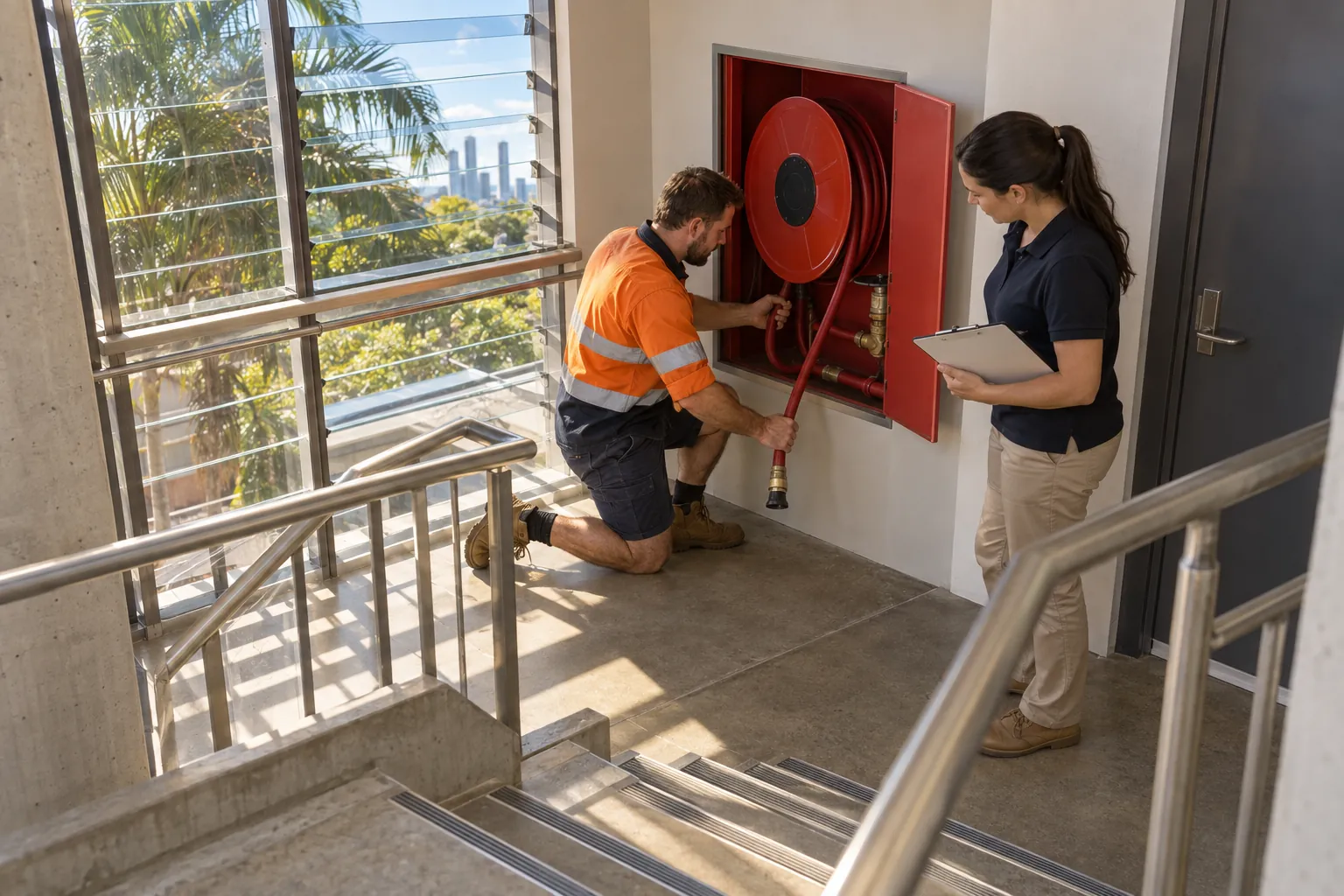
05
The records to keep, where, and for how long
The Regulation names four prescribed documents: a record of a review of the fire and evacuation plan, a fire and evacuation instruction record, an evacuation practice record, and a record of maintenance. With the occupier statements, they are what the QFD will ask to see.
- Fire and evacuation instruction record (section 45): for each occasion, the name of each person instructed, the name of the person who instructed them, the date, and a brief description of the instructions.
- Evacuation practice record (section 46): the date, the times the evacuation started and ended, and any action to be taken as a result, such as reviewing the plan or giving more instructions.
- Record of maintenance (section 55), as described above, with any critical defect notices.
- Record of the plan's yearly review (section 28).
- Occupier statements (section 55A), kept with the record of maintenance for two years.
Section 71 requires a copy of the plan and each prescribed document to be kept both "in the building" and "in a secure place in other premises", and allows electronic copies if the information is readily accessible where it is kept. Section 72 requires each prescribed document to be kept for at least two years after it was made, or for a document with many entries, two years after the last entry. When an occupier leaves during that time, they must hand the documents to the new occupier within a month.
The QFD's advisory notes say records may be kept electronically if they are available for inspection, with one exception: "logbooks required by an Australian Standard for the maintenance of fire safety installations". For the second copy kept elsewhere, the notes say copies of maintenance records can be retained by the fire contractor, while other records are to be kept by the occupier; a copy must still be kept in the building.
Good evidence answers four questions without anyone having to remember: which item or place, who, when, and what was found. A record that answers those, entry by entry, is one a fire officer can read and one the person signing the occupier statement can rely on.
06
Where the record fails
Queensland buildings rarely fail on the contractor's six-monthly visit. They fail in the months between. A fire door is chocked open with a bin for a delivery and stays that way. Stock builds up within two metres of a final exit because nobody walks that side of the building after lunch. A new cleaner starts on Monday and the general evacuation instructions, due within two days, never happen because the supervisor was off. A critical defect notice arrives by email, the repair slips past the month, and nobody notices until the occupier statement is being signed.
SiteClara is built for that everyday part. A tag at each final exit, fire door, hose reel, extinguisher point or stair lets the person doing the round scan it with their phone and confirm the check, with a photograph when one is asked for, so the record shows which point was checked, by whom and when. A check that was due and not done shows as not done rather than disappearing. A fault reported at the tag, a chocked door or a blocked exit, goes to the team responsible for it, and a daily report tells the building or centre manager what was checked and what is still open. That gives the person signing the occupier statement a working record to read first.
SiteClara is not a fire services contractor or a fire safety adviser, and it does not inspect, test or maintain any prescribed fire safety installation. It does not prepare, sign or lodge the occupier statement, and it is not the record of maintenance, the fire and evacuation plan, the instruction record, the evacuation practice record or a log book required by an Australian Standard. It does not decide whether an installation is in proper working order. It is not a CAFM system, and it does not do rostering or time and attendance. Where the Regulation requires a particular record, SiteClara is the working record of the checks made between services, not the statutory one.
07
Questions people ask
What is an occupier's statement in Queensland?
It is the occupier's statement to the Commissioner of the Queensland Fire Department about the maintenance of each prescribed fire safety installation for the building. Section 55A of the Building Fire Safety Regulation 2008 (Qld) requires the occupier to prepare it at the intervals QDC MP 6.1 sets, keep a copy with the record of maintenance for two years, and give the commissioner a copy within 10 business days after it is due, with a maximum penalty of 20 penalty units. Business Queensland's page on fire safety installations in buildings describes it as a yearly statement and links the form.
Who is responsible for fire compliance in Queensland?
The occupier. The Queensland Fire Department's Fire Safety Management Tool with Advisory Notes says an owner, lessee or body corporate "involved in occupying, leasing, or managing a building in Queensland" is an occupier under the Fire Services Act 1990, with "the important legal responsibility of ensuring the safety of anyone in the building in case of a fire". Business Queensland's page on fire safety installations in buildings adds that a tenant who occupies the building must ensure the fire safety installations are maintained, an owner who occupies it must do the same, and where there is no occupier the owner signs the occupier statement.
What are the new smoke alarm laws in Queensland for 2027?
They concern homes rather than the occupier statement. The Queensland Fire Department's Smoke alarms page says "All existing private homes, townhouses, units and manufactured homes require interconnected photoelectric smoke alarms by 1 January 2027." The alarms must comply with AS 3786-2014, be interconnected so they all go off together, be hardwired with a backup power source or run on a 10-year non-removable battery, and be fitted on each storey, in each bedroom and in hallways that connect bedrooms to the rest of the dwelling.
08
Where to read more, and a list to take away
The primary sources are the ones to rely on:
- Building Fire Safety Regulation 2008 (Qld): sections 7 to 11 (evacuation routes), 21 to 28 (the plan), 34 to 46 (adviser, instructions, practice and their records), 53 to 55A (maintenance, records and the occupier statement), 71 and 72 (keeping documents).
- Fire Services Act 1990 (Qld): sections 146L, 146M and 146O.
- Fire safety installations in buildings, Business Queensland, with links to QDC MP 6.1 and the occupier's statement form.
- Fire Safety Management Tool with Advisory Notes, Queensland Fire Department, a self-check for occupiers, owners, lessees and bodies corporate.
- Forms and templates, Queensland Fire Department: plan templates, the evacuation instruction record and the critical defect notice.
- Work Health and Safety Regulation 2011 (Qld): section 43, emergency plans.
A list to take away:
- Settle who the occupier is for each part of the building, and who signs the occupier statement.
- List the prescribed fire safety installations, and check the maintenance contract covers each at MP 6.1 intervals by licensed people.
- Put the occupier statement date, and the 10 business days after it, in the diary.
- Make sure every repair shown on a record of maintenance is done within a month, and chase critical defect notices the same day.
- Walk exits, final exits and fire doors between services, and record what you find.
- Give general evacuation instructions within two days of anyone starting, and keep the instruction record.
- Review the fire and evacuation plan and run an evacuation at least yearly, and record both.
- Keep every prescribed document for two years, in the building and somewhere else, and read them before the statement is signed.
Sources
Every document this guide quotes or links to, in the order it first cites them.
- Fire Services Act 1990 (Qld) legislation.qld.gov.au
- Building Fire Safety Regulation 2008 (Qld) legislation.qld.gov.au
- Building owners and occupiers fire.qld.gov.au
- Fire safety installations in buildings business.qld.gov.au
- Fire Safety Management Tool with Advisory Notes fire.qld.gov.au
- Forms and templates fire.qld.gov.au
- Work Health and Safety Regulation 2011 (Qld) legislation.qld.gov.au
- Smoke alarms fire.qld.gov.au
Related guides
 Fire and water checksAS 1851 routine service: what it asks of owners, fire contractors and building teamsWhat AS 1851-2012 routine service covers, how intervals and competent persons work, what the records must show, and how Victoria's regulations call it up.
 Fire and water checksFire drills and evacuation drills in Australia: the duty, the drill and the recordRunning a fire drill or evacuation drill in an Australian workplace: the WHS duty, Queensland's yearly rule, planning the exercise, the debrief and the record.
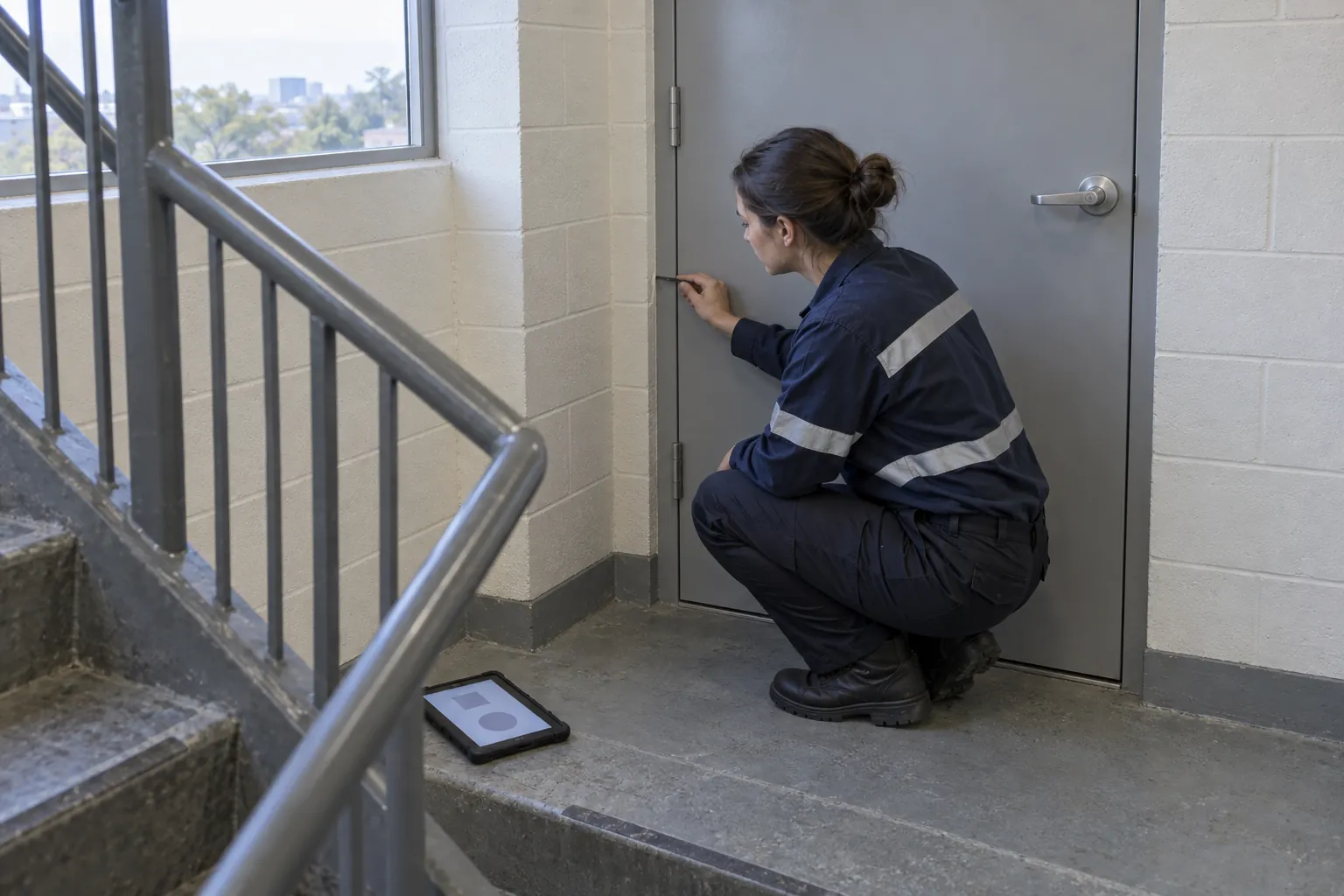 Fire and water checksFire door inspection: what the inspector checks, and what the owner keepsFire door inspection in Australia: what AS 1905.1 and the NCC require of a fire door, how AS 1851 and state law set the checks, who may inspect, and the records.
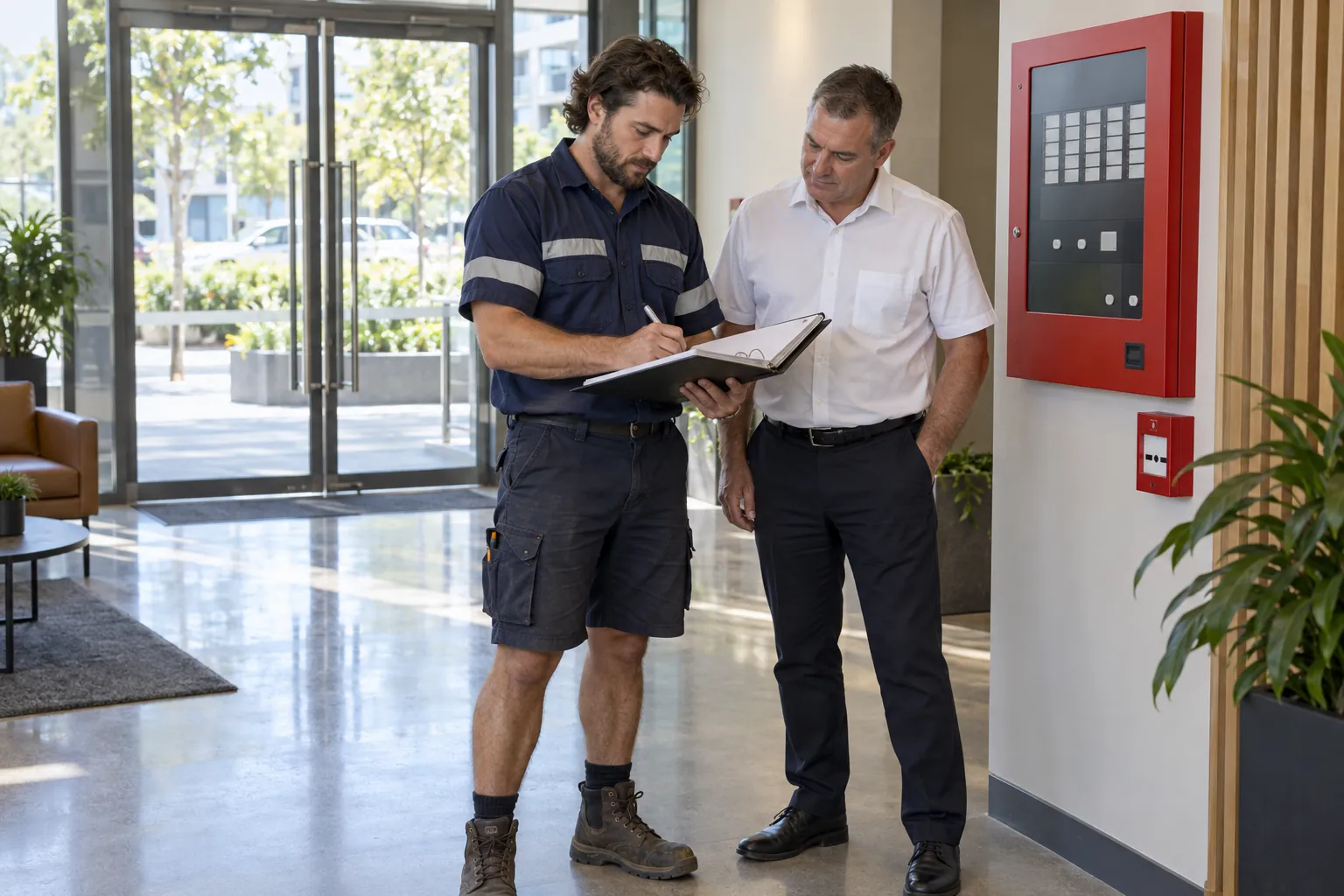 Fire and water checksFire safety logbook: what to record, who keeps it and for how longWhat a fire safety logbook should hold in Australia: AS 1851 service records, Victoria's ESM records, the NSW fire safety statement and Queensland's rules.