Cleaning
Childcare cleaning checklist: what an Australian service cleans, how often, and how to show it was done
Childcare cleaning in Australia means keeping a childcare centre's premises, furniture, equipment and toys safe, clean and in good repair, as regulation 103 of the National Regulations requires: in practice, detergent and water every day, and more often in the nappy change area, the bathrooms and the kitchen.
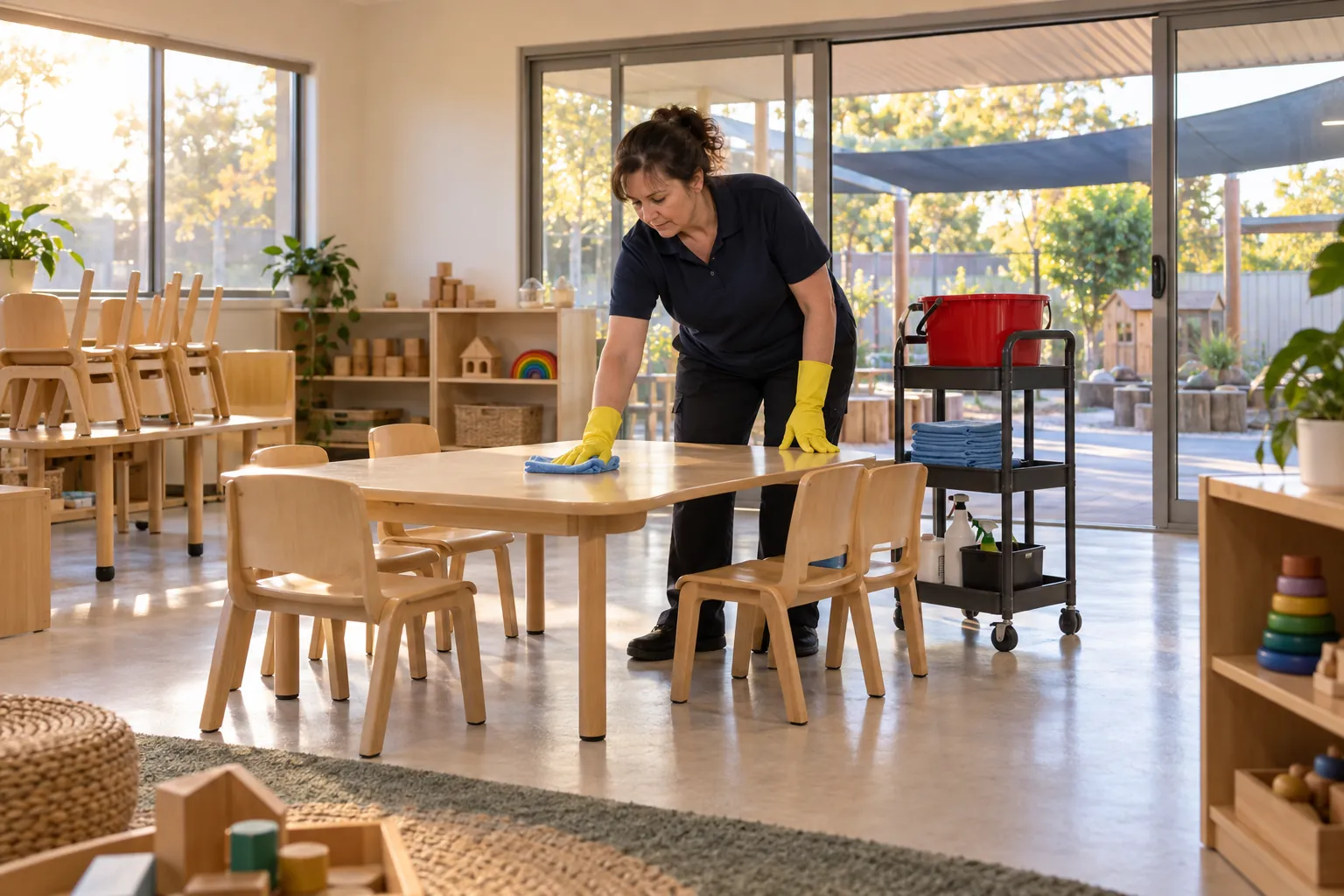
It is not ordinary office cleaning with smaller furniture: young children share toys, put things in their mouths and need nappies changed, so germs move quickly. The NHMRC's Staying healthy guidelines set out how to get there. This guide turns both into a working checklist, and covers who does what when educators and a contract cleaner share the job.
01
What the National Regulations and Staying healthy ask
Long day care and early learning centres, preschools and kindergartens, family day care and outside school hours care are regulated under the National Quality Framework: the Education and Care Services National Law as applied in each state and territory, and the Education and Care Services National Regulations. Several regulations bear directly on cleaning:
- Regulation 77 requires the approved provider to ensure that the nominated supervisor, staff members and volunteers implement "adequate health and hygiene practices" and safe food handling "to minimise risks to children". The nominated supervisor carries the same duty, and so does a family day care educator.
- Regulation 103 requires the approved provider to ensure that the premises "and all equipment and furniture used in providing the education and care service are safe, clean and in good repair".
- Regulation 106 requires laundry facilities, or other arrangements for soiled clothing, nappies and linen, that are adequate and appropriate, and located and maintained in a way that does not pose a risk to children.
- Regulation 112 requires a centre-based service with children in nappies to provide adequate and appropriate hygienic facilities for nappy changing.
- Regulations 168 to 171 require written policies and procedures on health and safety and on dealing with infectious diseases, require staff to follow them, and require them to be available for inspection.
The National Quality Standard, Quality Area 3 repeats the outcome in element 3.1.2, Upkeep: "Premises, furniture and equipment are safe, clean and well maintained." Quality Area 2 adds element 2.1.2, that "effective illness and injury management and hygiene practices are promoted and implemented".
Neither the law nor the standard says how often to mop a floor. That detail comes from the National Health and Medical Research Council's Staying healthy: Preventing infectious diseases in early childhood education and care services, 6th edition, published in 2024. NHMRC describes it as a best-practice resource aligned with the National Law and Regulations, and its key recommendations include that "routine environmental cleaning should be done daily and when surfaces are visibly dirty", and that cleaning with specific products should follow any spill of body fluids. Many services write their cleaning policy from it, and state health departments point to it; Queensland Health, for one, lists it among its resources for education and care services.
Check the current version of the Regulations for your state or territory before you rely on a regulation number or a penalty. And remember that the service is also a workplace: the work health and safety laws of the state or territory apply to the cleaning itself, and in Victoria that is the Occupational Health and Safety Act 2004 rather than the model WHS Act.
02
What a childcare cleaning checklist covers
A useful checklist helps the team maintain a clean environment for children and is organised by area, because that is how the work is done and how an assessor walks the service. Staying healthy picks out the places germs gather: horizontal surfaces, where droplets from coughs and sneezes land; frequently touched surfaces such as door handles, light switches and toys; and the wet areas, meaning the kitchen, the bathrooms and the nappy change area, where many germs thrive. A checklist for a centre-based service usually runs like this:
- Playrooms: tables, benchtops, low shelves, door handles and light switches; toys, especially those children put in their mouths; books; soft furnishings and cushion covers; floors, with carpets and mats vacuumed.
- Bathrooms and toilets: toilets, tap handles, basins, doorknobs and floors, with a check during the day as well as the full clean.
- Nappy change area: the change surface after every change and at the end of the day, change mats swapped during the day, the bin, and the hand basin beside it.
- Sleep and rest rooms: cots, stretchers, mattress covers and linen.
- Kitchen and eating areas: food preparation surfaces, eating tables before and after meals, crockery and cutlery after every use, tea towels daily. Food safety has its own rules and the service's food safety plan governs this area.
- Laundry: linen, towels, cloths, mop heads and dress-up clothes, and the storage for soiled items before they are washed.
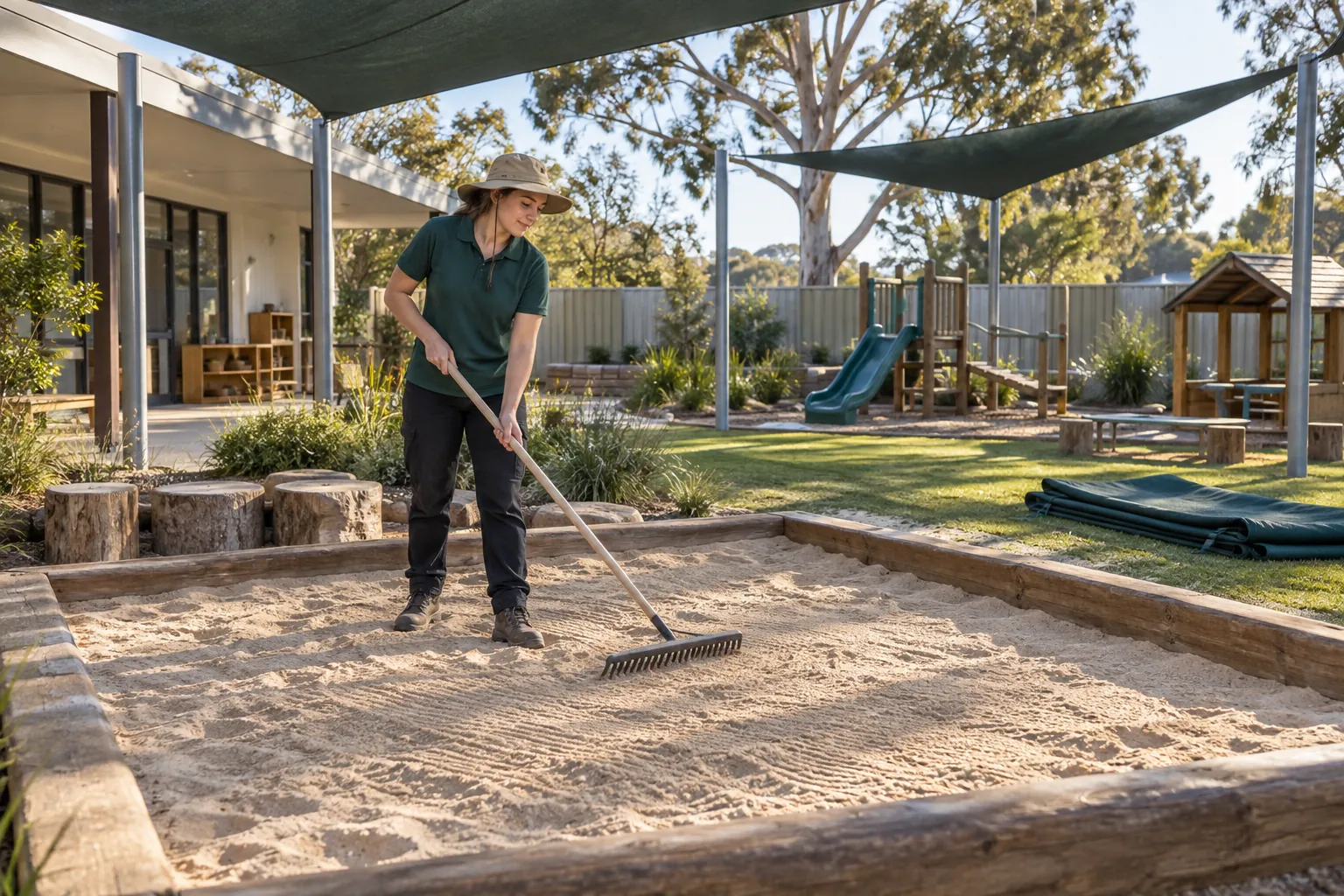
- Outdoor areas: plastic and metal equipment that is touched often, the sandpit, and any standing water.
- Cleaning equipment itself: buckets, cloths, mops and gloves cleaned and stored so they dry; the spill kit complete; chemicals stored away from children.
Family day care and outside school hours care use the same principles on a different scale. An OSHC service in a school hall may share the space with the school's own cleaner, which makes it more important to agree who cleans what.
03
How often: daily, weekly and after every use
Staying healthy's Table 3.1 sets a frequency for each surface: daily, weekly or regularly, and always again when visibly dirty or contaminated. It also says that if a separate organisation provides or supervises your cleaning, you should tell its cleaning staff about those requirements. The frequencies stated in the text are the backbone of a schedule:
- After every use: the nappy change surface after each change; crockery, cutlery and serving utensils after every use.
- Immediately: any spill of blood, vomit, urine, faeces or other body fluid, cleaned and then disinfected.
- During the day: bathrooms checked and cleaned if visibly dirty; toys removed to a "toys to wash" box if a child sneezes on one, puts it in their mouth or is unwell.
- Daily: horizontal and frequently touched surfaces at least once a day; kitchens, bathrooms, toilets and nappy change areas at least once a day; toys washed at the end of every day; carpets and mats vacuumed; the sandpit raked; tea towels and most sheets and towels washed; fresh detergent solution made up.
- Monthly: the sandpit dug deeply at least once a month to dry it out and expose it to sunlight.
- Every six months: carpets and mats steam cleaned at least every six months, and curtains washed every six months, or sooner when visibly dirty.
- In an outbreak: more than routine cleaning, on the advice of your local public health unit. Staying healthy says that with two or more cases of gastroenteritis you should refer to your state or territory's outbreak guidelines or contact the public health unit.
Timing matters too. Staying healthy suggests finishing vacuuming before children come into a room, unless the vacuum has a HEPA filter, so the dust settles. The checklist should also say which tasks belong to educators in session and which to the cleaner after close, so nothing is left because each side thought the other had it.
04
Doing it properly: detergent first, disinfectant when it counts
Staying healthy is clear that routine cleaning with detergent and water, followed by rinsing and drying, is the best way to remove germs from hard surfaces. Detergent loosens the germs, scrubbing removes them, rinsing takes away the residue, and drying makes it harder for what is left to survive. A disinfectant is not needed for routine cleaning; it is for body fluid spills and outbreaks, and it only works on a surface that has already been cleaned. The practical points a checklist should carry:
- Make up detergent solution fresh every day in a clean, dry container labelled with the time and date of mixing and the detergent used. Do not top it up with water during the day.
- Spray heavily and rub. A fine mist wiped straight off is not enough to dislodge germs.
- Work from the cleanest areas to the dirtiest, so a clean room is not contaminated from a dirty one.
- Colour-code cloths by area. Staying healthy gives an example: red for the bathroom, green for the kitchen, blue for general areas and yellow for infectious spills.
- Do not use vinegar or bicarbonate of soda as cleaning products or disinfectants; use products labelled and intended for cleaning, at the right dilution.
- Handle bleach with care. Make up a fresh batch each time, following the manufacturer's instructions and never with hot water. Never put it in a spray bottle or mix it with other chemicals, and wear gloves and eye protection.
- Launder hot. Linen, cloths and mop heads in a hot wash (60 °C) and dried completely, in the sun or on a hot dryer setting.
- Keep a spill kit: disposable and utility gloves, paper towel, disposable cloths, a disposable scraper and pan, detergent and disinfectant, with an absorbent for large spills.
The spill procedure itself is short and worth printing beside the kit: put a safety sign by the spill to keep people away, put on disposable gloves, remove the spill, bag and bin the waste, take off the gloves and wash hands, then put on utility gloves, clean with detergent and warm water, dry, wipe with disinfectant and let it dry, and wash hands again.
The chemicals are a work health and safety matter too. Under the model WHS Regulations a business must keep current safety data sheets readily accessible to workers who use a hazardous chemical, and keep a register of hazardous chemicals at the workplace. The Code of Practice: Managing risks of hazardous chemicals in the workplace notes that a consumer chemical used for its usual purpose does not need an SDS, but that supermarket cleaning products used in a way or quantity not consistent with home use may present greater risks and should have one. It gives the example of chlorine bleach, which can release harmful chlorine gas if mixed with incompatible chemicals. In Victoria, WorkSafe's Compliance code: Hazardous substances covers the same ground.
05
Educators, contract cleaners and the approved provider
The legal duty under regulation 103 sits with the approved provider, whoever holds the mop. Staying healthy frames infection control as a shared responsibility: service leaders set clear policies, make them accessible, monitor and audit compliance, and give staff time to learn; educators and other staff follow them and take part in reviewing them. It names cleaners among the contractors who should know the service's health and safety policies.
In practice there are usually three parties:
- The approved provider and nominated supervisor own the cleaning policy and the schedule, decide what educators do in session and what the cleaner does after close, and check that both happen.
- Educators do the cleaning that cannot wait: nappy change surfaces, meal tables, spills, the toys box and the bathroom checks during the day.
- The commercial cleaning contractor, where there is one, does the full clean to a specification agreed in the cleaning contract. Staying healthy suggests keeping your own cleaning equipment and products on hand, so the service keeps its own supplies, even if an external provider usually cleans.
When a contractor cleans, two businesses have duties for the same work. The hazardous chemicals code puts it plainly: section 46 of the WHS Act requires a business to consult, cooperate and coordinate with every other person who has a duty in relation to the same matter, so far as is reasonably practicable, and each should exchange information to find out who is doing what. For a childcare service that means the contractor's staff know the Table 3.1 frequencies, the colour code and the spill procedure; the service knows which chemicals the contractor brings in and where they are stored; and nobody leaves a bucket, trolley or product within reach of children.
Checking is part of the duty. A walk-through at opening catches most problems before children arrive, and a weekly check of the cleaner's work against the specification gives both sides something firmer than complaints to discuss.
06
Where the cleaning record fails
Most services have a cleaning checklist. The failure is usually in the record of whether it happened. The sheet on the bathroom door is initialled at the end of the week for every day. The evening cleaner's tick box says "toys washed" when the toys box was never emptied. Educators and the cleaner each assume the other did the cots. A broken change table strap is mentioned to whoever was on shift and nobody writes it down. When an assessor or a parent asks how you know the nappy change area was cleaned, the honest answer is often that someone said so.
SiteClara is built for that gap. A printed QR poster, with an optional NFC tag behind it, goes at each place where a check is scheduled: the nappy change area, each bathroom, the kitchen, the sleep room, the sandpit. The educator or cleaner scans or taps with their own phone, with no app to install, and marks the scheduled check done, with a photo when the check asks for one, or says what stopped it. A problem can be reported from the same tag and stays on the team's list of open jobs until someone closes it. A check nobody did shows as missed the next morning, not at the next assessment. The supervisor sees the day's checks and open jobs, and approves a daily report for the service's management.
In a childcare service a photo should show the surface or the equipment, never a child. Set up any check that asks for a photo with that rule, and say so in the service's policy.
07
Questions people ask
What cleaner do daycares use?
For everyday cleaning, detergent and warm water; a disinfectant is for body fluid spills and outbreaks, on a surface that has already been cleaned. Queensland Health's Viral or suspected viral gastroenteritis: information for directors and staff of early childhood education and care services (April 2025) says that in an outbreak surfaces "should be cleaned thoroughly with a mixture of detergent and warm water and dried before applying a bleach-based disinfectant", and that Staying healthy recommends household bleach "at 1000 ppm (0.1%)", with at least 10 minutes' contact time, made up just before use and never applied from a spray bottle.
What are the recommended cleaning procedures for childcare?
Clean first, with detergent and warm water, rinse and dry, and disinfect only where a spill or an outbreak calls for it. The same Queensland Health document, Viral or suspected viral gastroenteritis: information for directors and staff of early childhood education and care services, written in line with Staying healthy, adds the practical detail: spray a surface "heavily and rub it vigorously", because a fine mist wiped dry "is not enough to dislodge germs"; use single-use disposable cloths in an outbreak; and during one, clean frequently touched surfaces such as door handles, cot rails, light switches, taps, tables, chairs and toys an extra twice a day. For the routine schedule, Staying healthy's Table 3.1 shows how often to clean various surfaces and areas.
08
Where to read the official guidance, and a short checklist
Read Part 3, A healthy environment, of the NHMRC's Staying healthy guidelines, including Table 3.1, and regulations 77, 103, 106, 112 and 168 of the Education and Care Services National Regulations in the current version for your jurisdiction. For outbreaks and body fluid spills, your state health department's guidance applies, for example Queensland Health's Disease prevention in education and care services. For chemicals, read the hazardous chemicals code of practice your state has approved, or WorkSafe Victoria's compliance code.
A short list to take away:
- Write the cleaning schedule by area, from Staying healthy's Table 3.1 and section 3.2, with daily, weekly, monthly and six-monthly tasks.
- Split it between in-session tasks for educators and the after-hours clean, and name who owns each list.
- Clean with detergent and water, rinse and dry; keep disinfectant for spills and outbreaks.
- Make up detergent solution fresh each day, labelled, and colour-code cloths by area.
- Keep a stocked spill kit and print the spill procedure beside it.
- Keep safety data sheets and a chemicals register, and store every product away from children.
- Give a cleaning contractor the frequencies, the colour code and the spill procedure, and agree in writing who cleans what.
- Check the work at opening each day and against the specification each week, and keep the record where management can see it.
Sources
Every document this guide quotes or links to, in the order it first cites them.
- Education and Care Services National Regulations legislation.nsw.gov.au
- National Quality Standard, Quality Area 3 acecqa.gov.au
- Quality Area 2 acecqa.gov.au
- Staying healthy: Preventing infectious diseases in early childhood education and care services nhmrc.gov.au
- Occupational Health and Safety Act 2004 legislation.vic.gov.au
- Managing risks of hazardous chemicals in the workplace safework.nsw.gov.au
- Compliance code: Hazardous substances worksafe.vic.gov.au
- Viral or suspected viral gastroenteritis: information for directors and staff of early childhood education and care services health.qld.gov.au
- Disease prevention in education and care services health.qld.gov.au
Related guides
 CleaningToilet cleaning checklist: what to check, how often, and how to make the record believableWhat a toilet cleaning checklist should cover in Australian workplaces, how often to check, the WHS and OHS duties behind it, and how to make the record believable.
 CleaningCleaning log sheet: what to record, who signs it, and what a signature provesWhat a cleaning log sheet should record in Australian workplaces and food businesses, the WHS and food safety rules behind it, and what a signature proves.
 CleaningCleaning contracts in Australia: what to put in them, and how to know they are workingWhat an Australian commercial cleaning contract should cover, how the Cleaning Services Award and Fair Work Act shape it, and how to show the work was done.
 CleaningCommercial cleaning checklist: area by area, and how to know it is followedA commercial cleaning checklist for Australian offices and shared buildings, area by area, with the WHS duties behind it and how a supervisor checks it is followed.