Cleaning
Toilet cleaning checklist: what to check, how often, and how to make the record believable
A toilet cleaning checklist records, for each named toilet, when it was checked or cleaned and by whom, whether the pans, urinals, basins, floors, soap, toilet paper, hand drying, bins and sanitary disposal were in order, and any fault found and who it was reported to.
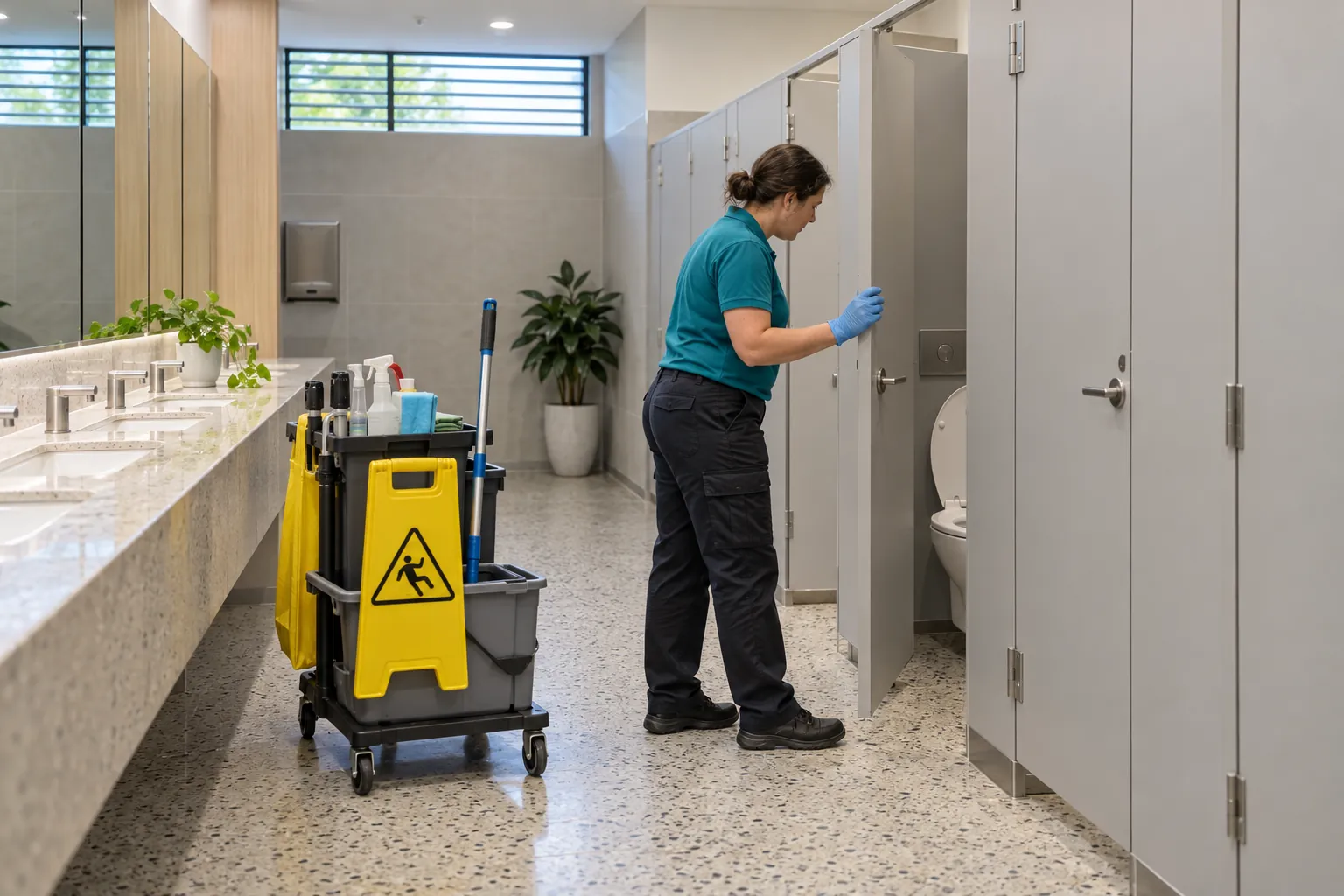
The sheet on the back of the amenities door is the cleaning record most people in a building ever see, and often the one they trust least. This guide covers the WHS and OHS duties behind it, what each check and each clean should cover, how often toilets need attention, and what makes the record stand up when a tenant, client or inspector asks about it.
01
The duty behind a toilet cleaning checklist
No Australian law says a checklist must hang on a toilet door. What the law requires is clean, working toilets, and the checklist is how the people responsible show, day by day, that they are getting there.
In every state and territory except Victoria, the duty comes from a Work Health and Safety Act based on the national model law. Queensland's Work Health and Safety Act 2011 is typical. Section 19(3)(e) requires a person conducting a business or undertaking (a PCBU) to ensure, so far as is reasonably practicable, "the provision of adequate facilities for the welfare at work of workers in carrying out work for the business or undertaking, including ensuring access to those facilities". Section 19(3)(g) adds that the health of workers and the conditions at the workplace are to be monitored.
The regulations are more specific. Regulation 41 of the model regulations, as made in Queensland's Work Health and Safety Regulation 2011, requires adequate facilities for workers, "including toilets, drinking water, washing facilities and eating facilities", and requires that they are maintained so as to be "in good working order" and "clean, safe and accessible". In deciding what is adequate, the PCBU must have regard to the nature of the work and its hazards, the size, location and nature of the workplace, and the number and composition of the workers.
Safe Work Australia's model code of practice, Managing the work environment and facilities, explains how to meet those duties, and each state that has adopted the model law has approved it in its own name. SafeWork NSW's version, Code of Practice: Managing the work environment and facilities (August 2019), says plainly: "Access to clean toilets must be provided for all workers while they are at work." It also says that facilities "should be cleaned regularly", and that consumable items, "including soap and toilet paper, should be replenished regularly".
Victoria keeps its own Occupational Health and Safety Act 2004. Section 21(2)(d) requires an employer to provide, so far as is reasonably practicable, adequate facilities for the welfare of employees at any workplace under its management and control, and WorkSafe Victoria's compliance code, Workplace facilities and the working environment (December 2023), says that "All employees need to have access to clean and hygienic toilet facilities at all times while at work, so far as is reasonably practicable."
02
What a toilet cleaning checklist should cover
A useful checklist records two things: that someone attended, and what they found and did. A column of ticks records only the first. Build the list from what the codes say a toilet needs, and name the room precisely: "Level 4 amenities, west core, female", not "toilets".
- Date, time and name. The actual time the check was done, and a name or initials that identify one person, not the company.
- Pans, seats and urinals. Clean inside and out, flushing properly, seats and lids secure, no blockages. The high-touch surfaces, such as the seat, the flush button or handle, and the cubicle lock and door handle, wiped with the disinfectant or toilet cleaner the contract specifies. The NSW code says toilets should be fitted with a hinged seat and lid.
- Cubicle doors and locks. Each door locking from the inside, as both codes describe, and nothing broken that stops a cubicle being used.
- Basins, taps and mirrors. Clean, draining, with hot and cold water or a mixer working. The NSW code expects hand washing facilities with "both hot and cold water taps or temperature mixers".
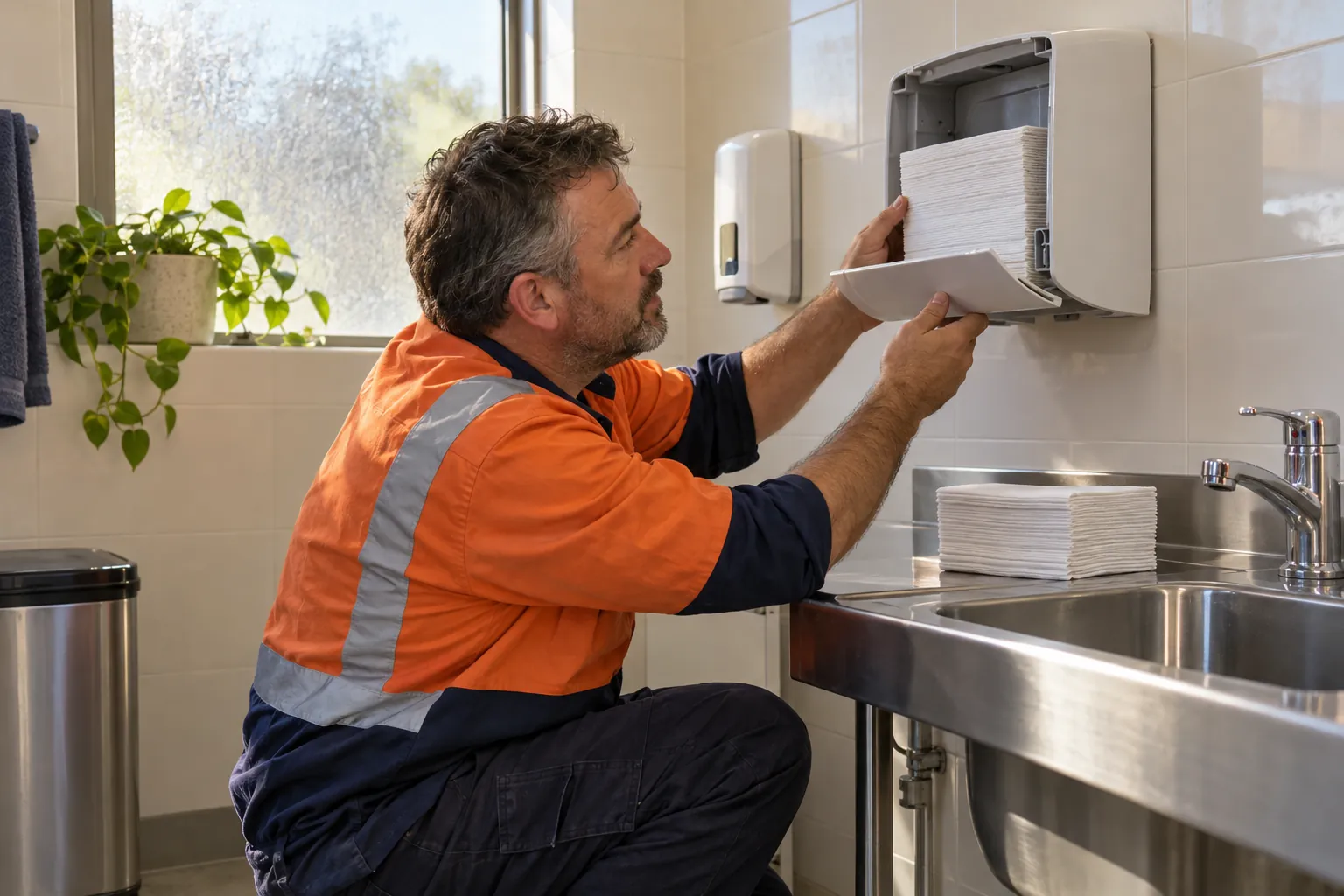
- Soap and hand drying. Dispensers filled and working, with paper towel stocked or the hand dryer running. The NSW code expects "non-irritating soap preferably from a soap dispenser" and "hygienic hand drying facilities".
- Toilet paper. Enough in each cubicle, with spares where the dispenser allows. The Victorian code asks for "enough toilet paper for each toilet and all persons using them".
- Bins and sanitary disposal. General waste bins emptied or within capacity, and sanitary disposal units present and serviced to their schedule. Where the building needs them, sharps disposal units and a hygienic way to dispose of incontinence products, which the Victorian code asks employers to consider.
- Floors. Dry, free of paper and litter, with any spill cleaned up and a wet floor sign out while it dries.
- Lighting, ventilation and smell. Lights working, the exhaust fan running, no lingering odour.
- Accessible and all-gender toilets. Checked on the same round as the others, including the grab rails, the emergency call button where there is one, and a clear path to the pan and basin, which is often the first thing stacked with stores.
- Faults found. A leaking cistern, a running urinal, a broken lock, a failed light, and who the fault was reported to and when.
- Supervisor's column. Completed less often, by someone who did not do the clean.
Keep the list short enough to complete honestly on every visit. A sheet with twenty boxes each hour will be ticked in one stroke at knock-off.
03
How often toilets should be checked and cleaned
There is no statutory frequency. The NSW code says workplaces and facilities should be cleaned regularly "taking into account the type of work performed, the likelihood of contamination, the number of workers using them, including during shiftwork, and the type of facility". The Victorian code says cleaning "may be needed at each shift change or daily, but can be needed more often", and that the cleaning schedule needs to account for high-use areas such as toilets, urinals and hand washing facilities.
In practice the interval follows how many people use the room and when, and it should be written into the cleaning contract or scope of works, not left to whoever is rostered on the day. As a starting point for the scope:
- Every 30 to 60 minutes at peak times: shopping centres, transport interchanges, stadiums, events, and public toilets in busy spots.
- Every one to two hours: busy office floors, schools and TAFE campuses during class time, gyms, and waiting rooms.
- Two or three times a day: lightly used offices and staff-only amenities.
- At least once a day: every toilet in use, with a full clean, and more often on shiftwork sites where the night shift uses the same amenities.
Time the checks to the pattern of use rather than the clock alone: after the morning arrival, after lunch, after a school recess, at the end of a function or a session in a stadium. An hourly check through a quiet afternoon and none during the lunchtime rush produces a tidy sheet and a dirty room.
The number of toilets matters too. The NSW code points to the National Construction Code for the ratio of toilets to workers, and says there should be "enough toilets available for the number of workers who may need to use them at the same time". A building short of toilets needs more frequent checks, not fewer. If it is open in the evening, overnight or at weekends, the checklist should show who covers the toilets then.
04
A check, a clean and a periodic clean are different jobs
Most disputes about toilet cleaning come from recording three different jobs in the same box.
- A check is a short visit: look in every cubicle, pick up paper, wipe what needs wiping, restock, report faults. It takes a few minutes and happens many times a day.
- A full clean is the scheduled clean in the scope of works: pans, seats, urinals, basins, taps, mirrors, partitions, dispensers, bins and floors, with the right cloths, mops and chemicals. It happens once or twice a day, often outside the busy hours.
- A periodic clean is the work done weekly, monthly or quarterly: descaling urinals and pans, scrubbing grout, cleaning exhaust grilles and high surfaces, machine scrubbing the floor, washing partitions and doors top to bottom.
Record them separately, or at least mark which was done. A tenant reading "cleaned 10:00, 11:00, 12:00" assumes three full cleans; the cleaner meant three checks.
The full clean usually has its own daily toilet cleaning checklist, kept by the cleaning supervisor, listing each task in the order it is done: remove waste, apply the toilet cleaner and leave it for its contact time, clean from the cleanest surfaces to the dirtiest, finish with the floor working towards the door. Keep toilet cloths and mops separate from those used in kitchens and tearooms, whatever colour code the contract uses.
Cleaning chemicals are hazards in their own right. Follow the product's label and safety data sheet for dilution, ventilation and personal protective equipment, never mix products, and put a wet floor sign out while floors dry. The NSW code notes that cleaning methods "should also take account of the potential for slips, which may be increased by the use of some cleaning agents".
05
Faults, follow-up, and what makes the record believable
A fault found on a check has to go somewhere that gets it fixed. Writing "urinal running" on the sheet records that it was seen; it does not tell the building manager or the plumber. The NSW code says broken or damaged fixtures and fittings, "including chairs, plumbing, air-conditioning and lighting should be replaced or repaired promptly", and the Victorian code says spills, blockages and waste "should be dealt with quickly as part of good housekeeping practices". The checklist should say who each fault was reported to, and when, and someone should close the loop when it is fixed.
Anyone who has managed a cleaning contract has seen a sheet completed in advance, every hour ticked in the same pen at the same angle. The things that make a record believable are simple:
- It is written at the time. The time recorded is the time the check happened, not the time it was due.
- It names a person. Initials that identify one person carry weight; the contractor's name does not.
- It shows exceptions. A sheet on which nothing ever ran out and nothing ever broke is not believed. "Soap refilled" or "cubicle 2 blocked, reported to building manager 2.20 pm" shows that someone looked.
- Someone else checks it. A supervisor or the facility manager who walks the amenities unannounced and signs the sheet gives it independence.
- Gaps are explained. A missed check with a reason, such as "closed for plumber" or "called to a spill in the foyer", is more credible than a sheet with no gaps at all.
- It is kept. Sheets binned each Monday cannot answer a complaint about the week before. Keep them for as long as the contract requires, and long enough to cover the period in which a complaint or claim might reasonably arise.
When a tenant, a client or an inspector asks, the question is usually the same: when were these toilets last checked, by whom, and what was done about the problem I saw? A good record answers all three. See the cleaning log sheet guide for how to set up the signatures, the checker's column and the review.
06
Where the paper checklist fails, and what SiteClara does about it
Paper works well enough in one building with a steady team. It struggles when a contractor looks after many sites, when staff change often, or when a client wants the record rather than an assurance. The sheet stays on the door, and the facility manager sees it only when they visit. Nobody notices a missed check until the next complaint, and nobody can tell from a tick whether it was written at 10 am or at 5 pm.
SiteClara replaces the sheet with a tag at the amenities door: a printed QR poster, with an NFC tag behind it if the team would rather tap than scan. A cleaner scans or taps it on their own phone, with no app to install, and sees the checks due there. They mark each one done, with a photo when the check asks for one, or say what stopped them. Their name and the time are recorded as it happens. A fault, such as a blocked pan or an empty soap dispenser, can be reported at the same tag and goes onto the team's list of open jobs until someone closes it.
The supervisor sees what is due, done and missed across the building, and can record why a check was missed. At the end of the day they review it, add a note and approve the report, which goes to the nominated client or management contacts the next morning, showing what was completed, what was reported and what is still open.
07
Questions people ask
What should I include on a checklist for toilet cleaning?
Start from what the regulator will ask. Appendix B of SafeWork NSW's Code of Practice: Managing the work environment and facilities asks whether toilets are "cleaned regularly and maintained in good working order", whether they are clearly marked with "lockable doors, lighting and ventilation", and whether "toilet paper, hand washing facilities and soap, rubbish bins and sanitary disposal bins" are provided. Put each of those on the list, then add the date and time, the name of the person who did it, and any fault found and who it was reported to.
What do professional cleaners use to clean a toilet?
Commercial cleaners use the toilet cleaners, detergents and disinfectants set out in the cleaning contract, with cloths and mops kept only for toilets. Those products carry duties of their own: WorkSafe Victoria's Workplace facilities and the working environment compliance code notes that "some cleaning agents may be classified as hazardous substances", and asks employers to "consider slip hazards when choosing cleaning methods as some cleaning agents may increase slip risks". Use each product as its label and safety data sheet direct.
08
Where to read more, and a list to take away
Start with the WHS Act and Regulations for your own state or territory: the Queensland versions linked above follow the national model, and New South Wales, South Australia, Tasmania, Western Australia and the territories have their own equivalents, and each regulator publishes its approved version of the code of practice, such as SafeWork NSW's Managing the work environment and facilities and WorkSafe WA's 2022 version. The NSW code's appendix is a checklist that asks, among other things, whether facilities are cleaned regularly and consumables replaced. In Victoria, read the Occupational Health and Safety Act 2004 and WorkSafe Victoria's Workplace facilities and the working environment compliance code, whose appendix sets out the number of toilets and washbasins needed for employees. For the toilets that visitors and the public use, see the public toilet cleaning guide, and for the rest of the floor the office cleaning checklist.
Before you print the next batch of checklists, make sure that:
- each checklist names one room, including the accessible and all-gender toilets;
- the check frequency for each room is written in the cleaning contract or scope of works and follows how the room is used;
- checks, full cleans and periodic cleans are recorded separately;
- each entry has the actual time and a name or initials that identify one person;
- soap, paper towel, toilet paper and sanitary disposal are on the list, not assumed;
- there is room to record faults, who they were reported to, and when they were fixed;
- a supervisor signs it on unannounced visits;
- evenings, night shifts and weekends are covered if the building is used then;
- completed checklists are kept, and you know for how long.
Sources
Every document this guide quotes or links to, in the order it first cites them.
- Work Health and Safety Act 2011 legislation.qld.gov.au
- Work Health and Safety Regulation 2011 legislation.qld.gov.au
- Code of Practice: Managing the work environment and facilities safework.nsw.gov.au
- Occupational Health and Safety Act 2004 legislation.vic.gov.au
- Compliance code, Workplace facilities and the working environment worksafe.vic.gov.au
- 2022 version worksafe.wa.gov.au
Related guides
 CleaningPublic toilet cleaning: frequencies, sharps and accessible facilitiesRunning public toilets for councils, parks, beaches and venues in Australia: the WHS and access duties, how often to clean, sharps, vandalism and Changing Places.
 CleaningCleaning log sheet: what to record, who signs it, and what a signature provesWhat a cleaning log sheet should record in Australian workplaces and food businesses, the WHS and food safety rules behind it, and what a signature proves.
 CleaningOffice cleaning checklist: what to clean, how often, and how to show it was doneAn office cleaning checklist for Australian workplaces: what WHS law expects, room-by-room tasks, how often, who does what, and how to show the list is kept.
 Premises and facilities managementWorkplace amenities: what the law asks for, and how to keep them clean and workingWorkplace amenities under Australian WHS and OHS law: what must be provided, the numbers the codes give, who cleans and maintains them, and what a good record shows.