Fire and water checks
Cooling tower requirements: what the law asks for, and how to show the maintenance was done
Cooling tower maintenance in Australia means treating the water continuously with biocide, inspecting and servicing the system at least once a month, sending samples to an accredited laboratory for bacteria and Legionella testing, and cleaning and disinfecting it at set intervals, as state public health law and AS/NZS 3666 require.
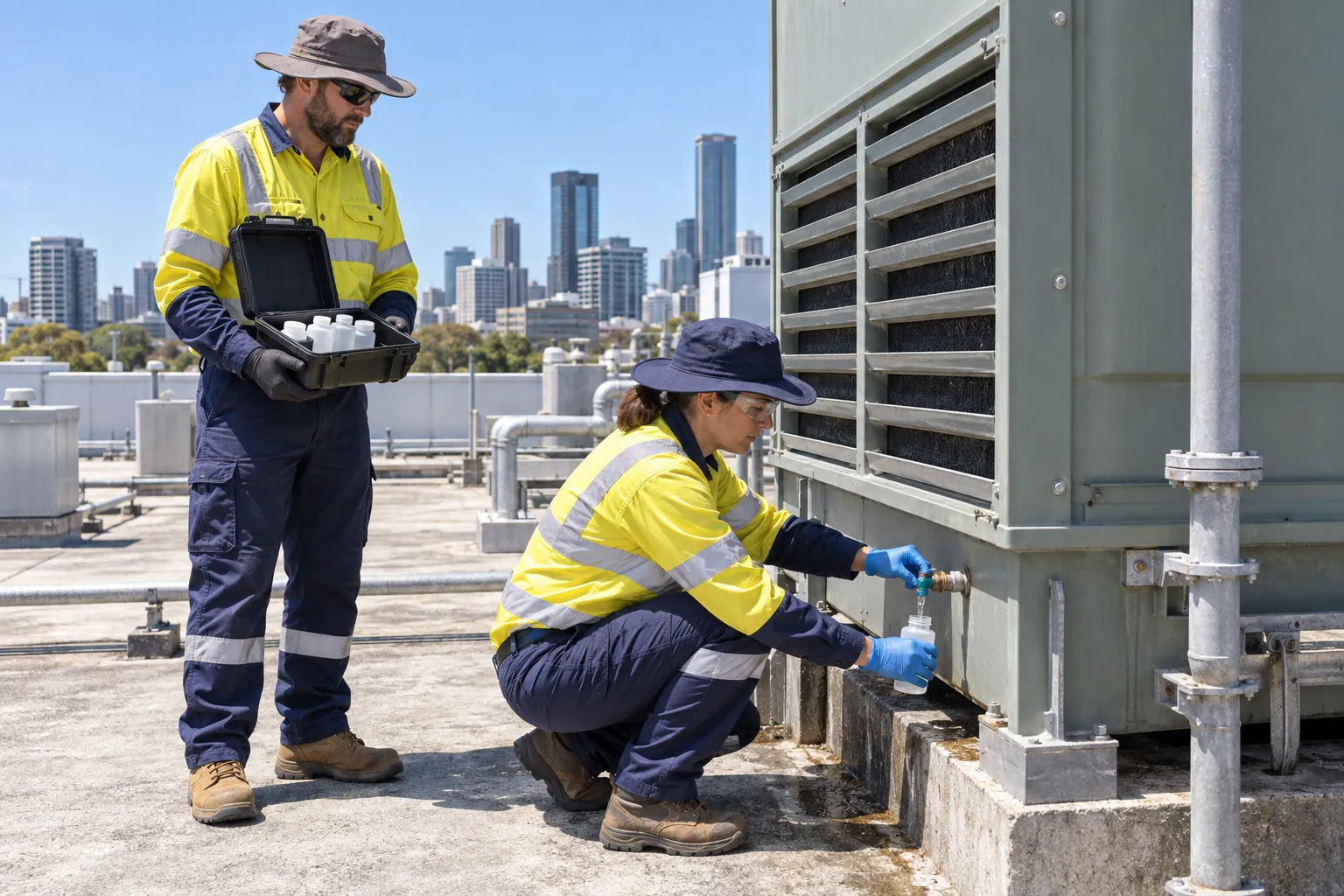
A cooling tower that is not looked after can grow Legionella and spray it over a street. That is why every state that regulates them asks for the same things in different words: register the system, control the risk, treat and test the water, inspect it regularly and keep a record someone can check. This guide sets out the cooling tower requirements in New South Wales, Victoria and South Australia, what routine cooling tower maintenance involves, who does what, and what the record needs to show.
01
Where cooling tower requirements come from
A cooling tower rejects heat from a building's air-conditioning or process plant by evaporating water into a stream of air, and some of that water leaves the tower as fine drift. As the Victorian Department of Health puts it on its page Guide to developing cooling tower risk management plans, "Legionella bacteria can be spread through aerosol spray and cause outbreaks of Legionnaires' disease, a potentially fatal form of pneumonia."
The law usually talks about the whole cooling water system, not just the tower on the roof. South Australia's regulations define one as a heat exchange system of heat generating plant, heat rejection plant, "interconnecting water recirculating pipework and associated pumps, valves and controls", including a cooling tower or evaporative condenser. The plant room is part of what the owner answers for.
In Australia the specific requirements are state public health law, not workplace safety law, and each state words them differently:
- New South Wales: the Public Health Act 2010 and the Public Health Regulation 2022, administered by NSW Health and enforced by local councils.
- Victoria: the Public Health and Wellbeing Act 2008 and the Public Health and Wellbeing Regulations 2019, administered by the Department of Health.
- South Australia: the South Australian Public Health (Legionella) Regulations 2013, with the local council as the relevant authority (the Chief Public Health Officer outside council areas).
- Queensland and the other states and territories use their own laws. Queensland Health's Legionella page points service contractors, designers and owners to a guide to Legionella control in cooling water systems, and says they "should use these guidelines to manage risks associated with Legionella". Check with the state health department and the local council before relying on another state's rules.
Underneath the state rules sits the Australian/New Zealand Standard AS/NZS 3666, Air-handling and water systems of buildings – Microbial control. The 2011 editions of AS/NZS 3666.1:2011 (design, installation and commissioning), AS/NZS 3666.2:2011 (operation and maintenance) and AS/NZS 3666.3:2011 (performance-based maintenance of cooling water systems) are the ones the regulations call up, and Standards Australia lists all three as pending revision. They are paid documents, so the detail is in the standard, not here.
Workplace safety law still applies alongside. Under the Work Health and Safety Act 2011 (Cth) and each state's mirror act, a person conducting a business or undertaking (PCBU) must ensure, so far as reasonably practicable, the health and safety of workers, including through "the provision and maintenance of safe plant and structures". In Victoria the equivalent is the Occupational Health and Safety Act 2004 (Vic).
02
What cooling tower maintenance covers in practice
Cooling tower maintenance mixes continuous controls, monthly routine and less frequent specialist work. Its purpose is to prevent the conditions in which Legionella grows, such as stagnant water, sediment, biofilm and corrosion. The same work keeps scale and fouling from cutting the tower's efficiency, but the regulations are written for the health risk. Across the three states below, the recurring pieces are:
- Registration of each system, kept up to date when towers are added, moved or removed.
- A risk management plan (NSW and Victoria) showing how Legionella could grow and spread in this system, and the controls that stop it.
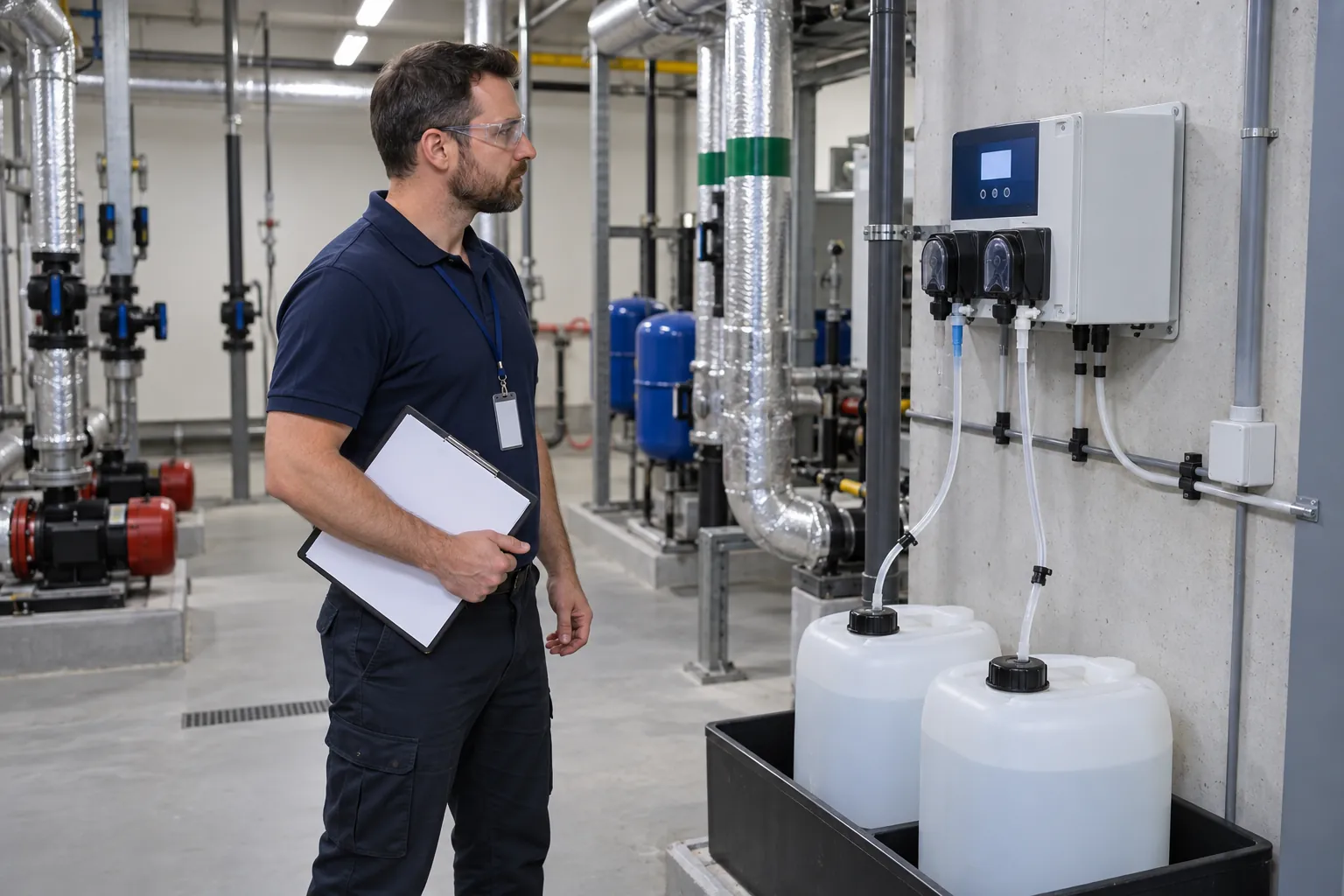
- Continuous water treatment: biocide dosing, usually by an automatic dosing unit.
- Monthly inspection and servicing of the tower, basin, drift eliminators and dosing equipment by the water treatment contractor, including mechanical components such as fans and pumps, with repairs arranged for any defect found.
- Sampling and laboratory testing for heterotrophic colony count (HCC) and Legionella, by a NATA-accredited laboratory.
- Cleaning and decontamination at set intervals, and whenever an inspection or a result calls for it, to remove debris, sludge and biofilm from the basin and the inside of the tower.
- Drift eliminators that cover the whole air stream and are kept clean and intact.
- An independent audit of the plan and how it is carried out (NSW and Victoria), or an annual inspection and test arranged by or for the council (South Australia).
- A log book or monthly reports that bring all of this together, kept where an authorised officer can see them.
03
New South Wales: the six safeguards
NSW Health summarises the Public Health Regulation 2022 as six key safeguards that the occupier of a building with a cooling water system must have in place. Its fact sheet Regulatory requirements at a glance lists them:
- "Assessing risk of Legionella contamination and preparing a Risk Management Plan (RMP) – every 5 years (or more frequently if required)."
- "Independent auditing of compliance with the RMP and Regulation – every year."
- "Providing certificates of RMP completion and audit completion to the local government authority."
- "Sampling and testing for Legionella and heterotrophic colony count – every month."
- "Notifying reportable laboratory test results (Legionella count ≥1,000 cfu/mL or heterotrophic colony count ≥5,000,000 cfu/mL) to the local government authority."
- "Displaying unique identification numbers on all cooling towers."
The NSW Health fact sheet for occupiers adds the time limits: a reportable result to the council "within 24 hours of receiving the result from the laboratory", the two certificates within 7 days, the council's identification number on every tower within 30 days, and a new installation notified within a month.
NSW names three roles, and it helps to know which is which:
- The duly qualified person is, in the Act's words, "a person who installs, operates or maintains a cooling water system", and the occupier engages them to "manage the cooling water system on a routine basis". According to NSW Health's duly qualified person fact sheet, that includes "performing monthly inspection, chemical analysis and microbial testing" and "performing system cleaning at a frequency specified in the Risk Management Plan". In practice this is usually the water treatment contractor.
- The competent person carries out the risk assessment and prepares the RMP.
- The independent auditor audits compliance with the RMP and the Regulation.
NSW Health's fact sheet on managing cooling water systems throughout their lifecycle ties each stage to a part of the standard: install to AS/NZS 3666.1:2011, operate to AS/NZS 3666.2:2011 and maintain to AS/NZS 3666.3:2011. Records must be "either kept in hard copy on the premises, or kept electronically and made available for inspection within 4 hours of request by an authorised officer", and decommissioning notified within 7 days. The duly qualified person fact sheet adds that audit reports and monthly reports are kept for the past 5 years. NSW Health's Legionella legislation page also notes that a licence from NSW Fair Trading may be needed before designing, installing or maintaining a cooling water system.
04
Victoria and South Australia
Victoria. The Department of Health's page on cooling tower systems sets out the three duties under the Public Health and Wellbeing Act 2008: register each system with the department, develop a risk management plan, and have it audited every year. "A penalty applies if you do not register a cooling tower system, develop a RMP and have the RMP audited every year." Its page on legal responsibilities says the plan must address the critical risks, stagnant water among them, and is reviewed at least once a year. Adding or removing a tower, or decommissioning or relocating the system, must be notified within 30 days.
The routine under the Public Health and Wellbeing Regulations 2019 is set out on the department's page on cooling tower system maintenance requirements. Unless the system is shut down or otherwise not in use:
- the water is "continuously treated with one or more biocides to effectively control the growth of microorganisms including Legionella";
- a sample goes to a NATA-approved laboratory for Legionella "at least once every three months", and for heterotrophic colony count "at least once each month";
- the system is "inspected and serviced at least once a month to ensure it is operating without defects";
- a clean and disinfect sequence (bio-dispersant, disinfection, cleaning the inside of each tower, re-disinfection) is carried out "immediately prior to a cooling tower system being put into operation for the first time, or following any shut down period of more than one month and at intervals not exceeding six (6) months"; and
- "maintenance and testing records are kept for 12 months" and can be produced to an authorised officer from the department on request.
The responsible person must notify the department within 24 hours when Legionella is detected "in three consecutive samples from the cooling tower" or "at a level above 1,000 cfu/ml in any sample taken from a cooling tower". The department's page on auditing the cooling tower risk management plan says the yearly audit is by an approved auditor, and is not the same as a competent person's reviews.
South Australia. The South Australian Public Health (Legionella) Regulations 2013 treat a cooling water system as a high risk manufactured water system. The owner of the premises must:
- register it with the relevant authority within a month of bringing it into service, naming the person responsible for its operation and maintenance, and renew the registration every 12 months (regulation 5);
- fit an automatic biocide dosing device, "operating effectively at all times while the system is in operation" (regulation 7), and a drift eliminator on every tower that covers the full exhaust air stream (regulation 8);
- make sure the person responsible for operation and maintenance is "knowledgeable in the operation and maintenance of the system and sufficiently competent" (regulation 11);
- maintain the system to Section 2.5 of AS/NZS 3666.2, Section 3 of AS/NZS 3666.3, or a maintenance program approved by the Minister (regulation 12); and
- keep an up-to-date log book on the premises with the particulars in clause 2.6.2 of AS/NZS 3666.2, every microbiological result, and the type, quantity and frequency of biocide dosing, and keep it for at least five years after the last entry (regulation 14).
At least once every 12 months the council inspects and tests each registered system, or requires the owner to arrange an inspection by an independent competent person and a NATA laboratory test (regulation 15). A result of 1,000 or more colony forming units of Legionella per millilitre means the owner must immediately shut the system down or decontaminate it, and submit the report to the council within 24 hours (regulation 17).
05
Who does what, and what a good record shows
Whatever the state, the owner or occupier holds the duty, and most of the technical work is contracted out:
- The owner or occupier: registration, the risk management plan, engaging the contractor and auditor, and notifying the council or department on time.
- The water treatment contractor: dosing, monthly inspection and service, sampling, cleaning and decontamination, and the monthly report. NSW Health says the duly qualified person's report records "site and contact details" and "results of monthly inspection, maintenance (including servicing), chemical analysis and microbial testing".
- The facility or building manager: keeping the plan, reports and certificates together, chasing overdue work, and making sure a reportable result reaches whoever must notify.
- The on-site team: roof and plant room access, a routine look at the tower and dosing unit between contractor visits, and reporting problems such as a leak, debris in the basin or a dosing alarm straight away.
A record that stands up when an auditor, a council officer or an investigator after a Legionnaires' case asks for it shows:
- each system and tower, with its registration and, in NSW, the identification number displayed on it;
- the current risk management plan, its date and who prepared it, and the last review;
- every monthly service visit: the date, who attended, what was inspected and what was put right;
- every laboratory result, with the date sampled and the date received, and what was done about any result over the action level;
- every notification to the council or department, with the time it was made;
- cleaning and decontamination dates, and any shutdown and restart;
- the site team's own checks between visits, including those missed and why, and faults reported and fixed; and
- the independent audit or annual inspection, its findings and the corrective actions closed.
06
Where the record fails, and what SiteClara does about it
The contractor's monthly report and the laboratory certificates are usually in order. The weak point is the building's own part. A plant room check sheet is filled in for the month on the last Friday. A cleaner notices the dosing alarm and mentions it to whoever is passing. A tower is restarted after a fit-out, and nobody writes down when. Asked what the site team saw between service visits, nobody can show who looked, or when.
SiteClara records those checks at the location. A printed QR poster, with an optional NFC tag behind it, goes at each place where a check is scheduled, such as the plant room door, the dosing unit or the roof access to the tower. Staff scan or tap on their own phone, with no app to install, see the checks due there, and mark each one done or explain what stopped them, such as no roof access that day. The time and the named person are recorded as it happens, with a photo when one is asked for, for example of the dosing drum level or the drift eliminators in place. A problem reported there, such as a leaking basin or a dosing alarm, goes onto the team's list of jobs until someone closes it.
The supervisor sees what is due, done and missed at each location, and records the reason a check was missed. Each day they review the checks and photos, add a note and approve a report that goes to nominated contacts, such as the owner's facility manager, at 8am the next morning, showing what was reported, what was completed, what is still open, and how the scheduled checks went.
07
Questions people ask
How often should cooling towers be serviced?
At least monthly where the law sets a frequency. In Victoria, the Department of Health's page on cooling tower system maintenance requirements says the system must be "inspected and serviced at least once a month to ensure it is operating without defects", with a heterotrophic colony count sample "at least once each month" and a Legionella sample "at least once every three months". In New South Wales, NSW Health's duly qualified person fact sheet describes "performing monthly inspection, chemical analysis and microbial testing, and preparing a monthly report".
What are the steps involved in a cooling tower maintenance checklist?
Victoria's routine is a fair model. The Department of Health's page on cooling tower system maintenance requirements lists continuous treatment with biocide, a monthly inspection and service, monthly and three-monthly laboratory samples, and a clean and disinfect sequence at intervals of no more than six months and after any shutdown of more than a month: add a biodispersant, disinfect the water, clean the inside of each tower, then disinfect again. Maintenance and testing records are kept for 12 months. In NSW the cleaning frequency is the one set in the risk management plan, according to NSW Health's duly qualified person fact sheet.
08
Further reading, and a list to take away
Read NSW Health's fact sheets in New South Wales, the Department of Health's cooling tower pages in Victoria, and the 2013 Legionella regulations in South Australia. Elsewhere, ask the state health department and the council. AS/NZS 3666 Parts 1 to 3 are available from Standards Australia.
To check your cooling tower requirements are in order:
- every cooling water system is registered, the particulars are current and, in NSW, every tower shows its identification number;
- the risk management plan is in date, prepared by a competent person, and reviewed on the cycle your state requires;
- the independent audit or annual inspection is booked, and its findings closed out;
- the contractor inspects and services the system at least monthly, and samples at your state's frequency, with a report every visit;
- everyone knows who receives laboratory results and who notifies the council or department within 24 hours;
- cleaning and decontamination dates are known, and a shutdown and restart follow the plan;
- the site team's routine checks between visits are recorded with a name and a time, and missed checks carry a reason;
- the log book or records are kept on site or electronically, for as long as your state requires (5 years in NSW and South Australia, 12 months in Victoria).
Sources
Every document this guide quotes or links to, in the order it first cites them.
- Guide to developing cooling tower risk management plans health.vic.gov.au
- Public Health and Wellbeing Regulations 2019 legislation.vic.gov.au
- South Australian Public Health (Legionella) Regulations 2013 legislation.sa.gov.au
- Queensland Health's Legionella page health.qld.gov.au
- AS/NZS 3666.1:2011 store.standards.org.au
- AS/NZS 3666.2:2011 store.standards.org.au
- AS/NZS 3666.3:2011 store.standards.org.au
- Work Health and Safety Act 2011 (Cth) legislation.gov.au
- Occupational Health and Safety Act 2004 (Vic) legislation.vic.gov.au
- Regulatory requirements at a glance health.nsw.gov.au
- NSW Health fact sheet for occupiers health.nsw.gov.au
- Duly qualified person fact sheet health.nsw.gov.au
- Fact sheet on managing cooling water systems throughout their lifecycle health.nsw.gov.au
- Legionella legislation page health.nsw.gov.au
- Cooling tower systems health.vic.gov.au
- Legal responsibilities health.vic.gov.au
- Cooling tower system maintenance requirements health.vic.gov.au
- Auditing the cooling tower risk management plan health.vic.gov.au
Related guides
 Fire and water checksTMV testing: what the rules ask for, and how to show the checks were doneTMV testing in Australia: the NCC temperature limits, AS 4032.3, the NSW Health monthly check, state rules, who does what, and what a good record shows.
 Fire and water checksEssential safety measures in Victoria: the duties, the annual report and the recordsWhat essential safety measures are under Victoria's Building Regulations 2018, who maintains them, the annual ESM report, the records to keep and the checks between.
 Premises and facilities managementPreventative maintenance: how to plan it for a building and prove it was donePreventative maintenance for Australian buildings: the WHS duty, the asset register and schedule, statutory and discretionary tasks, and keeping good records.
 Premises and facilities managementBuilding compliance checklist: the duties that come with an Australian buildingA building compliance checklist for Australian commercial buildings: WHS duties, fire safety maintenance by state, asbestos, plant, water, access and the records.