Premises and facilities management
Building compliance checklist: the duties that come with an Australian building
Building compliance in Australia means meeting the requirements that come with a building: the National Construction Code (NCC) and its approval when it is designed and built, then the ongoing duties of whoever owns, manages or controls it.
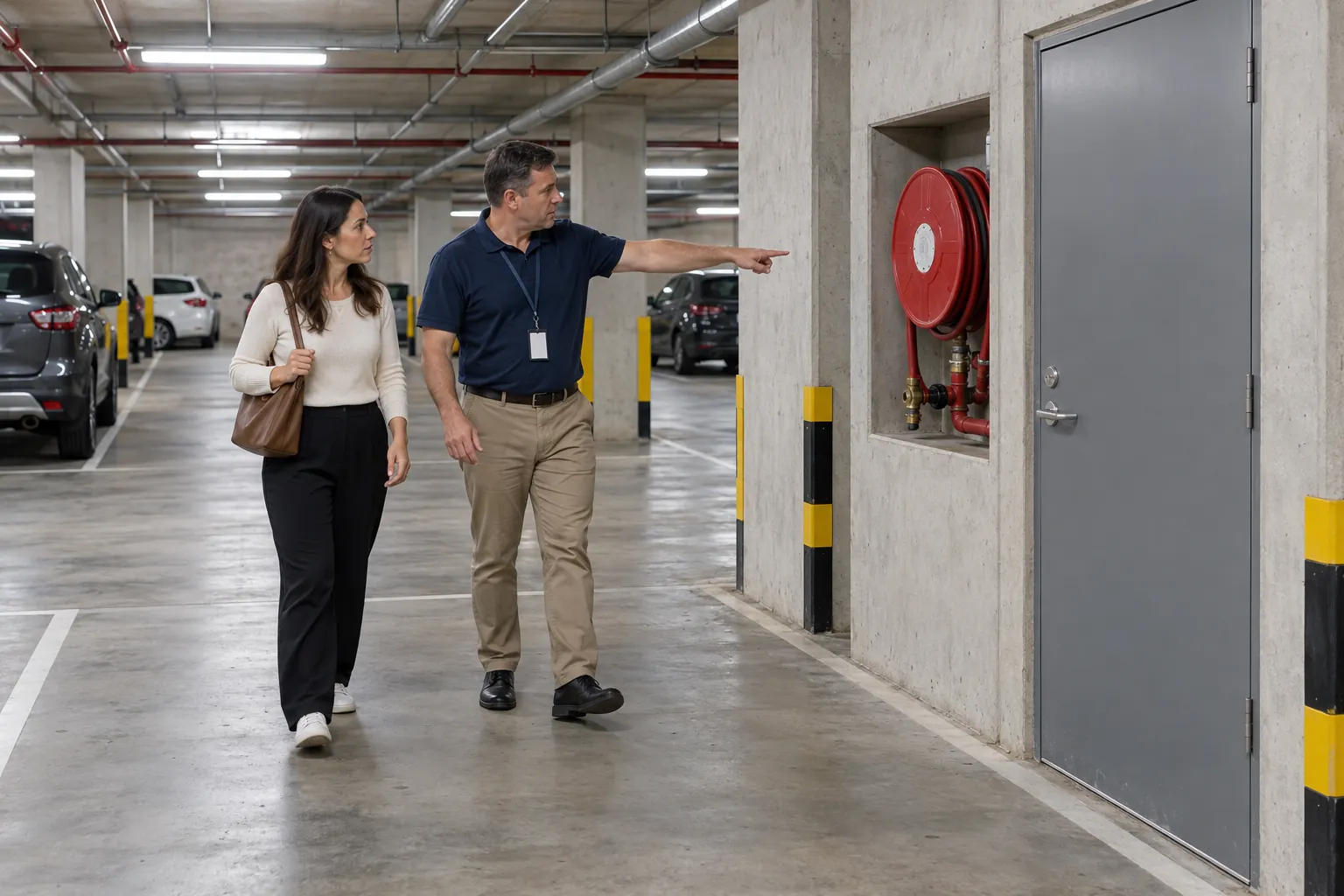
Those ongoing duties are not one law but several: the WHS or OHS duties of whoever manages or controls the workplace, state fire safety maintenance regimes built around AS 1851, asbestos, plant and lifts, cooling towers, access and the everyday workplace basics. This checklist sets out each duty, who usually holds it, how the work is checked and where the evidence should sit, for offices, shops, schools, strata buildings and other commercial premises.
01
Who is responsible for building compliance
There is no single building compliance act in Australia. Each duty comes from its own law, often a state law, and falls on its own duty holder, so gaps tend to open between people rather than within one role.
Workplace health and safety. Most states and territories have adopted a version of the model Work Health and Safety Act; Victoria has not. Under the Work Health and Safety Act 2011 (Cth), section 19 gives the person conducting a business or undertaking (the PCBU) the primary duty of care. Section 20 is the one that matters most for a building. In the Work Health and Safety Act 2011 (Qld), which follows the model text, section 20(2) reads: "The person with management or control of a workplace must ensure, so far as is reasonably practicable, that the workplace, the means of entering and exiting the workplace and anything arising from the workplace are without risks to the health and safety of any person."
Victoria is different. As WorkSafe Victoria's page on the OHS laws puts it, the Occupational Health and Safety Act 2004 (Vic) (version 045, in force from 6 August 2025) is the main workplace health and safety law in Victoria, with the OHS Regulations 2017 setting out how to fulfil the duties. A checklist used across states should cite each state's law separately.
Several duty holders at once. In a multi-tenant office, shopping centre or strata building, several parties can hold duties about the same thing. Section 46 of the same Act says that where more than one person has a duty in relation to the same matter, each must, so far as is reasonably practicable, "consult, cooperate and coordinate activities with all other persons who have a duty in relation to the same matter." A lease or strata by-law can decide who does the work, but not remove a legal duty. A good checklist names, for every item, who holds the duty, who does the work and who holds the record.
02
The building compliance checklist at a glance
The National Construction Code 2025, Part A6 sorts buildings into classes: Class 2 apartment buildings, Class 3 hotels and hostels, Class 5 offices, Class 6 shops and restaurants, Class 7a car parks, Class 7b storage, Class 8 factories and laboratories, Class 9a health-care buildings, Class 9b assembly buildings such as schools and theatres, and Class 9c residential care. The class and the building's approvals decide which fire safety measures it has. For a typical commercial building the checklist covers:
- Fire safety measures: exits and paths of travel, fire and smoke doors, exit signs and emergency lighting, extinguishers, hose reels, hydrants, sprinklers, detection and alarm systems, and any smoke control, each maintained under the state's regime, usually to AS 1851.
- The emergency plan: prepared, tested and trained, with wardens where the plan needs them and evacuation practice.
- Electrical safety: the installation maintained, and equipment and residual current devices tested where the regulations require.
- Asbestos: identified, recorded in an asbestos register, and managed under a plan where it is present.
- Plant and lifts: maintained, inspected and tested by a competent person.
- Water systems: cooling towers registered and managed under a risk management plan where state public health law requires it, and warm water systems controlled.
- Hazardous chemicals: a register and current safety data sheets for what is used, handled or stored.
- Access: new work and upgrades meeting the Disability (Access to Premises – Buildings) Standards.
- Workplace basics: toilets, drinking water, washing and eating facilities, first aid, and a way to report hazards and incidents.
Treat it as a template for your own register, not the whole list: a building with a commercial kitchen, a pool or a loading dock will have more. The building's approvals, your state's requirements and your competent contractors set the actual frequencies.
03
Fire safety maintenance, state by state
Every state requires a building's fire safety measures to be kept in working order; the states differ in what they call them, who signs off and what goes to the authorities.
- Victoria – essential safety measures. The Country Fire Authority's guidance on essential safety measures for businesses describes them as the building features that protect people in a fire: extinguishers, hose reels, hydrants, alarm systems, sprinklers and emergency lighting among them. Owners and owners corporations are generally responsible for keeping them in good working order, a lease may pass that to the tenant, and all occupants must keep exits and paths clear. The owner compiles an annual essential safety measures report, and the servicing records are commonly kept in a red Essential Safety Measures box in the front entry or another commonly accessible space. The rules are in the Building Regulations 2018 (Vic) (version 031, from 1 September 2026). See our guide to essential safety measures.
- New South Wales – the annual fire safety statement. NSW Planning's page on fire safety certification says annual fire safety statements "must be issued each year" by the owner of an existing building, covering every essential fire safety measure that applies to it, and that an accredited practitioner (fire safety) must assess, inspect and verify the performance of each measure. The requirements are in the Environmental Planning and Assessment (Development Certification and Fire Safety) Regulation 2021. See our guide to the annual fire safety statement.
- Queensland – the Building Fire Safety Regulation. Owners, occupiers, lessees and bodies corporate must comply with the Fire Services Act 1990 and, as the Queensland Fire Department's page for building owners and occupiers explains, the Building Fire Safety Regulation 2008 (Qld). Under that regulation the occupier must have prescribed fire safety installations maintained by an appropriately qualified person at the intervals in the Queensland Development Code MP 6.1 (section 54), give the commissioner a copy of the occupier statement within 10 business days after it is required to be prepared (section 55A), and hold evacuation practice at intervals of not more than one year (section 44).
- South Australia – essential safety provisions. The Metropolitan Fire Service's page on maintenance of fire safety systems says building owners must lodge a Form 3 – ESP Maintenance Verification with the local council at the start of each calendar year, under Ministerial Building Standard 002, with maintenance to AS 1851.
- Western Australia, Tasmania and the territories have their own arrangements.
AS 1851 in practice. The common servicing standard is AS 1851, Routine service of fire protection systems and equipment. It sets the routine service tasks and intervals for each kind of system, and it is a paid document, so ask your contractor which tables apply to your building rather than working from a summary. See our guide to AS 1851 routine service.
The emergency plan. Separately from the building regime, the WHS Regulations require the PCBU at a workplace to have an emergency plan. Regulation 43 of the Work Health and Safety Regulation 2011 (Qld) (current as at 29 March 2026), which follows the model text, requires a plan that provides for emergency procedures, for "testing of the emergency procedures, including the frequency of testing", and for training relevant workers. Many buildings organise this around AS 3745 and an emergency control organisation of wardens. See AS 3745 emergency planning and evacuation drills.
Between services, blocked exits, wedged fire doors and dark exit signs are found, or not, by whoever walks the building every day. Our guides to fire door inspection and emergency lighting testing cover those checks.
04
Asbestos, electrical, plant, chemicals and water
The WHS Regulations below are quoted from the Queensland version, which follows the model text except where noted; check your own jurisdiction's numbering. Victoria's OHS Regulations 2017 have their own provisions and numbering.
- Asbestos. The person with management or control of a workplace must ensure, so far as is reasonably practicable, that all asbestos or asbestos-containing material at the workplace is identified by a competent person, or assume it is present where it cannot be identified (regulation 422). They must keep an asbestos register at the workplace and keep it up to date (regulation 425), recording the date, location, type and condition of each item. Where asbestos is present or likely, they must have a written asbestos management plan (regulation 429), reviewed in set circumstances and "at least once every 5 years" (regulation 430). Newer buildings are exempt from the register where no asbestos is identified or likely, but the cut-off date differs: in Queensland it is a building constructed after 31 December 1989. Check your own jurisdiction's regulation.
- Electrical. Part 4.7 of the model WHS Regulations, reproduced in the Work Health and Safety Regulations 2011 (Cth), includes duties for the inspection and testing of electrical equipment (regulation 150) and the testing of residual current devices (regulation 165). Queensland does not use Part 4.7 (regulations 145 to 166 are marked not used in its WHS Regulation); electrical safety there is covered by separate electrical safety legislation. Your electrical contractor should set the schedule for your building and keep the test records.
- Plant, including lifts. Regulation 213 requires the person with management or control of plant to ensure that its "maintenance, inspection and, if necessary, testing" is carried out by a competent person, following the manufacturer's recommendations where there are any. For lifts and building plant, keep the contractor's service reports where you can find them, not only in the contractor's portal.
- Hazardous chemicals. Regulation 346 requires a PCBU to keep a register of hazardous chemicals used, handled or stored at the workplace, with the current safety data sheet for each, kept up to date and accessible to the workers who handle them.
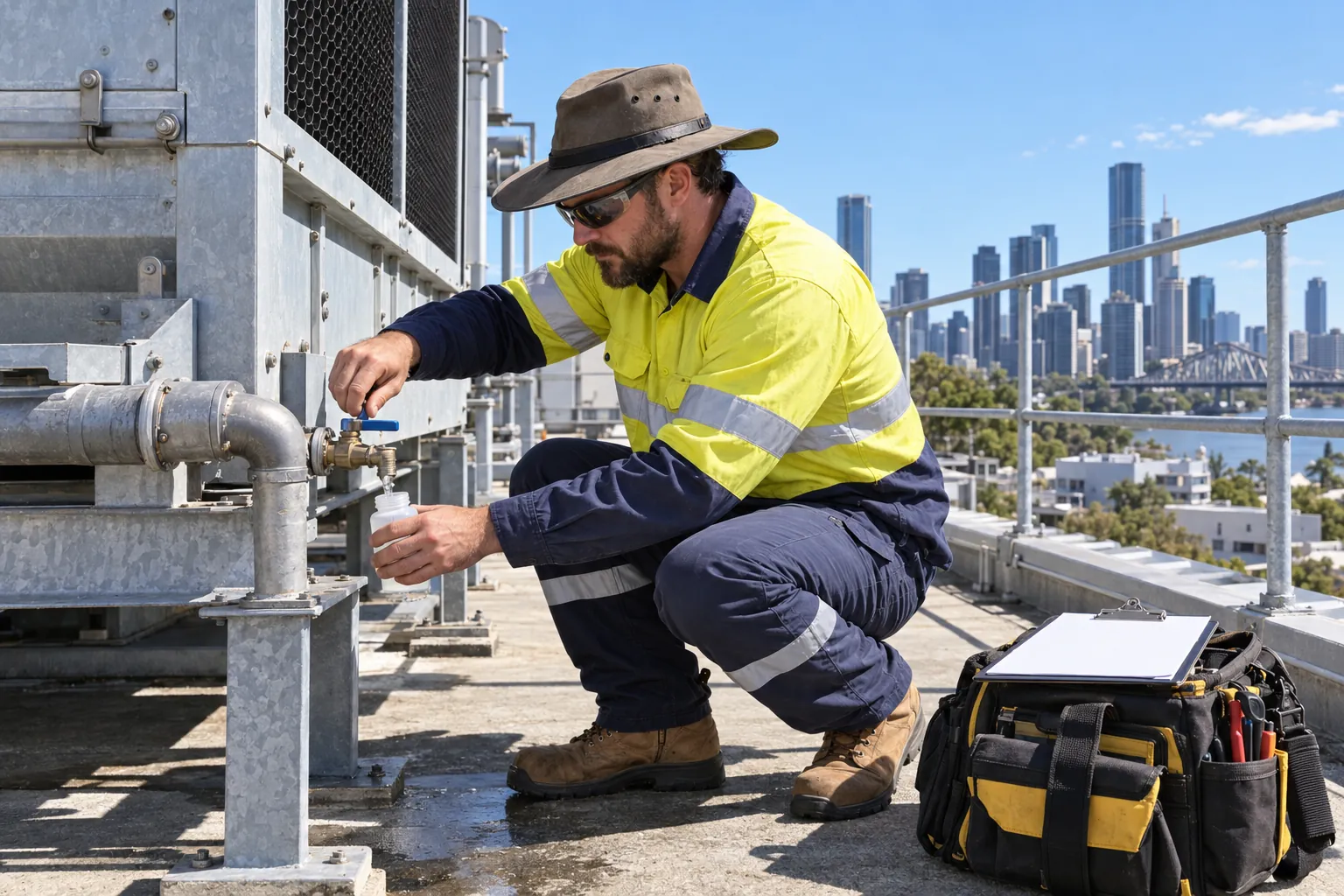
- Cooling towers and warm water systems. This is state public health law, not WHS. In Victoria, the Department of Health's page on cooling tower systems says the Public Health and Wellbeing Act 2008 requires every cooling tower system to be registered with the department, and the owner to develop a risk management plan to control Legionella, audited annually by an independent auditor. In New South Wales, NSW Health's Legionella control pages set out the duties under the Public Health Act and Regulation, including a risk management plan and independent audit.
05
Access, workplace basics, and where the records live
Access. The Disability (Access to Premises – Buildings) Standards 2010 require building certifiers, developers and managers to ensure buildings comply with the Access Code in Schedule 1, which covers access, signage, facilities and lifts. Ask the building surveyor or certifier how they apply to any new work or upgrade that needs building approval. Day to day, the job is keeping what was built working: accessible toilets not used as stores, ramps clear, lifts in service.
Workplace basics. Regulation 41 of the model WHS Regulations requires a PCBU to ensure, so far as is reasonably practicable, "adequate facilities for workers, including toilets, drinking water, washing facilities and eating facilities", and regulation 42 requires first aid equipment, access to it and access to facilities for administering first aid. See our first aid kit checklist.
Where the records live. The problem is rarely that the evidence does not exist; it is that nobody can find it when an inspector or insurer asks, or that it does not say what was done. The Queensland Fire Department's Fire Safety Management Tool with advisory notes (effective September 2025) is blunt about fire hose reels: "The maintenance tag, invoice or summary report are not acceptable as a record of maintenance", though they may indicate routine service is being carried out. A good arrangement has:
- a compliance register listing each item, its duty holder, the standard or law it answers to, its frequency, the date last done and the date next due;
- reports from services, tests and inspections, and certificates, filed against the building and asset, with the contractor's licence or accreditation noted;
- the registers that must be kept at the building, such as the asbestos and hazardous chemicals registers, where they belong and up to date;
- the building's approvals, fire engineering reports, inspection reports and maintenance manuals kept together;
- defects from every service tracked to completion, not just filed.
A service report listing defects is not evidence of compliance until the defects are fixed, so treat the fix as part of the job.
06
Where the record fails, and what SiteClara does about it
The contractor's annual and six-monthly reports tend to be well kept. The weak point is everything in between: the daily walk of the exits, the fire door wedged open, the hose reel blocked by a pallet, the hazard mentioned to whoever was passing. These are the checks an auditor asks about, and the ones often ticked in advance on a sheet on the back of the door, or not recorded at all.
SiteClara records those routine checks where they happen. A printed QR poster at each location, with an NFC tag behind it if you want staff to tap, lets the cleaner, security officer or building staff scan or tap on their own phone, with no app to install, to mark a scheduled check done or say what stopped them, with a photo when the check asks for one. A problem found is reported there and goes onto the team's list of jobs until someone closes it. The supervisor sees what was due, done and missed, can record why a check was missed, and each day approves a report that goes by email to nominated management or client contacts at 8 am the next morning.
07
Questions people ask
Do old buildings have to comply with new building regulations in Australia?
Not generally. The Australian Building Codes Board's General NCC FAQs say the NCC applies primarily to new buildings and "does not generally apply to existing buildings unless they are being altered, extended, or undergoing a change of use." The ongoing duties in this checklist are different: fire safety maintenance, asbestos, plant and WHS duties apply to an existing building now, whenever it was built.
What is the difference between the BCA and the NCC?
The BCA is part of the NCC. The Introduction to the National Construction Code in NCC 2025 says "The Building Code of Australia (BCA) is Volumes One and Two of the NCC and the Plumbing Code of Australia (PCA) is Volume Three of the NCC." Volume One "primarily covers the design and construction of multi-residential, commercial, industrial and public assembly buildings", so for most of the buildings this checklist is written for, the BCA people refer to is NCC Volume One.
Do builders have to comply with Australian standards?
For the design and construction of new work, the NCC is the rule, and it has legal force through state law. The same General NCC FAQs say the NCC "is given legal effect through its adoption into the regulatory frameworks of each state and territory", and that each jurisdiction may exclude, substitute or alter specific provisions. The NCC then calls up Australian Standards as referenced documents: the ABCB's Standards FAQs say that to comply using a Deemed-to-Satisfy Solution, "you must use the specific edition of the standard listed in Schedule 2."
Which Australian standards are mandatory?
For building work, look at the standards the NCC references. The ABCB's Standards FAQs say to "Check Schedule 2 of the NCC", which lists all referenced documents with the version that applies, and that the applicable version "depends on the edition of the National Construction Code (NCC) that your building work complies with." The NCC has three volumes: Volume One for Class 2 to 9 buildings, Volume Two for houses and Class 10 structures, and Volume Three for plumbing and drainage. Maintenance standards such as AS 1851 are called up separately, by each state's fire safety regime, as section 03 explains.
08
Where to read more, and a list to take away
Safe Work Australia publishes the model WHS laws and codes of practice, and each state regulator (SafeWork NSW, WorkSafe Victoria, WorkSafe Queensland, WorkSafe WA and the others) its own guidance. For fire safety, start with the state pages cited in section 03; for cooling towers, your state health department.
To check your building compliance is in order:
- you know the building's class and which fire safety measures its approvals require;
- every item has a named duty holder, checked against the lease or strata by-laws;
- the state's fire safety paperwork is current: the ESM report, the annual fire safety statement, the occupier's statement or the ESP verification, as applies;
- the emergency plan has been tested at the frequency it sets;
- the asbestos register, asbestos management plan and hazardous chemicals register are at the building and up to date;
- each contractor service has a date last done, a date next due and its defects tracked to completion;
- the routine daily and weekly checks between services are recorded as they are done, not afterwards;
- someone reviews the whole register at least quarterly.
Sources
Every document this guide quotes or links to, in the order it first cites them.
- Work Health and Safety Act 2011 (Cth) legislation.gov.au
- Work Health and Safety Act 2011 (Qld) legislation.qld.gov.au
- WorkSafe Victoria's page on the OHS laws worksafe.vic.gov.au
- Occupational Health and Safety Act 2004 (Vic) legislation.vic.gov.au
- National Construction Code 2025, Part A6 ncc.abcb.gov.au
- Country Fire Authority's guidance on essential safety measures for businesses cfa.vic.gov.au
- Building Regulations 2018 (Vic) legislation.vic.gov.au
- Fire safety certification planning.nsw.gov.au
- Building owners and occupiers fire.qld.gov.au
- Building Fire Safety Regulation 2008 (Qld) legislation.qld.gov.au
- Maintenance of fire safety systems mfs.sa.gov.au
- Work Health and Safety Regulation 2011 (Qld) legislation.qld.gov.au
- Work Health and Safety Regulations 2011 (Cth) legislation.gov.au
- Cooling tower systems health.vic.gov.au
- Legionella control health.nsw.gov.au
- Disability (Access to Premises – Buildings) Standards 2010 legislation.gov.au
- Fire Safety Management Tool with advisory notes fire.qld.gov.au
- General NCC FAQs abcb.gov.au
- Introduction to the National Construction Code in NCC 2025 ncc.abcb.gov.au
- Standards FAQs abcb.gov.au
Related guides
 Fire and water checksEssential safety measures in Victoria: the duties, the annual report and the recordsWhat essential safety measures are under Victoria's Building Regulations 2018, who maintains them, the annual ESM report, the records to keep and the checks between.
 Fire and water checksThe annual fire safety statement: what a NSW building owner declares, and how to make it trueWhat a NSW annual fire safety statement declares, which buildings need one, the 3-month assessment window, lodging and display, and the checks that make it true.
 Premises and facilities managementBuilding maintenance checklist: what to check, how often, and who byA building maintenance checklist for Australian commercial and strata buildings: daily to annual tasks, the WHS and fire safety law behind them, and who does each.
 Premises and facilities managementWorkplace inspection checklist: what WHS law asks, what to walk, and what to do nextWorkplace inspections under Australian WHS law: the duties behind them, what the checklist covers, how often, recording findings, and HSRs' right to inspect.