Fire and water checks
TMV testing: what the rules ask for, and how to show the checks were done
TMV testing is the field testing and servicing of a thermostatic mixing valve (TMV) by a licensed plumber, together with routine checks of the water temperature at the outlets it serves, to show that the valve still delivers warm water that is unlikely to scald.
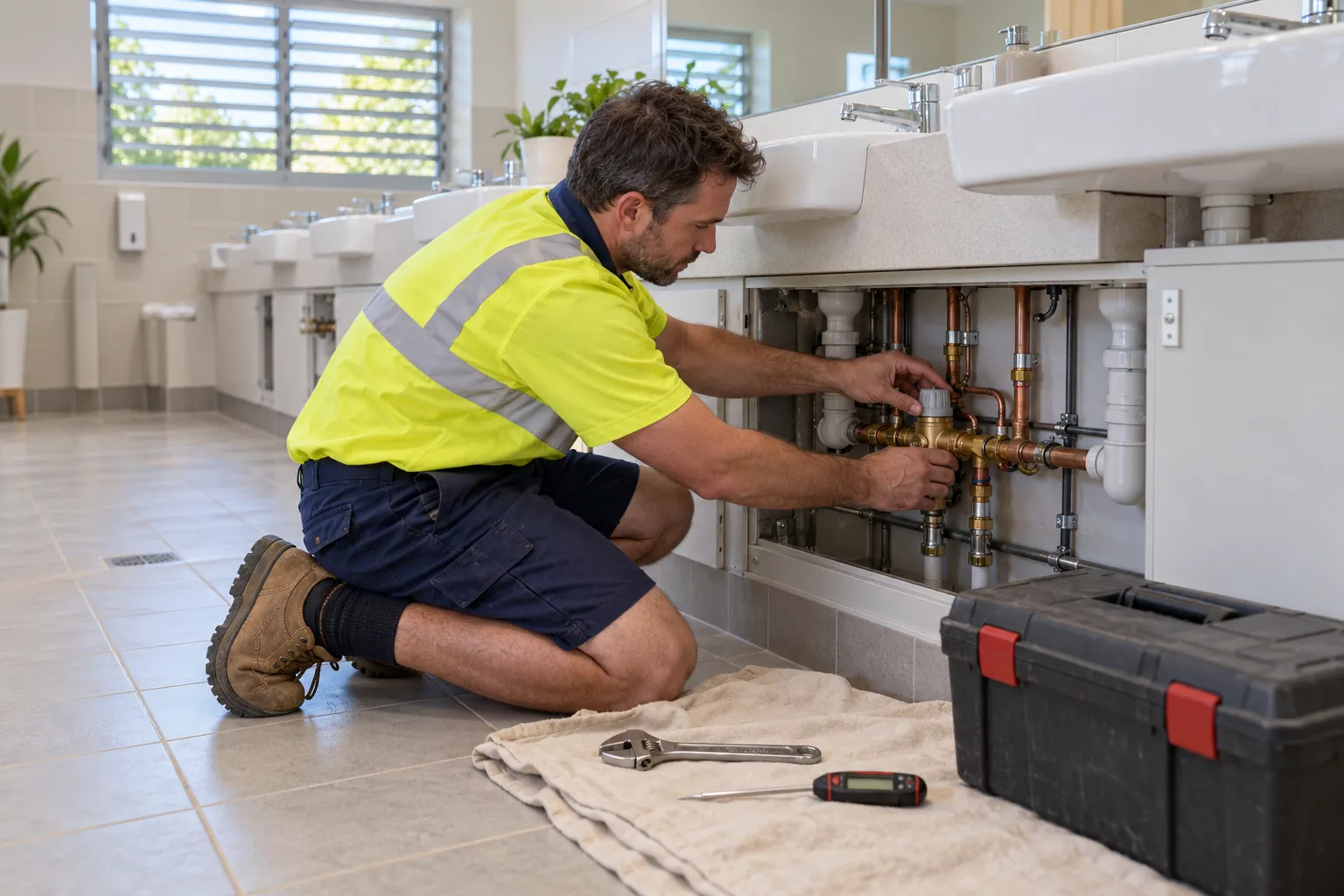
A TMV stands between a hot water system and the people using a basin or shower, and it only protects them while it keeps working: the plumber tests and services each valve, and the building team checks the temperature at the outlet in between. This guide covers where the requirements come from in Australia, what each check involves, who does it, and what a record needs to show.
01
What a TMV is, and where the requirement to test it comes from
A thermostatic mixing valve blends hot and cold water to a preset temperature using a thermostatic element, and adjusts as the supply changes so the water at the outlet stays close to that setting. A good valve also shuts off the hot supply if the cold supply fails, which is the failsafe that prevents a sudden scald. Queensland's Plumbing and Drainage Act 2018 groups TMVs with tempering valves and similar devices as temperature control devices: a mixing valve that "automatically controls the temperature from a mixed water outlet to a preselected temperature using a thermostatic element or sensor".
The duty to fit one comes from the Plumbing Code of Australia, which is Volume Three of the National Construction Code (NCC). In the NCC 2022 Volume Three, Part B2 Heated water services, performance requirement B2P2 says heated water "must be delivered from the point of discharge of fixtures and appliances at a temperature which is unlikely to scald". B2D5 sets the numbers for sanitary fixtures: not more than 45 °C in the residential part of an aged care building, a patient care area in a health-care building, and the parts of an early childhood centre or a primary or secondary school used by children (plus designated accessible facilities in the building classes it lists), and not more than 50 °C in all other cases.
B2D6 says which devices may do the job. Where the 45 °C limit applies, the device must be a thermostatic mixing valve or a thermostatically controlled tap; where the 50 °C limit applies, a tempering valve or a temperature limited water heater will also do. The maximum delivery temperature must be achieved in accordance with AS/NZS 3500.4, and the 2022 text adds that "thermostatic mixing valve work must comply with AS 4032.3", the Australian Standard for field testing, maintenance and replacement.
The code is adopted state by state. The NCC 2025 Volume Three, Part B2 keeps the 45 °C and 50 °C limits, but its B2D6 no longer names AS 4032.3. The ABCB's NCC 2025 state and territory adoption information lists Victoria from 1 May 2026, the ACT and Western Australia from 1 May 2026 with a 12-month transition, South Australia's Plumbing Code (Volume Three) from 1 May 2026, New South Wales, Queensland and Tasmania from 1 May 2027, and the Northern Territory as not adopted. Several states also vary B2D5 and B2D6, so check the edition and variation that applied where the valve was installed.
Once a TMV is in, workplace safety law expects it to be kept working. Under the model WHS laws, as in the Work Health and Safety Act 2011 (Cth) and each state's mirror act, a person conducting a business or undertaking (PCBU) must ensure, so far as reasonably practicable, the health and safety of workers and others, including by providing and maintaining safe plant and structures. Victoria's equivalent is the Occupational Health and Safety Act 2004 (Vic). Hospitals and some other premises have health rules of their own, covered below.
02
What TMV testing covers in practice
"TMV testing" is used loosely for two quite different jobs, testing and maintenance by a plumber and temperature checks by the building team, and most problems start when they are confused:
- Field testing and servicing by a licensed plumber: checking the mixed water temperature against the valve's setting, testing that the valve shuts off when the cold supply is interrupted, cleaning or replacing strainers and check valves, replacing components as the manufacturer requires, and recommissioning. This is the work AS 4032.3 governs.
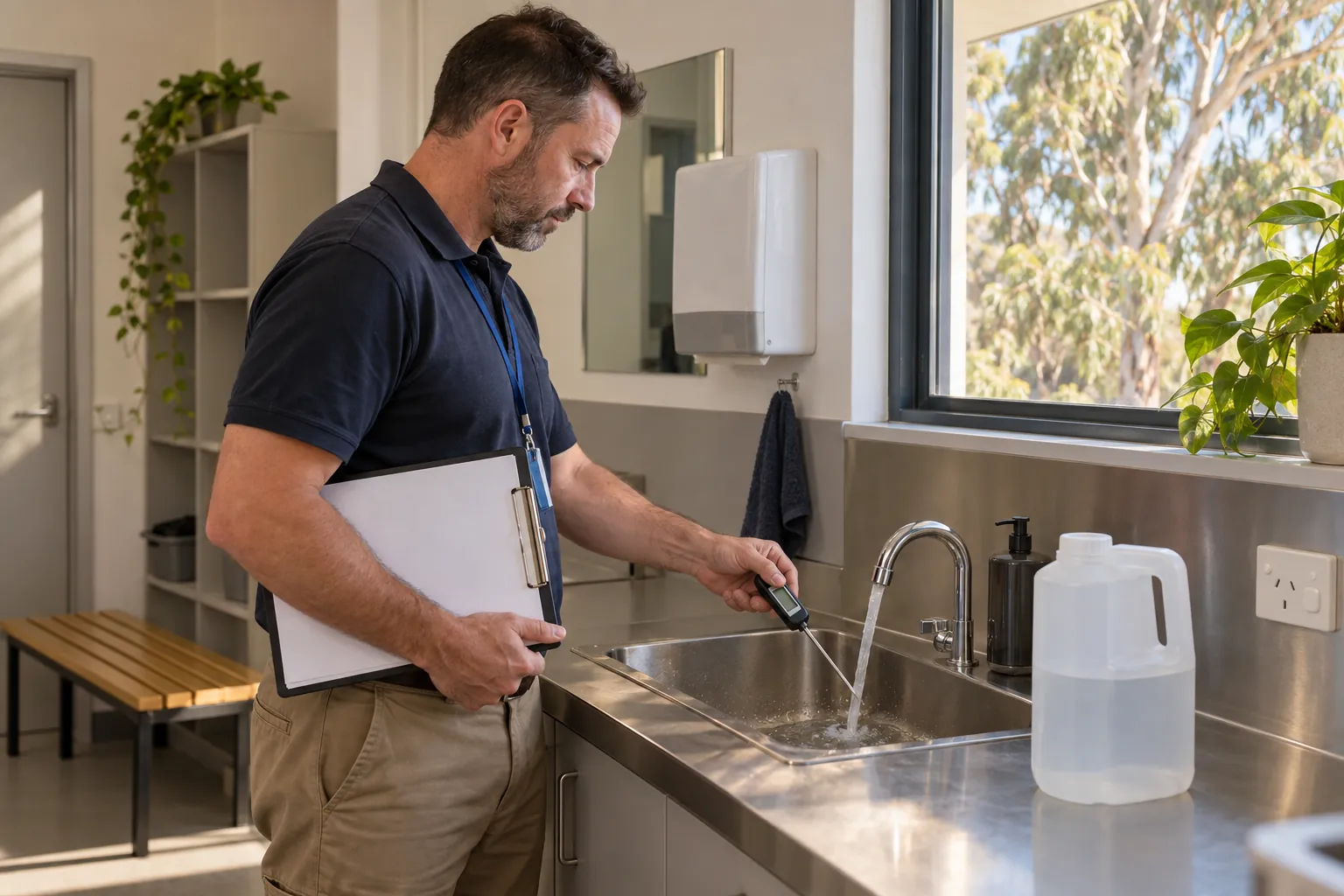
- Routine temperature checks by the building team: running an outlet served by each valve and reading the temperature with a calibrated thermometer, then acting at once if it is out of range. This is what NSW Health requires monthly in hospitals, and what many facility managers ask for elsewhere.
Around those two jobs sit the tasks that make them possible:
- A register of valves: each TMV with its make, model and location (often in a ceiling space or behind an access panel), and the outlets it serves.
- The set temperature and range for each valve, which depends on who uses the outlet.
- Access to plant rooms, ceiling spaces and occupied areas such as wards and change rooms.
- Commissioning and service reports from the plumber for each valve, filed where the next person can find them.
- Out-of-range findings and repairs: what was found, what was done in the meantime, and when the valve went back into service.
- Low-use outlets, which matter for temperature and water quality and often sit in a separate flushing program.
Not every building has TMVs. Offices and shopping centres may use tempering valves on the 50 °C side, so the register should say what is fitted where and which outlets each valve serves.
03
AS 4032.3, frequency and who may do the work
AS 4032.3:2022, Water supply – Valves for the control of heated water supply temperatures, Part 3: Requirements for field-testing, maintenance or replacement of valves, taps and devices, replaced AS 4032.3-2004. Standards Australia summarises it as specifying "the minimum requirements for field-testing, maintenance and replacement of thermostatic mixing valves, tempering valves, thermostatically controlled taps and end-of-line temperature-actuated devices". Its published contents run from a risk assessment through field testing, temperature measuring equipment, the record of test results and repairs, a management system and maintenance, to recommissioning and replacing the temperature actuator.
How often a valve is field-tested is set by the standard, the manufacturer and the owner's own risk assessment, not by an annual or six-monthly figure copied from a website. The 2004 edition's summary said it set the frequency of the work; the 2022 edition opens its field-testing section with a risk assessment. Write the interval for each valve into the maintenance schedule.
The people doing the work need to be qualified for it:
- Queensland: the Plumbing and Drainage Regulation 2019 lists a thermostatic mixing valve endorsement on a plumber's licence, covering "testing, commissioning and maintaining thermostatic mixing valves". The Plumbing and Drainage Act 2018 makes it an offence, unless authorised, to remove a temperature control device or do anything that makes it inoperable (250 penalty units), and requires the owner to take all reasonable steps to keep the plumbing on the premises in good condition.
- New South Wales hospitals: NSW Health requires people commissioning and servicing warm water systems to be licensed plumbers, technically trained by a Registered Training Organisation and experienced in TMV maintenance; others may work only under the direct supervision of such a plumber.
- Everywhere: the work on the valve itself is plumbing work for a licensed plumber under the state's licensing law. The building team's part is the outlet check, not adjusting the valve.
04
The routine temperature check: how NSW Health sets it out
The clearest published method for the building team's check is in NSW Health's policy directive Water – Requirements for the Provision of Cold and Heated Water (PD2015_008). It applies to hospitals as the Public Health Act 2010 defines them, including public and private hospitals and nursing homes, and it was written under the Public Health Regulation 2012, which has since been replaced by the Public Health Regulation 2022. Outside NSW hospitals it is not binding, but it is a sound model for any building with TMVs. It requires site management to institute:
- A monthly safety temperature check of warm water from at least one ablution outlet, preferably a hand basin, served by each warm water system, with the temperature recorded.
- A flow rate of 6 to 10 litres per minute at the outlet, which the directive notes is 12 to 20 seconds to fill a 2 litre jug, confirmed before the temperature is checked and before any cold water is added from a separate source.
- Immediate isolation of the system, which must not be used, where a variation of 2 °C or more from the manufacturer's specified operating range for the patient group is found after a 20 second stabilisation period.
- A service report from the maintenance staff detailing the repairs, parts and other work, and explaining the reason for the variation.
- Acknowledgement by site management of that report, confirming the system is reported to be operating within the required range, before it is returned to service.
The directive's table for patient areas sets warm water for personal hygiene at 38.0 to 40.5 °C with a 43.5 °C thermal shut-off for children, and 40.5 to 45.0 °C with a 46.0 °C shut-off for adults. It also asks each facility to have a warm water management plan covering site auditing, flushing of unused outlets, dead legs, maintenance records, temperature safety checks and scald incident management.
Two further NSW requirements sit alongside. NSW Health's page on Legionella control in warm water systems states that under the Public Health Regulation 2022 "a warm water system must not be installed in a hospital unless it is of a kind approved in writing by the Secretary", and that the occupier must notify the local council when a warm water system is installed or its particulars change. The directive's Attachment 1 is a commissioning and maintenance report form for each TMV, and it notes that AS 4032.3-2004 carried a template in its Appendix E.
05
Warm water systems, log books and what a good record shows
Some states regulate a TMV-fed warm water system as a Legionella risk as well as a scald risk. As NSW Health's Legionella control page puts it, warm water systems, including TMVs, "may allow the growth and transmission of Legionella bacteria". South Australia's South Australian Public Health (Legionella) Regulations 2013 define a warm water system as a reticulated system distributing warm water through most of its branches at a nominal 45 °C by means of a temperature controlling device. Such a system must be registered with the relevant authority for 12 months at a time, and regulation 13 requires the owner to ensure that:
- water in the storage areas is kept at 60 °C or more while the system operates;
- the temperature in storage and throughout distribution is measured at least once every month and recorded in the maintenance log book;
- the system is physically inspected at least once every month for cleanliness and mechanical condition;
- it is thoroughly cleaned whenever an inspection finds sludge, slime, scale or other impurities; and
- it is decontaminated at least every six months by a prescribed or approved procedure.
The log book must be kept on the premises, made available to an authorised officer, and retained for at least five years after the last entry. The regulations do not apply to a Class 1A, 4 or 10 building or a sole-occupancy unit in a Class 2 building, unless the warm water system serves more than one dwelling. Other states handle Legionella in warm water through their own health laws and guidance, so check with the state health department or local council.
Whatever the state, a record that stands up to a question after a scald or a positive sample shows:
- every valve on the register, with its location, outlets and set temperature;
- the plumber's commissioning and service reports, with the date, the licence holder and what was done;
- each routine check: the date and time, the outlet, the reading and who took it;
- every out-of-range reading, with the immediate action, the repair, and who signed it back into service;
- checks missed or not possible, with the reason; and
- for a registered warm water system, the statutory log book.
The weak point is rarely the plumber's report. It is the monthly check in between.
06
Where the record fails, and what SiteClara does about it
The monthly check is where TMV records go wrong. A sheet in the plant room is filled in for the quarter on one afternoon. The same basin is always used because it is nearest the lift. A reading of 48 °C in an aged care bathroom is written down and never reported. When a family, an assessor or an inspector asks what happened on a given day, nothing shows who was at that basin, or when.
SiteClara records those checks at the location. A printed QR poster, with an optional NFC tag behind it, sits at each outlet where a check is scheduled, such as the hand basin served by each valve. Staff scan or tap on their own phone, with no app to install, see the checks due there, and mark each one done or explain what stopped them. The time and the named person are recorded as it happens, with a photo, for example of the thermometer at the outlet, when one is asked for. A reported problem, such as a basin running too hot, goes onto the team's list of jobs until someone closes it.
The supervisor sees what is due, done and missed at each location, and records the reason a check was missed. Each day they review the checks and photos, add a note and approve a report that goes to nominated contacts, such as the owner's facility manager, at 8am the next morning, showing what was reported, what was completed, what is still open, and how the scheduled checks went.
07
Questions people ask
What does TMV mean in plumbing?
TMV stands for thermostatic mixing valve. Section 72 of the Plumbing and Drainage Act 2018 (Qld) does not use the name, but the first temperature control device it lists is a TMV: a mixing valve that "automatically controls the temperature from a mixed water outlet to a preselected temperature using a thermostatic element or sensor". The same section makes it an offence, unless authorised, to remove a temperature control device or make it inoperable.
What is the difference between a TMV and a tempering valve?
The Plumbing and Drainage Act 2018 (Qld) describes them as different kinds of temperature control device without naming them: a mixing valve that uses a thermostatic element or sensor to hold the mixed water at a preselected temperature, which is a TMV, and a mixing valve that is "temperature activated" and uses cold water to deliver hot water "at a lower temperature", which is a tempering valve. Under B2D6 of the NCC 2022 Volume Three, Part B2 Heated water services, only a TMV or a thermostatically controlled tap may be used where water must not exceed 45 °C, such as aged care, health care, early childhood and school areas; a tempering valve is allowed only where the 50 °C limit applies.
How often should a TMV be checked?
NSW Health's Water – Requirements for the Provision of Cold and Heated Water (PD2015_008) requires NSW hospitals and nursing homes to carry out a monthly safety temperature check from at least one ablution outlet served by each warm water system, and to record the temperature. Servicing by a plumber follows the interval set by AS 4032.3:2022, the manufacturer and the owner's risk assessment, and the directive's report form records the date the next service is due.
What are the Australian standards for thermostatic mixing valves?
The NCC 2022 Volume Three, Part B2 Heated water services requires the maximum delivery temperature to be achieved in accordance with AS/NZS 3500.4 and TMV work to comply with AS 4032.3. AS 4032.3:2022 specifies "the minimum requirements for field-testing, maintenance and replacement of thermostatic mixing valves, tempering valves, thermostatically controlled taps and end-of-line temperature-actuated devices".
08
Further reading, and a list to take away
Read Part B2 of the NCC Volume Three edition that applies in your state, with its variations; AS 4032.3:2022 and AS/NZS 3500.4 from Standards Australia; PD2015_008 for New South Wales hospitals and nursing homes; the Queensland plumbing Act and Regulation; the South Australian Legionella regulations; and your state's WHS Act, or in Victoria the Occupational Health and Safety Act 2004.
To check your TMV testing and compliance records are in order:
- every TMV and tempering valve is on a register, with its location, the outlets it serves and its set temperature;
- the edition of the NCC and any state variation that applied at installation is known for each valve;
- a licensed plumber field-tests and services each valve at an interval written into the maintenance schedule, with a report filed for every visit;
- a named outlet served by each valve is checked on a set routine, with a calibrated thermometer and a recorded reading;
- an out-of-range reading takes the outlet out of use at once and goes to someone who will act on it;
- no valve is signed back into service without the plumber's report and a named person's acknowledgement;
- missed checks are recorded with a reason, not quietly filled in later;
- where a state registers warm water systems, the statutory log book is kept and retained as its regulations require.
Sources
Every document this guide quotes or links to, in the order it first cites them.
- Plumbing and Drainage Act 2018 legislation.qld.gov.au
- NCC 2022 Volume Three, Part B2 Heated water services ncc.abcb.gov.au
- NCC 2025 Volume Three, Part B2 ncc.abcb.gov.au
- ABCB's NCC 2025 state and territory adoption information ncc.abcb.gov.au
- Work Health and Safety Act 2011 (Cth) legislation.gov.au
- Occupational Health and Safety Act 2004 (Vic) legislation.vic.gov.au
- AS 4032.3:2022 store.standards.org.au
- Plumbing and Drainage Regulation 2019 legislation.qld.gov.au
- Water – Requirements for the Provision of Cold and Heated Water (PD2015_008) www1.health.nsw.gov.au
- Legionella control in warm water systems health.nsw.gov.au
- Legionella control health.nsw.gov.au
- South Australian Public Health (Legionella) Regulations 2013 legislation.sa.gov.au
Related guides
 Fire and water checksCooling tower requirements: what the law asks for, and how to show the maintenance was doneCooling tower maintenance in Australia: the NSW, Victorian and SA rules, AS/NZS 3666, monthly testing, risk management plans, audits and a record that holds up.
 Premises and facilities managementPreventative maintenance: how to plan it for a building and prove it was donePreventative maintenance for Australian buildings: the WHS duty, the asset register and schedule, statutory and discretionary tasks, and keeping good records.
 Premises and facilities managementBuilding maintenance checklist: what to check, how often, and who byA building maintenance checklist for Australian commercial and strata buildings: daily to annual tasks, the WHS and fire safety law behind them, and who does each.
 Premises and facilities managementWorkplace amenities: what the law asks for, and how to keep them clean and workingWorkplace amenities under Australian WHS and OHS law: what must be provided, the numbers the codes give, who cleans and maintains them, and what a good record shows.