Premises and facilities management
Preventative maintenance: how to plan it for a building and prove it was done
Preventative maintenance, also called preventive maintenance, is regular, scheduled work on a building, its plant and its services to prevent failures before they occur.
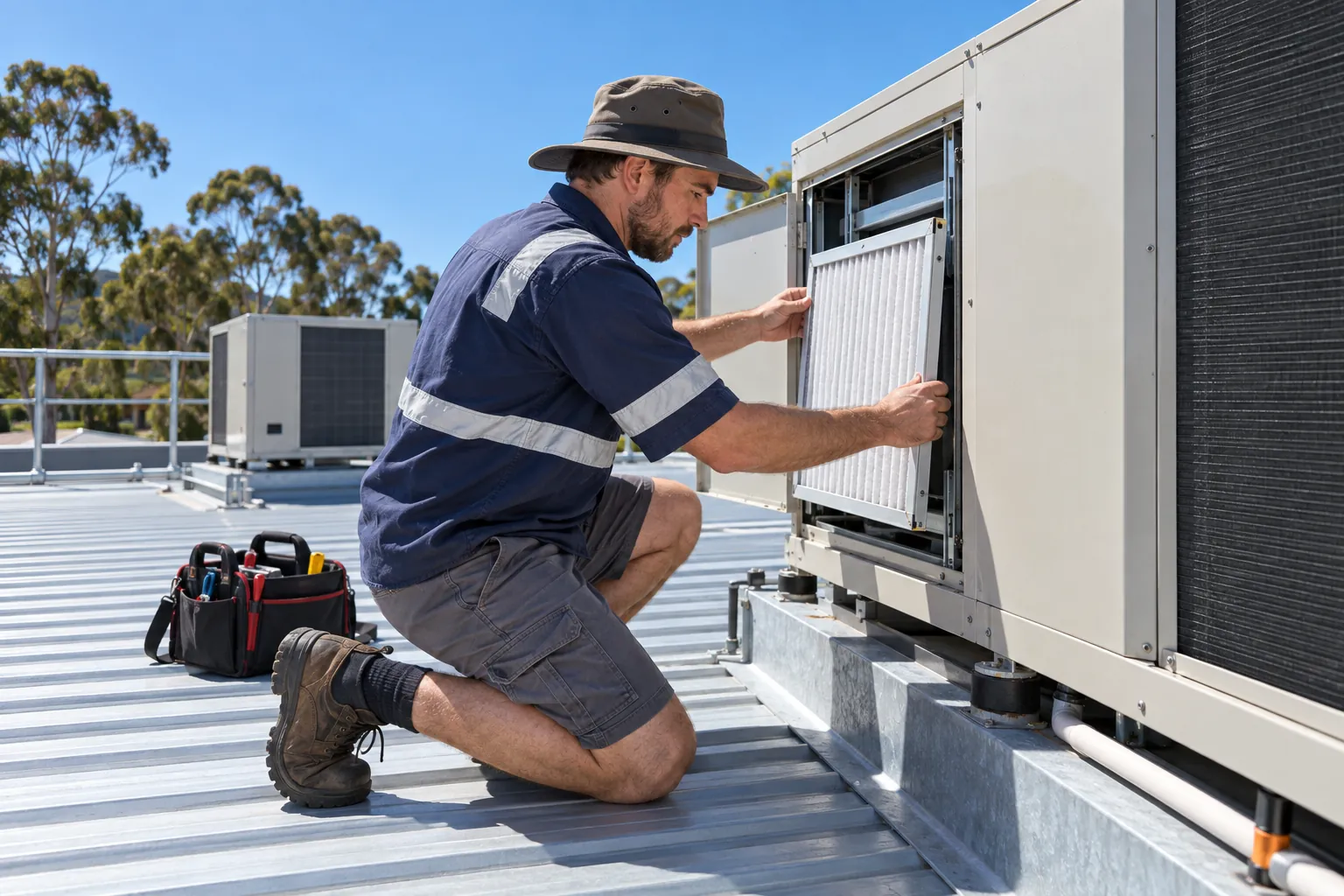
This guide explains where the duty comes from under Australian work health and safety and building law, what a program covers, how to build an asset register and a maintenance schedule, which tasks are required and which are a choice, and what a record of the work should show.
01
What preventative maintenance is, and where the duty comes from
Preventative maintenance, also called planned maintenance or planned preventative maintenance (PPM), is maintenance carried out at set intervals to keep a building, its plant and its equipment safe and in working order, and to prevent failures and unexpected breakdowns before they occur. It is the opposite of reactive maintenance, where work happens after something has failed. It is a proactive approach: regular inspections and servicing find worn parts and small problems while they are still minor, which helps keep operating costs down and extends the lifespan of plant. An air handling unit with its filters changed every quarter, a fire services contractor visiting every month under AS 1851, box gutters cleared before the storm season and emergency lights tested on the cycle their standard sets are all preventative maintenance.
Preventative maintenance can be triggered in different ways. Most building tasks are time-based, done weekly, monthly or yearly on a calendar. Some are usage-based, such as a generator serviced after a set number of operating hours. Condition-based maintenance, and predictive maintenance, its more data-driven form, go further: they monitor an asset's condition, through readings such as vibration, temperature or oil analysis, and schedule work when those readings show wear rather than at a fixed interval. They suit large, critical plant such as chillers; for most building services, a calendar schedule is simpler to run and to evidence.
The phrase covers two related things:
- Services maintenance: the routine servicing, inspection and testing of building services and equipment, such as air conditioning and ventilation, hot and cold water, electrical switchboards, fire protection systems, lifts and emergency lighting. Trades and specialist contractors deliver it to a schedule of tasks and frequencies.
- Long-term maintenance planning: a plan over five, ten or more years for the building fabric and major components, such as roof sheeting, facades, lifts, chillers and repainting. In strata, body corporate and owners corporation buildings this usually sits in a capital works or sinking fund plan prepared from a condition assessment.
The general work health and safety laws do not use the words preventative maintenance, but the duty to maintain is real. In every state and territory except Victoria, the model work health and safety (WHS) laws apply. Queensland's version shows the wording. Section 19 of the Work Health and Safety Act 2011 (Qld) requires a person conducting a business or undertaking (PCBU) to ensure, so far as is reasonably practicable, "the provision and maintenance of safe plant and structures" and "the provision and maintenance of a work environment without risks to health and safety". Section 21 puts a matching duty on the PCBU with management or control of fixtures, fittings or plant at a workplace to ensure, so far as is reasonably practicable, that they "are without risks to the health and safety of any person".
The regulations make the plant duty specific. Section 213 of the Work Health and Safety Regulation 2011 (Qld) says the person with management or control of plant at a workplace "must ensure that the maintenance, inspection and, if necessary, testing of the plant is carried out by a competent person". That work must follow the manufacturer's recommendations, if there are any; failing those, the recommendations of a competent person; and, for inspection where neither is reasonably practicable, it must happen annually. Section 41 adds that workers' facilities, such as toilets, drinking water, washing and eating facilities, must be maintained so as to be "in good working order" and "clean, safe and accessible". Check your own jurisdiction's WHS regulation, which follows the same model.
Victoria is the exception. It has its own Occupational Health and Safety Act 2004 (version 045 at August 2025) and its own regulations, so a Victorian building should be checked against those rather than the WHS model. On top of the workplace law, each state's building and fire safety rules require fire safety measures to be maintained, which is covered below.
02
What a preventative maintenance program covers
Examples of preventative maintenance in a typical office, school, shopping centre, hospital or strata building include:
- Air conditioning and ventilation: filter changes, belt and bearing checks, coil and drain tray cleaning, and the microbial control of air-handling and water systems.
- Water systems: hot water units, thermostatic mixing valves, backflow prevention devices, pumps, and cooling towers where the building has them.
- Electrical: switchboard inspection, thermal scanning where the risk calls for it, and inspection and testing of portable equipment and residual current devices (RCDs).
- Fire safety systems: sprinklers, hydrants, hose reels, fire detection and alarm systems, extinguishers, fire and smoke doors, and emergency lighting and exit signs.
- Lifts, escalators and moving walkways: routine servicing by the lift contractor and the checks that go with their registration.
- Building fabric: roofs, box gutters and downpipes, stormwater pits, facades, windows, doors and door closers, floors and stair nosings.
- Security and access control: roller doors, boom gates, card readers, CCTV and intruder alarms.
- Specialist plant: generators, pressure vessels and boilers, kitchen exhaust, and anything the manufacturer has asked to be serviced at set intervals.
The list for your building comes from what is actually in it. That is why every good program starts with an asset register.
03
Building an asset register and a maintenance schedule
A preventative maintenance schedule answers four questions for every asset: what is it, where is it, what does it need and how often. Building one is careful, methodical work:
- Survey the building and its assets. Walk every floor, plant room, riser and roof, and list each asset: type, make and model, location, age, condition and any registration number. A list inherited from a previous contractor is a starting point, not a register.
- Identify the required tasks. For each asset, note what the law, the building's fire safety schedule or maintenance determination, and the relevant Australian Standard require, with the frequency and where it comes from.
- Follow the manufacturer's recommendations. Section 213 of the Queensland regulation makes them the first reference for plant. They also set service intervals, consumables and warranty conditions, and a missed service can void a warranty.
- Decide the discretionary tasks. Some maintenance is sensible but not compulsory. Decide which you will do, and how often, based on how critical the asset is to the building's operations, what a failure would cost and the resources you have to do the work.
- Assign each task. Name the in-house team or contractor responsible, and check they are competent and, where the work calls for it, licensed.
- Put it in a calendar. Group tasks by building, trade and season, so maintenance teams are not sent to the same plant room three times in a month, and time disruptive work for when the building is quiet. In the north, schedule roof, gutter and tie-down checks before the wet season and cyclone season.
Who runs the program depends on the building. In a commercial building with several tenants, the owner or its property manager usually maintains the base building services and common areas, and the lease decides what each tenant looks after inside its own premises. In strata buildings, common property is maintained by the owners' governing body (an owners corporation in NSW and Victoria, a body corporate in Queensland, a strata company in WA), usually through the strata or body corporate manager and, in larger schemes, an on-site building manager or caretaker. Read the lease, the by-laws or the caretaking agreement before assuming.
Larger organisations usually hold the asset register and the schedule in maintenance management software, a computerised maintenance management system (CMMS) or computer-aided facilities management (CAFM) system, which issues the work orders, records their completion and keeps the data on each asset's history in one place. A small site can manage with a well-kept spreadsheet, provided someone owns it and keeps it current when assets are added, replaced or removed.
04
Statutory and discretionary tasks
The most useful distinction in any maintenance strategy is between tasks the law requires and tasks you choose to do. Statutory tasks are not negotiable when budgets are tight; discretionary tasks are where judgement comes in.
Typical statutory or legally driven tasks in an Australian non-domestic building include:
- Fire safety measures: routine service under AS 1851-2012 Routine service of fire protection systems and equipment, which Standards Australia describes as setting out "requirements for inspection, testing, preventive maintenance and survey of fire protection systems and equipment". Each state calls it up in its own way: essential safety measures in Victoria, the annual fire safety statement in NSW, and the occupier statement in Queensland.
- Emergency lighting and exit signs: periodic inspection and maintenance under AS/NZS 2293.2:2019 Emergency lighting and exit signs for buildings, Part 2: Routine service and maintenance.
- Registered plant: lifts, escalators and moving walkways, and boilers and pressure vessels in the higher hazard levels, are among the items of plant requiring registration in schedule 5 of the Queensland WHS regulation. For registered plant, section 237 requires the person with management or control to keep "a record of all tests, inspections, maintenance, commissioning, decommissioning, dismantling and alterations of the plant" for as long as the plant is used or until they give up control of it.
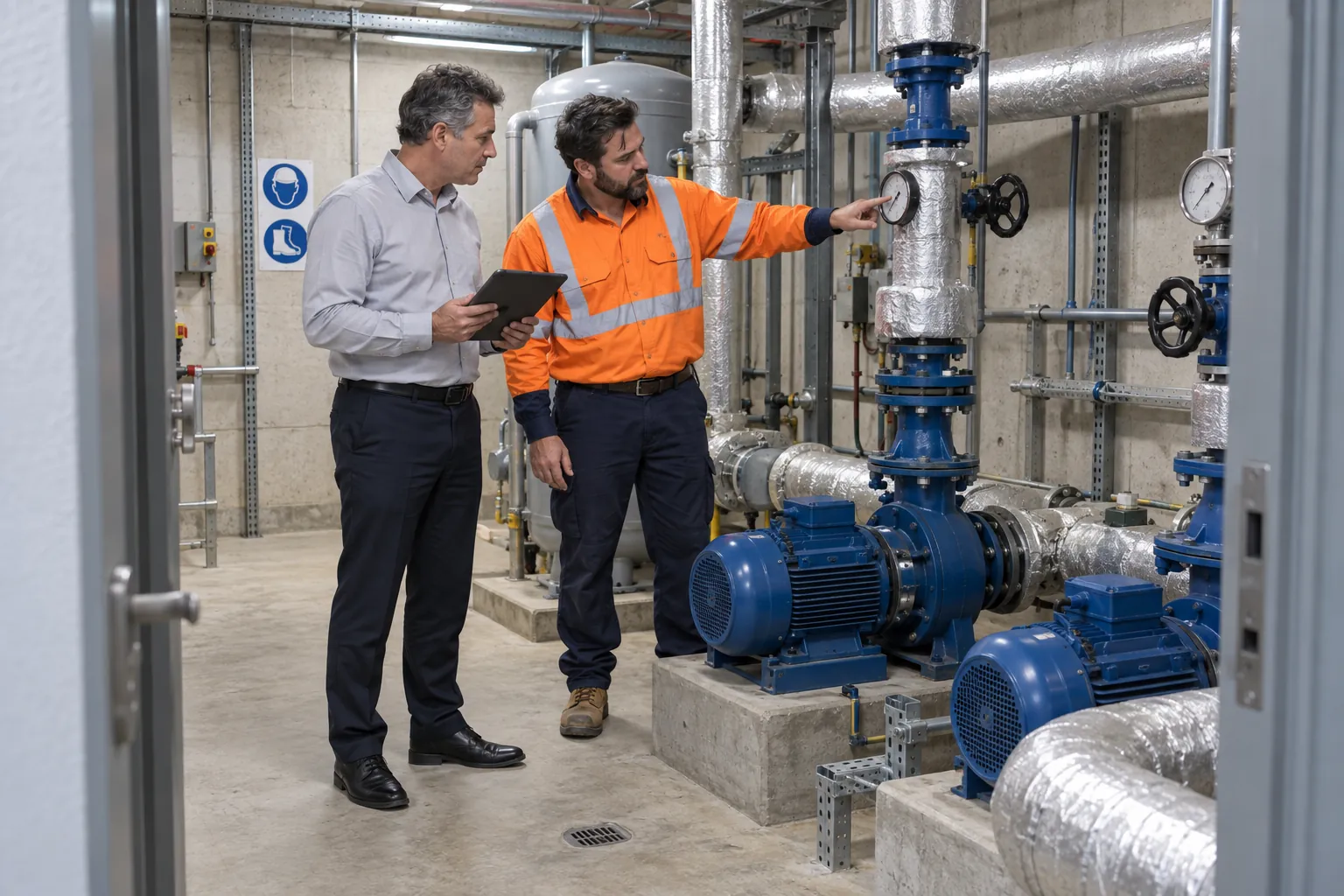
- Air-handling and water systems: microbial control following AS/NZS 3666.2:2011 Air-handling and water systems of buildings – Microbial control, Part 2: Operation and maintenance and, for cooling towers and other cooling water systems, the public health rules of your state, which differ from state to state.
- Electrical equipment: in-service inspection and testing, often called test and tag, under AS/NZS 3760:2022 In-service safety inspection and testing of electrical equipment and RCDs, where your state's electrical safety or WHS rules and the working environment call for it.
- Workers' facilities: keeping toilets, washing, drinking water and eating facilities in good working order and clean, safe and accessible, as section 41 of the Queensland regulation requires.
Discretionary tasks include much of the routine servicing that keeps plant running at its designed performance and energy efficiency and extends its life: cleaning coils, adjusting controls, lubricating door closers, clearing gutters before they overflow. None of them is required by name, but skipping them is how minor wear turns into leaks, breakdowns, downtime, costly repairs and emergency call-outs. Planned work can also be timed to avoid disrupting the building; an emergency repair cannot.
05
How completion is evidenced
A preventative maintenance program is only as credible as its records. When an insurer, an auditor, a WHS inspector, the fire authority or an owners' committee asks whether a task was done, the answer needs to be more than a tick on a planner.
Fire safety is where the law is most specific, and it shows what a good record looks like. In Victoria, regulation 225 of the Building Regulations 2018 (version 031, 1 September 2026) requires the owner to make available, within 24 hours of a request by the municipal building surveyor or the chief officer, the annual essential safety measures reports for the past 10 years, the maintenance schedules and determinations, and "the records of all inspections, testing and maintenance (including repairs)". In Queensland, section 55 of the Building Fire Safety Regulation 2008 requires the occupier to keep a record of maintenance for each prescribed fire safety installation, stating what was maintained, who did it and their licence number, the date, what was done, and the results, including whether the installation was in proper working order and any repairs or corrective action needed and taken. Section 54 of the same regulation requires that corrective action to be taken within one month unless the occupier has a reasonable excuse.
Outside fire safety, the same pattern makes good evidence for any preventative maintenance task:
- The job record: the asset, the date, who did the work, what they found and what they did about it.
- Certificates and reports: for statutory work, the document the competent or licensed person issues, filed against the asset it relates to.
- Defects and follow-up: faults found during maintenance visits, the remedial work raised, and when it was closed. A report listing defects that were never fixed is worse evidence than no report.
- Log books on site: the fire services log book, emergency lighting records and plant registration papers, kept up to date where they are required to be.
- Completion against plan: a monthly report showing tasks due, completed and overdue, by site and by trade.
A completion rate on its own tells you little. The questions worth asking of a monthly maintenance report are which tasks were missed, whether any were statutory, and what happened to the defects that were found.
Review the program at least once a year. Assets change, buildings change use, and a frequency that made sense five years ago may now be too often for a lightly used system or not often enough for a critical one.
06
Where the record fails, and where SiteClara fits
Maintenance records are usually strongest for the contractor's visit and weakest for the small, frequent checks in between: the building manager's weekly walk through the plant room, the look at the box gutters after a storm, the check that the fire doors on each floor still close and latch, the tap flushed in a little-used amenity. Those are often recorded on a sheet on a clipboard, if at all, and a problem found on one is passed on to whoever happens to be nearby.
SiteClara records those routine checks. A printed QR poster at each location, with an NFC tag behind it if you want staff to tap, lets staff scan or tap on their own phone, with no app to install, to mark a scheduled check done or say what stopped them. They can report an issue with a photo, and it goes onto the team's list of jobs until someone closes it. The supervisor sees what was due, done and missed, and each day an approved report goes to nominated management or client contacts at 8am the next morning.
07
Questions people ask
Is it preventative or preventive maintenance?
Both words mean the same thing: maintenance done on a schedule to stop a failure before it happens. Standards Australia uses preventive, describing AS 1851-2012 Routine service of fire protection systems and equipment as setting out requirements for "inspection, testing, preventive maintenance and survey of fire protection systems and equipment". This guide uses preventative throughout.
What are five examples of preventive maintenance?
Five common examples in an Australian building, each with a document behind it: the routine service of fire protection systems and equipment under AS 1851-2012 Routine service of fire protection systems and equipment; the periodic inspection and maintenance of emergency lighting under AS/NZS 2293.2:2019 Emergency lighting and exit signs for buildings, Part 2: Routine service and maintenance, so that it is "in a state of readiness for operation at all times"; the operation and maintenance of air-handling and water systems for microbial control under AS/NZS 3666.2:2011 Air-handling and water systems of buildings – Microbial control, Part 2: Operation and maintenance; the in-service inspection and testing of electrical equipment and RCDs under AS/NZS 3760:2022 In-service safety inspection and testing of electrical equipment and RCDs; and the maintenance, inspection and, where necessary, testing of plant by a competent person that section 213 of the Work Health and Safety Regulation 2011 (Qld) requires, following the manufacturer's recommendations where there are any.
What is corrective maintenance?
Corrective maintenance is the repair that follows when a fault is found, whether on a scheduled visit or after a breakdown, and the law can set a deadline for it. In Queensland, section 54 of the Building Fire Safety Regulation 2008 requires the occupier to ensure that any repair or corrective action shown on a fire safety installation's record of maintenance is carried out no later than one month after the maintenance, unless the occupier has a reasonable excuse. Section 53 requires the person maintaining the installation to give the occupier a critical defect notice within 24 hours after carrying out the maintenance when they become aware, or ought reasonably to be aware, of a critical defect in it.
08
Further reading, and a list to take away
Safe Work Australia publishes the model WHS Act, the model WHS Regulations and the model codes of practice, including the one on managing risks of plant in the workplace; your state or territory regulator publishes its own version and guidance. For the law itself, read your jurisdiction's WHS Act and regulation, or in Victoria the Occupational Health and Safety Act 2004. For fire safety maintenance, read your state's building and fire safety rules, such as the Building Regulations 2018 (Vic) and the Building Fire Safety Regulation 2008 (Qld), alongside AS 1851-2012.
To check your preventative maintenance is in order:
- every asset is on a register, checked on site, with its location;
- every statutory task is identified, with its frequency and where it comes from;
- the manufacturer's recommendations are on file for each item of plant;
- each task has a named owner who is competent, and licensed where required;
- discretionary tasks are chosen deliberately, not inherited;
- certificates, reports and plant records are filed against the asset they relate to;
- defects found on maintenance visits are raised, tracked and closed;
- overdue statutory tasks are reported by name, not buried in a percentage;
- the schedule is reviewed at least once a year.
Sources
Every document this guide quotes or links to, in the order it first cites them.
- Work Health and Safety Act 2011 (Qld) legislation.qld.gov.au
- Work Health and Safety Regulation 2011 (Qld) legislation.qld.gov.au
- Occupational Health and Safety Act 2004 legislation.vic.gov.au
- AS 1851-2012 Routine service of fire protection systems and equipment store.standards.org.au
- AS/NZS 2293.2:2019 Emergency lighting and exit signs for buildings, Part 2: Routine service and maintenance store.standards.org.au
- AS/NZS 3666.2:2011 Air-handling and water systems of buildings – Microbial control, Part 2: Operation and maintenance store.standards.org.au
- AS/NZS 3760:2022 In-service safety inspection and testing of electrical equipment and RCDs store.standards.org.au
- Building Regulations 2018 legislation.vic.gov.au
- Building Fire Safety Regulation 2008 legislation.qld.gov.au
Related guides
 Premises and facilities managementReactive maintenance: how to run it well in an Australian buildingReactive maintenance in Australian buildings: the WHS and strata duties, priorities and response times, make-safes, contractors, asbestos and closing the loop.
 Premises and facilities managementBuilding maintenance checklist: what to check, how often, and who byA building maintenance checklist for Australian commercial and strata buildings: daily to annual tasks, the WHS and fire safety law behind them, and who does each.
 Premises and facilities managementBuilding compliance checklist: the duties that come with an Australian buildingA building compliance checklist for Australian commercial buildings: WHS duties, fire safety maintenance by state, asbestos, plant, water, access and the records.
 Fire and water checksAS 1851 routine service: what it asks of owners, fire contractors and building teamsWhat AS 1851-2012 routine service covers, how intervals and competent persons work, what the records must show, and how Victoria's regulations call it up.