Fire and water checks
Essential safety measures in Victoria: the duties, the annual report and the records
Essential safety measures, or ESM, are the fire and life safety features of a building – fire doors, exit signs, emergency lighting, sprinklers, hose reels and the like – that Victoria's Building Regulations 2018 require building owners to keep working so that occupants are safe in a fire.
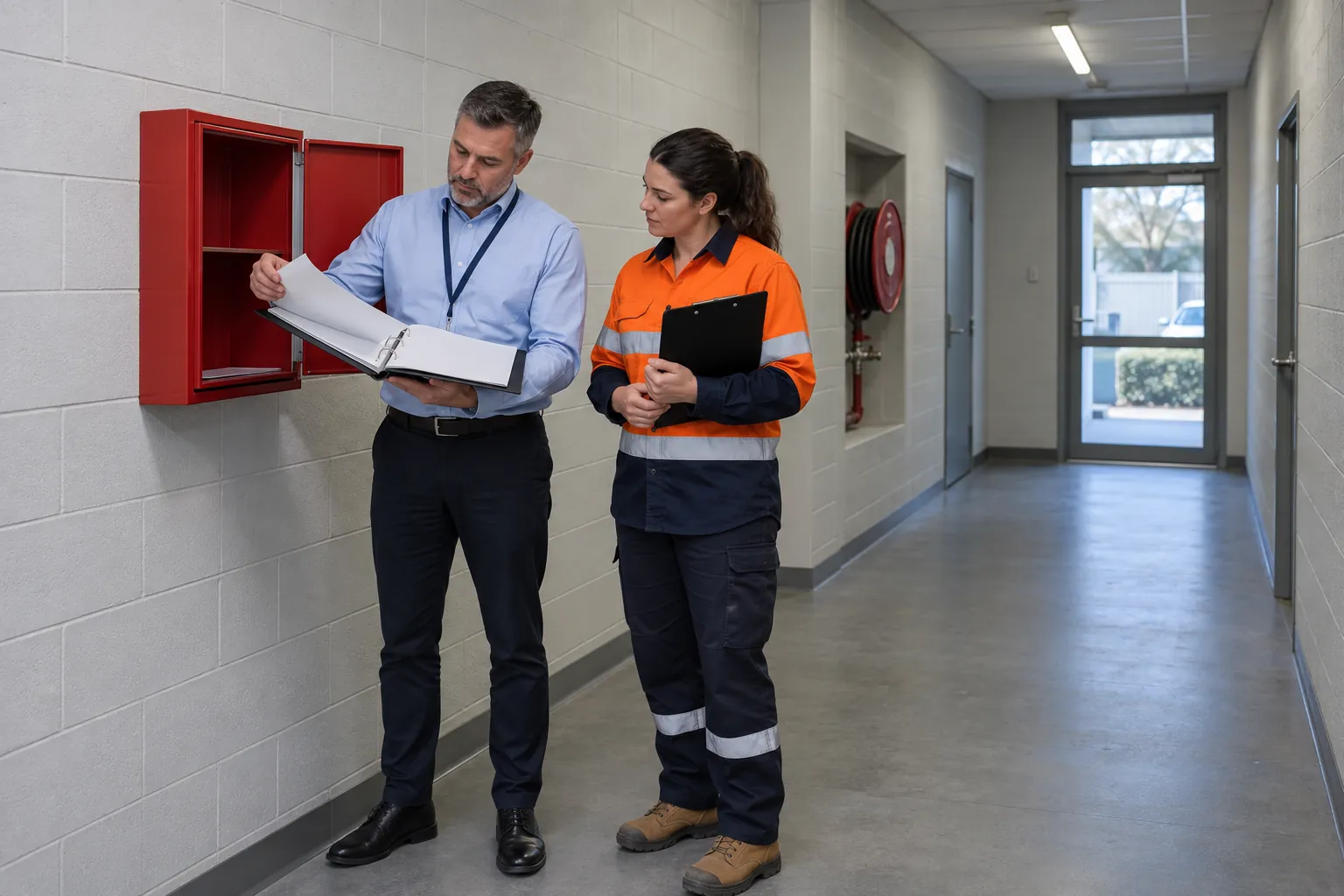
Part 15 of the Regulations sets the legal obligations: the owner keeps each measure maintained, has an annual essential safety measures report prepared and produces the records within 24 hours when asked, and the occupier keeps every exit clear. This guide explains what counts as an essential safety measure, who does what, what the annual report must say, and how to keep a record that holds up.
01
What essential safety measures are
Essential safety measures are Victoria's term, set out in Part 15 of the Building Regulations 2018 (Vic) (version 031, in force from 1 September 2026). Regulation 214 defines an essential safety measure as a safety measure listed in Schedule 8 that is required by or under the Building Act 1993 (Vic) or the Regulations for a building or a place of public entertainment. It also takes in any other fire safety item the relevant building surveyor designates, and any measure required before 1 July 1994.
The regime is Victorian. New South Wales has the annual fire safety statement, Queensland its Building Fire Safety Regulation, and other states their own laws, though most lean on the same servicing standard, AS 1851. Outside Victoria the ideas carry over; the forms, dates and penalties do not.
Division 1 of Part 15 applies to Class 1b, 2, 3, 5, 6, 7, 8 and 9 buildings, to a Class 4 part of a building, and to places of public entertainment (regulation 213). In the National Construction Code 2025, Part A6 classifications, that covers small guest houses, apartment buildings, hotels, offices, shops, storage and process buildings, and buildings of a public nature such as schools and hospitals. One item is left out: a smoke alarm inside a sole-occupancy unit of a Class 1b or 2 building, or in a Class 4 part.
Which measures a building has, and how each must be looked after, is in the building's own documents: the occupancy permit issued for it, and any maintenance determination and the maintenance schedule prepared by the building surveyor. That is where an owner, a strata manager or a facility manager starts.
02
What counts as an essential safety measure
Schedule 8 lists the safety measures in twelve parts, and it is broader than fire equipment: a stair handrail, a door closer and a lift sign are on it with the sprinklers.
- Building fire integrity: fire-resisting elements, fire and smoke doors with their closers and latches, fire windows and shutters, solid core doors, and fire protection at service penetrations.
- Means of egress: paths of travel to exits and from them to the road, exits themselves (stairways, ramps, treads, balustrades and handrails), smoke lobbies, and doors on the way out.
- Signs: exit and direction signs, lift warning signs, re-entry signs and door signs.
- Lighting: emergency lighting.
- Fire fighting services and equipment: the fire hydrant system with its pump set and booster connection, the fire hose reel system, the sprinkler system, portable fire extinguishers and the fire control centre or room.
- Air-handling systems: smoke hazard management systems such as stair pressurisation and smoke exhaust, and car park ventilation.
- Automatic fire detection and alarm systems: smoke and heat alarm and detection systems.
- Occupant warning systems: the emergency sound and intercom system and the building occupant warning system.
- Lifts: stretcher facilities, emergency lifts and the passenger lift fire service controls.
- Standby power supply system.
- Building clearance and fire appliances: open space and vehicle access around large isolated buildings.
- Mechanical ventilation and hot, warm and cooling water systems: mechanical ventilation systems incorporating cooling towers or hot and warm water systems.
No building has all of these. A small office may have exits, signs, emergency lighting and extinguishers; a high-rise apartment tower most of the list. The measures that apply to your building are those specified in its occupancy permit, a maintenance determination or, for an older building, the maintenance schedule.
The Country Fire Authority's guidance on essential safety measures for businesses notes that the documents are commonly kept in a red essential safety measures box near the front entry or in another commonly accessible space.
03
Who does what: owner, occupier, building surveyor and contractor
The relevant building surveyor sets the requirements. For a building with an occupancy permit, regulation 194 requires the permit to specify every essential safety measure provided under the building permit, the level of performance each must achieve to fulfil its purpose, and the frequency and type of inspection, testing and maintenance for each. Where a measure is added or altered under a building permit that needs no occupancy permit, or under an emergency or building order, the surveyor issues a maintenance determination with the same three elements (regulation 215). The surveyor then prepares a maintenance schedule listing every measure and its maintenance requirements (regulations 218 and 222) and gives the owner a copy without delay (regulation 221).
The owner keeps each measure working. Regulation 226 requires the owner to ensure that every essential safety measure required under the Act is "maintained in a state which enables the essential safety measure to fulfil its purpose". (The offence does not apply where the measure is subject to a maintenance determination, or where the occupancy permit makes maintenance a condition on the occupier and the owner occupies the building.) Regulation 227 requires the owner to make sure no measure is removed from its approved location except for inspection, testing or maintenance: an extinguisher moved to prop open a door is the everyday example. Regulation 195 makes inspection, testing and maintenance as specified a condition of the occupancy permit, and regulation 216 does the same for a maintenance determination. Each of regulations 216, 223, 225, 226 and 227 carries a penalty of 20 penalty units.
The occupier keeps the exits clear. The occupier of a Class 1b, 2, 3, 5, 6, 7, 8 or 9 building or place of public entertainment must ensure that every required exit, every path of travel to an exit, and every path from an exit across the site to a road is "kept readily accessible, functional and clear of obstructions so that egress from the building or place is maintained" (regulation 228, which also carries 20 penalty units). That may be a tenant, a school or a shopping centre operator, not the landlord.
Leases and owners corporations. The CFA says owners and owners corporations are generally responsible for keeping the measures in good working order, that a lease sometimes makes them the tenant's, and that the lease should say who holds the documentation. A lease does not change what the Regulations require of the building, so both sides should know which of them is keeping which record.
The fire services contractor services the equipment. Where the permit or determination names AS 1851-2012, the Standards Australia description is that it "sets out requirements for inspection, testing and preventive maintenance of fire protection systems and equipment". Where the documents call up AS 1851-2005 or earlier, regulations 196 and 217 let the owner work to AS 1851-2012 instead, and once they do they must continue to. Other measures have their own standards: the CFA points to AS/NZS 2293 for exit signs and emergency lighting.
The employer has a wider duty. Section 21 of the Occupational Health and Safety Act 2004 (Vic) requires an employer, so far as is reasonably practicable, to provide and maintain a working environment that is safe and without risks to health. Victoria has its own OHS Act, not the model WHS laws.
04
The annual essential safety measures report
Regulation 223 requires the owner of a building with essential safety measures required by an occupancy permit or a maintenance determination to ensure that an annual essential safety measures report is prepared within 28 days before each anniversary of the relevant anniversary date. That date is the earlier of the issue of the first occupancy permit (or amendment) that required a measure, and the making of the first maintenance determination that required one. For a building constructed before 1 July 1994 with measures required under earlier law, the report is due within 28 days before 13 June each year.
Regulation 224 says what the report must be and contain:
- in a form approved by the Authority (named in the Act as the Victorian Building Authority, which has operated as the Building and Plumbing Commission since 1 July 2025);
- signed by the owner of the building or place;
- the address of the building or place;
- the details of any inspection report made under section 227E of the Act about an essential safety measure there;
- where it applies, a statement that the owner is complying with AS 1851-2012 instead of the frequencies in the occupancy permit or maintenance determination;
- a statement that the owner has taken all reasonable steps to ensure that each measure is operating and has been maintained in a state that enables it to fulfil its purpose, and has been inspected, tested and maintained in accordance with the Act and the Regulations.
The CFA calls it the annual essential services report. Whatever the name, what matters is the owner's signature. The report is not a certificate from the contractor: it is the owner stating that all reasonable steps have been taken. An owner who signs on a contractor's summary alone, not knowing whether exits were blocked in March, is making a statement they cannot support.
Who can ask to see the records. Section 227E of the Building Act lets the chief officer (the Fire Rescue Commissioner inside the Fire Rescue Victoria fire district, the CFA's Chief Officer outside it) and the municipal building surveyor inspect a building's safety installations and the records of their maintenance. The owner receives a signed inspection report within 10 business days, and the next annual report must include its details.
Regulation 225 requires the owner to make these documents available for inspection at the building within 24 hours of a request by the municipal building surveyor (the council's building surveyor) or the chief officer:
- every annual essential safety measures report prepared within the 10 years before the request;
- every maintenance schedule for the essential safety measures;
- every maintenance determination requiring a measure to be provided;
- the records of all inspections, testing and maintenance, including repairs, of every essential safety measure.
The last item is wider than the contractor's service sheets. A repaired door closer, an exit sign found dark and the date it was fixed, and the exit walk that found a pallet in a corridor are all records of inspection and maintenance.
05
Between the contractor's visits: the checks the building team makes
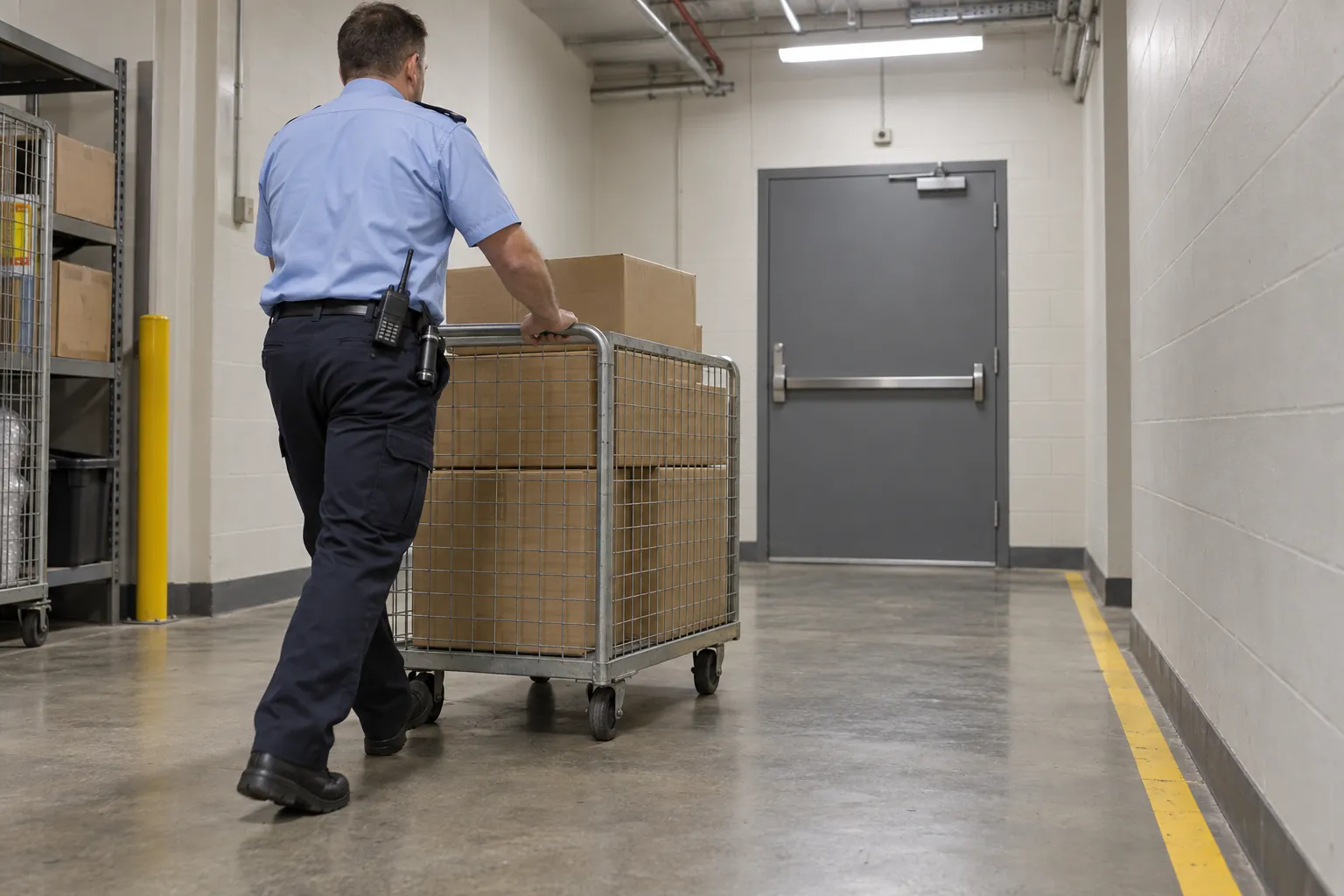
The contractor sees the building on service days. Most of the ways a measure stops fulfilling its purpose happen on the other days, and most are visible to anyone walking past. That is the gap an owner or occupier has to close to sign the annual report honestly and to meet regulation 228 every day.
How often the building team walks its exits and doors between services is a management decision, not a figure in the Regulations. Choose a frequency that suits how the building is used, and write it down: a shopping centre's service corridors or a loading dock that fills on delivery days need checking more often than a quiet office floor.
A useful routine covers the things that fail between services:
- Exits and paths of travel: corridors, stairs and exit doors clear of stock, bins and trolleys; the path outside to the road not blocked by skips, cars or locked gates.
- Exit doors: open freely and are not chained, padlocked or obstructed.
- Fire and smoke doors: close and latch on their own, not wedged, tied or propped open, and undamaged (see the fire door inspection guide).
- Exit signs and emergency lighting: signs lit and visible, not hidden behind signage, displays or fit-out.
- Extinguishers and hose reels: in their approved location, visible and accessible, with a maintenance tag; the CFA's extinguisher checklist also looks for a pressure gauge, where there is one, in the green sector.
- Hydrant boosters and fire control rooms: accessible, not used as storerooms.
- Signs: required signs on doors and at lifts still in place and legible.
What good evidence looks like. A good record names the place (the level and the door, not "building"), the date and time, the person who did the check, what they found, and what happened next. A fault that needs the contractor should show when it was reported and when it was rectified: the gap between the two is what an owner signing the annual report needs to know.
Faults go to someone who can fix them. A cleaner or security officer who finds a fire door not latching should know how to report it, and the report should reach the facility manager or contractor the same day.
Keep the building's documents together. The occupancy permit, any maintenance determinations, the maintenance schedule, the last ten annual reports and the service records should be in one place that someone on site can open within the 24 hours regulation 225 allows. Often that is the red ESM box; check that what is in it is current.
06
Where the record fails
Essential safety measures rarely go wrong for want of a logbook. They go wrong between the contractor's visits. The exit walk is a sheet in the plant room, ticked for the month on its first morning. A security officer notices a stair door that has stopped latching and mentions it at the desk, and the mention goes no further. The contractor's service report lands as a PDF in a shared inbox, and the defect on page four is still open when the owner signs the annual report.
SiteClara is built for that everyday part. A tag at each exit door, fire door, hose reel, extinguisher point or stair lets the person doing the round scan it with their phone and confirm the check, with a photograph when one is asked for, so the record shows which point was checked, by whom and when. A check that was due and not done shows as not done rather than disappearing. A fault reported at the tag goes to the team responsible for it, and a daily report tells the building manager what was checked and what is still open – a working record the owner can read before signing the annual report.
SiteClara is not a building surveyor or a fire services contractor, and it does not inspect, test or maintain any essential safety measure. It does not prepare or sign the annual essential safety measures report, and it is not the maintenance schedule, the occupancy permit or the contractor's AS 1851 service records. It does not decide whether a measure fulfils its purpose. It is not a CAFM system, and it does not do rostering or time and attendance. Where the Regulations, the occupancy permit or a contract require a particular record, SiteClara is the working record of the checks made between services, not the statutory one.
07
Questions people ask
What are the essential safety measures requirements in Victoria?
They are in Part 15 of the Building Regulations 2018 (Vic). The owner must ensure every required measure is "maintained in a state which enables the essential safety measure to fulfil its purpose" (regulation 226) and is not removed from its approved location except for inspection, testing or maintenance (regulation 227). The owner must also have an annual essential safety measures report prepared within 28 days before each anniversary of the relevant anniversary date (regulation 223), and make the last 10 years of reports and all inspection, testing and maintenance records available at the building within 24 hours of a request by the municipal building surveyor or chief officer (regulation 225). The occupier must keep exits and paths of travel "readily accessible, functional and clear of obstructions" (regulation 228). Each of these carries a penalty of 20 penalty units.
What are 5 safety measures?
In a building, five common essential safety measures are fire extinguishers, exit signs, emergency lighting, fire alarm systems and sprinklers. The Country Fire Authority's Essential safety measures for businesses describes ESMs as "critical safety features of a building, designed to protect people inside during a fire", and lists fire blankets, fire hose reels, fire hydrants and fire detection systems with them. The full list, which also takes in fire doors, paths of travel and handrails, is Schedule 8 of the Building Regulations 2018 (Vic).
How much clearance is needed around a fire extinguisher in Australia?
The Country Fire Authority's guidance on fire extinguishers gives no distance. It says to "make sure the space in front and around fire extinguishers is clear", with no furniture, luggage or stock in front of them, and that extinguishers "must not block exits". It also says the sign showing where an extinguisher is must be "clearly visible from a distance of up to 20 metres in all directions" and "installed 2 metres or more above floor level". Selection and location are set by AS 2444, Portable fire extinguishers and fire blankets – Selection and location, a paid standard.
08
Where to read more, and a list to take away
The primary sources are the ones to rely on:
- Building Regulations 2018 (Vic): regulations 194 to 196 in Part 13 (occupancy permits), Part 15 (regulations 213 to 228) and Schedule 8.
- Building Act 1993 (Vic): section 227E, inspection powers.
- Essential safety measures for businesses, Country Fire Authority, with its pages on exit signs and emergency lighting and fire extinguishers.
- AS 1851-2012 Routine service of fire protection systems and equipment, Standards Australia (a paid standard).
- Occupational Health and Safety Act 2004 (Vic): section 21.
- The Building and Plumbing Commission (the Authority in the Act, formerly the Victorian Building Authority) approves the forms for the maintenance schedule and the annual essential safety measures report (regulations 222 and 224) and publishes them on its website; ask your building surveyor or owner's agent for the current version.
A list to take away:
- Find the occupancy permit, maintenance determinations and maintenance schedule, and read the measures and frequencies.
- Check that the fire services contract covers every measure on that list.
- Put the anniversary date, and the 28-day window before it, in the diary.
- Decide who checks exits, doors and equipment between services, and how often.
- Record every check with the place, the person, the time and what was found.
- Send every fault to someone who can fix it the same day, and record when it was fixed.
- Keep ten years of annual reports and all service and repair records ready to produce within 24 hours.
- Read the year's records, open faults included, before the owner signs the annual report.
Sources
Every document this guide quotes or links to, in the order it first cites them.
- Building Regulations 2018 (Vic) legislation.vic.gov.au
- Building Act 1993 (Vic) legislation.vic.gov.au
- National Construction Code 2025, Part A6 ncc.abcb.gov.au
- Country Fire Authority's guidance on essential safety measures for businesses cfa.vic.gov.au
- AS 1851-2012 store.standards.org.au
- Occupational Health and Safety Act 2004 (Vic) legislation.vic.gov.au
- Guidance on fire extinguishers cfa.vic.gov.au
- Exit signs and emergency lighting cfa.vic.gov.au
Related guides
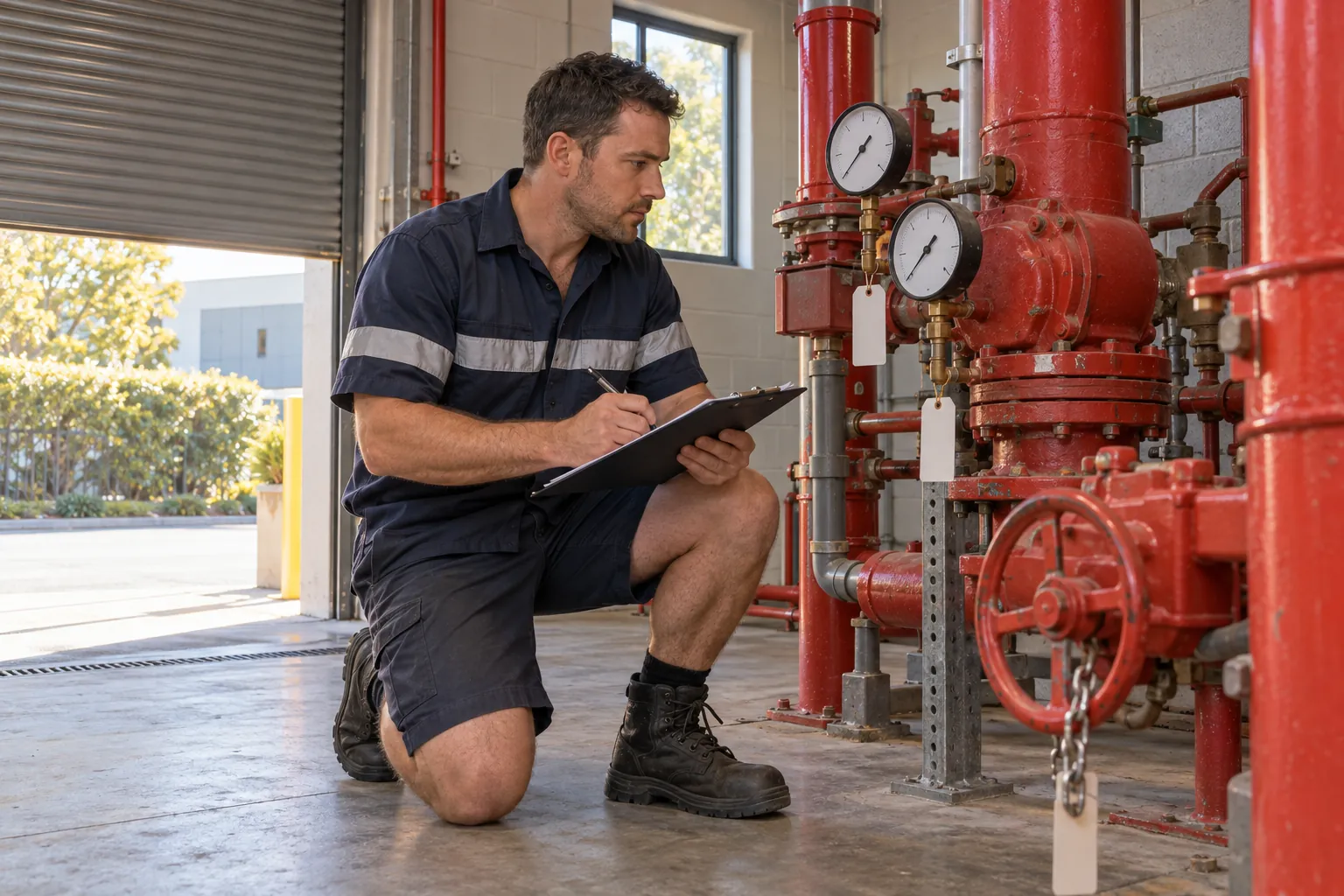 Fire and water checksAS 1851 routine service: what it asks of owners, fire contractors and building teamsWhat AS 1851-2012 routine service covers, how intervals and competent persons work, what the records must show, and how Victoria's regulations call it up.
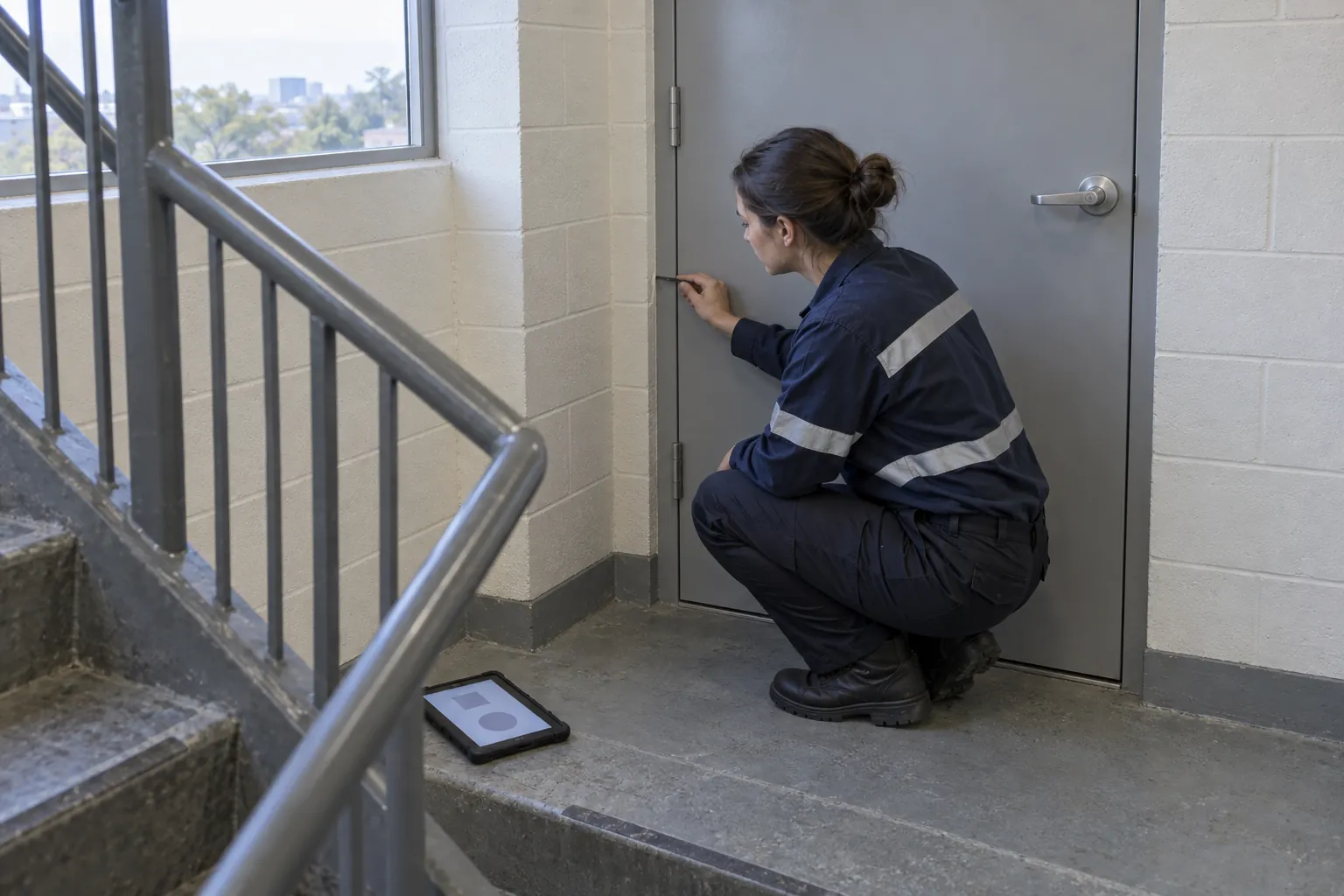 Fire and water checksFire door inspection: what the inspector checks, and what the owner keepsFire door inspection in Australia: what AS 1905.1 and the NCC require of a fire door, how AS 1851 and state law set the checks, who may inspect, and the records.
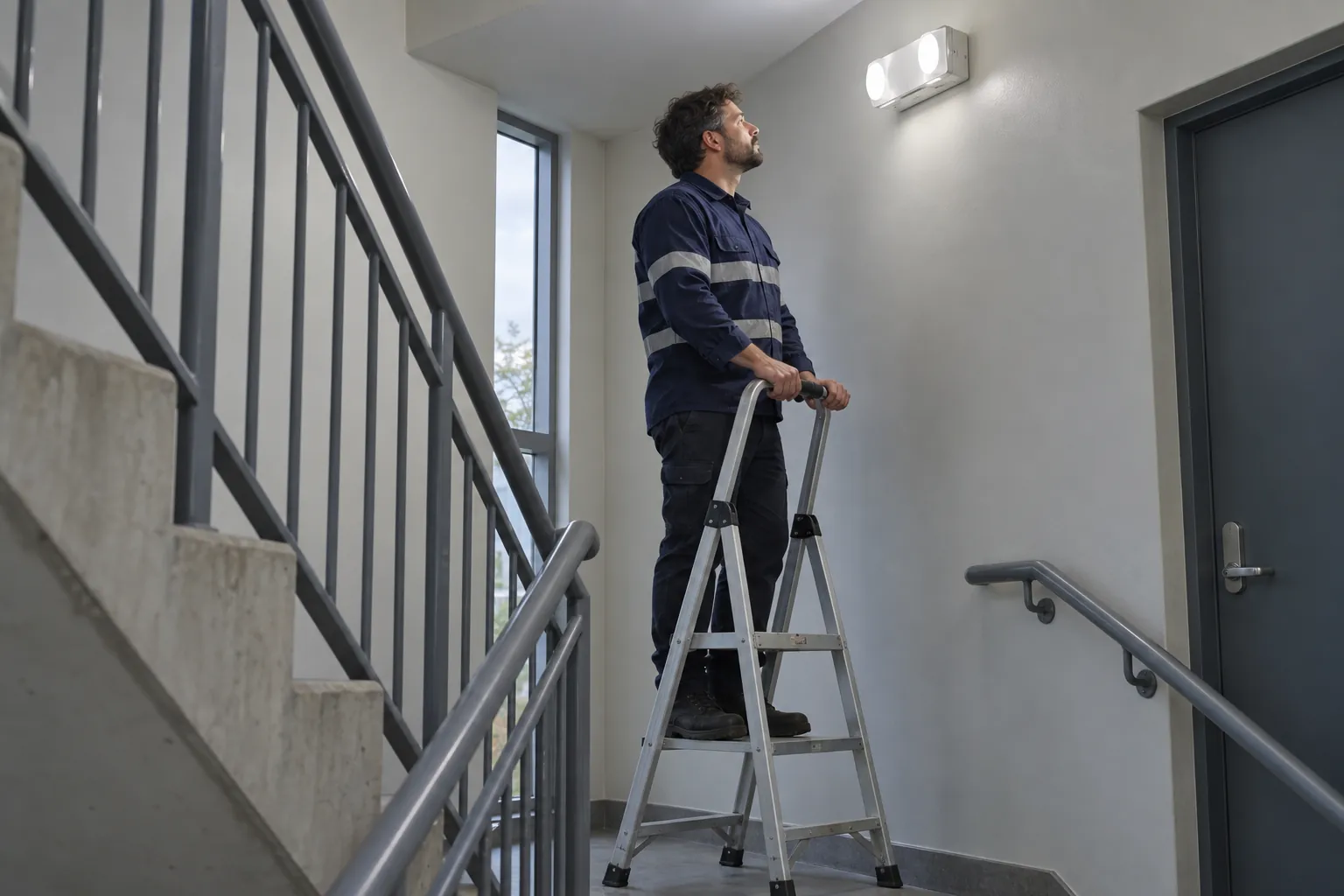 Fire and water checksEmergency lighting testing: who tests what, how often, and what the record must showEmergency lighting testing in Australian buildings: AS/NZS 2293.2 six-monthly and annual service, state maintenance law, checks between visits and the records.
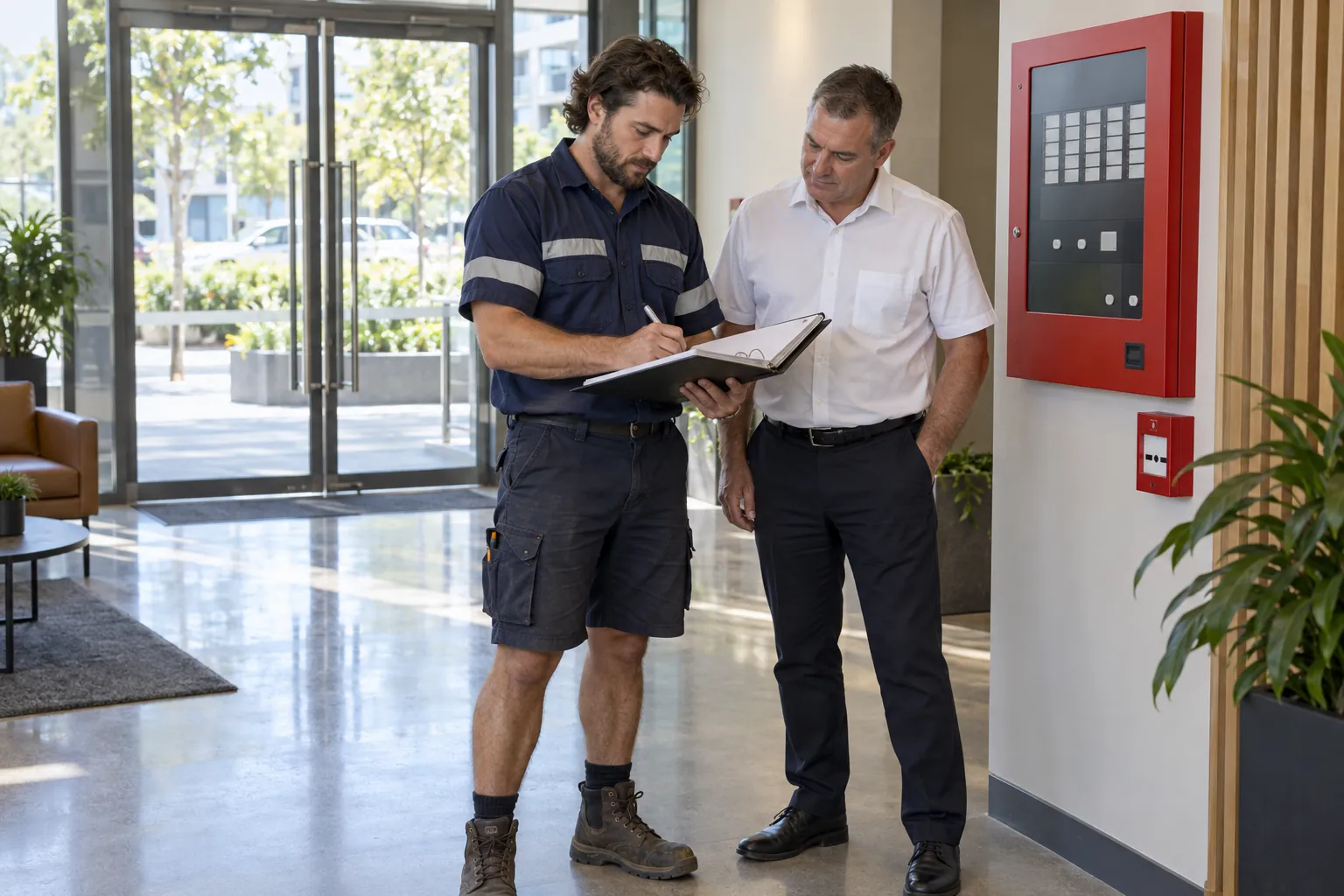 Fire and water checksFire safety logbook: what to record, who keeps it and for how longWhat a fire safety logbook should hold in Australia: AS 1851 service records, Victoria's ESM records, the NSW fire safety statement and Queensland's rules.