Premises and facilities management
Emergency shower and eyewash stations: when you need one, and how to know it will work
An emergency shower and eyewash is fixed or portable equipment that floods a person's eyes or body with water to remove a hazardous chemical or infectious substance straight after a splash, and an Australian workplace needs one wherever its risk assessment finds that injury could happen.
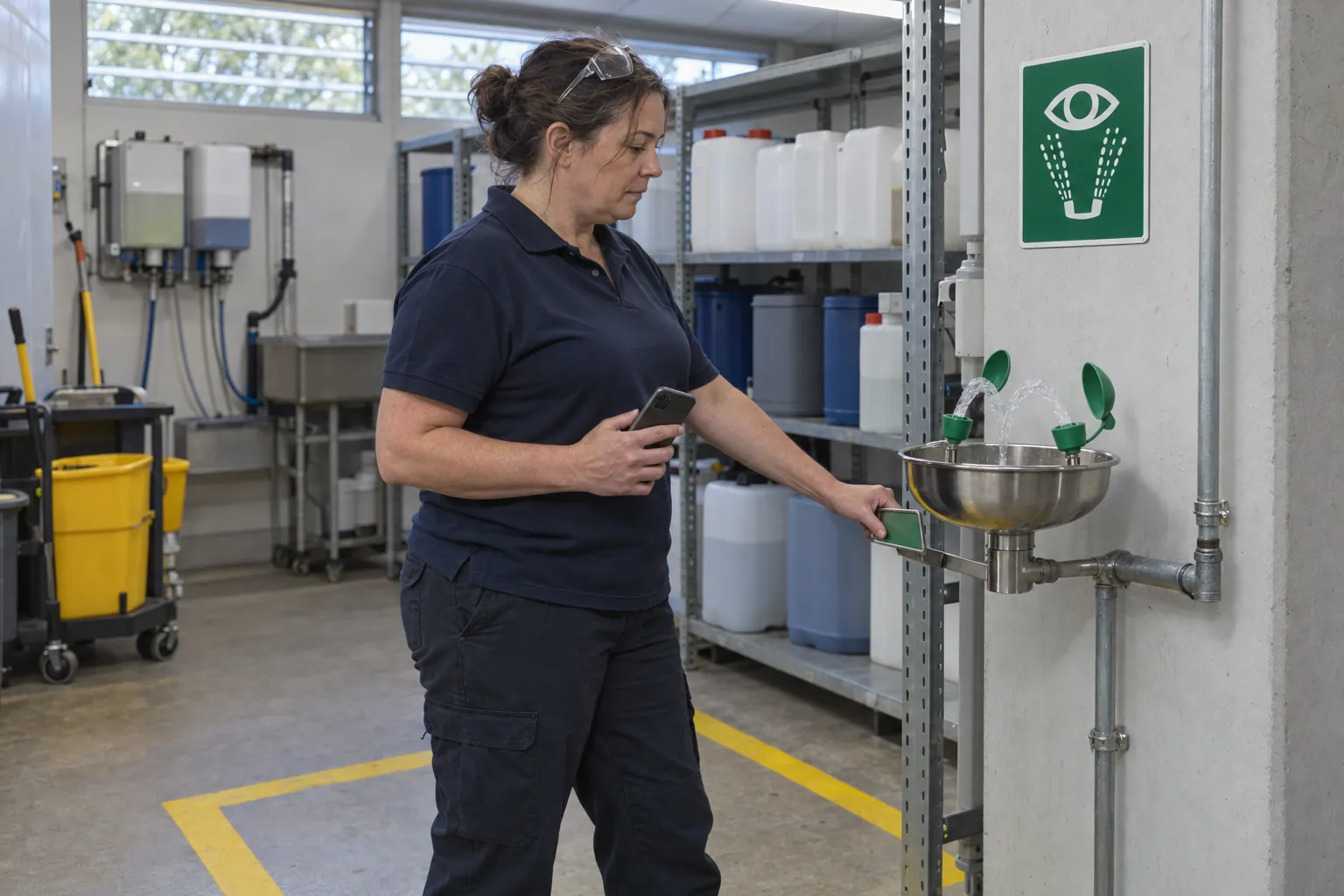
It is used for a few minutes in the worst moment of someone's working year. The rest of the time it hangs on a wall in a chemical store, a plant room or a workshop, where it can be blocked by a pallet, lose its dust caps, run dry or stop working without anyone noticing. This guide sets out what Australian work health and safety law and the codes of practice ask for, what AS 4775 covers, where emergency shower and eyewash equipment should go in an ordinary building, how often to check it and who should do it when several businesses share the site.
01
What Australian law asks: the WHS Regulations, the codes and AS 4775
No Australian regulation says every workplace must have an eyewash station. The requirement comes from the risk. Where the model work health and safety laws apply, three duties in the regulations meet at the eyewash on the wall, shown here in Queensland's version, the Work Health and Safety Regulation 2011 (Qld); the other states and territories that adopted the model laws have the same duties in their own regulations.
- First aid equipment. Regulation 42 says a person conducting a business or undertaking (PCBU) must ensure "the provision of first aid equipment for the workplace" and that each worker has access to it, having regard to the nature of the work and "the nature of the hazards at the workplace".
- Safety equipment for hazardous chemicals. Regulation 362 of the Work Health and Safety Regulation 2011 (Qld) applies "if safety equipment is required to control an identified risk" from hazardous chemicals, and then the PCBU "must ensure that the safety equipment is provided, maintained and readily accessible to persons at the workplace".
- Keeping controls working. Regulation 37 of the Work Health and Safety Regulation 2011 (Qld) requires a control measure to be maintained so that it remains effective, including "fit for purpose" and "installed, set up and used correctly".
The approved codes of practice turn that into plain advice. SafeWork NSW's Code of Practice: First aid in the workplace (January 2020 edition, based on Safe Work Australia's model code) has a short section headed "Eye wash and shower equipment". It says: "Emergency eye wash equipment should be provided where there is a risk of hazardous chemicals or infectious substances causing eye injuries." And: "Immediate access should be provided to emergency shower equipment in workplaces where there is a risk of" exposure to hazardous chemicals resulting in skin absorption or contamination from infectious substances, or serious burns to a large area of the face or body.
SafeWork NSW's Code of Practice: Managing risks of hazardous chemicals in the workplace lists "emergency showers and eye wash stations" among the emergency equipment a workplace may need, and says equipment "must be located so it is readily accessible for all workers if an emergency arises".
Victoria has not adopted the model WHS laws and works under the Occupational Health and Safety Act 2004 and the OHS Regulations 2017. WorkSafe Victoria's Compliance code: First aid in the workplace (2021) covers "Showers and eye wash stations" in paragraphs 153 to 156, in wording close to the NSW code's, and adds that the water should be tepid.
02
Where an ordinary building needs emergency shower and eyewash equipment
This guide is about the stations in ordinary buildings such as offices, schools, shopping centres, hospitals and strata complexes, not laboratories. Across the codes, the signals that a station or a shower is needed are these:
- Chemicals handled in open containers. The Victorian code says an eye module belongs in the first aid kit where "chemical liquids or powders are handled in open containers" or there is spraying or hosing, and that the module "does not necessarily replace the need to provide general eye wash facilities in workplaces with particular hazards".
- Corrosives. The NSW chemicals code says "Eyewash and safety showers should be readily accessible where corrosives are handled or transferred", and "Plumbed eye wash stations and safety showers should be installed in areas where workers may be exposed in the event of a spill during transfer operations."
- Caustic or acidic chemicals that can splash. For handling them the same code's examples of controls include "Provide an emergency eye wash facility."
- Caustic cleaners. The Victorian code's own example is a food processing facility where caustic cleaners are used, where "a plumbed-in emergency eyewash should be provided close to where the chemicals are used".
- Large splashes. The same paragraph says "A combination eyewash and shower facility should be provided where there is a potential for large or whole body splashes of concentrated solutions."
- Infectious substances that could reach the eyes, and serious burns, including chemical and electrical burns, where the codes call for an emergency shower.
In a typical managed building that points to where concentrated chemicals are stored, decanted or dosed: the cleaners' store and dilution unit, the pool plant room, kitchens using caustic products, workshops and science preparation rooms. The worked example in the NSW first aid code assesses two cleaners with a possible risk of daily exposure to solvents and disinfectants, notes that safety data sheets and labels "instruct to rinse cautiously with water for several minutes", and concludes: "Eye wash equipment required."
Start from the safety data sheets, the chemical register and the tasks, not from a floor plan. A building can need a station in the cleaners' store and none on the office floors. Where the answer is no station, record why.
03
Types of equipment, and where to put them
The codes describe the equipment in general terms. The NSW and Victorian codes say shower facilities can consist of "a deluge facility", "a permanently rigged hand-held shower hose", or "a portable plastic or rubber shower hose designed to be easily attached to a tap spout", the last for a small, lower-risk workplace where a fixed deluge shower would not be reasonably practicable. The NSW code's example is a fish and chip shop.
- Plumbed eyewash or eye/face wash: wall mounted, or fixed to a pedestal or sink, fed from the water supply.
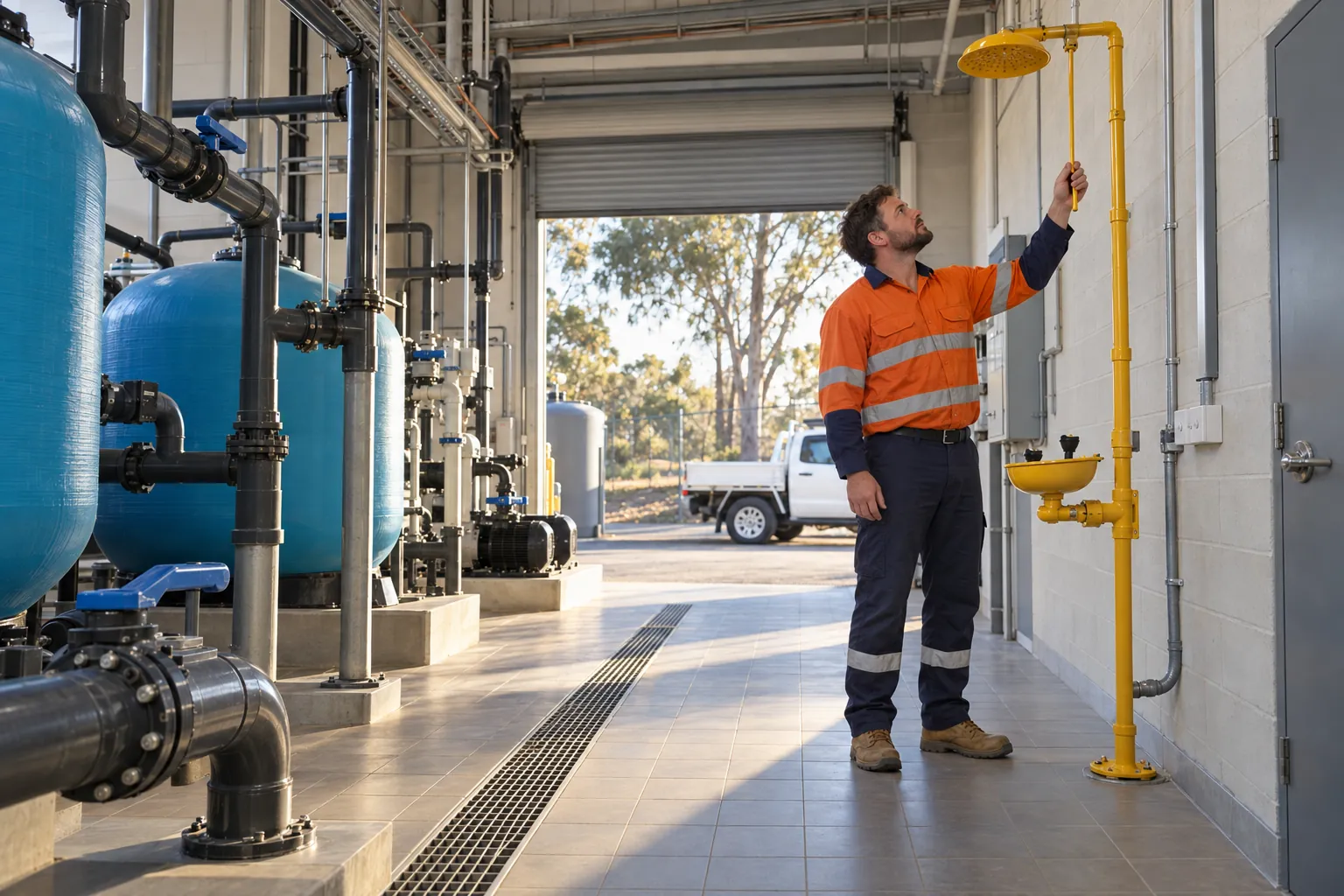
- Emergency deluge shower: overhead, operated by a pull rod or handle, for splashes to the body.
- Combination unit: shower and eyewash together, for where whole-body splashes are possible.
- Drench hose: hand-held, on a flexible hose; AS 4775:2026 covers drench hoses by name.
- Portable, self-contained units: these "have their own flushing fluid" and, the codes say, "need to be refilled or replaced after use".
- Eye wash in the first aid kit: the Victorian eye module lists "one litre eye wash (for single use) and/or access to eye wash station". A bottle is not a substitute for a station where chemicals splash.
On placement, the wording is about access: "readily accessible" in regulation 362, "immediate access" to showers, and "close to where the chemicals are used" in the Victorian example. In practice the station is on the same level as the hazard, on a route a person can follow with their eyes shut and with help, with no locked door in between. Take installation distances and performance requirements from the current AS 4775.
The Victorian code adds that eye wash and shower equipment "should deliver water at a tepid temperature". The temperature depends on the supply as much as on the fitting on the wall, so ask the plumber who installs or services the unit how the supply is tempered and how it will be checked.
Signs matter as much as the fitting. The NSW code says well-recognised first aid signs "will assist in easily locating first aid equipment and facilities" and refers to AS 1319-1994 on safety signs. Where there is a risk of burns, both codes say the burns module should include waterproof burn treatment instruction cards, one in the kit "and the other to be located on the wall next to the emergency shower or water supply". The Victorian code also says first aid officers "need to be trained in the use of these facilities".
04
How often to check an eyewash station, and what the check covers
Neither the regulations nor the codes set a single national interval for checking emergency shower and eyewash equipment. The duty is that it is "maintained" and remains effective, and the codes point to AS 4775 for the detail. The NSW first aid code says your first aid procedure should cover "who is responsible for the first aid kits and facilities and how frequently they should be checked and maintained". Write both into the procedure for each station: a named role, and an interval taken from the standard and the maker's instructions.
The NSW chemicals code adds that maintenance procedures "should include mechanisms for workers to report defective control measures as soon as they are identified so that prompt remedial action can be taken".
A routine check by a person on site is usually quick. A sensible one covers:
- Access: nothing stored in front of or under the station; the route from the hazard is clear; any door on the route opens.
- Signage: the sign is present, visible from the work area and not hidden by stock or a door.
- Covers and nozzles: dust caps in place and free to move; nozzles clean.
- Activation and flow: for a plumbed unit or shower, operate it as the maker's instructions and the standard direct, and confirm the water reaches both eyes or the shower head.
- Temperature: the water is tepid, not cold and not hot.
- Portable units and bottles: sealed, full and within the date the maker gives; refilled or replaced after any use.
- Card and kit: the burns card on the wall where one is needed; the nearest first aid kit's eye module complete.
- Defects: anything wrong reported at once to the person who can fix it, and the station marked out of use until it is.
Separately, a competent person, usually the plumber or the supplier's technician, services plumbed units against AS 4775 at the interval the standard and maker set. Keep their reports with the station's record.
Check after every use as well as on schedule. A portable unit that has been used is empty until it is refilled. An eye or skin exposure also needs its own record: an injury requiring "immediate treatment" for "a serious eye injury" or "a serious burn" is a serious injury under section 36 of the Work Health and Safety Act 2011 (Qld), and so a notifiable incident under the model laws, reported to the regulator. Victoria's notification rules are in its own OHS Act.
05
Who does what in a shared building
In a managed building the eyewash in the cleaners' store is often the building owner's fixture, used by the cleaning contractor's staff, handling the contractor's chemicals, and checked by nobody in particular. Each of those parties may have a duty. The model Act's duty to consult, shown here as section 46 of the Work Health and Safety Act 2011 (Qld), says that if more than one person has a duty in relation to the same matter, each must, so far as is reasonably practicable, "consult, cooperate and coordinate activities" with the others. The NSW first aid code puts it plainly: "more than one person can have the same duty at the same time", and duty holders "should exchange information to find out who is doing what".
A workable split, agreed in writing and kept with the contract, looks like this:
- The PCBU whose work creates the risk, often the cleaning or maintenance contractor, assesses its chemicals and tasks, says where equipment is needed, and shows its staff where it is.
- The building owner, managing agent or facility manager provides and maintains fixed plumbed equipment that is part of the building and arranges its servicing.
- A named person on site, a building manager, caretaker, cleaning supervisor or first aider, does the routine check at the agreed interval and signs for it.
- Everyone who works there reports a blocked, dry or damaged station at once, and knows who to tell.
In strata and body corporate buildings, the common property plant room raises the same question: whose station is it, and who checks it? When a contract changes hands, walk the stations with the incoming contractor and hand over the check record.
06
Where the record fails
An eyewash station that was installed properly can still be blocked, run dry or stop working between checks, and the only way to know is a record of whether anyone has looked at it since.
The tag hanging from the station has the weaknesses of any card on a wall. Only someone standing at the station sees it, so the facility manager cannot tell from their desk which stations are overdue. A month of initials entered in one sitting looks exactly like initials entered after the water was run. And the cleaner who finds the station dry tells whoever is passing, and the report goes no further.
SiteClara is built for this gap. Each station, or the wall beside it, carries an NFC tag or QR code. The person checking scans it on their phone, works through that station's checklist and, when a photo is asked for, takes one of the station as they left it. The check is recorded against that station with who did it and when. A scheduled check shows as done or missed, so a check nobody did is visible the next morning, not at the annual audit. Staff who find a fault can report it from the same tag, and the report goes to whoever looks after that station as a job that stays open until someone deals with it.
It has limits. SiteClara does not measure flow, pressure or temperature: the person checking does, and the record is only as honest as that person. It does not replace servicing by a plumber or technician against AS 4775, the maker's maintenance schedule or any log book the standard or your procedure requires. It does not record first aid treatment or notify the regulator of an incident. It does not decide where stations are needed, which is the PCBU's risk assessment. It is the working record that each station was checked, by whom and when.
07
Questions people ask
What is an emergency shower and eyewash?
It is equipment for flushing a harmful substance off a person as quickly as possible. SafeWork NSW's Code of Practice: First aid in the workplace says eye wash and shower equipment "may be permanently fixed or portable, depending on the workplace", and that portable, self-contained units "have their own flushing fluid to flush chemicals, foreign objects or substances from the eyes or body". The same code says shower facilities can be a deluge facility, a permanently rigged hand-held shower hose, or, in a small, lower-risk workplace, a portable hose that attaches to a tap spout.
What are the requirements for an emergency shower in Australia?
The requirement follows the risk, not the type of building. SafeWork NSW's Code of Practice: First aid in the workplace says immediate access should be provided to emergency shower equipment where there is a risk of exposure to hazardous chemicals resulting in skin absorption or contamination from infectious substances, or of "serious burns to a large area of the face or body, including chemical or electrical burns or burns that are deep, in sensitive areas or larger than a 20 cent piece". Emergency eye wash equipment should be provided where hazardous chemicals or infectious substances could injure the eyes. For the equipment itself, the code points to AS 4775, now in its 2026 edition.
What are the regulations regarding emergency showers?
No Australian regulation names emergency showers as such. Under the model WHS laws the duty comes through regulation 362 of the WHS Regulations, shown here in Queensland's Work Health and Safety Regulation 2011 (Qld): "if safety equipment is required to control an identified risk in relation to using, handling, generating or storing hazardous chemicals at a workplace", the PCBU "must ensure that the safety equipment is provided, maintained and readily accessible to persons at the workplace". Queensland sets a maximum penalty of 60 penalty units. The first aid duty in regulation 42 also applies, and Victoria has its own OHS laws and compliance code.
08
Where to read the official guidance, and a short checklist
Read regulations 37, 42 and 362 of the WHS Regulations for your state or territory and its approved first aid and hazardous chemicals codes, such as SafeWork NSW's. In Victoria, read paragraphs 153 to 156 of WorkSafe Victoria's compliance code. For design, installation and performance, work from AS 4775:2026.
A short list to take away:
- List the chemicals handled on site from the safety data sheets and the register, with the tasks that could splash them.
- Decide, area by area, where eyewash, shower or combination equipment is needed, record the location of each one, and record where none is needed and why.
- Put each station close to the hazard, on a clear route, with a sign, and with a burns card where there is a burn risk.
- Have plumbed units installed and serviced by a competent person against the current AS 4775, with tepid water.
- Name a person and an interval for each station's routine check in the first aid procedure, and check after every use.
- Give everyone a way to report a fault at once, and mark a faulty station out of use until it is fixed.
- In a shared building, agree in writing whose station it is, who checks it and who repairs it.
Sources
Every document this guide quotes or links to, in the order it first cites them.
- Work Health and Safety Regulation 2011 (Qld) legislation.qld.gov.au
- Code of Practice: First aid in the workplace safework.nsw.gov.au
- Code of Practice: Managing risks of hazardous chemicals in the workplace safework.nsw.gov.au
- Compliance code: First aid in the workplace worksafe.vic.gov.au
- AS 4775-2007 Emergency eyewash and shower equipment store.standards.org.au
- AS 4775:2026 Emergency shower, eyewash and eye/face wash equipment and drench hoses store.standards.org.au
- Work Health and Safety Act 2011 (Qld) legislation.qld.gov.au
Related guides
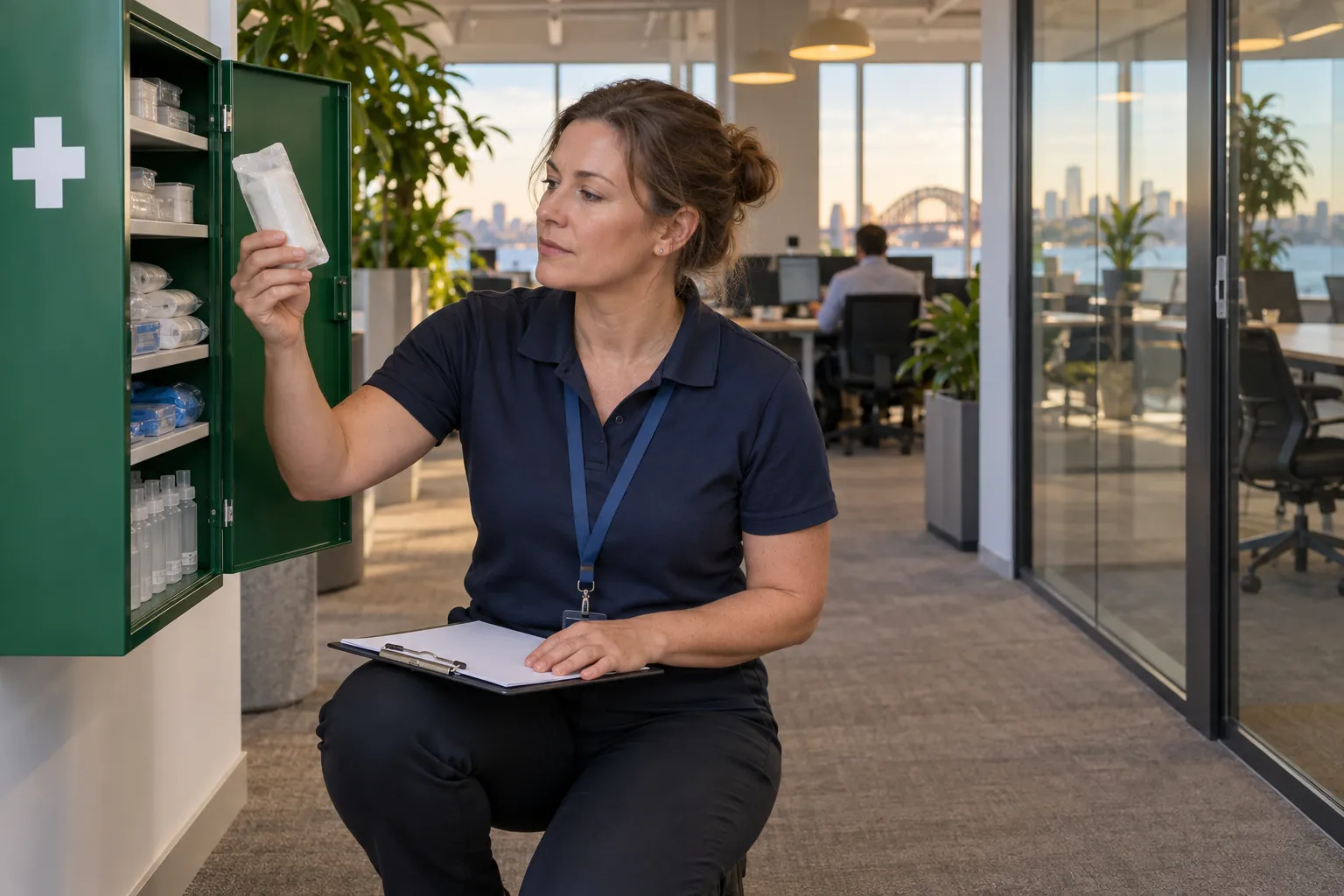 Premises and facilities managementFirst aid kit checklist: what an Australian workplace kit holds, and how to keep it completeWhat a workplace first aid kit should hold under Australian WHS law and the codes, how many kits and where, how often to check them, and who restocks them.
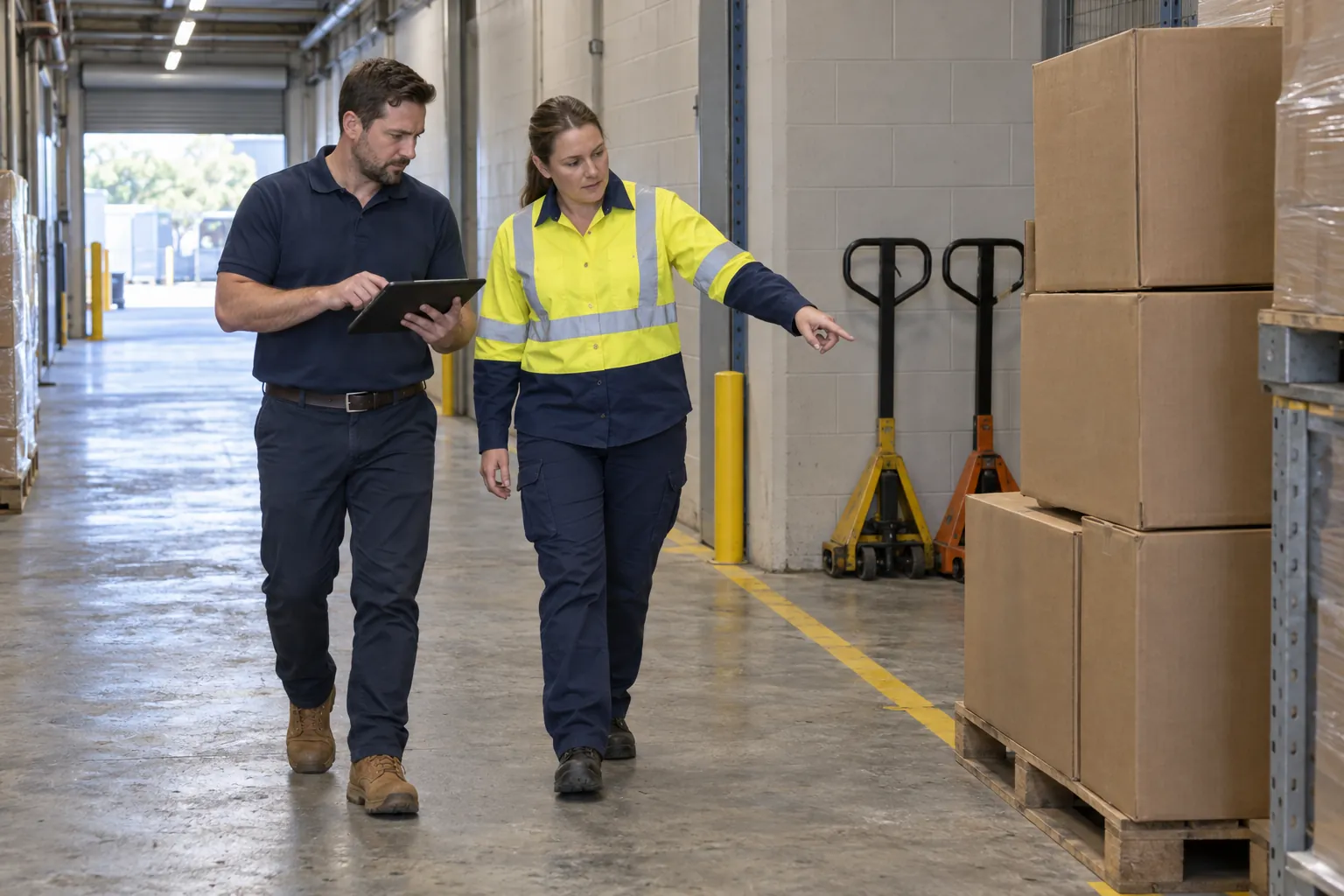 Premises and facilities managementWorkplace inspection checklist: what WHS law asks, what to walk, and what to do nextWorkplace inspections under Australian WHS law: the duties behind them, what the checklist covers, how often, recording findings, and HSRs' right to inspect.
 Premises and facilities managementHazard report forms and hazard reporting: what WHS law asks, and how to close the loopHazard reporting under Australian WHS law: the duty to identify hazards, what a hazard report form should hold, who acts on it, and how to show the fix was made.
 Premises and facilities managementAED maintenance checklist: keeping a workplace defibrillator ready in AustraliaWhat Australian WHS codes and ANZCOR say about workplace defibrillators, what an AED check covers, how often to do it, and who looks after it in a shared building.