Premises and facilities management
AED maintenance checklist: keeping a workplace defibrillator ready in Australia
An AED maintenance checklist is the regular check that keeps a workplace defibrillator ready to use: its status indicator, pads, battery, cabinet and sign are looked at on a set routine, and the battery and pads are replaced at the intervals the manufacturer specifies.
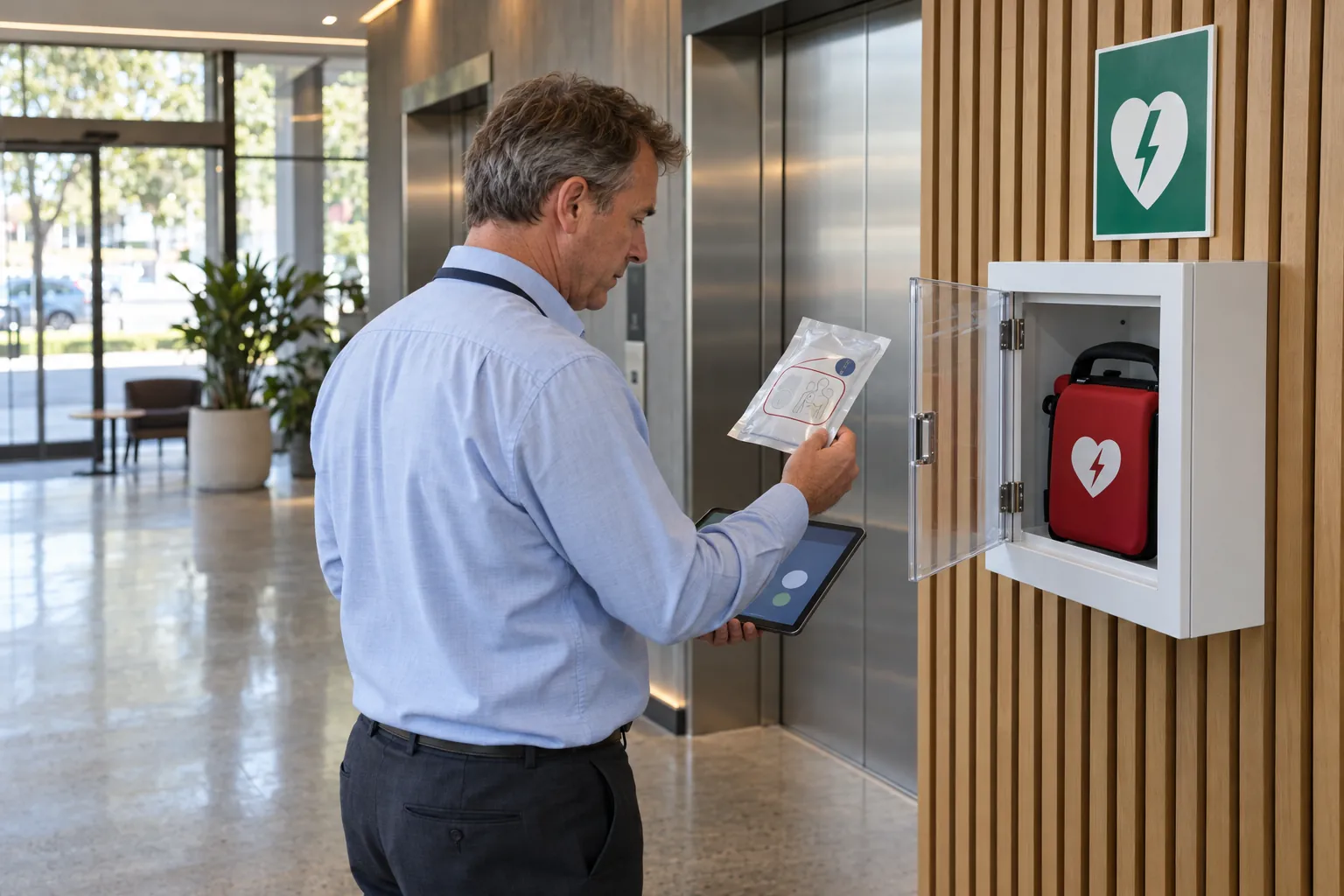
Australia's first aid codes ask for AEDs to be clearly signed and maintained to the manufacturer's instructions, and Victoria's spells out replacing batteries and pads at the specified intervals. An automated external defibrillator is bought once and then hangs on a wall for years, often without being used at all. That is the point of it, and also the problem: a unit nobody has looked at since it was installed may have a flat battery, pads that expired last summer or a cabinet hidden behind a stack of chairs. This guide sets out what Australian work health and safety law and the codes of practice say about AEDs, what a routine check covers, how often to do it, what to do after a use, and how to keep a record of the checks that someone could rely on.
01
What Australian law and the codes say about AEDs
The first aid regulation in the model work health and safety laws does not name AEDs. The duty that brings them in is the general duty to provide first aid. Regulation 42 of the Commonwealth's Work Health and Safety Regulations 2011, "Duty to provide first aid", says a person conducting a business or undertaking (PCBU) at a workplace must ensure the provision of first aid equipment, that each worker has access to it, access to facilities for the administration of first aid, and an adequate number of trained first aiders (or access to them). The harmonised states and territories have the same regulation; section 42 of Queensland's Work Health and Safety Regulation 2011, for example, requires "the provision of first aid equipment for the workplace" and that "each worker at the workplace has access to the equipment", with a maximum penalty of 60 penalty units.
Whether that equipment includes an AED is a judgement for the PCBU, and the Code of Practice: First aid in the workplace guides it. SafeWork NSW's Code of Practice: First aid in the workplace (January 2020), which is based on the national model code, says under "Other first aid equipment" that providing an AED "can reduce the risk of fatality from cardiac arrest" and that "defibrillation is the only way to restore a heart with a fatal heart rhythm back to a normal heart rhythm".
The same code says you should consider providing an AED "if there is a risk to workers at your workplace from electrocution, if there would be a delay in ambulance services arriving at the workplace, or where there are large numbers of members of the public". Once you have one, it says AEDs "should be located in an area clearly visible, accessible and not exposed to extreme temperatures. They should be clearly signed and maintained according to the manufacturer's specifications."
The clinical guidance comes from the Australian and New Zealand Committee on Resuscitation. ANZCOR Guideline 7: Automated External Defibrillation in Basic Life Support (April 2021) says public access defibrillation programs should consider "optimising AED availability, AED signage, novel delivery methods, public awareness, device registration, mobile apps for AED retrieval" and more, and that ANZCOR suggests AED signage "is consistent with international recommendations". It is guidance for rescuers and program managers, not a maintenance schedule.
Neither code makes an AED a legal requirement in every workplace. Check whether your state or territory has a separate rule for particular buildings or venues, and whether a lease or contract asks for one. Where you have an AED, the codes expect it to work.
02
What an AED maintenance checklist covers
The manufacturer's manual for your model is the authority on what to check and how often. Most manuals, and the two codes, come back to the same handful of components. A routine visual check usually covers:
- Location: the AED is where the floor plan, the evacuation diagram and the signs say it is, and nothing blocks the way to it.
- Signage: the AED sign is in place, visible from the corridor or the approach, and not covered by a poster, a banner or a stack of boxes.
- Cabinet: the cabinet or wall bracket is intact, the door opens freely, and it is not locked (the Victorian code says AEDs "should not be locked"). If the cabinet has an alarm, the alarm works and its battery is not flat.
- Status indicator: the unit's ready light, symbol or display shows it is ready to use, with no warning light, chirp or error message.
- Pads: the electrode pads are sealed in their packet, connected or pre-connected where the model requires it, and within their expiry date. Where the building has child or paediatric pads, or a unit that switches to a child setting, check those too.
- Battery: the battery is fitted, in date, and the unit reports no low-battery warning.
- Rescue kit: the accessories kept with the AED are present and sealed: typically gloves, a razor for chest hair, trauma shears, a towel or wipes and a resuscitation face shield. ANZCOR notes that rescuers may need to remove moisture or excessive chest hair before applying pads.
- Condition and storage: the case is clean and dry, with no cracks or other damage, and the unit is not stored in direct sun or somewhere that gets very hot or very cold.
- Instructions and contacts: first aid contact details and emergency numbers are posted nearby, as the Victorian code asks for first aid kits.
A fuller check, less often, adds the things a glance cannot show: the expiry dates written into a register so the replacement can be ordered in advance, the unit's self-test log where the model keeps one, the date the device was last serviced or updated if the manufacturer calls for it, and whether the AED is still in the right place for the way the building is used now.
03
How often to check an AED
No Australian regulation sets a frequency for AED checks. The codes say to follow the manufacturer, and the manufacturer's manual for most models says what the unit tests on its own and what a person should look at. A sensible routine for an ordinary building, to be adjusted to the manual, looks like this:
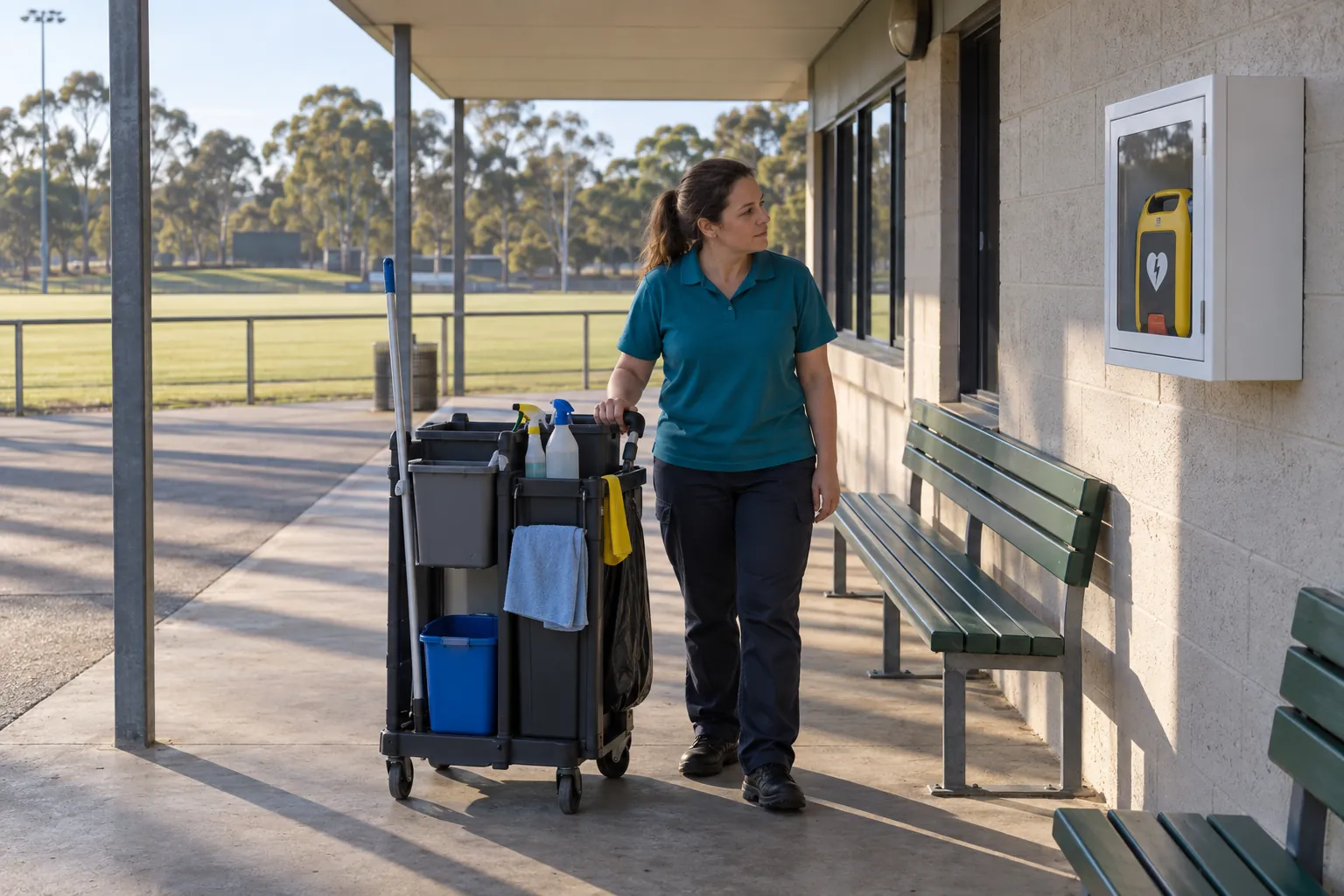
- Frequently, as part of a walk the building already has (daily or weekly): the location, sign, cabinet and status indicator. This is a glance, and it suits whoever already passes the AED on a round: the cleaner opening up, the security officer on a lock-up patrol, the building manager on a morning walk.
- Monthly: the visual check plus the pads and battery dates, the rescue kit and the cabinet alarm, by a nominated person who knows the model.
- At the interval the manufacturer gives: replacing pads and batteries before their dates, and any service, software update or inspection the manual calls for.
- After every use: restoring the unit to service, which is covered below.
- After anything unusual: a warning light, the unit being moved, a cabinet damaged, a building fit-out, or a recall or safety notice from the manufacturer or supplier.
The frequent check matters more than it looks. Most AEDs run self-tests and signal a fault with a light or a sound, but a warning only helps if someone sees or hears it. A unit chirping for a fortnight in a quiet stairwell is a unit nobody is checking.
Heat matters in Australia. The NSW code says AEDs should not be "exposed to extreme temperatures". An outdoor cabinet on a sunny wall, a car park in summer or a sports pavilion can take a unit outside the operating range in its manual, so check those units more often in the hottest months.
04
Placement, signage and what to do after a use
A working AED in the wrong place helps nobody. WorkSafe Victoria's compliance code says AEDs "should be installed in well-known, visible and accessible locations", and its guidance box recommends that they are "located within two minutes brisk walk from the places they are likely to be needed". In practice that means asking, once a year or after any change to the building:
- Can someone reach the AED from the furthest point of each floor, or each building on a campus, in about two minutes at a brisk walk?
- Is it reachable at every hour the building is occupied, including by night cleaners, weekend staff and security officers, or is it inside a tenancy that is locked after 6 pm?
- Do the signs lead to it from the main corridors, lifts and entrances, and is it marked on the evacuation diagrams?
- Do the people who work there know where it is? The Victorian code says AEDs should be in "well-known" locations, which is a matter of telling people, not just fixing a sign.
The Victorian code notes that "anyone can use an AED on someone suspected of being in cardiac arrest by following the voice prompts and picture guidance. Training is not required." That is a reason to make the unit easy to find. Both codes still expect enough trained first aiders at the workplace, and ANZCOR recommends AED use by "trained lay and professional responders".
After a use, the unit must be put back into service quickly, because the next emergency will not wait for the paperwork. A post-use routine usually covers:
- Replace the used pads with a new sealed set, and replace any rescue kit items that were opened.
- Check the battery and the status indicator, following the manual for any post-use test.
- Clean the case as the manufacturer directs.
- Keep the event data. The NSW code notes that most AEDs "keep records once they are activated including some vital signs and whether shocks have been recommended and administered". Follow the manual and your procedure for retrieving it, and treat it as health information.
- Report the incident as your WHS procedure requires, and check with your regulator whether it must be notified.
- Record that the unit was restored to operational use, by whom and when, and return it to its cabinet.
05
Who does what in a shared building
In a building with one occupier the answer is simple: the PCBU owns the AED and names a person, usually a first aider or the office manager, to check it. In a shared building it is rarely that tidy, and the AED in the lobby often belongs to nobody in particular.
- The building owner, strata or owners corporation, or the facilities manager acting for them, usually owns AEDs in common areas: the lobby, the car park, the gym, the end of trip facilities. They choose the model, pay for pads and batteries, and arrange replacement.
- Tenants who buy their own AED for a tenancy own that unit and its checks, and should tell the building manager so it appears on the building's list and evacuation diagrams.
- The building manager or caretaker is the natural person to hold the register of every AED in the building, whoever owns it, with its location, model, pad and battery dates and the person responsible.
- Cleaning and security contractors walk past AEDs every day. Adding a glance at the status light and the cabinet to a round they already do costs almost nothing, as long as the contract says so and they know whom to tell when something is wrong.
- The chief warden and the emergency control organisation need to know where every AED is, and the emergency plan should say who fetches it.
Write the split down. When the lobby AED shows a warning light, the cleaner who sees it should know whether to tell the building manager, the tenant's first aider or the facilities help desk, and that person should know they are expected to act. Without that, a fault is reported to whoever happens to be passing, or to nobody.
06
Where the record fails
AEDs rarely fail because nobody bought one. They fail because nobody looked, or because the looking left no trace anyone could check.
The tag hanging from the cabinet has three weaknesses. Only someone at the cabinet can read it, so the person responsible cannot see which units are overdue. Initials filled in one afternoon for the whole quarter look exactly like initials filled in week by week. And a warning light noticed by a cleaner at 6 am depends on that cleaner finding the right person before the unit is needed. A spreadsheet in the facilities office is easy to read and just as easy to fill in without walking the building.
SiteClara is built for this gap. Each AED cabinet, or the wall beside it, carries an NFC tag or QR code; the person checking scans it on their phone, works through that unit's checklist and, where the check asks for one, takes a photo of the status indicator or the pad dates. The check is recorded against that AED with who did it and when. A scheduled check shows as done or missed, so a monthly check nobody did is visible the next morning rather than at the annual review. Anyone who finds a fault, a chirping unit or a blocked cabinet can report it from the same tag, and it goes to whoever looks after that AED as a job that stays open until someone deals with it.
It has limits. SiteClara does not talk to the AED or read its self-test; the person checking reads the status indicator, and the record is only as honest as that person. It does not order pads or batteries, track expiry dates on its own, register the unit with an ambulance service or download event data after a use. It does not replace the manufacturer's service requirements, a competent technician or your first aid procedure, and it does not decide whether you need an AED or where it should go. It is the working record that each AED was checked, by whom and when.
07
Questions people ask
What are the maintenance requirements for an AED?
The first aid codes set the requirement by reference to the manufacturer. SafeWork NSW's Code of Practice: First aid in the workplace says AEDs should be "clearly signed and maintained according to the manufacturer's specifications" and kept somewhere "clearly visible, accessible and not exposed to extreme temperatures". WorkSafe Victoria's Compliance code: First aid in the workplace adds, at paragraph 151, that this includes "replacing batteries and pads at the specified intervals", and that AEDs "should not be locked".
Do AEDs need to be inspected monthly?
Not by a fixed legal rule. Neither SafeWork NSW's Code of Practice: First aid in the workplace nor WorkSafe Victoria's Compliance code: First aid in the workplace gives a frequency for AED checks; both say to maintain the unit as the manufacturer directs. A monthly check, with a quicker look more often, is a common routine that you should adjust to the manual for your model.
What should an AED maintenance checklist include?
Start with what the codes ask of the unit. WorkSafe Victoria's Compliance code: First aid in the workplace says AEDs "should be installed in well-known, visible and accessible locations", unlocked and clearly signed, with batteries and pads replaced at the specified intervals, and recommends they are "located within two minutes brisk walk from the places they are likely to be needed". SafeWork NSW's Code of Practice: First aid in the workplace adds that they should not be "exposed to extreme temperatures". A checklist therefore covers the location and sign, the cabinet, the status indicator, the pad and battery dates and the storage conditions, plus whatever the manufacturer's manual adds for your model.
08
Where to read the official guidance, and a short checklist
Read regulation 42 of the WHS Regulations for your jurisdiction and the Code of Practice: First aid in the workplace your state or territory has approved, such as SafeWork NSW's Code of Practice: First aid in the workplace. In Victoria, read paragraphs 149 to 152 of WorkSafe Victoria's Compliance code: First aid in the workplace. For the clinical side, read ANZCOR Guideline 7. Above all, read the manufacturer's manual for each model you have: the codes defer to it on maintaining the unit.
A short list to take away:
- Decide, and record, whether each workplace needs an AED, using the factors in your state's code.
- Keep a register of every AED in the building: location, model, owner, pad and battery dates, and the person responsible.
- Put each unit where it can be reached in about two minutes, at every hour the building is occupied, unlocked and clearly signed.
- Glance at the status indicator and cabinet on a round that already happens, and do a fuller check monthly.
- Replace pads and batteries before the earlier of their dates, and follow the manual for any service.
- After a use, restore the unit at once, keep the event data as the manual says and report the incident.
- In a shared building, agree in writing who owns, checks and restocks each unit, and who a fault is reported to.
Sources
Every document this guide quotes or links to, in the order it first cites them.
- Work Health and Safety Regulations 2011 legislation.gov.au
- Work Health and Safety Regulation 2011 legislation.qld.gov.au
- Code of Practice: First aid in the workplace (January 2020) safework.nsw.gov.au
- Occupational Health and Safety Act 2004 legislation.vic.gov.au
- Compliance code: First aid in the workplace worksafe.vic.gov.au
- ANZCOR Guideline 7: Automated External Defibrillation in Basic Life Support anzcor.org
Related guides
 Premises and facilities managementFirst aid kit checklist: what an Australian workplace kit holds, and how to keep it completeWhat a workplace first aid kit should hold under Australian WHS law and the codes, how many kits and where, how often to check them, and who restocks them.
 Premises and facilities managementEmergency shower and eyewash stations: when you need one, and how to know it will workWhen an Australian workplace needs an emergency shower or eyewash station, what WHS law, the codes and AS 4775 say, where to put one and how to check it works.
 Premises and facilities managementWorkplace inspection checklist: what WHS law asks, what to walk, and what to do nextWorkplace inspections under Australian WHS law: the duties behind them, what the checklist covers, how often, recording findings, and HSRs' right to inspect.
 Premises and facilities managementBuilding compliance checklist: the duties that come with an Australian buildingA building compliance checklist for Australian commercial buildings: WHS duties, fire safety maintenance by state, asbestos, plant, water, access and the records.