Premises and facilities management
Facilities management report: what to include, and what makes it believable
A facilities management report is the regular account, usually monthly, that a facility manager or facilities management provider gives the owner, tenant or asset manager of the buildings and services it runs: what was done, what was not, what is at risk and what it cost.

It is where an FM contract, or an in-house facilities team, is judged: the client reads it to decide whether the building is safe, compliant and looked after, and the facility manager or provider writes it to show that it is. This guide covers what a facilities management report should include in Australia, how to report fire safety and other compliance that differs from state to state, and what makes the figures in it believable.
01
What a facilities management report is for
A facilities management report is the regular account a facility manager, an FM team or a company providing facilities management services gives of the buildings and services it runs, from a single office tower to a campus or a council's portfolio: what was done, what was not, what is at risk, and what it cost. It usually goes monthly to the asset or property manager, the owner, the tenant's workplace team, the head of property or, in a strata building, the strata committee, body corporate committee or owners corporation, and it is reviewed at a monthly contract or operations meeting.
There is no statutory format. The content is set by the contract: the scope of services, the service levels and the key performance indicators the two sides agreed, which a facilities management contract should spell out. The industry body, the Facility Management Association of Australia (FMA), describes itself as "the peak national industry body for facilities management, representing and supporting professionals and organisations responsible for the operational management of Australia's built environments".
Behind the report sit legal duties that belong to the business, its officers and whoever controls the building, whoever does the work. Every state and territory except Victoria has adopted a version of the model Work Health and Safety Act. Under section 20(2) of the Work Health and Safety Act 2011 (Qld), which follows the model text, "the person with management or control of a workplace must ensure, so far as is reasonably practicable, that the workplace, the means of entering and exiting the workplace and anything arising from the workplace are without risks to the health and safety of any person."
Section 27 of the same Act explains why the report matters to the people who read it. Officers of the business must exercise due diligence, and section 27(5) says that includes taking reasonable steps to "ensure that the person conducting the business or undertaking has appropriate processes for receiving and considering information regarding incidents, hazards and risks" and to "verify the provision and use of the resources and processes". For many organisations, the monthly facilities management report is the main way officers receive that information and verify it.
Victoria has its own law, the Occupational Health and Safety Act 2004 (Vic) (version 045, in force from 6 August 2025), with similar duties for employers and for those who manage or control a workplace. Fire safety maintenance and legionella control are state law everywhere, under different names. The report is where an owner or tenant learns whether all of those duties are being met on their behalf, which is why its compliance section matters more than any other.
02
What to include
A useful facilities management report covers the same headings every month, so that changes stand out:
- Summary: one page, in plain words, of what went well, what did not, and what the owner or client needs to decide or know.
- Work health and safety: incidents, injuries, near misses and hazards reported, any notifiable incident and the date the regulator was told, contractor inductions and permits issued, and the actions taken.
- Statutory compliance: the status of each inspection, test and statement the building needs, such as the fire safety measures and their AS 1851 routine service, the annual fire safety statement, essential safety measures report or occupier statement, emergency lighting, emergency planning and evacuation exercises, cooling towers and warm water systems, thermostatic mixing valves, lifts, electrical test and tag, and the currency of the asbestos register, with anything overdue, failed or awaiting rectification shown clearly.
- Preventative maintenance: tasks scheduled, completed, missed and why, across air conditioning and mechanical services, electrical, hydraulics, fire services, lifts, the building management system and the building fabric.
- Reactive maintenance: work orders raised by the service desk, by priority and building, attended and completed within the agreed times, and still open, with the oldest explained.
- Soft services: cleaning, security, waste and recycling, pest control, grounds, car parks, end of trip facilities and reception, with audit scores or the contract's own measures.
- Key performance indicators: the KPIs in the contract, against target, with the trend over several months.
- Finance: operating costs against budget, variations and repairs outside the fixed price, quotations awaiting approval, and progress on capital works.
- Energy, water and waste: consumption against the same month last year, progress on efficiency works, and, for offices covered by the Building Energy Efficiency Disclosure Act 2010 (Cth), whether the building energy efficiency certificate is current, since section 11 of that Act is headed "No sale, lease or sublease without a building energy efficiency certificate".
- Condition: the findings of any facility condition assessment carried out in the period, the condition of the building fabric and major systems, and the estimated cost of the work it recommends.
- Risks, issues and recommendations: failing plant, repeat faults, items near the end of their life, and the repairs or replacements the facility manager recommends, with the likely impact on occupants.
- Actions: what was agreed at the last meeting, and whether it has been done.
Used as a template, these headings make a document the reader can compare month to month; keep what the contract asks for and cut the rest.
03
Reporting compliance properly, state by state
The compliance section is the one an owner relies on, and the one most often written loosely. "Fire safety: compliant" tells the reader nothing. A good compliance report is a table, one row per duty and per building, showing what the check, service or statement is and how often it is due; when it was last done, by whom, and the result; when it is next due; any defects or rectification from the last inspection and whether they are closed; and where the certificate, logbook or record is held.
Fire safety is the clearest case, because each state sets its own regime, usually with AS 1851 as the common standard for routine service. The report should name the regime that applies to each building:
- New South Wales: under the Environmental Planning and Assessment (Development Certification and Fire Safety) Regulation 2021, NSW Planning explains in its guidance on fire safety certification that annual fire safety statements "must be issued each year and include all the essential fire safety measures that apply to a building", and that the statement "also verifies that an accredited practitioner (fire safety) has inspected and confirmed that the exit systems in the building are in compliance". Supplementary fire safety statements "are issued at more regular intervals (as specified in the fire safety schedule) for any critical fire safety measures". Report the date of the last annual fire safety statement, the next one, any supplementary statements due, and the defects found in the assessment.
- Victoria: essential safety measures are maintained under the Building Regulations 2018 (Vic) (version 031, in force from 1 September 2026). CFA's guidance on essential safety measures for businesses says that "generally speaking, building owners and owners corporations are responsible for ensuring that all ESMs are maintained in good working order". Report the date of the annual essential safety measures report, the next one, and whether the records of the most recent services are where an inspector would look for them, often the red ESM box.
- Queensland: under section 55A of the Building Fire Safety Regulation 2008 (Qld), the occupier "must, at intervals in compliance with QDC, part MP6.1, prepare a statement (an occupier statement)" about the maintenance of each prescribed fire safety installation, and give the commissioner a copy within 10 business days after the statement is required to be prepared. Section 55 requires a record of each maintenance visit, including a description of the installation and, where an appropriately qualified person did the work, their name and licence number. Report when the last occupier statement was prepared and lodged, and when the next is due.
- Other states and territories have their own regimes; name the one that applies and report against it in the same way.
Water hygiene works the same way. In New South Wales, NSW Health's factsheet on legionella control for occupiers lists the occupier's duties for cooling water systems under the Public Health Regulation 2022, including "sampling and testing for Legionella and heterotrophic colony count – monthly", notifying reportable results to the local government authority "within 24 hours of receiving the result from the laboratory", and independent audit of compliance "annually". A report for a building with cooling towers should show each month's result, any reportable count and the date council was told, and the audit date.
An item that is overdue, or passed with defects still open, should be obvious at a glance, not hidden in a percentage. A figure such as "96% of statutory tasks complete" can hide one overdue lift inspection or one failed cooling tower sample.
04
Incidents, KPIs and the evidence behind them
Incidents need their own care. Under section 35 of the Queensland Act, a notifiable incident is "(a) the death of a person; or (b) a serious injury or illness of a person; or (c) a dangerous incident". SafeWork NSW's page on incident notification says "you must report it to us immediately", and in Victoria WorkSafe's guidance on notifiable incidents under the OHS Act asks for a call "immediately", written notification "within 48 hours", and a copy kept "for at least 5 years". The monthly report should say which incidents were notified and when, not leave the reader to guess.
Key performance indicators work best when there are few of them, each measures something the owner, tenant or client cares about, and each can be checked against data. Common FM KPIs in Australian contracts include:
- statutory and fire safety tasks completed on time;
- preventative maintenance completed on schedule;
- reactive work orders attended and completed within the agreed times, by priority;
- service desk requests logged, and repeat faults;
- cleaning and security audit results against the specification;
- occupant satisfaction, from a short survey or feedback when jobs close;
- incidents, near misses and hazards reported, and the time taken to close the actions.
A KPI is only as good as the record behind it. If "99% of cleaning tasks completed" comes from sheets signed at the end of each shift, or "all security patrols completed" from an occurrence book nobody checks, the owner is reading the provider's assurance, not evidence. Before a figure goes into the report, the facility manager writing it should know where it came from and be able to produce the underlying records if asked.
Trends matter more than single months. A report that shows the last six or twelve months for each KPI lets the reader see a slow slide, such as reactive work orders creeping up as air conditioning plant ages, that a single month's figure hides.
05
Presenting the report and the monthly meeting
Good facilities management reports share a few habits:
- Lead with exceptions. Put what is overdue, failed, at risk or needs a decision on the first page. Green charts can come later.
- Use the same structure every month, so the reader knows where to look and can compare months.
- Report by building where there are several, because an average across a portfolio hides the one site that is struggling.
- Explain every miss. A miss with a reason and a new date is credible; a bare miss invites the question.
- Be timely. A report issued three weeks into the next month describes a building that no longer exists. Agree a date, and keep to it.
- Keep the actions list live. Each action has an owner and a date, and stays on the list until it is done.
The monthly meeting should work through the exceptions and the actions, not read the report aloud, and cover anything received during the month from a regulator, the fire brigade, council, an insurer or a visiting technician.
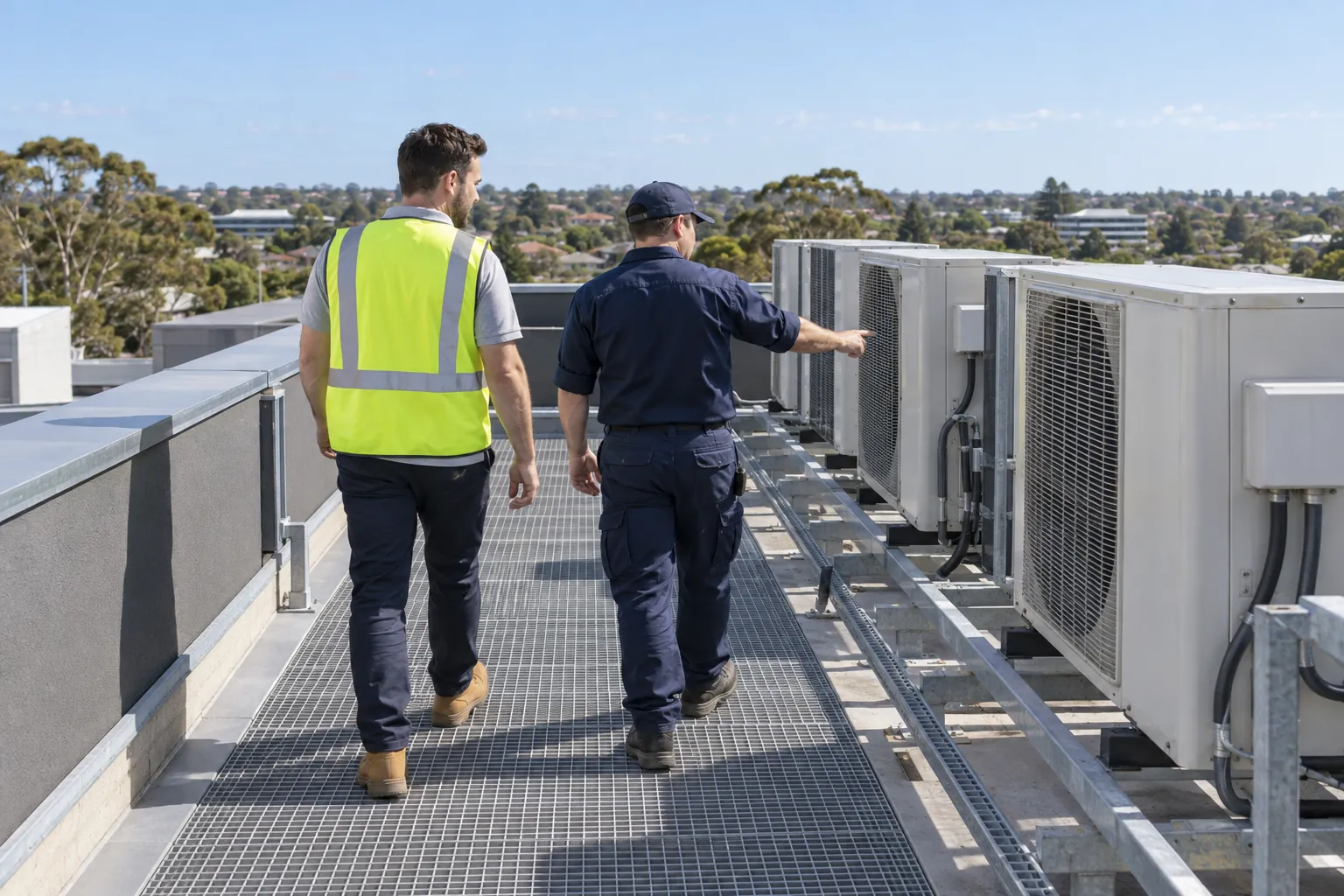
Good facility managers also walk part of the building with the owner or tenant from time to time. What the report says and what the building shows should match; when they do not, the report is the thing to fix.
06
Where the record fails, and what SiteClara does about it
The monthly report is usually assembled at the end of the month from whatever records exist: the CAFM or CMMS system for maintenance, the fire services contractor's logbook and certificates for compliance, and, for cleaning and security, paper sheets on the back of the amenities door, an occurrence book and the supervisor's memory. Those last records are the weakest, and they cover the services occupants notice most. A month of problems nobody wrote down arrives in the report as a single line: "no issues".
SiteClara does not write the monthly report. It produces a record each day. A printed QR poster, with an NFC tag behind it if staff prefer to tap, sits at each location; cleaning, security and building staff scan or tap with their own phone, with no app to install, complete the checks due there or explain what stopped them, and report issues with a photo, which go onto the team's list of jobs until someone closes them.
Each day the supervisor reviews the totals and photos, adds a note, records who was notified and approves the daily report, which goes to nominated management or client contacts at 8am the next morning. It shows what was reported, what was completed, what is still open and how the scheduled checks went, for example 12 of 12 completed. Whoever writes the monthly report has a month of approved daily reports to draw on, rather than a month of memory.
07
Questions people ask
What are the different types of facility management reports?
Most fall into three kinds. The first is the regular management report, usually monthly, on maintenance, compliance, incidents, KPIs and cost, which this guide covers. The second is the statutory fire safety statement or report each state requires: NSW Planning's page on fire safety certification says "Annual fire safety statements must be issued each year and include all the essential fire safety measures that apply to a building", and CFA's guidance on essential safety measures for businesses describes a record of the maintenance inspections and checks "in the form of an annual 'essential services report'". The third is the condition report, from a facility condition assessment of the building fabric and plant; the Victorian Department of Treasury and Finance's Asset Management Accountability Framework counts "condition reports" among the measures of how assets are performing, and Consumer Affairs Victoria's page on maintenance surveys, inspections and reviews says that every year an owners corporation "or its delegate should inspect the common property and must review the maintenance plan".
What is a KPI in facilities management?
A key performance indicator is a measure, agreed in advance, of whether the buildings and the services in them are doing what they should. The Victorian Department of Treasury and Finance's Asset Management Accountability Framework, written for Victorian public sector bodies, says that to ascertain the performance of an organisation's assets "key performance indicators (KPIs) should be established", and that they "can be financial or non-financial, qualitative or quantitative, leading or lagging". It ties them to agreed standards: establishing KPIs and targets for assets "should be driven by government policy objectives, established service standards, and available resources". In an FM contract, the KPIs are the ones the contract sets.
What are the top three KPIs in facilities management?
There is no official top three; the right KPIs are the ones in your contract. The Victorian Department of Treasury and Finance's Asset Management Accountability Framework does group useful KPIs under three headings: "operational performance of the asset in meeting its service delivery objectives (e.g. the quality of the service delivered by using the asset, user satisfaction)"; asset utilisation, which it says takes in "Occupational Health and Safety standards" and "legislative, regulatory or statutory compliance, condition reports"; and "operating costs (e.g. cleaning and energy costs, maintenance expenditure)". In a monthly facilities management report, that becomes service quality and occupant satisfaction, safety and statutory compliance, and cost against budget.
08
Further reading, and a list to take away
Safe Work Australia publishes the model WHS laws, and each state regulator its own guidance. For fire safety, read NSW Planning on fire safety certification, CFA on essential safety measures, and Queensland's Building Fire Safety Regulation 2008. State health departments publish the legionella rules for cooling towers. The FMA is the industry body for facility managers.
Before the next facilities management report goes out, check that:
- the first page shows what is overdue, failed, at risk or needs a decision;
- statutory compliance is a table by duty and building, not a percentage;
- each building names its state's fire safety regime and the date its next statement or report is due;
- notifiable incidents show the date the regulator was told;
- reactive work orders show response and completion times separately, and open jobs by age;
- every KPI has a named source record that could be produced if asked;
- cleaning and security figures come from records made at the time, not end-of-shift sheets;
- trends cover at least six months;
- every missed task has a reason and a new date;
- the actions list has owners and dates, and is reviewed at the monthly meeting.
Sources
Every document this guide quotes or links to, in the order it first cites them.
- Facility Management Association of Australia (FMA) fma.com.au
- Work Health and Safety Act 2011 (Qld) legislation.qld.gov.au
- Occupational Health and Safety Act 2004 (Vic) legislation.vic.gov.au
- Building Energy Efficiency Disclosure Act 2010 (Cth) legislation.gov.au
- Fire safety certification planning.nsw.gov.au
- Building Regulations 2018 (Vic) legislation.vic.gov.au
- Essential safety measures for businesses cfa.vic.gov.au
- Building Fire Safety Regulation 2008 (Qld) legislation.qld.gov.au
- Legionella control for occupiers health.nsw.gov.au
- Incident notification safework.nsw.gov.au
- Notifiable incidents under the OHS Act worksafe.vic.gov.au
- Asset Management Accountability Framework dtf.vic.gov.au
- Maintenance surveys, inspections and reviews consumer.vic.gov.au
Related guides
 Premises and facilities managementFacilities management contract: what to put in it in Australia, and how to make it workWhat goes into an Australian facilities management contract: scope, state fire safety duties, payment, KPIs and abatements, WHS, transfer of business and exit.
 Premises and facilities managementFacility manager duties in Australia: what the role covers, and how to show it is doneWhat a facility manager does in Australia: the WHS duties behind the role, contractors, fire safety and asbestos, the compliance year and the records that show it.
 Premises and facilities managementPreventative maintenance: how to plan it for a building and prove it was donePreventative maintenance for Australian buildings: the WHS duty, the asset register and schedule, statutory and discretionary tasks, and keeping good records.
 Premises and facilities managementReactive maintenance: how to run it well in an Australian buildingReactive maintenance in Australian buildings: the WHS and strata duties, priorities and response times, make-safes, contractors, asbestos and closing the loop.