Premises and facilities management
Reactive maintenance: how to run it well in an Australian building
Reactive maintenance is repair work carried out after a piece of equipment, plant or part of a building has failed or broken down, rather than on a schedule to prevent the failure.
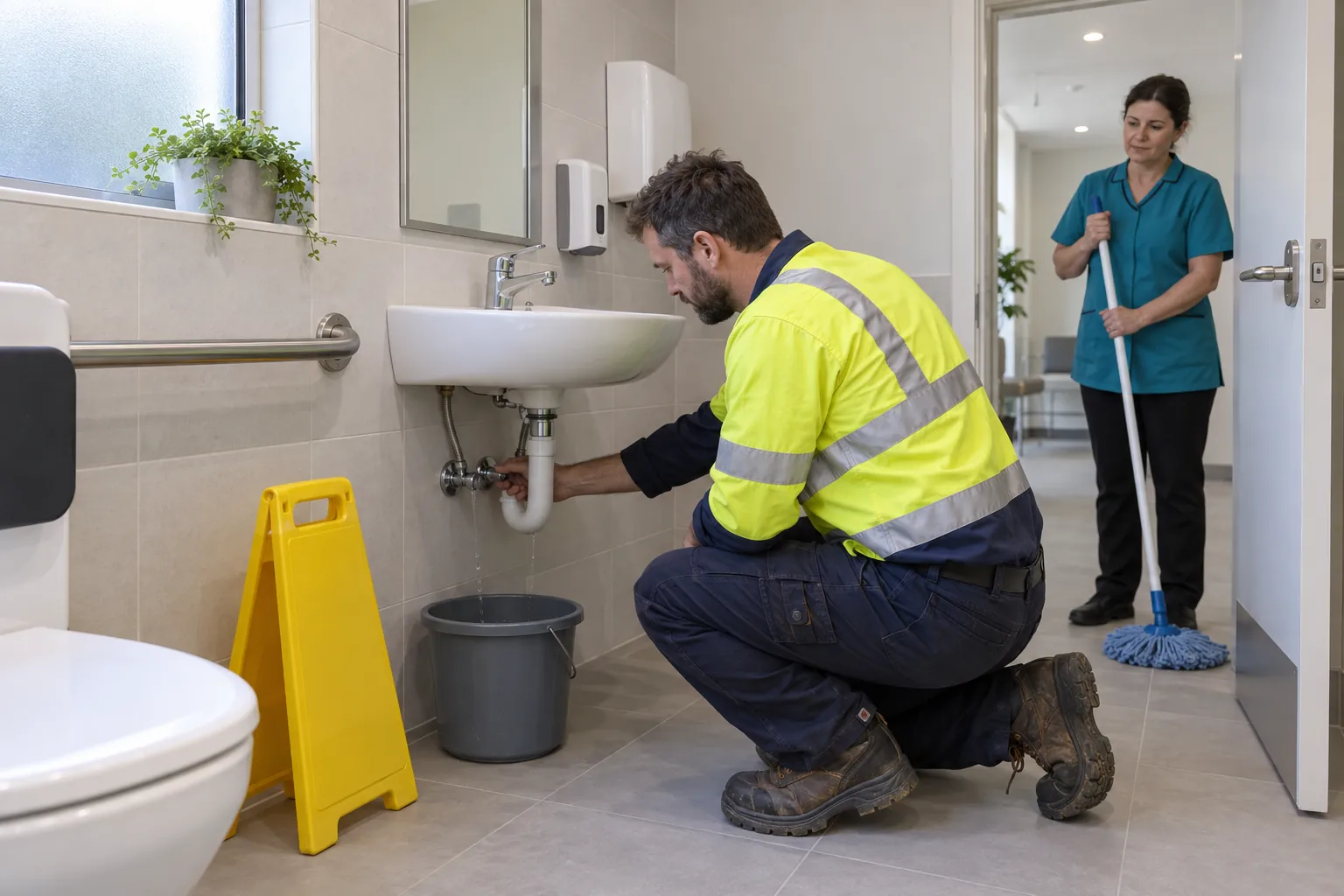
Every building needs some, and too much of it is a sign that the planned work is not being done. This guide explains where the duty to repair comes from under Australian work health and safety and strata law, how to prioritise faults and set response times, what a make-safe is, what to check before a contractor starts, and how to close the loop with the person who reported the fault.
01
What reactive maintenance is, and where the duty comes from
Reactive maintenance, also called breakdown, corrective or unplanned maintenance, is work done in response to a fault or an unexpected failure of equipment: an air conditioner that has stopped cooling, a leaking hot water unit, a box gutter overflowing after a storm. Its most urgent form is emergency maintenance.
It is one of several maintenance strategies:
- Preventative (or preventive) maintenance: servicing, inspection and testing of assets on a schedule, to stop failures before they happen.
- Condition-based or predictive maintenance: work triggered when monitoring shows something is wearing out.
- Run to failure: a deliberate decision to let a cheap, non-critical item fail and then replace it. A fluorescent tube in a store room is a fair candidate; a fire indicator panel, a lift or a stairwell light is not.
No Australian law sets how much reactive maintenance a building may have, but the duty to put faults right is plain in work health and safety (WHS) law. Every state and territory except Victoria has adopted the model WHS laws, and Queensland's version shows the wording. Section 19(3) of the Work Health and Safety Act 2011 (Qld) says the primary duty of a person conducting a business or undertaking (PCBU) includes "the provision and maintenance of a work environment without risks to health and safety" and "the provision and maintenance of safe plant and structures". Section 21(2) puts a matching duty on the person with management or control of fixtures, fittings or plant at a workplace to ensure, so far as is reasonably practicable, "that the fixtures, fittings and plant are without risks to the health and safety of any person".
Safe Work Australia's model code of practice on the work environment makes the point in everyday terms. The NSW edition, Managing the work environment and facilities (August 2019), says: "Broken or damaged furniture, fixtures and fittings, including chairs, plumbing, air-conditioning and lighting should be replaced or repaired promptly. Facilities must be clean, safe, accessible and in good working order."
Victoria is the exception. It has its own Occupational Health and Safety Act 2004 (version 045, 6 August 2025) and its own regulations, so a Victorian building should be checked against those rather than the WHS model.
In apartment and mixed-use buildings, strata law adds a second duty for the common property, in each state's own words: the owners corporation in New South Wales and Victoria, the strata company in Western Australia and the body corporate in Queensland. The NSW Government's guidance on strata repairs and maintenance says "The owners corporation is responsible for maintenance and repair of common property", and Queensland's page on body corporate maintenance says "A body corporate must maintain the common property in a good and structurally sound condition."
02
What reactive maintenance covers in practice
In a typical office, school, shopping centre, medical centre or residential block, reactive jobs fall into a few familiar groups:
- Plumbing and drainage: leaking taps and cisterns, blocked toilets, burst flexible hoses, overflowing box gutters.
- Air conditioning and ventilation: a unit not cooling, a failed car park exhaust fan, a faulty controller.
- Electrical: lights out, tripped circuits, damaged power points.
- Doors, access and security: automatic doors and boom gates that stick, broken closers, faulty swipe readers.
- Fabric and finishes: roof leaks, fallen ceiling tiles, lifting vinyl, broken fittings.
- Fire safety and emergency equipment: a fire door that no longer closes and latches, an exit sign or emergency light that is out, a fault shown on the fire indicator panel.
- Damage and incidents: storm and hail damage, vandalism, graffiti, forced entry.
Each follows the same path, whether the work is done by an in-house maintenance team, a facilities management contractor or trades called in job by job: the fault is reported, logged and given a priority; someone attends, makes it safe if needed and fixes it; the fix is checked; the job is closed; and the person who reported it is told. How faults and hazards reach you in the first place is covered in our guide to a hazard report form. This guide is about what happens next.
Much of the reporting comes from cleaners, security officers and caretakers, not maintenance staff, so the process is only as good as the route they have for passing faults on.
03
Priorities, response times and make-safes
Reactive work needs a priority scale that everyone uses the same way, set out in the contract or the building's procedures. The times below are examples, not a standard.
- Priority 1, emergency: an immediate risk to health, safety, security or the building, such as a burst pipe, a live electrical fault or a door that cannot be secured. Attend and make safe within an hour or two, around the clock.
- Priority 2, urgent: a fault that stops part of the building being used or will get worse quickly, such as no air conditioning to an occupied floor in summer. Attend the same day or within 24 hours.
- Priority 3, routine: a fault that is a nuisance but not a risk. Attend within a few business days.
- Priority 4, planned: work that can wait and be grouped with other jobs or done out of hours, within weeks.
Three habits make a priority scale work:
- Measure attendance and completion separately. The response time is when someone arrives or makes the fault safe; the rectification time is when it is fixed. Measure both, or every response target can be met while jobs stay open for weeks.
- Judge the risk, not the complaint. Priority follows the hazard and the asset, not how loudly the fault was reported: a light out is a nuisance in a meeting room and a fall risk in a fire stair.
- Plan for after hours. Say who answers an emergency at night and on weekends, who can authorise a call-out, and what the team on site should do meanwhile.
A make-safe is not a repair. Isolating a leak at the valve, barricading a damaged area, taking a faulty appliance out of use or boarding a broken window is the right first response, but the job should stay open until the permanent repair is done. In the storm and cyclone season, expect a run of make-safes after each event and a backlog of permanent repairs behind them; our cyclone preparation checklist covers what to do beforehand.
04
The balance between planned and reactive work, and the cost
Reactive maintenance is not a failure in itself; some faults cannot be foreseen. The problem is a building run purely reactively, where most of the budget goes on breakdowns.
The disadvantages of reactive maintenance as the main strategy are well known:
- Higher cost per job: call-out fees, after-hours and public holiday rates, parts bought at short notice and secondary damage, such as a ceiling ruined by a leak a routine check would have found.
- Downtime: rooms, floors, lifts, amenities or whole building systems out of use while the fault is fixed, disrupting the operations of the tenants and staff who rely on them.
- Shorter asset life: plant run until it breaks wears out sooner.
- Compliance risk: equipment that is only looked at when it fails is, by definition, not being maintained.
- A budget nobody can forecast: reactive costs arrive unevenly.
For plant, a purely reactive approach can also fall short of the law. Section 213 of the Work Health and Safety Regulation 2011 (Qld), which follows the model regulations, says the person with management or control of plant at a workplace "must ensure that the maintenance, inspection and, if necessary, testing of the plant is carried out by a competent person", following the manufacturer's recommendations where there are any. That plant belongs on the planned schedule, not only the reactive list.
No ratio of planned to reactive work suits every building. A more useful habit is to track reactive jobs by asset, location and cause. Repeat faults on the same item point to something that should be replaced or added to the planned schedule; a cluster of faults in one area points to a root cause, such as a failing roof membrane or an undersized stormwater drain. A computerised maintenance management system (CMMS) makes that far easier, because the data on every job sits against the asset it concerns.
The aim is not to eliminate reactive work but to choose it: decide, asset by asset, whether planned work is worth its cost or whether running to failure is acceptable, and write that into the maintenance plan. In strata buildings the same analysis feeds the capital works or sinking fund plan.
05
Contractors, safety on site, and closing the loop
Most buildings use contractors for at least some reactive work. The arrangements that matter are:
- Approved contractors: a short list per trade, with public liability insurance, workers compensation cover and licences checked. Electrical work, plumbing and gasfitting are licensed trades, so check the licence against the state or territory's public register.
- How they are paid: a schedule of rates, a fixed price per job or a comprehensive contract. Agree call-out fees, minimum charges and after-hours rates before the first emergency, not during it.
- Authorisation: who can instruct a contractor and up to what value, so that a routine job does not become an expensive one without anyone deciding. In a strata scheme, that means knowing what the strata manager, building manager or committee can approve.
- Evidence of completion: a job sheet saying what was found and done, photos where they help, and any further work recommended.
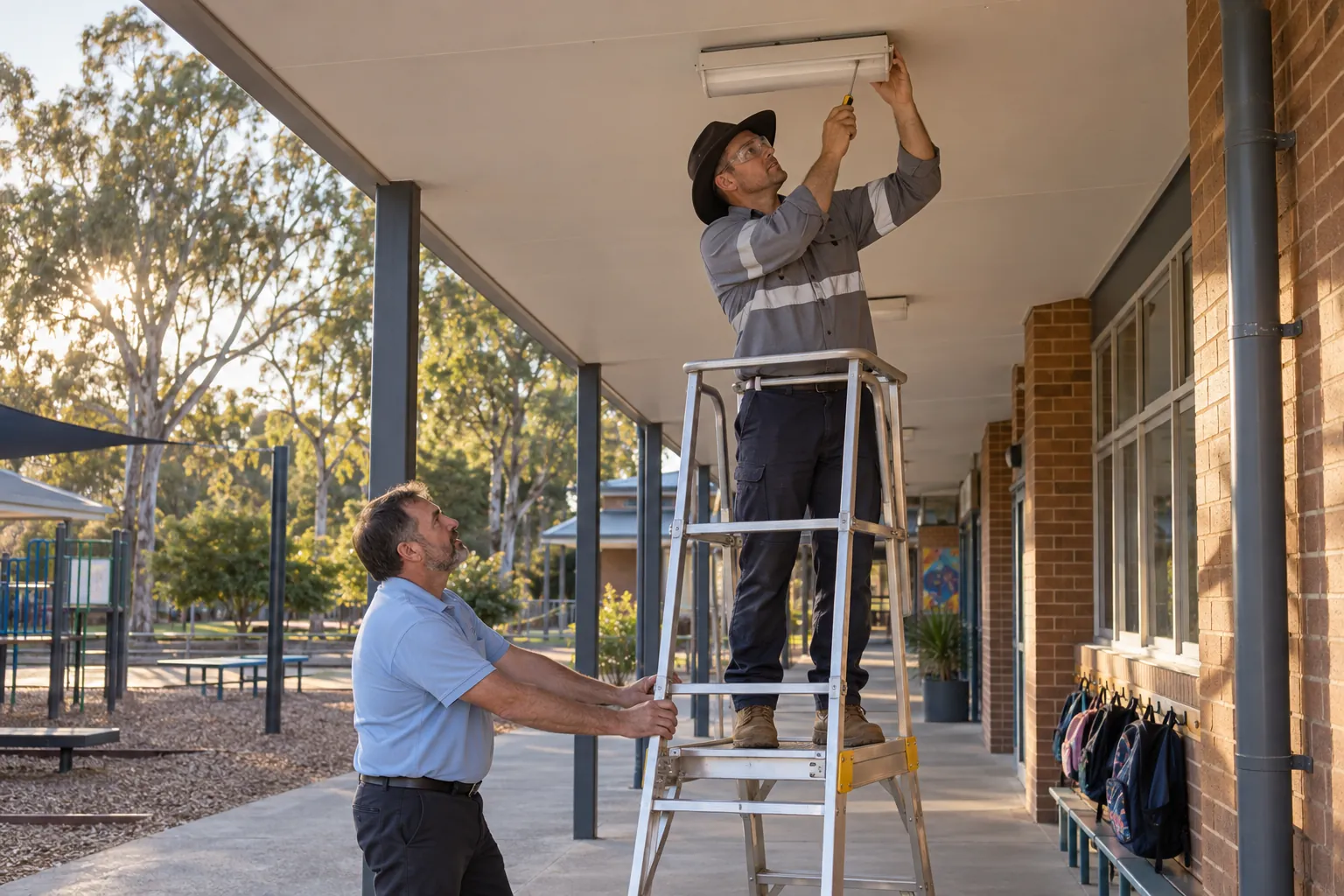
Repairs are often construction work in the eyes of WHS law. Section 289 of the Queensland WHS Regulation, which follows the model, defines construction work as "any work carried out in connection with the construction, alteration, conversion, fitting-out, commissioning, renovation, repair, maintenance, refurbishment, demolition, decommissioning or dismantling of a structure". Section 291 lists high risk construction work, which includes work that "involves a risk of a person falling more than 2m", work that "involves, or is likely to involve, the disturbance of asbestos" and work "carried out on or near energised electrical installations or services". It needs a safe work method statement (SWMS), and construction workers need a white card. The model code, published in NSW as Construction work (August 2019), explains both and notes that some jurisdictions use 3 metres.
Asbestos needs checking before anyone drills, cuts or lifts anything. SafeWork NSW's asbestos guidance says that if a workplace was built before 31 December 2003, or asbestos has been identified there, you must keep a register of where it is, what type it is and what condition it is in. The model code, How to manage and control asbestos in the workplace, explains that the register must be readily accessible to a PCBU who intends to carry out work at the workplace, and that where their work involves a risk of exposure to airborne asbestos, the person with management or control of the workplace must give them a copy. Make showing it part of every contractor's sign-in.
Closing the job has two halves, and the second is the one that gets forgotten:
- Check the fix. Someone on site, not only the contractor, confirms the fault is resolved before the job is closed.
- Tell the person who reported it. A short message that the fault has been fixed, or when it will be, is what turns a fault report into trust. People who never hear back stop reporting.
Review response and rectification times, repeat call-outs and reopened jobs with each contractor monthly, and keep the records with the asset and location. When a tenant, an insurer, a strata committee or a WHS inspector asks what was done about a fault, the answer should be a record, not a recollection.
06
Where the record fails, and where SiteClara fits
Reactive maintenance records are usually good once a job is logged with the contractor or in the CMMS, and weak either side of it: before, because faults found by cleaners, security officers and caretakers are passed on verbally or not at all; after, because nobody checks the fix or tells the person who reported it.
SiteClara covers the teams on the ground. A printed QR poster at each location, with an NFC tag behind it if you want staff to tap, lets staff scan or tap on their own phone, with no app to install, and report an issue with a photo. The report already knows the building and the location, and it goes onto the team's list of jobs until someone closes it. The supervisor's queue groups open jobs by building and floor, and a supervisor can escalate a job to the building manager, who can answer it.
Each day the supervisor approves a report that goes to nominated management or client contacts at 8am the next morning, showing what was reported, what was completed and what is still open.
07
Questions people ask
What is the difference between reactive and corrective maintenance?
In practice, very little: both mean putting right a fault that has already appeared, and the terms are often used interchangeably. Consumer Affairs Victoria's page on the owners corporation maintenance plan uses corrective maintenance for routine fixes "to keep your building at an acceptable standard", such as "cleaning gutters and changing light bulbs", and emergency corrective maintenance for work that "must happen immediately for health, safety, security reasons", such as "roof repairs after storm damage, or repairing broken glass".
What is the difference between reactive and proactive maintenance?
Reactive maintenance waits for the failure; proactive maintenance plans ahead to prevent it. The same Consumer Affairs Victoria page on the owners corporation maintenance plan describes predictable maintenance of major capital items as work "to prevent the predictable failure of building infrastructure or major capital items; for example, replacing lifts due to wear and tear", and warns that "Poor maintenance or neglect can lead to serious damage and safety hazards." In NSW, the Government's page on strata repairs and maintenance says the owners corporation's 10-year capital works plan "predicts what major repairs might be needed and forecasts their costs".
08
Further reading, and a list to take away
Safe Work Australia publishes the model codes of practice, and each state and territory regulator publishes the version approved for its own jurisdiction; this guide uses SafeWork NSW's editions of the three cited above. In Victoria, read WorkSafe Victoria's guidance under the Occupational Health and Safety Act 2004 instead. For common property, start with your state's strata guidance; for fire safety measures, the state scheme alongside AS 1851-2012.
To keep reactive maintenance under control, check that:
- every fault is logged with a location and a priority, whoever reports it, including cleaners, security officers and caretakers;
- priorities follow the hazard and the criticality of the asset, with example faults for each level;
- response and rectification times are measured separately;
- after-hours emergencies have a named route and an authorised person;
- make-safes stay open until the permanent repair is done;
- faults on fire safety measures go to the fire services contractor and into the fire safety records;
- contractors are licensed, insured, inducted and shown the asbestos register before intrusive work, with a SWMS for high risk construction work;
- repeat faults are reviewed and fed into the preventative maintenance schedule or the capital works plan;
- the person who reported the fault is told when it is fixed.
Sources
Every document this guide quotes or links to, in the order it first cites them.
- Work Health and Safety Act 2011 (Qld) legislation.qld.gov.au
- Managing the work environment and facilities (August 2019) safework.nsw.gov.au
- Occupational Health and Safety Act 2004 legislation.vic.gov.au
- Strata repairs and maintenance nsw.gov.au
- Body corporate maintenance qld.gov.au
- Essential safety measures for businesses cfa.vic.gov.au
- Work Health and Safety Regulation 2011 (Qld) legislation.qld.gov.au
- Construction work (August 2019) safework.nsw.gov.au
- SafeWork NSW's asbestos guidance safework.nsw.gov.au
- How to manage and control asbestos in the workplace safework.nsw.gov.au
- Owners corporation maintenance plan consumer.vic.gov.au
Related guides
 Premises and facilities managementPreventative maintenance: how to plan it for a building and prove it was donePreventative maintenance for Australian buildings: the WHS duty, the asset register and schedule, statutory and discretionary tasks, and keeping good records.
 Premises and facilities managementHazard report forms and hazard reporting: what WHS law asks, and how to close the loopHazard reporting under Australian WHS law: the duty to identify hazards, what a hazard report form should hold, who acts on it, and how to show the fix was made.
 Premises and facilities managementBuilding maintenance checklist: what to check, how often, and who byA building maintenance checklist for Australian commercial and strata buildings: daily to annual tasks, the WHS and fire safety law behind them, and who does each.
 Premises and facilities managementStrata maintenance: keeping common property in repair, and showing that you haveStrata maintenance in Australia: the duty to repair common property in NSW, Victoria and Queensland, the plans a scheme needs, who does what and the records to keep.