Premises and facilities management
Facility manager duties in Australia: what the role covers, and how to show it is done
A facility manager's duties are to plan, coordinate and check the maintenance, cleaning, security, safety and compliance of an organisation's buildings, so that they operate efficiently, stay safe and cost what they should, usually across more than one site and mostly through contractors.

In Australia the legal duties behind the role belong to the business, its officers and whoever controls the workplace, under the model WHS laws or, in Victoria, the OHS Act. This guide sets out the duties most facility manager position descriptions share, how the work divides between the facility manager, contractors and the business, the compliance year, and what a good record of it looks like.
01
What a facility manager is, and the law behind the duties
Facility management is the work of keeping an organisation's buildings, and the services people rely on in them, fit for what the organisation does. A facility manager (also a facilities manager, FM or, in universities and hospitals, an estates or campus services manager) leads that work. Where a building manager usually looks after one building for its owner, a facility manager looks after the services one organisation needs across the buildings it occupies: maintenance, cleaning, security, waste, reception, space, and the compliance under all of them.
The industry body is the Facility Management Association of Australia (FMA), which describes itself as "the peak national industry body for facilities management, representing and supporting professionals and organisations responsible for the operational management of Australia's built environments".
No Australian law describes a facility manager's job. The duties the role carries out belong in law to the business or undertaking, to its officers and to whoever manages or controls the workplace. Every state and territory except Victoria has adopted a version of the model Work Health and Safety Act. In the Work Health and Safety Act 2011 (Qld), which follows the model text, three sections shape most of a facility manager's work:
- Section 19, the primary duty of care: a person conducting a business or undertaking (PCBU) "must ensure, so far as is reasonably practicable, the health and safety of" its workers, including those "whose activities in carrying out work are influenced or directed by the person", which takes in contractors' cleaners, guards and technicians. It includes "the provision and maintenance of a work environment without risks to health and safety" and "the provision of adequate facilities for the welfare at work of workers".
- Section 20, the duty of the person with management or control of a workplace to make sure the workplace, the ways in and out of it and anything arising from it are without risks to anyone, so far as is reasonably practicable.
- Section 46: "If more than 1 person has a duty in relation to the same matter under this Act, each person with the duty must, so far as is reasonably practicable, consult, cooperate and coordinate activities with all other persons who have a duty in relation to the same matter." In a leased office or a shared campus that means the landlord, the tenant, and each contractor.
Section 27 matters to the people a facility manager reports to. An officer of the business "must exercise due diligence" to make sure it complies, and section 27(5) says that includes making sure it has "appropriate processes for receiving and considering information regarding incidents, hazards and risks and responding in a timely way to that information", and taking steps "to verify the provision and use of the resources and processes" it relies on. Much of a facility manager's reporting is how officers meet that duty to verify.
Victoria has its own law. Under section 21(1) of the Occupational Health and Safety Act 2004 (Vic) (version 045, in force from 6 August 2025), an employer "must, so far as is reasonably practicable, provide and maintain for employees of the employer a working environment that is safe and without risks to health". Section 26(1) requires whoever "has, to any extent, the management or control of a workplace" to ensure that it "and the means of entering and leaving it are safe and without risks to health". The effect is much the same.
02
The key duties of a facility manager
Position descriptions vary between a bank's offices, a university campus, a hospital or a council's buildings, but the same duties and responsibilities appear in nearly all of them:
- WHS and compliance: knowing which inspections, tests, registers and plans each building needs, making sure they happen on time, and holding the certificates, logbooks and records.
- Contractor safety: inductions, safe work method statements, permits for hot work and confined spaces, and asbestos information before work that could disturb it.
- Building maintenance: preventative maintenance of building services such as air conditioning, electrical, hydraulics, lifts, fire systems and the building management system, and reactive maintenance when something fails. This is often called hard services.
- Soft services: cleaning, security, reception, mail, catering, waste and recycling, pest control, grounds and car parks.
- Contracts and suppliers: writing specifications, running tenders, managing contracts and holding providers to agreed service levels.
- Budgets: operating budgets, capital plans for plant and fabric, and variances.
- Space and workplace: fit-out and refurbishment projects, moves and workplace amenities.
- Emergency management and business continuity: the emergency plan, the emergency control organisation of wardens and their training, and what happens when power, water, air conditioning or access fails.
- Sustainability: energy, water and waste, and the ratings the organisation reports.
- Reporting to the business: telling management and the officers, with data rather than impressions, whether the portfolio is safe, compliant and on budget, and what it needs next.
In a small organisation one person may do all of this with a handful of contractors. In a large one, the facility manager leads site coordinators and a service desk, and spends more of the week on contracts, budgets and reporting.
03
In-house, outsourced, and who holds which duty
How the duties divide depends on the delivery model, and a facility manager needs to be clear which one they are working in:
- In-house: the organisation employs its own maintenance staff, cleaners or security officers, and the facility manager runs them directly.
- Single services contracted: separate contracts for cleaning, security, mechanical, electrical, fire services, lifts and so on, each managed by the facility manager.
- Integrated or total facility management: one provider delivers most services under a single facilities management contract, and the facility manager becomes the informed client, setting the specification and checking performance.
- Leased premises: the landlord and its building manager run the base building and common areas, and the tenant's facility manager looks after the tenancy. The lease says who maintains what, but it does not remove anyone's WHS duty.
Contracting moves the work, not the duty. A cleaning or security contractor is a PCBU with its own duties, and the organisation that engaged it keeps its duties for the workplace and for the work it influences or directs; section 46 requires both to consult, cooperate and coordinate. In Victoria, section 21(3)(b) of the OHS Act extends the employer's duty to a contractor and its employees "in relation to matters over which the employer has control or would have control if not for any agreement purporting to limit or remove that control". A contract cannot push the duty away.
That is why so much of the role is specifications, service levels and inspections: they are how the client side knows what is being delivered, and the evidence its officers point to when asked how they verified it.
For each building and service, write down who does the work, who checks it, where the record is kept and who is told when it goes wrong. Failures gather at the boundaries: between two contractors, or between the landlord's building manager and the tenant's facility manager.
04
The working week and the compliance year
The weekly work is mostly overseeing day-to-day operations: walking sites, dealing with faults, complaints and after-hours call-outs, meeting contractors, and approving quotes and invoices.
Behind that sits a compliance calendar for each building. Much of it is set by state law, with AS 1851-2012, Routine service of fire protection systems and equipment, as the common standard for routine servicing of fire systems:
- New South Wales: under the Environmental Planning and Assessment (Development Certification and Fire Safety) Regulation 2021, an annual fire safety statement is issued by or on behalf of the owner each year, confirming that an accredited practitioner (fire safety) has assessed, inspected and verified the performance of each essential fire safety measure. NSW Planning explains it on its page on fire safety certification.
- Victoria: the owner maintains the building's essential safety measures (regulation 226) and prepares an annual essential safety measures report (regulation 223) under the Building Regulations 2018 (Vic).
- Queensland: under the Building Fire Safety Regulation 2008 (Qld), section 54(2), the occupier "must ensure each prescribed fire safety installation for the building is inspected and tested at intervals in compliance with QDC, part MP6.1", and section 44(2) requires an evacuation to be carried out at intervals of not more than 1 year. The occupier also prepares an occupier statement and gives the commissioner a copy.
- Other states and territories have their own fire safety maintenance rules; check with the state fire authority and building regulator.
Around the fire safety year sit the WHS records. Under the Work Health and Safety Regulation 2011 (Qld), which follows the model regulations, regulation 43 requires an emergency plan for the workplace, and regulation 40 sets the general workplace facilities duties: safe entry and exit, work space, floors, lighting, ventilation and temperature. The person with management or control of a workplace keeps an asbestos register recording any asbestos identified or likely to be present, or stating that none is identified (regulation 425; newer buildings with no asbestos identified or likely are exempt). Where asbestos has been identified or is likely to be present, they also keep an asbestos management plan (regulation 429), reviewed, and revised as necessary, when the asbestos register or a control measure is reviewed, when asbestos is removed, disturbed, sealed or enclosed, when the plan is no longer adequate, when a health and safety representative asks, and at least once every 5 years (regulation 430). Victoria's asbestos rules, including the register, are in the Occupational Health and Safety Regulations 2017 (Vic).
Then come the routine checks, mostly done by a contractor or site staff:
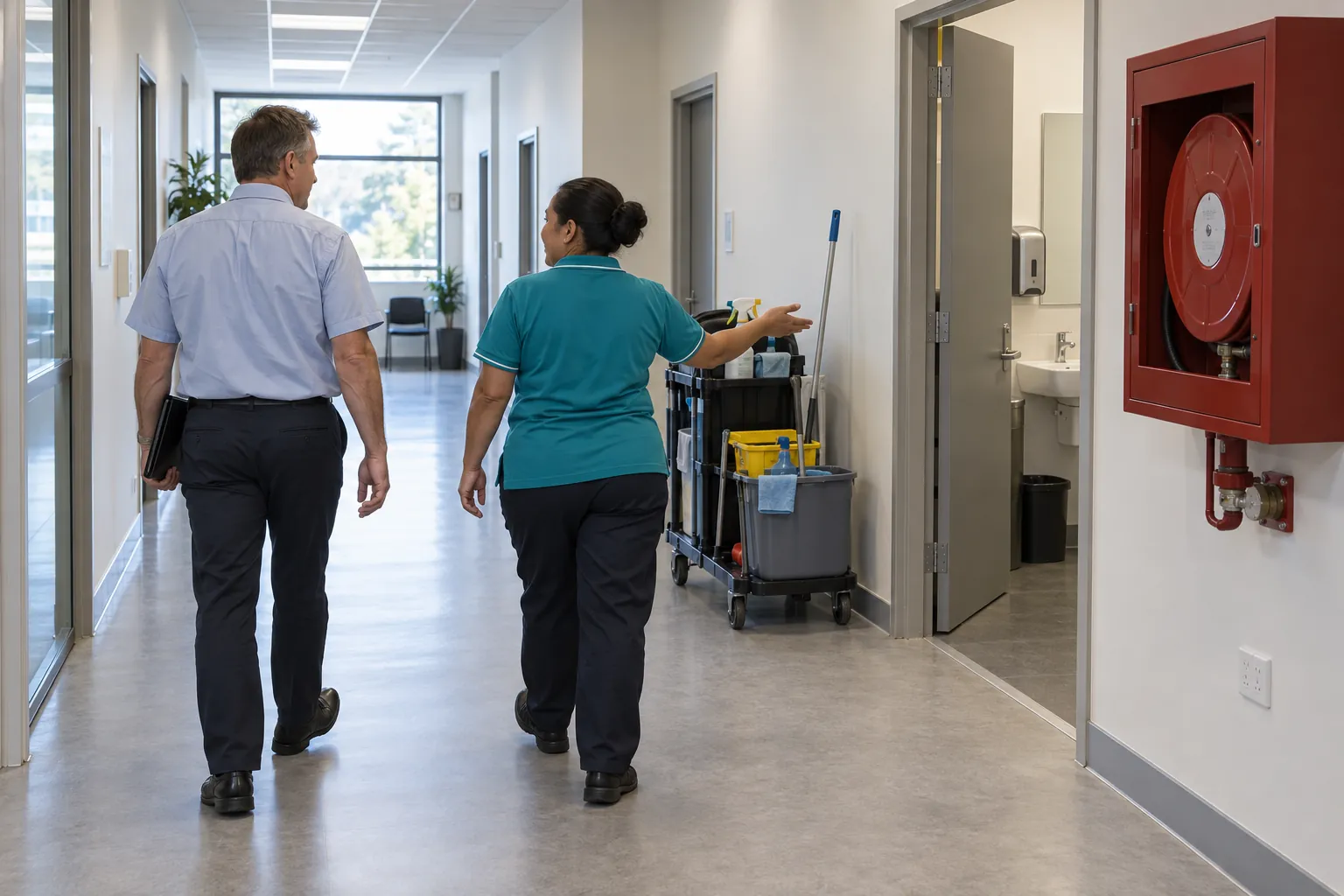
- Daily and weekly: exit paths and fire doors, amenities, bin rooms, car parks, plant rooms, and the cleaning and security rounds the contracts specify.
- Monthly to six-monthly: the AS 1851 routines for fire systems and emergency lighting tests.
- Annual and periodic: the fire safety statement or report, evacuation exercises, lift servicing, cooling tower programs where state health law requires them, electrical testing, and reviews of the emergency plan and the asbestos management plan.
Energy has a federal rule. Part 2 of the Building Energy Efficiency Disclosure Act 2010, behind the Commercial Building Disclosure program, prohibits the sale, lease or sublease of a building or area it affects without a building energy efficiency certificate, and requires advertisements to include the energy efficiency rating.
Many teams keep this calendar in facilities management software; smaller ones use a spreadsheet. Either way, the job is to make sure each check has an owner, happens on time, and leaves a record someone else can find and trust.
05
Skills, qualifications, and what good evidence looks like
There is no licence to practise as a facility manager and no single career path in. People arrive from the trades, engineering, the Defence Force, hospitality, property, real estate or office management, and some take a diploma or degree in facilities or property. Qualifications in work health and safety and in contract management are common in job advertisements.
The skills that matter most are organisation, contract and budget management, a working knowledge of building services, and the ability to say plainly what is compliant, what is not and what it will cost to fix. That is more use to officers exercising due diligence than a report where everything is green.
Good evidence of the duties being done well is not a thick folder. It is being able to answer quickly, with a record behind each answer:
- Which inspections, tests and statements are due in the next 90 days, and which are overdue?
- Were last week's routine checks done at every site, and by whom?
- Are the contractors delivering what their contracts say, measured the same way each month?
- Which faults and hazards were reported, and is each one closed?
- Where is the money going against budget, and what capital works are coming?
The second and fourth questions are the ones most often answered from memory. Contractors certify their periodic services and sign the AS 1851 logbook; the everyday rounds, and the faults mentioned in passing, are rarely recorded as well. When a WHS inspector, an insurer, a fire authority or the organisation's own audit committee asks, the gaps show.
06
Where the record fails, and what SiteClara does about it
A facility manager usually has good records of what contractors certify and weak records of what happens every day. The fire services contractor signs the logbook, but the cleaners' sheet on the back of the amenities door is signed in advance for the week, the lock-up patrol is in a notebook in the guard room, and a fault mentioned to a cleaner in the car park may never reach anyone. Asked whether the routine checks were done across every site last month, the honest answer is often an assurance rather than a record.
SiteClara records that routine work at the place it happens. A printed QR poster at each location, such as an amenities block, a plant room, a fire stair door, a loading dock or a bin room, with an optional NFC tag behind it, lets cleaning, security or site staff scan the code or tap the tag on their own phone, with no app to install. They see the scheduled checks due there and mark each one done, or say what stopped them, with a photo when the check asks for one. An issue reported there goes onto the team's list of jobs until someone closes it, and the supervisor's queue groups open jobs by building and floor.
Each day the supervisor reviews the checks and photos, adds a note and approves a report, which goes to the facility manager and other nominated contacts the next morning: what was reported, completed and still open, and how the scheduled checks went. Where a cleaning contractor and a security contractor share a building, each runs its own staff, forms and approval.
07
Questions people ask
What are the responsibilities of a facilities manager in Australia?
To organise and coordinate the management of an organisation's buildings so they operate safely and efficiently, while the legal duties stay with the business. The Australian Bureau of Statistics' ANZSCO 2022, unit group 1499 Other Hospitality, Retail and Service Managers describes a Facilities Manager (149913) as someone who "Organises, controls and coordinates the strategic and operational management of buildings and facilities in a public and private organisations to ensure the proper and efficient operation of all physical aspects of a facility, to create and sustain safe and productive environments for occupants." The safety duties the role carries out belong in law to the business and to whoever controls the workplace: under section 20(2) of the Work Health and Safety Act 2011 (Qld), which follows the model law, "The person with management or control of a workplace must ensure, so far as is reasonably practicable, that the workplace, the means of entering and exiting the workplace and anything arising from the workplace are without risks to the health and safety of any person." In Victoria the equivalent duties are in the OHS Act 2004.
What qualifications does a facility manager need?
The national occupation classification sets the usual level. The ABS's ANZSCO 2022, unit group 1499 Other Hospitality, Retail and Service Managers puts Facilities Manager at Skill Level 2, which in Australia means an "AQF Associate Degree, Advanced Diploma or Diploma", and adds that "At least three years of relevant experience may substitute for the formal qualifications listed above." In practice many facility managers come from the trades, engineering or property, and add training in work health and safety or contract management.
08
Where to read more, and a list to take away
Safe Work Australia publishes the model WHS Act, Regulations and codes of practice, and your state or territory regulator publishes the version that applies where the building is; in Victoria, start with WorkSafe Victoria's page on the Occupational Health and Safety Act and Regulations. For fire safety, read the state fire authority and building regulator. The Facility Management Association of Australia runs professional development for the industry.
If you are writing a facility manager position description, or starting in the role, check that you know:
- every building and service you are responsible for, and the ones you are not;
- which state or territory's law applies to each building, and whether it is the model WHS law or Victoria's OHS Act;
- who the PCBUs, the persons with management or control and the officers are, and which of their duties you carry out;
- the fire safety obligations for each building, who services each measure to AS 1851, and when the annual statement or report is due;
- where each asbestos register, asbestos management plan and emergency plan is, and when each was last reviewed or tested;
- where each routine check is recorded, and how you would see that it was missed;
- how faults and hazards are reported, and how you know each one is closed.
Sources
Every document this guide quotes or links to, in the order it first cites them.
- Facility Management Association of Australia (FMA) fma.com.au
- Work Health and Safety Act 2011 (Qld) legislation.qld.gov.au
- Occupational Health and Safety Act 2004 (Vic) legislation.vic.gov.au
- Routine service of fire protection systems and equipment store.standards.org.au
- Fire safety certification planning.nsw.gov.au
- Building Regulations 2018 (Vic) legislation.vic.gov.au
- Building Fire Safety Regulation 2008 (Qld) legislation.qld.gov.au
- Work Health and Safety Regulation 2011 (Qld) legislation.qld.gov.au
- Occupational Health and Safety Regulations 2017 (Vic) legislation.vic.gov.au
- Building Energy Efficiency Disclosure Act 2010 legislation.gov.au
- ANZSCO 2022, unit group 1499 Other Hospitality, Retail and Service Managers abs.gov.au
- Occupational Health and Safety Act and Regulations worksafe.vic.gov.au
Related guides
 Premises and facilities managementBuilding manager duties in Australia: the law, the daily work and the recordWhat a building manager does in Australian offices, shopping centres and strata buildings: the WHS duties, strata rules, fire safety upkeep and the records to keep.
 Premises and facilities managementFacilities management contract: what to put in it in Australia, and how to make it workWhat goes into an Australian facilities management contract: scope, state fire safety duties, payment, KPIs and abatements, WHS, transfer of business and exit.
 Premises and facilities managementFacilities management report: what to include, and what makes it believableWhat an Australian facilities management report should contain: WHS, fire safety compliance by state, maintenance, KPIs, costs and the evidence behind them.
 Premises and facilities managementBuilding compliance checklist: the duties that come with an Australian buildingA building compliance checklist for Australian commercial buildings: WHS duties, fire safety maintenance by state, asbestos, plant, water, access and the records.