Premises and facilities management
Facilities management contract: what to put in it in Australia, and how to make it work
A facilities management contract is a service agreement under which a building owner, tenant or government agency engages a provider to maintain and run its buildings, setting out which facilities management services it is buying, how it will pay, how it will know it is getting them, and what happens at the start and the end.

This guide walks through each part as it applies in Australia: the Commonwealth Procurement Rules and state policies for public buyers, fire safety maintenance that differs from state to state, WHS duties that no contract can hand over, transfer of business under the Fair Work Act, and the places FM contracts most often go wrong. It is general guidance, not legal advice.
01
What a facilities management contract is
A facilities management contract, sometimes called a facility services agreement, is a service contract between a client and an FM provider for building services over a term of years. It may cover a single service, such as mechanical, electrical and fire services maintenance, or bundle several, such as maintenance, cleaning, security, waste and grounds, into one integrated FM contract. Hard services are the building's physical systems, such as mechanical, electrical, fire, plumbing and lifts; soft services are the ones occupants notice day to day, such as cleaning, security, waste and grounds. The client might own an office tower or a shopping centre, lease a national portfolio, or run a university, a hospital, a council's community facilities or a government agency.
Private buyers are free to write their own terms, start from their organisation's standard terms, or accept the provider's. Public buyers usually have less choice. Commonwealth agencies buy under the Commonwealth Procurement Rules (CPRs), the current version commencing 17 November 2025, issued by the Finance Minister under the Public Governance, Performance and Accountability Act 2013. They state that "Achieving value for money is the core rule of the CPRs", and that "Price is not the sole factor": quality, fitness for purpose and a supplier's "relevant experience, performance history and ethical conduct" count too. They also require non-corporate Commonwealth entities to use the Commonwealth Contracting Suite for contracts under $200,000, and every entity bound by the CPRs to build the Commonwealth Supplier Code of Conduct into Commonwealth forms of contract.
At or above the procurement threshold, $125,000 for a non-corporate Commonwealth entity buying anything other than construction services, the stricter rules in Division 2 of the CPRs apply as well. States and territories have their own procurement policies. In Victoria, for example, the Fair Jobs Code, operating since 1 December 2022 and revised from 1 September 2024, requires suppliers seeking government contracts of $1 million or more (excluding GST) to hold a Fair Jobs Code pre-assessment certificate. Whichever sector you are in, the logic is the same: a clear specification, a fair price and an agreed way to measure what is delivered.
02
What a facilities management contract covers
Whatever the form, most FM contracts contain the same parts, though the names differ from one organisation to the next:
- Scope: the buildings, the services, and the assets and equipment included, with a schedule of what is excluded.
- Service specifications: what each service must achieve, for example preventative maintenance to the manufacturers' requirements and the relevant Australian Standards, reactive maintenance with response and rectification times by priority, cleaning to a written specification, and security to agreed site instructions.
- Statutory fire safety maintenance: which routine servicing the provider arranges, for example to AS 1851, who signs the state's statement or report, and who holds the records. This is state law, and it differs: essential safety measures in Victoria, the annual fire safety statement in New South Wales, and the Building Fire Safety Regulation in Queensland. A national contract needs a schedule by state.
- Licences and awards: security work is licensed under state and territory law, and cleaners and security officers are paid under modern awards or enterprise agreements; the contract should require the provider to hold and keep the licences and pay what the law requires.
- Work health and safety: how the parties consult, cooperate and coordinate, and who manages inductions, permits to work, hazardous chemicals and incident reporting.
- Price and payment: how fixed work, reactive work and extras are paid for, and when.
- Performance regime: KPIs and service levels, how they are measured and what follows when they are missed.
- Governance: named contract managers, monthly reports, review meetings and a dispute resolution path.
- Risk and liability: insurances, indemnities, caps on liability and business continuity.
- Change: how services, buildings and assets are added, removed or varied, and at what price.
- Term, transition and exit: the start date, the length, extension options and what happens at the end.
- Data: who owns the asset register, the maintenance history and any CAFM data, and in what form they come back.
The specification does most of the work. A contract with strong clauses and a vague specification produces arguments about what was included; a contract with a clear specification and ordinary clauses usually works. In a strata, body corporate or owners corporation building, check first who is the client for each service.
03
Payment mechanisms, and estimating the value
How the provider is paid shapes how it behaves, so choose the mechanism for each part of the service rather than for the contract as a whole.
- Fixed price: a monthly charge for defined services, such as cleaning, guarding or routine maintenance. Predictable, but only as good as the specification it prices.
- Schedule of rates: agreed rates for labour, call-outs and materials, for reactive maintenance and minor works. Costs follow volume, so approval limits matter.
- Cost plus: actual costs plus a management fee, for uncertain work, with open-book accounting.
- Gain share: a target cost with savings or overruns shared, which needs an honest measure of actual cost.
- Pass-through costs: consumables, utilities or specialists paid at cost, sometimes with a handling fee.
Most FM contracts combine these: a fixed price for routine services, a schedule of rates for reactive work, and pass-through costs for items the provider does not control. Award and agreement rates change, so a fixed price over several years needs a rise-and-fall clause.
Commonwealth buyers must value the whole term: under the CPRs the expected value "is the maximum value of the proposed contract, including options, extensions, renewals or other mechanisms that may be executed over the life of the contract". Their principle on risk suits any buyer: "risks should be borne by the party best placed to manage them".
04
KPIs, abatements and the WHS duties no contract can hand over
The performance regime is how the contract turns a specification into consequences. A typical one has:
- Service levels for individual tasks, such as attendance and rectification times by priority.
- KPIs measured monthly, such as statutory and preventative maintenance completed, help desk performance, audit scores and occupant or customer satisfaction.
- Abatements: a reduction in the monthly fee when a KPI is missed, weighted towards what matters most and capped.
- Rectification periods before an abatement applies, and sometimes a way to earn it back.
- Persistent failure: notices, an improvement plan and, in the end, a right to terminate.
Every KPI needs a definition, an agreed data source and an agreed way of measuring it, and if the provider's own system is the only record, the client should be able to audit it. The CPRs take the same view of standards: where one applies, entities must check compliance during the contract, including by "periodic auditing of compliance by an independent assessor". Many contracts allow a bedding-in period after the start during which KPIs are reported but abatements do not apply.
Watch the balance of the terms when either side is a small business. The ACCC explains that since 9 November 2023 "proposing, using or relying on unfair contract terms in standard form contracts" has been banned, with penalties, and that a small business is protected if it has fewer than 100 employees or less than $10 million in annual turnover. Its guidance on contracts and unfair contract terms lists examples such as terms that let one party, but not the other, change the terms, end the contract or penalise the other for a breach. A one-sided abatement or termination clause in a standard form contract with a small cleaning or security business deserves a second look.
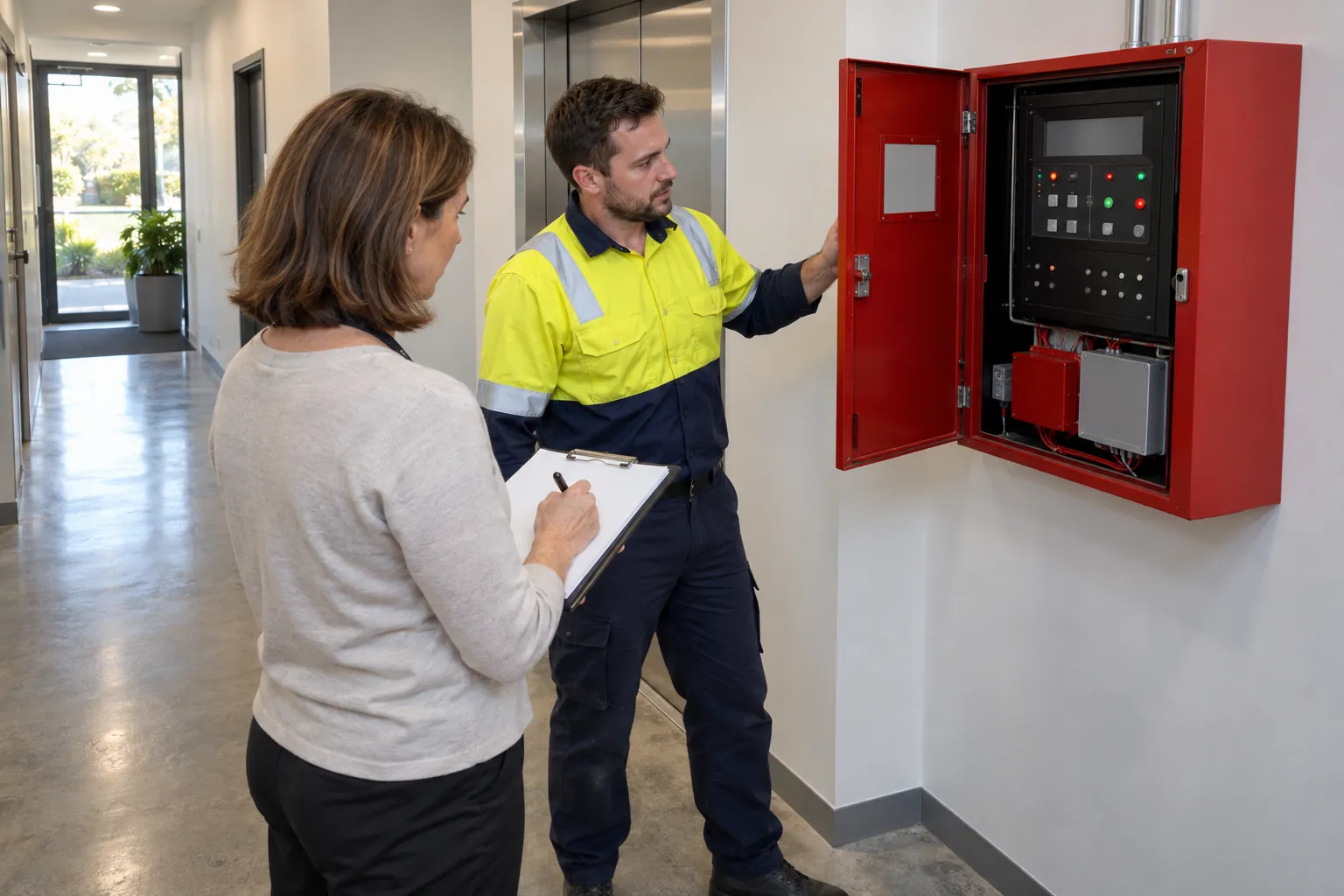
Health and safety sits outside all of this. Under the Work Health and Safety Act 2011 (Cth), "A duty cannot be transferred to another person", and section 46 requires each duty holder to "consult, co-operate and co-ordinate activities with all other persons who have a duty in relation to the same matter", so far as is reasonably practicable. An FM contract can say who does what, but the owner or tenant, the FM provider and each subcontractor keep their own duties. Every other state and territory has its own WHS Act based on the model law, but Victoria has the Occupational Health and Safety Act 2004, so check the wording in the jurisdiction where the building is.
05
People, transfer of business, transition and exit
Transfer of business. Australia has no automatic transfer of staff to a new contractor of the kind some other countries have. What the Fair Work Act 2009 (Cth) does, in Part 2-8, is carry certain instruments across when there is a transfer of business. Under section 311 that happens when an employee's employment with the old employer ends, the employee is employed by the new employer within 3 months, the work is "the same, or substantially the same", and there is a connection between the two employers. The connections include a transfer of assets used in the work, the old employer outsourcing the work to the new one, the new employer ceasing to outsource work to the old one, and the two being associated entities. When it applies, a transferable instrument, such as an approved enterprise agreement, covers the new employer and the transferring employee for that work. Whether a change of contractor is caught depends on the facts, including whether assets pass between them, so take advice before you tender and before you bring a service back in-house.
Pay and ethical supply chains. Cleaners are usually covered by the Cleaning Services Award 2020, which covers "the business of providing cleaning services under a contract", and security officers by the Security Services Industry Award 2020, unless an enterprise agreement applies. A price below what those instruments cost is a warning sign, not a bargain. The CPRs require Commonwealth officials to make reasonable enquiries about tenderers' practices on "labour regulations, including ethical employment practices", and not to contract with tenderers that have an unsatisfied judicial decision against them on employee entitlements. Large clients may have their own obligations: the Modern Slavery Act 2018 (Cth) requires entities based or operating in Australia with annual consolidated revenue of at least $100 million to report each year on the risks of modern slavery in their operations and supply chains. In cleaning, the Cleaning Accountability Framework is one way buyers ask for evidence.
Licences. Require the provider and its subcontractors to hold and keep the licences their work needs. Security licensing is state law; in Victoria, for example, Victoria Police regulates the industry under the Private Security Act 2004, with separate licences for security businesses and for individuals, as its private security licensing pages explain.
Transition in, between award and the start date, should cover staffing, inductions, a survey of the asset register, a baseline of fire safety maintenance in each state, keys, access cards and alarm codes, and the handover of logbooks and certificates. Plan the first month of reporting as carefully as the first day.
Exit should be planned at the start: an exit plan, cooperation with the incoming provider, and the return of the asset register, maintenance history, fire safety records and client data in a usable form. A client that does not own its FM data will find retendering slow and expensive.
06
Where the evidence fails, and what SiteClara does about it
FM contracts are good at measuring what the provider's systems measure: work orders closed, preventative maintenance completed, help desk calls answered. They are weaker on the soft services that happen every day without a work order: the amenities checks, the cleaning of each floor, the lock-up patrol, the fault noticed on a walk-round. Those are often evidenced by a sheet on the back of the amenities door, signed in advance, and a line in the monthly report. When an abatement is argued over, neither side has much to show.
SiteClara records those routine checks where they happen. A printed QR poster at each location, with an optional NFC tag behind it, lets cleaning or security staff scan or tap with their own phone, with no app to install. They mark each scheduled check done or explain what stopped them, with a photo when one is asked for, and an issue reported there goes onto the team's list of jobs until someone closes it. The supervisor sees what is due, done and missed, and can record why.
Each day the supervisor reviews and approves a report, which goes to nominated client and management contacts at 8am the next morning, showing what was reported, what was completed, what is still open and how the scheduled checks went, for example 12 of 12 completed. Where a cleaning contractor and a security contractor work in the same building, each can run its own staff, forms and approval. The client has a record made at the time to set beside the monthly report, and the provider has evidence of work that would otherwise go unrecorded.
07
Questions people ask
What is an AS 4000 contract?
AS 4000 is the Australian Standard general conditions of contract for construction, not a facilities management contract. Standards Australia describes AS 4000:2025 General Conditions of Contract, which superseded AS 4000-1997, as "a comprehensive contract that provides the general conditions for construction projects in Australia", with "a formal instrument of agreement and provisions for contract administration, variations, payment terms, and dispute resolution", and a superintendent "appointed by the principal". It is written for building works rather than a term of ongoing services, so an FM contract usually needs its own service conditions and specification.
What are the steps of contract management?
There is no single official list of five. Victoria's Contract management: Goods and services guide says contract management "covers all activities at the commencement of, during and after the contract period", starting in the procurement planning phase and continuing "right through contract negotiation, implementation and outcomes evaluation". It suggests a contract management plan outlining "contract objectives and outcomes", "roles, responsibilities and obligations of the parties and their agents", how "performance management and reporting (KPIs) will be managed", the framework for managing variations, and "contract governance requirements".
08
Further reading, and a list to take away
Commonwealth buyers should start with the Commonwealth Procurement Rules and the Department of Finance's guidance on them; state buyers with their own state's policy, such as Victoria's Fair Jobs Code. The Fair Work Ombudsman publishes plain guidance on transfer of business and on the cleaning and security awards, Safe Work Australia and the state regulators on WHS, and the ACCC on unfair contract terms. For fire safety maintenance, read the regime of each state the contract covers.
Before you issue an FM tender or sign a facilities management contract, check that:
- the scope lists every building, service and asset, and names what is excluded;
- each service has a specification someone could inspect against;
- fire safety maintenance is scheduled by state, with a named signatory for each statement or report;
- each payment mechanism has approval limits for extra work and a rise-and-fall clause for wages;
- every KPI has a definition, a data source, a target and a consequence;
- abatements are proportionate and capped, with a bedding-in period;
- the contract sets out how the parties will consult, cooperate and coordinate on WHS;
- licences, awards and subcontractors have been checked, and any transfer of business question has been looked at by someone qualified;
- the transition plan and the exit plan are both in the contract;
- you will own the asset register, fire safety records and service data at the end;
- a lawyer has reviewed the terms before signature.
Sources
Every document this guide quotes or links to, in the order it first cites them.
- Commonwealth Procurement Rules legislation.gov.au
- Fair Jobs Code buyingfor.vic.gov.au
- Guidance on contracts and unfair contract terms accc.gov.au
- Work Health and Safety Act 2011 legislation.gov.au
- Occupational Health and Safety Act 2004 legislation.vic.gov.au
- Fair Work Act 2009 legislation.gov.au
- Cleaning Services Award 2020 awards.fairwork.gov.au
- Security Services Industry Award 2020 awards.fairwork.gov.au
- Modern Slavery Act 2018 legislation.gov.au
- Private security licensing pages police.vic.gov.au
- AS 4000:2025 General Conditions of Contract store.standards.org.au
- Contract management: Goods and services guide buyingfor.vic.gov.au
Related guides
 Premises and facilities managementFacility manager duties in Australia: what the role covers, and how to show it is doneWhat a facility manager does in Australia: the WHS duties behind the role, contractors, fire safety and asbestos, the compliance year and the records that show it.
 Premises and facilities managementFacilities management report: what to include, and what makes it believableWhat an Australian facilities management report should contain: WHS, fire safety compliance by state, maintenance, KPIs, costs and the evidence behind them.
 Premises and facilities managementPreventative maintenance: how to plan it for a building and prove it was donePreventative maintenance for Australian buildings: the WHS duty, the asset register and schedule, statutory and discretionary tasks, and keeping good records.
 Premises and facilities managementReactive maintenance: how to run it well in an Australian buildingReactive maintenance in Australian buildings: the WHS and strata duties, priorities and response times, make-safes, contractors, asbestos and closing the loop.