Fire and water checks
AS 1851 routine service: what it asks of owners, fire contractors and building teams
AS 1851-2012 is the Australian Standard for the routine service of fire protection systems and equipment: the inspection, testing and preventive maintenance that keep sprinklers, hydrants, hose reels, alarms and extinguishers ready for the day they are needed.
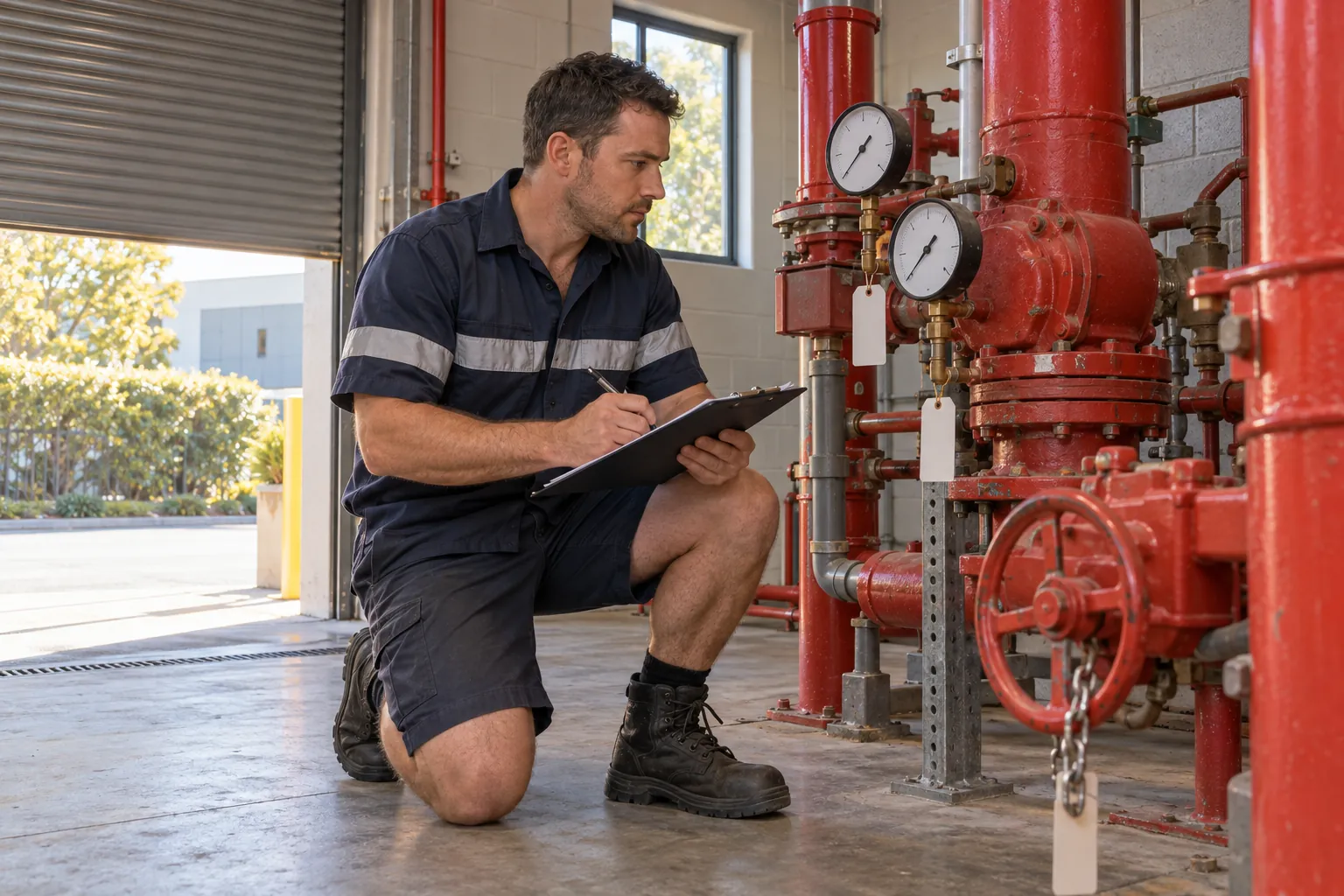
It is written for fire services contractors and their technicians, but building owners, facility managers and building managers carry the consequences when the servicing slips or the records do not hold up. This guide explains what the standard covers, how it becomes a legal requirement, what good records look like, and what the building team can do between the contractor's visits.
01
What AS 1851 is, and when it becomes a legal requirement
The current edition is AS 1851-2012 Routine service of fire protection systems and equipment, published by Standards Australia on 3 December 2012 and amended by AS 1851-2012 Amendment 1:2016 in November 2016. Standards Australia describes it as setting out "requirements for inspection, testing, preventive maintenance and survey of fire protection systems and equipment". It runs to 195 pages, and the store lists the 2012 edition as pending revision, with a draft revision (DR AS 1851) on its record. Check the edition in force before you sign a new service contract.
A standard does not bind anyone on its own. It becomes a requirement when legislation, an occupancy permit, a maintenance determination or a contract calls it up. Fire safety maintenance in Australia is state and territory law, so the same building would be handled differently in Melbourne, Sydney and Brisbane: essential safety measures in Victoria, the annual fire safety statement in New South Wales, and Queensland's own building fire safety regime. AS 1851 is the common thread, the method most regimes and most fire services contracts point to for how the work is done. New South Wales has made it explicit: Building Commission NSW's page Building fire safety requirements under AS 1851-2012 says that from 13 February 2026 the standard is a mandatory requirement under the Environmental Planning and Assessment (Development Certification and Fire Safety) Regulation 2021 for all new and existing class 1b and class 2 to class 9 buildings, and that building owners must ensure essential services are maintained in accordance with it.
Victoria shows how the link works. Under Parts 13 and 15 of the Building Regulations 2018 (Vic) (regulations 194 and 215), an occupancy permit or a maintenance determination specifies, for each essential safety measure, "the frequency and type of inspection, testing and maintenance required". Where that document specifies the older AS 1851-2005 or an earlier standard, regulations 196 and 217 say that compliance with AS 1851-2012 "is taken to be compliance" with those requirements, but an owner who moves to the 2012 edition for a measure "must continue to comply with AS 1851-2012" for it. So an owner may adopt the current standard, but cannot move between editions to suit a particular year.
The standard's general section sets the rules every system shares: its scope and objective, how it applies, the routine service process and procedures, baseline data, system retrofit, competent persons, the frequency and tolerances of routine service intervals, the systems interface test, adverse operating environments, precautions, defect rectification, routine service records and reports. The sections after it deal with particular kinds of system, each with its own schedule of activities.
02
What AS 1851 routine service covers in a building
Routine service is the planned, repeating work that confirms an installed fire protection system still performs as it was designed to. It is not the design, the installation or the commissioning of a system, and it is not a repair after a failure, although a routine service often finds the defects that lead to one.
The documents AS 1851 refers to give a fair picture of its reach. Its referenced documents include the standards for fire hose reels, wheeled fire extinguishers, emergency warning and intercommunication systems, fire and smoke control in air-handling systems, and fire protection for mobile and transportable equipment. In an ordinary commercial building, the routine service contract typically reaches:
- Water-based systems: sprinkler systems, fire hydrant systems with their pump sets and booster connections, and fire hose reels.
- Detection and alarm: the fire indicator panel, detectors, manual call points and the link to the fire brigade where there is one.
- Emergency warning and intercommunication systems, where the building has them.
- Smoke control: air-handling systems that shut down or run in fire mode, and smoke exhaust or pressurisation.
- Portable equipment: fire extinguishers, including wheeled units (see the fire extinguisher testing guide).
Victoria's list of essential safety measures, in Schedule 8 of the Building Regulations 2018, is broader than fire equipment alone. It includes paths of travel to exits, exits and their doors, exit signs, emergency lighting, fire hydrant, hose reel and sprinkler systems, portable fire extinguishers and fire control rooms. Some of those are serviced to AS 1851 and some to other standards. Standards Australia sells AS 1851 in a set with the standards for emergency and exit lighting, which have their own maintenance requirements, so do not assume one contract covers everything on the list.
Start from the building's own documents. In Victoria that is the maintenance schedule the building surveyor prepares, which must list every essential safety measure and its maintenance requirements. Elsewhere it is the fire safety schedule, the occupier's documents or the list in the service contract. The contractor's scope should match that list line for line.
03
Intervals, tolerances and competent persons
AS 1851 sets how often each activity is done for each kind of system, from frequent visual checks to longer-interval tests and surveys, and it sets tolerances: how far a service may fall either side of its due date and still count. Clause 1.11, Frequency and tolerances of routine service intervals, is where that sits, and it was among the clauses revised by the 2016 amendment. Two practical points follow for anyone managing a contract:
- A late service is a non-conformance, not a delay. A service that falls outside its tolerance should be reported as out of tolerance, not quietly recorded as done in the right month.
- The schedule belongs to the building, not the technician. Keep a calendar of what is due at the site, by system and by interval, so that a change of contractor or technician does not reset it.
The standard also has a clause on competent persons. Routine service is skilled work: testing a sprinkler valve set, a hydrant pump or a fire indicator panel needs training and the right equipment, and the business should be able to show that each technician is competent under the standard and under any licensing rules that apply where the building is. Ask the contractor who will do the work, what qualifications they hold, and how they will show it. A building manager or cleaner who glances at an extinguisher gauge is not carrying out AS 1851 routine service, and nobody should record it as if they were.
The systems interface test checks that systems work together: that the fire indicator panel starts the warning system, shuts down or switches the air handling, releases held-open doors and calls the brigade where connected. Faults often sit in the links between systems maintained by different trades, so agree who runs the interface test and who attends.
Baseline data is the information a system was designed and commissioned to, such as pressures, flows and settings, against which each routine service is compared. Where it is missing, for example in an older building, the contractor cannot say whether a reading is right, only that it was taken. Ask for the gap to be reported, not papered over.
04
Records, defects and the yearly condition report
The general section of AS 1851 has clauses on routine service records and on reports, the latter covering "defects, non-conformances and out of tolerance activities" and "yearly condition reports". In practice a sound set of records shows, for each system and each visit:
- the date, the activity carried out and the interval it belongs to;
- the name of the technician and the business;
- the results, including readings where the activity takes them;
- every defect found, how serious it is, and whether it was fixed on the spot;
- anything not done, and why, including areas the technician could not access;
- the tags or labels applied to equipment, where the contract uses them.
Defects need an owner. A routine service that lists the same defect for six months has not failed as a service; the building's follow-up has. Agree how defects are sent to the owner or facility manager, how quickly a quote follows, who approves the repair, and how the repair is recorded as closed. Clause 1.15 of the standard deals with defect rectification, and a fire safety logbook that lists defects without their closure dates will not answer the question an auditor asks first.
In Victoria the records are a legal matter. Regulation 225 of the Building Regulations 2018 requires the owner to make the following available for inspection at the building within 24 hours of a request by the municipal building surveyor or the chief officer (the Fire Rescue Commissioner in the Fire Rescue Victoria fire district, the CFA's Chief Officer elsewhere):
- all annual essential safety measures reports prepared within 10 years before the request;
- all maintenance schedules for the essential safety measures;
- all maintenance determinations requiring an essential safety measure;
- "the records of all inspections, testing and maintenance (including repairs)" of any essential safety measure.
The penalty under regulation 225 is 20 penalty units, as it is under regulation 223 for failing to prepare the annual essential safety measures report. That report, under regulations 223 and 224, must be in the form approved by the Authority (the Victorian Building Authority, which now trades as the Building and Plumbing Commission), signed by the owner, and state that the owner has taken all reasonable steps to ensure each measure "is operating and has been maintained in a state that enables the essential safety measure to fulfil its purpose" and has been inspected, tested and maintained in accordance with the Act and the Regulations. Where the owner has adopted AS 1851-2012 instead of the frequencies in the permit or determination, the report must say so. The essential safety measures guide covers the Victorian regime in full.
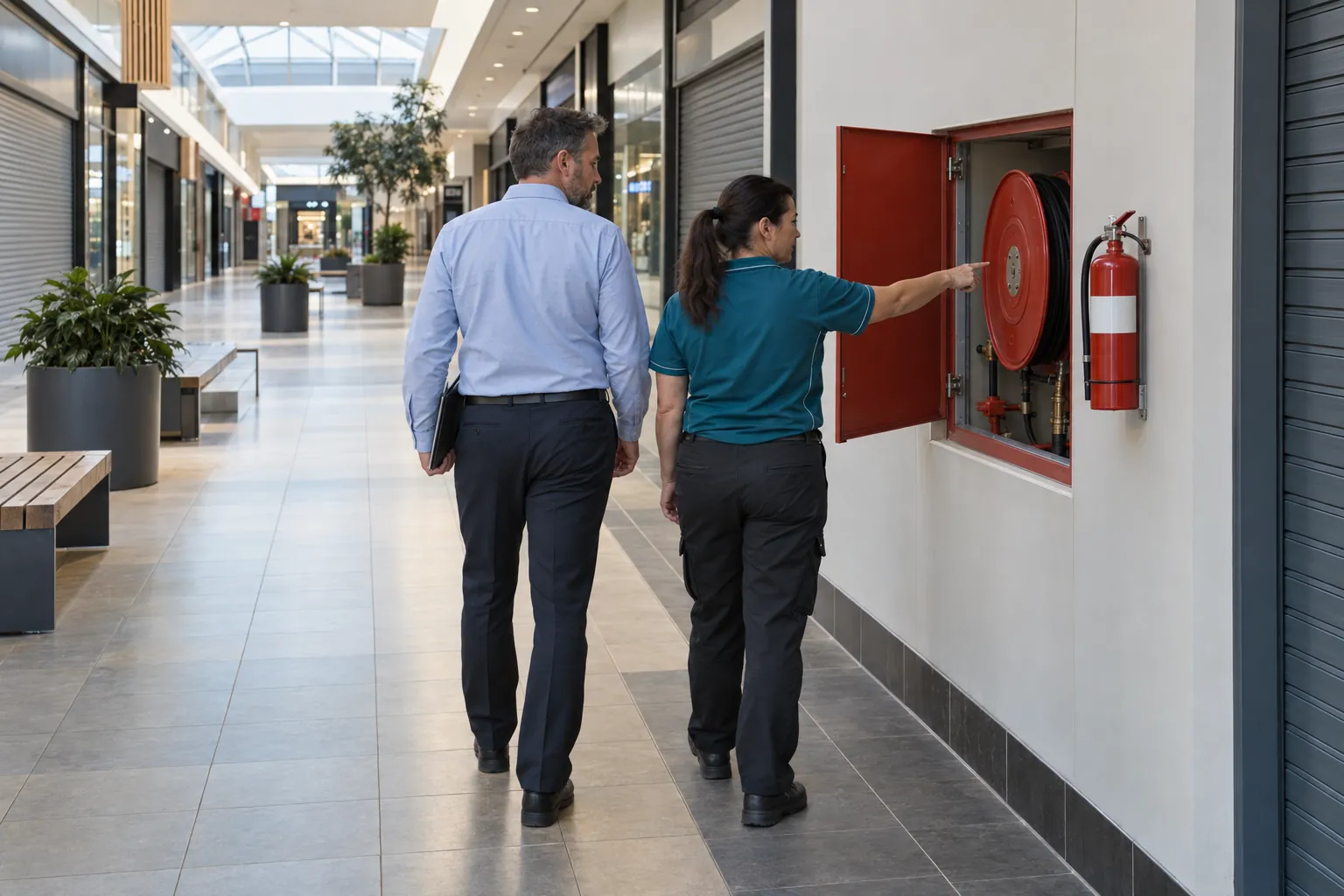
05
What the owner, the occupier and the building team do between visits
A fire services contractor may be on site once a month or less. A building's fire protection can be compromised on any day in between: an extinguisher borrowed for a stuck door, a hose reel buried behind stock, a fire door wedged open for a delivery, an exit sign out, a panel showing a fault nobody reported. None of that waits for the next routine service.
Victorian law puts part of that on the occupier and the owner directly. Regulation 228 requires the occupier of most buildings other than houses to keep exits, paths of travel to exits and paths of travel from exits to a road "readily accessible, functional and clear of obstructions", and regulation 227 requires the owner to make sure an essential safety measure is not removed from its approved location except for inspection, testing or maintenance. Regulation 226 makes the owner responsible for keeping each measure in a state that enables it to fulfil its purpose. The contractor services the equipment; the people in the building keep it usable.
A short walk-around by the building manager, caretaker, cleaning supervisor or security officer covers the gap. It is an observation, not a test, and it should say so. A sensible list for a commercial building:
- exits, exit doors and paths of travel clear, unlocked where they must be, and nothing stored in fire stairs;
- fire doors and smoke doors closing and latching, with no wedges, hooks or door stops holding them open;
- extinguishers and fire blankets in their places, visible, not obstructed, and with the pin and tamper seal in place;
- hose reels unobstructed, with the hose rolled on the reel;
- exit signs lit and emergency lights showing their normal indicator;
- the fire indicator panel showing normal, with any fault or isolation reported to whoever holds the service contract;
- hydrant boosters and sprinkler valve rooms accessible and not used for storage.
The value is in the reporting. Each finding goes to one named person who arranges the fix, and the walk-around records that the problem was seen, when, and by whom. A defect found on a Tuesday and fixed on the Wednesday is a good day for the building; the same defect found at the next routine service a month later is a month the building ran without it.
Agree the split in the contracts. The fire services contract covers AS 1851 routine service, defects and reports. The cleaning, security or building management contract can cover the walk-around and the reporting of what staff see. Neither should be written as if it did the other's job.
06
Where the record fails, and what SiteClara does about it
The contractor's service records are usually the strongest part of a building's fire safety file. The weak part is everything in between: the walk-around that was ticked on a sheet at the end of the week, the wedged fire door mentioned to whoever was passing, the panel fault a security officer saw at night and nobody followed up. When an owner signs an annual statement, or a surveyor asks for the records, nothing shows whether the building team actually looked, or what happened to what they found.
SiteClara records those checks at the location. A printed QR poster, with an optional NFC tag behind it, sits at each place a check is scheduled, such as a fire stair door, a hose reel or the fire indicator panel. Staff scan or tap on their own phone, with no app to install, see the checks due there, and mark each one done or explain what stopped them. The time and the named person are recorded as it happens, with a photo when one is asked for, and a reported problem goes onto the team's list of jobs until someone closes it.
The supervisor sees what is due, done and missed, and records the reason a check was missed. Each day they review the checks and photos, add a note and approve a report that goes to nominated contacts, such as the owner's facility manager, at 8am the next morning, showing what was reported, what was completed, what is still open, and how the scheduled checks went.
07
Questions people ask
What is the AS 1851 Australian Standard?
AS 1851-2012 is the Australian Standard for the routine service of fire protection systems and equipment. Standards Australia's store page for AS 1851-2012 Routine service of fire protection systems and equipment says it "sets out requirements for inspection, testing and preventive maintenance of fire protection systems and equipment".
Is AS 1851 mandatory in NSW?
Yes, from 13 February 2026. Building Commission NSW's page Building fire safety requirements under AS 1851-2012 says the standard is mandatory under the Environmental Planning and Assessment (Development Certification and Fire Safety) Regulation 2021 for "all new and existing class 1b and class 2 to class 9 buildings in NSW". Building owners, including strata committees, owners corporations and developers before an occupation certificate, must ensure essential services are maintained in accordance with it.
What is the latest version of AS 1851?
The current edition is AS 1851-2012, as amended by AS 1851-2012 Amendment 1:2016, published on 16 November 2016. Standards Australia's store page for AS 1851-2012 lists the edition as pending revision, with AS 1851-2005 superseded, so check the page before you sign a new service contract.
Can I download AS 1851-2012 as a free PDF?
Not from Standards Australia, which sells the standard. Its store page for AS 1851-2012 Routine service of fire protection systems and equipment offers the 195-page document as a PDF to purchase, with a preview available first.
08
Further reading, and a list to take away
Standards Australia sells AS 1851-2012 Routine service of fire protection systems and equipment and AS 1851-2012 Amendment 1:2016; the store page lists the edition's status and any draft revision. In Victoria, Part 15 of the Building Regulations 2018 sets the owner's and occupier's obligations for essential safety measures, and Schedule 8 lists the measures. In New South Wales, Building Commission NSW's page Building fire safety requirements under AS 1851-2012 sets out building owners' responsibilities and links a good practice guide for the maintenance of fire protection systems, developed by the NSW Fire Safety Industry Reference Group. In other states, start from the state's building and fire safety legislation and the fire safety schedule or certificate for the building, and ask the fire services contractor which regime and which edition of the standard their contract assumes.
Before you agree or review an AS 1851 service contract, check that:
- the scope matches the building's own list of fire safety measures, line for line;
- the contract names the edition of AS 1851 and any other standard it relies on;
- there is a calendar of what is due, by system and interval, held by the building;
- late services are reported as out of tolerance, not recorded as on time;
- technicians' competence, and any licence the state requires, is shown before work starts;
- the systems interface test has an owner and the other trades attend;
- every defect has a person, a date for a quote and a closure date;
- the records could be produced at the building within a day if asked;
- the building team walks the exits, doors and equipment between visits and reports what it finds to one named person.
Sources
Every document this guide quotes or links to, in the order it first cites them.
- AS 1851-2012 Routine service of fire protection systems and equipment store.standards.org.au
- AS 1851-2012 Amendment 1:2016 store.standards.org.au
- Building fire safety requirements under AS 1851-2012 nsw.gov.au
- Building Regulations 2018 (Vic) legislation.vic.gov.au
Related guides
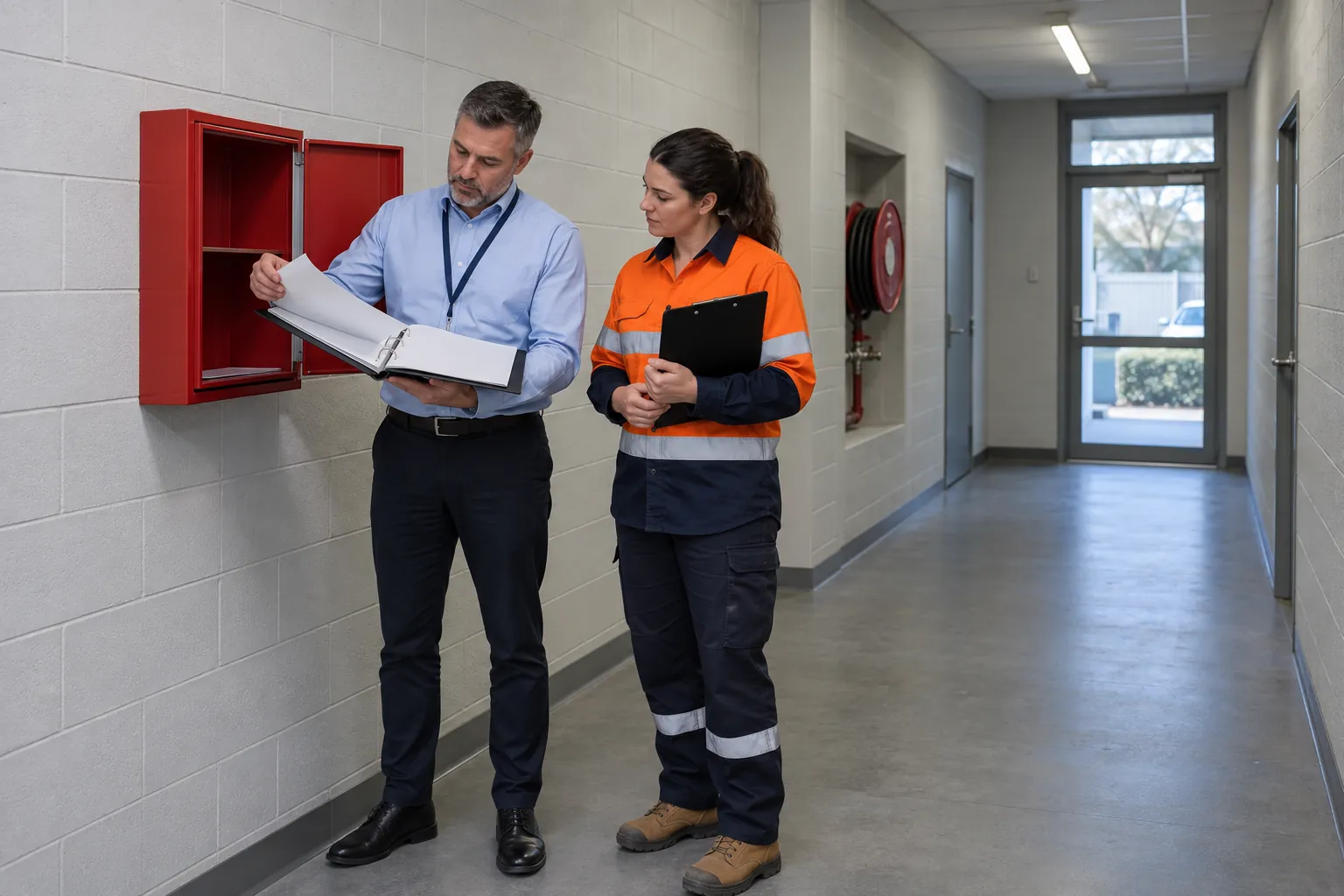 Fire and water checksEssential safety measures in Victoria: the duties, the annual report and the recordsWhat essential safety measures are under Victoria's Building Regulations 2018, who maintains them, the annual ESM report, the records to keep and the checks between.
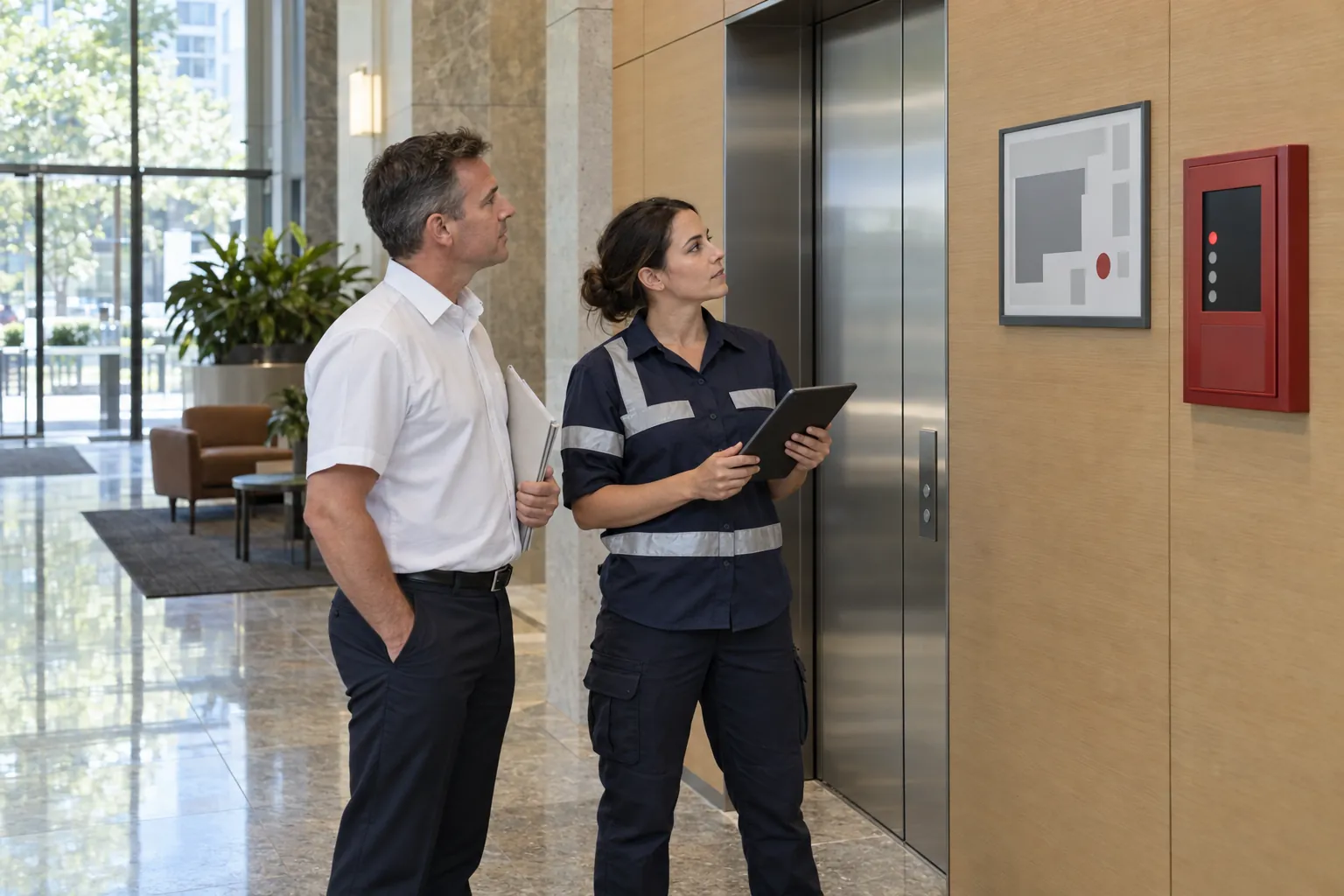 Fire and water checksThe annual fire safety statement: what a NSW building owner declares, and how to make it trueWhat a NSW annual fire safety statement declares, which buildings need one, the 3-month assessment window, lodging and display, and the checks that make it true.
 Fire and water checksFire safety logbook: what to record, who keeps it and for how longWhat a fire safety logbook should hold in Australia: AS 1851 service records, Victoria's ESM records, the NSW fire safety statement and Queensland's rules.
 Fire and water checksFire extinguisher testing and inspection: the AS 1851 service and the checks in betweenHow portable fire extinguishers are inspected and tested in Australia: the AS 1851 six-monthly, yearly and five-yearly service, state rules, and the checks between.