Fire and water checks
Fire extinguisher types: the colour bands, the classes of fire and which goes where
In Australia there are six main types of portable fire extinguisher, each a red cylinder with a coloured band that shows what is inside: water (all red), wet chemical (oatmeal band), foam (blue), dry chemical powder (white), carbon dioxide (black) and vaporising liquid (yellow), and each is rated for particular classes of fire from A to F.

Using the wrong one can be dangerous: water on a switchboard or a fryer fire makes things worse. Which type goes where in a building is set by the National Construction Code and AS 2444, and keeping the right one in the right place is part of the building's routine fire safety checks. This guide covers the classes of fire, the six types and their colours, which type belongs where, and how to keep it that way.
01
The six classes of fire, and the rules that tie extinguishers to them
Fires are grouped into classes by what is burning, and each type of extinguisher in Australia is rated for one or more of those classes. The Country Fire Authority's page Fire extinguishers lists six:
- Class A: ordinary combustibles such as wood, paper, textiles, plastics and coal.
- Class B: flammable and combustible liquids such as petrol, kerosene, oil, tar and paint.
- Class C: flammable gases such as LPG, butane and propane.
- Class D: combustible metals such as magnesium, aluminium and potassium.
- Class E: fires involving energised electrical equipment, including power boards.
- Class F: cooking oils and fats such as vegetable oil, olive oil, lard and butter.
Australia's letters are its own: Class C is flammable gas here, where in the United States it is electrical. The FPA Australia fact sheet cited below notes that on aircraft, ships and some industrial sites, or overseas, extinguishers may follow other colour schemes, so read the label.
Three layers of rules decide which extinguishers a building needs.
The building code says where they must be. Clause E1D14 of the National Construction Code 2025, Volume One, Part E1 Fire fighting equipment requires portable fire extinguishers in Class 2 to 9 buildings to cover particular fire risks: Class AE or E risks at emergency services switchboards, Class F risks from cooking oils and fats in kitchens, Class B risks where more than 50 litres of flammable liquids are stored or used, and Class A risks in various compartments and occupancies. They are to be selected, located and distributed in accordance with Sections 1 to 4 of AS 2444.
The standard says how to choose and place them. AS 2444-2001, Portable fire extinguishers and fire blankets – Selection and location, is the current edition (reconfirmed in 2021). It is a paid document, used by the designer, certifier and fire services company. The extinguishers themselves are made to the AS/NZS 1841 series, Portable fire extinguishers, whose Part 1 sets the general requirements, with a further part for each type.
Workplace safety law says the equipment must suit the risk. Under the model WHS laws, the person conducting a business or undertaking (PCBU) must prepare, maintain and implement an emergency plan: in Queensland that is section 43 of the Work Health and Safety Regulation 2011 (Qld). The code of practice Managing the work environment and facilities, as approved in New South Wales (August 2019), lists the use and maintenance of fire extinguishers among the things a workplace's emergency procedures should address, and its checklist asks: "Is the fire protection equipment suitable for the types of risks at the workplace?" Victoria has its own law, the Occupational Health and Safety Act 2004 (Vic) and its regulations.
02
The six types of fire extinguisher, and their colour bands
Each of the six main types marketed in Australia has a red body and is named for the extinguishing agent inside it. Water is solid red; each of the others has a coloured band or label, and the ID disc on the wall above it names the type too. A 2009 fact sheet from Fire Protection Association Australia, Fire Extinguishers – Types & Uses, published by the CFA, sets out what each type is suitable for and where it is ineffective or dangerous:
- Water – solid red. Suitable for Class A fires. Not considered effective for Class B and C fires, and dangerous on electrically energised equipment or cooking oils and fats.
- Wet chemical – red with an oatmeal band. Suitable for Class F fires and may be used on Class A. Not considered effective for Class B or C fires, and dangerous on Class E.
- Foam – red with a blue band. Suitable for Class A and B fires, with limited effectiveness on Class F. Not considered effective for Class C, and dangerous on electrically energised equipment.
- Dry chemical powder, often called dry powder – red with a white band. Rated either ABE or BE. An ABE extinguisher is considered suitable for Class A, B, C and E fires and not effective for Class F; a BE extinguisher is suitable for Class B, C and E fires, with limited effectiveness on Class F.
- Carbon dioxide (CO2) – red with a black band. Suitable for Class E fires, with limited effectiveness on Class A, B and F.
- Vaporising liquid – red with a yellow band. Suitable for Class A and E fires, with limited effectiveness on Class B, and not considered effective for Class F.
Class D fires, in combustible metals, need special purpose extinguishers. The CFA's current table differs in places: it rates BE powder as suitable for Class F fires and carbon dioxide as not suitable for them, for example. Where the two disagree, go by the label on the extinguisher and ask the fire services company.
The CFA notes that dry chemical powder extinguishers are widely used in commercial settings because they work on a range of fires, and warns that a CO2 extinguisher used in an enclosed space brings a risk of not being able to breathe in enough oxygen.
Fire blankets sit alongside extinguishers, and AS 2444 covers both. The CFA rates a fire blanket as suitable for Class F fires, of limited use on Class A and B fires, and not suitable for Class C or E.
03
Which type goes where in a building
The fire hazards in each part of a building decide the type, under AS 2444 and the NCC. The pattern most site teams meet:
- Emergency services switchboards: an extinguisher for Class AE or E risks, as E1D14 requires; ask the fire services company about the main switchboard too. That usually means ABE powder or CO2, never water, foam or wet chemical.
- Commercial kitchens and food outlets: an extinguisher for the Class F risk of cooking oils and fats, as E1D14 requires, usually wet chemical, often with a fire blanket.
- Plant rooms, workshops, stores and car park areas holding fuels or solvents: foam or dry powder for the Class B risk, which E1D14 requires where more than 50 litres of flammable liquids are stored or used (fuel in vehicle tanks not counted).
- Offices, corridors, classrooms and general areas: an extinguisher for Class A risks where the NCC calls for one, often water or ABE powder, depending on what else is nearby and whether fire hose reels already cover the area.
- Apartment buildings: in a Class 2 or 3 building or a Class 4 part, E1D14 requires the portable extinguishers to be ABE type, at least 2.5 kg, placed outside the sole-occupancy units, each serving only its own storey, with a travel distance of no more than 10 m from the entrance doorway of any unit to the nearest extinguisher.
- Health-care, detention and aged care buildings: Class A and E cover, with an extinguisher for the Class E risk allowed at each nurses' station, supervisors' station or the like.
Where hazardous chemicals are kept, the WHS regulations go further. Under section 359 of the Queensland regulation, the PCBU must make sure the workplace has fire protection and firefighting equipment designed and built for the types of hazardous chemicals there, in the quantities and conditions in which they are kept, that it is properly installed, tested and maintained, and that a dated record of the latest testing and maintenance is kept until the next test.
A site team does not redesign any of this. Its job is to notice when the building has changed and the extinguishers have not: a new kitchen in a former office, a store that now holds paint and solvents, a fit-out that moved an extinguisher. Each is a question for the fire services company, not for whoever is walking past.
04
Reading the extinguisher: label, rating, ID disc and sign
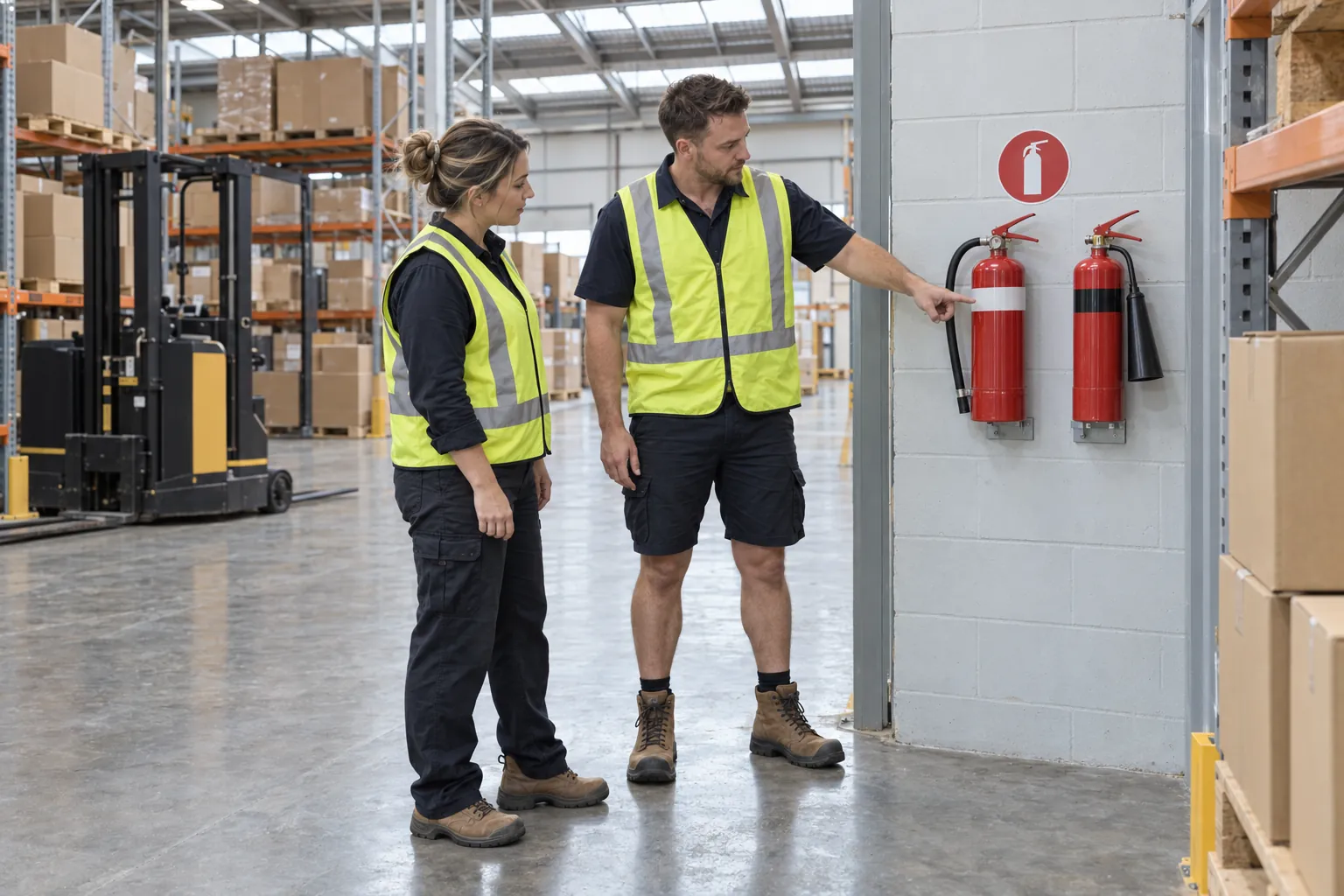
Three things on and around an extinguisher tell a person where it is and which type of fire it is for.
- The label on the cylinder names the type and shows the classes of fire it is rated for, with operating instructions. The FPA Australia fact sheet notes that the higher the rating, the larger the fire it can be used on, though larger, heavier extinguishers can be harder to handle.
- The ID disc on the wall above the extinguisher shows its type and the classes of fire it can be used on. The CFA calls ID discs essential, to help people find the correct fire extinguisher in an emergency.
- The location sign shows where the extinguisher is. The CFA says signs must be installed to show the location of a fire extinguisher, 2 metres or more above floor level, and clearly visible from up to 20 metres in all directions.
If the disc says wet chemical and the cylinder has a white band, something has been swapped: one of the most useful things a walk-around can catch.
Knowing the type only matters if people know what to do with it. The CFA recommends fire extinguisher training for all staff, not just fire wardens, so that everyone is ready to use one in an emergency. Training should also make clear when not to: raise the alarm, call Triple Zero (000) and leave if in doubt. The wardens and emergency control organisation under AS 3745-2010, Planning for emergencies in facilities, are natural owners of that training.
05
Keeping the right type in the right place
Choosing the right fire extinguisher for each location happens at design or fit-out. Keeping it there is the work of every month after.
The register. Keep a list of every extinguisher and fire blanket by location, type and size, ideally from the fire services company after its first visit. It is what makes a swapped or missing extinguisher obvious.
The routine service. The CFA says all fire equipment requires regular inspection, maintenance and servicing. Portable extinguishers are serviced by a competent fire technician to AS 1851-2012, Routine service of fire protection systems and equipment, which has six-monthly, yearly and five-yearly schedules; our guide to fire extinguisher testing covers them, and how the duty to maintain them differs between the states.
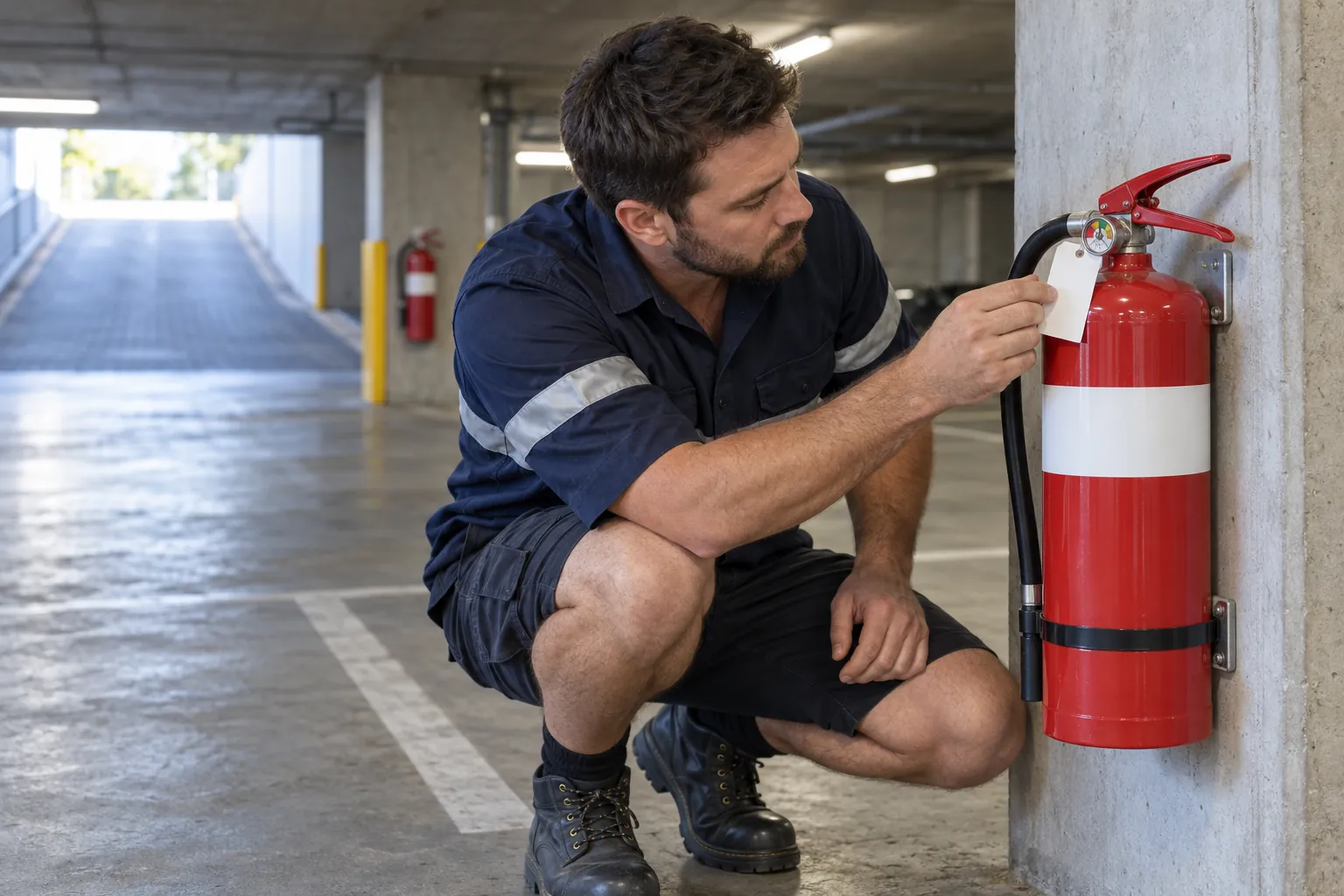
The walk-around between services. Someone on site looks at each extinguisher regularly, monthly being a sensible default, and checks that it:
- is on its bracket at the location on the register;
- is the type the ID disc and the register say it should be;
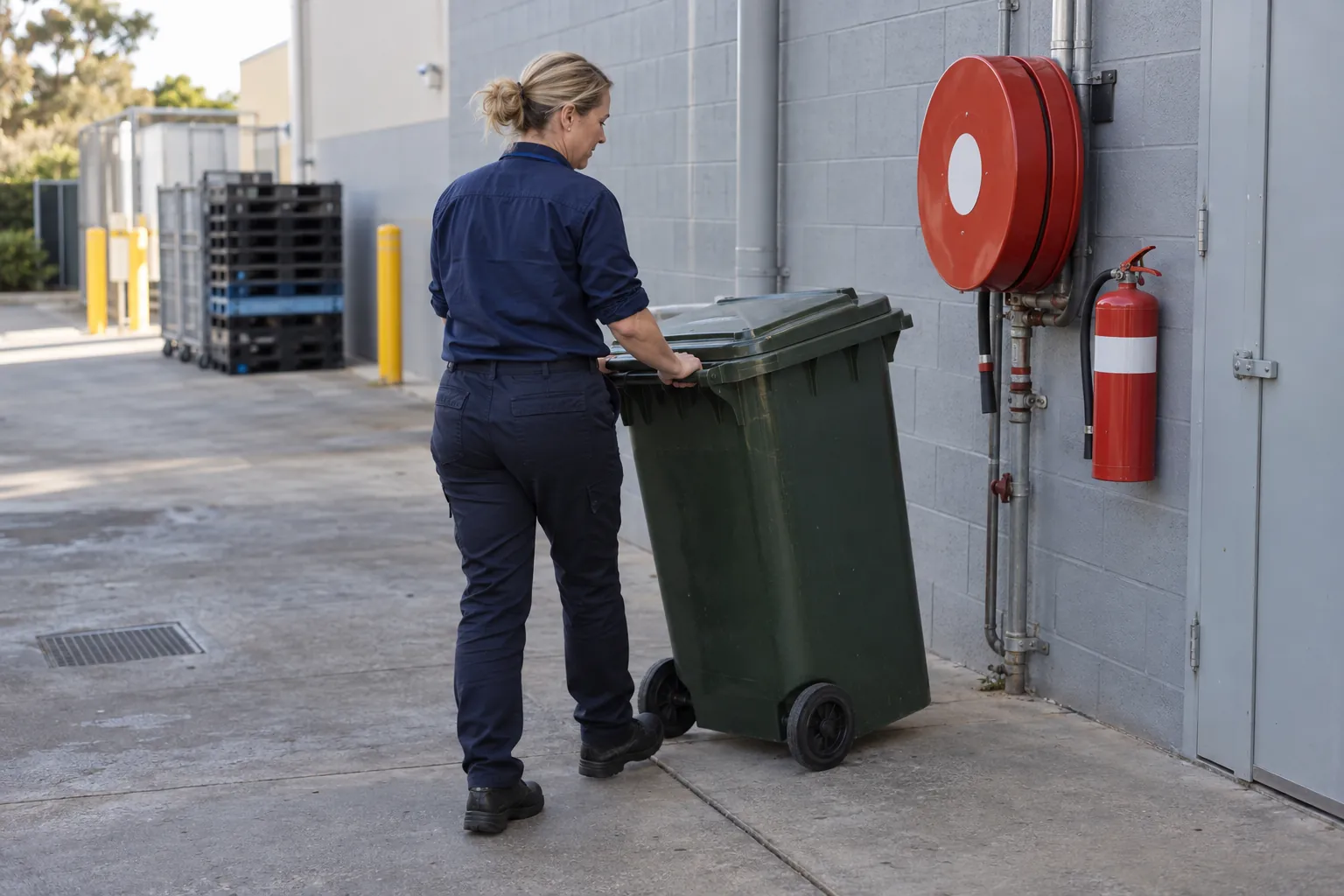
- is visible and reachable, not hidden behind stock, furniture or bins;
- has its pin and seal intact and, where it has a gauge, a reading in the green;
- has a label facing outwards and a current service tag.
Who does it. Often the building manager, a caretaker, a security officer on the lock-up patrol or the floor warden: name one person and a deputy for each area.
What happens to a fault. A missing, discharged or wrong-type extinguisher goes to whoever manages the fire services contract the same day. Under section 359 of the Queensland regulation, where firefighting equipment protecting hazardous chemicals becomes unserviceable, the PCBU must assess the implications, take alternative measures for the risks it was controlling, and return it to full operation as soon as practicable. Until the right extinguisher is back, that spot has none.
06
Where the record fails, and what SiteClara does about it
The six-monthly service is booked and invoiced, so it happens. The months in between go unrecorded: the wet chemical extinguisher hung back by the stairs, the CO2 moved during a fit-out, the plant room that started storing fuel. The register says one thing, the walls another, and nobody notices until the next service, or a fire.
SiteClara puts a printed QR poster at an extinguisher point or group of points, with an optional NFC tag behind it. Staff scan the code or tap the tag with their own phone, with no app to install, see the checks due at that location, such as the monthly walk-around, and mark each one done, or say what stopped them. A problem, such as a missing extinguisher, a type that does not match its ID disc or a broken seal, is reported there with a photo and goes onto the team's list of jobs until someone closes it.
The supervisor sees what is due, done and missed, and records why a check was missed. A job that needs the building manager can be escalated to them to answer. Each day the supervisor reviews and approves a report that goes to nominated management or client contacts the next morning, showing what was reported, completed and still open, and how the scheduled checks went.
07
Questions people ask
What is a Class E fire?
A Class E fire involves energised electrical equipment, including power boards, as the CFA's page Fire extinguishers puts it. The FPA Australia fact sheet Fire Extinguishers – Types & Uses rates ABE and BE powder, carbon dioxide and vaporising liquid extinguishers as suitable for it, and calls water, foam and wet chemical dangerous on it. Clause E1D14 of the National Construction Code 2025, Part E1 Fire fighting equipment requires extinguishers for Class AE or E fire risks at emergency services switchboards.
What is a Class C fire in Australia?
In Australia a Class C fire is one involving flammable gases, such as LPG, butane and propane. Dry chemical powder extinguishers, ABE or BE, are the type rated for Class C, while water, foam and wet chemical extinguishers are not considered effective on it, according to the FPA Australia fact sheet Fire Extinguishers – Types & Uses, which the CFA publishes.
What are the four types of fire extinguishers?
Australia has six main types, not four. The FPA Australia fact sheet Fire Extinguishers – Types & Uses lists water (solid red), foam (blue band), powder (white band), carbon dioxide (black band), vaporising liquid (yellow band) and wet chemical (oatmeal band), and says Class D fires in combustible metals need special purpose extinguishers. The lists of four seen online usually name water, foam, CO2 and dry powder, leaving out wet chemical, the type the fact sheet rates as suitable for Class F fires in cooking oils and fats, a risk the National Construction Code requires kitchens to cover.
What is a foam extinguisher used for?
A foam fire extinguisher, red with a blue band, is suitable for Class A fires in ordinary combustible materials and Class B fires in flammable and combustible liquids, with limited effectiveness on Class F cooking oil fires, according to the FPA Australia fact sheet Fire Extinguishers – Types & Uses. It is not considered effective on Class C gas fires, and it is dangerous on electrically energised equipment.
08
Where to read more, and a list to take away
The Australian Building Codes Board publishes the NCC's fire fighting equipment provisions free to read online. Standards Australia sells AS 2444-2001 (selection and location), the AS/NZS 1841 series (the extinguishers themselves) and AS 1851-2012 (routine service). Your own state's fire service and building regulator can say what applies to your building.
To take away:
- there is a register of every extinguisher and fire blanket, by location, type and size;
- each extinguisher's colour band, label and ID disc agree with each other and with the register;
- switchboards have powder or CO2, kitchens with cooking oils have wet chemical and a fire blanket, and fuel and solvent stores have foam or powder;
- any change of use or fit-out is referred to the fire services company;
- a named person walks the extinguishers between AS 1851 services and the walk-around is recorded;
- staff, not just wardens, know which extinguisher is for which fire, and to call Triple Zero (000) and leave if in doubt.
Sources
Every document this guide quotes or links to, in the order it first cites them.
- Fire extinguishers cfa.vic.gov.au
- National Construction Code 2025, Volume One, Part E1 Fire fighting equipment ncc.abcb.gov.au
- AS 2444-2001, Portable fire extinguishers and fire blankets – Selection and location store.standards.org.au
- AS/NZS 1841 series, Portable fire extinguishers store.standards.org.au
- Work Health and Safety Regulation 2011 (Qld) legislation.qld.gov.au
- Managing the work environment and facilities safework.nsw.gov.au
- Occupational Health and Safety Act 2004 (Vic) legislation.vic.gov.au
- Fire Extinguishers – Types & Uses cfa.vic.gov.au
- Fire Safety Equipment Disposal mfs.sa.gov.au
- AS 3745-2010, Planning for emergencies in facilities store.standards.org.au
- AS 1851-2012, Routine service of fire protection systems and equipment store.standards.org.au
Related guides
 Fire and water checksFire extinguisher testing and inspection: the AS 1851 service and the checks in betweenHow portable fire extinguishers are inspected and tested in Australia: the AS 1851 six-monthly, yearly and five-yearly service, state rules, and the checks between.
 Fire and water checksAS 1851 routine service: what it asks of owners, fire contractors and building teamsWhat AS 1851-2012 routine service covers, how intervals and competent persons work, what the records must show, and how Victoria's regulations call it up.
 Fire and water checksWorkplace fire safety checklist: the checks, who does them and the records they leaveA workplace fire safety checklist for Australia: the emergency plan duty, state fire safety rules, daily to annual checks, who does each, and what records show.
 Fire and water checksFire warden duties: what the chief warden and floor wardens do, day to day and when the alarm soundsWhat a chief warden and floor wardens do in an Australian workplace: the law behind the role, the routine checks, the job in an evacuation, and the records to keep.