Fire and water checks
Fire extinguisher testing and inspection: the AS 1851 service and the checks in between
In Australia, fire extinguisher inspection and testing is done by a competent fire technician to AS 1851, with a service every six months, a fuller one each year and a five-yearly service, while the building's own people check in between that each extinguisher is in place and ready.
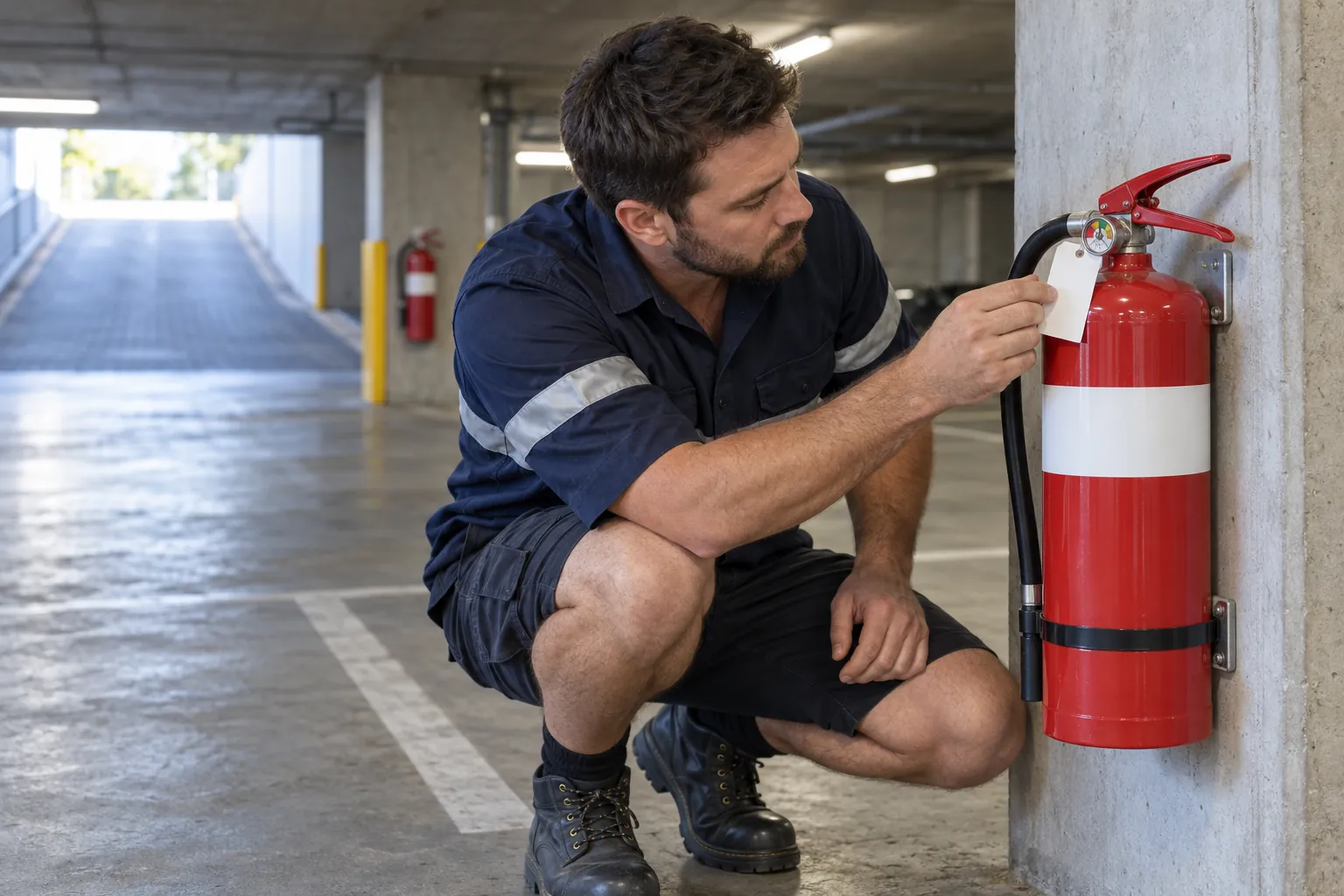
This guide covers where the duty comes from, what each service involves, how the rules differ from state to state, and what the record should show.
01
Where the duty comes from, and the standard behind it
There is no single national fire extinguisher law in Australia. The duty is spread across three layers of law, with one Australian Standard tying them together, and compliance means meeting every layer that applies to the building.
Building law says where extinguishers go. The National Construction Code, Volume One, Part E1 sets out firefighting equipment for Class 2 to 9 buildings. Clause E1D14, worded the same way in NCC 2022 and NCC 2025, lists the fire risks that portable fire extinguishers must cover in Class 2 to 9 buildings (except within sole-occupancy units of a Class 9c building):
- to cover Class AE or E fire risks associated with emergency services switchboards;
- to cover Class F fire risks involving cooking oils and fats in kitchens;
- to cover Class B fire risks where more than 50 litres of flammable liquids are stored or used, not counting fuel in vehicle tanks;
- to cover Class A fire risks in normally occupied fire compartments of less than 500 m² with no fire hose reels, excluding open-deck car parks;
- to cover Class A fire risks in classrooms and associated corridors in primary and secondary schools with no fire hose reels;
- to cover Class A fire risks associated with a Class 2, 3 or 5 building or a Class 4 part of a building.
E1D14 also requires extinguishers to serve the whole of a Class 2, 3 or 5 building or Class 4 part where internal fire hydrants are installed (or any fire compartment over 500 m² where they are not), and adds Class A and E cover in health-care buildings, detention and correctional occupancies, Class 3 accommodation for children, aged persons and people with disabilities, and Class 9c buildings.
Extinguishers are to be selected, located and distributed in accordance with Sections 1 to 4 of AS 2444-2001, Portable fire extinguishers and fire blankets – Selection and location. In a Class 2 or 3 building or Class 4 part, the clause adds that they must be ABE type, at least 2.5 kg, outside the sole-occupancy units, serving only their own storey, and no more than 10 m from the entrance door of any unit.
State and territory law says they must be maintained. Keeping fire safety equipment working after the building is finished is a matter for each state and territory, and each has its own scheme and its own words: essential safety measures in Victoria, essential safety provisions in South Australia, prescribed fire safety installations in Queensland. Section 05 covers three of them.
Work health and safety law applies to the workplace. In the jurisdictions that have adopted the model WHS laws, the person conducting a business or undertaking (PCBU) must prepare, maintain and implement an emergency plan; in Queensland that is section 43 of the Work Health and Safety Regulation 2011 (Qld). Victoria has its own law: section 21 of the Occupational Health and Safety Act 2004 (Vic) requires an employer, so far as is reasonably practicable, to provide and maintain a working environment that is safe and without risks to health.
The standard says how maintenance is done. AS 1851-2012, Routine service of fire protection systems and equipment sets out requirements for the inspection, testing, preventive maintenance and survey of fire protection systems and equipment. Section 10 covers portable and wheeled fire extinguishers and Section 11 fire blankets. The current edition is AS 1851-2012 with Amendment 1 (2016); Standards Australia lists it as pending revision, with a draft revision published, so check the edition your building's maintenance schedule names.
02
What is on site: types, fire classes and the register
The types of fire an extinguisher can tackle are called fire classes, defined in AS 2444, and the ones the NCC names are the ones most buildings and workplaces meet:
- Class A: ordinary combustible materials such as paper, wood and fabric, found in almost every occupied area.
- Class B: flammable liquids, in plant rooms, workshops, stores and anywhere fuels or solvents are kept.
- Class E: fires involving energised electrical equipment, which is why the NCC names emergency services switchboards.
- Class F: cooking oils and fats, in commercial kitchens and some staff kitchens.
Extinguishers are rated for the classes they can tackle, and the rating is on the label. An ABE dry powder extinguisher, the type the NCC requires in the common areas of apartment buildings, covers Classes A, B and E. Other common types are water, foam, carbon dioxide, wet chemical for kitchens, and vaporising liquid. AS 1851 has its own provisions for some of them, including vaporising liquid extinguishers and powder, and extinguishers themselves are made to the AS/NZS 1841 series, Portable fire extinguishers, whose Part 1 covers general requirements including instructions and markings.
Which type goes where is decided by the design and AS 2444, not by the person doing a walk-around; their job is to notice an extinguisher moved, swapped for the wrong type, or gone.
The foundation for all of this is a register: every extinguisher and fire blanket by location, type and size. AS 1851 expects the service provider to keep location records for extinguishers, covering where each one is and how it is identified, so ask for a copy after the first service and keep it with the building's fire safety records. A register makes a missing extinguisher obvious; without one, it is simply not noticed.
03
The AS 1851 service: six-monthly, yearly and five-yearly
Fire extinguisher testing and servicing in Australia is the competent person's job. AS 1851 has a clause on competent persons, and in practice the work is done by a fire protection technician from a fire services company. Section 10 of the standard sets out the routine service schedules for portable and wheeled extinguishers at three intervals:
- Six-monthly service: the regular inspection and service of each extinguisher, done twice a year.
- Yearly service: a fuller service once a year.
- Five-yearly service: the longest interval in the schedule, which is where pressure testing comes in; the standard has provisions on pressure test marking, recharging and the recharging agent.
The detailed tasks are in the standard's schedules, a paid document, so ask your service company what each visit includes. The standard also covers:
- Adverse operating environments: extinguishers in corrosive, dusty or exposed locations may need more attention.
- Frequency and tolerances: service intervals have tolerances and rules for changing a scheduled date, so a service can move a little without breaking the cycle, but it cannot drift indefinitely.
- Defects: the standard treats defects, non-conformances and out-of-tolerance findings as things to be reported and rectified, not just noted.
- Service provider labels and tags: each extinguisher carries the service provider's label and a tag recording its service.
Extinguishers that fail, are damaged beyond repair or have been discharged are recharged or replaced. A discharged extinguisher, even one used for a second, must go back to the service company, not onto its bracket.
04
Between services: the walk-around check
Between technician visits, somebody on site should look at the extinguishers regularly. This is a visual check, not a test: it takes a few seconds per extinguisher and needs no tools. AS 1851 itself includes an appendix, Appendix J, with monthly verification schedules for emergency evacuation equipment and facilities, one of them for emergency response and firefighting equipment and its records. Whether your building uses it depends on its maintenance schedule and emergency plan, but a monthly walk-around is a sensible default.
A good fire extinguisher inspection checklist for the walk-around asks whether each extinguisher:
- is in its place, on its bracket or stand, at the location on the register;
- is visible and reachable, not hidden behind furniture, pallets, bins or deliveries, with its location sign in place;
- is the right type for the spot, for example the wet chemical one still by the kitchen fryers;
- has its pin and tamper seal intact, which shows it has not been used or tampered with;
- shows a pressure reading in the green, where it has a gauge;
- has no obvious damage: dents, corrosion, leaks, or a cracked or blocked hose or nozzle;
- has legible operating instructions, facing outwards;
- carries a service tag showing it is within its service interval.
Kitchen fire blankets belong on the same walk-around.
Anything that fails goes to whoever arranges the fire services contract straight away. A missing or discharged extinguisher is urgent, because until it is replaced that area has no extinguisher. Where firefighting equipment protects hazardous chemicals, the WHS rules are explicit: under section 359 of the Queensland regulation, if part of the equipment becomes unserviceable, the PCBU must assess the implications, put alternative measures in place for the risks it was controlling, and return it to full operation as soon as practicable.
Who does it depends on the building. It is often the building manager or facility manager, a caretaker, a security officer on the lock-up patrol, a cleaning supervisor, or the floor's fire warden. Name them and a deputy, give them the register, and make the check a routine. The emergency plan and the emergency planning committee under AS 3745-2010, Planning for emergencies in facilities, are a natural home for the routine, because wardens need to know that the equipment on their floor is there and ready.

05
State rules, and what the record should show
The maintenance duty, and the paperwork, depend on the state or territory. Three examples show how differently the same extinguisher is treated.
Victoria. Under Part 15 of the Building Regulations 2018 (Vic), portable fire extinguishers are one of the essential safety measures listed in Schedule 8. The owner must ensure each essential safety measure is maintained in a state that enables it to fulfil its purpose (regulation 226), must not remove one from its approved location except for inspection, testing or maintenance (regulation 227), and must have an annual essential safety measures report prepared (regulation 223). Records of all inspections, testing and maintenance, including repairs, must be available at the building within 24 hours of a request by the municipal building surveyor or the chief officer of the fire service (regulation 225). Where a maintenance determination names AS 1851-2005, complying with AS 1851-2012 is taken to be compliance (regulation 217).
Queensland. The Queensland Fire Department's guidance for building owners and occupiers explains the occupier's responsibilities under the Fire Services Act 1990 and the Building Fire Safety Regulation 2008, and that fire safety installations must meet the Queensland Development Code Mandatory Part 6.1. Its information sheet for low occupancy Class 2 unit buildings lists fire extinguishers among the prescribed fire safety installations that must be maintained in accordance with the Queensland Development Code MP6.1 by an appropriately qualified person, and makes the body corporate responsible for the building's common area Fire and Evacuation Plan.
South Australia. The South Australian Metropolitan Fire Service explains that building fire safety systems are listed on a building's schedule of essential safety provisions, maintained in line with AS 1851 and Ministerial Building Standard 002, and that owners submit a Form 3 maintenance verification notice to the local council at the start of each calendar year: see Maintenance of Fire Safety Systems.
The other states and territories have their own schemes; your building surveyor or certifier, the council or the fire service can say which applies.
Whatever the state, AS 1851 expects routine service records, which may be kept as logbooks, tags, labels and summary records, plus reports on defects and a yearly condition report, and it has a clause on how long records are retained. A good set of extinguisher records shows:
- the register of extinguishers by location, type and size;
- each technician visit: the date, the company, what was done to each extinguisher, and any defects;
- each walk-around between services: the date, who checked, which locations, and what was found;
- what happened about each defect, and when it was closed;
- the annual statement or report your state requires, with the records behind it.
Familiar faults: an extinguisher used as a door stop, one left on the floor after a fit-out, tags past their interval, a walk-around record that stops after a few months, and a used extinguisher hung back on its bracket.
06
Where the record fails, and what SiteClara does about it
Six-monthly services are booked and invoiced, so they tend to happen. The checks in between fade: skipped in a busy month, then one tick for the whole building on a sheet in the plant room. Nobody can then say whether the extinguisher by the loading dock was on its bracket in July, and a missing one turns up at the next service, or at a fire.
SiteClara puts a printed QR poster at each extinguisher point or group of points, with an optional NFC tag behind it. Staff scan the code or tap the tag on their own phone, with no app to install, see the checks due at that location, such as the monthly extinguisher walk-around, and mark each one done, or say what stopped them. A problem, such as a missing extinguisher, a broken seal or a gauge out of the green, is reported there with a photo and goes onto the team's list of jobs until someone closes it.
The supervisor sees what is due, done and missed, and records why a check was missed. A job that needs the building manager can be escalated to them to answer. Each day the supervisor reviews and approves a report that goes to nominated management or client contacts at 8 am the next morning, showing what was reported, completed and still open, and how the scheduled checks went, for example 12 of 12 completed.
07
Questions people ask
How often do fire extinguishers need to be inspected in Australia?
A fire technician services them every six months under AS 1851, with a fuller service each year and a five-yearly service. The contents of AS 1851-2012, Routine service of fire protection systems and equipment, listed on Standards Australia's store page, show Section 10, Portable and wheeled fire extinguishers, with three routine service schedules: six-monthly, yearly and five-yearly. Clause 1.11 of the standard sets the tolerances on those intervals, and its Appendix J includes a monthly verification schedule for emergency response and firefighting equipment and its records, which is the basis for a monthly walk-around between services.
Who can inspect and test fire extinguishers?
A competent person: the contents of AS 1851-2012, Routine service of fire protection systems and equipment include a clause on competent persons (clause 1.10), and in practice the work is done by a fire protection technician. State law adds its own words. In Queensland, the Queensland Fire Department's information sheet for low occupancy Class 2 unit buildings says prescribed fire safety installations, fire extinguishers among them, "are required to be maintained in accordance with the Queensland Development Code, MP6.1 by an appropriately qualified person". In New South Wales, Building Commission NSW's page Building fire safety requirements under AS 1851-2012 says the standard has been mandatory since 13 February 2026 and that building professionals working to it need to hold the appropriate licences and qualifications.
What should you check on a fire extinguisher between services?
The Country Fire Authority's guidance on fire extinguishers covers the basics of a visual check: the extinguisher should be maintained and carry a maintenance tag, with servicing to AS 1851, its pressure gauge, if it has one, should be "in the green sector, indicating charge", and no furniture, luggage or stock should be placed in front of it. It also says extinguishers "must not block exits", and that the ID disc above each one tells the user what kind of fire it can be used for. The full walk-around checklist is in section 04.
08
Further reading, and a list to take away
Standards Australia publishes AS 1851-2012 (routine service), AS 2444-2001 (selection and location) and AS 3745-2010 (planning for emergencies in facilities). The Australian Building Codes Board publishes the NCC's firefighting equipment provisions online, free to read. For maintenance, go to your own state's building regulator, fire service and legislation site, and ask your local fire service about your own building.
Before the next six-monthly service, check that:
- there is a register of every extinguisher and fire blanket, by location, type and size;
- the service company works to AS 1851-2012 and you know what each visit includes;
- the six-monthly, yearly and five-yearly services are booked and tracked, so none drifts;
- a named person walks the extinguishers between services and the walk-around is recorded;
- faults and missing extinguishers are reported and fixed, not just noted;
- defects from the last service report have been closed;
- you know which state scheme applies and what statement or report it needs each year;
- the records could be produced at the building at short notice;
- employees and wardens have had basic training in which extinguisher is for which types of fire, and know to get out and call Triple Zero (000) if they are unsure.
Sources
Every document this guide quotes or links to, in the order it first cites them.
- National Construction Code, Volume One, Part E1 ncc.abcb.gov.au
- AS 2444-2001, Portable fire extinguishers and fire blankets – Selection and location store.standards.org.au
- Work Health and Safety Regulation 2011 (Qld) legislation.qld.gov.au
- Occupational Health and Safety Act 2004 (Vic) legislation.vic.gov.au
- AS 1851-2012, Routine service of fire protection systems and equipment store.standards.org.au
- AS/NZS 1841 series, Portable fire extinguishers store.standards.org.au
- AS 3745-2010, Planning for emergencies in facilities store.standards.org.au
- Building Regulations 2018 (Vic) legislation.vic.gov.au
- Building owners and occupiers fire.qld.gov.au
- Information sheet for low occupancy Class 2 unit buildings fire.qld.gov.au
- Maintenance of Fire Safety Systems mfs.sa.gov.au
- Building fire safety requirements under AS 1851-2012 nsw.gov.au
- Fire extinguishers cfa.vic.gov.au
Related guides
 Fire and water checksAS 1851 routine service: what it asks of owners, fire contractors and building teamsWhat AS 1851-2012 routine service covers, how intervals and competent persons work, what the records must show, and how Victoria's regulations call it up.
 Fire and water checksEssential safety measures in Victoria: the duties, the annual report and the recordsWhat essential safety measures are under Victoria's Building Regulations 2018, who maintains them, the annual ESM report, the records to keep and the checks between.
 Fire and water checksFire hose reel inspection: the six-monthly service, the records and the checks in betweenHow fire hose reels are inspected in Australia: AS 2441 and the NCC, the six-monthly and yearly AS 1851 service, state records rules, and the checks between visits.
 Fire and water checksWorkplace fire safety checklist: the checks, who does them and the records they leaveA workplace fire safety checklist for Australia: the emergency plan duty, state fire safety rules, daily to annual checks, who does each, and what records show.