Fire and water checks
Workplace fire safety checklist: the checks, who does them and the records they leave
A workplace fire safety checklist in Australia covers clear exits and paths of travel, closed fire doors, extinguishers, hose reels and fire blankets in place, a quiet fire indicator panel, lit exit signs and emergency lighting, routine service by a fire services contractor, and evacuation drills under the emergency plan.
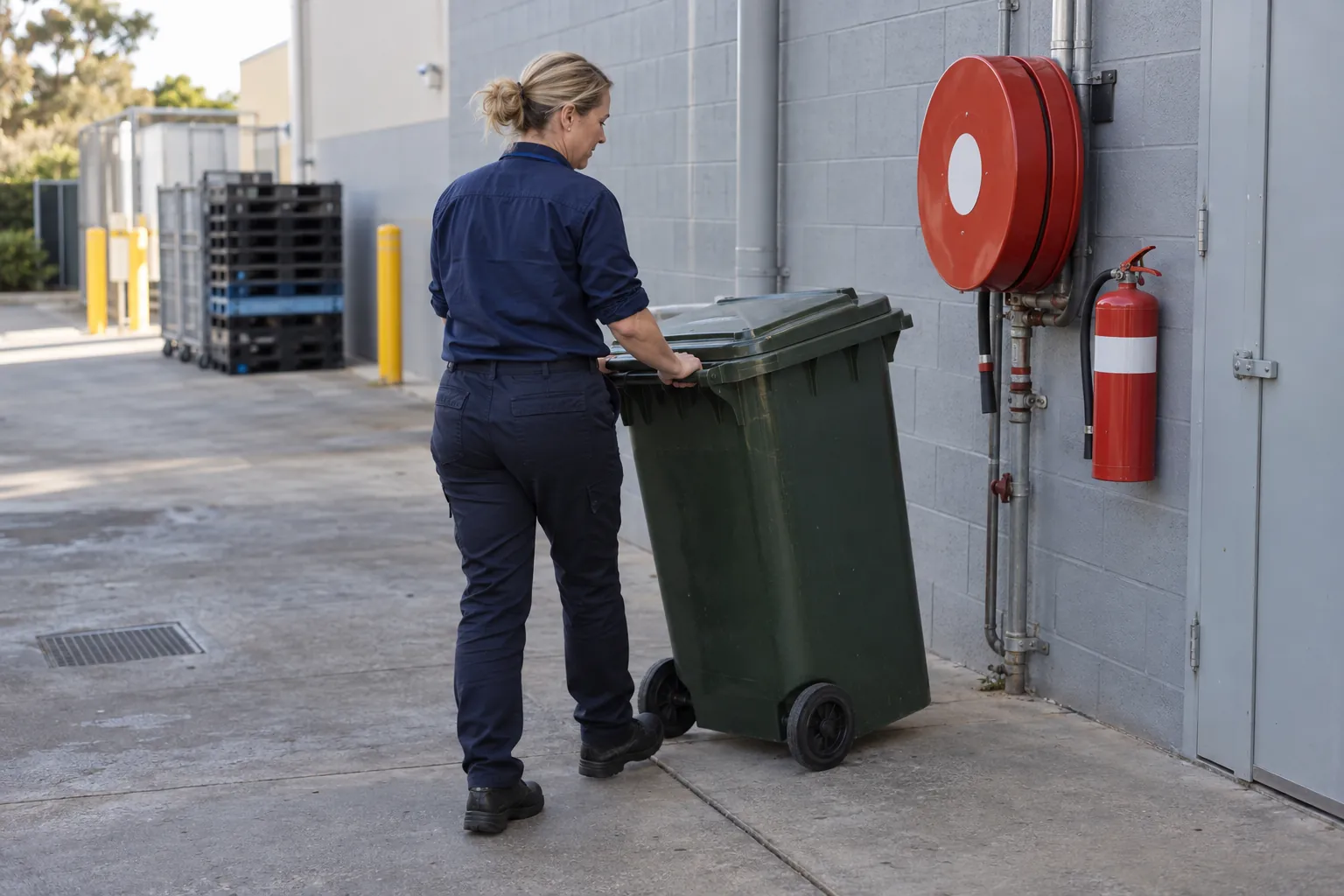
Most of it rests on small checks done on time. The law splits the duty between workplace health and safety legislation and state building and fire safety rules, and AS 1851 governs the contractor's routine service. This guide sets out a workable checklist, who should do each check, and what the record should show when an auditor, a fire authority or the owner asks.
01
Who is responsible for fire safety in an Australian workplace
Two bodies of law meet in every workplace fire safety checklist. The first is work health and safety law, which puts the duty on the person conducting a business or undertaking (PCBU). Where the model WHS laws apply, regulation 43 requires the PCBU to make sure an emergency plan is prepared for the workplace. In Queensland's Work Health and Safety Regulation 2011, section 43, the plan must provide for emergency procedures, including "an effective response to an emergency", evacuation procedures, notifying emergency services at the earliest opportunity, medical treatment and assistance, and effective communication between whoever coordinates the response and everyone at the workplace. It must also provide for "testing of the emergency procedures, including the frequency of testing", and for information, training and instruction to relevant workers.
The PCBU must then maintain the plan so that it remains effective, and implement it in an emergency. The Commonwealth's Work Health and Safety Regulations 2011 carry the same duty at regulation 43, and the other jurisdictions that have adopted the model laws have it in their own regulations. Victoria has not adopted them: a Victorian workplace works from the Occupational Health and Safety Act 2004 (Vic) and its own regulations, so check the Victorian rules rather than assume a regulation 43.
The second body of law is state building and fire safety legislation, which looks after the building itself and usually puts the duty on the owner or the occupier:
- Queensland: the occupier carries the duties in the Building Fire Safety Regulation 2008, made under the Fire Services Act 1990: keeping evacuation routes clear, a written fire and evacuation plan, evacuation instructions and practice, and maintenance of prescribed fire safety installations.
- New South Wales: the owner must issue an annual fire safety statement each year covering the building's essential fire safety measures, with an accredited practitioner (fire safety) assessing each measure, under the Environmental Planning and Assessment (Development Certification and Fire Safety) Regulation 2021. The NSW Planning page on fire safety certification explains the statement and the fire safety schedule.
- Victoria: essential safety measures (ESM) under the Building Regulations 2018. The CFA's guide to essential safety measures for businesses says that, generally speaking, owners and owners corporations are responsible for keeping ESM in good working order, that a lease can give tenants some of that responsibility, and that everyone must keep exits and pathways clear, accessible and functional at all times.
In a leased or strata building, the PCBU, the occupier and the owner are often different people, each with its own duties.
02
The fire safety checklist, from daily to annual
No statute lists the routine checks line by line. The frequencies below are a common pattern for an office, school, shopping centre or warehouse with a fire indicator panel, exit signs, emergency lighting, extinguishers and hose reels. Your emergency plan, your state's rules and the building's approvals decide what actually applies, and they may add to it.
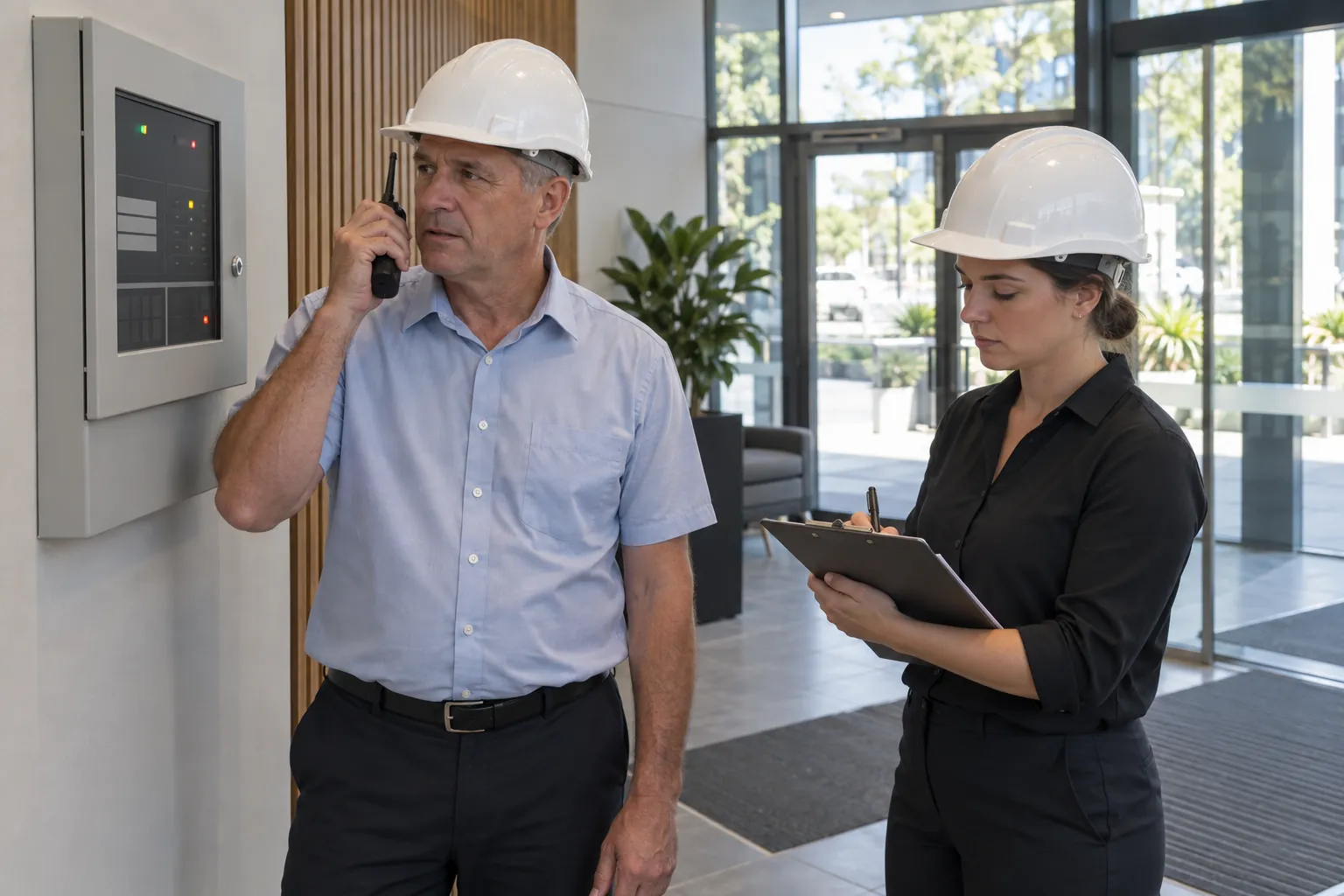
- Daily: exits and paths of travel clear; exit doors unlocked while people are inside and opening easily; the area outside each final exit clear; fire doors and smoke doors shut or on hold-open devices that release on alarm, never wedged; the fire indicator panel showing normal, with any fault or isolation reported; rubbish and packaging not building up near heaters, switchboards or other ignition sources.
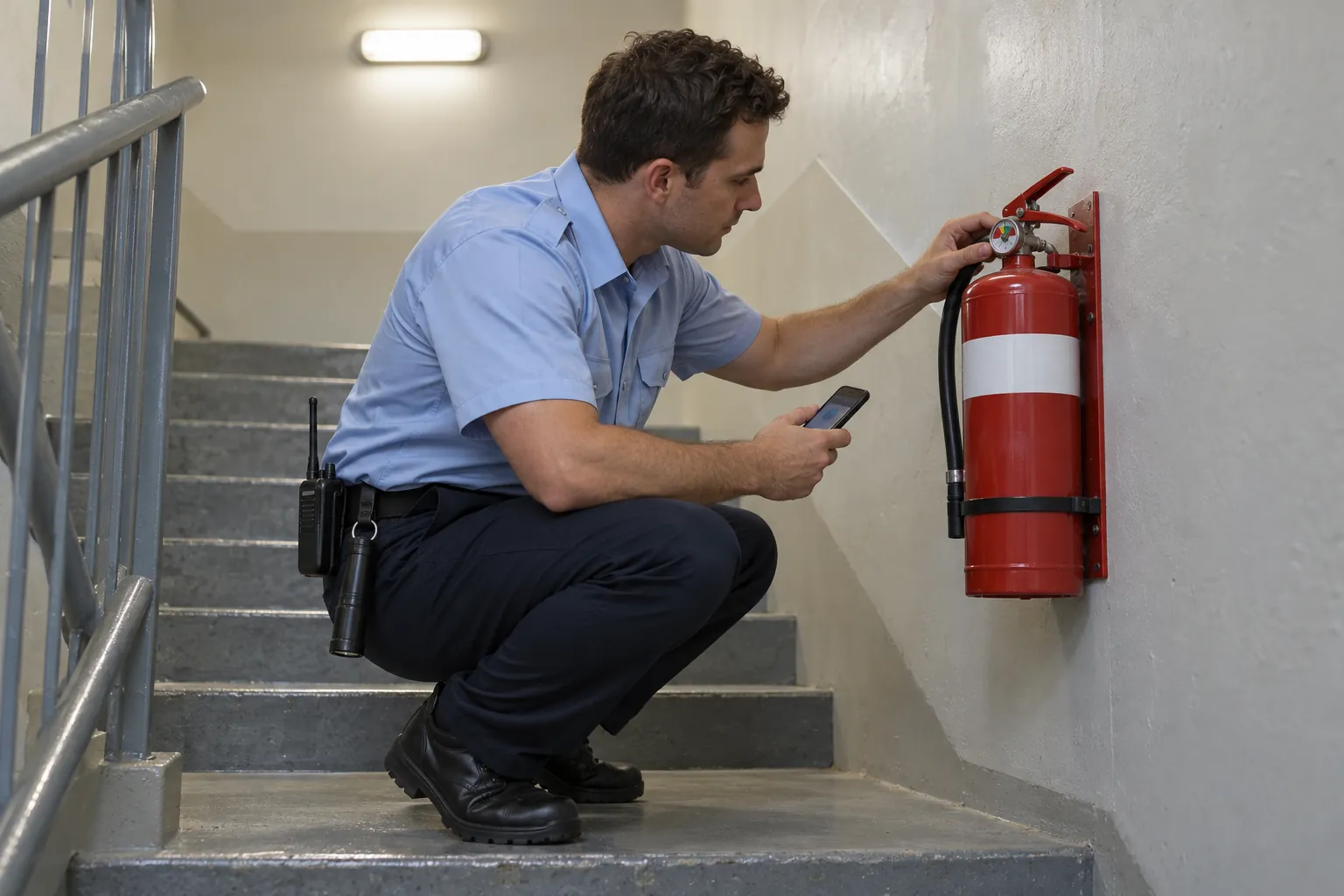
- Weekly: a walk past each extinguisher, fire blanket and hose reel to confirm it is in its place, visible, unobstructed and not obviously damaged; exit signs lit; evacuation diagrams in place and not covered.
- Monthly: a slower walk-round of fire doors (closers working, seals intact, nothing fixed to the door that stops it closing), stair doors and the doors onto the street; a look at the emergency lighting and exit signs area by area; a check that storage has not crept into corridors, stair landings or plant rooms.
- At the contractor's intervals: routine service of fire protection systems and equipment by a competent fire services contractor, usually to AS 1851-2012 or the standard the building's approvals call up, with faults recorded and put right.
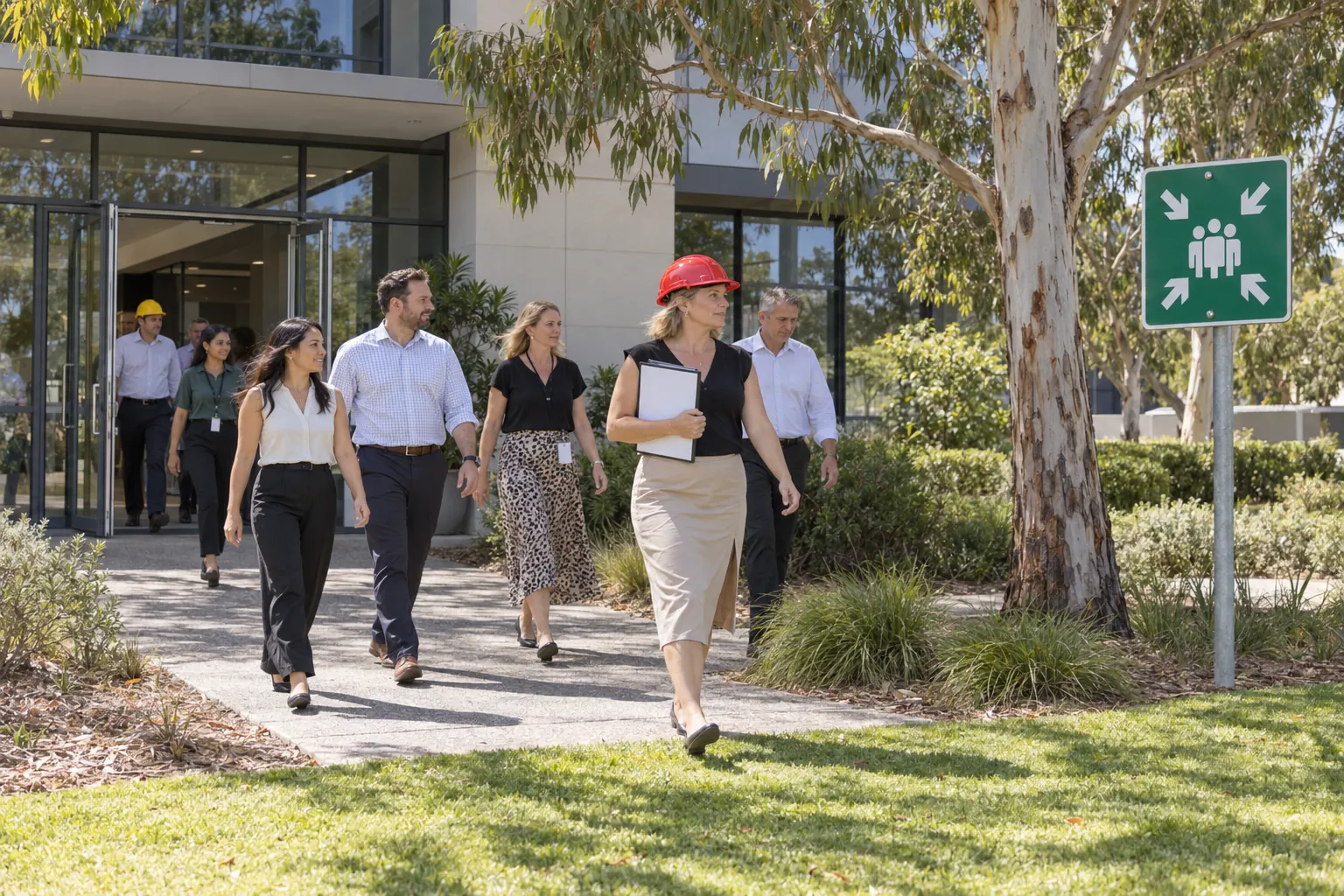
- At least yearly: an evacuation exercise, reviewed and recorded; a review of the emergency plan and the fire and evacuation instructions given to staff; in NSW, the annual fire safety statement; in Victoria, the annual essential safety measures report.
03
Who does each check: the building team, the wardens and the contractor
Every line on the checklist is one of two kinds of work, and gaps usually open where they are confused.
- Routine checks by the building team: a building manager, facility manager, caretaker, cleaning supervisor or security officer walks the building and looks. They are short and frequent, and their job is to catch the obvious faults early and get them reported.
- Routine service by a competent person: the fire services contractor inspects, tests and maintains the systems. In Queensland, section 54 of the Building Fire Safety Regulation 2008 requires maintenance of each prescribed fire safety installation to be carried out by an appropriately qualified person, inspected and tested at intervals in line with the Queensland Development Code MP6.1, and any repair or corrective action the maintenance record shows to be done no later than one month after the maintenance, unless the occupier has a reasonable excuse.
A walk-round does not replace a service, and a contractor's visit every few months does not replace the walk-rounds in between. An auditor, an insurer or a fire safety inspector will expect both.
Wardens are a third role. AS 3745-2010, Planning for emergencies in facilities, is the Australian Standard most emergency plans follow, with an emergency control organisation of a chief warden and floor or area wardens who direct people in an emergency. Wardens are often, but not always, the same people who do the routine checks. Where they are, give each check to a named person with a deputy for leave and sick days; the building team is not a name.
Queensland puts instructions on a timetable. Under section 35, the occupier must give general evacuation instructions to each person working in the building at intervals of not more than one year, and to a new starter no later than two days after they start. Section 45 requires a record of each occasion: who was given the instructions, who gave them, the date and a brief description. Elsewhere the timetable is for the emergency plan to set, but contractors, cleaners working after hours and agency staff still need to know where the exits are and what the alarm sounds like.
04
Exits, paths of travel and housekeeping
The daily walk is the check that matters most and is the easiest to skip, because nothing has usually changed since yesterday. It is also where a fire safety officer starts. Queensland puts it plainly: under section 8 of the Building Fire Safety Regulation 2008, the occupier must not allow a thing to be placed or to remain within 2 metres of a final exit outside the building, or elsewhere on an evacuation route, if it would be likely to "unduly restrict, hinder or delay" someone using the route in a fire or hazardous materials emergency, and must take reasonable steps to stop people obstructing an evacuation route. Section 11 requires the occupier to make sure a door on an evacuation route is not locked while anyone is inside on the internal side of it.
Whatever the state, the walk covers:
- Paths of travel: corridors and fire stairs clear of stock, furniture, deliveries, trolleys and bins, and lit.
- Exit doors: unlocked while the building is occupied, opening with the escape hardware in one action, and clear on the outside, where pallets, skips, cars and bicycles tend to end up.
- Fire and smoke doors: closed or on hold-open devices that release on alarm; no wedges, hooks or door stops.
- Signs and diagrams: exit signs visible and lit, evacuation diagrams on the wall and the right way round for where they hang.
- Equipment: extinguishers, fire blankets and hose reels in place, unobstructed and not used as door stops or coat hooks; manual call points clear.
- Housekeeping: no build-up of rubbish or packaging near ignition sources; damaged electrical appliances, leads and power boards taken out of use and reported; flammable liquids stored as the risk assessment says; plant rooms and switchboard cupboards not used as store rooms.
Changes to the building shift the fire risk faster than any schedule: a fit-out, building works, a new tenant, a sale in the shopping centre, or temporary storage that quietly became permanent. Each should prompt a check of the affected paths of travel and a question about whether the emergency plan, the evacuation diagrams or the instructions need to change. In Queensland, section 27 requires the fire and evacuation plan to be changed within one month of a change of circumstances that affects it.
05
What a good fire safety record shows
Fire authorities, auditors, insurers and the owner will all ask for the record, and the law is specific in places. In Queensland, section 46 requires an evacuation practice record for each evacuation, stating the date, the times it started and ended, and any action to be taken as a result, such as reviewing the fire and evacuation plan or giving further instructions. Section 44 requires an evacuation of the building by an appropriate number of persons, in an appropriate way, at intervals of not more than one year. Section 55 sets out the record of maintenance for each prescribed fire safety installation, and section 72 requires prescribed documents to be kept for at least two years and handed to a new occupier within one month of leaving. In Victoria, the CFA says the most recent service records are usually kept in the red essential safety measures box.
Beyond what a state prescribes, a record that can be believed:
- Records each check when it is done, with the date, the time and the name of the person who did it.
- Says what was checked: which floor's exits, which fire doors, which extinguishers and hose reels.
- Records faults and what happened next: who was told, when it was fixed, and by whom.
- Shows the gaps honestly: a missed walk-round with a reason is more credible than a year of identical ticks.
- Sits beside the contractor's service records, so a defect raised on a service visit can be followed to its repair.
- Covers drills and instructions: the date, how long the evacuation took, what went wrong, and who took part.
The usual failure is not a missing check but a record nobody can rely on: every entry in the same pen, a walk-round logged for a day the building was closed, three years of ticks with no fault recorded. A sheet filled in from memory at the end of the month is not evidence of anything, and an auditor can usually tell.
06
Where the record fails, and what SiteClara does about it
A paper checklist on the back of the plant room door works in one building with a careful building manager. It struggles when the checks are spread across a campus, a shopping centre or a portfolio, when the people doing them change from shift to shift, or when the person accountable is not the person in the building. The gap usually surfaces months later, when an auditor or the owner asks.
SiteClara records those checks at the location. A printed QR poster, with an optional NFC tag behind it, sits at each place a check is scheduled, such as a fire stair door, a hose reel or the fire indicator panel. Staff scan or tap on their own phone, with no app to install, see the checks due there, and mark each one done or explain what stopped them. The time and the named person are recorded as it happens, with a photo when one is asked for. A problem found on the walk, such as a blocked exit or a wedged fire door, is reported there with a photo and goes onto the team's list of jobs until someone closes it.
The supervisor sees what is due, done and missed, and records the reason a check was missed. A job that needs the building manager can be escalated to them to answer. Each day the supervisor reviews the checks and photos and approves a report that goes to nominated contacts, such as the owner's facility manager, at 8am the next morning, showing what was reported, what was completed, what is still open, and how the scheduled checks went.
07
Questions people ask
What is the first step of fire safety?
Identifying the hazards. In work health and safety law, managing any risk starts there: Queensland's Work Health and Safety Regulation 2011, section 34 says a duty holder "must identify reasonably foreseeable hazards that could give rise to risks to health and safety". For fire, that means looking for ignition sources, fuel such as stored rubbish and flammable liquids, and anything that would slow an evacuation.
What are the steps of a fire risk assessment?
The WHS regulations set out four, not five. Part 3.1 of Queensland's Work Health and Safety Regulation 2011, which follows the model regulations, requires the duty holder to identify reasonably foreseeable hazards (section 34); to eliminate the risks so far as is reasonably practicable or, if that is not reasonably practicable, minimise them (section 35), working down the hierarchy of control measures (section 36); to make sure each control measure is maintained so that it remains effective (section 37); and to review the control measures when one fails, the workplace changes, a new hazard appears, consultation shows a review is needed or a health and safety representative asks (section 38).
Can I do a fire risk assessment myself?
The duty is the PCBU's, and Part 3.1 of the Work Health and Safety Regulation 2011 does not require an outside consultant to carry it out. It must not be done alone, though: sections 47 and 49 of Queensland's Work Health and Safety Act 2011 require the PCBU to consult affected workers, so far as is reasonably practicable, "when identifying hazards and assessing risks" and when deciding how to eliminate or minimise them. The fire protection equipment is different: in Queensland, section 54 of the Building Fire Safety Regulation 2008 requires its maintenance to be carried out by an "appropriately qualified person", and in NSW the NSW Planning page on fire safety certification explains that a fire safety statement confirms an accredited practitioner (fire safety) has assessed, inspected and verified the performance of each fire safety measure.
08
Further reading, and a list to take away
For the emergency plan duty, read regulation 43 of the WHS regulations in force where you are, such as Queensland's Work Health and Safety Regulation 2011 or the Commonwealth's Work Health and Safety Regulations 2011, and in Victoria the Occupational Health and Safety Act 2004. For the building, Queensland occupiers should read the Queensland Fire Department's page for building occupiers, owners, lessees and bodies corporate and the Building Fire Safety Regulation 2008; NSW owners the fire safety certification page; Victorian owners and tenants the CFA's essential safety measures for businesses. The standards are AS 3745-2010 (planning for emergencies in facilities) and AS 1851-2012 (routine service of fire protection systems and equipment), both from Standards Australia.
Before the next emergency plan review, check that:
- every routine check the plan relies on has a frequency, a named person and a deputy;
- the daily walk of exits and paths of travel happens and is recorded, including outside the final exits;
- fire doors, extinguishers, hose reels and exit signs are checked between the contractor's visits, with faults and repairs recorded;
- the contractor's service records are filed, and every defect they raise has been followed to its repair;
- evacuation exercises and staff instructions are recorded, including for contractors, cleaners and after-hours staff;
- you know which state rules apply to the building, and who signs the annual statement or report;
- in a shared or strata building, everyone knows which checks are theirs and sees the results.
Sources
Every document this guide quotes or links to, in the order it first cites them.
- Work Health and Safety Regulation 2011, section 43 legislation.qld.gov.au
- Work Health and Safety Regulations 2011 legislation.gov.au
- Occupational Health and Safety Act 2004 (Vic) legislation.vic.gov.au
- Building Fire Safety Regulation 2008 legislation.qld.gov.au
- NSW Planning page on fire safety certification planning.nsw.gov.au
- Essential safety measures for businesses cfa.vic.gov.au
- AS 1851-2012 store.standards.org.au
- AS 3745-2010 store.standards.org.au
- Queensland's Work Health and Safety Act 2011 legislation.qld.gov.au
- Building occupiers, owners, lessees and bodies corporate fire.qld.gov.au
Related guides
 Fire and water checksAS 3745: planning for emergencies in a facility, and keeping the plan trueWhat AS 3745-2010 asks of an Australian facility, how it sits beside the WHS duty to have an emergency plan, who runs it, and what a record should show.
 Fire and water checksFire warden duties: what the chief warden and floor wardens do, day to day and when the alarm soundsWhat a chief warden and floor wardens do in an Australian workplace: the law behind the role, the routine checks, the job in an evacuation, and the records to keep.
 Fire and water checksFire drills and evacuation drills in Australia: the duty, the drill and the recordRunning a fire drill or evacuation drill in an Australian workplace: the WHS duty, Queensland's yearly rule, planning the exercise, the debrief and the record.
 Fire and water checksAS 1851 routine service: what it asks of owners, fire contractors and building teamsWhat AS 1851-2012 routine service covers, how intervals and competent persons work, what the records must show, and how Victoria's regulations call it up.