Cleaning
Hospital cleaning standards in Australia: what is cleaned, how often, and how it is checked
Hospital cleaning, usually called environmental cleaning, is the scheduled, risk-based cleaning and disinfection of a hospital's wards, theatres, bathrooms and equipment to reduce the risk of healthcare-associated infection.
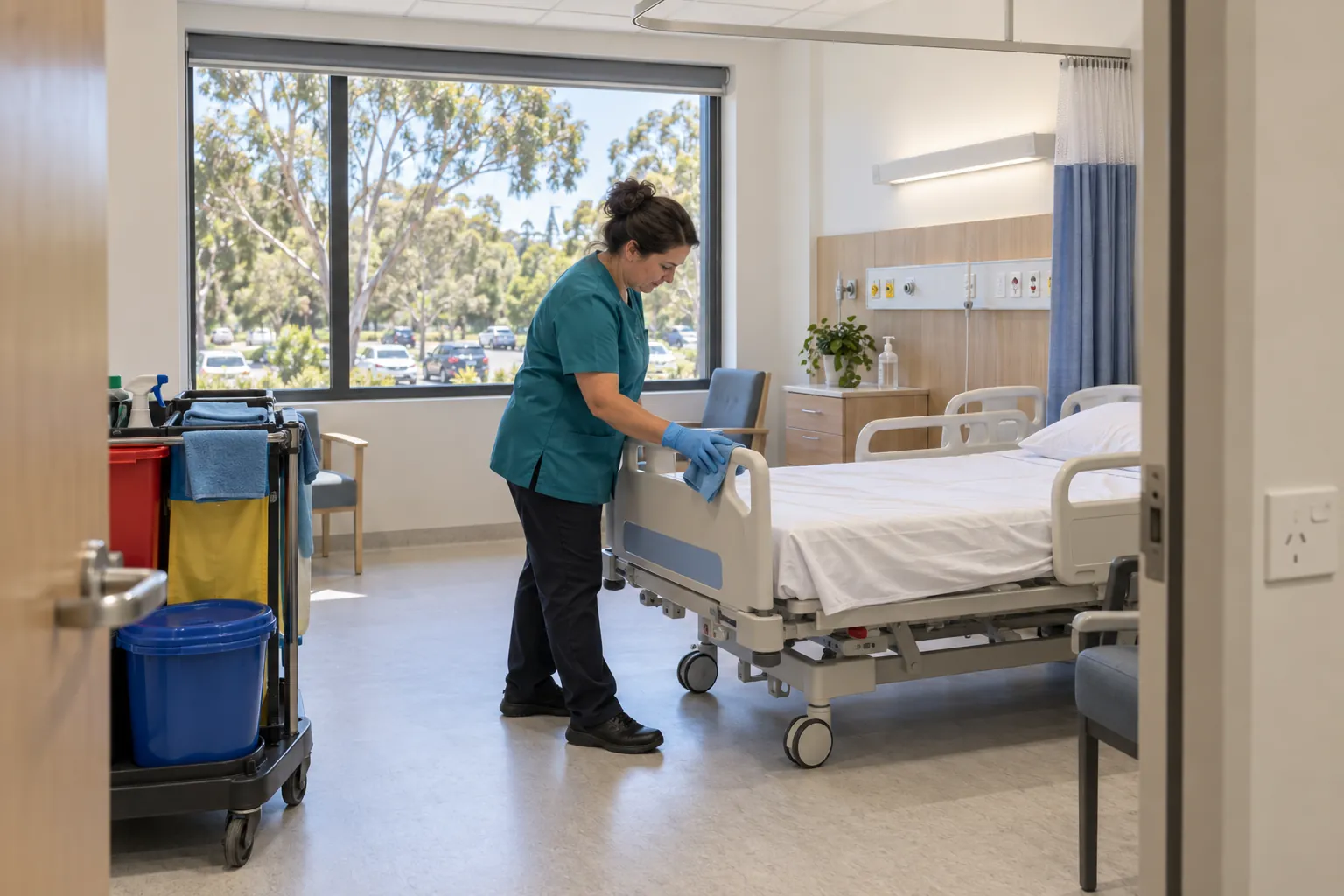
It is part of infection prevention and control, not a housekeeping extra. In Australia it sits under the National Safety and Quality Health Service (NSQHS) Standards, the Australian Guidelines for the Prevention and Control of Infection in Healthcare, and each state's own health department policy. This guide explains what those ask for, how risk categories set the cleaning and audit frequencies, how a contract cleaner fits in, and what a record of the work should show.
01
The standard: NSQHS Action 3.13 and the state policies under it
Three layers set the rules for cleaning in an Australian hospital or day procedure service.
- The NSQHS Standards, published by the Australian Commission on Safety and Quality in Health Care, are the national accreditation standards. The Preventing and Controlling Infections Standard (Standard 3) carries the environmental cleaning actions.
- The Australian Guidelines for the Prevention and Control of Infection in Healthcare (NHMRC, 2019) set out the practice.
- State and territory policy turns both into requirements for public health services. NSW Health's policy directive, distributed to private hospitals and day procedure centres as well as the public system, is the most detailed public example and is used throughout this guide.
NSW Health's Cleaning of the Healthcare Environment policy directive (PD2023_018), issued in August 2023 and due for review in August 2028, summarises Action 3.13 of the Preventing and Controlling Infections Standard. Health service organisations must have processes to maintain a clean, safe and hygienic environment, in line with the current edition of the Australian Guidelines and jurisdictional requirements, that:
- respond to environmental risks, including novel infections such as COVID-19;
- require cleaning and disinfection using products listed on the Australian Register of Therapeutic Goods (ARTG), consistent with manufacturers' instructions for use and recommended frequencies;
- provide access to training on cleaning processes for routine and outbreak situations, and novel infections;
- audit the effectiveness of cleaning practice and compliance with the organisation's environmental cleaning policy;
- use the results of audits to improve environmental cleaning processes and compliance with policy.
The NSW directive puts the responsibility at the top: the chief executive must ensure that cleaning of the healthcare environment meets the minimum standards "irrespective of whether cleaning is provided in-house or by external cleaning services". NSW Health's wider Infection Prevention and Control in Healthcare Settings policy directive (PD2023_025) requires every NSW Health organisation to have an environmental cleaning program managed by suitably qualified personnel and overseen by an appropriate committee or directorate.
Other states publish their own requirements. Queensland Health's page on cleaning of the healthcare environment says that, as per the Australian Guidelines, "local risk assessment should determine the appropriate product, method and frequency of cleaning of the healthcare environment", and points Queensland Health facilities to its own operational cleaning guidelines. Other states and territories publish their own guidance. Read your state's, and your organisation's local policy, alongside this guide.
02
What hospital cleaning covers in practice
Hospital cleaning is usually called environmental cleaning, and the people who do it may be called cleaners or environmental services staff depending on the health service. It can look like hotel housekeeping or commercial cleaning, but its cleaning duties are set by infection risk rather than appearance, and its cleanliness is audited against a written standard. The work covers:
- Routine cleaning of patient rooms, bathrooms, wards, corridors, waiting areas and offices, on a documented schedule.
- High-touch surfaces in the patient zone. The NSW directive lists bedrails, trolleys, commodes, doorknobs, light switches and tap handles as examples, needing more frequent cleaning than floors, ceilings, walls and blinds.
- Discharge or terminal cleaning, which PD2023_018 defines as the cleaning required "after patient(s) have vacated the room, either through room transfer or discharge".
- Spot cleaning of visible spills and marks between scheduled cleans, including blood and body substance spills.
- Cleaning under transmission-based precautions, where daily and terminal cleaning of isolation rooms is set with the local infection prevention and control team.
- Toilets and bathrooms, cleaned and checked at frequencies set by risk and by how many people use them.
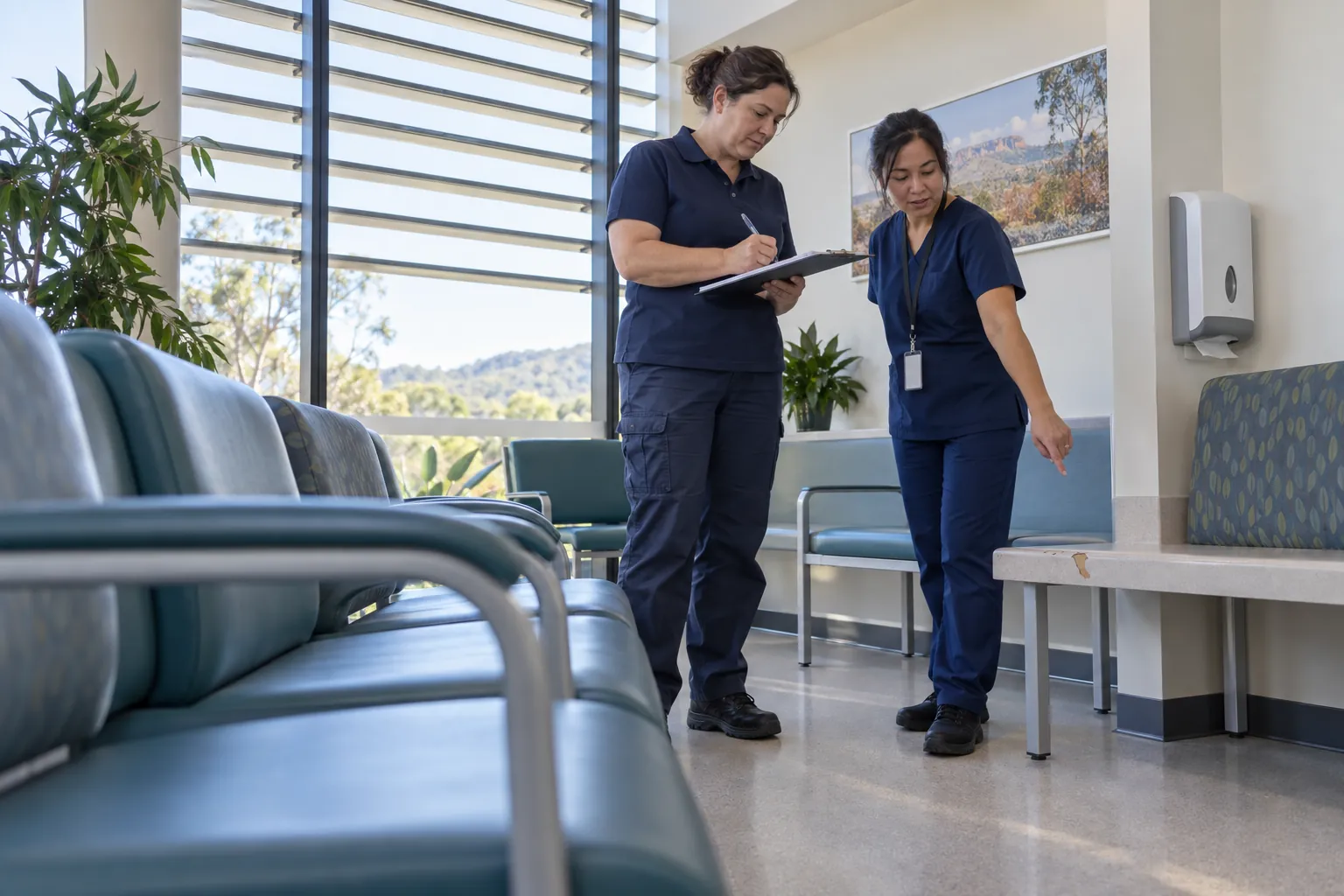
- Reporting building faults that stop a surface being cleaned properly, from worn porcelain to threadbare carpet.
Queensland Health describes the pattern simply: the environment "should be cleaned daily as part of routine cleaning or on a schedule as part of periodic cleaning", and a patient's room or clinic space also needs cleaning after discharge.
03
Risk categories and cleaning frequencies
Australian hospital cleaning is risk based. Every area that needs cleaning is a functional area, and each functional area sits in one of four risk categories: extreme, high, medium or low. Under the NSW directive, each area is scored on the likelihood of contamination, how vulnerable the patients there are to infection, and the potential for exposure through invasive devices, and the score is read against a risk matrix. The category then sets how often and how intensively the area is cleaned, and how often it is audited.
The minimum cleaning frequencies in Appendix 1 of PD2023_018 are:
- Extreme risk (for example operating theatres, intensive care units, delivery suites, interventional suites and radiology): theatres and procedural areas before the first patient, between each case and at the end of the list; elsewhere, patient beds, furnishings, fixtures, medical equipment and high-touch points in the patient zone daily at a minimum and between each patient, with capacity for rapid spot cleaning; toilets cleaned and disinfected at least twice daily and checked at least twice daily in addition.
- High risk (for example general wards, special clinic treatment areas, mortuaries performing autopsies and emergency transport vehicles): the same daily and between-patient cleaning of the patient zone, with capacity for rapid spot cleaning; toilets cleaned and disinfected at least daily and checked at least twice daily.
- Medium risk (for example outpatient departments, non-emergency transport vehicles and pharmacy): a daily clean, cleaning between each patient and according to the volume of use, and capacity for spot cleaning; toilets cleaned at least daily and checked at least twice daily.
- Low risk (for example ambulance stations, offices and non-patient transport vehicles): cleaning as required, planned targeted cleaning and capacity for spot cleaning; toilets cleaned at least daily and checked more often in areas of high use.
Two further rules apply. All rooms and corridors with direct open access into a functional area are cleaned to the same level as that area. And an area's risk level goes up when its patients are at increased risk, for example during an outbreak, and may go back to its previous category once that risk is no longer a factor. Both decisions are taken in consultation with local infection prevention and control staff and clinical management.
The directive recommends starting high and medium risk areas with a daily clean and increasing intensity according to the patients, the procedures and the risk of multidrug-resistant organisms. The frequencies are a floor, not a target.
04
Who does what, including when the cleaning is contracted out
Hospital cleaning involves more people than the cleaner with the trolley. Under the NSW directive:
- The chief executive and executive managers make sure the program is resourced, run by suitably qualified people and overseen by a committee or directorate, including where no cleaner is on site permanently.
- Cleaning service managers and supervisors oversee and monitor that the facility is clean and that staff undertaking cleaning follow the requirements. At least one cleaning manager sits on the infection prevention and control committee or another relevant committee.
- All health workers are responsible for maintaining a safe and clean environment and must do cleaning tasks correctly, with the correct cleaning equipment and personal protective equipment. In wards and units they must have access to cleaning equipment when regular cleaning staff are not available.
- The infection prevention and control team advises on disinfectants, transmission-based precautions and changes to an area's risk level.
Everyone who cleans must be trained and assessed as competent in infection prevention and control principles and the correct use of personal protective equipment, work health and safety, the safe use of cleaning chemicals, and doing each task safely and correctly.
Where cleaning is bought from a contractor, the NSW directive requires a service level agreement that "clearly defines and documents the roles, responsibilities, scope of services, and relationship" between the health organisation and the provider. The health organisation remains responsible for making sure the audits happen, and the external audit of extreme and high risk areas cannot be done by staff from the cleaning provider.
The contractor has its own duties too. Under the model work health and safety laws, which each state and territory except Victoria has adopted in its own Act (the Commonwealth's is the Work Health and Safety Act 2011 (Cth)), a cleaning company is a person conducting a business or undertaking (PCBU) with a primary duty of care for its workers under section 19. Section 46 requires the cleaning company and the hospital, as duty holders over the same matters, to consult, cooperate and coordinate activities with each other so far as is reasonably practicable. In Victoria the equivalent duties are in the Occupational Health and Safety Act 2004 (Vic).
Cleaning procedures must be written down and available to the people who use them, including an external provider: reporting lines, frequencies and methods, chemicals and their safety data sheets, personal protective equipment, equipment, safe work practices and outbreak plans.
05
Cleaning audits and acceptable quality levels
A hospital proves its cleaning through audit. PD2023_018 requires every NSW Health organisation to have "a cleaning audit system that measures and records cleaning outcomes", with internal audits in every functional area across all risk categories. Each category has a minimum audit frequency and a minimum acceptable quality level (AQL), the score an area must reach to pass:
- Extreme: aim to audit every room at least monthly; at minimum 50% of rooms each month and all rooms every two months. AQL 90%. Failed elements put right within 24 hours, and risks to patient safety immediately.
- High: aim to audit every room every two months; at minimum 50% of rooms every two months and all rooms every four months. AQL 88%. Failed elements put right within 48 hours.
- Medium: at minimum 50% of rooms every three months and all rooms every six months. AQL 85%. Failed elements put right within 72 hours.
- Low: all rooms audited at least once a year. AQL 80%. Failed elements put right within seven days.
Repeated failure escalates. In an extreme risk area, two consecutive failures mean targeted cleaning and a weekly inspection of every room until the benchmark is met; in a high risk area the same follows three consecutive failures. Six failures in a year in either category bring an external or independent audit and an entry on the local risk register. In a medium risk area, three consecutive failures bring monthly inspection until the benchmark is met, and a review. A failed audit is re-audited as soon as the issues are fixed.
Auditors must be trained and know both the cleaning standards and the cleaning processes. Where possible a staff member from the area walks the audit with them, and the auditor always checks the previous audit and its open actions first. Results and improvement plans go to the quality and risk and infection prevention and control committees, and extreme and high risk areas are also externally audited at least every two years. NSW Health organisations should also seek feedback from patients, carers and visitors on the cleanliness and maintenance of the healthcare environment, and act on it where appropriate.
The main method is visual assessment. The NSW directive suggests fluorescent gel or adenosine triphosphate (ATP) bioluminescence testing as an extra check, for example after an outbreak or on high-touch surfaces in extreme risk areas, noting that it shows whether the correct cleaning process was used rather than how contaminated a surface is.
06
Where the cleaning record fails
Most hospitals have a cleaning schedule and an audit system. The weak point is the record in between. A toilet check sheet on the back of the door is initialled for the whole shift at the end of it. A discharge clean is marked done, but nobody knows when or by whom. A cracked bench top is mentioned to whoever was passing and is still there at the next audit, as a failed element. When infection prevention and control asks, during an outbreak, whether last week's twice-daily toilet checks were done, the honest answer is often that someone said so.
SiteClara is built for that gap. A printed QR poster, with an optional NFC tag behind it, goes at each place a check is scheduled: a ward bathroom, a waiting area, a dirty utility room, an outpatient toilet block. The cleaner or supervisor scans or taps with their own phone, with no app to install, sees the checks due there, and marks each one done, with a photo when the check asks for one, or says what stopped it. The time and the named person are recorded as it happens. A fault can be reported from the same tag and stays on the team's list of open jobs until someone closes it, so a damaged surface is not forgotten between audits.
The supervisor sees what is due, done and missed across the day, and records the reason a check was missed. Each day they review the checks and photos, add a note and approve a report that goes to nominated managers the next morning, showing what was reported, what was completed and what is still open.
In a hospital a photo should show the surface, the fitting or the fault, never a patient, a patient's details or a clinical record. Set up any check that asks for a photo with that rule, and say so in the local procedure.
07
Questions people ask
What is hospital cleaning called?
Environmental cleaning. NSW Health's Cleaning of the Healthcare Environment policy directive (PD2023_018) commits NSW Health to "the implementation of environmental cleaning programs across NSW Health organisations to reduce the risk of healthcare associated infections". It replaced PD2020_022, which had itself superseded NSW Health's Environmental Cleaning Policy (PD2012_061).
What are the guidelines for hospital cleaning?
Nationally, Action 3.13 of the NSQHS Preventing and Controlling Infections Standard, which NSW Health's Cleaning of the Healthcare Environment policy directive (PD2023_018) summarises as processes to maintain "a clean, safe and hygienic environment, in line with the current edition of the Australian Guidelines for the Prevention and Control of Infection in Healthcare and jurisdictional requirements". Each state then sets its own policy. Queensland Health's page on cleaning of the healthcare environment adds that, as per the Australian Guidelines, local risk assessment should determine the product, method and frequency of cleaning.
What skills do I need for hospital cleaning?
Under NSW Health's Cleaning of the Healthcare Environment policy directive (PD2023_018), all health workers undertaking cleaning are to be trained and assessed as competent in applying infection prevention and control principles, including the correct use of personal protective equipment; applying work health and safety principles; the safe and correct use of cleaning chemicals; and performing cleaning tasks safely and correctly.
What are the steps of the hospital cleaning process?
Australian policy gives no fixed number of steps, but Queensland Health's guidance on cleaning of the healthcare environment sets out the method: clean from clean to dirty and from high to low; use detergent for most room cleaning; use a disinfectant only after the item has been cleaned with detergent, and where both cleaning and disinfection are needed, a combined cleaning and disinfectant product; fold the cloth to use its different surfaces, and never re-dip it or use it across multiple surfaces; and let surfaces dry on their own so the chemicals have enough contact time.
08
Further reading, and a list to take away
Start with your own state. In New South Wales, read the Cleaning of the Healthcare Environment policy directive (PD2023_018) and the Infection Prevention and Control in Healthcare Settings policy directive (PD2023_025); the Clinical Excellence Commission publishes Environmental Cleaning Standard Operating Procedures to go with them. In Queensland, read Queensland Health's guidance on cleaning of the healthcare environment. Nationally, the Australian Commission on Safety and Quality in Health Care publishes the NSQHS Standards, and the NHMRC the Australian Guidelines for the Prevention and Control of Infection in Healthcare.
Before you agree or review a hospital cleaning program, check that:
- every functional area has a risk category, recorded and agreed with infection prevention and control;
- cleaning frequencies meet at least your state's minimums, and rise with outbreaks and volume of use;
- procedures are written down, including chemicals, safety data sheets, equipment and outbreak plans, and the contractor has them, with colour-coded equipment as NSW recommends;
- disinfectants are ARTG listed and used to the manufacturer's instructions, and detergent is the default;
- internal audits run at the frequency for each category, with the AQL and rectification times written down;
- extreme and high risk areas have an independent external audit, never by the contractor's own staff;
- faults that stop a surface being cleaned are reported and fixed, not just noted;
- there is a day-to-day record of scheduled checks, recorded at the time, between audits.
Sources
Every document this guide quotes or links to, in the order it first cites them.
- Cleaning of the Healthcare Environment policy directive (PD2023_018) www1.health.nsw.gov.au
- Infection Prevention and Control in Healthcare Settings policy directive (PD2023_025) www1.health.nsw.gov.au
- Cleaning of the healthcare environment health.qld.gov.au
- Work Health and Safety Act 2011 (Cth) legislation.gov.au
- Occupational Health and Safety Act 2004 (Vic) legislation.vic.gov.au
Related guides
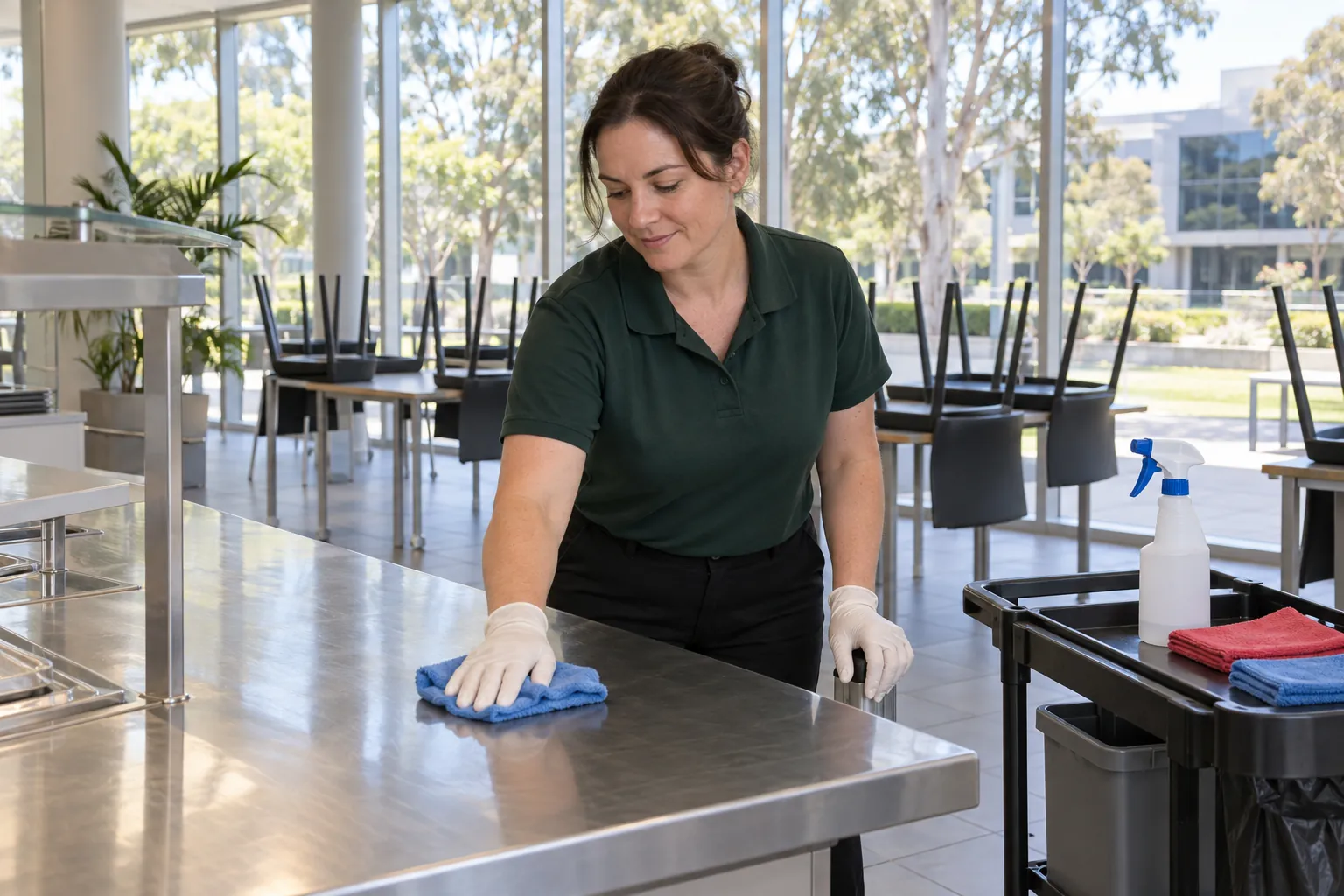 CleaningCleaning standards in Australia: a map, and how to chooseA map of Australian cleaning standards: WHS and OHS duties, NSQHS Action 3.13, state health policy, the Food Standards Code, aged care and contract specs.
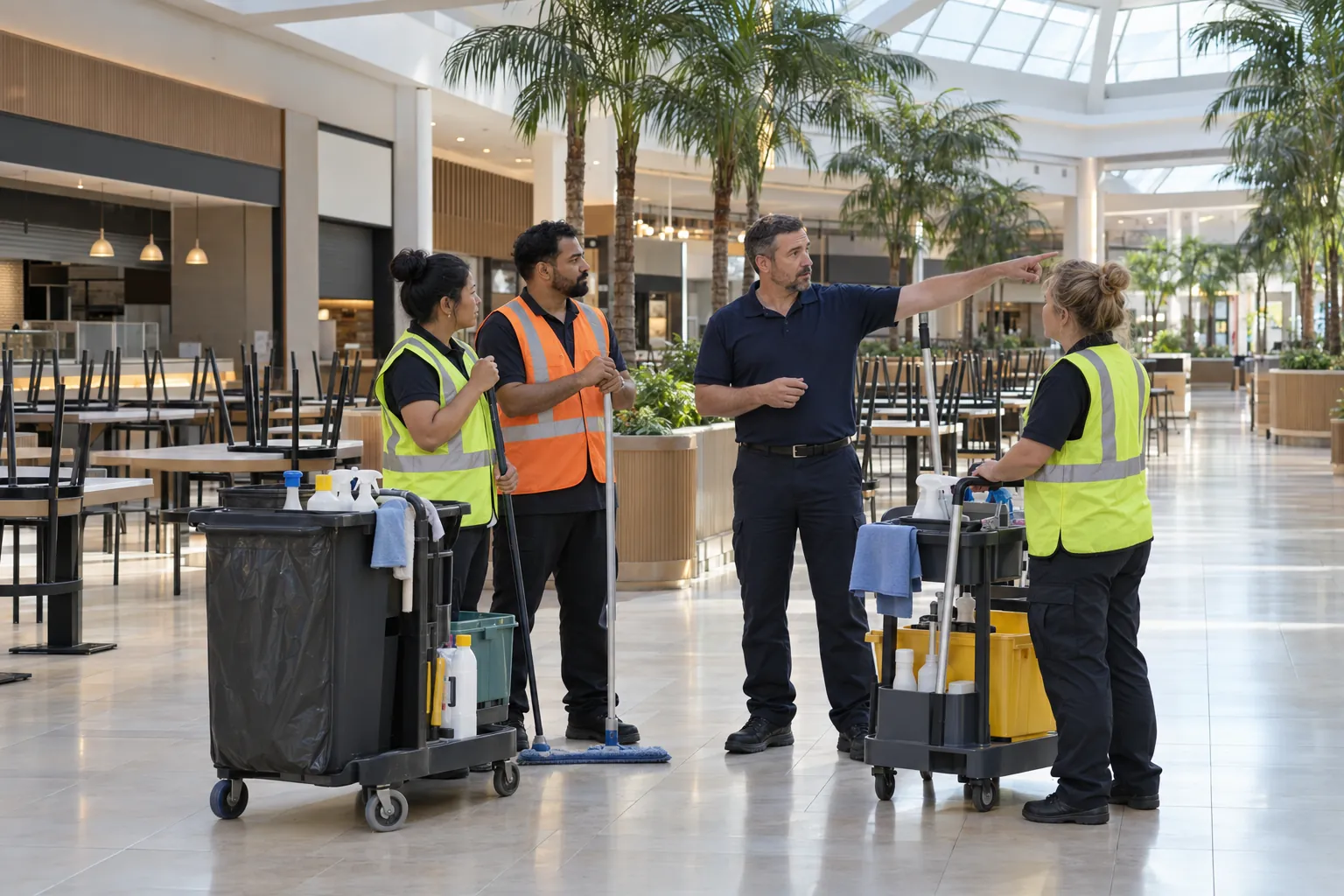 CleaningCleaning supervisor duties: what the role involves in Australia, and what good looks likeWhat a cleaning supervisor does in Australia: the Cleaning Services Award, WHS duties, a typical shift, managing the team, checking the work and reporting.
 CleaningToilet cleaning checklist: what to check, how often, and how to make the record believableWhat a toilet cleaning checklist should cover in Australian workplaces, how often to check, the WHS and OHS duties behind it, and how to make the record believable.
 CleaningCleaning log sheet: what to record, who signs it, and what a signature provesWhat a cleaning log sheet should record in Australian workplaces and food businesses, the WHS and food safety rules behind it, and what a signature proves.