Cleaning
Cleaning supervisor duties: what the role involves in Australia, and what good looks like
A cleaning supervisor leads a team of cleaners on one or more sites, allocating the work, checking it meets the standards in the cleaning specification and keeping the team safe.
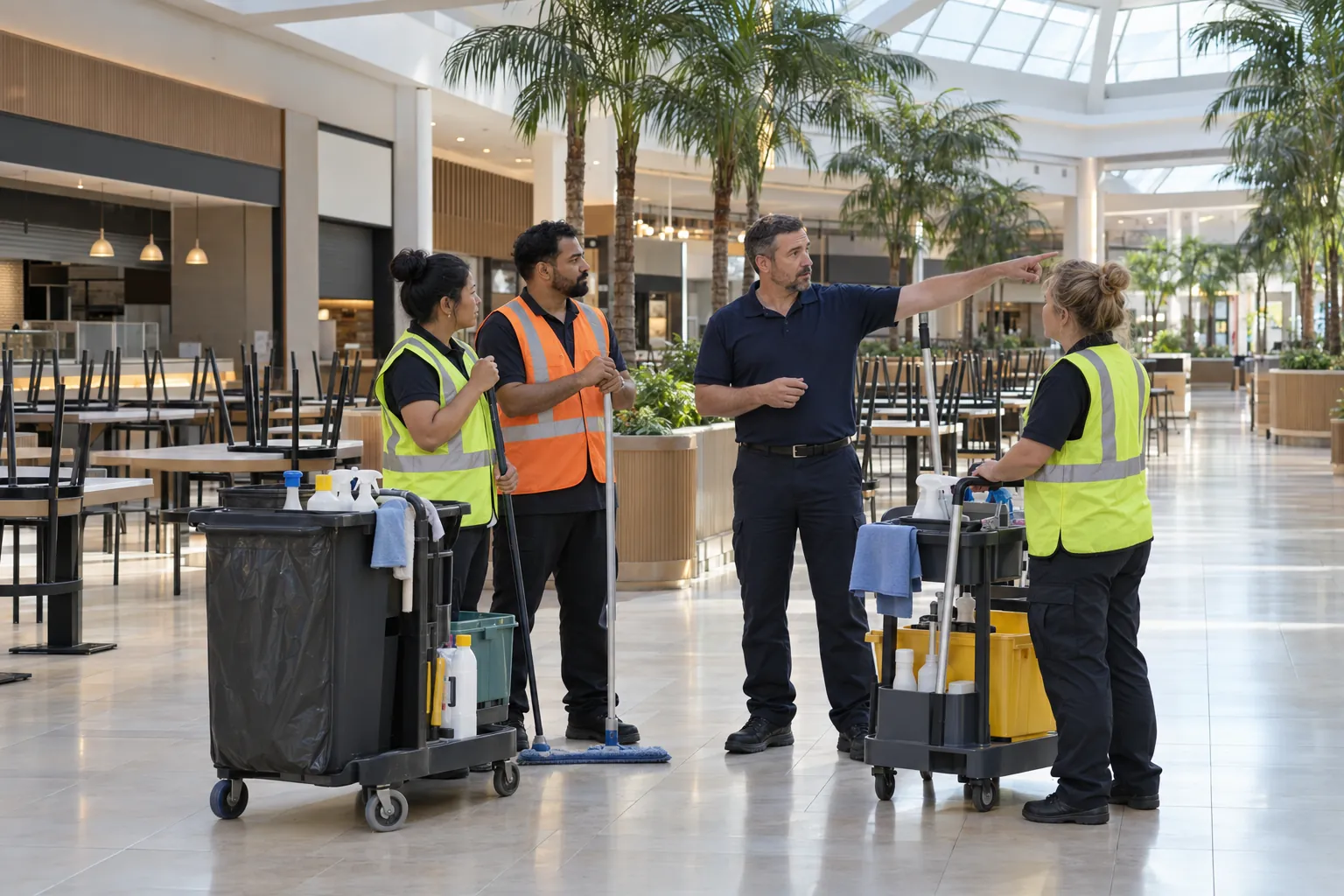
The job combines that leadership with WHS law (or OHS law in Victoria) and being the client's first point of contact, whether the service is commercial cleaning of offices or cleaning in hospitals, schools and shopping centres. This guide covers where the role sits in the Cleaning Services Award, the main duties, a typical shift, the safety side and the records a good supervisor keeps.
01
What a cleaning supervisor is, and where the duties come from
A cleaning supervisor is responsible for a team of cleaners on one site or across several: allocating the work, checking it is done to the standard in the contract, keeping the team safe and dealing with the client. The title varies. In contract cleaning you will see site supervisor, night supervisor, area supervisor and leading hand; in hospitals, hotels and universities the same job may be called cleaning services supervisor, housekeeping supervisor or team leader. On a small site the supervisor usually cleans alongside the team; on a large one it is a full-time management role.
For employers in the contract cleaning services industry, the role is described in the Cleaning Services Award 2020. Its classification definitions (Schedule A) set out three levels. A Cleaning Services Employee Level 2 may carry out "those roles expected of a leading hand", and clause 17.7 pays a leading hand allowance to an employee "placed in charge of other employees", at a rate that rises with the number of people in their charge. A Level 3 is expected to "co-ordinate the work of CSE 1s and CSE 2s and generally superintend the activity of all the building cleaners as a building supervisor or manager". Its indicative tasks include dealing with tenants or owners about the cleaning of the building and handling routine personnel, industrial relations or health and safety matters. The award covers contract cleaning employers; a cleaner employed directly by a school, hospital or council may be under a different award or an enterprise agreement, so check which instrument applies before relying on these definitions.
The safety duties behind the role sit mainly with the business, not the supervisor personally. Under section 19 of the Work Health and Safety Act 2011, the Commonwealth version of the model WHS Act, a person conducting a business or undertaking (PCBU) must ensure, so far as is reasonably practicable, the health and safety of its workers, including "the provision of any information, training, instruction or supervision that is necessary to protect all persons from risks to their health and safety". The states and territories that have adopted the model law carry the same wording in their own Acts. The supervisor is how that duty is met on the floor, and is also a worker with their own duties under section 28: to take reasonable care for their own health and safety, to take reasonable care that what they do or fail to do does not harm others, to comply, so far as they reasonably can, with the PCBU's reasonable instructions, and to co-operate with its reasonable health and safety policies and procedures.
Victoria has its own Occupational Health and Safety Act 2004 rather than the model WHS Act. WorkSafe Victoria's summary of OHS legal duties says employers must give employees "the necessary information, instruction, training or supervision to enable them to do their work in a way that is safe and without risks to health".
Most cleaning happens in a building someone else controls, so there is usually more than one duty holder. Section 46 of the WHS Act requires each person with a duty in relation to the same matter to consult, co-operate and co-ordinate activities with the others, so far as is reasonably practicable. In practice the cleaning supervisor is where the contractor's duties meet the building owner's and the facility manager's.
02
The main duties and responsibilities
Position descriptions vary by employer and sector, but a cleaning supervisor's main responsibilities usually include:
- Organising the work: allocating areas and tasks so the whole specification is covered in the hours available, including daily cleaning, amenities checks and periodicals such as carpet extraction, hard floor strip and seal, high dusting and window cleaning.
- Running the team: briefing cleaners, covering absences, dealing with lateness and performance, and helping the employer recruit and induct new starters.
- Training: showing new cleaners the methods, chemicals, equipment and site, and spotting when someone needs a refresher.
- Inspecting work: walking the building against the specification, and making sure anything missed is put right.
- WHS on the floor: making sure safe work procedures are followed, PPE is worn, wet floor signs go out, and incidents, hazards and near misses are reported.
- Equipment and consumables: keeping machines safe and working, ordering chemicals, paper and soap, and keeping the cleaners' store locked and tidy.
- Client liaison: being the first point of contact for the facility manager, building manager or centre management, taking requests and complaints and reporting back.
- Records: check sheets, inspection results, training and induction records, incident reports, and the handover to the next shift.
- Access and security: keys, swipe cards and alarm codes, locking up, and reporting anything found wrong with the building.
The setting shapes the job. In a hospital the supervisor works within infection prevention and control procedures; in a shopping centre the day shift is mostly reactive, with spills, food court tables and amenities through trading hours. In a school or childcare centre it means working around the day and the holidays, and around the children; see the childcare cleaning checklist. In an office tower it often means a night shift across many floors, with end of trip facilities and kitchens checked first thing.
03
What a typical shift looks like
Every site is different, but a supervisor's shift on a contract cleaning site often follows a pattern like this:
- Before the shift: check who is in and who is not, and how any gap will be covered; read messages from the client and the previous shift's handover.
- Briefing: a few minutes with the team covering changes, events in the building, faults reported and the areas that need extra attention today.
- During the shift: walk the building, check work in progress, help where the team is stretched, deal with spills and urgent requests, and answer building users.
- Scheduled checks: make sure the checks that happen through the day, such as amenities rounds, have actually happened; the end of trip facilities and toilets in a busy building may be checked several times a shift.
- Problems: report faults such as leaks, broken fittings or blocked toilets to whoever fixes them, and follow up those still open.
- End of shift: confirm what was done and record why anything was not, lock up, secure equipment and chemicals, and hand over anything outstanding.
04
Managing people and keeping them safe
Most of what makes a good supervisor is people management: teams are often casual, work unsocial hours and speak many first languages. The model WHS Regulations (regulation 39 in Queensland's version) require information, training and instruction to be suitable for the work and its risks and, so far as is reasonably practicable, given in a way that is readily understandable by the person receiving it, which for many cleaning teams means showing rather than handing over a document.
The safety side is where the supervisor carries most responsibility in practice:
- Chemicals: under the model WHS Regulations the PCBU must obtain the current safety data sheet (SDS) for each hazardous chemical and keep a register of hazardous chemicals, with the SDS, readily accessible to workers who use them (regulations 344 and 346 in the Queensland version). There is a narrow exemption for a consumer product used only in household quantities and in a way that is both consistent with household use and incidental to the work. For a cleaning team, whose work is using those chemicals, it will rarely apply, so treat each hazardous cleaning chemical as needing its SDS and a place on the register unless you have checked otherwise. The supervisor makes sure only approved chemicals are used, at the right dilution, in labelled containers, with the PPE the SDS calls for.
- Hazardous manual tasks: buckets, bins, trolleys, furniture and machines. Regulation 60 requires the risks of musculoskeletal disorders to be managed, having regard to posture, force, duration, frequency and the layout of the work.
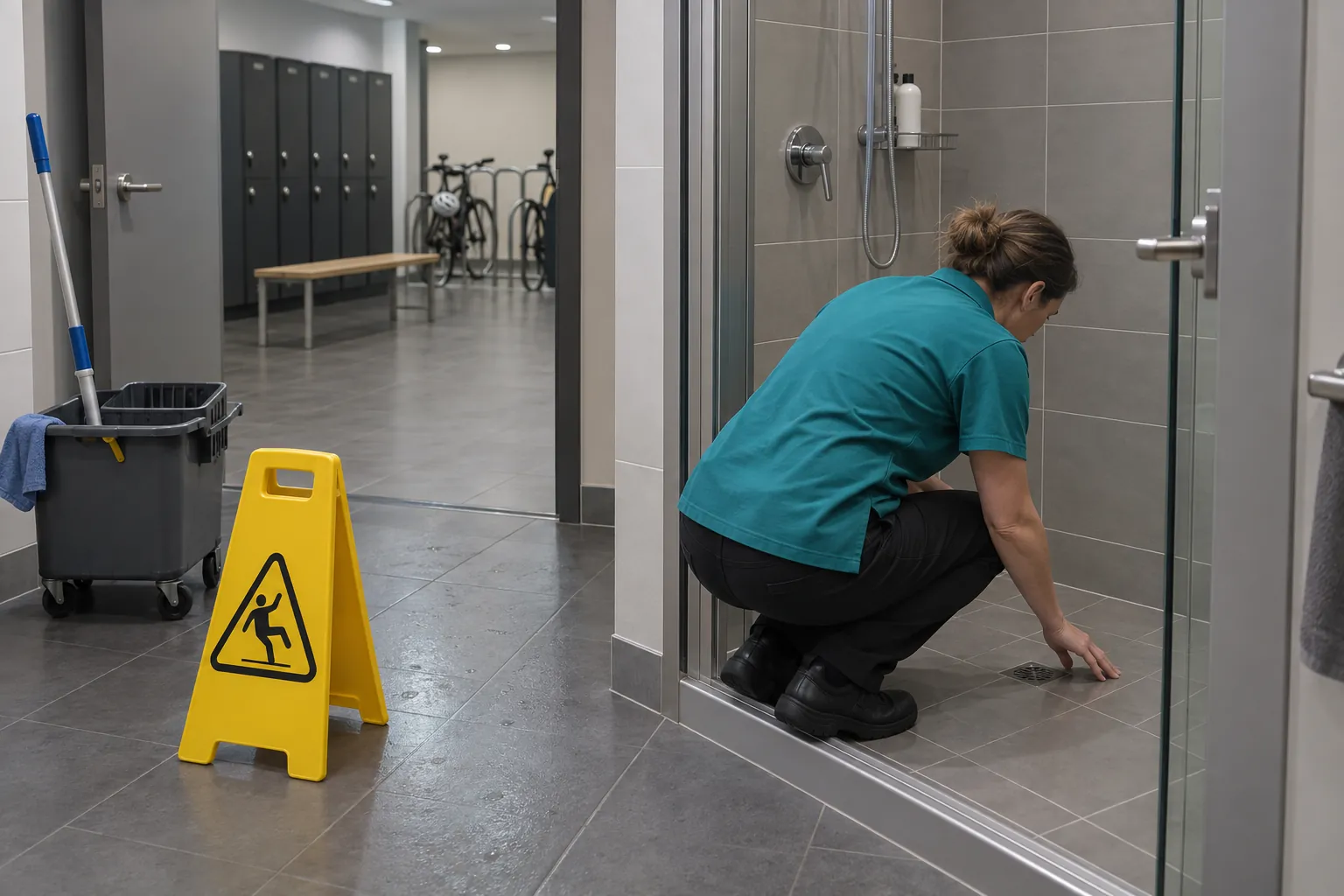
- Floors and slips: regulation 40 requires floors and other surfaces to be maintained so work can be done without risk. Wet floor signs go out, cords are managed, and spills are dealt with at once.
- Incidents and hazards: every injury, hazard and near miss is recorded and passed to the employer; see the hazard report form and near miss reporting.
- Checks for sensitive sites: schools, childcare centres, aged care and some hospitals require a working with children check, a police check or other screening under state or territory law before anyone starts. The supervisor makes sure nobody works on site until the client's requirements are met.
Supervisors also need to know the limits of the role. Pay, classifications, rosters, disciplinary decisions and hiring usually sit with the area manager or HR, and a good supervisor knows when to pass something up rather than handle it alone.
05
Checking the work and reporting to the client
Keeping the building clean is the point of the job, so the supervisor needs to know, at any time, whether the building is clean and whether the scheduled work was done. That takes two kinds of checking:
- Inspecting quality: regular inspections against the specification, sampling different areas and times, with failures put right and recorded. Many contracts add joint inspections with the client, often scored; see the cleaning contract guide for how these are usually set up.
- Confirming delivery: that each scheduled clean and check actually happened, when and by whom, and that anything missed is known and explained rather than found by the client.
The amenities are where both matter most. Regulation 41 of the model WHS Regulations requires a PCBU to provide adequate facilities for workers, including toilets, drinking water, washing and eating facilities, and to keep them in good working order and clean, safe and accessible. When the cleaning is contracted out, the client relies on the cleaning team for the "clean" part, and the supervisor's records are how both sides show it happened.
A short, honest report of what was done, what was missed and why, and what is still open is worth more than a long one that says everything went well. Clients rarely mind an explained gap; they mind finding it themselves.
06
Where the supervisor's record fails, and what SiteClara does about it
Much of a supervisor's day goes on finding out what has happened. Were the amenities checks done, or was the sheet on the back of the door initialled for the whole shift at the start? Did anyone report the leaking cistern on level 4, or was it mentioned to whichever cleaner was passing? Did the night cleaner reach the end of trip room? On paper, the end-of-day report is written from memory. When the facility manager asks what happened last Tuesday, the answer depends on who remembers.
SiteClara gives the supervisor that picture without the walk. Each location, such as an amenities block, a lift lobby or a car park level, has a printed QR poster, with an optional NFC tag behind it. Cleaners, enrolled in advance, scan or tap with their own phone, with no app to install, see the checks due there and mark each one done or say what stopped them, with a photo when the check asks for one. A problem can be reported at the same tag, and it goes onto the team's list of open jobs until someone closes it.
The supervisor sees what is due, done and missed, records the reason a check was missed from the company's own list, and works from a queue of open jobs grouped by building and floor, escalating a job to the building manager when it needs them. At the end of the day they review the checks and photos, add a note and approve the daily report, which goes to nominated client or management contacts the next morning, showing what was completed, what is still open and how the scheduled checks went.
07
Questions people ask
What do cleaning supervisors do?
They lead the cleaning team: allocating the work, checking it meets the standard in the specification, training and supervising cleaners, keeping the team safe and dealing with the client. The Cleaning Services Award 2020 describes its top classification, Cleaning Services Employee Level 3, as employees who "co-ordinate the work of CSE 1s and CSE 2s and generally superintend the activity of all the building cleaners as a building supervisor or manager", who are responsible for ensuring the quality of their work and who assist in on-the-job training (Schedule A, clause A.3).
How much do cleaning supervisors get paid?
For employers covered by the Cleaning Services Award 2020, the minimum depends on the classification. From 1 July 2026 a Cleaning Services Employee Level 3, the building supervisor level, has a minimum weekly rate of $1,119.10 for a full-time employee, or $29.45 an hour (clause 15.1, Table 2). An employee placed in charge of other employees also gets the weekly leading hand allowance in clause 17.7, which rises with the number in their charge: up to 10, 11 to 20, or more than 20. Casual employees get a 25% loading (clause 11.2), and work at the times and on the days in clause 20 attracts penalty rates. These are minimums, usually reviewed from 1 July each year, and an enterprise agreement or another award may apply instead, so check the current award before relying on a figure.
What skills are needed for a cleaning supervisor?
Practical cleaning experience, leadership, organisation, communication and a working knowledge of WHS. The nationally recognised CPP40421 Certificate IV in Cleaning, taken with its Cleaning Management specialisation, reflects the role of cleaning industry personnel who may be responsible for operational cleaning management, managing staff, providing quotations, planning and overseeing work and providing customer support. Its core units are organising and monitoring cleaning tasks, taking part in WHS hazard identification and risk control, writing simple documents and developing personal work priorities, and the Cleaning Management electives include supervising cleaning staff, leading and facilitating a team, conducting an induction and rostering staff.
08
Skills, training and further reading
Most cleaning supervisors come up from cleaner or leading hand, and employers look for practical cleaning experience, leadership, organisation, communication, reliability and the ability to supervise a team they may once have worked in. Useful training includes nationally recognised cleaning qualifications from a registered training organisation, a first aid course, and a WHS course for supervisors. Pay depends on the classification, the shift and the allowances, so read the current rates in the award itself.
Where to read the rules for yourself:
- the Cleaning Services Award 2020, for the classification levels and the leading hand allowance;
- the Work Health and Safety Act 2011 and your state or territory's own WHS Act and Regulations, such as Queensland's Work Health and Safety Regulation 2011;
- in Victoria, WorkSafe Victoria's page on the Occupational Health and Safety Act 2004 and Regulations 2017;
- your state regulator's page on notifying incidents, such as SafeWork NSW's incident notification page.
A good cleaning supervisor, at the end of each shift, can say:
- who was on site, and how any absence was covered;
- that every area in the specification was allocated to someone;
- which scheduled cleans and checks were done, and why any were not;
- what was inspected, what failed and what was put right;
- which faults were reported, to whom, and which are still open;
- that any incident, hazard or near miss was recorded and passed on;
- that chemicals, equipment, keys and swipe cards are secure;
- what the client has been told.
Sources
Every document this guide quotes or links to, in the order it first cites them.
- Cleaning Services Award 2020 awards.fairwork.gov.au
- Work Health and Safety Act 2011 legislation.gov.au
- Occupational Health and Safety Act 2004 legislation.vic.gov.au
- OHS legal duties worksafe.vic.gov.au
- Work Health and Safety Regulation 2011 legislation.qld.gov.au
- Incident notification safework.nsw.gov.au
- CPP40421 Certificate IV in Cleaning training.gov.au
- Occupational Health and Safety Act 2004 and Regulations 2017 worksafe.vic.gov.au
Related guides
 CleaningThe Cleaning Accountability Framework: certification, prequalification and the records behind themWhat the Cleaning Accountability Framework is, how CAF building certification and contractor prequalification work, and the records behind them.
 CleaningCommercial cleaning checklist: area by area, and how to know it is followedA commercial cleaning checklist for Australian offices and shared buildings, area by area, with the WHS duties behind it and how a supervisor checks it is followed.
 CleaningCleaning contracts in Australia: what to put in them, and how to know they are workingWhat an Australian commercial cleaning contract should cover, how the Cleaning Services Award and Fair Work Act shape it, and how to show the work was done.
 CleaningToilet cleaning checklist: what to check, how often, and how to make the record believableWhat a toilet cleaning checklist should cover in Australian workplaces, how often to check, the WHS and OHS duties behind it, and how to make the record believable.