Cleaning
Cleaning standards in Australia: a map, and how to choose
Cleaning standards in Australia come from several sources rather than one: work health and safety law requires every workplace and its facilities to be kept clean, and healthcare, aged care, childcare and food businesses have their own standards on top.
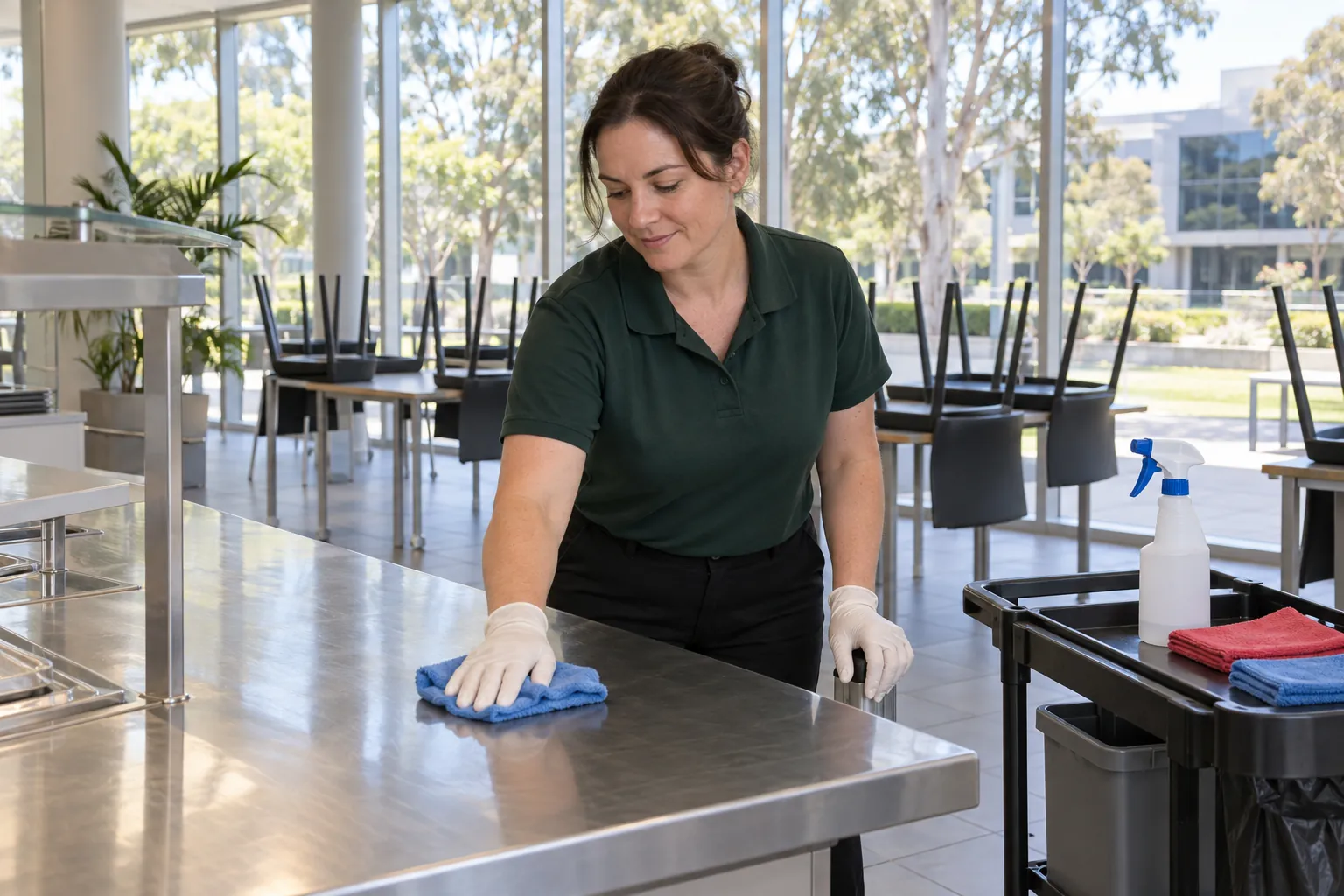
A hospital ward, an aged care home, a café kitchen, a school corridor and an office bathroom each answer to different rules, and most buildings answer to more than one. This guide maps the cleaning standards that exist in Australia, says who they apply to, and shows how to decide which should shape your own cleaning specification and audits.
01
What "cleaning standards" means in Australia
People use "cleaning standards" for three different things: the law that says a workplace must be kept clean, published standards and policies that say how clean, how often and how it is checked in a particular sector, and the contract standard written into a particular cleaning specification. It helps to keep them apart, because only the first applies to almost every building.
The legal floor is work health and safety law, and it is state and territory law. Most jurisdictions have adopted the model Work Health and Safety (WHS) laws, so the same duty appears in each state's own WHS Regulation. Safe Work Australia's model code of practice, adopted in NSW as the Managing the work environment and facilities code of practice, explains it: under the facilities regulation (regulation 41 in the model and NSW numbering) the person conducting a business or undertaking (PCBU) must provide adequate facilities for workers, including toilets, drinking water, washing and eating facilities, and "These facilities must be in good working order, clean, safe and accessible." The same code says "The work environment must be maintained so that it remains in a clean and safe condition."
Victoria is the exception to the model laws. There the duties sit in the Occupational Health and Safety Act 2004 and the OHS Regulations 2017, and WorkSafe Victoria's compliance code on workplace facilities and the working environment, published in December 2023, covers "how to maintain, clean and monitor workplaces". The code is not mandatory, but WorkSafe says a duty holder who complies with it will be considered to have complied with the duties it deals with.
Above that floor, the sector decides. Healthcare has national accreditation standards and state health department policies with risk categories and audit regimes. Aged care and early childhood education and care have their own quality frameworks and regulators. Food businesses have the Food Standards Code. Most offices, schools, shopping centres, car parks and strata common property have no sector standard at all, and their cleaning standard is whatever the client writes into the specification, often borrowing from the others.
02
The map of Australian cleaning standards
The standards and rules you are most likely to meet are:
- The National Safety and Quality Health Service (NSQHS) Standards, and in particular the Preventing and Controlling Infections Standard. Its Action 3.13 requires health service organisations to have processes to maintain a clean, safe and hygienic environment in line with the current edition of the Australian Guidelines for the Prevention and Control of Infection in Healthcare, published by the NHMRC, and jurisdictional requirements.
- State and territory health department policy, which turns Action 3.13 into rules for public hospitals and health services. NSW Health's Cleaning of the Healthcare Environment policy directive (PD2023_018) is a detailed example; Queensland Health publishes its guidance on cleaning of the healthcare environment, and the other states have their own.
- The Aged Care Quality Standards, against which the Aged Care Quality and Safety Commission assesses and audits registered providers; the Aged Care Rules 2025 provide for the grade a provider is given for conformance with them.
- The National Quality Framework for long day care, preschools and outside school hours care, which covers children's health and safety and the physical environment. See our guide to the childcare cleaning checklist.
- The Australia New Zealand Food Standards Code: Standard 3.2.2 on food safety practices, including cleanliness and the cleaning and sanitising of equipment; Standard 3.2.3 on food premises and equipment; and Standard 3.2.2A on food safety management tools, which adds records for some businesses.
- The WHS rules on hazardous chemicals, which govern the cleaning products themselves: a register of hazardous chemicals and a current safety data sheet (SDS) for each one.
- Labour and contracting standards, which say nothing about how clean a floor is but a great deal about how the cleaning is bought: the Cleaning Services Award and the Cleaning Accountability Framework, a certification scheme for fair labour standards in commercial buildings.
- The client's specification, which in most buildings is the cleaning standard in practice. See our guide to the cleaning contract.
03
Healthcare and aged care: the most developed standards
Healthcare has the most complete cleaning framework in Australia, and the one other sectors borrow from. The national layer is short. As NSW Health's policy sets it out, Action 3.13 requires processes that:
- respond to environmental risks, including novel infections such as COVID-19;
- require cleaning and disinfection using products listed on the Australian Register of Therapeutic Goods, consistent with the manufacturer's instructions for use and recommended frequencies;
- provide access to training on cleaning processes for routine and outbreak situations, and novel infections;
- audit the effectiveness of cleaning practice and compliance with the environmental cleaning policy;
- use the results of audits to improve environmental cleaning processes and compliance with policy.
The states fill in the detail. NSW Health's Infection Prevention and Control in Healthcare Settings policy directive (PD2023_025) requires each NSW Health organisation to have an environmental cleaning program managed by suitably qualified personnel and overseen by a committee or directorate, with a risk assessment for each functional area. PD2023_018 then groups every functional area into four risk categories, extreme, high, medium and low, which "reflect the frequency and intensity of cleaning required". High-touch surfaces such as bedrails, doorknobs, light switches and tap handles are cleaned more often than low-touch surfaces such as floors and walls, and bathroom and toilet cleaning frequency "must be appropriate for the number of people using them". For routine cleaning the policy recommends a neutral detergent and water, and keeps disinfectants for extreme risk areas, outbreaks, terminal cleaning after a multi-resistant organism or infectious disease, and toilets.
Audits follow the same categories. Under PD2023_018, every functional area has a minimum acceptable quality level (AQL) and a minimum audit frequency:
- Extreme risk: at least half the rooms audited each month and all rooms every two months, with an AQL of 90%.
- High risk: at least half the rooms every two months and all rooms every four months, AQL 88%.
- Medium risk: at least half the rooms every three months and all rooms every six months, AQL 85%.
- Low risk: all rooms once a year, AQL 80%.
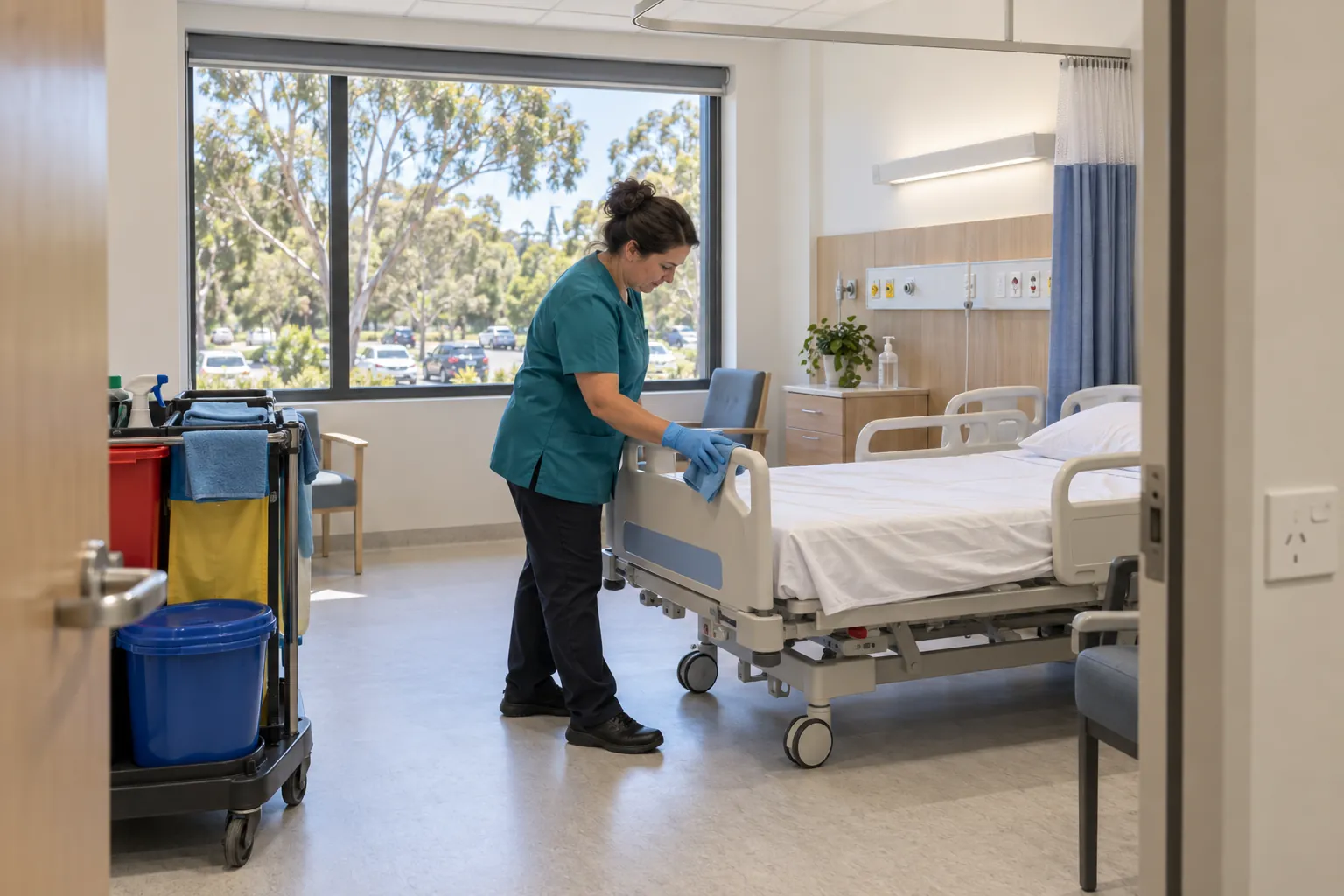
Extreme and high-risk areas must also be externally audited at least every two years, and a health organisation that uses an external cleaning provider remains responsible for making sure the audits happen. Queensland Health's guidance makes the same point about risk from another angle: the environment should be cleaned daily as routine cleaning or on a schedule as periodic cleaning, with the risk assessment taking in local prevalence of multi-resistant organisms, the type of clinical area, the patient population and any outbreak. Our guide to hospital cleaning standards goes further into who does what and how audits are run.
Aged care homes are assessed against the Aged Care Quality Standards, so take what they ask of the environment and infection prevention from the Aged Care Quality and Safety Commission's current guidance. The healthcare approach, scaled to a home, is a sound model: risk categories, set frequencies and regular audits.
04
Food areas, chemicals and everyday buildings
Food areas. A café, a staff canteen, a school tuckshop or a food court is a food business under the Food Standards Code. Standard 3.2.2, Food Safety Practices and General Requirements, says in clause 19 that a food business must maintain food premises "to a standard of cleanliness where there is no accumulation of" garbage (except in garbage containers), recycled matter, food waste, dirt, grease or other visible matter, and must keep fixtures, fittings and equipment free of an accumulation of food waste, dirt, grease or other visible matter. Clause 20 requires eating and drinking utensils to be in a clean and sanitary condition immediately before each use, and food contact surfaces whenever food that will touch them is likely to be contaminated. A "clean and sanitary condition" means clean and then treated with heat, chemicals or other processes, so that microorganisms are reduced to a level that does not compromise the safety of the food or permit the transmission of infectious disease.
Since December 2023, Standard 3.2.2A has added food safety management tools for food service, catering and retail businesses that handle unpackaged, potentially hazardous, ready-to-eat food. As FSANZ's guide explains, a category one business, such as a restaurant or caterer, must keep a record that substantiates, among other things, its compliance with clause 20 on cleaning and sanitising, unless it can show compliance in another way an authorised officer accepts. FSANZ's Safe Food Australia, its guide to the food safety standards, includes templates, and its page on cleaning and sanitising gives practical methods. Local councils and state food authorities enforce.
Cleaning chemicals. The WHS rules on hazardous chemicals apply to cleaning products too. NSW's version of the model Managing risks of hazardous chemicals in the workplace code of practice explains that a PCBU must keep a register of hazardous chemicals, with the current SDS for each, and make the SDS readily accessible to workers who use them. It also warns that domestic cleaning chemicals bought from a supermarket may need an SDS when they are used at work in a way or quantity not consistent with home use.
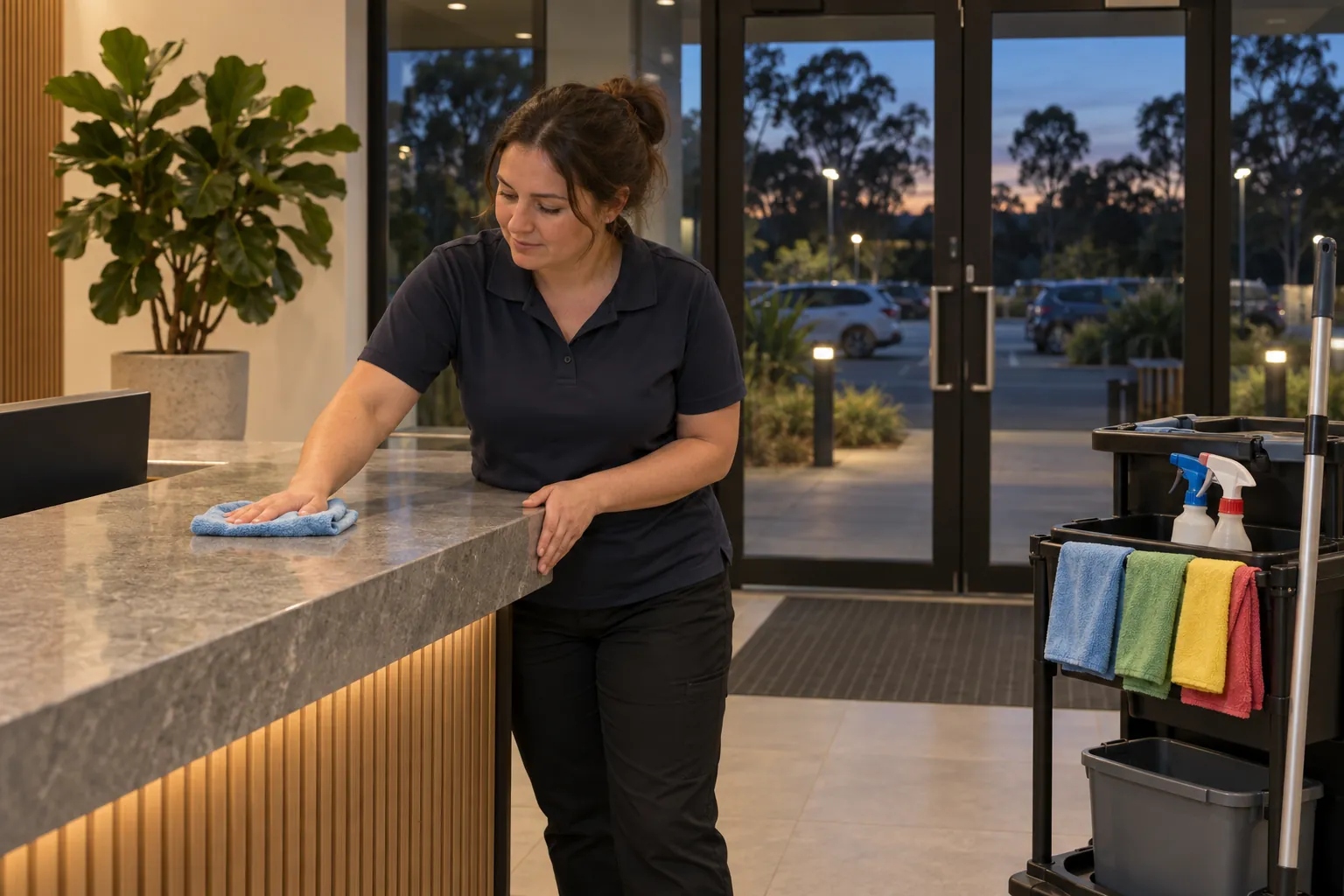
Offices, schools, shopping centres and strata common property. Here the legal standard is the WHS or OHS duty, and the working standard is the specification. The model code gives a useful starting point: workplaces and facilities "should be cleaned regularly taking into account the type of work performed, the likelihood of contamination, the number of workers using them" and the type of facility, and consumables such as soap and toilet paper "should be replenished regularly". Broken or damaged furniture, fixtures and fittings "should be replaced or repaired promptly". The best specifications borrow the healthcare idea of risk: bathrooms, kitchens, entries, lifts and high-touch surfaces cleaned and checked more often than low-risk areas such as storerooms. See our commercial cleaning checklist for a working list.
05
Choosing which cleaning standards apply to you
Work through the building area by area, not as a whole, because one site often carries several regimes. A private hospital with a public café and a staff car park has at least three.
- Start with the law. Identify which state or territory's WHS Regulation applies, or Victoria's OHS Act and Regulations, and record how you meet the facilities duty and the hazardous chemicals rules.
- Identify regulated activity. Public health services follow NSQHS Action 3.13 and their state's cleaning policy. Aged care follows the Aged Care Quality Standards. Early childhood education and care follows the National Quality Framework.
- Find the food areas. Kitchens, servery counters, tuckshops and food stores follow the Food Standards Code, whoever cleans them. Check whether the food business is category one under Standard 3.2.2A, because then cleaning and sanitising must be substantiated.
- Check the contract. A client, landlord, strata committee or government buyer may require a named policy, CAF certification, trained staff or a particular audit method.
- Set the rest by risk. Group the remaining areas into a few risk levels, give each a frequency and a standard someone can inspect, and write it into the specification.
- Decide how it will be measured. Audits for quality, records for delivery, and a small set of measures to report, agreed before the contract starts rather than argued about after it.
Borrowing is fine and often wise. An office that adopts the healthcare logic of risk categories and audit frequencies, scaled down, will usually have a clearer standard than one that says "clean to a high standard" and leaves it there. Check every frequency against your own building before adopting it: a template written for a hospital will overclean a storeroom and underclean a busy bathroom in a shopping centre.
06
Where standards fail in practice, and where SiteClara fits
Every standard on the map assumes the work was done as scheduled. Audits then sample the result, and in a low-risk area that might be once a year. The weak link is the gap between the two: the bathroom check that should happen every two hours, the high-touch surfaces wiped twice a day during an outbreak, the kitchen cleaning schedule initialled at the end of the shift for the whole day. When an auditor, a client or an infection prevention lead asks whether the frequency was met, the answer is often a sheet filled in afterwards, or someone's word.
SiteClara records the scheduled checks as they happen. A printed QR poster at each location, with an optional NFC tag behind it, lets cleaning staff confirm a check with a scan or a tap on their own phone, with no app to install. They see what is due there and mark it done, with a photo when the check asks for one, or say what stopped them. A fault, such as a broken dispenser or a leaking tap, can be reported from the same tag and stays on the team's list of open jobs until someone closes it. The supervisor sees what is due, done and missed, records the reason for a miss, and approves a daily report that goes to the client or management the next morning, showing what was completed and what is still open.
07
Questions people ask
Is there an Australian standard for commercial cleaning?
Not a single one. For offices, shops and other commercial buildings the legal standard is the work health and safety duty, and the detail is set in the cleaning specification. SafeWork NSW's Code of Practice: Managing the work environment and facilities, based on Safe Work Australia's model code, says facilities "must be clean, safe, accessible and in good working order", and that workplaces and facilities "should be cleaned regularly taking into account the type of work performed, the likelihood of contamination, the number of workers using them" and the type of facility.
What is the difference between cleaning and sanitising?
Food Standards Australia New Zealand's page on cleaning and sanitising puts it simply: "Cleaning is removing general dirt, grease and food waste. Sanitising destroys microorganisms." It adds that items must be cleaned before they are sanitised.
What are the steps for manual cleaning and sanitising?
FSANZ's page on cleaning and sanitising sets them out: pre-clean by scraping or wiping off food scraps and rinsing with water; wash with hot water and detergent to remove grease and food residue, soaking if needed; rinse off the detergent; then sanitise, for example in very hot water at 77°C for 30 seconds, in diluted bleach, with a commercial sanitiser used to the manufacturer's instructions, or in a dishwasher that can sanitise. It says air-drying is best, that diluted bleach should be thrown away after 24 hours, and that a dishwasher should be unpacked with clean hands.
What cleaning standards apply to healthcare facilities?
Health services are accredited against the NSQHS Standards, and each state health department sets its own cleaning policy. In NSW, every NSW Health organisation must implement routine environmental cleaning programs under the Cleaning of the Healthcare Environment policy directive (PD2023_018), which sets risk categories, cleaning frequencies and audit levels, and says "All health workers are responsible for maintaining a safe and clean environment." For routine cleaning it recommends a neutral detergent and water, with disinfectants kept for extreme risk areas, outbreaks, terminal cleaning after a multi-resistant organism or infectious disease, and toilets.
08
Further reading, and a list to take away
The primary sources are the NSQHS Standards and the Australian Guidelines for the Prevention and Control of Infection in Healthcare, both available from the Australian Commission on Safety and Quality in Health Care; your state's health department cleaning policy, such as NSW Health's PD2023_018; the Aged Care Quality and Safety Commission's guidance on the Aged Care Quality Standards; the Food Standards Code and FSANZ's Safe Food Australia; and Safe Work Australia's model codes of practice, or WorkSafe Victoria's compliance codes in Victoria, through your state regulator.
To settle which cleaning standards apply:
- list every area and its use, not just the building type;
- note the law that applies to each: WHS or OHS, hazardous chemicals, food, aged care, childcare or healthcare;
- use the current version of any policy or standard, not a summary of an old one;
- group the remaining areas by risk and set frequencies accordingly;
- write the cleaning procedures and an inspectable standard for each area into the specification;
- keep a chemicals register and a current SDS for every hazardous cleaning product;
- agree how quality is audited and how delivery is recorded;
- review the choice when the building's use changes.
Sources
Every document this guide quotes or links to, in the order it first cites them.
- The Managing the work environment and facilities code of practice safework.nsw.gov.au
- Occupational Health and Safety Act 2004 legislation.vic.gov.au
- Compliance code on workplace facilities and the working environment worksafe.vic.gov.au
- Cleaning of the Healthcare Environment policy directive (PD2023_018) www1.health.nsw.gov.au
- Its guidance on cleaning of the healthcare environment health.qld.gov.au
- Aged Care Rules 2025 legislation.gov.au
- Infection Prevention and Control in Healthcare Settings policy directive (PD2023_025) www1.health.nsw.gov.au
- Standard 3.2.2, Food Safety Practices and General Requirements legislation.gov.au
- Safe Food Australia foodstandards.gov.au
- Its page on cleaning and sanitising foodstandards.gov.au
- Managing risks of hazardous chemicals in the workplace code of practice safework.nsw.gov.au
- Cleaning of the Healthcare Environment policy directive (PD2023_018) www1.health.nsw.gov.au
Related guides
 CleaningHospital cleaning standards in Australia: what is cleaned, how often, and how it is checkedHospital cleaning in Australia: NSQHS Action 3.13, risk categories, cleaning and audit frequencies, acceptable quality levels, and the record that shows it was done.
 CleaningCommercial cleaning checklist: area by area, and how to know it is followedA commercial cleaning checklist for Australian offices and shared buildings, area by area, with the WHS duties behind it and how a supervisor checks it is followed.
 CleaningCleaning contracts in Australia: what to put in them, and how to know they are workingWhat an Australian commercial cleaning contract should cover, how the Cleaning Services Award and Fair Work Act shape it, and how to show the work was done.
 CleaningThe Cleaning Accountability Framework: certification, prequalification and the records behind themWhat the Cleaning Accountability Framework is, how CAF building certification and contractor prequalification work, and the records behind them.