Cleaning
Graffiti removal: who must do it, how fast, and how to do it safely
In Canadian cities, graffiti removal is the property owner's job: municipal by-laws such as Toronto Municipal Code Chapter 485 require the owner or occupant to keep a property free of graffiti vandalism, and the city can order it removed, do the work itself and recover the cost through the property tax bill.
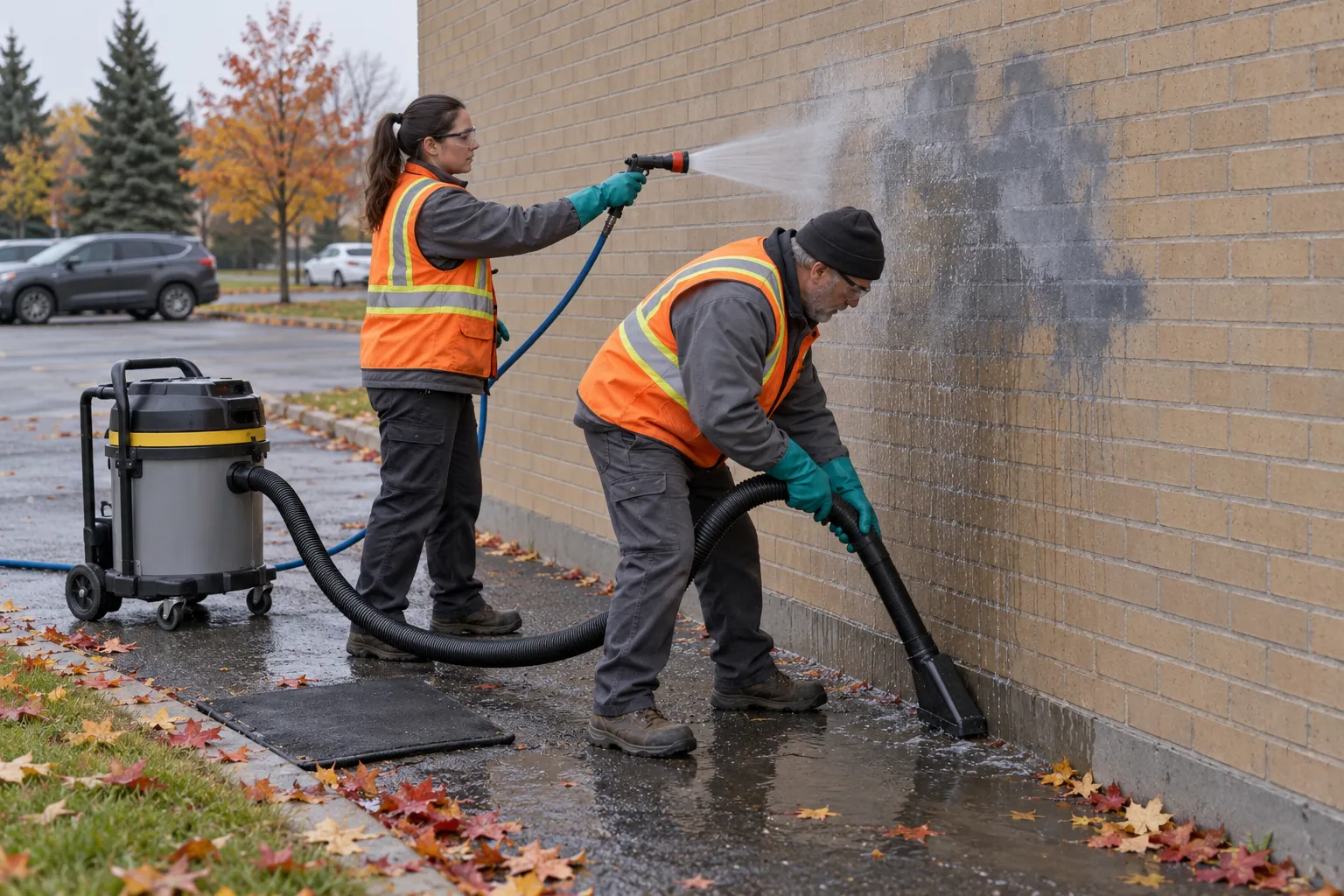
The rules are set city by city, so the deadline, the exemptions and the penalties differ between Toronto, Ottawa, Calgary and everywhere else. The method is up to the owner, and a hasty one can scar a wall for good. This guide covers who is responsible under the by-laws, what counts as graffiti, how to remove it from brick and other surfaces without damage, the WHMIS and runoff rules for the chemicals, and the procedure and record a property manager should keep.
01
Who is responsible for graffiti removal
The duty to remove graffiti from a building comes from municipal by-laws, and in the large cities they follow one pattern: the owner or occupant must keep the property free of graffiti, an officer can give written notice to remove it, and if the notice is ignored the city can do the work and charge the owner. The details differ:
- Toronto. Toronto Municipal Code Chapter 485, Graffiti (By-law 1218-2011) says in section 485-3B: "The owner or occupant of property shall maintain the property free of graffiti vandalism." An officer's notice sets a time to comply "no sooner than 72 hours after the notice is given" (section 485-4A). If it is ignored, the City may enter, do the work and add its costs "to the tax roll" (section 485-7), and a conviction carries a fine of up to $5,000.
- Ottawa. The City of Ottawa's Graffiti Management By-law No. 2008-01 says in section 5: "No owner of property shall fail to maintain such property free of graffiti." The notice period is "no sooner than 7 calendar days after the notice is given" (section 6), after which the City may enter and carry out the work (section 11) and recover the cost by legal action or on the tax roll (section 12).
- Calgary. The Community Standards Bylaw 32M2023, which replaced Bylaw 5M2004, says in section 19(2): "Every owner or occupier of a Premises shall ensure that Graffiti placed on their Premises is removed, painted over, or otherwise blocked from public view." Failing to comply with a remedial order within the time it sets is itself an offence.
Not every city works this way. The City of Winnipeg's graffiti control page does not set out an owner's deadline; it offers its "free, year-round graffiti removal service" to owners who complete a waiver form, and lists its removal equipment as "soda blasters, pressure washers, paint sprayers, and chemical wipes and sprays." Read your own city's by-law before assuming either model.
"Owner" is wider than the name on the title. Toronto's chapter includes "the person for the time being managing or receiving the rent," whether for themselves "or as agent or trustee of any other person," and treats as an occupant a lessee who, "under the terms of a lease, is required to repair and maintain the property." Ottawa's definitions read the same way. So a property manager collecting rent for a client, or a commercial tenant responsible for exterior upkeep, can be the person the notice is addressed to. The lease and the janitorial or maintenance contract should say who removes graffiti, and how fast.
02
What counts as graffiti, and what the by-laws leave out
Toronto's Chapter 485 defines graffiti vandalism as deliberate markings, not exempted or regularized, that were made without the owner's permission, are a tag ("a stylized signature or logo that is intended to identify an individual or group"), may incite hatred or violence against a person or identifiable group, or contain "profane, vulgar or offensive language." Ottawa's definition covers letters, symbols, etchings, figures, inscriptions or stains that disfigure or deface a property, and Calgary's includes "stickers applied, scribbled, scratched, etched, sprayed or attached," so stickers and scratched glass count there too. What is left out matters as much:
- Murals and approved art. Toronto leaves out an art mural or graffiti art that the City has exempted or regularized; the owner's approval alone is not enough. An owner, a BIA or a community group can apply to have a piece regularized (section 485-6), and an owner who receives a notice can ask, within the notice period, for the City's Graffiti Panel to review it as graffiti art or an art mural. An approved piece is registered and must be "maintained in a state of good repair" to stay exempt. Ottawa excludes permitted mural signs, and Calgary a sign with a development permit.
- Interior spaces. Neither Toronto's chapter nor Ottawa's by-law applies to an interior space. Graffiti in a washroom or stairwell is still a cleaning job, and someone has to clean it, but it is not usually what a graffiti notice is about.
- Vehicles. Calgary's definition leaves out vehicles; Toronto's definition of property includes them, and fences.
Hate graffiti is handled faster. Under section 485-4F, where graffiti "may incite hatred or violence against any person or identifiable group," the City may remove it before giving notice, at its own cost. The City of Toronto's Graffiti and Postering page tells owners that "Graffiti must be removed within 72 hours" and "Hate or gang-related graffiti must be removed within 24 hours," and asks that hate or gang-related graffiti be reported to the Toronto Police Service. Photograph it before removing it: once it is gone, the photograph is the evidence.
03
How to remove graffiti from brick, concrete and painted walls
The Standards and Guidelines for the Conservation of Historic Places in Canada, which Parks Canada calls "the benchmark for heritage conservation practice in Canada," sets the rule for any wall worth keeping. Its Standard 7 says: "Use the gentlest means possible for any intervention." With graffiti, the fastest methods are often the most damaging. A sound routine:
- Record it. Photograph the graffiti with the date and where it is on the building, and note any city notice number.
- Identify the surface. Spray paint on painted metal is a different job from marker on porous brick, limestone or unsealed concrete, where pigment soaks into the pores.
- Repaint a painted surface. Matched paint over the patch is often the simplest fix. Winnipeg's graffiti control page notes that its service uses a paint matcher to prevent patchy paint jobs, and tells anyone painting over a tag to choose a top line and cover the wall "down to the ground" rather than patching just the tag.
- Test on bare masonry. Try the graffiti remover on a small, out-of-sight area, follow the manufacturer's instructions and dwell time, and record what worked on that wall.
- Start gentle. Water and a mild detergent, then a remover chosen for the surface. Alberta's Historic Resources Management Branch, in Dealing with Graffiti at Historic Places, says "Specially formulated chemical paint strippers have a long track record of successful spray paint removal from historic sites," with the product chosen for the material.
- Rinse and check. Rinse at low pressure, collect the runoff, and look again in daylight once the wall is dry for any residue or shadow of the tag.
- Call a specialist for professional graffiti removal on heritage buildings, polished stone, glass and anything a tested method will not shift.
The Alberta post is blunt about the shortcuts. Sandblasting, soda and other grit blasting "are go-to methods for quick graffiti removal even today," but they cause permanent pitting and more moisture absorption, and "High-pressure powerwashing can leave pitting similar to sandblasting." Acidic cleaners can etch granite and glass and damage lime mortar. On a designated heritage property, ask the municipal or provincial heritage staff first; the post suggests agreeing a tested method in advance, before the next tag appears.
04
Graffiti remover safety: WHMIS, respirators and runoff
Graffiti removers are solvents, strippers and strong cleaners, and at work they are hazardous products under WHMIS, the Workplace Hazardous Materials Information System. CCOHS's WHMIS general information page explains that WHMIS is regulated in the workplace "by the provinces, territories and federal (for federally regulated workplaces) governments under their occupational health and safety legislation." Employers must "Educate and train workers on the hazards and safe use of products," "Provide access to up-to-date safety data sheets to workers" and "Prepare workplace labels, as needed."
In Ontario the rules are in R.R.O. 1990, Regulation 860, Workplace Hazardous Materials Information System (WHMIS). Section 7 requires workers to be instructed in labels, safety data sheets and "procedures for the safe use, storage, handling and disposal of a hazardous product." Section 10 requires a workplace label when a product is transferred from the supplier's container to another, such as remover decanted into a spray bottle, unless the portable container is used only by the worker who filled it, during that shift, with its contents clearly identified, or is all needed for immediate use. Section 17 requires a supplier safety data sheet for each hazardous product. Other provinces have their own WHMIS rules on a common model.
Solvent vapour in a stairwell or parking garage is a breathing hazard. CCOHS's page on respirator selection says respirators are for when other controls, such as substitution or ventilation, "cannot be implemented or are not fully effective," and that "Employers should have a written respiratory protection program," including fit testing, referring to CSA Standard Z94.4, Selection, Use, and Care of Respirators. The safety data sheet says which gloves, eye protection and respirator the product needs.
Plan where the rinse water goes. Dissolved paint washed into a catch basin goes straight to a creek or the lake. In Toronto, section 681-4 of Toronto Municipal Code Chapter 681, Sewers forbids discharging into a storm sewer anything with a "visible film, sheen or discolouration," or containing combustible liquids or hazardous waste chemicals. Cover nearby drains, collect the runoff with absorbent or a wet vacuum, and dispose of it as the safety data sheet and your municipality direct.
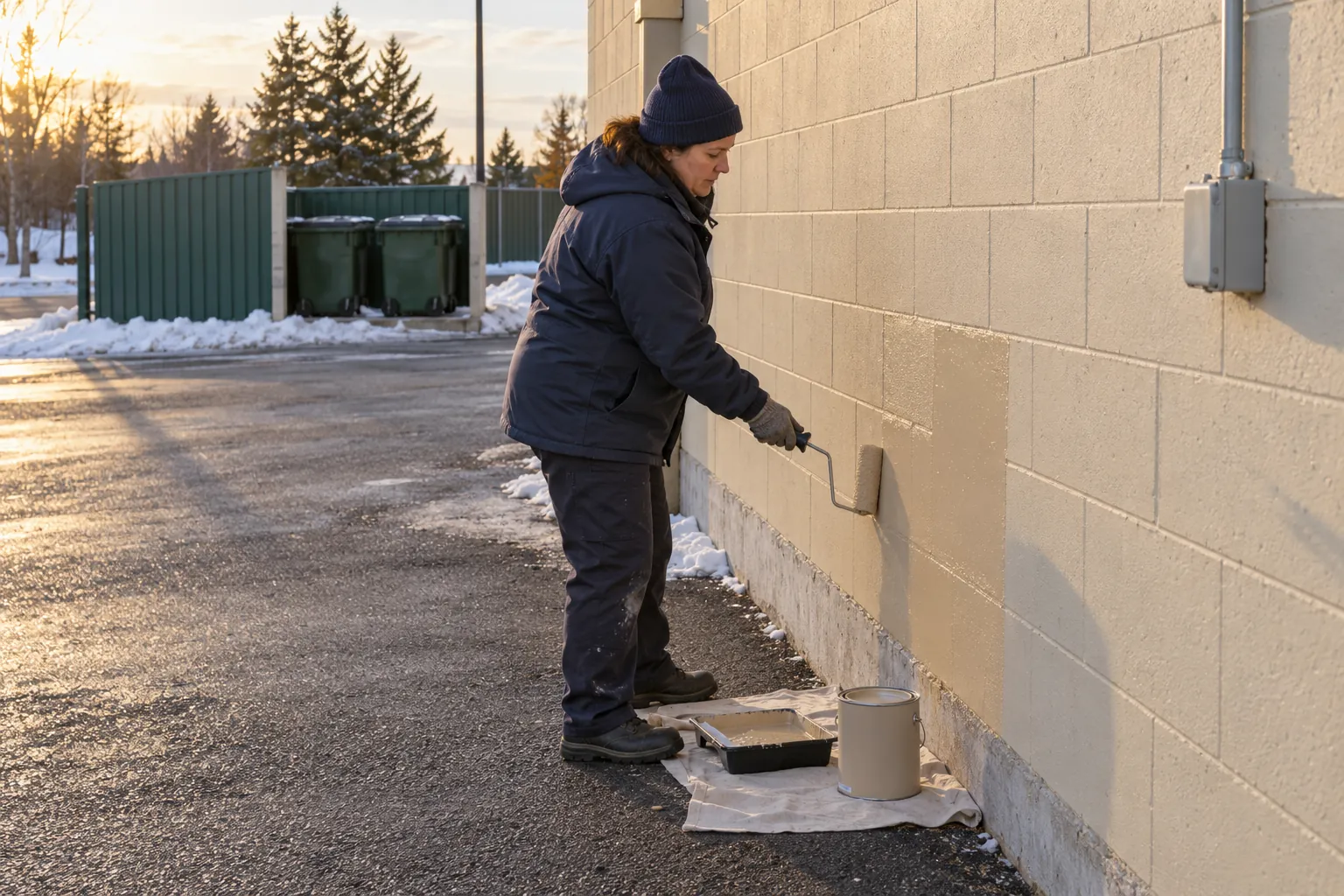
05
A graffiti removal procedure, and how fast to act
A city's notice period is the latest the work can be done, not the target. The Alberta post notes that "the possibility of follow-up or copycat attacks and, in some cases, local bylaw requirements all urge timely actions to remove graffiti," and Winnipeg's page says: "if you remove it again within 24 hours, taggers most likely will become discouraged and move on."
A written graffiti removal procedure, kept with the janitorial scope of work or the building's operations manual, should answer:
- Who looks for it: which custodial rounds, security patrols or building operator walks take in the exterior walls, loading dock, parking garage and garbage enclosure, where tagging tends to recur, and how tenants report new tags.
- Who removes it, and by when: the in-house cleaning crew for painted surfaces and fresh marker, a specialist for bare masonry, heritage surfaces and glass; within 24 hours for anything hateful or offensive, and a set number of business days for the rest.
- Who receives city notices, and how a notice and its deadline reach the person who books the work.
- Methods by surface: what has been tested on each wall, the paint colours to match, and what is ruled out, such as grit blasting on brick.
- Products and safety: approved graffiti removal products, their safety data sheets, workplace labels, PPE, and how runoff is collected.
- Records: a before photograph, when it was found, who removed it and when, an after photograph, and any police report or notice number.
Prevention belongs in the same procedure. To protect a building, Toronto's Graffiti and Postering page suggests lighting and security cameras, fencing, vines against walls, dark paint or anti-graffiti coatings, and a legal mural, for which funding may be available through its StreetARToronto program. The Alberta post warns that "so-called graffiti repellent coatings" need to be "investigated and evaluated for their effectiveness and possible impacts," so test one before coating a whole wall. A wall hit every few weeks shows up in the record, which is the evidence a property manager needs to justify a coating, a light or a camera.
06
Where the graffiti record fails, and what SiteClara does about it
Graffiti removal usually fails between people, not chemicals. The security guard notices a fresh tag on the night patrol and writes it in the notebook; the property manager reads about it days later, if at all; the janitorial crew never hears; and the first anyone knows is a by-law notice with its deadline already running. Even when the tag is cleaned, nobody can say when, by whom, or that the same wall was hit three times last month.
SiteClara records the work where it happens. A printed QR code poster, with an NFC tag behind it if staff would rather tap than scan, sits at each point on a patrol or custodial round: a main entrance, the loading dock, a parking garage stairwell, a rear wall. The guard, custodian or cleaner scans the code or taps the tag on their own phone, with no app to install, and marks the checks due there done. If they find graffiti, they report it there with a photograph, and it goes onto the team's list of open jobs, with their name and the time, until someone closes it.
A supervisor sees what is open, done and missed, and the daily report they approve goes to the nominated property manager or client contacts the next morning: what was reported, what was completed and what is still open. Over weeks, the same wall turning up again is visible in the record.
07
Questions people ask
Who is responsible for graffiti removal on private property?
The property owner, or an occupant whose lease makes them responsible for upkeep, under the city's by-law. Toronto Municipal Code Chapter 485 says "The owner or occupant of property shall maintain the property free of graffiti vandalism," and its definition of owner includes whoever manages the property or receives the rent.
How long do I have to remove graffiti after a notice?
As long as the notice says, within each city's minimum. In Toronto the period is no sooner than 72 hours after the notice is given; in Ottawa, under Graffiti Management By-law No. 2008-01, no sooner than 7 calendar days. After that the city may do the work and recover the cost from the owner.
Will the city remove graffiti for free?
Some will. The City of Winnipeg's graffiti control page offers a free, year-round removal service to owners who complete a waiver form, and the City of Calgary's page on bylaws related to graffiti mentions a Private Graffiti Abatement Program to assist private property owners who are victims of graffiti. Ask your own city through 311.
How do I report graffiti?
To your city, and to the police where it is a crime. The City of Toronto's Graffiti and Postering page says to report graffiti on City roads, sidewalks, bridges and parks online or through 311, to report hate or gang-related graffiti to the Toronto Police Service, and to call 911 if graffiti is being made at that moment. Calgary's page also points to 311 when the graffiti is not in progress.
Is graffiti illegal in Canada?
Graffiti made without the owner's permission can be a crime as well as a by-law matter. Section 430 of the Criminal Code, Mischief covers anyone who wilfully "destroys or damages property," and where the property is worth $5,000 or less it can be prosecuted as an indictable offence carrying up to two years in prison, or on summary conviction. Winnipeg's graffiti control page tells owners to report graffiti vandalism to police as damage or mischief to property.
08
Further reading, and a list to take away
Start with your own city's by-law: in Toronto, Chapter 485, Graffiti; in Ottawa, By-law No. 2008-01; in Calgary, section 19 of the Community Standards Bylaw 32M2023. For older walls, read The Standards and Guidelines for the Conservation of Historic Places in Canada and Alberta's Dealing with Graffiti at Historic Places. For the chemicals, CCOHS's WHMIS general information page and your province's WHMIS regulation. Before the next tag appears, check that:
- you know your city's by-law, its notice period and who receives its notices;
- leases and contracts say who removes graffiti, and how fast;
- patrols and custodial rounds take in the walls and corners that get hit;
- graffiti is photographed before it is cleaned, and hate graffiti is reported to the police;
- each surface has a tested method and matched paint, with grit blasting and high pressure ruled out on masonry;
- removers have safety data sheets, decanted products have workplace labels, and the crew is trained on both;
- runoff is kept out of storm drains;
- each removal is recorded with who, when and an after photograph, and walls hit repeatedly are reviewed.
Sources
Every document this guide quotes or links to, in the order it first cites them.
- Toronto Municipal Code Chapter 485, Graffiti toronto.ca
- Graffiti Management By-law No. 2008-01 ottawa.ca
- Community Standards Bylaw 32M2023 calgary.ca
- City of Winnipeg's graffiti control page legacy.winnipeg.ca
- Graffiti and Postering page toronto.ca
- The Standards and Guidelines for the Conservation of Historic Places in Canada parks.canada.ca
- Dealing with Graffiti at Historic Places albertashistoricplaces.com
- WHMIS general information page ccohs.ca
- R.R.O. 1990, Regulation 860, Workplace Hazardous Materials Information System (WHMIS) ontario.ca
- Respirator selection ccohs.ca
- Toronto Municipal Code Chapter 681, Sewers toronto.ca
- City of Calgary's page on bylaws related to graffiti calgary.ca
- Criminal Code, Mischief laws-lois.justice.gc.ca
Related guides
 CleaningParking garage cleaning: the routine, the spring wash and the recordCleaning an underground parking garage or parkade in Canada: the OHS, fire code and by-law duties, a daily to yearly routine, the spring salt wash and the record.
 Premises and facilities managementWHMIS labels: the supplier label, the workplace label and the SDS beside themWHMIS supplier and workplace labels explained: what each must show, when a decanted spray bottle needs one, how SDSs are kept, and the provincial rules.
 Security patrolsSecurity patrols in Canada: what they are, how to run them and what they should proveWhat a security patrol is in Canada: the licence behind it, foot, mobile and remote patrols, what to check, how often, and the record a property manager should see.
 Premises and facilities managementProperty manager duties in Canada: licensing, legal duties and the daily recordWhat a property manager does in Canada: provincial licensing, the owner's duties under occupiers', tenancy and fire law, the daily work and the records.