Premises and facilities management
Property manager duties in Canada: licensing, legal duties and the daily record
A property manager's duties are to lease the units and deal with the tenants, collect the rent and pay the building's expenses, hire and check the contractors, keep the property in repair and safe, and report to the owner on whose behalf the building is run.
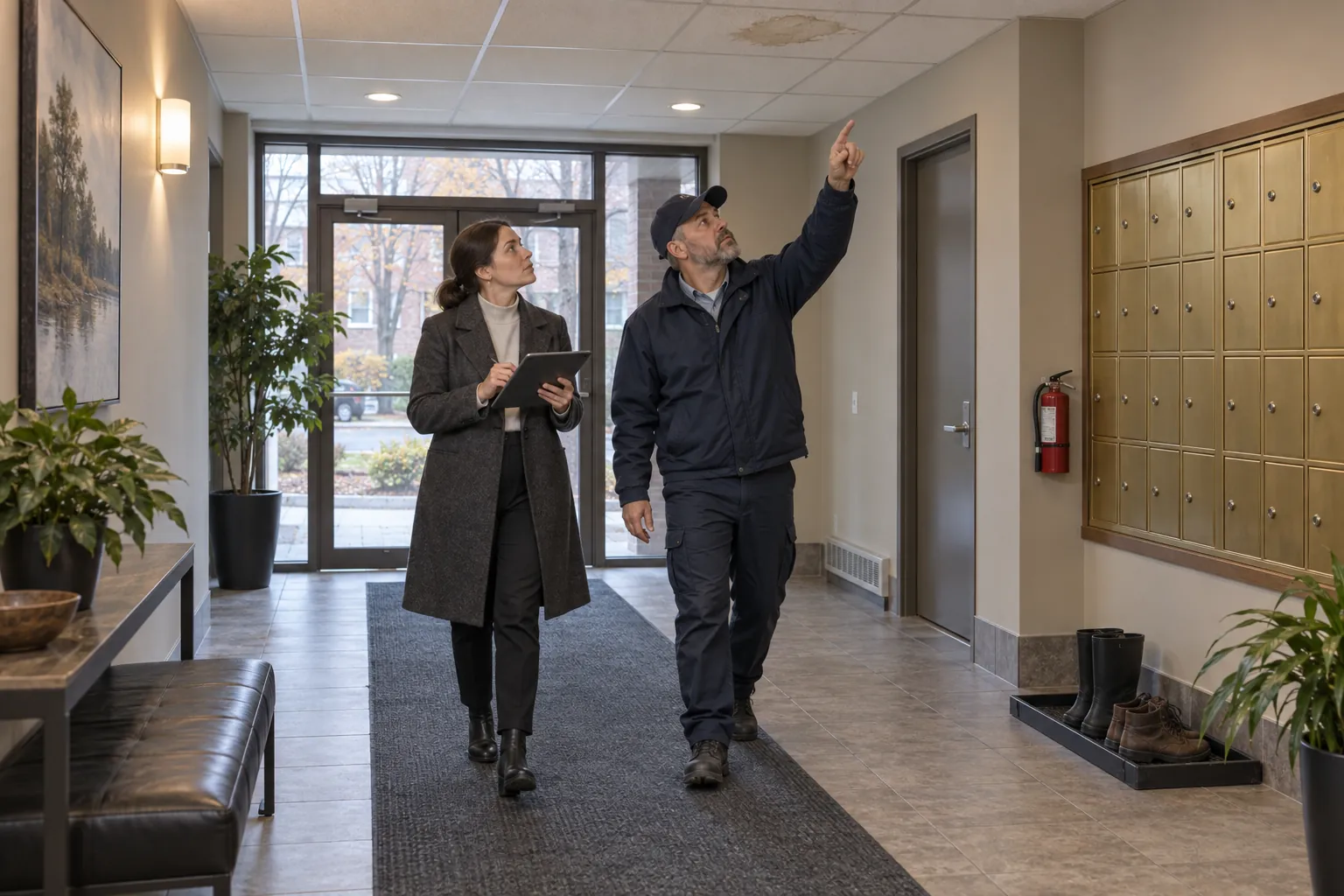
In Canada the rules on who may do that work, and the duties that come with the building, are mostly provincial. This guide covers the licensing that applies in some provinces, the owner's legal duties a property manager carries out day to day, how the work is split between the office and the site, and what a record of it should show when a tenant, an insurer or a fire inspector asks.
01
What a property manager is, and when the role needs a licence
A property manager looks after real estate on behalf of its owner. In a rental apartment building that means leasing units, collecting rent, handling tenant requests and keeping the building in repair. In an office, industrial or retail property it means administering leases, recovering operating costs from tenants, and running the base building and common areas that the tenants share. The owner keeps the asset and the investment; the property manager runs its day-to-day operations.
The title overlaps with others. A facility manager usually works for the organization that occupies a building and looks after the services its people use. A building superintendent or building operator is the person on site, often living in the building, who does or arranges the repairs and cleaning. A condominium manager works for a condominium corporation rather than a single owner. In a small portfolio one person may do all of it.
Whether the role needs a licence depends on the province and on the work. Three examples:
- British Columbia. Section 3(1) of the Real Estate Services Act says a person "must not provide real estate services to or on behalf of another, for or in expectation of remuneration" unless licensed or exempt. The Act defines "rental property management services" to include collecting rents or security deposits and managing the real estate on the owner's behalf by "making payments to third parties", "negotiating or entering into contracts", "supervising employees or contractors hired or engaged by the owner" or "managing landlord and tenant matters". Strata management services, for a strata corporation, are defined separately.
- Alberta. The Real Estate Council of Alberta sets out its licence types: a property management licence covers leasing or offering to lease real estate, negotiating or approving leases, and holding money received in connection with a lease or rental. RECA has also licensed condominium managers since 1 December 2021.
- Ontario. Condominium managers and condominium management providers are licensed under the Condominium Management Services Act, 2015, which defines condominium management services to include collecting common expense contributions, making payments and entering into contracts on the corporation's behalf, and "supervising employees or contractors hired or engaged by the corporation". Section 48 requires a written contract for the services.
Outside those cases, check with your own province's real estate regulator whether the leasing and trust money work in your contract needs registration. A licence covers the right to do the business. It does not describe how to run the building. That comes from the duties the law places on owners, landlords and occupiers, which the property manager usually carries out for them.
02
The owner's legal duties a property manager carries out
The examples below are from Ontario, the most populous province. Every province has its own equivalents, and federally regulated tenants such as banks have their own workplace rules under the Canada Labour Code.
- Occupiers' liability. Section 3(1) of the Occupiers' Liability Act says an occupier "owes a duty to take such care as in all the circumstances of the case is reasonable to see that persons entering on the premises, and the property brought on the premises by those persons are reasonably safe while on the premises." An occupier includes a person "who has responsibility for and control over the condition of premises", and there can be more than one occupier of the same premises. Section 8 gives a landlord who is responsible for maintenance or repair under a tenancy the same duty in respect of dangers arising from a failure to carry out that responsibility.
- Contractors. Under section 6(1) of the same Act, an occupier is not liable for an independent contractor's negligence if it acted reasonably in entrusting the work, and took such steps as it reasonably ought to be satisfied "that the contractor was competent and that the work had been properly done". Checking the contractor's work is part of the defence, not an optional extra.
- Residential repair. Section 20(1) of the Residential Tenancies Act, 2006 makes a landlord "responsible for providing and maintaining a residential complex, including the rental units in it, in a good state of repair and fit for habitation and for complying with health, safety, housing and maintenance standards." Section 27 governs entry: written notice at least 24 hours ahead, specifying "the reason for entry, the day of entry and a time of entry between the hours of 8 a.m. and 8 p.m."
- Fire safety. Under Division A, Article 1.2.1.1 of the Ontario Fire Code (O. Reg. 213/07), "unless otherwise specified, the owner is responsible for carrying out the provisions of this Code", and Article 1.4.1.2 of Division A defines owner as any person, firm or corporation "having control over any portion of the building or property". That brings in the fire safety plan, the inspection and testing of fire alarm, sprinkler, standpipe and emergency lighting systems, and keeping exits clear.
- Workplace owners. The province's Guide to the Occupational Health and Safety Act explains that the owner of a workplace, which includes a lessee or occupier, must ensure that "workplace facilities are provided and maintained as prescribed" and that the workplace complies with the regulations. Before a construction project, the owner must list any designated substances, such as asbestos, and give the list to the constructor.
The property management agreement should say which of these the manager carries out, which the owner keeps, and which each commercial tenant carries in its own premises. Most disputes after an incident turn on exactly that line.
03
Property manager duties, listed
Job descriptions and daily tasks differ between residential, commercial and mixed portfolios, but the core responsibilities are consistent:
- Leasing and tenant relations: marketing vacancies and finding tenants, tenant screening, preparing and renewing leases, handling complaints and requests, and giving proper notice before entering a unit.
- Rent and operating costs: collecting rent and deposits, holding trust money where a licence requires it, paying expenses, preparing budgets, and reconciling operating costs recovered from commercial tenants each year.
- Maintenance, repair and upkeep: a preventive maintenance program for the base building systems (HVAC, boilers, elevators, roofs, parking structures), and a reliable way for tenants to raise a maintenance request and see it closed.
- Contractors and vendors: selecting, instructing and checking janitorial, security, snow removal, landscaping, waste and trade contractors, with insurance certificates and, where the work is construction, the designated substances list.
- Fire and life safety: the fire safety plan, supervisory staff where the plan calls for them, and the inspections and tests the fire code requires, with their records kept at the building.
- Health and safety: owner duties for common areas and shared facilities, and coordination with each employer in the building.
- Seasonal work: snow and ice control, winterization, spring roof and drainage checks.
- Reporting to the owner: monthly financial statements, occupancy, capital needs, incidents and what is outstanding.
- Emergencies: floods, power and heating failures, elevator entrapments and after-hours calls, with a plan and an on-call schedule.
04
How the work is split between the office and the site
Most property managers look after several buildings and are not in any one of them all day. The duties above are carried out by people they do not directly supervise every hour: a building superintendent or operator, a janitorial contractor, a security company, a snow contractor, trades on call. The property manager's job is to make sure that work happens and to know when it has not.
A typical week reads like this:
- Site visits on a set rotation, walking the lobby, corridors, stairwells, parking garage, garbage room, mechanical rooms and roof access, and noting anything the site team has missed.
- Maintenance requests from tenants, logged, sent to the superintendent or a contractor, and chased until closed, with the tenant told the outcome.
- Routine checks carried out by the site team or contractors: fire extinguisher and emergency lighting inspections, fire door checks, boiler and generator logs, washroom cleaning, salt and sanding on walkways.
- Contractor oversight: comparing what the janitorial or security contract says with what was delivered, and dealing with gaps before the invoice is approved.
- Owner reporting: what happened, what is open, what costs money, and what needs the owner's decision.
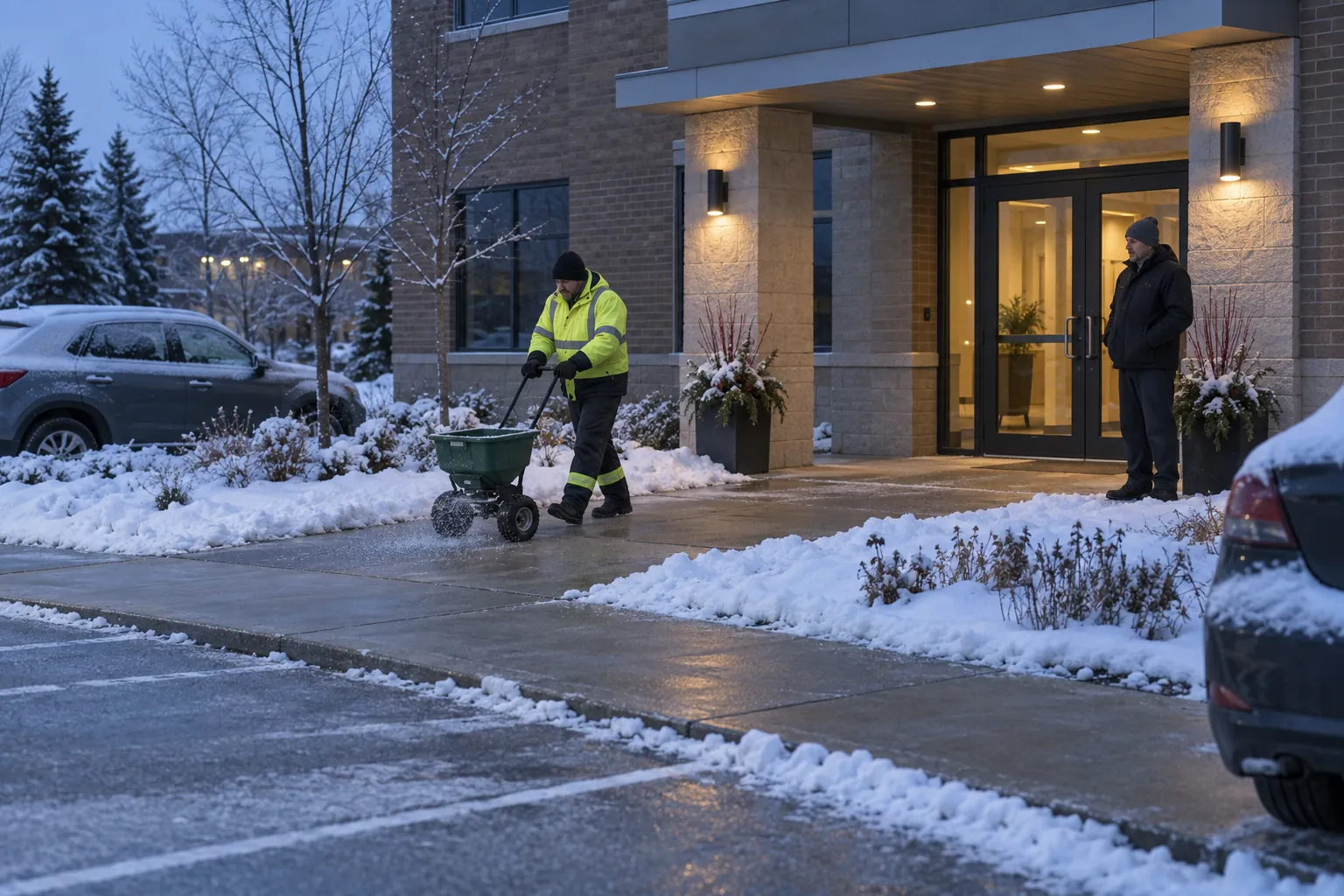
Snow and ice deserve a word of their own in Canada. In Ontario, section 6.1 of the Occupiers' Liability Act, in force since 29 January 2021, means no action for personal injury caused by snow or ice can be brought against an occupier or its snow removal contractor unless written notice, "including the date, time and location of the occurrence", is served within 60 days, subject to exceptions for death and for a reasonable excuse where the defendant is not prejudiced. A claim can therefore arrive weeks after a fall, naming a date, a time and a spot. The question will be what was done there, and when.
05
What good evidence looks like
When something goes wrong, the property manager is asked to show that the building was run properly. The answer is in records made at the time, not in a recollection.
Some records are required outright. Division B, Subsection 1.1.2 of the Ontario Fire Code says that where the Code requires tests, corrective measures or operational procedures, "records shall be made noting what was done and the date and time it was done". They are kept at the building for at least two years, with at least the two most recent records of each test, and electronic records that can be made readily available to the Chief Fire Official on request are deemed to comply. Since 1 January 2026, under Ontario Regulation 480/24, employers and constructors in Ontario must keep records of washroom cleaning. The province's page on maintaining clean washroom facilities for workers explains that the records can be posted in or near the washroom, or electronically, and must include "the date and time of the two most recent cleanings".
Other records are what a reasonable occupier would keep. A useful set for each building:
- the fire safety plan and the inspection and test reports for each fire protection system, with deficiencies tracked to repair;
- logs of routine site checks, made when the check is done, naming who did it and saying why any check was missed;
- a snow and ice log for each walkway, entrance, ramp and parking area: when it was cleared, when salt or sand went down, and the conditions;
- a maintenance request log showing when each request arrived, who took it, and when and how it was closed;
- records that contracted janitorial, security and snow services were delivered, not only invoiced;
- entry notices given to residential tenants, and the work done on each entry;
- certificates of insurance and qualifications for each contractor.
A record is only as good as its timing and its author. A sheet completed at the end of the week, or signed for a whole month at once, tells an adjuster, a tribunal or an inspector very little. A dated entry by a named person, at the place, with a note of what they found, tells them a great deal.
06
Where the record fails, and what SiteClara does about it
Property managers usually have good records of what the office does, such as leases, rent and contractor invoices, and weak records of what happens on site every day. The superintendent's checks live in a binder in the mechanical room. The janitorial contractor's sign-off sheets live in their closet. The snow contractor says the lot was salted at 5 a.m. A tenant reports a leak to whoever is at the front desk, and it never reaches the maintenance list. When the manager visits once a week, most of that is invisible.
SiteClara puts a printed QR poster at each location, such as a washroom, a lobby entrance, a stairwell, a garbage room or a parking garage ramp, with an optional NFC tag behind it. The site team or a contractor's staff scan the code or tap the tag on their own phone, with no app to install, see the scheduled checks due there, and mark them done or explain what stopped them, with a photo when one is asked for. An issue reported at the poster goes onto the team's list of jobs until someone closes it. The supervisor's queue groups open jobs by building and floor, and a supervisor can escalate a job to the building manager, who can answer it.
Each day the supervisor approves a report that goes to the property manager and other nominated contacts the next morning, showing what was reported, what was completed, what is still open and how the scheduled checks went, with the reason where one was missed. Where two companies work in the same building, such as a janitorial contractor and a security company, each can run its own staff, forms and approval on the same site.
07
Questions people ask
What are the responsibilities of a property manager?
The federal National Occupational Classification profile for property administrators (NOC 13101), which lists commercial and residential property managers among its example titles, says they negotiate or approve leases on behalf of property owners, prepare and administer contracts for property services such as cleaning and maintenance, coordinate repairs, maintenance and renovations, keep records of operating expenses and income, prepare reports and review rents, make sure trouble calls from tenants are acted upon and administer damage deposits. They may also hire and supervise rental agents, property clerks and building superintendents.
What qualities should a property manager have?
The NOC profile for property administrators describes what employers usually ask for rather than personal skills: completion of secondary school (except in British Columbia, which asks for a language proficiency index and a minimum age of 19), sometimes training courses or a vocational program in property or strata management or real estate, and usually several years of administrative experience as a property clerk, contract clerk or administrative officer. Strata property managers must hold a licence in British Columbia.
What does a property manager earn in Canada?
Job Bank's wage report for property managers, classed under facility operation and maintenance managers (NOC 70012), gives a national median of $45.20 an hour, with $25.96 at the low end and $70.67 at the high end, for the 2023–2024 reference period from Statistics Canada's Labour Force Survey; the highest regional medians, from Statistics Canada's small area estimates for 2024, are in Nunavut, at $65.34 an hour, and the Northwest Territories, at $63.05. Its wage report for residential property managers (NOC 13101) gives a national median of $31.25 an hour, from $18.46 to $56.41.
08
Where to read more, and a list to take away
For licensing, start with your province's real estate law and regulator: the Real Estate Services Act in British Columbia, RECA's page on licence types in Alberta, and the Condominium Management Services Act, 2015 for condominium managers in Ontario. For the building itself in Ontario, read the Occupiers' Liability Act, the Residential Tenancies Act, 2006 for rental housing, the Ontario Fire Code, and the Guide to the Occupational Health and Safety Act. Elsewhere, go to your own province's or territory's statutes and fire code, and your municipality's property standards bylaw.
If you are taking on a building, or writing a property manager job description, check that you know:
- whether your province requires a licence for the leasing, rent and trust money work you do;
- which of the owner's duties the management agreement gives you, and which stay with the owner or the tenants;
- where the fire safety plan is, which fire protection systems need inspection and testing, and where the records are kept;
- which routine checks the superintendent and contractors do, how often, and where each is recorded;
- who clears snow and ice from each walkway and entrance, and how that is logged;
- how tenants raise a maintenance request, and how you know it was closed;
- how you confirm that contracted services were delivered before the invoice is paid;
- what the owner expects to see from you, and how often.
Sources
Every document this guide quotes or links to, in the order it first cites them.
- Real Estate Services Act bclaws.gov.bc.ca
- Licence types reca.ca
- Condominium Management Services Act, 2015 ontario.ca
- Occupiers' Liability Act ontario.ca
- Residential Tenancies Act, 2006 ontario.ca
- Ontario Fire Code ontario.ca
- Guide to the Occupational Health and Safety Act ontario.ca
- Maintaining clean washroom facilities for workers ontario.ca
- National Occupational Classification profile for property administrators (NOC 13101) noc.esdc.gc.ca
- Wage report for property managers jobbank.gc.ca
- Wage report for residential property managers jobbank.gc.ca
Related guides
 Premises and facilities managementFacility manager duties in Canada: what the role covers, and how to show it is doneWhat a facility manager does in Canada: the owner, employer and supervisor duties under provincial OHS and fire law, contractors, and the records that show it.
 Premises and facilities managementBuilding superintendent duties: what the super does, and how to show it was doneWhat a building superintendent does in Canada: the landlord's duties a super carries out, heat and vital services, fire safety, working alone and the daily record.
 Premises and facilities managementCondo manager duties: the licence, the code and the recordWhat a condo manager does in Canada: licensing in Ontario, BC and Alberta, the code of ethics, the management contract, site oversight and the records to keep.
 Premises and facilities managementMaintenance request forms: what to capture, how fast to answer, and what to keepWhat a maintenance request form should capture, how requests are prioritized and closed, and what Ontario, Toronto and BC rules say about repairs and records.