Security patrols
Security patrols in Canada: what they are, how to run them and what they should prove
A security patrol is a planned round of a property by a licensed security guard, on foot, by vehicle or by camera, to check that it is secure and safe, find hazards and deter crime by being seen.
Also written for United Kingdom · United States · South Africa
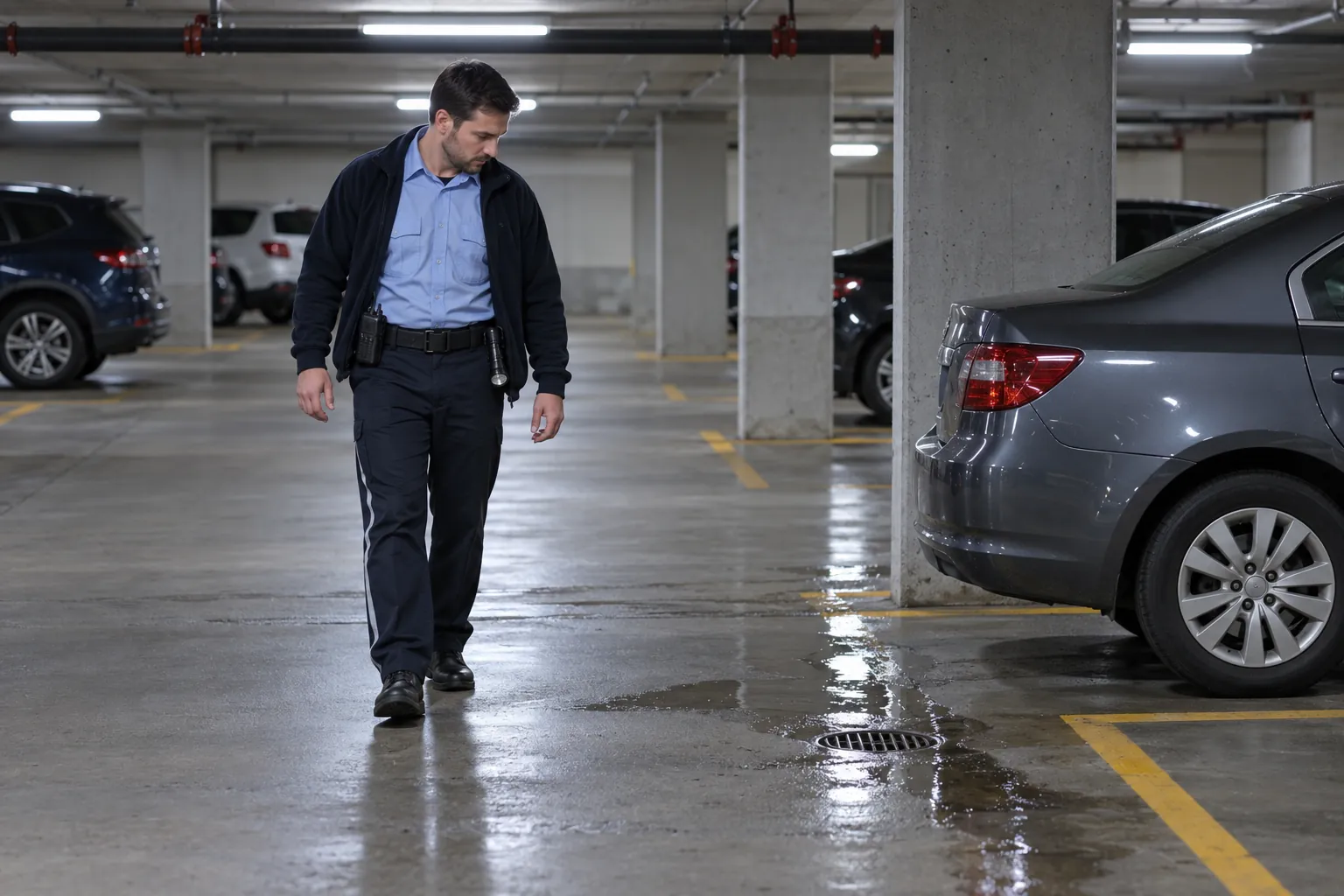
In Ontario the law defines a security guard by exactly that work: guarding or patrolling for the purpose of protecting persons or property. This guide covers the licence behind a patrol, the types of patrol, what a patrol should check on a Canadian property, how often and when to patrol, and the record a property manager should expect to see afterwards.
01
What a security patrol is, and the licence behind it
A security patrol is a round of a property by a security guard, on foot or by vehicle, to check that the property is secure, to find and deal with anything unusual, and to be seen. A visible presence on the property is itself a deterrent, and a trained guard already on patrol can respond quickly to incidents, alarms and people who need help. Most guarding contracts mix static duties, such as a concierge desk, a gatehouse or a control room, with patrols of the building and grounds at set times through the shift. On a property too large to watch from one post, the patrol is how one guard covers it.
In Canada, patrolling is regulated work. Ontario's Private Security and Investigative Services Act, 2005 says at section 2(4) that "a security guard is a person who performs work, for remuneration, that consists primarily of guarding or patrolling for the purpose of protecting persons or property", and section 6 says no person shall act as a security guard unless they hold the appropriate licence. The province's page on the security guard licence for individuals puts it plainly: "You must have a valid licence to work as a security guard, private investigator or both in Ontario." That includes in-house guards: under section 5, a business that employs its own security guard, rather than selling guarding to the public, must register as an employer.
British Columbia's Security Services Act covers the same ground. Its definition of a security guard service includes a person who "provides or supervises a guard patrol or watch of property", section 2 requires a security worker licence for security work, section 11 requires a licence to carry on a security business, and section 21 requires a security business licensee to "maintain the prescribed books and records". In Quebec, the Bureau de la sécurité privée issues the agent's permit for gardiennage, and its page on the permis régulier sets out the mandatory training of at least 70 hours. Each other province and territory licenses security guards under its own law, so check the one where the property is.
What the law does not do is say how often a property must be patrolled. Patrol frequency, routes and checkpoints come from the contract, the client's insurer and the site's post orders. The law governs who patrols and how they conduct themselves. In Ontario, the Code of Conduct, O. Reg. 363/07, sets the professional standard: it requires every licensee working as a security guard to "act with honesty and integrity" and to "refrain from exercising unnecessary force". Section 35 of the Act requires a guard to carry the licence and produce it on request, and O. Reg. 362/07, Uniforms, requires an identification tag with the guard's name or licence number on the uniform.
02
The types of security patrol
The national standard for guard training, CAN/CGSB-133.1-2017, Security officers and security officer supervisors (reaffirmed September 2022), is a voluntary standard from the Canadian General Standards Board. Its basic training program for security officers includes a session on patrol procedures, and it names three types of patrol:
- Foot patrols: a guard walks the route, inside and outside, trying doors and looking at what has changed. The commonest type on office towers, condos, hospitals, campuses and retail centres.
- Remote visual patrols: a guard checks areas by camera from a control room or security desk, often between foot patrols, or for a site watched off-site at night.
- Mobile patrols: a guard in a vehicle, either covering a large single property such as an industrial park or a hospital campus, or driving between several clients' properties on a schedule.
Mobile patrol services, also sold as mobile security or patrol security services, are what most property managers buy when a property does not need a guard on-site all night. A patrol company sends a licensed guard in a vehicle to make a set number of visits, often called hits, at varying times: a walk of the exterior, a check of doors and the parkade, sometimes a walk through the interior. The same service usually offers lock-ups and unlocks, alarm response when the monitoring station calls, and checks on vacant buildings. In Ontario a marked patrol vehicle must show the word "SECURITY" or "SÉCURITÉ" on both sides, front and back, and never "Police", under O. Reg. 364/07, Vehicles. Each visit is short, so the value of the service depends on what is checked and what the client is shown afterwards.
The standard also names the purposes of patrols: "security, prevention of losses and protection of assets", "detection of safety and fire hazards", and "minimizing the opportunity for crime through prevention, detection and response". The aim is a safe environment for the people who live, work and visit there, not just a locked building. The second purpose is easy to forget. On many properties a patrol finds more leaks, failed lights and propped exit doors than intruders.
03
What a patrol should check on a Canadian property
A patrol plan starts with a list of the places that matter on this property and why. The guard training standard lists, among the duties related to the security of property, "conducting patrols, both internal and external", "knowledge of property vulnerabilities and hazards" and "knowledge of utility control locations". On most Canadian commercial and residential properties the list includes:
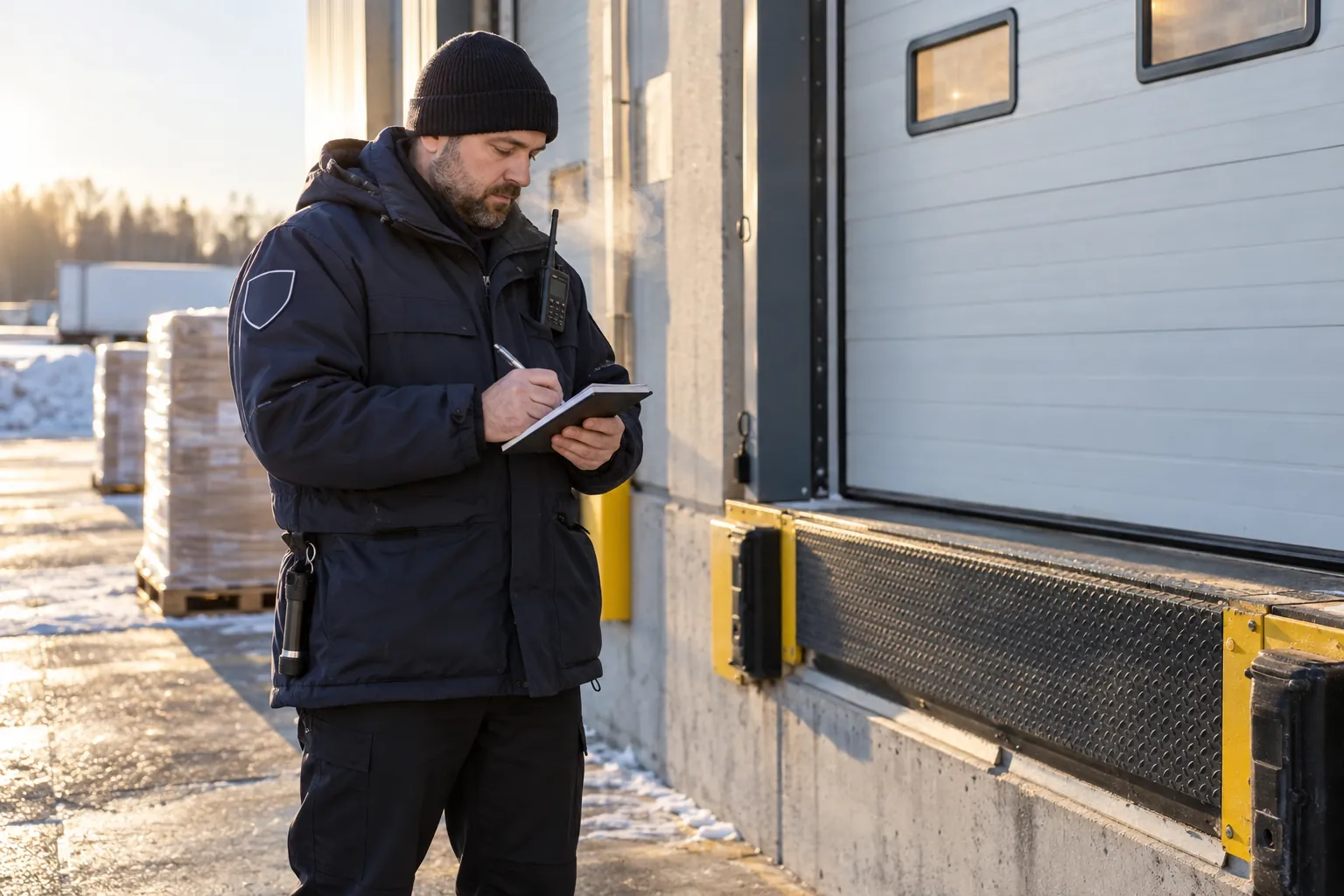
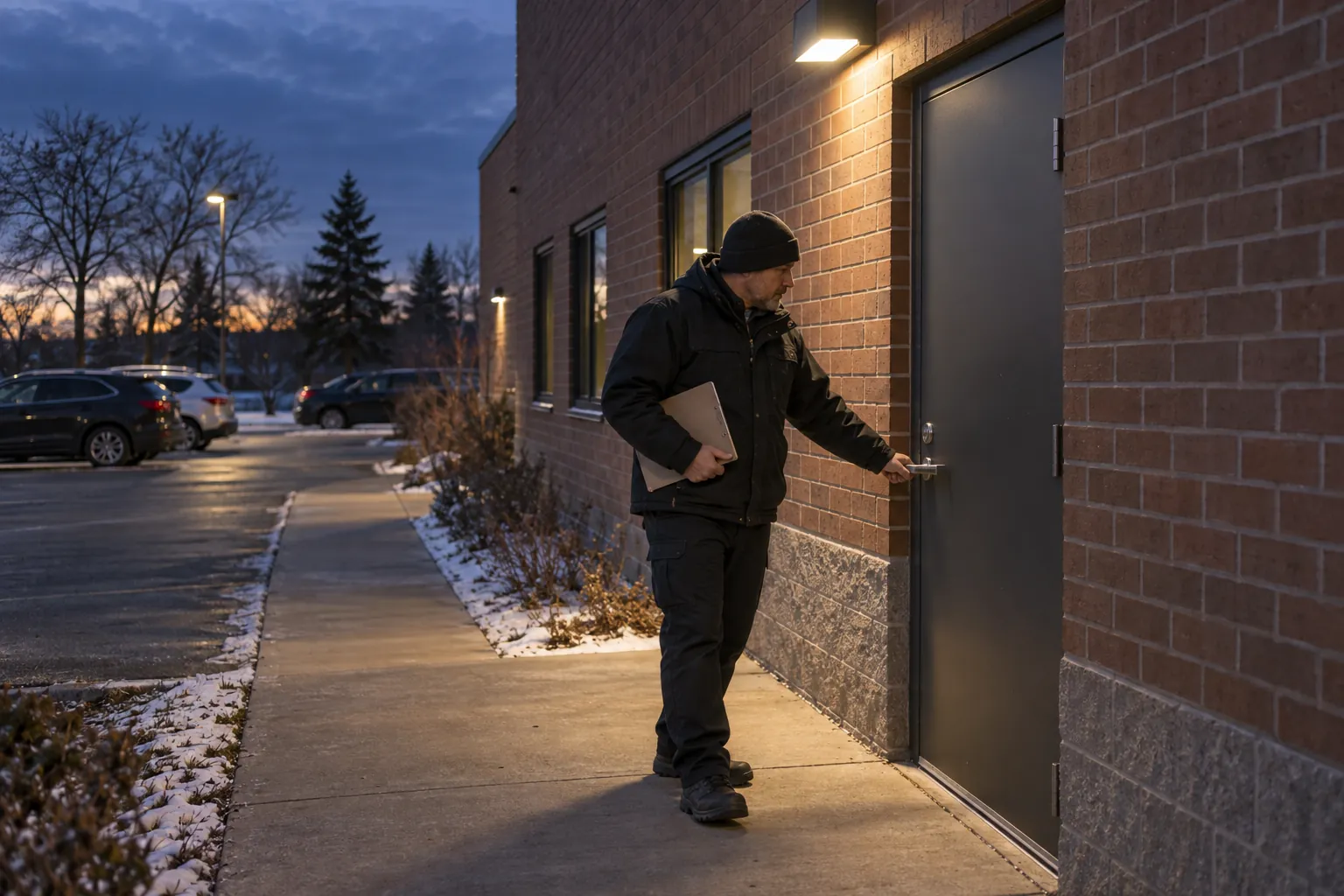
- Exterior doors and the perimeter: exit doors closed and latched, loading dock doors and overhead doors down, gates and fences intact, access control doors and card readers working, nothing stacked against a wall that could be climbed.
- The parkade: each level, the stairwells and the vestibules, looking for people sheltering, vehicles that should not be there, damage and water.
- Vulnerable rooms: mechanical and electrical rooms, the sprinkler room, roof hatches, storage lockers, the garbage room and anywhere holding valuable stock or equipment.
- Fire safety: exits and exit routes clear, fire doors closed, the fire alarm panel and other fire protection systems showing normal, no combustible waste piled against the building. A patrol watching for a system out of service is a fire watch, with its own rules.
- Winter hazards: walkways and entrances clear of snow and ice, salt spread where the contract says so, no frozen or burst pipes, heat on in vestibules and stairwells, ice building up above entrances.
- Building faults: water on the floor, lights out in a stairwell or parkade, doors that will not latch, elevators out of service, an alarm on plant.
- People: anyone on the property after hours, contractors working late, trespassers and people in distress, handled exactly as the post orders say.
Each of these becomes a checkpoint: a named place where the guard stops, checks what the post orders say to check there, and records that they did. Twenty checkpoints on a hospital campus and six on a small office building can be equally thorough; what matters is that the list follows the risk rather than the floor plan. A useful starting point is a building security checklist.
Guards should also know what a patrol is not for. A guard is not a police officer: they can observe, report, ask a trespasser to leave on the owner's behalf and call 911, and the post orders should say when to do which. Our guide to security guard duties covers those limits.
04
Routes, frequency and timing, and the guard working alone
Among the "aspects of patrols", the CGSB standard lists "frequency and timing", "determination of area activity patterns" and "use of mechanical and technical aids". In practice the patrol plan answers three questions, and the answers belong in the post orders, so that a relief guard on a first night does the same patrol as the regular one and the property's coverage does not depend on who is on shift:
- Route: a logical sequence of checkpoints that covers the perimeter, the exterior doors, the parkade and the high-risk rooms without doubling back. Many properties need a separate exterior patrol and interior patrol.
- Frequency: how many patrols a shift, or how many mobile patrol visits a night. A common pattern is a patrol at lock-up, regular patrols through the night and a final patrol before the building opens, with more after a recent incident, during a holiday closure or in winter storms.
- Timing: when each patrol starts. A patrol that leaves the desk at the top of every hour tells anyone watching exactly when the back of the building is unwatched. Vary the start times, and the direction of the route where the layout allows.
Varied timing makes the record harder to read, because a patrol due at 02:00 might properly start at 02:25. The answer is to schedule each patrol within a window, such as "one exterior patrol between 01:00 and 03:00", and record the actual time each checkpoint was reached. The proof is then the checkpoints, not the timetable.
Night patrols are often lone work, and CCOHS lists security guards among the workers who may work alone. Its OSH Answers on working alone advises employers to "define under what circumstances the lone worker will check in and how often" and to "check the regulations in your area". Some provinces are specific. In British Columbia, the Occupational Health and Safety Regulation, Part 4, section 4.21, requires a written procedure for checking the well-being of a worker assigned to work alone or in isolation, with set intervals, a person designated to make contact and record the results, and a check at the end of the shift. A patrol checkpoint is not a well-being check, and a working alone procedure is needed whether or not patrols are recorded.
If patrols are followed by GPS, that is electronic monitoring of the guard. In Ontario, an employer with 25 or more employees on January 1 of a year must have a written policy on electronic monitoring of employees saying how, in what circumstances and for what purposes it monitors them.
05
What a patrol should leave behind
A patrol that leaves no record cannot be shown to have happened. The guard's notebook holds the observations in the guard's own words, and the daily activity report summarizes the shift, but neither shows on its own which checkpoints were reached and when. A good patrol record gives:
- the guard's name, not just the shift or the post;
- the actual time each checkpoint was reached, recorded there and then;
- what was found at each checkpoint, including "all secure" where it was;
- each hazard, fault or incident, with a photo where it helps, who it was reported to and when;
- each missed patrol or checkpoint, with the reason, such as an alarm call or a medical emergency elsewhere in the building;
- a supervisor's review, so someone on the security team other than the guard reads the record.
Many companies record checkpoints with a guard tour system, which time-stamps each point; our guide to them compares the types. Anything more than a line belongs in a security officer report. Whatever the method, the record should be written during the patrol, not reconstructed at the end of the shift, and in Ontario the Code of Conduct requires a guard to act with honesty and integrity while working, which applies to what goes in the record as much as anything else.
Buying patrols. A property manager or condo board buying a mobile patrol service should agree in the contract what proof each visit leaves, not just how many visits there are. Ask for:
- the number of visits a night and the window each falls in;
- the checkpoints on each visit and what is checked at each, exterior and interior;
- a time-stamped record of each checkpoint and the name of the guard;
- photos of anything found, and who on the property side is called, for what, and how fast;
- missed visits reported with a reason, not left out of the report;
- a regular report the property manager will actually read, with the faults found and what happened to them.
Handover is where patrol information is most often lost. An exit door that would not latch at 04:00 is the day shift's problem and the building operator's too, and it only reaches them if the outgoing guard passes it on and both note it.
06
Where patrol records fail, and where SiteClara fits
The usual patrol record is a line in the notebook or the daily activity report: "02:00 patrol, all secure". It tells a supervisor that the guard says they patrolled, not which checkpoints were reached or when. A mobile patrol's visit becomes a line on an invoice. A leak or a broken door found at 3 a.m. stays in the log rather than reaching whoever fixes it, and the client, who pays for the patrols, sees nothing unless they ask.
SiteClara records the patrol checkpoint by checkpoint. A printed QR poster, with an optional NFC tag behind it, goes at each checkpoint the post orders name: an exit door, the loading dock, a parkade level, the roof hatch, the mechanical room. The guard scans the code or taps the tag on their own phone, with no app to install, sees the checks due at that point and marks them done, or says what stopped them, such as a locked room. The time and the named guard are recorded as it happens, with a photo when the check asks for one. A hazard or fault found on the round is reported there and goes onto the team's list of jobs until someone closes it, and a supervisor can escalate a job to the building's property manager.
The security supervisor sees what was due, done and missed, and records the reason a patrol was missed. At the end of the day the supervisor reviews and approves a report that goes to nominated management or client contacts at 8 a.m. the next morning, showing what was reported, what was completed, what is still open and how the scheduled checks went.
07
Questions people ask
What are three types of security patrols?
Foot, remote visual and mobile: those are the three types of patrol named in the patrol procedures session of CAN/CGSB-133.1-2017, Security officers and security officer supervisors, the national standard for guard training. A foot patrol walks the route, a remote visual patrol checks areas by camera, and a mobile patrol uses a vehicle, on one large property or between several.
What is a security patrol officer?
A licensed security guard whose work is patrolling property to protect people and property. Ontario's Private Security and Investigative Services Act, 2005 defines a security guard as a person paid to do work "that consists primarily of guarding or patrolling for the purpose of protecting persons or property", and requires a licence to do it.
Do in-house security guards need a licence in Ontario?
Yes. Section 6 of the Private Security and Investigative Services Act, 2005 requires the licence of anyone acting as a security guard, including one employed by a business that does not sell security services, and section 5 requires that business to register as an employer.
08
Further reading, and a list to take away
Start with your own province's security licensing law, the CGSB guard training standard, CCOHS and your province's rules on working alone, and, in Ontario, the guide to electronic monitoring policies. All are linked above.
Before the next patrol plan or patrol contract is agreed, check that:
- every guard who patrols holds the province's licence, in-house guards included;
- the patrol routes, checkpoints and windows are written in the post orders;
- each checkpoint is named, with what to check there, winter hazards included;
- patrol start times and directions vary;
- the desk is covered or secured while the guard patrols;
- a working alone procedure covers the guard at night, separately from the patrol record;
- each checkpoint is recorded at the time, by a named guard, with findings and photos of faults;
- missed patrols and visits are recorded with a reason;
- faults found on patrol reach the building operator or property manager;
- a supervisor and the client read the patrol records for gaps and patterns.
Sources
Every document this guide quotes or links to, in the order it first cites them.
- Private Security and Investigative Services Act, 2005 ontario.ca
- Security guard licence for individuals ontario.ca
- Security Services Act bclaws.gov.bc.ca
- Permis régulier bspquebec.ca
- Code of Conduct, O. Reg. 363/07 ontario.ca
- O. Reg. 362/07, Uniforms ontario.ca
- CAN/CGSB-133.1-2017, Security officers and security officer supervisors publications.gc.ca
- O. Reg. 364/07, Vehicles ontario.ca
- OSH Answers on working alone ccohs.ca
- Occupational Health and Safety Regulation, Part 4 worksafebc.com
- Written policy on electronic monitoring of employees ontario.ca
Related guides
 Security patrolsGuard tour systems in Canada: how they work, what they prove, and how to choose oneHow guard tour systems record security patrols in Canada – wands, RFID, NFC, QR codes, GPS apps – what the data shows, and what to check before choosing one.
 Security patrolsSecurity post orders: what they should say, and how to keep them workingSecurity post orders in Canada: what they are, what to put in them, how Ontario's PSISA and fire and safety law shape them, and how to check guards follow them.
 Security patrolsSecurity guard notes: how to keep a notebook that stands upSecurity guard notes in Canada: what goes in the notebook, the rules for writing it, what provincial security law and the Canada Evidence Act mean for it.
 Security patrolsBuilding security checklist: what to check, how often, and how to show it was doneA building security checklist for Canadian workplaces: doors, locks, fobs, lighting, CCTV, alarms and exits, how often to check them, and how to keep a record.