Cleaning
Parking garage cleaning: the routine, the spring wash and the record
Parking garage cleaning is the routine sweeping, spill clean-up, drain clearing and spring pressure washing that keeps an underground garage or parkade clear of litter, salt and oil, safe to walk through and within the workplace, fire code and sewer rules.
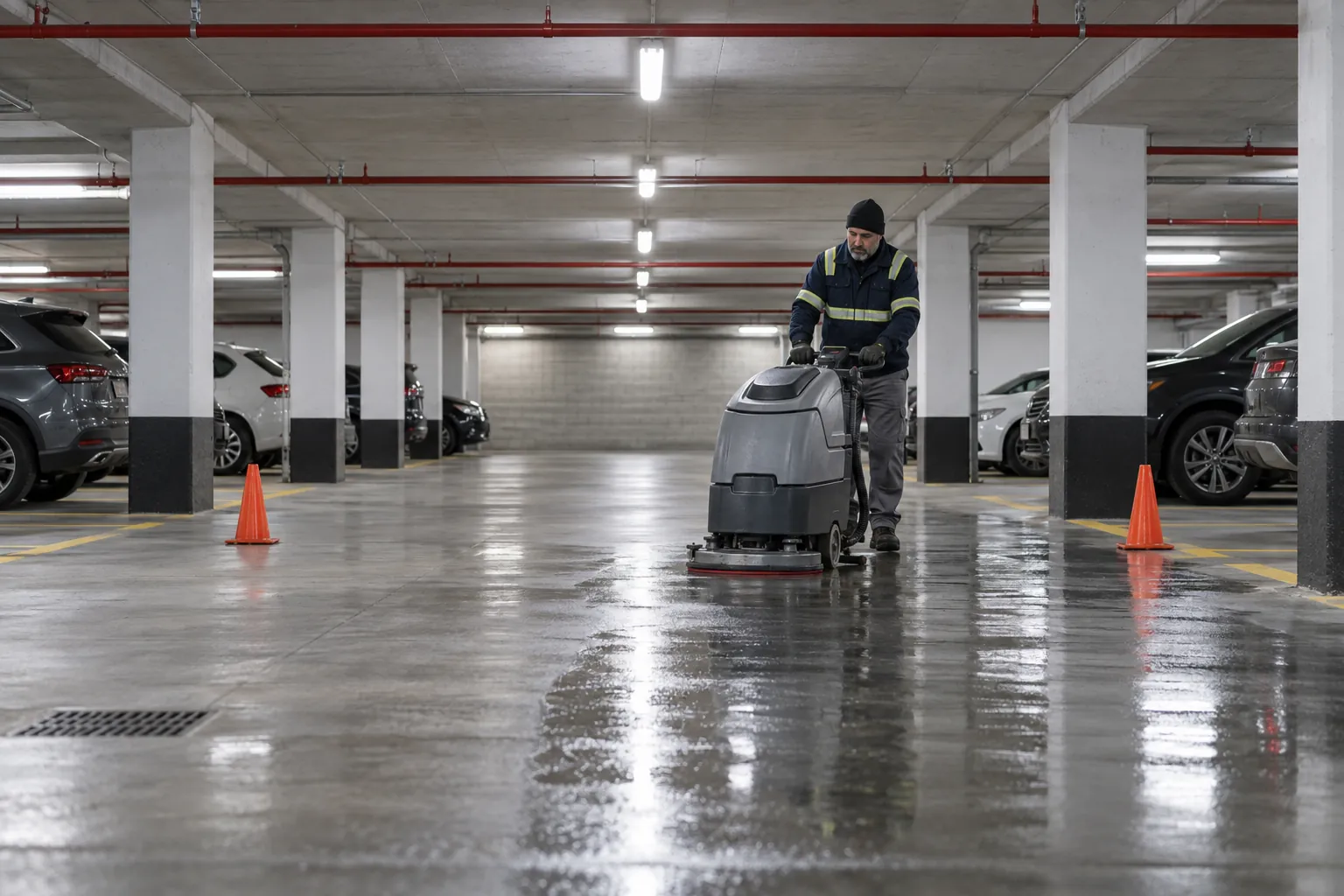
A parking garage is the first part of many buildings that people see and the last that gets cleaned. In a condo, an office tower or a hospital, the underground garage or parkade collects litter, oil drips, sand and a winter's worth of road salt carried in on every car, and it hides problems a lobby never would: a blocked drain, a light out in a stairwell, a needle behind a column. This guide sets out what Ontario's workplace, fire and municipal rules expect, a routine from daily to yearly, how the spring wash is done without breaking the sewer by-law, and what a useful cleaning record looks like.
01
What the rules say about cleaning a parking garage
No Canadian law is called a parking garage cleaning rule. The duties come from workplace health and safety law, the fire code, municipal by-laws on upkeep and wash water, and the law that makes someone responsible for the building. Almost all of it is provincial or municipal. Ontario and Toronto are the worked example below; elsewhere, read your own province's regulation and fire code and your city's by-laws.
Ontario's Occupational Health and Safety Act requires an employer to "take every precaution reasonable in the circumstances for the protection of a worker" (clause 25(2)(h)), and places matching duties on supervisors in section 27. The Act defines an industrial establishment as "an office building, factory, arena, shop or office" and "any land, buildings and structures appertaining thereto", so the garage under an office tower or a shopping plaza is covered by the Industrial Establishments Regulation (R.R.O. 1990, Reg. 851). Its section 11 is the cleaning duty in a sentence:
Section 21 of the same regulation adds that where natural light is inadequate "artificial lighting shall be provided and shadows and glare shall be reduced to a minimum", which in a garage is most of the day.
The Ontario Fire Code (O. Reg. 213/07) calls a parking garage a storage garage. Sentence 2.4.1.1.(1) says that combustible materials "shall not be accumulated in or around a building in such quantity or such location as to create a fire hazard". Article 2.4.1.6. is the one a garage crew meets most often: "Flammable liquid or combustible liquid spills in a building shall be removed immediately with an absorbent material that will not increase the hazard and shall be disposed of in a safe manner." And Sentence 2.7.1.7.(1) requires that "Means of egress shall be maintained in good repair and free of obstructions", which includes the stairwells and exit doors out of every level.
Municipal property standards set the upkeep test. Toronto Municipal Code Chapter 629, Property Standards, which "applies to all property in the City of Toronto", has a section on parking and storage garages:
Who answers for all this depends on the building. Under section 90 of Ontario's Condominium Act, 1998, "the corporation shall maintain the common elements and each owner shall maintain the owner's unit", unless the declaration says otherwise (section 91). A garage's drive aisles, ramps, lobbies and stairwells are usually common elements, even where the parking spaces themselves are owned as units. In a rental building it is the landlord, and in a commercial building the owner or whoever the lease names. A cleaning contractor may do the work, but the owner answers for the result.
02
What parking garage cleaning covers
A garage is several different spaces joined by a ramp. List each one in the scope of work, because each has its own tasks and its own way of being forgotten:
- Drive aisles, ramps and parking stalls: litter, sand, salt, oil drips, leaves blown in at the entrance, and the build-up along curbs and under wheel stops.
- Entrances and the overhead door: the apron, the trench drain across it, the door tracks and the safety sensor that stops the door closing on someone.
- Pedestrian areas: elevator lobbies, vestibules, stairwells, handrails and walkways, the places visitors judge the garage by.
- Drains: catch basins, trench drains and floor drains on every level, and the oil or sand interceptor they run to.
- Walls, columns and ceilings: dust, cobwebs, tire marks, graffiti and the painted surfaces Toronto's by-law expects to be kept reasonably clean.
- Lighting and signage: lenses cleaned, dead lamps reported, directional and exit signs kept visible.
- Rooms off the garage: bike rooms, storage lockers and garbage rooms, easily left out of a garage contract.
- Pay stations, intercoms and gate arms: wiped with the other touch points.
- Found hazards: needles, broken glass, abandoned items, spilled fluids and water leaking through the slab.
Structural repairs, membrane work, fire protection servicing and top-deck snow clearing are usually other contracts; the cleaner's part is to notice and report, and the scope should say to whom.
03
A routine from daily to yearly
No rule sets cleaning frequencies for a parking garage; the rules set outcomes. The frequencies below are a starting point, to be adjusted for the traffic, the season and whether the public walks in off the street.
- Daily: a walk of every level, including the bottom one; litter picked; spills dealt with at once; elevator lobbies swept or mopped, glass and buttons wiped; stairwells checked for rubbish and anything blocking the way out; lights and exit signs looked at; anything unsafe reported.
- Weekly: drive aisles and ramps swept, by walk-behind or ride-on sweeper in a large garage; entrance trench drains and catch basin grates cleared; stairwells swept and handrails wiped; oil stains treated with absorbent or degreaser.
- Monthly: floor scrubbing of lobbies and walkways; walls and columns spot-cleaned where marked; light lenses and signs wiped; bike and storage rooms tidied and abandoned items tagged.
- In winter: more sweeping, not less, as sand and salt pile up at the bottom of ramps and in drains. Mats at every door from the garage, and a check of ramps and entrances for ice at the start of every shift where the garage is open to the weather, recorded in the snow and ice log if the building keeps one.
- In spring: the annual wash-down, described in the next section.
- In fall: drains and interceptors cleared before winter, leaves removed from the entrance and top deck, lighting checked before the long nights.
Write the routine down with the level, zone and frequency for each task, so a relief cleaner or a new contractor can follow it. If the schedule just says "garage", it will be done where the cleaner happens to start.
Time the work around the cars: nights or weekends in an office garage, the working day in a residential one. Cone off the area being worked and wear high-visibility clothing; a cleaner bent over a drain at the bottom of a ramp is hard to see from a car coming round the corner.
04
The spring wash, the drains and the sewer by-law
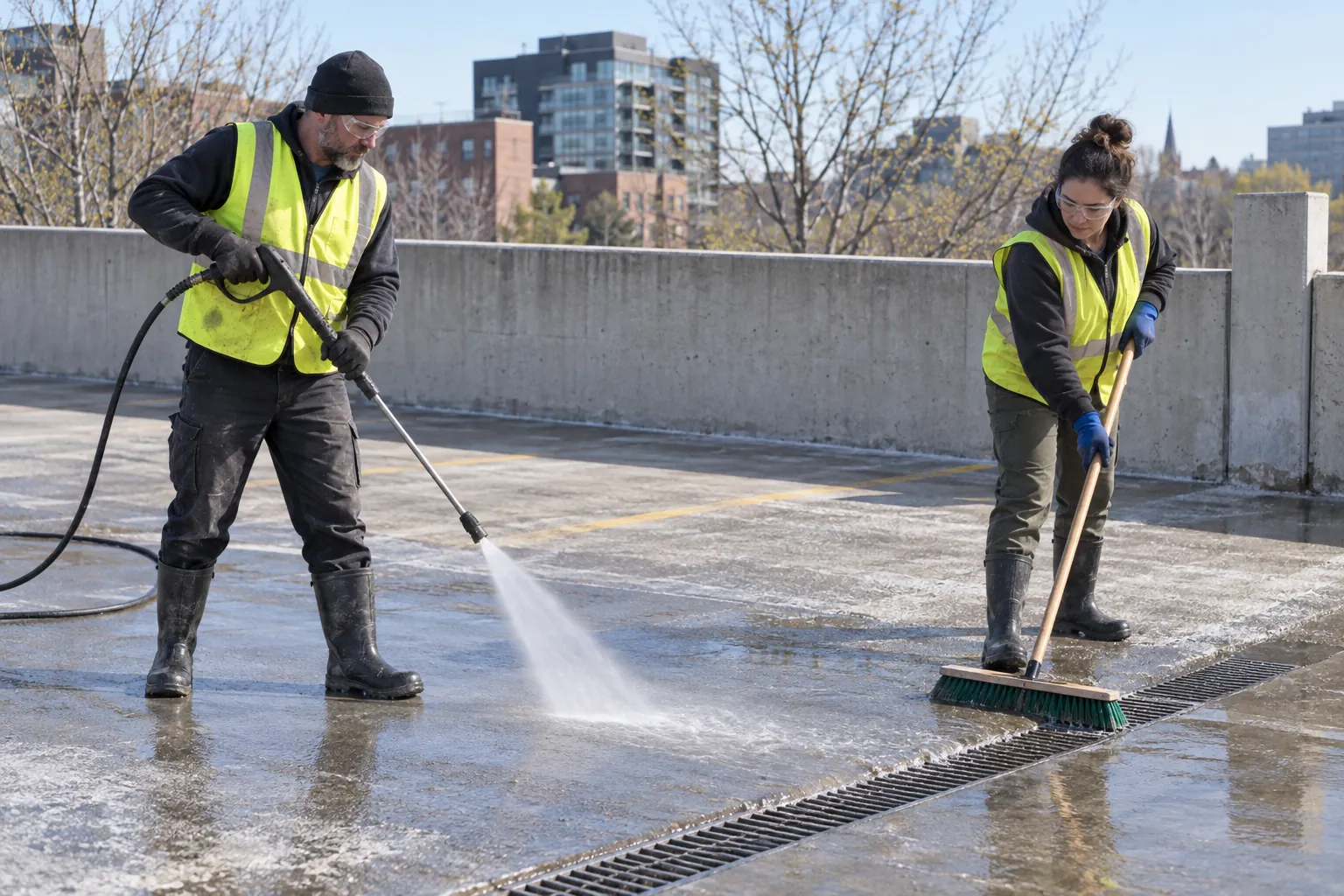
In most of Canada the big job of the year is washing the salt out. The National Research Council's Canadian Building Digest CBD-224, Deterioration of indoor parking garages (1982), put the problem plainly: "The cause of the deterioration is usually corrosion of the reinforcing steel due to the action of de-icing salts carried in by the vehicles." Washing the salt off once winter is over, by pressure washing or with a ride-on scrubber, is common practice, usually by a contractor working one level at a time while residents move their cars. How often to wash, and which products the floor membrane will tolerate, is a question for the building's engineer, not the cleaning schedule.
Where the water goes matters as much as the washing. In Toronto, Toronto Municipal Code Chapter 681, Sewers, defines a storm sewer as one for "uncontaminated water, storm water, drainage from land or from a watercourse", and section 681-4 says no person shall discharge into a storm sewer anything that may "Have one or more of the following characteristics: (1) Visible film, sheen or discolouration", or that contains fuel, among other things. Wash water carrying oil, grit and degreaser from a garage floor has all of these. Before the wash, find out where every drain on every level goes, and do not hose dirty water out of the entrance into a street catch basin.
The same chapter makes the drains themselves somebody's job. Section 681-10 D requires every owner or operator of premises "from which sand, grit or similar materials may directly or indirectly enter a municipal sewer connection or municipal sewer" to "take all necessary measures to ensure that such materials is prevented from entering", and section 681-10 C requires an oil interceptor at a motor vehicle service station, repair shop or garage, or other premises where motor vehicles are repaired, lubricated or maintained, where the sanitary discharge is connected directly or indirectly to a sewer. Where the drains run through an interceptor, it needs emptying on a schedule; the cleaner's part is to keep grates clear and report water backing up. If something does reach the sewer, section 681-9 requires the person responsible to "immediately notify the General Manager" and to send a written report within five days.
Inside the garage, a fuel spill is also a fire code matter. Article 2.4.1.6. of the Ontario Fire Code requires it to be "removed immediately with an absorbent material that will not increase the hazard". Keep absorbent and a sealed bin for used absorbent where the cleaners can reach them, and write down where the spill was, what it was and how it was dealt with.
05
What good evidence looks like, and how it is checked
A garage is mostly empty, so nobody sees the cleaning happen, which makes the record matter more. When a resident complains or an inspector finds an exit blocked, the building needs to show what was done, where and when.
A useful record for each visit shows:
- the level and zone, not just "the garage";
- the task done, against the task scheduled for that day;
- who did it and when, recorded at the time rather than filled in at the end of the week;
- what was found and reported: a light out on P3, a drain backing up at the ramp, a leak through the slab, a needle in the east stairwell;
- photos where they help: the drain after clearing, the spill before and after, the stain that will not come out;
- for the spring wash, the dates each level was done, what was used, and where the water went.
Checks work best in layers. The cleaner records the routine as they go. The supervisor walks the garage on a set day and looks where things get missed: the bottom level, the far stairwell. The property manager or condo manager walks it with the contractor regularly, and after the spring wash, and compares what they see with the record. Where the contract has a written scope of work, measure against it; where it has only "garage cleaning, weekly", agree what that means before arguing about it.
Keep problems that need another trade separate from cleaning tasks, and keep them open until someone closes them. A light reported out on Monday and still out on Friday is a record of a known problem left unfixed.
06
Where the garage cleaning record fails, and what SiteClara does about it
Garage cleaning records fail in familiar ways. The sheet by the P1 elevator is signed for every level, although nobody went below P2. A resident tells the security guard about glass on the ramp, and the message never reaches the cleaner. When the board asks which levels were washed on which day in April, the answer is an invoice.
SiteClara records the work at the place it is done. A printed QR code on each level, in each stairwell and at the elevator lobbies, with an NFC tag behind it if staff would rather tap than scan, lets the cleaner or custodian mark the scheduled check or cleaning for that spot done on their own phone, with no app to install, or say what stopped them, such as a level closed for repairs. Their name and the time are recorded as it happens, and they can add a photo when one is asked for. A problem found, such as a blocked drain, a light out or a leak through the slab, goes onto the team's list of open jobs until someone closes it.
The supervisor sees what is due, done and missed on each level, and can record the reason a check was missed. At the end of the day they review it, add a note and approve the report, which goes to nominated client or management contacts, such as the property manager or the condo manager, at 8 a.m. the next day, showing what was completed, what is still open and how the scheduled checks went.
07
Questions people ask
What is the best way to clean a dirty parking garage?
Dry first, then wet: sweep up the litter, sand and salt, deal with oil at once, keep the drains clear, and wash the salt off once winter is over. The salt is what does the damage. The National Research Council's Canadian Building Digest CBD-224, Deterioration of indoor parking garages says "The cause of the deterioration of parking garages is usually corrosion of the reinforcing steel due to the action of de-icing salts carried in by vehicles", and that "if water does not accumulate on the surface of concrete the problem of influx may not even arise", which is why the drains matter as much as the floor. For fuel and other flammable or combustible liquids, Article 2.4.1.6. of the Ontario Fire Code (O. Reg. 213/07) requires a spill to be "removed immediately with an absorbent material that will not increase the hazard".
How do you clean a car parking area?
Sweep before you wash, and know where the water goes. In Toronto, section 681-4 of Toronto Municipal Code Chapter 681, Sewers forbids discharging into a storm sewer anything with a "Visible film, sheen or discolouration" or that contains fuel or combustible liquids, which rules out hosing oily wash water into a street catch basin. Section 681-10 D requires the owner or operator of premises from which sand or grit may reach a sewer to "take all necessary measures to ensure that such materials is prevented from entering the drain", so pick up the winter sand dry rather than washing it down the drain. Elsewhere, check your own city's sewer by-law.
08
Further reading, and a list to take away
In Ontario, read section 11 of the Industrial Establishments Regulation, Subsections 2.4.1 and 2.7.1 of the Ontario Fire Code, and section 25 of the Occupational Health and Safety Act. In Toronto, read sections 629-36 (lighting, with a minimum of 50 lux in garages in its table for public areas), 629-39 and 629-40 of Chapter 629, Property Standards and sections 681-4, 681-9 and 681-10 of Chapter 681, Sewers. Elsewhere, the same questions are answered by your own province and city. For the workers, read the CCOHS pages cited above.
Before you rewrite the garage cleaning routine, check that:
- every level, ramp, stairwell, lobby, drain and side room is named in the scope of work, each with a frequency;
- someone walks every level daily, and stairwells and exit doors are kept clear;
- absorbent is on hand for oil and fuel spills, and used absorbent goes in a sealed bin;
- you know where every drain goes, and no dirty wash water reaches a storm sewer;
- the oil and grit interceptor has a cleaning interval and the last clean-out is on record;
- the spring wash is booked with the engineer's advice on products and method, and levels are recorded as they are done;
- the ventilation runs while the crew works, and cleaners know the signs of carbon monoxide exposure;
- cleaners have a sharps container, tongs and gloves, and know how to report a needle;
- lights out, leaks and damage go onto a list of open jobs with a name and a date, and stay there until they are fixed.
Sources
Every document this guide quotes or links to, in the order it first cites them.
- Occupational Health and Safety Act ontario.ca
- Industrial Establishments Regulation (R.R.O. 1990, Reg. 851) ontario.ca
- Ontario Fire Code (O. Reg. 213/07) ontario.ca
- Toronto Municipal Code Chapter 629, Property Standards toronto.ca
- Condominium Act, 1998 ontario.ca
- Canadian Building Digest CBD-224, Deterioration of indoor parking garages nrc-publications.canada.ca
- Toronto Municipal Code Chapter 681, Sewers toronto.ca
- Carbon monoxide profile ccohs.ca
- WHMIS - General ccohs.ca
- Needlestick and Sharps Injuries ccohs.ca
- Prevention of Slips, Trips and Falls ccohs.ca
Related guides
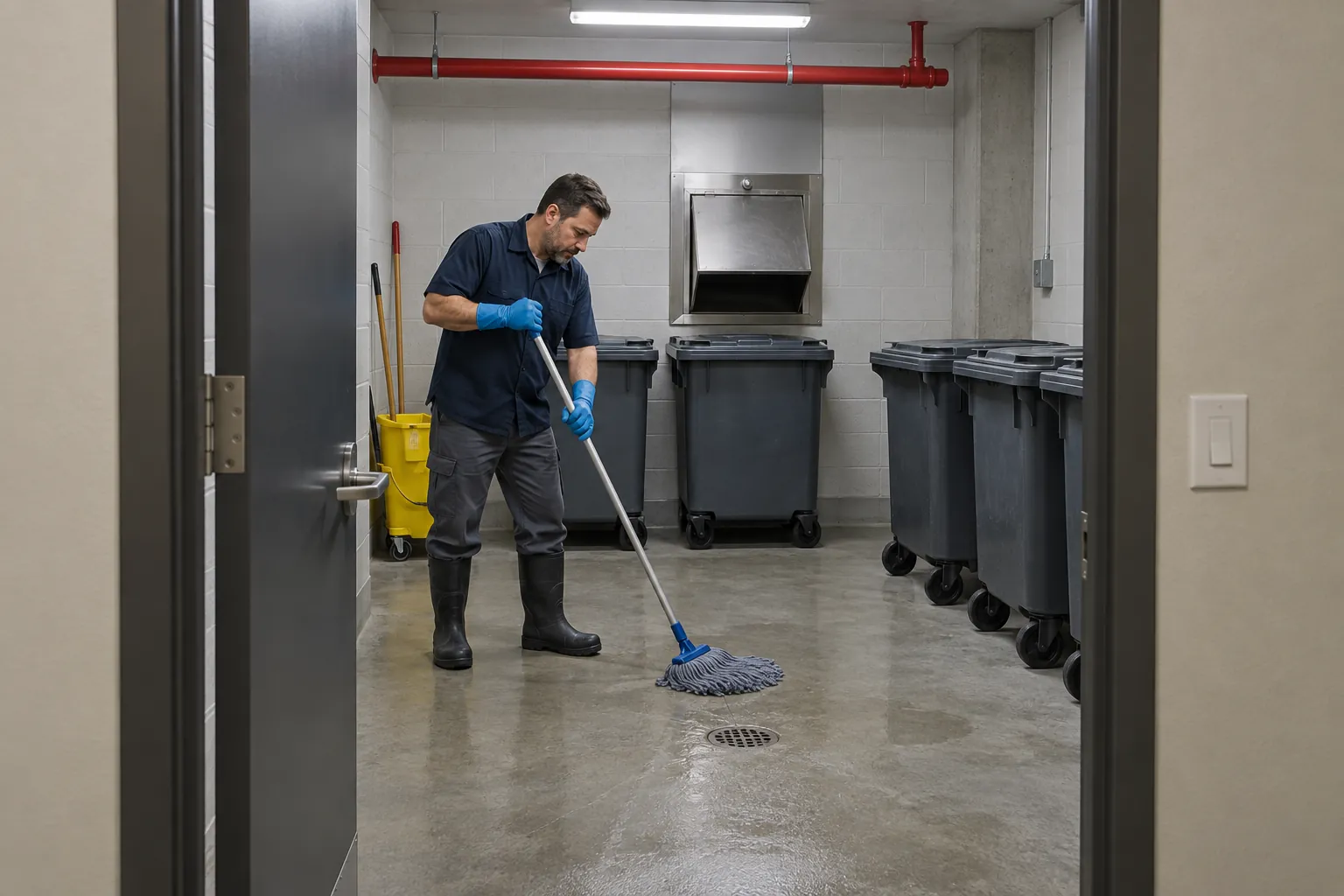 CleaningGarbage room and garbage chute cleaning: the routine, the rules and the recordKeeping garbage rooms, chutes and bins clean in Canadian buildings: the fire code and by-law duties, a daily and periodic routine, chute washing, and the records.
 CleaningJanitorial scope of work: what it should say, and how to show it is metWhat a janitorial scope of work should contain in Canada: areas, tasks, frequencies, standards, winter care, WHMIS and products, and how to show the work was done.
 Premises and facilities managementSnow removal log: what to record, when, and why it mattersWhat a snow removal log should record, when to make entries, who keeps it, and how Ontario's 60-day notice rule for snow and ice claims makes the log count.
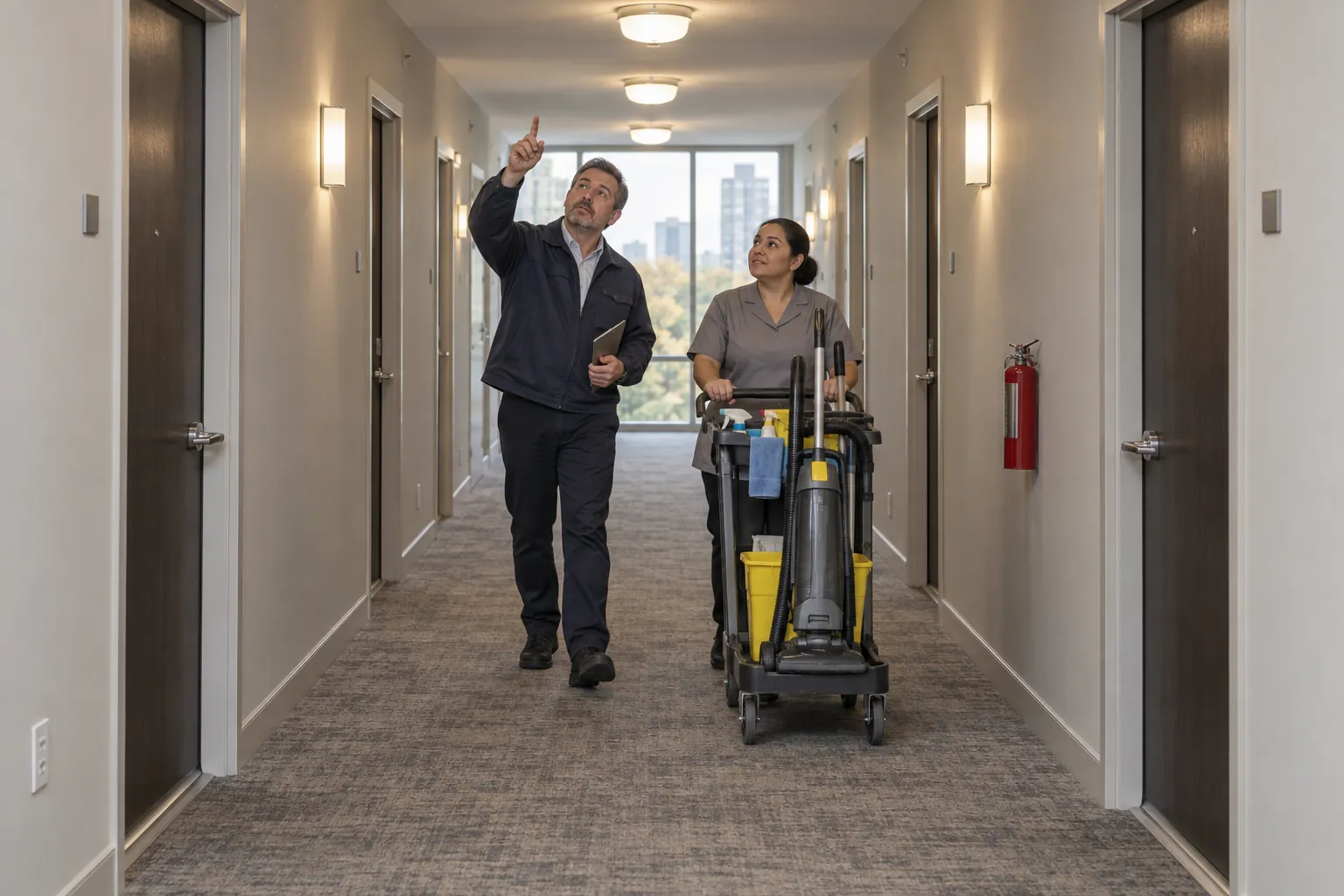 Premises and facilities managementCondo maintenance: looking after the common elements, and proving itWho maintains a condo's common elements under Ontario's Condominium Act and other provinces' laws, what the work covers, how often, and what the record should show.