Premises and facilities management
WHMIS labels: the supplier label, the workplace label and the SDS beside them
WHMIS labels come in two kinds: the supplier label a hazardous product arrives with, whose contents are set by the federal Hazardous Products Regulations, and the workplace label an employer must put on any container the product is transferred into, which is set by the provincial, territorial or federal occupational health and safety rules that cover the workplace.
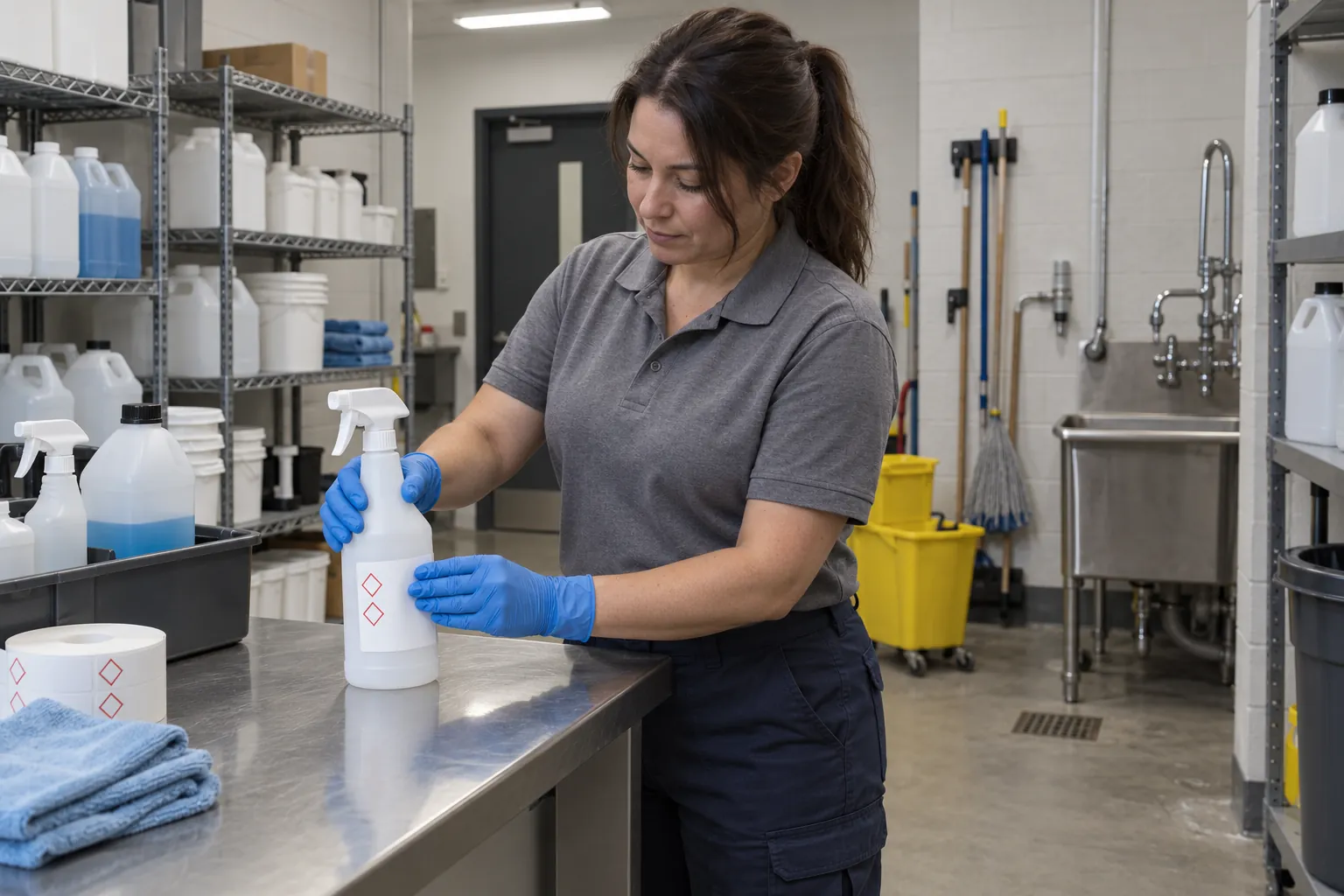
Behind both sits the safety data sheet (SDS), which every worker who may be exposed must be able to reach. For a janitorial team or a facility manager the everyday cases are ordinary ones: a concentrate decanted into a spray bottle, a label worn off a jug in the custodial room, an SDS binder nobody has checked since the last product change. This guide covers what each label must show, when a workplace label is needed, how to keep the SDSs current, and what shows the program is working.
01
What WHMIS labels are, and whose rules set them
The Canadian Centre for Occupational Health and Safety's WHMIS general information describes the Workplace Hazardous Materials Information System as "a comprehensive system for providing health and safety information on hazardous products intended for use, handling, or storage in Canadian workplaces": labels, safety data sheets, and worker education and training. CCOHS adds that "Canada has aligned the Workplace Hazardous Materials Information System (WHMIS) with the Globally Harmonized System of Classification and Labelling of Chemicals (GHS)"; the Hazardous Products Regulations that did so in 2015 replaced the now repealed Controlled Products Regulations of WHMIS 1988. The legislation is split in two:
- Suppliers are regulated by Health Canada under the Hazardous Products Act and the Hazardous Products Regulations (SOR/2015-17), which set the hazard classification of a product, the supplier label and the safety data sheet (SDS). Suppliers are responsible for determining how each product is classified against the hazard classes and criteria in the regulations.
- Employers are regulated by their province or territory, or federally for federal work. In Ontario that is R.R.O. 1990, Regulation 860 (WHMIS) under the Occupational Health and Safety Act; in British Columbia, Part 5 of the WorkSafeBC Occupational Health and Safety Regulation; for banks, airports and other federal work, Part X of the Canada Occupational Health and Safety Regulations. These set the workplace label, SDS access and training.
Under section 3 of the Hazardous Products Regulations, a supplier label shows the product identifier, the initial supplier identifier and, for each hazard category the product falls into, the pictogram, signal word, hazard statement and precautionary statements. "The pictogram, signal word and hazard statement must be grouped together on the label" (section 3.3), the label must be "in both official languages of Canada" (section 6.2), and it must stay legible "under normal conditions of transport and use" (section 3.5). The signal word, which alerts the reader to a potential hazard, is either "Danger", for the more severe hazards, or "Warning". CCOHS's WHMIS pictograms page lists nine: flame, flame over circle, gas cylinder, corrosion, exploding bomb, skull and crossbones, health hazard, exclamation mark and biohazardous infectious materials.
A workplace label is shorter, and workplace labels are the employer's responsibility. Ontario's Regulation 860 defines it as a label that discloses "(a) a product identifier identical to that found on the safety data sheet for the hazardous product, (b) information for the safe handling of the hazardous product, and (c) that a safety data sheet, if supplied or produced, is available." British Columbia's section 5.1 is the same in substance.
02
When a workplace label is needed, and when it is not
CCOHS's WHMIS labels page says a workplace label is required when "a hazardous product is produced (made) at the workplace and used in that workplace, a hazardous product is decanted (e.g., transferred or poured) into another container, or a supplier label becomes lost or illegible (unreadable)." In Ontario's Regulation 860:
- Decanted products, section 10(1): "If a hazardous product that an employer receives in a container from a supplier is transferred to another container, the employer shall ensure that the other container has a workplace label." That is the spray bottle filled from the original 4 L jug, or degreaser poured into a smaller can for the parking garage.
- Lost or illegible labels, section 8(3): if a label "becomes illegible or is removed, an employer shall replace the label with either a supplier label or a workplace label." Section 8(2) forbids altering a supplier label while any product remains in the container.
- Products made at the workplace, section 9(1): these need a workplace label too.
The one exemption is for portable containers. Section 10(2) says no label is needed on a portable container filled from a labelled one if the product "is under the control of and is used exclusively by the worker who filled the portable container", "is used only during the shift in which the portable container was filled", and "the contents of the portable container are clearly identified", or "if all of the hazardous product in the portable container is required for immediate use." British Columbia's section 5.10(2) is in the same terms. The federal section 10.37 still requires a work place label showing the product identifier, unless the product is for immediate use.
The exemption rarely fits a cleaning crew. A spray bottle left on a janitor's cart overnight, shared with the next shift or refilled over several days is outside it. Labelling every refillable bottle is simpler than deciding each time.
Where a product is not in a container, section 12 allows a placard carrying the workplace label information, "of such size and in such a location that the information is conspicuous and clearly legible to workers".
03
Writing a workplace label for a spray bottle or a decanted jug
No layout is prescribed for this kind of WHMIS label. CCOHS says "in general, a workplace label requires the following information: Product name (matching the SDS product name). Safe handling precautions may include pictograms or other supplier label information. A reference to the SDS (if available)." It adds that "workplace label requirements fall under your provincial or territorial jurisdiction". A workable label for a refillable bottle carries:
- The product identifier, exactly as on the SDS. Not "blue cleaner" or "washroom spray", so anyone can find the right sheet.
- Safe handling information: a few precautions taken from the supplier label, such as the gloves or eye protection to wear to use it safely; CCOHS says these may include its pictograms.
- Where the SDS is, for example the custodial room binder.
- The dilution, for a diluted product. It is not a legal element, but concentrate and ready-to-use solution look the same in a bottle.
Three habits keep labels right:
- One bottle, one product. When a bottle changes product, the old label comes off before it is filled. A bottle labelled for one product and holding another is worse than no label.
- Never a food or drink container, whatever label is added.
- Replace a worn label right away. CCOHS tells workers to "ask for a new label when the old one cannot be seen or read properly" and not to use "a product that is not labelled or if the label is unreadable." Spare labels in the custodial room make that possible the night it is noticed.
04
The SDS: getting it, keeping it current and making it reachable
CCOHS's safety data sheets page calls SDSs "summary documents that provide information about the hazards of a product and advice about safety precautions." Schedule 1 of the Hazardous Products Regulations fixes 16 headings in order, from identification and hazard identification through first-aid measures, handling and storage and exposure controls to regulatory and other information, and section 4.2 requires the product identifier and supplier identifier to be "identical to those provided on the label".
In Ontario, Regulation 860 section 17 requires the employer to obtain the supplier's SDS and to update it "as soon as practicable after significant new data about the product is provided by the supplier or otherwise becomes available". Section 38 of the Occupational Health and Safety Act requires every current SDS to be "made available by the employer in the workplace in such a manner as to allow examination by the workers", furnished to the joint health and safety committee or representative, and made "readily available to those workers who may be exposed". An electronic copy counts (section 38(5)), and the employer must consult the committee on how SDSs are made available (section 38(6)). British Columbia's section 5.16 likewise requires an SDS to be readily available at the workplace.
CCOHS accepts computerized access where "all workers have access to and are trained on how to use the computer or device", with hard copies on request. An app on a phone the night custodian does not have, or a binder in a locked office, does not meet that.
Suppliers no longer work to a fixed interval. CCOHS states: "The Hazardous Products Act and regulations no longer require suppliers to update a safety data sheet every three years, as was the case under WHMIS 1988." A supplier must instead update it within 90 days of becoming aware of significant new data. Employers' duties depend on the jurisdiction. Ontario's is the section 17(2) update above. In British Columbia, section 5.14(2) requires the employer, once a supplier SDS "is 3 years old", to obtain an up-to-date one from the supplier, unless the supplier confirms in writing that it has not changed or that is not practicable (section 5.14(3)); in federal workplaces, section 10.32(2) requires the same "if feasible". CCOHS lists the same three-year duty for Saskatchewan, Newfoundland and Labrador, the Northwest Territories, Nova Scotia, Nunavut and Yukon. Either way, the question for a binder is whether each sheet is the supplier's current version and matches the product on the shelf.
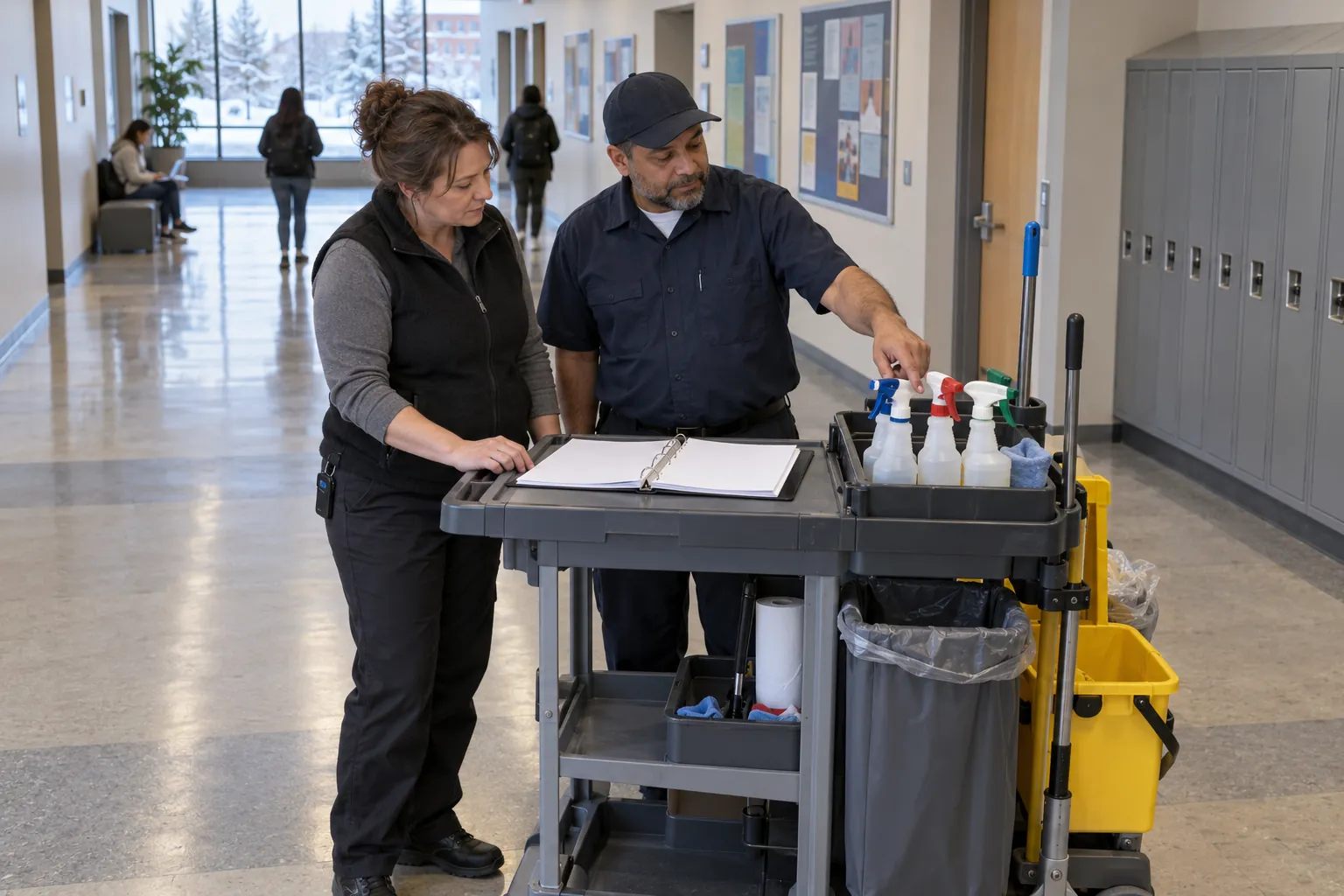
A useful binder opens with an inventory: each product, where it is stored and used, the date of its SDS and when it was last checked against the supplier's current version. Products that leave the building leave the binder too.
05
Training, the annual review and the checks that show it works
Ontario's Regulation 860, section 7(1), requires every worker who works with or may be exposed to a hazardous product to be instructed in "the contents required on labels and the purpose and significance of the information contained on the labels", the same for the SDS, safe use, storage, handling and disposal, and emergency procedures. Section 7(2) requires the program to be developed for the employer's own workplace, so generic online training alone does not cover a building's own products and procedures. Labels and SDSs work as hazard communication only when the people using the products have been taught to read them.
Section 42(3) of Ontario's Act requires the employer to review the training "and the worker's familiarity therewith at least annually", with the joint health and safety committee or representative. British Columbia's section 5.5 requires a WHMIS program that "is reviewed at least annually, or more frequently if required by a change in work conditions or available hazard information".
Between reviews, labels are something to look at on an ordinary walk-through of each custodial room, cart and chemical store:
- every container has a supplier or workplace label, none worn or illegible;
- each workplace label's product identifier matches a current SDS;
- there is an SDS for every product on the shelf, and none for products no longer used;
- workers on every shift can reach the SDSs;
- no chemical is in a food or drink container.
In Ontario, section 9(26) of the Act has a designated committee member inspect the physical condition of the workplace at least once a month, and the labels and binder belong in that inspection; the JHSC workplace inspection guide sets out how. Good evidence of compliance is not a training certificate in a file: it is labels that are right when someone looks, a binder that matches the shelf, and a record of who checked, when, and what was put right.
On a contract, decide in writing who holds what. The janitorial contractor usually brings its own products, holds their SDSs and trains its staff; the facility manager holds the SDSs for the building's own products. Both must be reachable by anyone exposed, including the night crew.
06
Where the record fails, and what SiteClara does about it
The rules are rarely the weak point; the record of keeping them is. A label check is ticked on a monthly sheet filled in at the desk. A worn label is mentioned to whoever was passing and is still worn a month later. The binder was checked once, before an audit, and nobody can say which SDS versions were looked at.
SiteClara puts a tag at each location: a printed QR code, with an NFC tag behind it if staff prefer to tap. A custodian or supervisor scans the tag at the custodial room or chemical store on their own phone, with no app to install, sees the checks due there, such as the label and SDS check, and marks each one done or says what stopped them; the person and the time are recorded as it happens, with a photo when one is asked for. Anyone who finds a missing or unreadable label can scan the same tag and report it, and it goes onto the team's list of open jobs with the time it was reported. A supervisor sees what is still open across their buildings, reviews the day, and the approved report goes to the client or facility manager the next morning.
07
Questions people ask
What are the two main types of labels used in WHMIS?
Supplier labels and workplace labels. CCOHS's WHMIS labels page says: "There are two main types of WHMIS labels: supplier labels and workplace labels." The supplier label comes on the product from its supplier; the employer puts on a workplace label when a product is decanted, made at the workplace or loses its supplier label.
What are the two signal words used on WHMIS labels?
"Danger" and "Warning". CCOHS's WHMIS labels page explains that "'Danger' is used for high-risk hazards, while 'Warning' is used for less severe hazards."
When is a WHMIS workplace label required?
CCOHS's WHMIS labels page gives three cases: when "a hazardous product is produced (made) at the workplace and used in that workplace, a hazardous product is decanted (e.g., transferred or poured) into another container, or a supplier label becomes lost or illegible (unreadable)."
What information is not required on a WHMIS workplace label?
CCOHS's WHMIS labels page says a workplace label in general needs only the product name matching the SDS, safe handling precautions and a reference to the SDS. The supplier identifier, signal word, hazard statements and the grouped layout of a supplier label are not on that list, and CCOHS adds that the hatched border of WHMIS 1988 "is no longer required". Check your own province's regulation, because workplace labels are set there.
What are the 9 hazard symbols in WHMIS?
CCOHS's WHMIS pictograms page lists flame, flame over circle, gas cylinder, corrosion, exploding bomb, skull and crossbones, health hazard, exclamation mark, and biohazardous infectious materials.
What must an SDS include?
Sixteen sections in a fixed order. CCOHS's safety data sheets page lists them as the Hazardous Products Regulations require: identification; hazard identification; composition and information on ingredients; first-aid measures; fire-fighting measures; accidental release measures; handling and storage; exposure controls and personal protection; physical and chemical properties; stability and reactivity; toxicological information; ecological information; disposal considerations; transport information; regulatory information; and other information. It adds that the information "must be in both official languages of Canada (English and French)".
08
Where to read more, and a checklist to take away
The primary sources, from their owners' own sites:
- Hazardous Products Regulations (SOR/2015-17): Part 3 for the supplier label, Part 4 and Schedule 1 for the SDS.
- Ontario, Regulation 860 (WHMIS), sections 7 to 12 and 17, and the Occupational Health and Safety Act, sections 38 and 42.
- British Columbia, OHS Regulation Part 5, sections 5.5 to 5.16.
- Federal workplaces, Canada Occupational Health and Safety Regulations, Part X.
- CCOHS, WHMIS labels and safety data sheets.
- Elsewhere: your own province's or territory's WHMIS regulation.
A checklist for a building or janitorial contract:
- Every product received has a legible, unaltered supplier label.
- Every decanted container has a workplace label: the product identifier as on the SDS, safe handling information and where the SDS is.
- Worn or missing labels are replaced the day they are found.
- Every product on the shelf has a current SDS, and every worker on every shift can reach it.
- WHMIS training covers this workplace's own products and is reviewed at least annually.
- Each label and SDS check is recorded as it is done, by the person who did it.
Sources
Every document this guide quotes or links to, in the order it first cites them.
- WHMIS general information ccohs.ca
- Hazardous Products Act laws-lois.justice.gc.ca
- Hazardous Products Regulations (SOR/2015-17) laws-lois.justice.gc.ca
- R.R.O. 1990, Regulation 860 (WHMIS) ontario.ca
- Occupational Health and Safety Act ontario.ca
- WorkSafeBC Occupational Health and Safety Regulation worksafebc.com
- Canada Occupational Health and Safety Regulations laws-lois.justice.gc.ca
- WHMIS pictograms ccohs.ca
- WHMIS labels ccohs.ca
- Consumer chemical products in the workplace ccohs.ca
- Safety data sheets ccohs.ca
- Amended Hazardous Products Regulations canada.ca
Related guides
 CleaningHealth Canada approved disinfectants: what the DIN tells you, and how to use itHow to tell a Health Canada approved disinfectant: the DIN, what the label must show, how to check it, and what the Biocides Regulations changed.
 Premises and facilities managementEyewash station requirements: what the law asks, and how to keep them workingEyewash station requirements in Canada: Ontario, Alberta, B.C. and federal rules, the ANSI Z358.1 benchmark, weekly and monthly flushing, and what to record.
 Premises and facilities managementWorkplace inspection checklist: how a JHSC inspection should workA workplace inspection checklist for Canadian JHSCs and representatives: Ontario, BC, Alberta and federal rules, what to walk, how often and what to record.
 Premises and facilities managementFirst aid kit requirements: what the law asks, province by provinceWorkplace first aid kit requirements in Canada: Ontario's Regulation 1101, CSA Z1220-17 kits in Alberta and B.C., federal rules, and how often to inspect.