Cleaning
Hospital environmental cleaning: the standards, the frequencies and the audits
Hospital environmental cleaning is the routine cleaning and disinfection of patient rooms, washrooms, high-touch surfaces and noncritical medical equipment, done to stop the transmission of infections between patients, staff and visitors.
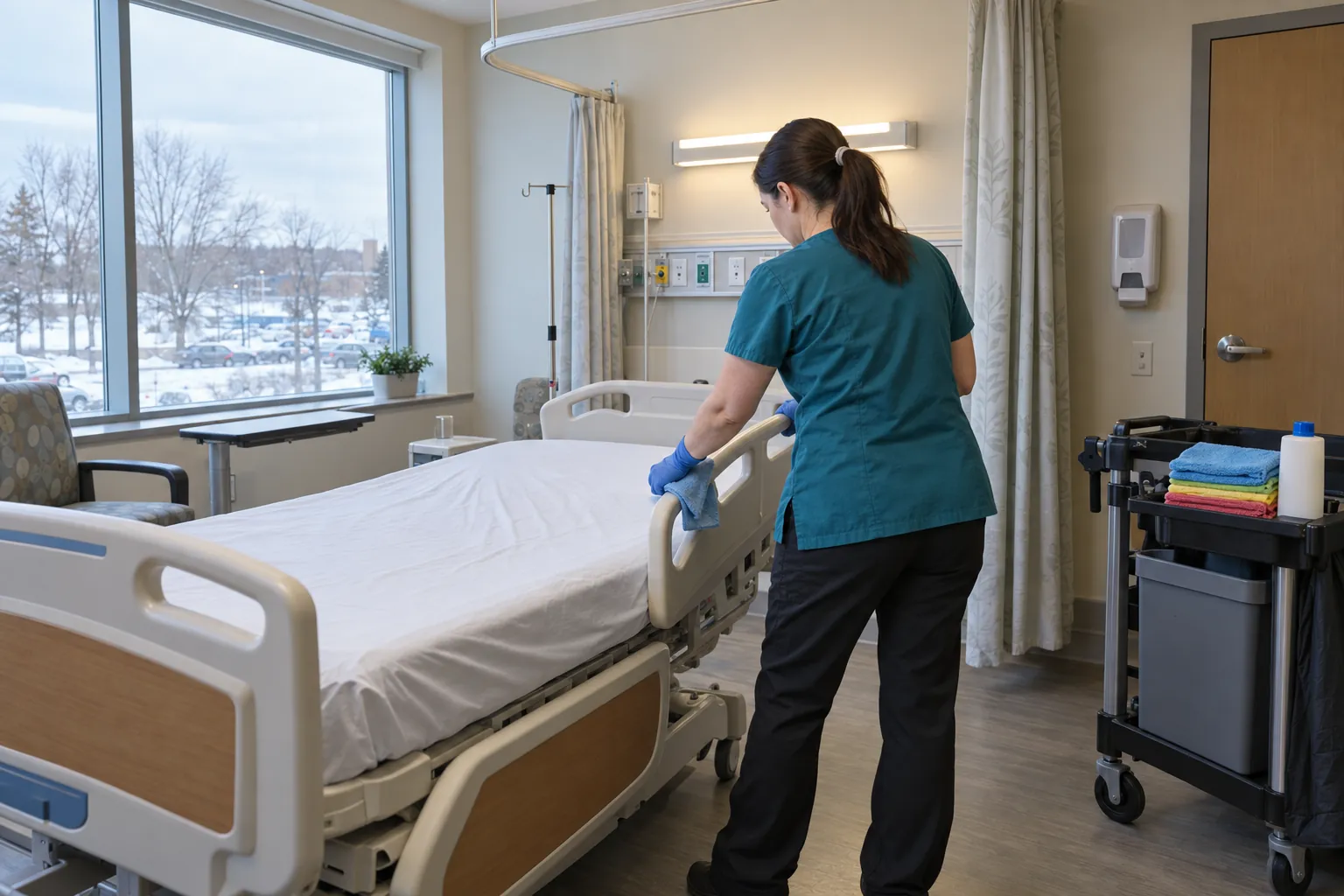
In Canada it is shaped by provincial best practice, above all Ontario's PIDAC guidance, by the national standard CSA Z317.12, and by provincial health and safety law. This guide covers what those documents ask for, how often each area is cleaned, who is responsible for what, and how environmental services shows the cleaning was actually done.
01
What hospital environmental cleaning is, and which documents govern it
The most detailed Canadian source is Ontario's Provincial Infectious Diseases Advisory Committee (PIDAC). Its Best Practices for Environmental Cleaning for Prevention and Control of Infections in All Health Care Settings, published by Public Health Ontario, is in its 3rd edition (2018), with a 1st revision in November 2025. It defines cleaning as "the physical removal of foreign material (e.g., dust, soil) and organic material (e.g., blood, secretions, excretions, microorganisms)", adding that cleaning "physically removes rather than kills microorganisms". Disinfection is "the inactivation of disease-producing microorganisms", and it does not destroy bacterial spores.
PIDAC then separates two standards of clean. A hotel clean is "a measure of cleanliness based on visual appearance that includes dust and dirt removal, waste disposal and cleaning of windows and surfaces", and it is the basic level for every area of the building. A health care clean is a hotel clean plus disinfection of high-touch surfaces with a hospital disinfectant, cleaning and disinfection of noncritical medical equipment between patients, and cleaning practices that are "periodically monitored and audited with feedback and education". It applies to all patient care areas and to washrooms, which PIDAC counts as part of the health care component "even if located outside of care areas".
The national standard is CSA Z317.12:25, Cleaning and disinfecting of health care facilities. This second edition, published in 2025, supersedes the 2020 edition. According to CSA Group's published scope, it applies to all facilities, public or private, that provide health care treatments, health-related services or diagnostic testing, "regardless of type, size, location, or range of services". It also applies to everyone who cleans and disinfects there, "regardless of their departmental affiliation or professional designation (whether directly employed by the HCF or out-sourced personnel)". CSA Group sells it, and readers in Canada can also view it online with a free CSA Group account. This guide quotes only its published scope.
02
What environmental cleaning covers on a hospital unit
Environmental services (EVS) departments, and the housekeeping teams of smaller facilities, usually organize the work into a few kinds of clean. PIDAC's sample procedures and appendices describe each:
- Routine daily cleaning of a patient room: an assessment walk-through, then cleaning from clean to dirty and from high to low, starting with the door, handles, push plate and frame, then light switches, wall-mounted dispensers, furnishings, horizontal surfaces, bedrails, bed controls and call bell, then the bathroom and the floor.
- The patient bathroom, cleaned last. A bathroom in a private room is cleaned daily; for shared bathrooms in semi-private or ward rooms, daily is the minimum, and PIDAC says twice daily should be considered, particularly where a ward room houses more than two patients.
- Discharge or transfer cleaning (often called terminal cleaning): "the thorough cleaning of a client/patient/resident room or bed space following discharge, death or transfer", so the next occupant does not pick up what the last one left.
- Rooms on Additional Precautions: for C. difficile a sporicidal agent, and for VRE a low-level hard surface disinfectant, with fresh cloths, mop heads and solutions for the room. Facilities must have written procedures for C. difficile, norovirus, VRE and CPE.
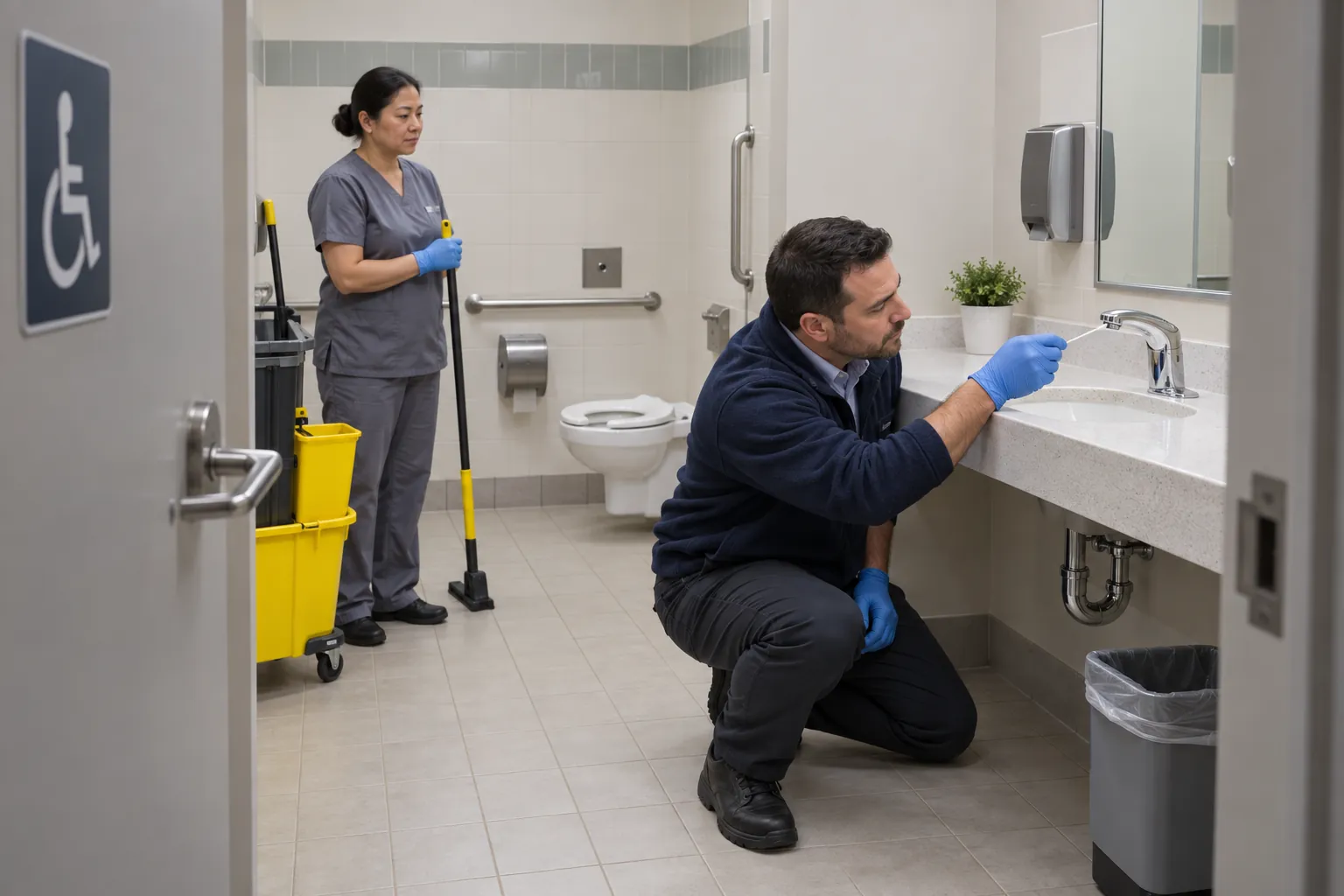
- Emergency and urgent care washrooms: at a minimum, patients' and public bathrooms there should be cleaned every four hours and disinfected with a sporicidal agent, and more often when needed.
- Noncritical medical equipment, cleaned and disinfected between patients.
- Periodic work: high dusting and baseboards at least weekly, window blinds dusted monthly, window curtains cleaned at least annually, shower walls scrubbed at least weekly and shower curtains changed at least monthly. Privacy curtains should be changed after every discharge.
- Spills of blood and body fluids, under written policies and procedures.
Some practice points apply to all of it. Cloths are not dipped back into disinfectant (no "double-dipping"), aerosol and trigger sprays for cleaning chemicals are not used, and disinfectants must have a Drug Identification Number (DIN) from Health Canada. Cleaning products are used according to the manufacturer's instructions for dilution, temperature, water hardness and contact time. Gloves come off and hands are cleaned between patient environments. Mould, cracks and leaks are reported for repair.
03
How often: the risk stratification matrix
PIDAC says cleaning schedules "must be developed based on an assessment of the risk of contaminated surfaces resulting in infection". Appendix 21 of the best practices document turns that into a score for each area, built from three factors:
- Probability of contamination: heavy (3), for areas routinely exposed to copious fresh blood or body fluids, such as a birthing suite, a hemodialysis station or the emergency room; moderate (2), which every patient room and bathroom is at a minimum; or light (1), such as lounges, libraries and offices.
- Vulnerability of the population: more susceptible (1) for immunocompromised patients in oncology, transplant and chemotherapy units, level 2 and 3 nurseries and burn units; otherwise less susceptible (0).
- Potential for exposure: high-touch surfaces (3), "those that have frequent contact with hands", such as doorknobs, telephones, call bells, bedrails and light switches; or low-touch surfaces (1), such as walls, ceilings, mirrors and window sills.
Add the three scores. A total of 7 is high risk: clean after each case, event or procedure and at least twice a day. A total of 4 to 6 is moderate risk: clean at least once a day. A total of 2 or 3 is low risk: clean to a fixed schedule. Every band adds "clean additionally as required", for gross soiling for example. PIDAC's examples put a cardiac catheterization area at 7 and a burn unit at 6.
The matrix gives minimums, not targets. Each total becomes a line in the cleaning schedule, with a time, an area and a named role.
04
Who is responsible for what
PIDAC asks for an environmental service program with "a single individual assigned overall responsibility for the care of the physical facility", enough trained supervisors to support every frontline worker, and written procedures with "defined lines of accountability" and "defined responsibility for specific areas and items". Its policies section puts it plainly: cleaning standards, frequency and accountability should be clearly defined, "i.e., who cleans, what do they clean and when do they clean it", and schedules, procedures and checklists should "ensure that no area or item is missed from routine cleaning".
The gap often opens between direct care staff and environmental services staff. British Columbia's Best Practices for Environmental Cleaning (PICNet, 2016) notes that "there is often confusion between direct care providers and ES staff over the allocation of cleaning responsibilities, especially of clinical equipment", which "can result in a whole range of items not being cleaned". Its answer is a written split. Direct care staff clean equipment used between patients, equipment attached to a patient and their own items, such as stethoscopes and phones. Environmental services clean equipment dedicated to a patient but not attached to them, and equipment in the patient environment is covered by the discharge clean. Whatever the split, write it down and decide it before new equipment is bought.
Staffing and supervision are part of the standard, not an afterthought:
- Staffing levels must reflect the physical nature and acuity of the facility; PIDAC notes that Canadian acute care EVS departments are "frequently under-resourced".
- Dedicated environmental service workers are preferred. If other tasks, such as patient transport or meal delivery, are given to them, staffing must be recalculated and cleaning must stay the priority.
- PIDAC gives an example supervisory ratio of one supervisor to 15 to 20 workers in the patient care areas of an acute care facility. Supervisors are responsible for training, for auditing and for the correct use of personal protective equipment, and they should be certified.
- Where cleaning is contracted out, the contract should set clear expectations for frequency, standards, audit and feedback.
05
How cleaning is checked: audits, marking and feedback
PIDAC requires "a process in place to measure the quality of cleaning" and recommends at least one measure that directly assesses cleaning, environmental marking or ATP bioluminescence, in addition to observational assessments such as visual assessment or performance observation. Results should feed back to frontline workers, and aggregate results must go to EVS leadership, infection prevention and control, and administration.
Public Health Ontario's Introduction to Implementing Environmental Cleaning Auditing (August 2023) describes the methods side by side:
- Visual assessment: a trained observer, usually the EVS supervisor, inspects an area after cleaning against a checklist. It shows a hotel clean, not that surfaces are free of microorganisms.
- Performance observation: the supervisor watches a worker clean and checks each step against the procedure. People may work differently when observed.
- Environmental marking: an invisible fluorescent gel or powder is placed on set surfaces before cleaning and checked with a black light afterwards. PIDAC suggests marking 15 specific surfaces each time and keeping staff unaware of which rooms are marked. When marking programs start, many high-touch surfaces are found to be missed.
- ATP bioluminescence: a swab and meter measure organic residue. It is quick, but some products, including bleach and hydrogen peroxide, can interfere with the reading.
- Satisfaction surveys of patients, residents and families. Environmental cultures, PIDAC says, should not be done routinely.
The same Public Health Ontario document summarizes what the 2020 edition of CSA Z317.12 required: visual assessments along with one of environmental marking, ATP bioluminescence, microbial culture or survey; an assessment of patient, resident and family satisfaction; and performance observations "at least once a year for every health care worker involved in cleaning and disinfection". Check the 2025 edition for the current wording. It also lists "an incident management reporting system to document reports of unclean areas that are identified outside of routine audits".
Public Health Ontario's introduction sets no fixed audit frequency. Each organization sets its own, spreading audits across staff and shifts, auditing higher-risk areas more often, and adding audits after training, after a change in process, or when C. difficile, VRE or norovirus is a concern. British Columbia's guidance adds that monitoring should happen "immediately after cleaning", and that the data should be retained and used for trend analysis.
06
Where the cleaning record fails, and what SiteClara does about it
The daily record is often the weakest part of the program. The discharge clean is ticked on a sheet or a bed board with no time. The four-hourly clean of the emergency department washroom is initialled in a column that fills up at the end of the shift. The broken towel dispenser is mentioned to whoever was passing and never reaches maintenance. During an outbreak, nobody can say who cleaned a room or when. PIDAC notes the same pattern from marking audits: surfaces are often missed because workers "were not aware that they were responsible for cleaning a specific surface or item".
SiteClara records routine checks at the place where the work happens. Each location, such as a public washroom, an emergency department waiting room, a soiled utility room or a housekeeping closet, has a printed QR poster, with an NFC tag behind it if staff would rather tap than scan. The worker scans or taps with their own phone, with no app to install, sees the checks due there and marks each one done, or says what stopped them. The time and the named person are recorded as it happens, with a photo when one is asked for; in a patient area, that photo should never show a patient. A problem found on the round, such as a leaking tap, an empty hand rub dispenser or a damaged surface, is reported from the same scan and stays on the team's list of open jobs until someone closes it.
Checks are scheduled per location, each with its own due time, so a washroom on a four-hour cycle shows every one of its cleans as due, done or missed. The supervisor sees what was done and what was missed, records the reason a check was missed, and at the end of the day reviews and approves a report. That report goes to the nominated managers, for example the EVS manager and the infection prevention and control lead, at 8 a.m. the next morning, showing what was completed and what is still open.
07
Questions people ask
What is the purpose of environmental cleaning in healthcare?
To stop the spread of infection. PIDAC's Best Practices for Environmental Cleaning for Prevention and Control of Infections in All Health Care Settings explains that caring for large numbers of patients contaminates surfaces and equipment with harmful microorganisms, and that "contaminated surfaces and equipment contribute to the transmission of microorganisms and to the burden of health care-associated infection". Routine and effective cleaning and disinfection, it says, "protects clients/patients/residents, staff and visitors from infection", which is why a hospital is cleaned more often and more intensively than other buildings.
What are the 7 steps of the hospital cleaning process?
There is no official seven-step list in Canada. The nearest is Appendix 4 of PIDAC's Best Practices for Environmental Cleaning for Prevention and Control of Infections in All Health Care Settings, a sample procedure for the routine daily cleaning of a patient room in eight steps: assess the room, assemble supplies, clean hands and put on gloves and any other personal protective equipment, clean the room from clean to dirty and from high to low, dispose of soiled cloths, linen and waste, remove gloves and clean hands, replenish supplies, and clean hands again. Within the cleaning step, the bathroom and then the floor come last.
What chemicals do they use to clean hospitals?
A cleaning agent to remove soil and a hospital disinfectant to inactivate microorganisms, often combined as a one-step cleaner/disinfectant. PIDAC's Best Practices for Environmental Cleaning for Prevention and Control of Infections in All Health Care Settings lists the hospital disinfectants commonly used in health care settings as alcohol (ethyl or isopropyl), improved hydrogen peroxide, iodophors, phenolics, quaternary ammonium compounds and sodium hypochlorite (bleach), with a sporicidal agent for the rooms of patients with C. difficile. In Canada a disinfectant is regulated as a drug and must have a DIN from Health Canada, with sodium hypochlorite and alcohol-based disinfectants the exceptions. PIDAC recommends choosing a single hospital disinfectant that meets all or most of a facility's needs, to limit training and errors.
What is the position called when you clean hospitals?
Usually environmental service worker (ESW), working in the environmental services (EVS) department, though hospital cleaner and housekeeper are also common. The National Occupational Classification profile for NOC 65310, Light duty cleaners lists "Environmental service worker (ESW) - hospital" and "Hospital cleaner" among its example titles, and PIDAC's best practices document calls the role environmental service worker throughout.
08
Further reading, and a list to take away
Public Health Ontario's Environmental Cleaning resources page gathers the PIDAC best practices document, illustrated guides to routine and discharge cleaning, online learning modules, and audit checklists for visual assessment, environmental marking and performance observation. In British Columbia, the Provincial Infection Control Network publishes the British Columbia Best Practices for Environmental Cleaning for Prevention and Control of Infections in All Healthcare Settings and Programs (September 2016). CSA Group sells CSA Z317.12:25. For Ontario hospitals and long-term care homes, the health and safety duties are in O. Reg. 67/93. Elsewhere, check your own province's regulation, its infection prevention and control network and any guidelines from your local health authority.
Before you rely on your environmental cleaning program, check that:
- one person holds overall responsibility for cleaning the facility;
- every area has a risk score and a cleaning frequency that meets PIDAC's minimum for that score;
- written procedures say who cleans each area and each item of equipment, including where nursing and EVS divide;
- routine, discharge and Additional Precautions cleaning each have a written procedure;
- every disinfectant in use has a DIN and is used at the manufacturer's dilution and contact time;
- training and proficiency are documented for every worker;
- audits combine an observational method with marking or ATP, and results go back to the workers and up to leadership;
- each scheduled clean is recorded with a time and a name, missed cleans are recorded as missed, and reported problems stay open until they are fixed;
- health and safety measures and procedures are reviewed at least once a year.
Sources
Every document this guide quotes or links to, in the order it first cites them.
- Best Practices for Environmental Cleaning for Prevention and Control of Infections in All Health Care Settings publichealthontario.ca
- CSA Z317.12:25, Cleaning and disinfecting of health care facilities csagroup.org
- O. Reg. 67/93, Health Care and Residential Facilities ontario.ca
- Best Practices for Environmental Cleaning picnet.ca
- Introduction to Implementing Environmental Cleaning Auditing publichealthontario.ca
- National Occupational Classification profile for NOC 65310, Light duty cleaners noc.esdc.gc.ca
- Environmental Cleaning resources publichealthontario.ca
Related guides
 CleaningLong-term care cleaning: the rules, the frequencies and a record that holds upLong-term care cleaning in Ontario: the housekeeping duty in O. Reg. 246/22, PIDAC cleaning frequencies, who does what, and records that show it was really done.
 CleaningHigh-touch surfaces: what counts, how often to clean them, and how to prove itHigh-touch surfaces in Canadian workplaces: what counts, how often to clean and disinfect them, how to do it properly, and how to check it was really done.
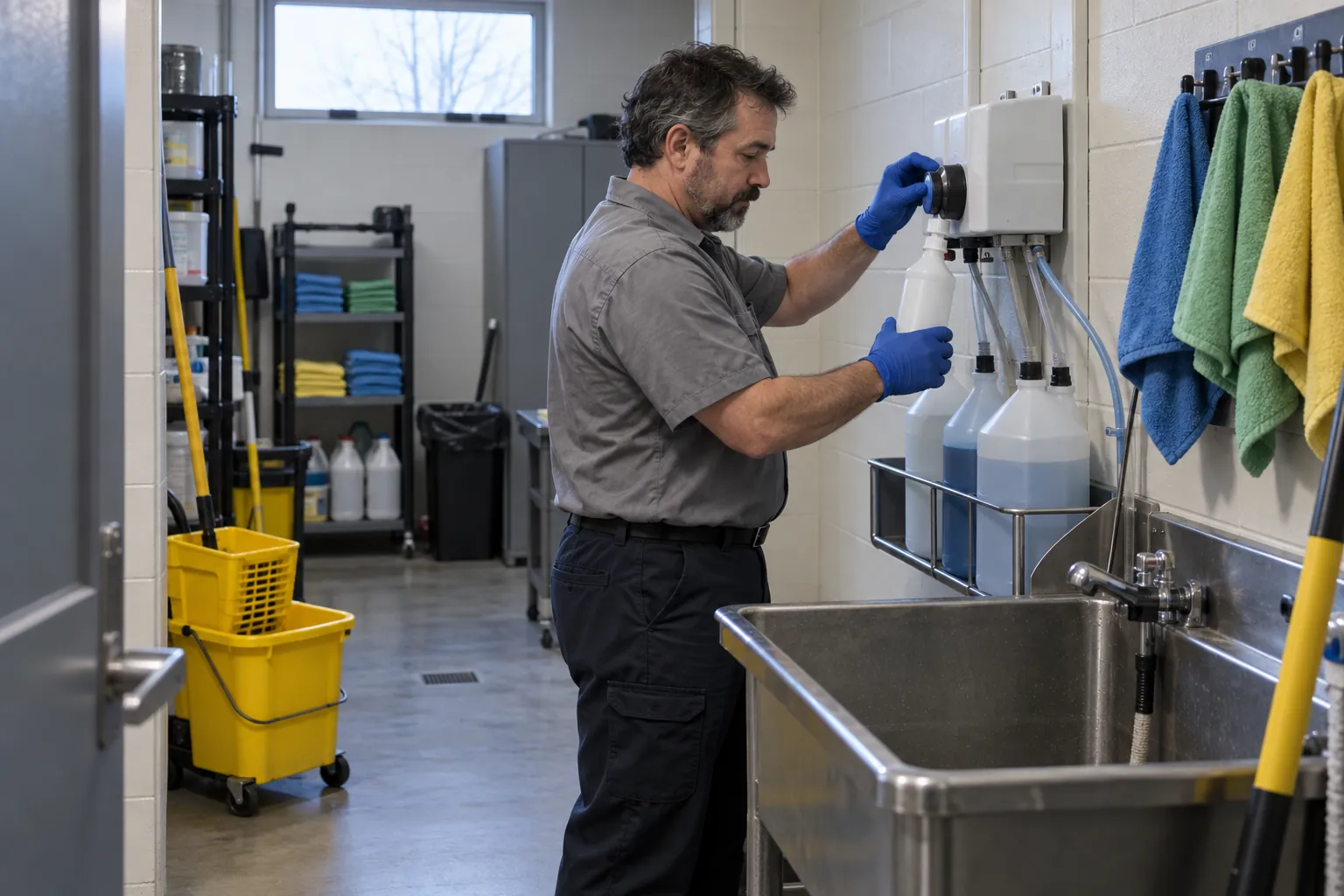 CleaningHealth Canada approved disinfectants: what the DIN tells you, and how to use itHow to tell a Health Canada approved disinfectant: the DIN, what the label must show, how to check it, and what the Biocides Regulations changed.
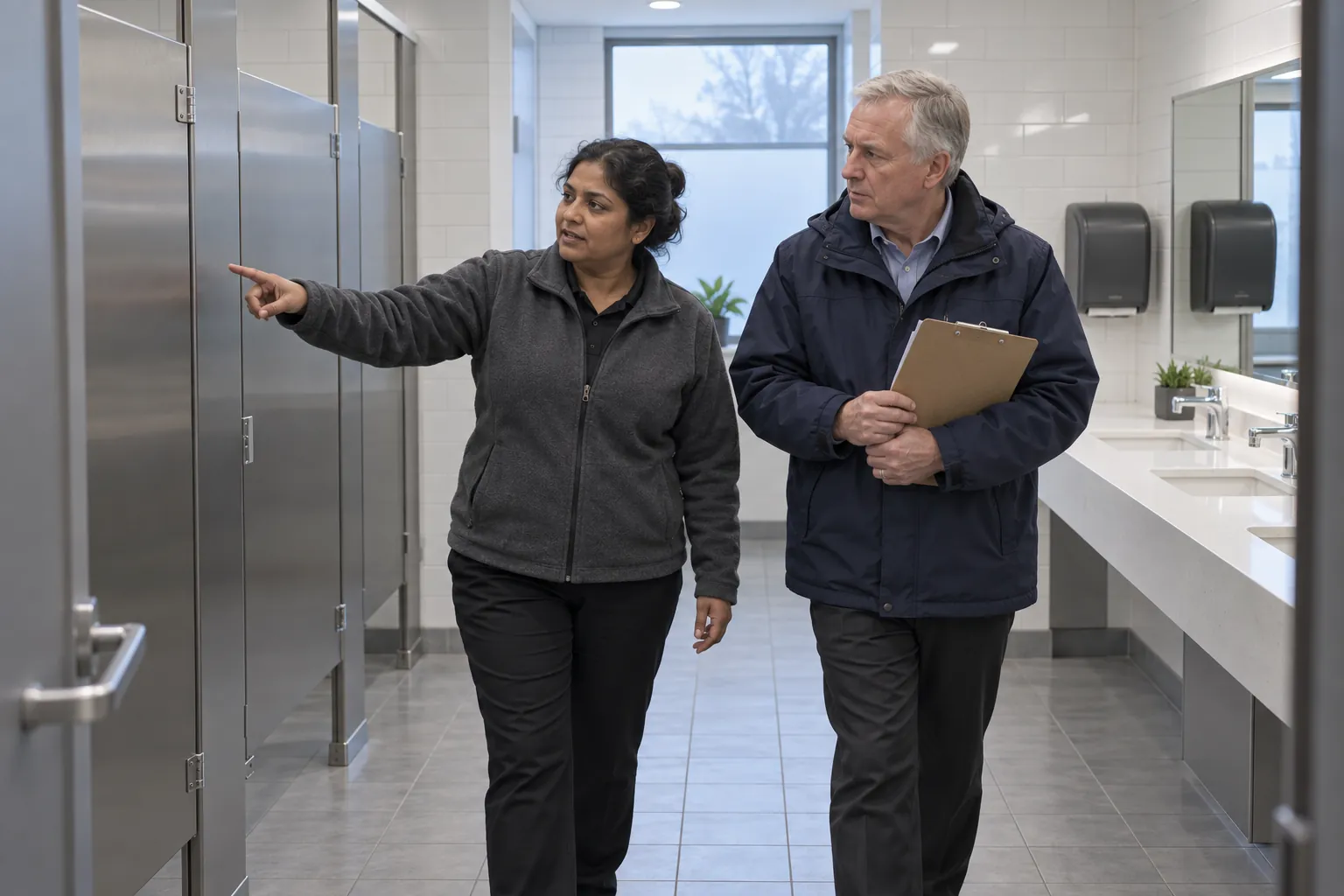 CleaningJanitorial quality control: how to inspect, correct and show the standard heldHow janitorial quality control works in Canada: QA versus QC, inspections, sampling, corrective action, CIMS, the PIDAC audit model and records that hold up.