Cleaning
Janitorial quality control: how to inspect, correct and show the standard held
Janitorial quality control is the routine of inspecting a cleaning service's work against a written standard, recording what falls short and making sure each failure is put right.
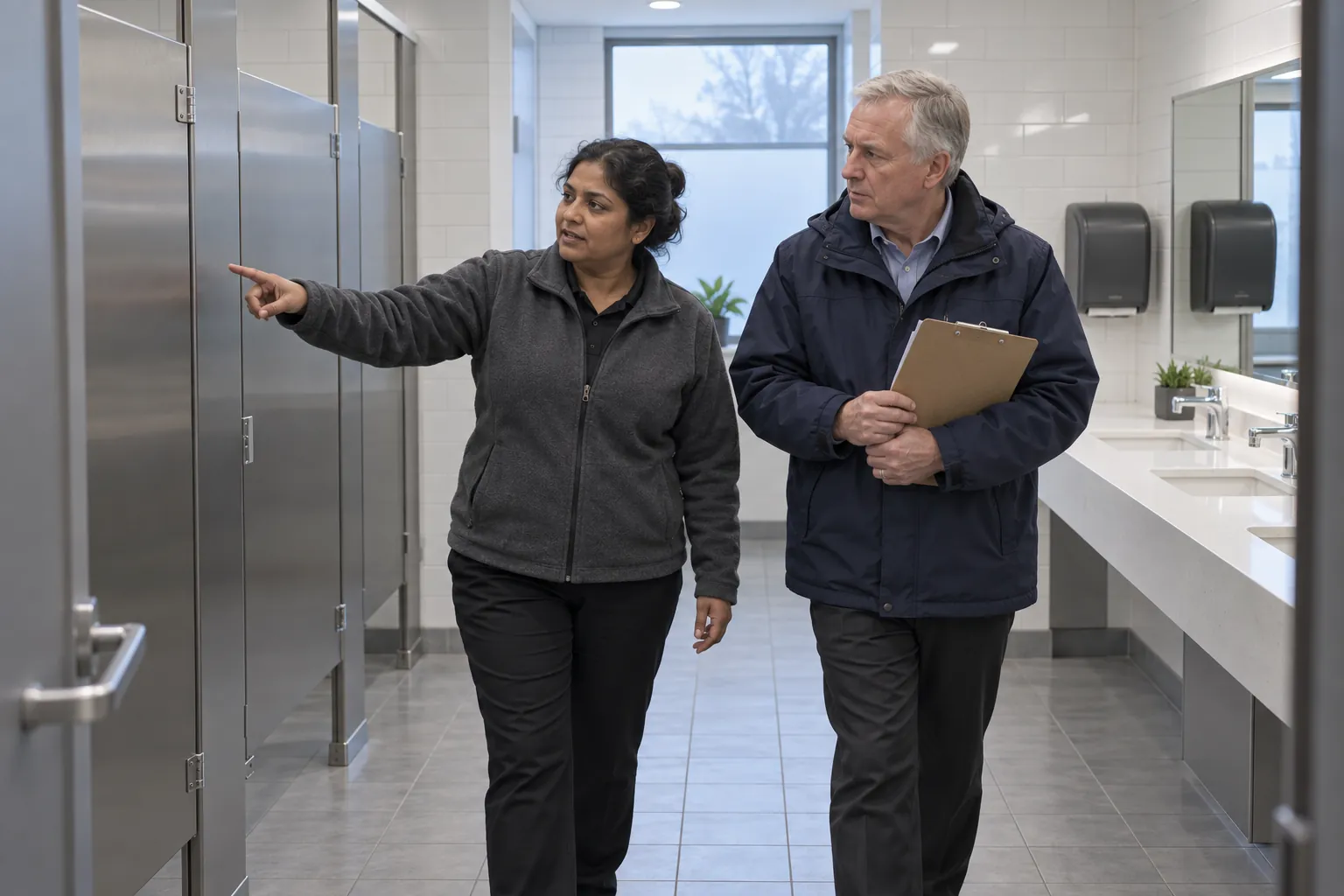
It is what separates a commercial cleaning contract that looks good on the night of the walk-through from one that is good every night. This guide covers the difference between quality assurance and quality control, the standards and rules behind them in Canada, how to run inspections and corrective action, and what a quality record looks like that the facility manager and the client can rely on.
01
Quality assurance and quality control in janitorial work
The two terms are often used as if they meant the same thing. They are related, but they do different jobs.
- Quality assurance (QA) is the system that makes good cleaning likely: a clear janitorial scope of work, trained staff, written methods, the right equipment and chemicals, enough hours, and supervision. It is about preventing failures.
- Quality control (QC) is the checking: inspections of the result, records of what was done, and corrective action when something falls short. It is about finding failures and fixing them.
Quality control is part of quality assurance, not a substitute for it. A janitorial company with thorough inspections but untrained crews will find the same failures every week; one with good training and no inspections will never know when the standard slips.
No Canadian law sets a janitorial quality control program for an ordinary building. What the law sets is the outcome, and it is mostly provincial. In Ontario, the province's guidance Maintaining clean washroom facilities for workers says employers and constructors must "ensure any washroom facilities they provide for workers are maintained in a clean and sanitary condition", points to sections 23.1 and 25.3 of the Occupational Health and Safety Act and to O. Reg. 480/24, and requires them to "keep, maintain, and make available records of cleaning". For federally regulated workplaces, such as banks, airports and telecoms, the Canada Occupational Health and Safety Regulations, Part IX require every personal service room and food preparation area to be kept "in a clean and sanitary condition" (subsection 9.2(1)) and each personal service room to be "cleaned at least once every day that it is used" (section 9.4). Other provinces set their own general conditions.
Industry standards fill the gap between those outcomes and a working program:
- The ISSA Cleaning Industry Management Standard (CIMS), which ISSA describes as "the global benchmark for operational excellence in cleaning". It is written for both building service contractors and in-house cleaning organizations, certification is third-party, by accredited assessors, and the areas it asks an organization to address include quality planning, workloading, training, regulatory compliance, documentation and risk management. A green building level, CIMS-GB, helps customers earn points under LEED for Existing Buildings: Operations and Maintenance.
- ISO 9001, the general quality management system standard, held by some larger janitorial businesses.
- Public Health Ontario's PIDAC Best Practices for Environmental Cleaning for Prevention and Control of Infections in All Health Care Settings (3rd edition, revised November 2025). It is written for health care, but its chapter on assessing cleanliness and quality control is a detailed public model of janitorial QC, and it says its recommendations apply in all health care settings "regardless of whether cleaning is conducted by in-house staff, or contracted out".
02
What a janitorial quality control program covers
A working quality control program for a commercial cleaning contract has a few parts, and each one needs an owner, whether that is the janitorial supervisor, the contractor's operations manager or the client's property or facility manager:
- Written quality standards: what the result must look like in each area type, taken from the scope of work. "Washroom floors free of visible soil, standing water and paper" can be inspected; "washrooms cleaned" cannot.
- An inspection checklist for each area type, listing the elements to inspect: floors, horizontal surfaces, high-touch points, glass, waste receptacles, washroom fixtures and dispensers. It is separate from the task list the cleaner works through, such as a washroom cleaning checklist, which lists tasks rather than results.
- An inspection schedule: how often each area is inspected, by whom, and how rooms are sampled.
- A scoring method, so results can be compared over time, between shifts and between buildings.
- Records of work done, showing that the scheduled tasks were carried out, by whom and when, including the washroom cleaning record where a province requires one.
- Corrective action: how failures are put right, by when, and how the fix is confirmed.
- Review: a regular look at results, complaints and recurring failures, feeding into training, hours and methods.
- Feedback from occupants: how tenants, staff and the client raise problems, how those reach the crew, and how the answer gets back to them. Clear communication both ways keeps a small complaint from becoming a contract dispute.
- Periodic work: a check that each strip and refinish, carpet extraction and high dusting in the schedule actually happened, along with the winter program for entrance matting and salt residue. These are the tasks most easily skipped.
Keep the inspection checklist short enough to use: ten well-chosen elements per room, taken from your own scope of work, will be completed properly where a hundred will be completed quickly and badly. The parts are the same for offices, schools and long-term care homes; what changes is how often each area is inspected and how quickly a failure must be put right.
03
Running quality inspections
Regular inspections are the core of janitorial quality control. To be worth doing, they need to be consistent, representative and honest. The CCOHS guide to workplace housekeeping puts the reason plainly: inspection "is the only way to check for deficiencies in the program so that changes can be made", and a housekeeping program should assign responsibility for "inspection to ensure cleanup is complete".
- Inspect against the standard, not against an impression. Each element is acceptable or not according to the written standard. "Looks fine" is not a result.
- Use a standardized checklist. PIDAC says that when conducting visual assessments "a standardized approach and checklist is important to ensure consistency", because results otherwise vary between inspectors.
- Sample fairly. Inspect a spread of rooms and spaces across floors and types, including the ones cleaned last on the night shift, not only the ones by the elevators.
- Vary the timing. Unannounced inspections, and some at busy times, show the standard occupants actually experience. A washroom inspected at 7 a.m. tells you about the night clean, not about 2 p.m.
- Match frequency to risk. Washrooms, lunchrooms and entrances need inspecting more often than a storage room. Health care, food premises, child care and schools need more still.
- Share the inspection. A joint walk-through with the property manager or client representative, perhaps monthly, removes arguments about the score and shows both sides the same thing.
- Separate the inspector from the cleaner. The supervisor or a quality manager inspects; the cleaner who did the room does not score it.
PIDAC describes three observational methods, and each answers a different question. Visual assessment by a trained observer after cleaning is easy and allows feedback to individual staff, but its results "may vary across different observers". Performance observation, where a supervisor watches the work being done, checks the method rather than the result; it is labour intensive, and people may work differently when they know they are watched. Satisfaction surveys show how occupants see the building, not how well a surface was cleaned.
Scores are usually the percentage of inspected elements that pass. PIDAC suggests reporting visual assessments as "the proportion of items or surfaces inspected that were 'clean', out of the total number of items/surfaces assessed". Record failures by element and location, not only the overall score, because a steady 92% hides whether the same 8% fails every time.
04
Corrective action and continuous improvement
An inspection that finds a failure is only useful if the failure is fixed and does not come back. Every failure needs:
- Immediate rectification: the item is re-cleaned within a time set by its priority. A soiled washroom in a busy building cannot wait for the next shift.
- A named owner and a date for anything that cannot be fixed on the spot, such as a stained carpet that needs extraction or a broken dispenser the building has to replace.
- Confirmation: someone checks it has been done, rather than taking the action as closed when it is ticked.
- A cause: for anything that recurs, ask why. Too few hours, a missing product, a training gap, a floor that became busier, or a task nobody was told about.
Act on the cause, not only the symptom. If the same lunchroom fails every Monday, the fix may be a change to the weekend schedule rather than a word with the Monday cleaner. PIDAC makes the same point about environmental marking: when surfaces are missed, the reasons often turn out to be that staff "were not aware that they were responsible for cleaning a specific surface or item", did not know it needed cleaning, or were afraid of damaging it.
Complaints belong in the same loop. Treat each one as a free inspection: log it, fix it, and look for the pattern.
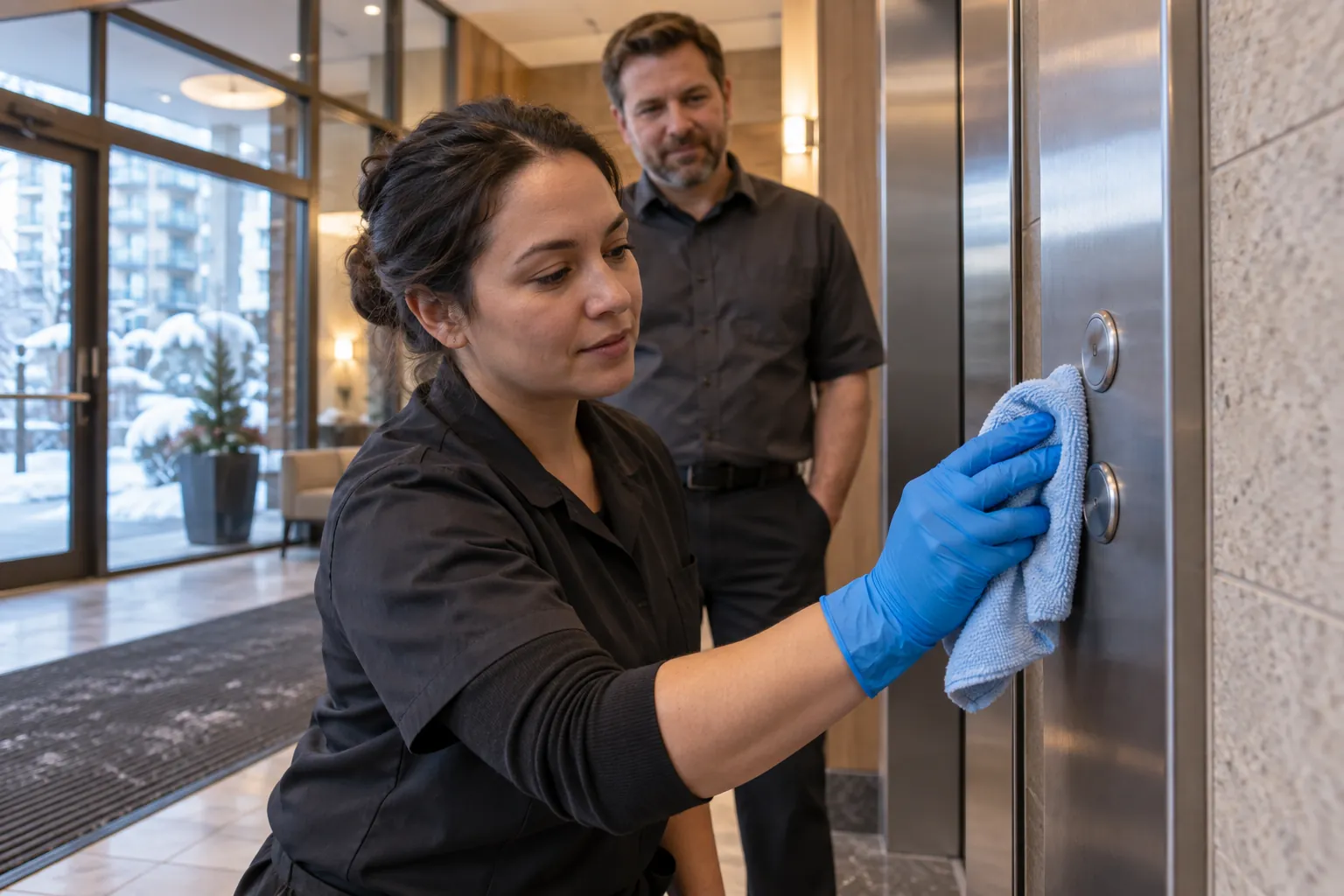
Continuous improvement comes from looking at results over time. A monthly review of inspection scores, complaints and recurring failures shows where the cleaning process is weak and where training, equipment or hours need to change. PIDAC recommends that audit results be used "for the purposes of training and to provide positive and constructive feedback to frontline environmental service workers", and that aggregate results go to leadership. In a contract, that means sharing the findings with the crew as well as with clients, and agreeing the measures in advance: our guides to cleaning KPIs and the janitorial service level agreement cover how.
05
Training, supervision and the crew
Most quality problems start with people and process rather than effort. A cleaner who has never been shown the right method, or who has too much square footage for the hours, will fall short however hard they work. The quality control program should feed back into:
- Training: orientation for every new cleaner, method training for each task and machine, and refresher training when inspections show a gap. PIDAC names inspection results as a tool for training, not only for grading.
- Methods and colour coding: consistent methods and colour-coded cloths and mops, so what is used in washrooms is never used in lunchrooms, protect hygiene as much as any inspection does.
- WHMIS and chemicals: CCOHS's guide Sanitation and Infection Control for Cleaning Staff tells cleaners to check labels and safety data sheets, not to mix cleaners and disinfectants "unless the labels say it is safe", and to take part in WHMIS training when working with hazardous products. The wrong product or dilution is a quality failure as well as a safety one.
- Disinfectants with a DIN: Health Canada's Guidance documents on disinfectants: Summary explains that disinfectants for environmental surfaces need a pre-market assessment and a drug identification number before they can be sold in Canada. A quality program checks that the product in the bottle is the one the scope of work names, used as its label directs.
- Supervision: in Ontario, the Guide to the Occupational Health and Safety Act sets out that a supervisor must ensure a worker works "in the manner and with the protective devices, measures and procedures required", and must "take every precaution reasonable in the circumstances for the protection of workers". A supervisor who walks the building during the shift catches problems while they can still be fixed. The janitorial supervisor duties guide covers the role.
The aim is cleaning that holds on an ordinary Tuesday in February, not only on the night the client walks the building: a standard that does not depend on who is watching.
06
Where the quality record fails, and what SiteClara does about it
Many quality control programs are strong on inspection and weak on everything between inspections. The monthly walk-through is written up; the nightly record of what was done lives on sheets taped inside closet doors, and a reported problem goes to whoever was passing. When a property manager asks whether a failure found on Thursday was put right, or whether the washroom rounds happened on Friday afternoon, the answer is often a recollection rather than a record.
SiteClara records the routine checks where they happen. A printed QR poster, with an optional NFC tag behind it, sits at each location. Staff scan or tap it on their own phone, with no app to install, see the scheduled checks due there, and mark each one done or explain what stopped them, with a photo when one helps. A problem reported there goes onto the team's list of open jobs until someone closes it, so a failure found on an inspection has an open job, an owner and a closing time rather than a note in a margin.
The supervisor sees what is due, done and missed, records why a check was missed, and can escalate a job to the building manager. The approved daily report goes to nominated management or client contacts at 8 a.m. the next morning, showing what was reported, what was completed, what is still open and how scheduled checks went, for example 12 of 12 completed.
07
Questions people ask
What should a janitorial quality control checklist include?
The elements to inspect in each area type, each judged clean or not clean against the written standard, so the result can be scored. Public Health Ontario's PIDAC Best Practices for Environmental Cleaning for Prevention and Control of Infections in All Health Care Settings says that when conducting visual assessments "a standardized approach and checklist is important to ensure consistency", suggests reporting the proportion of items or surfaces inspected that were clean, and gives sample environmental cleaning checklists in Appendix 22. Keep the inspection checklist separate from the task list the cleaner works through, and short enough to complete properly.
How do you manage janitorial staff?
With clear responsibility, enough trained supervisors, written procedures and regular feedback from inspections. For health care, Public Health Ontario's PIDAC environmental cleaning best practices call for a single individual with overall responsibility, "a sufficient number of supervisors trained and knowledgeable in cleaning standards and practices", written procedures with defined lines of accountability and responsibility for specific areas and items, initial and continuing education, and monitoring whose results go back to the staff, whether cleaning is done by in-house staff or contracted out. CCOHS's Workplace Housekeeping – Basic Guide adds that a good program assigns responsibility for each task, including inspection.
What are the 5 basic cleaning principles?
No Canadian standard sets out exactly five, but Public Health Ontario's PIDAC environmental cleaning best practices, written for health care, state the principles most such lists draw on: remove dirt and debris completely, using friction, because microorganisms can only be removed or inactivated once it is gone; clean surfaces of visible soil before disinfecting them, since organic material may inactivate a disinfectant; work from clean to dirty; work from high to low; and apply cleaning procedures "regularly, consistently and correctly".
08
Further reading, and a list to take away
For the standard of a well-run janitorial organization, read ISSA's CIMS pages for building service contractors. For a detailed public model of inspection and audit, read chapter 9, Assessment of Cleanliness and Quality Control, of Public Health Ontario's PIDAC environmental cleaning best practices. For the law, start with your own province: in Ontario, the province's washroom guidance and the OHSA; in British Columbia, Part 4 of the WorkSafeBC Occupational Health and Safety Regulation; for federally regulated work, Part IX of the Canada Occupational Health and Safety Regulations. CCOHS's pages on housekeeping and on cleaning staff are short and practical.
To check your own janitorial quality control, ask whether:
- written standards exist for each area type, and the crew has seen them;
- the inspection checklist is short enough to be completed properly;
- inspections are sampled fairly, some unannounced, and some joint with the client;
- the person inspecting is not the person who cleaned;
- failures are recorded by element and location, not only as a score;
- every corrective action has an owner, a date and a confirmation;
- recurring failures are traced to a cause;
- results feed back into training, hours, products and methods;
- the washroom cleaning record your province requires is kept as the rule describes;
- there is a record of work done between inspections, as well as the inspections themselves.
Sources
Every document this guide quotes or links to, in the order it first cites them.
- Maintaining clean washroom facilities for workers ontario.ca
- Canada Occupational Health and Safety Regulations, Part IX laws-lois.justice.gc.ca
- ISSA Cleaning Industry Management Standard (CIMS) cims.issa.com
- Areas it asks an organization to address cims.issa.com
- PIDAC Best Practices for Environmental Cleaning for Prevention and Control of Infections in All Health Care Settings publichealthontario.ca
- Workplace housekeeping ccohs.ca
- Sanitation and Infection Control for Cleaning Staff ccohs.ca
- Guidance documents on disinfectants: Summary canada.ca
- Guide to the Occupational Health and Safety Act ontario.ca
- Part 4 of the WorkSafeBC Occupational Health and Safety Regulation worksafebc.com
Related guides
 CleaningCleaning KPIs: what to measure in a janitorial contract, and how to know the figures are trueThe cleaning KPIs worth measuring in a Canadian janitorial contract, how to define and target them, how to report them, and how a green dashboard can mislead.
 CleaningJanitorial scope of work: what it should say, and how to show it is metWhat a janitorial scope of work should contain in Canada: areas, tasks, frequencies, standards, winter care, WHMIS and products, and how to show the work was done.
 CleaningJanitorial supervisor duties: what the role involves in Canada, and what good looks likeWhat a janitorial or cleaning supervisor does in Canada: the main duties, a typical shift, the legal duties of a supervisor, WHMIS, checking the work and reporting.
 CleaningJanitorial service level agreement: what to include, and how to show it is metWhat a janitorial or cleaning service level agreement should contain in Canada: service levels, response times, holdbacks, escalation and proof of delivery.