Cleaning
High-touch surfaces: what counts, how often to clean them, and how to prove it
High-touch surfaces are the surfaces many people touch with their hands, such as door handles, elevator buttons, handrails, faucets and light switches, and Canadian workplace guidance says to clean them at least once a day, and more often where the workplace needs it.
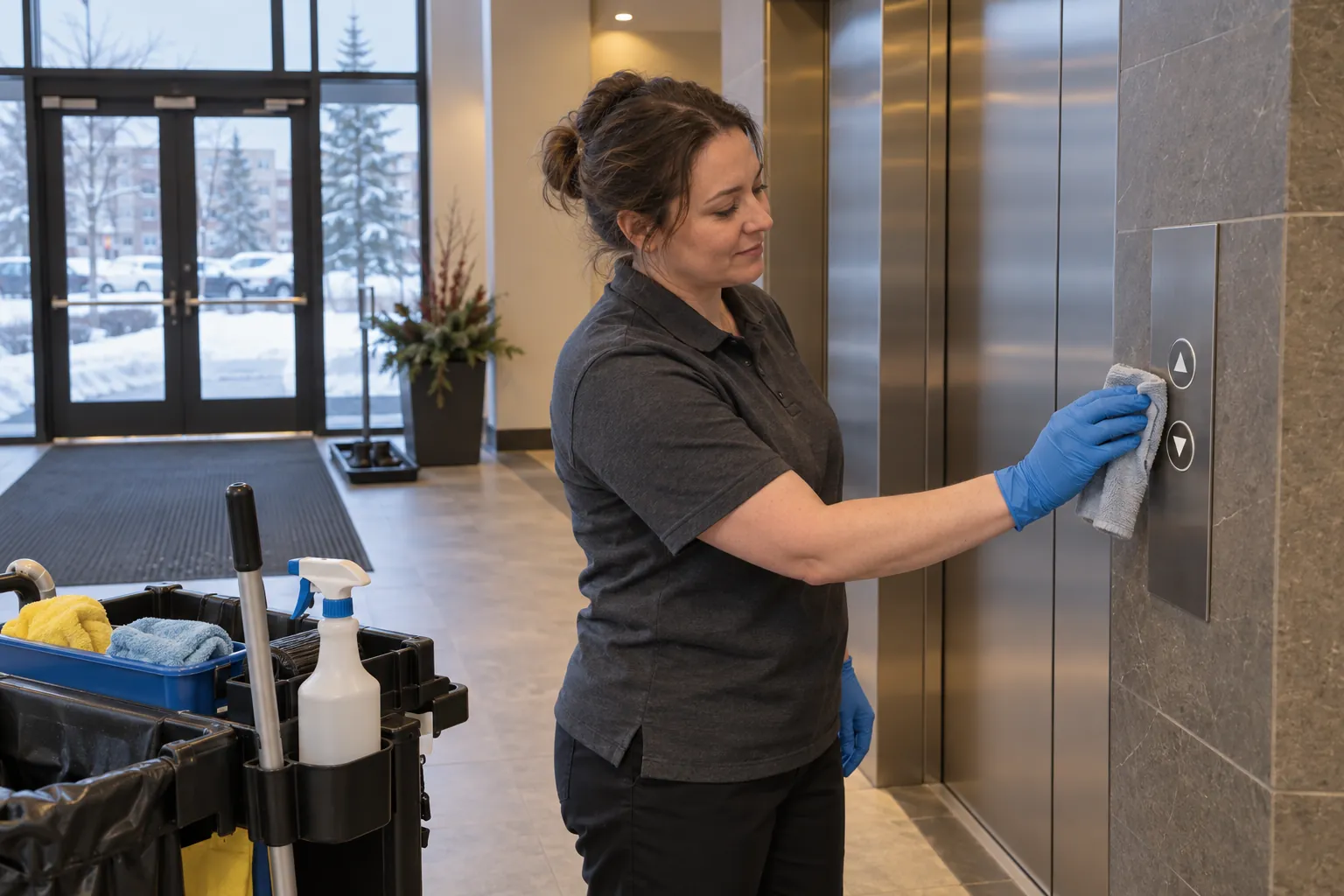
They are small, easy to miss and the reason a building can look clean while germs move from hand to hand. This guide explains what Canadian public health guidance means by a high-touch surface, which ones to list in an ordinary building, how often to clean and disinfect them, how to do it so it works, and how a supervisor can tell it was done.
01
What a high-touch surface is, and who defines it
The clearest Canadian definition comes from Ontario's Provincial Infectious Diseases Advisory Committee (PIDAC). Its Best Practices for Environmental Cleaning for Prevention and Control of Infections in All Health Care Settings, published by Public Health Ontario (3rd edition, first revised in November 2025), says: "High-touch surfaces are those that have frequent contact with hands." Its examples include doorknobs, elevator buttons, telephones, call bells, bedrails, light switches, toilet flushes and the edges of privacy curtains. Low-touch surfaces are "those that have minimal contact with hands", such as floors, walls, ceilings, mirrors and window sills.
Any surface can be contaminated, but PIDAC notes that the risk is greater for surfaces handled often by hands or gloves. A floor may look dirtier than a push plate, but it is the push plate that passes bacteria, viruses and other microbes from one hand to the next.
The Canadian Centre for Occupational Health and Safety (CCOHS), in its guide Sanitation and Infection Control for Cleaning Staff, uses the word "touch point" for the same thing: "any surface that can be touched by bare hands by multiple people, multiple times." Its examples are closer to an office or a school: door knobs, handles, kettles, coffee makers, water faucets, and shared items such as touch screens, photocopiers and telephones.
The Public Health Agency of Canada makes the same point outside health care in COVID-19: Cleaning and disinfecting, which advises people to regularly clean and disinfect high-touch surfaces in their home, especially when they are visibly dirty or when someone is sick, and tells workers to focus on high-touch surfaces such as phones, card machines, keypads, elevator buttons, light switches, door handles and handrails.
02
The high-touch surfaces in an ordinary building
PIDAC is careful to say that the specific surfaces that should be treated as high-touch vary from one setting to another. The best list is made by walking the building and watching what people actually touch. As a starting point for an office, school, community centre, retail store or residential tower, most janitorial teams end up with something like this:
- Entrances and lobbies: door handles and push plates, automatic door buttons, the reception counter, sign-in tablets, intercom panels.
- Elevators and stairs: call buttons on every floor, the car's buttons and handrail, stair handrails.
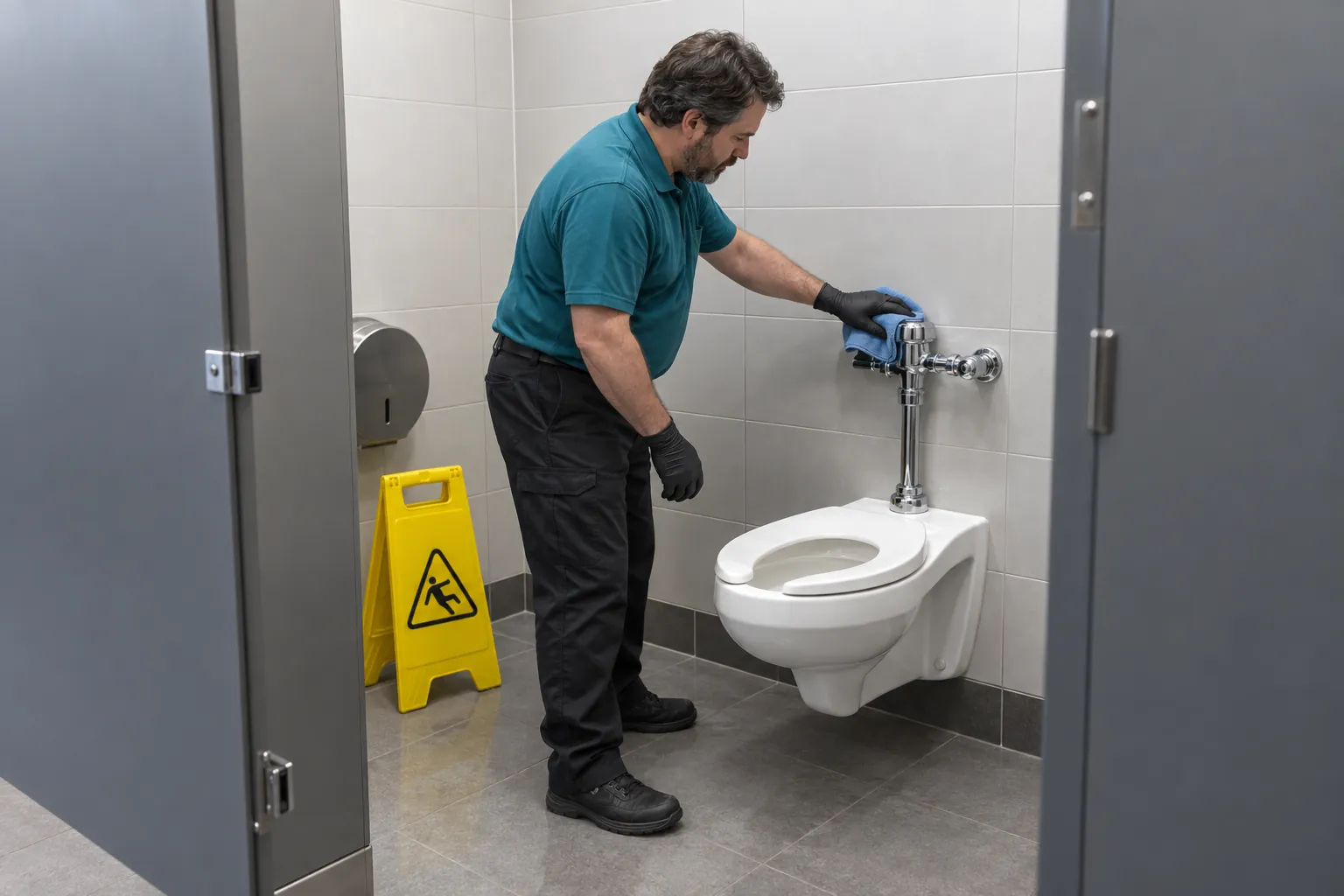
- Washrooms: door handles and locks, flush handles, toilet seats, faucets, soap and towel dispensers, hand dryer buttons, diaper changing tables.
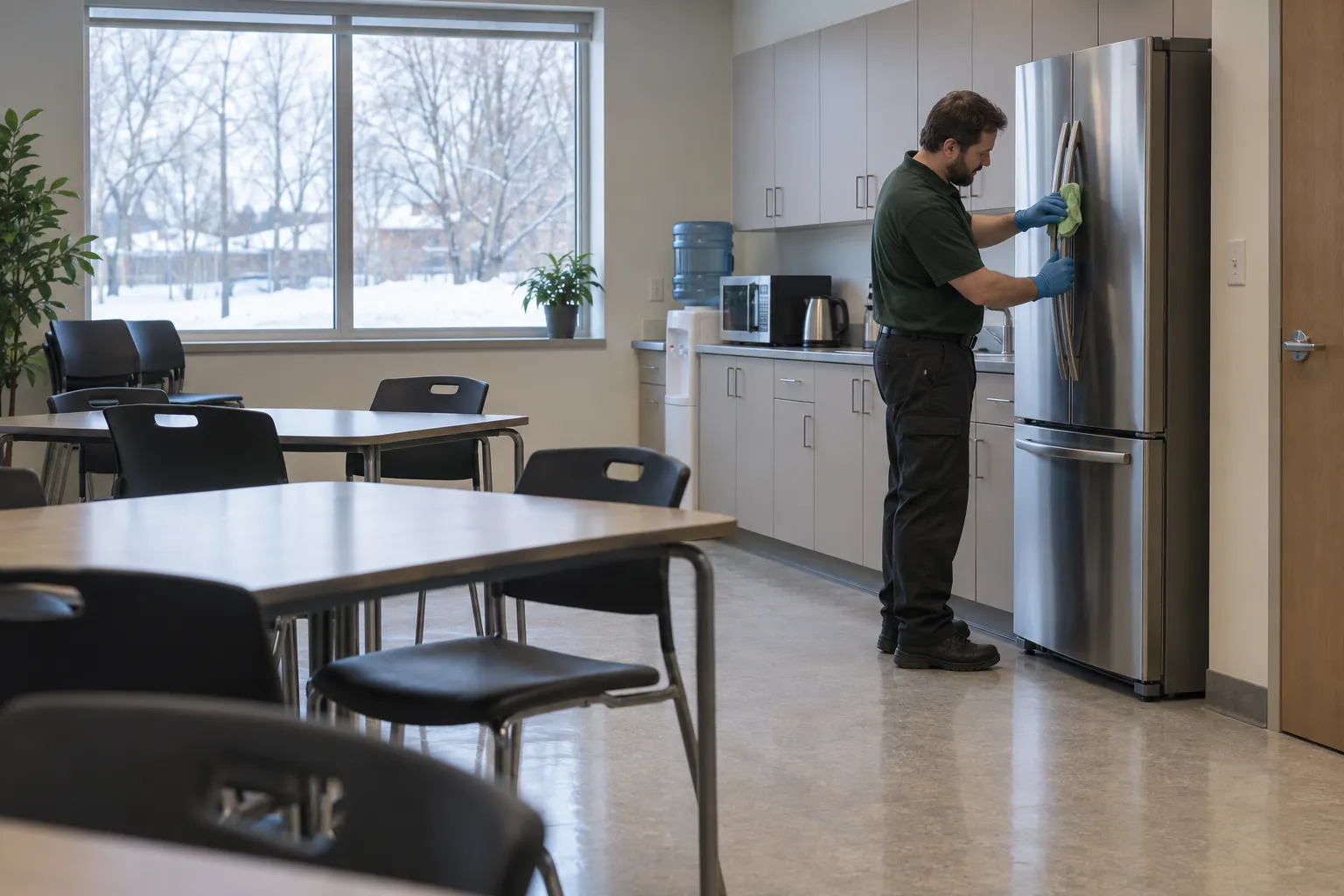
- Kitchens and lunchrooms: fridge, microwave and cupboard handles, kettle and coffee maker controls, water cooler taps, tables, vending machine buttons.
- Offices and meeting rooms: shared desks, meeting tables and chair arms, light switches, conference phones, screen remotes.
- Shared equipment: photocopier panels, shared keyboards, badge readers, touch screens, payment keypads.
- Classrooms, gyms and change rooms: desks, shared tablets, fitness machine grips, lockers and benches.
- Parkades and service areas: parking pay machines, stairwell door bars, garbage room doors, loading dock controls.
Write the list per location: a checklist that names the elevator call buttons on every floor gets them cleaned; one that says "lobby" often does not.
Low-touch surfaces still need cleaning, on their own schedule. PIDAC's guidance for care settings is that low-touch surfaces are cleaned on a regular basis and when soiled or spilled on, and that for many of them cleaning can be less often than daily, such as every other day or weekly, as long as they are cleaned sooner when visibly soiled.
03
How often to clean high-touch surfaces
There is no single frequency for every building. The Canadian guidance gives a floor and a way to decide how far above it to go.
CCOHS's advice for workplaces is to clean touch points "at least once per day but more frequent cleaning (every 2 to 3 hours) may be necessary", and, where the workplace runs in shifts, to clean between shifts or at least once during each shift. For washrooms, its Workplace Housekeeping – Basic Guide says they require cleaning once or more each shift, with a good supply of soap and towels.
PIDAC gives the most structured method, written for hospitals and other health care settings but easy to borrow. Each area gets a score from three factors:
- Probability of contamination: heavy (3) where surfaces are regularly exposed to significant amounts of blood or body fluids, moderate (2) where they become contaminated with blood or body fluids but it is contained or quickly removed, as in patient rooms and bathrooms, light (1) where surfaces are not exposed to blood or body fluids, such as lounges, libraries and offices.
- Vulnerability of the people there: more susceptible (1), such as transplant units or neonatal nurseries, or less susceptible (0) for everyone else.
- Potential for exposure: high-touch surfaces (3) or low-touch surfaces (1).
The total sets the minimum frequency. A score of 7 means clean after each case or event and at least twice a day; 4 to 6 means clean at least once daily; 2 or 3 means clean on a fixed schedule; and in every band, clean additionally as required, for example after gross soiling. On that scale, the high-touch surfaces of an ordinary office, lounge or meeting room score 4 (3 for high-touch, 1 for light contamination, 0 for a less susceptible population), so the minimum is once a day, with more when needed.
In practice, frequency follows use. A lobby door pushed by hundreds of people at 8 a.m. warrants more than a lunchtime wipe. Go above once a day for heavy foot traffic at fixed times (school start, a food court's lunch rush, a shift change), during an outbreak of gastrointestinal or respiratory illness, where people are more vulnerable to infection, and in washrooms. Anything visibly soiled is cleaned at once, whatever the schedule says.
Whatever you choose, write it per location and per time: "elevator buttons, all floors, 10 a.m. and 3 p.m." is a task someone can do and be checked on; "high-touch surfaces regularly" is not.
04
How to clean and disinfect high-touch surfaces so it works
Cleaning and disinfecting are different jobs. PIDAC defines cleaning as physically removing dirt, organic material and microorganisms with water, detergent and mechanical action: "the key to cleaning is the use of friction". Disinfection kills most disease-causing microorganisms. The Public Health Agency of Canada agrees that soap and water do not necessarily kill germs but reduce them by removing them.
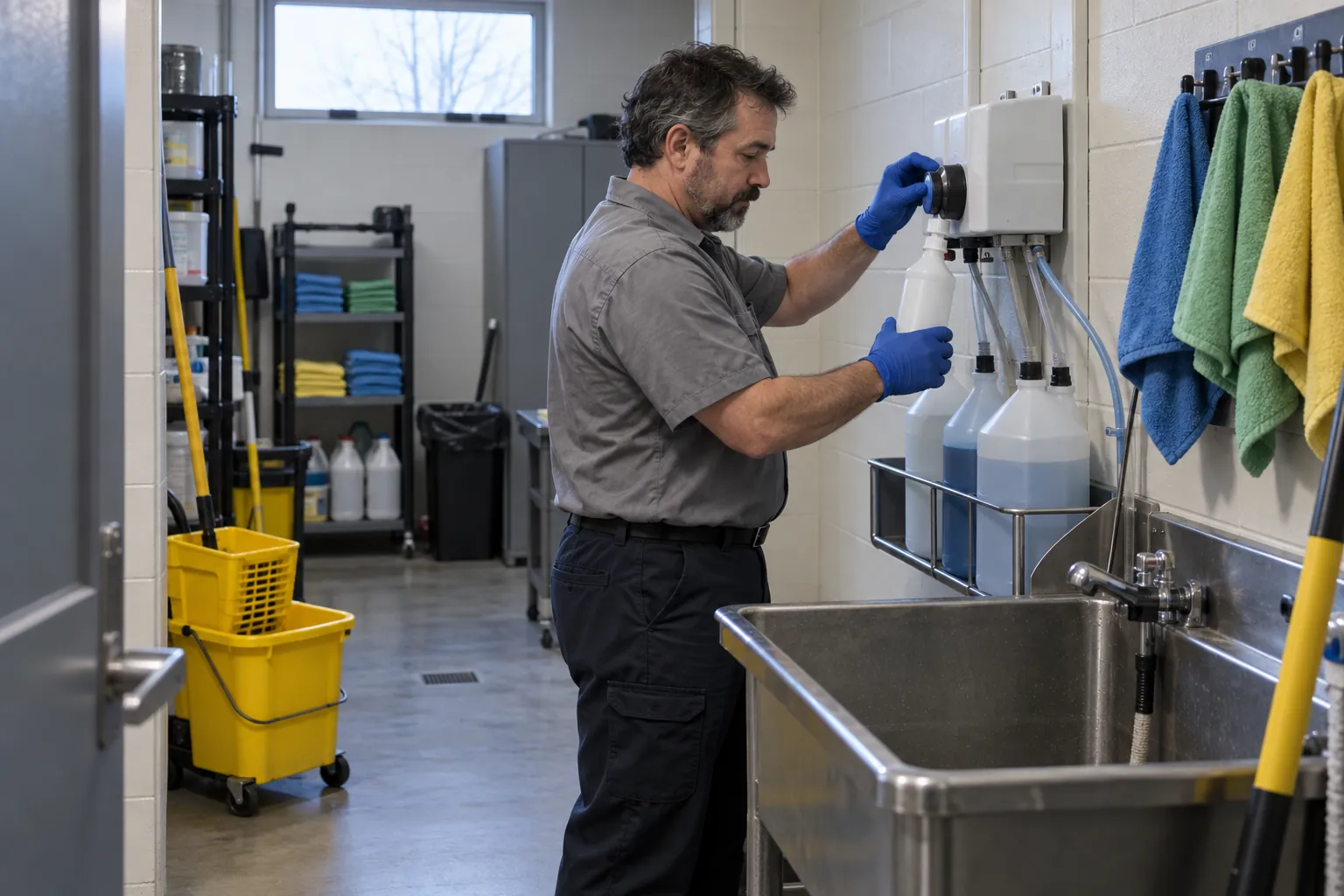
Organic material can inactivate a disinfectant, so a surface is cleaned before it is disinfected, in two steps or with a one-step cleaner-disinfectant. The Canadian guidance asks for this:
- Read the label and the safety data sheet first. CCOHS's Cleaning Products – Working Safely asks workers to know a product's hazards before using it, under WHMIS, and to wear any protective equipment it calls for, such as gloves and goggles.
- Use a disinfectant with a DIN. In Canada disinfectants are regulated as drugs, and both CCOHS and the Public Health Agency of Canada tell you to check the label for a drug identification number. You can look a product up by its DIN, name or company in Health Canada's Drug Product Database, which classes disinfectants by use, such as hospital and health care facilities, food premises and domestic. Our guide to disinfectants with a DIN goes further.
- Dilute exactly as the manufacturer says, always adding the concentrate to the water, and never mix products: CCOHS warns that products containing bleach and ammonia must never be mixed, because hazardous gases may be released.
- Clean visibly soiled surfaces first with soap and water or a cleaning product, then disinfect.
- Apply the disinfectant to a clean cloth, not the air. CCOHS says to saturate the cloth before treating touch points and reapply as needed, and to use a dedicated cloth, changed daily or when it becomes visibly soiled.
- Leave it wet for the contact time. The label gives the dwell time, the time the product must sit on the surface to work. CCOHS says to follow it and let the surface air dry. A quick wipe that dries in five seconds with a product that needs a minute has cleaned the surface but not disinfected it.
- Work from clean to dirty and from high to low, as PIDAC puts it, so that dirt is not carried from a dirty area to a cleaner one and does not drip onto what has already been done. In a washroom, that usually means the door, dispensers and sinks before the toilets.
- Do not double-dip. PIDAC warns against dipping a used cloth back into the disinfectant solution; change the solution and cloths often and clean the equipment itself.
Wipes are convenient between full cleans, but PIDAC notes they can dry out if stored badly or during use. Whatever the method, a surface is only disinfected if enough product stayed on it for long enough.
05
Who does it, and how to check it was really done
High-touch cleaning falls between jobs more often than any other task. The janitorial contractor does the washrooms, the building operator the elevators, and the photocopier belongs to nobody. PIDAC reports the same in hospitals: auditing quickly shows many high-touch surfaces are missed, in some cases because the worker did not know the surface was theirs, did not know it needed cleaning, or was afraid of damaging it.
So the first control is clarity. The janitorial scope of work should name, per location, the high-touch surfaces, who cleans them, how often and with what, including anything the occupier's own staff wipe between visits.
The second control is checking. PIDAC describes several ways to assess cleaning, among them the four below, and the Public Health Ontario environmental cleaning resources include audit tools for the first three:
- Visual inspection by a supervisor walking the route with a checklist. It is cheap and quick, but a surface can look clean and not be.
- Performance observation: a trained observer, often a supervisor, watches staff do routine cleaning. It allows feedback to each worker, but it is labour intensive, and PIDAC notes that people may not work the same way when nobody is watching.
- Environmental marking: a fluorescent or chemical marker is put on surfaces before cleaning, and a trained observer checks afterwards, for example with an ultraviolet light, whether it was removed. It measures thoroughness, and PIDAC notes that sharing the results with cleaning staff and supervisors typically leads to rapid improvement.
- ATP bioluminescence: a swab measures organic material left on a surface. It is quick but has limits: some products and surfaces distort the readings, and PIDAC notes that in some studies ATP levels do not correlate closely with microbial contamination.
Outside health care, a supervisor's walkthrough with a checklist is the usual method, sometimes with marking on a sample of surfaces. The point is feedback: tell the team what was missed and why, change the checklist, and check again. See our guide to janitorial quality control.
The third control is the cleaning log. It cannot show that a door handle was disinfected properly, but it can show who did it and when.
06
Where the high-touch record fails, and what SiteClara does about it
The usual record is a sheet on the washroom door or a clipboard on the janitorial cart, initialled "touch points done". It fails in familiar ways. The sheet is filled in at the end of the shift. The afternoon elevator wipe is missed when the cleaner is covering another floor, and nobody knows until someone complains. The empty soap dispenser is mentioned to whoever was passing and never reported. And when a tenant asks what was done during an outbreak, the answer is a column of initials that cannot show when anything happened.
SiteClara replaces the clipboard with a tag at each location, such as a washroom, lunchroom, lobby or elevator bank: a printed QR code, with an NFC tag behind it if staff would rather tap than scan. The cleaner scans or taps it on their own phone, with no app to install, and marks the location's cleaning done; the person and the time are recorded as it happens. If something is wrong, such as an empty dispenser, a loose handle or a spill, they report it there, with a photo if it helps, and it goes onto the team's list of open jobs until someone closes it.
Scheduled checks are set per location, each with its own due time, so a twice-daily wipe of the elevator buttons is two checks, not one. Staff see what is due and mark it done, or say what stopped them. The supervisor sees what was done and what was missed and can record why, and at the end of the day reviews it and approves a report that goes to the building's manager or the client at 8 a.m. the next morning, showing what was completed and what is still open.
07
Questions people ask
What are some examples of high-touch surfaces?
The Public Health Agency of Canada's COVID-19: Cleaning and disinfecting tells workers to focus on high-touch surfaces and objects such as phones, credit and debit card machines, desks, restaurant tables and chairs, keypads, elevator buttons, light switches, cash registers, customer service counters, door accessibility buttons, door handles, handrails and doorknobs. In a building, add push plates, faucets, soap and towel dispensers, photocopier panels and shared keyboards.
What does high-touch point mean?
It is another name for a high-touch surface. CCOHS's fact sheet Sanitation and Infection Control for Cleaning Staff defines it: "A touch point is any surface that can be touched by bare hands by multiple people, multiple times." Its examples are door knobs, handles, kettles, coffee makers, water faucets, touch screens, photocopiers and telephones.
How often should you clean high-touch surfaces?
CCOHS's Sanitation and Infection Control for Cleaning Staff says to "Clean at least once per day but more frequent cleaning (every 2 to 3 hours) may be necessary." Go above once a day where use is heavy, during an outbreak and where people are more vulnerable to infection, and clean anything visibly soiled at once.
What should be used to disinfect high-touch surfaces?
A disinfectant approved for sale in Canada, which you can tell by its drug identification number (DIN). CCOHS's Sanitation and Infection Control for Cleaning Staff says to "Use a disinfectant with a drug identification number (DIN)", or, if no disinfectant is available, "a mixture of 5 mL of bleach (5% sodium hypochlorite) and 250 mL of water", and to follow the label's dwell time and let the surface air dry. The Public Health Agency of Canada's COVID-19: Cleaning and disinfecting adds that, ideally, you should "always clean surfaces first with soap or detergent, and then disinfect them."
08
Further reading, and a list to take away
Public Health Ontario publishes PIDAC's Best Practices for Environmental Cleaning for Prevention and Control of Infections in All Health Care Settings, the fullest Canadian treatment of high- and low-touch surfaces, cleaning frequency and auditing, with audit tools on its environmental cleaning page. CCOHS covers workplaces in Sanitation and Infection Control for Cleaning Staff and Cleaning Products – Working Safely. Outside Ontario, check your own province's occupational health and safety rules, and your sector's rules in child care, long-term care or health care.
Before you rely on your high-touch cleaning, check that:
- each location has its own written list of high-touch surfaces, made by watching what people touch;
- each surface has an owner, whether the janitorial contractor, the building operator or the occupier's own staff;
- the frequency is at least daily, and higher where use, illness or vulnerability calls for it;
- washrooms are cleaned at least once each shift, and in Ontario the records rule is met;
- the disinfectant has a DIN, is diluted as the label says and stays wet for its contact time;
- staff clean before they disinfect, work clean to dirty and high to low, and never double-dip;
- a supervisor checks a sample of surfaces and feeds the results back to the team;
- the record shows who cleaned each location and when, as it happened, not at the end of the shift.
Sources
Every document this guide quotes or links to, in the order it first cites them.
- Best Practices for Environmental Cleaning for Prevention and Control of Infections in All Health Care Settings publichealthontario.ca
- Sanitation and Infection Control for Cleaning Staff ccohs.ca
- COVID-19: Cleaning and disinfecting canada.ca
- Occupational Health and Safety Act ontario.ca
- Ontario Regulation 480/24 ontario.ca
- Maintaining clean washroom facilities for workers ontario.ca
- Workplace Housekeeping – Basic Guide ccohs.ca
- Cleaning Products – Working Safely ccohs.ca
- Drug Product Database health-products.canada.ca
- Environmental cleaning resources publichealthontario.ca
Related guides
 CleaningHealth Canada approved disinfectants: what the DIN tells you, and how to use itHow to tell a Health Canada approved disinfectant: the DIN, what the label must show, how to check it, and what the Biocides Regulations changed.
 CleaningWashroom cleaning checklist: what to check, how often, and Ontario's new cleaning recordsWhat a workplace washroom cleaning checklist should cover, how often to clean, and Ontario's posted cleaning records required since January 1, 2026.
 CleaningJanitorial quality control: how to inspect, correct and show the standard heldHow janitorial quality control works in Canada: QA versus QC, inspections, sampling, corrective action, CIMS, the PIDAC audit model and records that hold up.
 CleaningCleaning log sheet: what to record, who fills it in, and what the law in Canada asks forWhat a cleaning log sheet should record, where Canadian workplaces use one, what Ontario and federal rules require, and how to keep a log people believe.