Cleaning
Health Canada approved disinfectants: what the DIN tells you, and how to use it
Health Canada approved disinfectants are surface disinfectants that Health Canada has authorized for sale in Canada, and each one carries an eight-digit identification number after the letters DIN on its label.
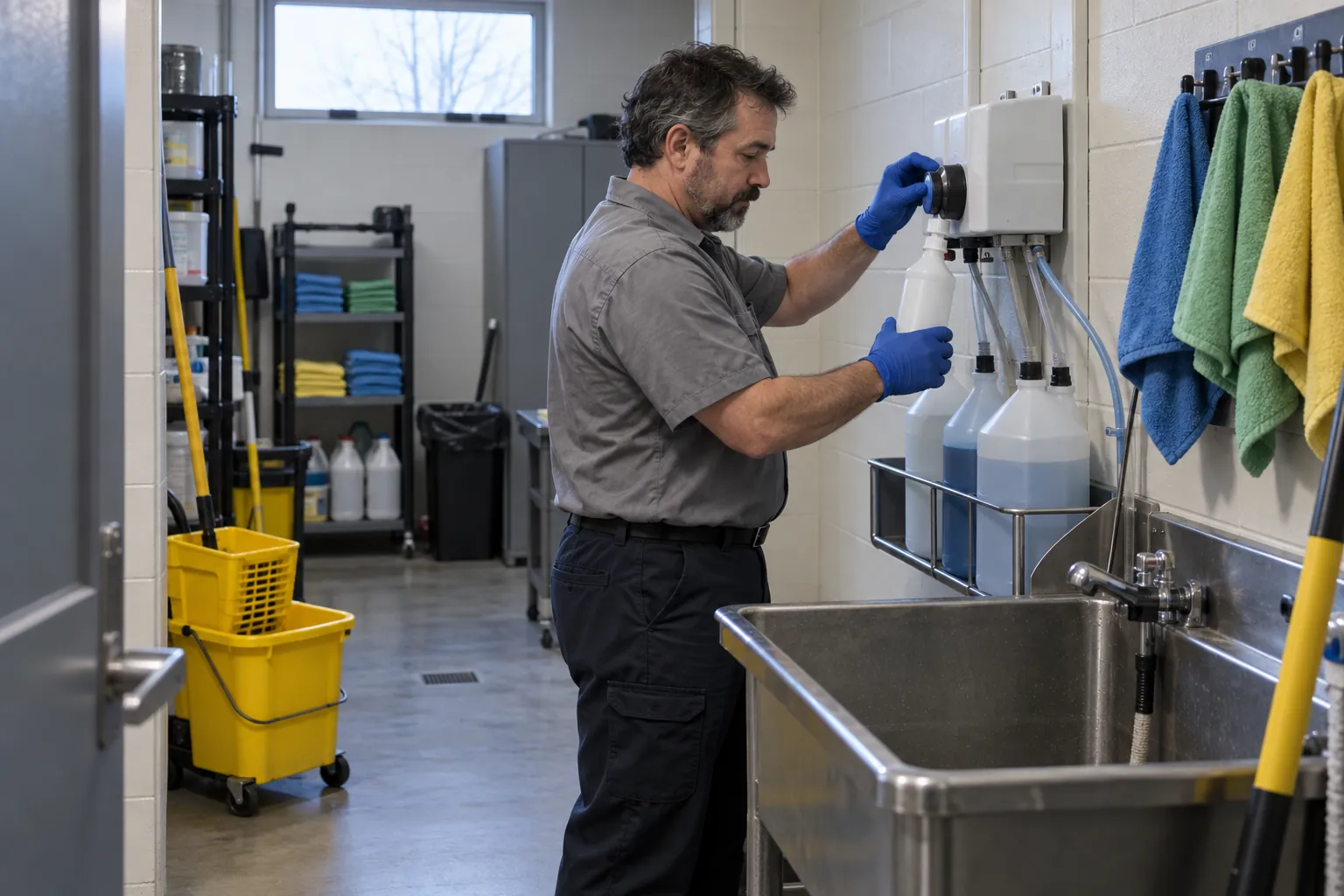
That number is the quickest way to tell an approved disinfectant from a cleaner that only looks like one, and the label around it tells a janitorial team where the product may be used, how to dilute it and how long the surface must stay wet. This guide explains what the DIN means, what has changed under the Biocides Regulations, how to check a number, how to choose a product for the building, and what record shows it was used properly.
01
What a DIN on a disinfectant means
"Health Canada approved" disinfectant means a product with a drug identification number (DIN). Surface disinfectants are regulated in Canada as drugs, not as ordinary cleaning chemicals. The Food and Drugs Act defines a drug to include any substance sold or represented for use in "the diagnosis, treatment, mitigation or prevention of a disease" and in "disinfection in premises in which food is manufactured, prepared or kept".
Until 31 May 2025, disinfectants were authorized under the Food and Drug Regulations, section C.01.014, which says: "No manufacturer shall sell a drug in dosage form unless a drug identification number has been assigned for that drug". Surface sanitizers were a separate case: they were registered as pest control products and carried a registration number under the Pest Control Products Act instead of a DIN.
Since 31 May 2025, both have come under one framework. The Biocides Regulations (SOR/2024-110) treat surface disinfectants and surface sanitizers alike as biocides. Health Canada's Biocides page puts it plainly: "In other words, biocides are surface disinfectants and sanitizers." A biocide must receive a market authorization before it can be imported, sold or advertised in Canada, and Health Canada assigns it an eight-digit identification number that must appear on the label.
For the person buying or using the product, the practical answer has not changed. Section 31 of the Biocides Regulations requires the principal display panel to show "the biocide's identification number, preceded by the designation 'DIN' in capital letters". So the letters DIN and eight digits remain the thing to look for, on older disinfectants authorized under the Food and Drug Regulations and on biocides authorized under the new rules.
There is no single "approved list" of every disinfectant: approval is product by product, and the DIN is how you look one up.
02
What the label must show, and what to read on it
The label is the product's instructions and its authorization in one place. Under sections 31 and 32 of the Biocides Regulations, a biocide label must show, in English and French:
- On the principal display panel: the brand name; at least one intended use or purpose, which on most labels is a claim such as disinfectant or sanitizer; the settings in which it is intended to be used; the DIN; the net quantity; and "Keep out of reach of children."
- Elsewhere on the label: the conditions of use, which the Regulations define as the intended uses, the settings, the risk information, the directions for use and the directions for storage; the quantity of each active ingredient; the lot number; the expiry date (a household product with a shelf life over a year may leave it off); the name and contact information of the market authorization holder; and the physical form, such as a liquid, a spray or wipes, unless it is obvious.
Health Canada's guidance on packaging and labelling for transitioning biocides lists the settings as household, industrial or institutional, hospital or health care, food premises and animal housing areas, and says the directions for use include application rates, contact time, surfaces, frequency of application and any limitations. The directions only hold for the settings the label names.
The words on the front also mean specific things. Health Canada's archived 2018 Guidance Document: Disinfectant Drugs, which Health Canada has since replaced with a summary page, set out the definitions in use when most products now on the shelf were authorized:
- Sanitizer: reduces the bacterial population on a surface "by significant numbers (e.g., a minimum 3 log10 reduction)" but "does not destroy all bacteria". Food contact sanitizers are for surfaces such as cutting boards and countertops.
- Disinfectant: destroys or irreversibly inactivates disease-causing micro-organisms, "but not necessarily bacterial spores". A general disinfectant kills both Gram-positive and Gram-negative bacteria.
- Hospital disinfectant: kills both kinds of bacteria on non-critical medical devices and surfaces, and is represented for use in hospitals, clinics, dental offices and other health care facilities.
- Virucide: effective against at least one specific virus. A broad-spectrum virucide is effective against at least one representative hard-to-kill non-enveloped virus.
- One-step cleaner/disinfectant: tested in the presence of light to moderate soil, so it may be used without a separate pre-cleaning step for that level of soil, as its label directs.
A product that makes no antimicrobial claim is regulated as a cleaner and has no DIN. It may clean well, but a scope of work that calls for disinfection is not met by using it.
03
How to check a DIN, and keep a product register
Health Canada keeps two places to look. Disinfectants authorized under the Food and Drug Regulations before 31 May 2025 are in the Drug Product Database online query; its page Drug Product Database: More information says that drugs in the database "can be identified by a Drug Identification Number (DIN)" and that they include disinfectants. The search takes the eight digits, typed without punctuation such as hyphens, and it can also be narrowed to the class "Disinfectant". A product authorized under the Biocides Regulations, whether new or transitioned from the old framework, is in Health Canada's Market Authorized Biocides Database, which shows whether it is authorized, marketed, suspended or revoked.
- Find the DIN on the label, usually on the front panel, and search for it in the Drug Product Database, then in the Market Authorized Biocides Database if it is not there or shows as transitioned.
- Check the product and company match the container in your hand. A number that belongs to a different product is a problem to raise with the supplier.
- Read the status. The Drug Product Database offers statuses including Marketed, Dormant, Cancelled Post Market and Cancelled (Transitioned To Biocides). Health Canada's Drug product database: Terminology defines the last as a DIN cancelled after the product received a market authorization under the Biocides Regulations. That is not a problem: the product keeps the same eight-digit number, so look it up in the Market Authorized Biocides Database instead, where a status of Suspended or Revoked means it cannot legally be sold. Any other cancelled status is worth a question to the supplier.
- Compare the settings. A product authorized for domestic use only is not the one for a hospital, and a product without food premises uses is not the one for a staff kitchen counter that food is prepared on.
- Compare the claims with the risk: a virus claim for washrooms during an outbreak, a hospital disinfectant for health care, a food contact sanitizer for food surfaces.
For viruses, Health Canada publishes a list of surface disinfectants for emerging viral pathogens. It explains that non-enveloped viruses, such as norovirus, are more resistant than enveloped viruses, so a product effective against them will probably also work against enveloped ones. Search it by DIN too; Health Canada says it is not comprehensive and is not an endorsement.
Once the products are checked, keep a short product register for the building or the contract. For each product it records:
- the product name and DIN, and the date it was last checked in the database;
- the settings and claims on the label, its form (a liquid concentrate, a ready-to-use spray or wipes), and the areas it is used in;
- the dilution rate, the contact time and the protective equipment the label calls for;
- where the label copy and any safety data sheet are kept.
Check it again when the supplier changes a product or reprints a label, and when a new area joins the scope of work.
04
Choosing the right disinfectant for the building
The right product is the one whose label covers the setting, the surfaces and the organisms that matter in that building, and that the team can use correctly every time.
- Offices, schools, daycares and other commercial and public facilities are institutional settings. Health Canada gives daycares, schools and office buildings as examples. Look for industrial or institutional use on the label.
- Health care settings need a hospital disinfectant. Ontario's PIDAC Best Practices for Environmental Cleaning for Prevention and Control of Infections in All Health Care Settings, 3rd Edition, 1st revision (November 2025) recommends that "Disinfectants must have a DIN from Health Canada", and defines a hospital disinfectant as a low-level disinfectant with a DIN "indicating its approval for use in Canadian health care settings". Hospital environmental cleaning goes further into that setting.
- Kitchens and food areas need a label with food premises uses, and a food contact sanitizer claim where food touches the surface.
- Washrooms, and any area with vomit or diarrhea, call for a virus claim. The emerging viral pathogens list is one place to find products with evidence against a hard-to-kill non-enveloped virus. Vomit cleanup and norovirus cleaning sets out the procedure.
- Wipes are disinfectants too. PIDAC says ready-to-use wipes "should be approved by Health Canada and have a DIN number", must be kept wet by keeping the lid closed, and should be discarded if they dry out.
Fewer products are better. PIDAC recommends that health care facilities "select a limited number of hospital disinfectants to minimize training requirements and the risk of error", and the same logic applies to a multi-tenant office tower or a school board's custodial program: one or two well-chosen products, used correctly, beat a cupboard of half-used bottles with different dilutions and contact times.
PIDAC notes that sodium hypochlorite and alcohol-based disinfectants are exceptions to the DIN rule in health care, used "in the appropriate concentration". For bleach, Health Canada's archived page on hard-surface disinfectants and hand sanitizers (COVID-19) gave 20 mL of 5% bleach in 1 litre of water for a 0.1% solution, prepared fresh and diluted only in water. Follow the label of the bleach you actually have.
Two things are not surface disinfectants. Hand sanitizer is for skin; PIDAC says skin antiseptics "must never be used as environmental disinfectants". And a disinfectant is not a general-purpose cleaner: PIDAC says disinfectants "must not be used as general cleaning agents, unless combined with a cleaning agent as a one-step cleaner/disinfectant".
05
Using it properly: cleaning first, dilution and contact time
A disinfectant with a DIN only does what its label says when it is used as the label says. Most failures come from the same few steps.
- Clean first. PIDAC says hospital disinfectants "must only be applied after visible soil and other impediments to disinfection have been removed". A one-step cleaner/disinfectant may be used on light to moderate soil, as its label allows; heavy soil still needs cleaning first.
- Dilute exactly. The archived Health Canada guidance expected dilution directions in metric units or ratios, such as millilitres per litre or 1:256, and a statement of how long a diluted solution stays effective. A wall-mounted dispenser or proportioner takes the guesswork out; PIDAC prefers products that need little or no mixing.
- Respect the contact time. The archived guidance gave the usual label wording: "Allow surface to remain wet for (X) minutes." A surface wiped dry before then has been cleaned, not disinfected.
- Do not double-dip. PIDAC says cloths "must not be repeatedly immersed into disinfectant". Use a fresh cloth, or a microfibre system, for each area.
- Never mix products. Health Canada's Biocides page says never to use a biocide at the same time as other chemical products such as cleaners, unless the products are labelled for use together.
- Wear what the label says. PIDAC recommends, marking it as a legislative requirement, that where personal protective equipment is recommended to prevent exposure to a disinfectant, it shall be worn.
Worker safety law is provincial and territorial, and it applies alongside the product rules. The Canadian Centre for Occupational Health and Safety's WHMIS general information lists drugs as defined in the Food and Drugs Act among the products excluded from WHMIS, which means a disinfectant may come without a WHMIS supplier label or safety data sheet. It adds: "while a product may be exempt from the requirement to have a WHMIS label and SDS, employers must still provide education and training on health effects, safe use, and storage." Ask the supplier for whatever safety information it publishes, and train staff on the label.
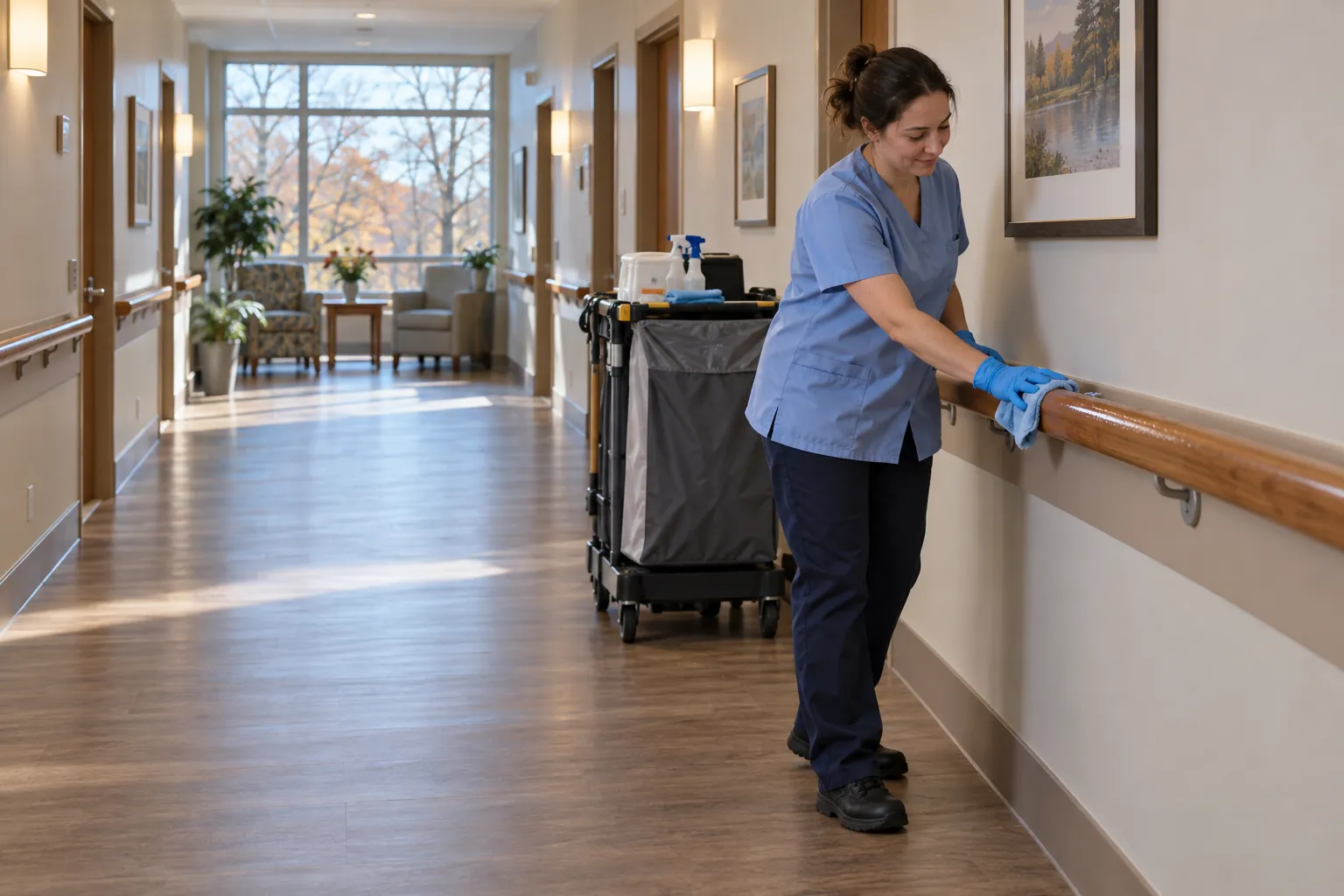
What shows that disinfection was done is not the product alone: it is the product register, the training records, and a record that each scheduled clean was done, by whom and when, rather than a sheet initialled in advance. The high-touch surfaces guide covers which touch points to disinfect and how often.
06
Where the record fails, and what SiteClara does about it
The product is rarely the weak point. A building can have a disinfectant with a valid DIN in every custodial room and still be unable to show it was used. The washroom sheet is initialled at the start of the shift for the whole day. Touch-point disinfection is added to the scope of work but never appears on any record. A spill is reported to whoever is passing and nobody notes when it was cleaned. Asked what was disinfected and when, the answer is an assurance.
SiteClara puts a tag at each location: a printed QR code, with an NFC tag behind it if staff prefer to tap. The custodian scans the tag on their own phone, with no app to install, sees the checks due at that location and marks each one done, or says what stopped them; the person and the time are recorded as it happens, with a photo when one is asked for. Anyone who finds a spill can scan the same tag and report it, and it goes onto the team's list of open jobs with the time it was reported, so the time to respond is plain. A supervisor sees what is still open across the buildings they look after, reviews the day, adds a note, and the approved report goes to the client or facility manager the next morning.
07
Questions people ask
Is there a list of Health Canada approved disinfectants?
Not one list of everything. Health Canada's Biocides page points to the Drug Product Database for disinfectants authorized under the Food and Drug Regulations and to the Pesticide Product Information Database for sanitizers registered under the Pest Control Products Act, both authorized before 31 May 2025. A product authorized under the Biocides Regulations, new or transitioned, is in the Market Authorized Biocides Database. Health Canada's list of surface disinfectants for emerging viral pathogens, the list many people looked for during COVID-19, "contains disinfectants approved by Health Canada", but Health Canada says it "is not comprehensive" and that appearing on it "does not mean Health Canada has endorsed it". Look a disinfectant up by the DIN on its label.
What is a hospital grade disinfectant?
In Canada the term is hospital disinfectant. Public Health Ontario's PIDAC Best Practices for Environmental Cleaning, 3rd Edition, 1st revision (November 2025) defines it as "a low-level disinfectant that has a drug identification number (DIN) from Health Canada indicating its approval for use in Canadian health care settings", and notes that hospital disinfectants "were referred to as 'hospital-grade disinfectants' in previous editions". It adds that a hospital disinfectant carries efficacy claims against the bacteria Pseudomonas aeruginosa and Staphylococcus aureus.
What chemical disinfectants are used in hospitals?
The same PIDAC Best Practices for Environmental Cleaning lists the hospital disinfectants commonly used in all health care settings: alcohol (ethyl or isopropyl), improved hydrogen peroxide, iodophors, phenolics, quaternary ammonium compounds and sodium hypochlorite (bleach). Its Appendix 1 sets out the advantages and disadvantages of each. Whichever active ingredient is chosen, the product itself still needs a DIN and a label that covers health care use.
Are EPA registered disinfectants approved in Canada?
Registration with the US Environmental Protection Agency is a US authorization. Health Canada's Biocides page says biocides "must undergo a pre-market assessment with the NNHPD and be issued a market authorization before they can be imported, sold or advertised in Canada". Look for the Canadian DIN on the label, not an EPA registration number.
08
Where to read more, and a checklist to take away
The primary sources, all from their owners' own sites:
- Biocides Regulations (SOR/2024-110), sections 31 and 32 for the label.
- Health Canada, Biocides, on the old and new frameworks.
- Health Canada, Drug Product Database online query, to look up a DIN authorized before 31 May 2025, and the Market Authorized Biocides Database for a biocide authorized under the Biocides Regulations.
- Public Health Ontario, PIDAC Best Practices for Environmental Cleaning for Prevention and Control of Infections in All Health Care Settings, 3rd Edition, 1st revision (November 2025).
- CCOHS, WHMIS general information, and your province's or territory's occupational health and safety law.
A checklist for a building or a janitorial contract:
- Every product used to disinfect or sanitize shows DIN and eight digits on its label, and each DIN has been checked in the Drug Product Database or the Market Authorized Biocides Database.
- The label's settings and claims fit where the product is used and the risk there.
- A product register records the DIN, dilution, contact time and protective equipment for each product.
- Staff are trained on the label, and the training is recorded.
- Surfaces are cleaned first, unless a one-step product is used on light soil.
- Dilution is measured, and the surface stays wet for the contact time.
- Each scheduled clean is recorded as it is done, by the person who did it.
Sources
Every document this guide quotes or links to, in the order it first cites them.
- Food and Drugs Act laws-lois.justice.gc.ca
- Food and Drug Regulations, section C.01.014 laws-lois.justice.gc.ca
- Biocides Regulations (SOR/2024-110) laws-lois.justice.gc.ca
- Biocides canada.ca
- Guidance on packaging and labelling for transitioning biocides canada.ca
- Archived 2018 Guidance Document: Disinfectant Drugs canada.ca
- Drug Product Database online query health-products.canada.ca
- Drug Product Database: More information canada.ca
- Market Authorized Biocides Database dhpp.hpfb-dgpsa.ca
- Drug product database: Terminology canada.ca
- List of surface disinfectants for emerging viral pathogens canada.ca
- PIDAC Best Practices for Environmental Cleaning for Prevention and Control of Infections in All Health Care Settings, 3rd Edition, 1st revision (November 2025) publichealthontario.ca
- Archived page on hard-surface disinfectants and hand sanitizers (COVID-19) canada.ca
- WHMIS general information ccohs.ca
Related guides
 CleaningHigh-touch surfaces: what counts, how often to clean them, and how to prove itHigh-touch surfaces in Canadian workplaces: what counts, how often to clean and disinfect them, how to do it properly, and how to check it was really done.
 CleaningHospital environmental cleaning: the standards, the frequencies and the auditsHospital environmental cleaning in Canada: PIDAC best practices, CSA Z317.12, risk-based frequencies, who cleans what, and how cleaning is audited.
 CleaningVomit cleanup and norovirus cleaning: a workplace procedureHow to clean up vomit safely at work in Canada: the spill kit, step-by-step procedure, disinfectant choice for norovirus, outbreak cleaning and the record to keep.
 CleaningBlood spill cleanup: a workplace procedure for CanadaHow to clean up a blood spill at work in Canada: the kit, a step-by-step procedure, bleach strengths, needles in the spill, exposures and the record to keep.