Cleaning
Long-term care cleaning: the rules, the frequencies and a record that holds up
Long-term care cleaning is the housekeeping and disinfection that keeps a long-term care home's resident rooms, washrooms, tub rooms, shared care equipment and common areas clean and sanitary, and in Ontario the licensee must provide it seven days a week under written procedures.
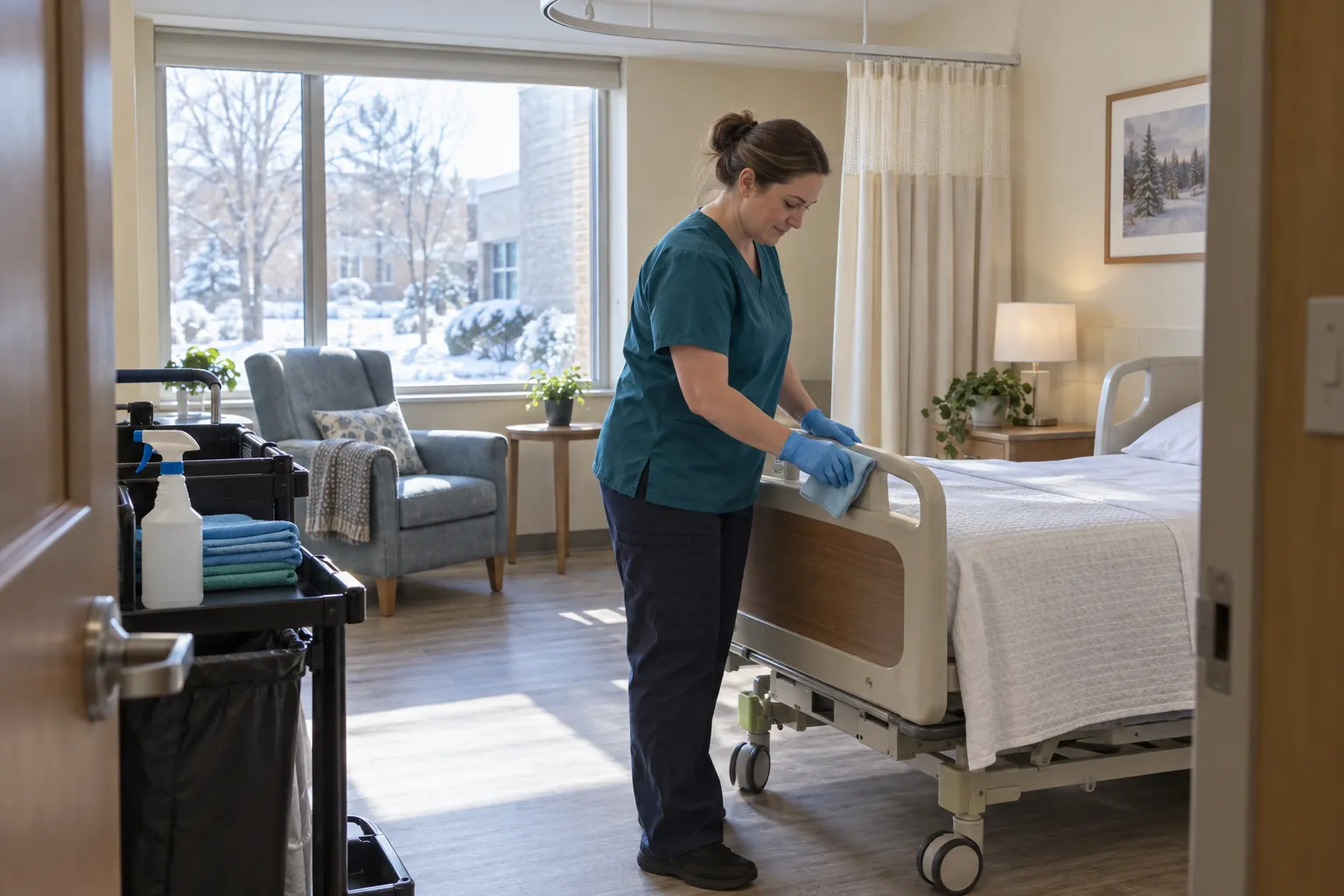
It is a legal program, not only a matter of a tidy building, with a qualified lead and a disinfectant chosen with the infection prevention and control lead. This guide sets out what the Fixing Long-Term Care Act, 2021 and O. Reg. 246/22 require, what Public Health Ontario's PIDAC guidance says about how often to clean, who does what, and how a home can show the work was actually done.
01
The housekeeping duty in Ontario law
In Ontario, cleaning a long-term care home is a duty of the licensee under the Fixing Long-Term Care Act, 2021. Section 19 requires "an organized program of housekeeping for the home" and that "the home, furnishings and equipment are kept clean and sanitary". Section 23 requires an infection prevention and control (IPAC) program with evidence-based policies and procedures, measures to prevent the transmission of infections and a hand hygiene program.
The detail is in the general regulation, O. Reg. 246/22 under the Fixing Long-Term Care Act, 2021 (consolidated to 1 January 2026). Section 93 says housekeeping services must be provided seven days per week, and that the licensee must develop and implement procedures for:
- cleaning resident bedrooms, "including floors, carpets, furnishings, privacy curtains, contact surfaces and wall surfaces";
- cleaning common areas and staff areas, including floors, carpets, furnishings, contact surfaces and wall surfaces;
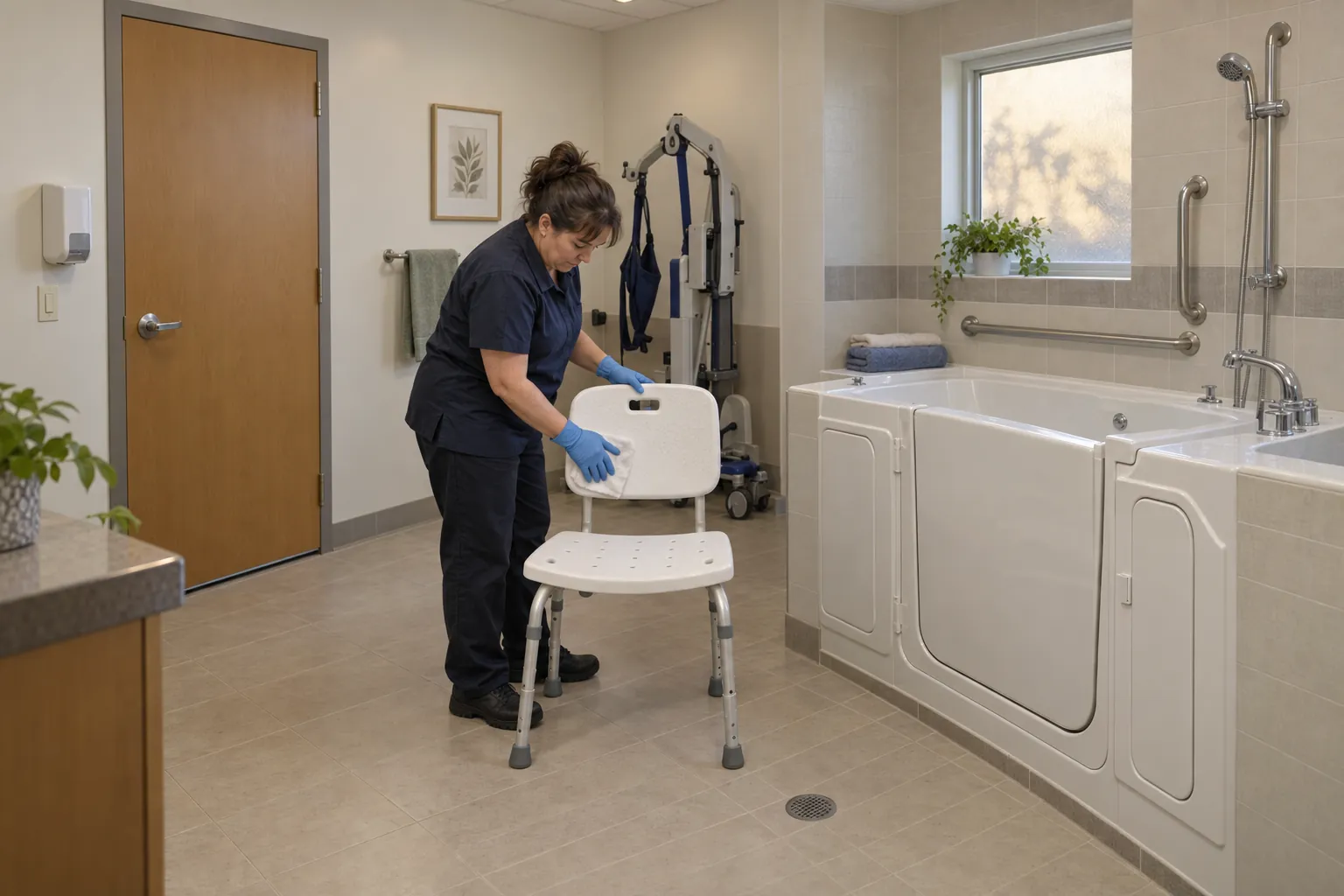
- cleaning and disinfecting resident care equipment "such as whirlpools, tubs, shower chairs and lift chairs", supplies and devices including assistive and positioning aids, and contact surfaces, following the manufacturer's specifications and using "at a minimum, a low level disinfectant";
- removing and safely disposing of dry and wet garbage; and
- "addressing incidents of lingering offensive odours".
The same section says the IPAC lead must be involved in selecting the disinfectant, and that a sufficient supply of housekeeping equipment and cleaning supplies must be readily available to all staff.
Two further points matter to anyone running or supplying housekeeping. First, the Act's definition of "staff" includes people who work at the home under a contract with the licensee or through an agency, so a contract cleaning company's housekeepers are staff for the purposes of training and the IPAC program. Section 82 says no staff member may start their duties before orientation that includes infection prevention and control. Second, the Act's fundamental principle is that a long-term care home "is primarily the home of its residents". The room being cleaned is someone's bedroom.
02
What long-term care housekeeping covers
In most homes the housekeeping program covers:
- Resident bedrooms and their washrooms: floors, walls, furnishings, privacy curtains, bed rails and call bells, and the high-touch surfaces around the bed.
- Tub and shower rooms: whirlpools, tubs, shower chairs, bath boards and lift chairs, cleaned and disinfected between residents.
- Resident care equipment and devices: walkers, wheelchairs, commodes, mechanical lifts, positioning aids and assistive aids, where the procedures must say whether housekeeping or care staff clean each one.
- Common areas: dining rooms, lounges, activity rooms, corridors and handrails, elevators and the home area's shared washrooms, where residents, staff and visitors all touch the same surfaces.
- Staff areas: nursing stations, staff rooms, staff washrooms and change rooms, which section 93 names alongside resident areas.
- Soiled utility rooms and garbage: dry and wet garbage removed and disposed of safely, and lingering odours dealt with.
- Spills of blood and body fluids: contained, cleaned and disinfected immediately, whatever the area's routine schedule, with a written procedure saying who responds in each area at every hour.
- Discharge and transfer cleaning: the full clean of a room when a resident moves, is transferred or dies.
Laundry and pest control are separate programs under O. Reg. 246/22. Section 95 covers linen and personal clothing, and section 94 requires a preventive pest control program using a licensed pest controller, "including records indicating the dates of visits and actions taken".
Residents' own furniture needs a word. PIDAC's Best Practices for Environmental Cleaning for Prevention and Control of Infections in All Health Care Settings recommends that surfaces and furnishings in care areas be cleanable with hospital cleaners and disinfectants, but makes an exception for "those long-term care homes where the furniture is supplied by the resident". A resident's armchair still needs a regular cleaning regimen; the procedure should say what housekeeping does with it and what it reports when an item is stained, torn or cannot be cleaned.
03
How often to clean: daily, twice daily and on a schedule
The regulation sets the days (seven a week), not the frequencies. For how often each area is cleaned, the reference is the Provincial Infectious Diseases Advisory Committee (PIDAC) best practices published by Public Health Ontario, written for all health care settings including long-term care homes. Its starting points are these:
- High-touch surfaces in care areas, such as door handles, call bells, bed rails, light switches and toilet flushes, are cleaned and disinfected "at least daily and more frequently if the risk of environmental contamination is higher".
- Low-touch surfaces, such as floors, walls and window sills, are cleaned regularly, when soiled and when a resident is discharged; some may be done less often than daily if they are cleaned sooner when visibly soiled.
- Resident bathrooms: a private bathroom daily, with the room. For shared bathrooms in semi-private or ward rooms, daily is the minimum and twice daily should be considered, particularly for ward rooms with more than two residents.
- Showers: shower walls thoroughly scrubbed at least weekly, and shower curtains changed at least monthly and as required.
- Shared equipment: noncritical equipment used between residents is cleaned and disinfected after each use. PIDAC's Appendix 8 lists walkers and wheelchairs after each use, bath boards after each use, commodes between residents and when soiled, and a lift sling laundered between residents and when soiled.
Beyond these, PIDAC asks each setting to set its schedule by risk. Recommendation 41 says cleaning schedules "must be developed based on an assessment of the risk". Appendix 21 gives a risk stratification matrix that scores each area on the probability of contamination, how often it is touched and how vulnerable the people there are. A total of 7 means clean after each event and at least twice a day; 4 to 6 means at least once daily; 2 or 3 means a fixed schedule. PIDAC treats all resident rooms and bathrooms as at least moderately contaminated, and the bathrooms of residents with diarrhea or incontinence as heavily contaminated.
Outbreaks change the schedule. PIDAC says enhanced cleaning is often required during an outbreak, that environmental services should be represented on the outbreak management committee, and (Recommendation 30) that resources must allow surge capacity. For a resident with C. difficile it recommends twice-daily cleaning and disinfection of the room and twice-daily cleaning of the bathroom with a sporicidal agent; where residents have vomiting or diarrhea, prompt cleaning followed by a disinfectant effective against norovirus. Under section 102 the IPAC team meets more often during an outbreak; agree and write down the changed cleaning schedule there.
04
Who does what: leads, housekeepers and care staff
O. Reg. 246/22 names two roles that shape the work:
- The designated lead for housekeeping (section 98), who must have the skills, knowledge and experience to perform the role, including knowledge of evidence-based practices (or, where there are none, prevailing practices) in housekeeping, and experience in a managerial or supervisory capacity or, in the licensee's reasonable opinion, appropriate skills, knowledge and experience in a health care or relevant setting. One person may lead housekeeping, laundry and maintenance.
- The IPAC lead (section 102), whose required education and experience include cleaning and disinfection, and whose duties include auditing IPAC practices in the home and implementing improvements the audits call for. Section 93 says this person is involved in choosing the disinfectant.
PIDAC adds the structure below them. It says that reducing the risk of infection transmitted from the health care environment "requires the cooperation of all staff in the health care setting" and "an appropriately staffed, trained, educated and supervised environmental services program". Recommendation 31 calls for a single individual responsible for cleaning the physical facility, and supervisors responsible for safe work, the correct use of personal protective equipment and "ensuring adherence to cleaning schedules and protocols". Recommendation 33 asks for written procedures that include "defined responsibility for specific items and areas". PIDAC is explicit that its practices apply whether cleaning is done in-house or contracted out, and that they are meant as "the basis for specifications if cleaning services are contracted out".
The line between housekeeping and care staff is where things go missing. Who wipes the mechanical lift between residents: the personal support worker who used it, or the housekeeper on the home area? Who cleans the commode? Write the answer down, item by item, using PIDAC's Appendix 8 as a starting table.
Housekeepers need their own protection too. The Canadian Centre for Occupational Health and Safety's Sanitation and Infection Control for Cleaning Staff tells workers to check labels and safety data sheets, to take WHMIS training for hazardous products, and warns that mixing products such as chlorine bleach and ammonia cleaners can create poisonous substances.
The disinfectant itself must be one authorized for sale in Canada. Health Canada's Biocides page explains that the Biocides Regulations came into force on 31 May 2025 and that an authorized surface disinfectant carries an eight-digit identification number on its label. Our guide to disinfectant DINs explains how to check one. Dilution and contact time come from the label, since section 93 requires the manufacturer's specifications to be followed.
05
What good records look like, and how the cleaning is checked
Section 93 requires the home to develop and implement cleaning procedures. The regulation names some records outright: under section 34, every required program has a written description and an evaluation at least once a year, with a written record of the date, who took part, what changed and when the changes were implemented; section 102 asks for the same record of the IPAC program's annual evaluation; section 94 asks for pest control visit records. Section 93 itself does not prescribe a daily cleaning sheet, but a home that cannot show its procedures were followed will struggle to show they were implemented.
A useful daily record for each room or area shows:
- the room or area, by number or name, not by the resident's name or diagnosis;
- the kind of clean: routine daily, twice-daily, discharge or transfer, or enhanced during an outbreak;
- who did it, and the time it was actually done rather than the time on the schedule;
- anything found and reported for repair, such as mould, a leak or a torn mattress;
- anything not done, and why.
Records show the work was done; audits show it was done well. PIDAC's Recommendation 76 says there must be a process to measure the quality of cleaning, and Recommendation 77 that homes should use at least one direct measure, such as environmental marking or ATP testing, alongside observation. Recommendation 78 says audit results should be used for training and "positive and constructive feedback" to frontline workers, and Recommendation 79 that aggregate results go to environmental services leadership, IPAC and administration.
Public Health Ontario publishes free audit tools on its Environmental Cleaning page. The Visual Assessment Audit checklist records the date, time, unit and room, then checks supplies and waste (hand rub, gloves, soap, paper towel, sharps containers under three-quarters full) and surfaces from the door handle to the bed and mattress. The Environmental Marking Audit checklist marks surfaces such as the door handle, light switch, bed rail, call bell and bedside table before cleaning, then records which were cleaned.
For discharge and transfer cleans of rooms on Contact Precautions, PIDAC says there must be a process to make sure the room and shared equipment were adequately cleaned and disinfected, for example a task checklist and a post-cleaning inspection of the room or bed space; Appendices 4, 6 and 22 have sample protocols and checklists.
06
Where the long-term care cleaning record fails, and what SiteClara does about it
The usual record is a sheet in a binder on the housekeeping cart, initialled room by room. It fails in familiar ways. The sheet is filled in at the end of the shift, so every room shows as done at the same moment. The second clean of an isolation room during an outbreak is missed on the evening shift and nobody can tell. The cracked tub seat or the leaking tap in a resident's washroom is mentioned to whoever was passing and never reaches maintenance. And when the IPAC lead asks what was done on a home area during the outbreak, the answer is a column of initials that cannot show when anything happened.
SiteClara replaces the binder with a tag at each location, such as a resident room, a tub room, a dining room or a soiled utility room: a printed QR code, with an NFC tag behind it if staff would rather tap than scan. The housekeeper scans or taps it on their own phone, with no app to install, and marks the location's cleaning done; the person and the time are recorded as it happens. If something is wrong, such as a leak, mould or a broken grab bar, they report it there, with a photo if it helps, and it goes onto the team's list of open jobs until someone closes it.
Scheduled checks are set per location, each with its own due time, so a twice-daily clean of an isolation room is two checks, not one. Staff see what is due and mark it done, or say what stopped them, such as a resident asleep or the room being in use. The supervisor sees what was done and what was missed and can record why, and at the end of the day reviews it and approves a report that goes to the administrator, the housekeeping lead or the client at 8 a.m. the next morning, showing what was completed and what is still open.
07
Questions people ask
What are the responsibilities of a cleaner in a care home?
In Ontario the duty sits with the licensee, and section 93 of O. Reg. 246/22 under the Fixing Long-Term Care Act, 2021 sets out what the housekeeping program must cover: housekeeping services "seven days per week"; cleaning resident bedrooms (privacy curtains included), common areas and staff areas, "including floors, carpets, furnishings, contact surfaces and wall surfaces"; cleaning and disinfecting resident care equipment, supplies, devices and contact surfaces "in accordance with manufacturer's specifications"; removing dry and wet garbage; and "addressing incidents of lingering offensive odours". A housekeeper's own duties are whatever the home's written procedures assign from that list, which is why the procedures should name, item by item, who cleans each area and each piece of equipment.
What are the cleaning standards for healthcare facilities?
In Ontario the reference is PIDAC's Best Practices for Environmental Cleaning for Prevention and Control of Infections in All Health Care Settings, published by Public Health Ontario and revised in November 2025. It provides "criteria for cleanliness in health care settings" that environmental service managers may adopt for their own staff "or for the use of contracted services", and says that while care settings differ, "the fundamental principles and requirement for routine cleaning and disinfection do not". It covers the physical environment and noncritical equipment; the high-level disinfection and sterilization of medical devices is in a separate PIDAC document. Its basic rule is cleaning before disinfection: "Thorough cleaning is required for any equipment/device to be disinfected as organic material may inactivate a disinfectant", using a cleaner followed by a disinfectant or a one-step combined cleaner/disinfectant product.
How is terminal cleaning performed in long-term care?
PIDAC's Best Practices for Environmental Cleaning for Prevention and Control of Infections in All Health Care Settings treats terminal cleaning as discharge/transfer cleaning: "the thorough cleaning of a client/patient/resident room or bed space following discharge, death or transfer", to remove microorganisms the next occupant or staff might acquire. Its Appendix 6 sample procedure starts with an assessment and fresh disinfectant, strips the bed and says "In long-term care homes, change curtain." The room is then cleaned "from clean to dirty and from high to low": doors and handles, light switches, wall-mounted dispensers, furnishings and high-touch surfaces, equipment such as walkers and wheelchairs, and the inside and outside of the resident's cupboard. The mattress is cleaned on its top, sides and underside and checked for cracks or holes, then the bathroom, the floor, waste and sharps are done and supplies replenished. For C. difficile it adds replacing the soap, toilet paper, paper towels, glove box and toilet brush, and using a sporicidal agent.
08
Where to read the official guidance, and a list to take away
The primary sources for long-term care cleaning in Ontario are:
- the Fixing Long-Term Care Act, 2021, sections 1, 19, 23 and 82;
- O. Reg. 246/22, sections 34 (program requirements), 93 (housekeeping), 94 (pest control), 95 (laundry), 98 (designated lead) and 102 (IPAC program), and any standard or protocol the Director issues under section 102;
- PIDAC's Best Practices for Environmental Cleaning for Prevention and Control of Infections in All Health Care Settings, third edition, which Public Health Ontario lists as updated in November 2025;
- Public Health Ontario's Environmental Cleaning page for the audit tools;
- Health Canada's Biocides page for authorized disinfectants.
A short list to take away:
- Confirm housekeeping runs seven days a week, weekends and holidays included.
- Write procedures for resident bedrooms, common areas and staff areas, resident care equipment such as tubs and shower chairs, supplies and devices, contact surfaces, garbage and odours, as section 93 lists them, and add washrooms and tub rooms explicitly.
- Agree, item by item, whether housekeeping or care staff clean each piece of shared equipment.
- Set frequencies by risk using PIDAC's matrix: high-touch surfaces at least daily, more during outbreaks.
- Choose the disinfectant with the IPAC lead, and keep a sporicide ready for C. difficile.
- Record each clean as it happens, with who and when, and what was not done and why.
- Audit with observation plus at least one direct measure, and feed results back to the housekeepers.
- Evaluate the program at least once a year and keep the written record.
Sources
Every document this guide quotes or links to, in the order it first cites them.
- Fixing Long-Term Care Act, 2021 ontario.ca
- O. Reg. 246/22 under the Fixing Long-Term Care Act, 2021 ontario.ca
- Best Practices for Environmental Cleaning for Prevention and Control of Infections in All Health Care Settings publichealthontario.ca
- Sanitation and Infection Control for Cleaning Staff ccohs.ca
- Biocides page canada.ca
- Environmental Cleaning page publichealthontario.ca
- Visual Assessment Audit checklist publichealthontario.ca
- Environmental Marking Audit checklist publichealthontario.ca
Related guides
 CleaningHospital environmental cleaning: the standards, the frequencies and the auditsHospital environmental cleaning in Canada: PIDAC best practices, CSA Z317.12, risk-based frequencies, who cleans what, and how cleaning is audited.
 CleaningHigh-touch surfaces: what counts, how often to clean them, and how to prove itHigh-touch surfaces in Canadian workplaces: what counts, how often to clean and disinfect them, how to do it properly, and how to check it was really done.
 CleaningHealth Canada approved disinfectants: what the DIN tells you, and how to use itHow to tell a Health Canada approved disinfectant: the DIN, what the label must show, how to check it, and what the Biocides Regulations changed.
 CleaningVomit cleanup and norovirus cleaning: a workplace procedureHow to clean up vomit safely at work in Canada: the spill kit, step-by-step procedure, disinfectant choice for norovirus, outbreak cleaning and the record to keep.