Cleaning
Janitorial service level agreement: what to include, and how to show it is met
A cleaning service level agreement (SLA), also called a janitorial service level agreement, is the part of a cleaning contract that sets the standard of service, how quickly problems are put right, how performance is measured and reported, and what happens when it falls short.
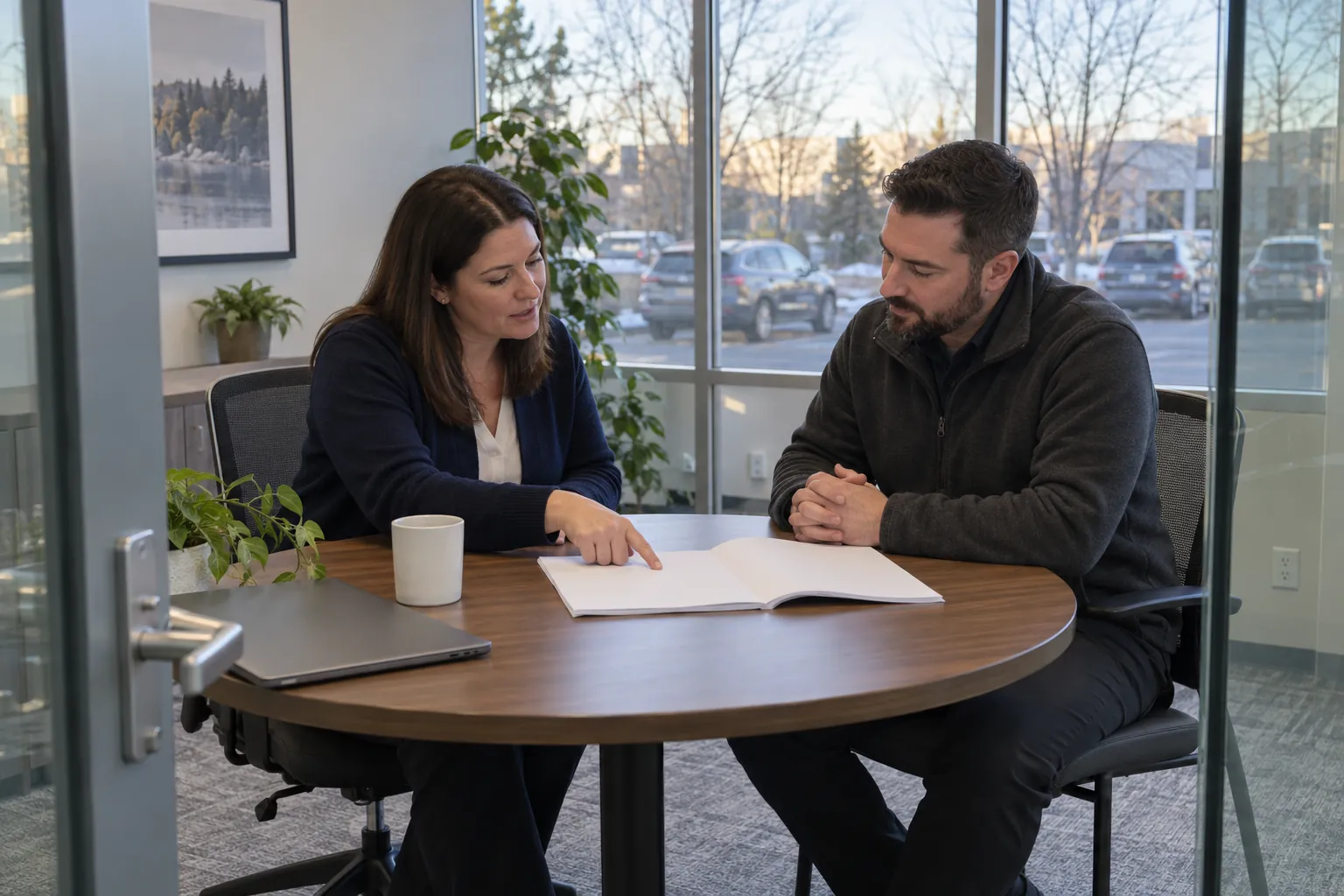
It turns a contract for cleaning services into something both sides can measure. This guide covers what to put in one for a Canadian building, the provincial and federal rules that sit behind it, and how to show the service was actually delivered.
01
What a janitorial service level agreement is, and the rules behind it
A service level agreement (SLA) is the part of a service contract that sets out the level of service the client should receive and how it will be measured. In commercial janitorial work it usually sits beside two other documents: the contract, with the legal terms such as length, price, payment, insurance, liability and termination, and the janitorial scope of work, which says what is cleaned, where and how often. The SLA says how well, how fast, and how anyone will know.
No Canadian law requires a janitorial SLA; it is a commercial document, enforceable as part of the contract. What the law requires is the outcome it protects, and in Canada most of that law is provincial. Federal law covers only federally regulated work such as banks, airports, telecoms and interprovincial transport, so an SLA should name the province and be read against its rules.
For federally regulated workplaces, the Canada Occupational Health and Safety Regulations (SOR/86-304) set the baseline in Part IX (Sanitation). Section 9.2 requires every employer to maintain each personal service room (a change room, toilet room, shower room or lunch room, among others) and food preparation area used by employees "in a clean and sanitary condition". Section 9.4 says each personal service room "shall be cleaned at least once every day that it is used". Section 9.3 speaks to the janitorial crew directly: janitorial work that may cause dusty or unsanitary conditions must be carried out so that it prevents the contamination of the air by dust or other substances injurious to health.
02
What a janitorial SLA should include
There is no single template. A hospital, a school board, a condo corporation and a downtown office tower need different detail. But the parts of a usable cleaning service level agreement are well established:
- Parties, buildings and scope: who the contractor and client are, the areas covered, and what is excluded. Floor stripping and refinishing, carpet extraction, high windows and snow clearing at entrances are common grey areas.
- Service description: a reference to the scope of work rather than a copy of it, so the two cannot drift apart.
- Service hours: when cleaning happens and when the contractor must answer calls, including evenings, weekends and statutory holidays.
- Performance standards: what "clean" means for lobbies, washrooms, lunch rooms, offices and stairwells, written so that two inspectors would agree.
- Response and correction times for work orders and reported failures, by priority: the time to attend and the time to put it right.
- Key performance indicators: what is measured, the target for each, how and by whom (see our cleaning KPIs guide).
- Reporting: what the contractor reports, how often and to whom.
- Escalation: how issues are raised, who handles them at each level, and within what time.
- Remedies: rectification, holdbacks or service credits if the parties agree to have them, and the point at which persistent failure allows the client to end the contract.
- Client responsibilities: access, keys and alarm codes, a janitor's closet and storage, who supplies washroom consumables, and notice of changes in the building's use.
- Health and safety: the contractor's program, WHMIS training for workers using hazardous products, access to labels and safety data sheets, personal protective equipment, and incident reporting.
- Staffing: supervision, screening where the site needs it, orientation for new staff, and cover for absence.
- Records the law requires: who keeps them, such as Ontario's washroom cleaning record, and in what form.
- Review: how often the SLA is reviewed and how changes are agreed.
Insurance, liability, privacy and termination usually belong in the main terms. Keep the SLA to what is measured and managed day to day, so the people running it actually use it.
03
Setting service levels that can be measured
The commonest weakness in a janitorial SLA is a service level nobody can measure: "a high standard of cleanliness at all times". Each should say what is measured, the target, the period and the evidence.
Federal buyers are held to the same discipline. The CanadaBuys Buyer's Guide page Review a statement of work, published by Public Services and Procurement Canada, tells buyers to check that "the deliverables are precisely defined, including any specific products, services, or outcomes", that the delivery schedule is realistic and clearly outlined, and that "all tasks and responsibilities are thoroughly described". A private property manager writing an SLA is doing the same job: a contractor cannot price, or meet, a standard nobody has written down.
Response and correction times work best in a small number of priorities. As an illustration of the shape, not an industry standard:
- Urgent: a spill or slush on a lobby floor that creates a slip hazard, a blocked toilet, a washroom out of soap or paper towel, a vomit or body fluid clean-up. Attend within a short time during service hours, often measured in minutes, and make safe at once.
- High: a missed clean in a busy area, or a failure a tenant or visitor would notice. Put right the same day.
- Routine: an item missed in a low-use area, or a request for extra work. Put right by the next scheduled clean or by agreement.
The numbers you choose should be ones the contractor can meet with the crew on site. A 15-minute response in a building with one day porter, or one cleaner on an evening shift, is a promise the contract has already broken. Write winter in too: entrance matting, salt and slush removal and more frequent lobby floor care, agreed now rather than argued about in February.
Quality is usually set as an inspection score: the percentage of inspected elements that pass. Delivery is set as completion: scheduled cleans and checks completed against those planned. Both are needed. Quality alone can be met by cleaning half the rooms well; delivery alone by visiting every room and cleaning none properly.
04
How the SLA is measured and reported
Most janitorial SLAs rest on three sources of evidence, and a good one names all three:
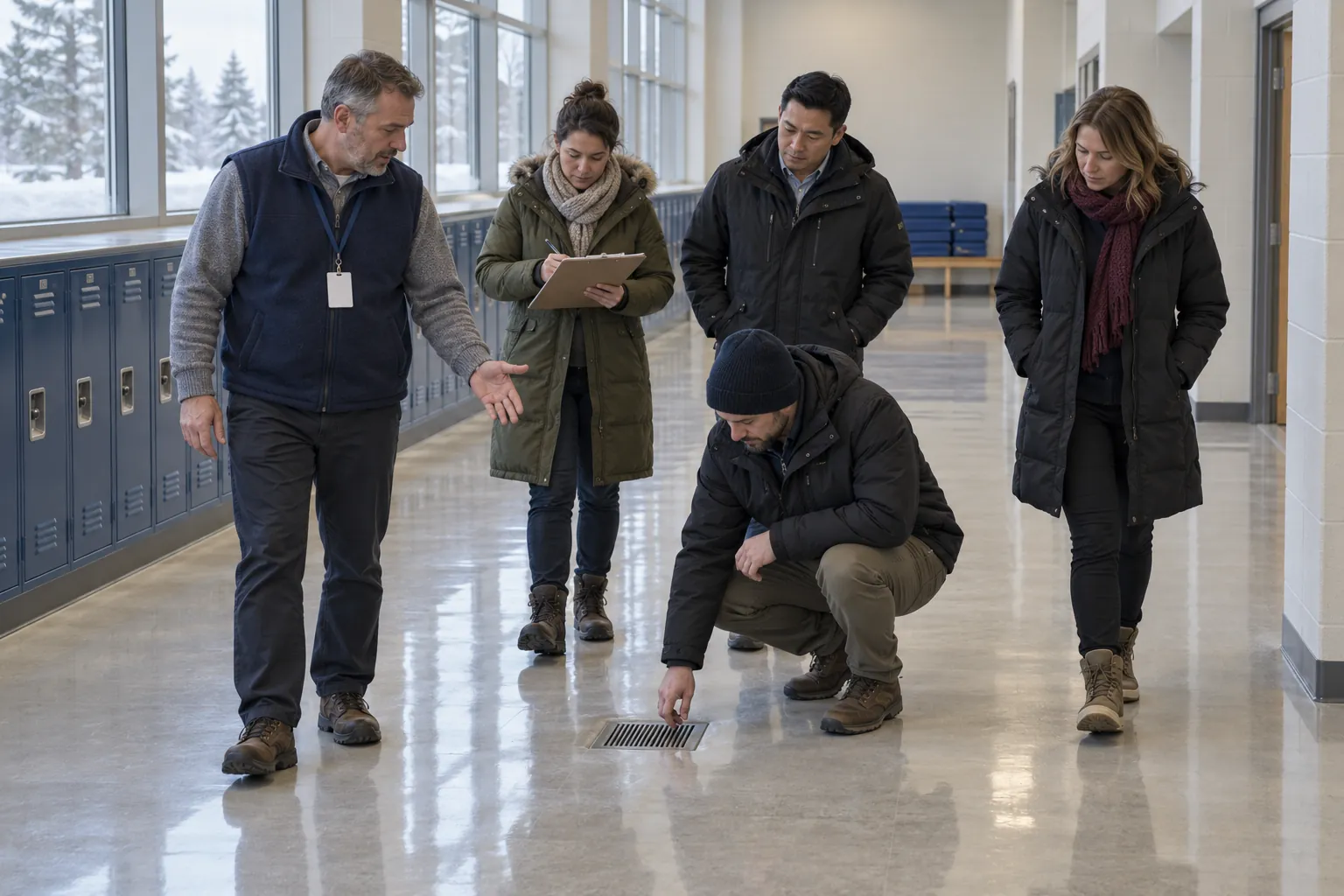
- Inspections: a janitorial supervisor, the property or facility manager, or both inspect a sample of rooms against the standard and score them. Joint inspections, walked by both sides, take much of the heat out of disputes (see our janitorial quality control guide). The Canadian Centre for Occupational Health and Safety puts it plainly in its guide to workplace housekeeping: "The final step to any housekeeping program is inspection." The same page says a good program assigns responsibility for "inspection to ensure cleanup is complete".
- Records of work done: checklists, logs or digital records showing each scheduled task was carried out, by whom and when.
- Work orders and complaints: every reported failure, with the time it was reported, the time it was put right, and whether the same problem keeps coming back.
In health care, Public Health Ontario's Provincial Infectious Diseases Advisory Committee (PIDAC) sets the bar in its Best Practices for Environmental Cleaning for Prevention and Control of Infections in All Health Care Settings (3rd edition). Where cleaning is contracted out, it says infection control and occupational health priorities must be "clearly outlined in the contract", with "clear expectations regarding cleaning frequency, adherence to cleaning standards, and the need for routine audit, feedback, and ongoing education". That is a fair description of what any janitorial SLA should do, hospital or not.
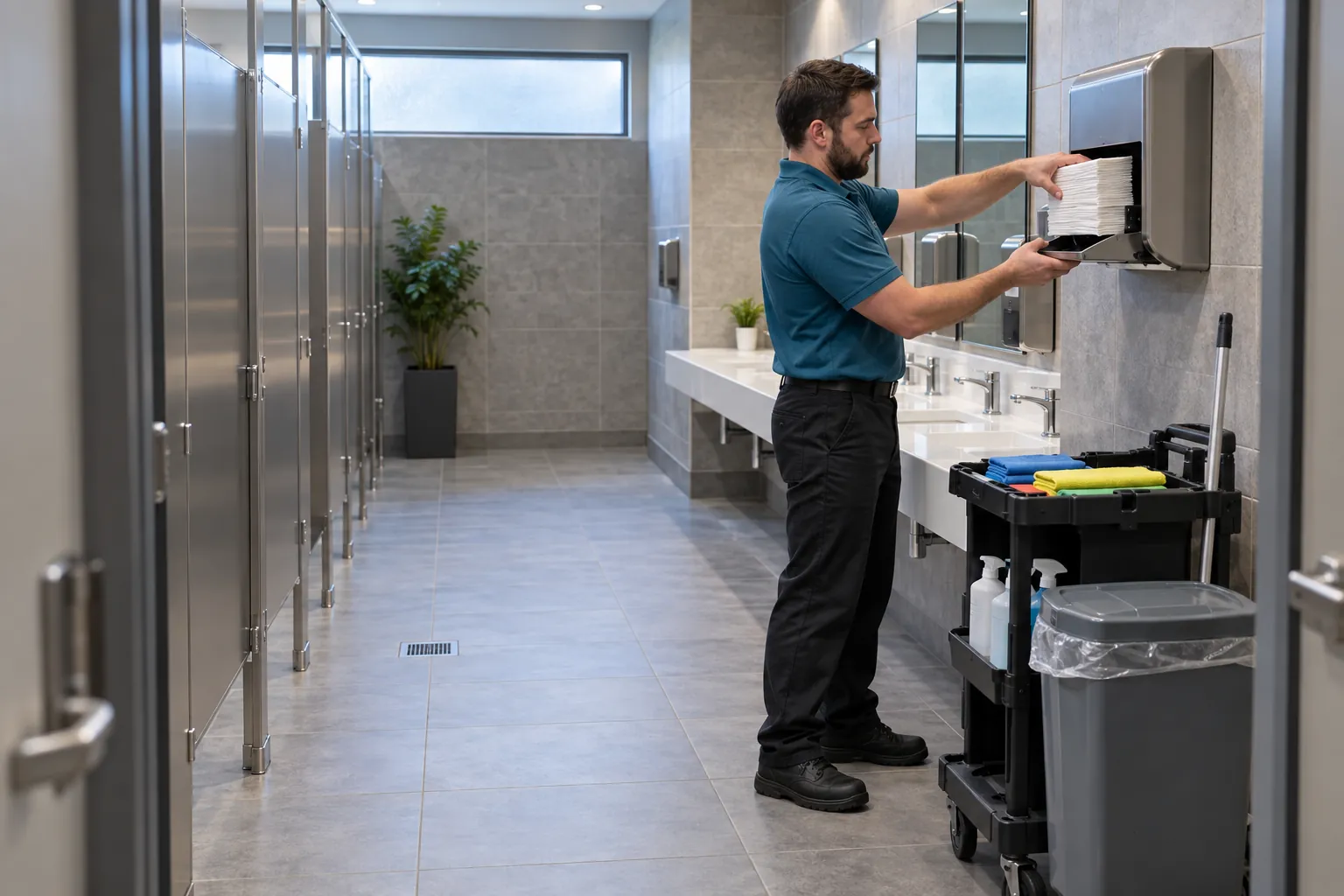
Reporting should match the pace of the contract. A monthly report with KPI results, trends and actions, reviewed by the property manager and the contractor's account manager, is normal. Many clients also want a daily or weekly summary of what was done, missed and still open, so problems surface before the monthly figures do.
Review the SLA at least once a year and whenever the building's use changes: a floor vacated, a clinic opened on the ground floor, offices empty on Fridays. One left alone becomes a list of targets for a building that no longer exists.
05
Holdbacks, credits, escalation and changing contractors
A good SLA deals with the uncomfortable question of what happens when the service falls short. The usual tools, from mildest to strongest, are:
- Rectification: the failure put right within the agreed time, at no extra cost.
- Escalation: from site supervisor to account manager to a named senior contact, each with a time to respond.
- A corrective action plan: agreed actions and dates, reviewed until the KPI recovers.
- Holdbacks or service credits: part of the payment withheld, or the invoice reduced, when a KPI is missed, usually capped.
- Termination for persistent failure, with written notice.
Federal buying guidance describes the same tools. The CanadaBuys page on holdbacks explains that "a portion of the contractor's payment is withheld until specific performance criteria are met". Its page on incentives tells buyers to "confirm that the performance objectives can be measured and verified" and to "keep incentive structures simple with high-level objective measurements rather than complex formulas". The same holds for service credits in a private contract: a small, certain reduction focuses attention; a large one mainly produces arguments. Take legal advice on how credits and holdbacks are drafted in your province before you finalize the contract.
Whatever the remedy, keep the paper trail. The CanadaBuys page on vendor performance tells federal buyers to document "specific performance issues like non-compliance with contract criteria" and "evidence of communication with the contractor regarding these issues", and to notify a contractor in writing of the performance issue when a contract is terminated for default. A private client relying on a termination clause needs the same record.
PIDAC adds that contracts "should support (without penalty or financial barrier) a proactive and cooperative environment": an outbreak that doubles the cleaning load should trigger an agreed change, not a dispute over credits.
Recourse runs both ways: failures caused by the client, such as no access or no consumables it agreed to supply, should not count against the contractor.
06
Where SLA evidence fails, and what SiteClara does about it
Most janitorial SLAs are strong on quality evidence and weak on delivery evidence. Inspections are written up monthly; the daily record sits on a sheet inside the janitor's closet door, sometimes initialled for the whole shift at once. Asked whether the service was delivered last Tuesday, the contractor can describe the schedule but cannot show it, and the first sign of a missed clean is a tenant complaint.
SiteClara gives each location a printed QR code poster, with an optional NFC tag behind it. The crew scan or tap it on their own phone, with no app to install, and see the scheduled checks due there. They mark each one done, or say what stopped them. The time and the named person are recorded as it happens, with a photo when one is asked for. A problem found on the round is reported there and goes onto the team's list of jobs until someone closes it.
The supervisor sees what is due, done and missed, records why a check was missed, and approves the daily report, which goes to the nominated property manager or client contacts at 8 a.m. the next day. It shows what was reported, what was completed, what is still open, and how scheduled checks went, for example 12 of 12 completed. That is the delivery half of the SLA, recorded as it happened rather than assembled for the monthly meeting.
07
Questions people ask
What is included in a service level agreement?
The Treasury Board of Canada Secretariat's Guideline on Service Agreements: Essential Elements groups what a service agreement covers under six headings: scope, governance, operations, finances, performance and implementation. It says service agreements "can enhance governance, accountability, and service quality by clearly defining roles, responsibilities, processes, and performance expectations". Its example SLA, in Appendix D, has sections for scope, service levels and performance targets, operational considerations, and performance tracking and reporting, among others. In a janitorial contract that means the areas and tasks covered, who does and decides what, measurable standards and response times, how results are reported, and what happens when a target is missed.
How do you write a service level agreement?
Define the service first, then the levels. The Treasury Board's Guideline on Service Agreements: Essential Elements calls defining the service relationship (the nature and scope of the services, how the relationship will be governed and operated, finances, and the performance measurement and reporting regime) "a necessary prerequisite" to the agreement, and asks whether there are gaps between existing service levels and the provider's, and how they will be dealt with. Targets "should be measurable at a reasonable cost", and any measure used to assess penalties should be "as objective as possible", with the measures, how they are calculated and the measurement process "clearly spelled out in the agreement". It also strongly recommends consulting expert counsel, such as corporate and legal services, when developing one.
Can you give me some examples of service levels?
The example SLA in the Treasury Board's Guideline on Service Agreements: Essential Elements lists common targets including response times and "time to fix", the number of incidents or complaints, and a report's timeliness ("receive report within three (3) days of month end"), completeness, and accuracy by spot audit. It says a target is typically described by, among other things, its definition, timeframe, measurement formula, reporting period, data sources and escalation. In a janitorial SLA the same shapes become attendance and correction times by priority, an inspection pass rate, scheduled cleans completed against those planned, and the monthly report delivered on time.
Can you provide some examples of service agreements?
The Treasury Board's Guideline on Service Agreements: Essential Elements gives three in its appendices: a memorandum of understanding (Appendix B), a master agreement (Appendix C) and a service level agreement (Appendix D). They are written for services between federal departments, not cleaning contracts, but the SLA example works as a free template outline: recitals, commencement and duration, definitions, scope, service levels and performance targets, operational considerations, and performance tracking and reporting. A cleaning service level agreement fills the same outline with the building's areas, tasks and standards.
08
Further reading, and a checklist to take away
Start with your own province's occupational health and safety act and regulations, or, for federally regulated work, Part IX of the Canada Occupational Health and Safety Regulations. The Canadian Centre for Occupational Health and Safety publishes plain-language guides on workplace housekeeping and sanitation and infection control for cleaning staff, which covers WHMIS training, protective equipment and access to safety data sheets. Health care buyers should read PIDAC's Best Practices for Environmental Cleaning. Going out to tender? Our cleaning RFP guide covers the rest of the package. For the contract terms, take legal advice; an SLA is only as enforceable as the contract it sits in.
Before you sign or renew a janitorial SLA, check that:
- it names the province and the buildings, refers to the current scope of work and lists what is excluded;
- every service level says what is measured, the target, the period and the evidence;
- it measures delivery as well as quality;
- response and correction times are set by priority and can be met with the crew on site;
- winter work at entrances and lobbies is written in, not assumed;
- the escalation path names people and times;
- holdbacks or service credits, if any, are simple, proportionate and capped;
- it says who keeps any record the law requires, such as Ontario's washroom cleaning record;
- the client's own responsibilities are written down;
- a change of contractor has been thought through, including provincial employment standards;
- there is a date for its next review.
Sources
Every document this guide quotes or links to, in the order it first cites them.
- Canada Occupational Health and Safety Regulations (SOR/86-304) laws-lois.justice.gc.ca
- Maintaining clean washroom facilities for workers ontario.ca
- Review a statement of work canadabuys.canada.ca
- Workplace housekeeping ccohs.ca
- Best Practices for Environmental Cleaning for Prevention and Control of Infections in All Health Care Settings publichealthontario.ca
- Holdbacks canadabuys.canada.ca
- Incentives canadabuys.canada.ca
- Vendor performance canadabuys.canada.ca
- Your guide to the Employment Standards Act: building services providers ontario.ca
- Guideline on Service Agreements: Essential Elements tbs-sct.canada.ca
- Sanitation and infection control for cleaning staff ccohs.ca
Related guides
 CleaningJanitorial scope of work: what it should say, and how to show it is metWhat a janitorial scope of work should contain in Canada: areas, tasks, frequencies, standards, winter care, WHMIS and products, and how to show the work was done.
 CleaningCleaning KPIs: what to measure in a janitorial contract, and how to know the figures are trueThe cleaning KPIs worth measuring in a Canadian janitorial contract, how to define and target them, how to report them, and how a green dashboard can mislead.
 CleaningJanitorial quality control: how to inspect, correct and show the standard heldHow janitorial quality control works in Canada: QA versus QC, inspections, sampling, corrective action, CIMS, the PIDAC audit model and records that hold up.
 CleaningCleaning RFP: how to run a janitorial tender as the buyerA buyer's guide to a cleaning RFP or tender in Canada: trade agreement rules, the bid package, site visits, successor rules, evaluation and the first months.