Cleaning
Washroom cleaning checklist: what to check, how often, and Ontario's new cleaning records
A washroom cleaning checklist, sometimes called a restroom or bathroom cleaning checklist, lists what must be cleaned and restocked on each visit to a washroom, from toilets, sinks and touch points to supplies, waste and floors, and records the date, the time and the person who did each cleaning.
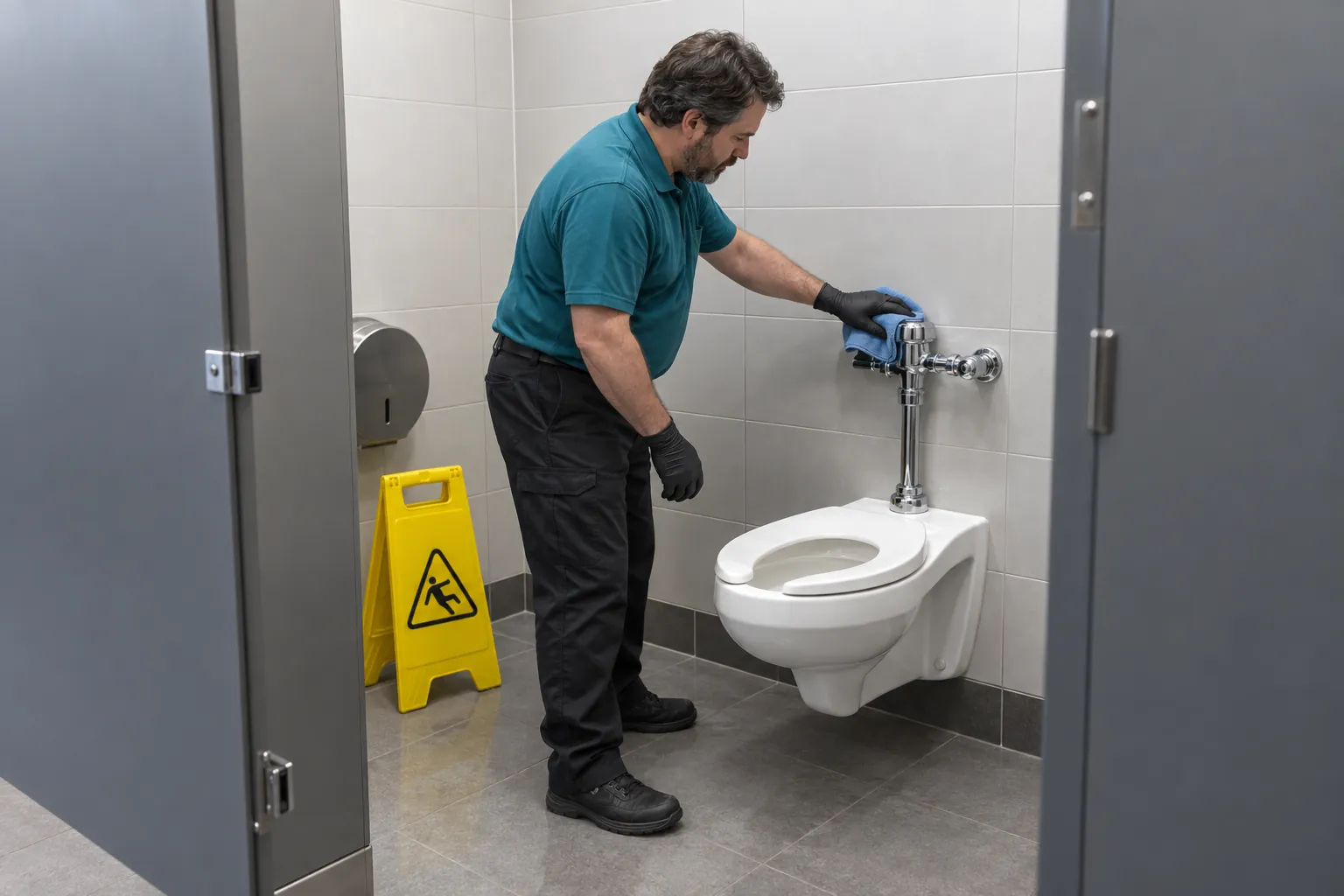
Since January 1, 2026, Ontario employers who provide washrooms for workers have had to keep records of cleaning, with the date and time of the two most recent cleanings posted at or near the washroom or made available electronically. This guide covers the law in Ontario and elsewhere in Canada, what a washroom cleaning checklist should include, how often to clean, and how to keep a record people will believe.
01
The law behind the checklist: Ontario's washroom rules, and the rest of Canada
For years no Canadian law said you had to post a cleaning sheet on a washroom door. In Ontario that changed. The Working for Workers Five Act, 2024 (Bill 190, royal assent October 28, 2024) added two duties to the Occupational Health and Safety Act (OHSA): section 23.1 for constructors on a project and section 25.3 for employers. Each must ensure that the washroom facilities, if any, that they provide for the use of workers are maintained in a clean and sanitary condition, and must keep, maintain and make available records of the cleaning of those facilities, as prescribed.
The clean and sanitary duty came into force on July 1, 2025. The records rule is set out in Ontario Regulation 480/24, filed in November 2024 and in force from January 1, 2026. The province's own guidance, Maintaining clean washroom facilities for workers, gives the reason: poor sanitary conditions of washroom facilities can directly impact worker health and the spread of infectious diseases. It also explains how an employer or constructor may meet the requirement:
- the records of cleaning are posted in a conspicuous place in or near the washroom facility they relate to, where they are likely to come to the attention of workers, or electronically where workers can access them, in which case workers must be told where and how to find them;
- the posted records include the date and time of the two most recent cleanings of that washroom facility.
A "washroom facility" is defined broadly in subsection 1(1) of the OHSA: a washroom, toilet facility, clean-up facility, urinal, shower or other similar facility. It does not include an eye wash station or an emergency shower. Ministry inspectors may look at the washroom's actual condition, such as visible soiling; how often it is cleaned, given its type and level of use; whether the cleaning practices suit that workplace; and anything else they consider relevant. Whether a washroom has been "provided" for workers is decided on the facts inspectors find in the workplace.
Wherever you work, Ontario's rule describes what a good washroom cleaning checklist has always been for: showing when the room was last cleaned, and by whom. The rest of this guide applies in every province.
02
What a washroom cleaning checklist should cover
A washroom cleaning checklist does two jobs. It tells the custodian or janitorial worker what to do on each visit, and it records that the visit happened. Ontario's posted record only needs the date and time of the two most recent cleanings, but a checklist that is any use to a supervisor or a client says more. Each entry should carry:
- The date and the actual time the cleaning was done, written at the time, not the time it was scheduled.
- Who did it: a name or initials that identify one person, not a crew or a company.
- Toilets and urinals: bowls, seats, hinges and flush handles cleaned and disinfected, flushing properly, stall locks and hooks working.
- Sinks, taps, counters and mirrors: basins and faucets cleaned and free of stains, mirrors free of spots and streaks, hot and cold water running, no standing water on the counter.
- Touch points: door handles and push plates, stall latches, light switches, dispenser levers and taps, the surfaces CCOHS calls touch points.
- Supplies: toilet paper, hand soap, paper towels or a working hand dryer, and, where they are provided, menstrual products and hand sanitizer, restocked before they run out.
- Waste: garbage emptied and liners replaced, sanitary disposal containers emptied or within capacity.
- Floors: swept and mopped, dry, drains clear, wet floor sign out while it dries.
- Showers and change rooms, where there are any: floors, walls and drains, because the Ontario definition of a washroom facility includes showers and clean-up facilities.
- Smell and ventilation: exhaust fan running, no lingering odour.
- Deficiencies found: a leak, a plugged toilet, a broken lock, a burnt-out light, and who it was reported to, such as the building's maintenance staff.
- Supervisor check: a separate line, completed less often, by someone who did not do the cleaning.
Touch points and dispensers get lines of their own because CCOHS singles out touch points, and because a handle can look clean when it is not. Keep it short enough to complete honestly. Twenty boxes per visit get ticked in one stroke at the end of the shift.
Post it where the person cleaning will see it and fill it in on the spot: inside the washroom door or beside it in the corridor, at eye height, in a clear holder, with a pen on a string. In Ontario that is also the simplest way to meet O. Reg. 480/24, because the two most recent entries are right there for workers to read.
03
How often a workplace washroom should be cleaned
Ontario sets no fixed frequency. Its inspectors look at whether the frequency suits the type of washroom and the level of use. The federal regulations set a floor of once every day a toilet room is used, and CCOHS's Workplace Housekeeping – Basic Guide says washroom facilities require cleaning once or more each shift, with a good supply of soap, towels and, if needed, disinfectants. Beyond that, the interval follows use, and it belongs in the scope of work.
As a starting point, which each building should adjust to its own pattern of use:
- Every 30 to 60 minutes at peak times: transit stations, malls, arenas, event venues and other public washrooms.
- Every one to two hours: busy offices, schools during the day, clinic waiting areas, gyms and recreation centres.
- Two or three times a day: lightly used offices and staff-only washrooms.
- At least once a day, or once each shift: every washroom in use, with a full cleaning.
Schedule by use, not by the clock alone: after the morning arrival, after lunch, after recess or a shift change. An hourly visit through a quiet afternoon and nothing during the noon rush produces a tidy checklist and a dirty washroom.
04
A check is not a cleaning, and a cleaning is not a disinfection
Much of the trouble with washroom records comes from putting different jobs in the same box.
- A check is a short visit: look, pick up paper, wipe a counter, restock, report a deficiency. It takes a few minutes and may happen many times a day.
- A cleaning is the scheduled job in the scope of work: toilets, urinals, sinks, touch points, dispensers, garbage and floors, done in order with the right colour-coded cloths and mops. It happens once or more each day, often outside the busiest hours.
- A periodic or deep cleaning: descaling, grout, partitions, dust on vents and light fittings, high dusting and behind fixtures, on a weekly or monthly schedule, not on the door sheet.
Ontario's rule asks for records of cleaning. A walk-through that restocked the paper towels, posted as a cleaning, records something that did not happen. Agree which visits count as cleanings, write it into the scope of work, and mark each entry.
Cleaning and disinfecting are different again. CCOHS's Cleaning Products – Working Safely distinguishes cleaners, which remove dirt by wiping, scrubbing or mopping, from sanitizers, which reduce micro-organisms on a surface, and disinfectants, which destroy or inactivate them. Its guidance for janitorial staff, Sanitation and Infection Control for Cleaning Staff, says to clean visibly soiled surfaces before disinfecting, to make a checklist of all surfaces to be cleaned, especially touch points, and to record when cleaning and disinfection have been done.
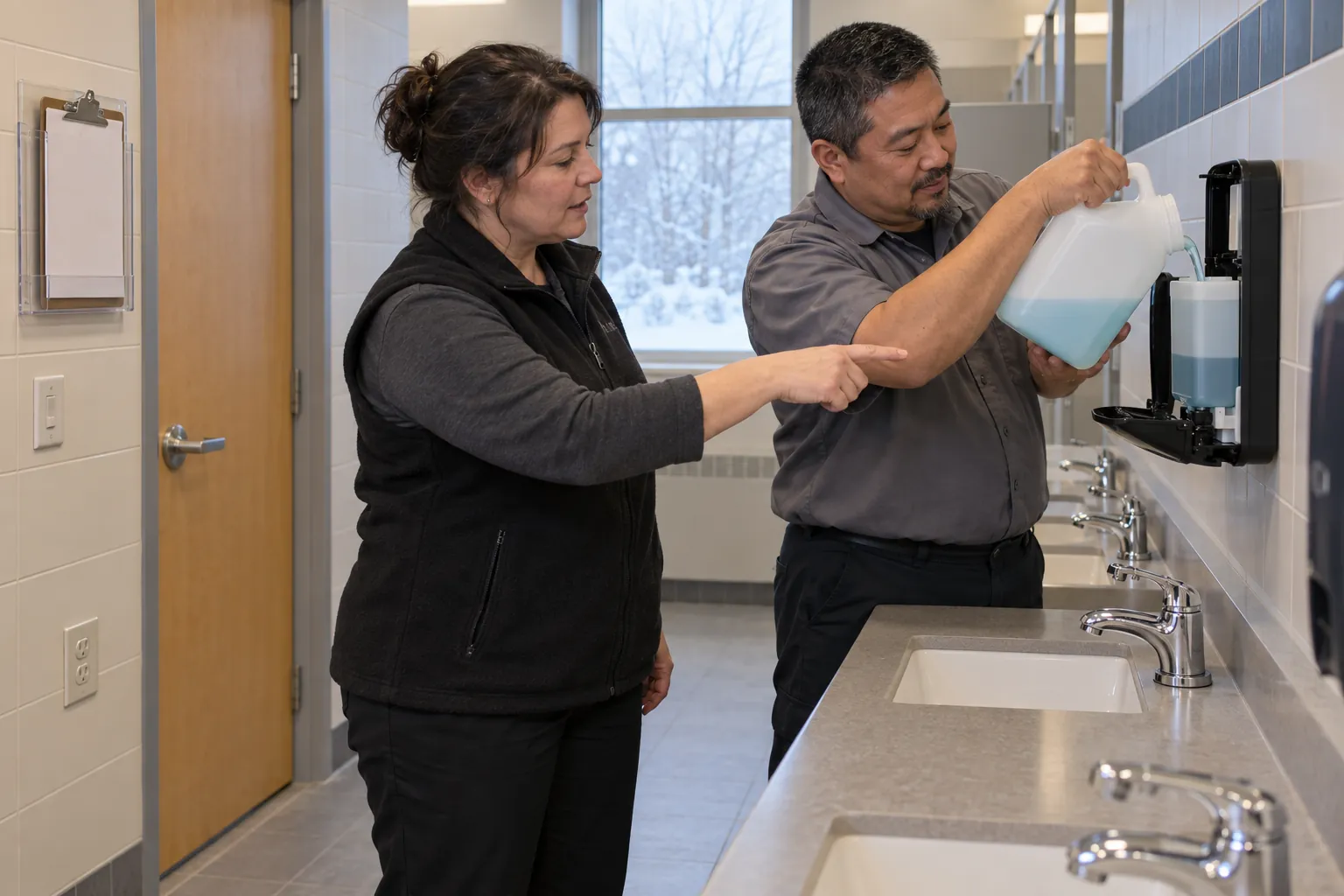
The same pages set the safety basics: read the label and the safety data sheet, as WHMIS training teaches; never mix products containing bleach and ammonia, because hazardous gases may be released; when diluting, add the concentrate to the water; work with good ventilation; wear the gloves and eye protection the product calls for; and keep products in their original containers. Hand hygiene matters for the cleaner too: the same guidance for cleaning staff says to wash hands regularly, especially after each exposure.
A deficiency found on a visit needs to reach someone who will fix it. "Tap leaking" on the sheet shows it was seen; it does not tell the building operator.
05
What makes a washroom cleaning record credible
Anyone who has managed a janitorial contract has seen a sheet filled in ahead of time, or a whole day of entries in the same pen at the same slant. Clients know it, workers know it, and a joint health and safety committee member on a workplace inspection knows it. Now that Ontario workers are entitled to see the two most recent cleanings, a record that does not match the room is more visible than it used to be. What makes a record believable is simple:
- It is written at the time. The time on the record is when the cleaning was finished, not when it was due.
- It names one person. Initials that identify an individual carry weight; "night crew" does not.
- It shows exceptions. A sheet where the soap never ran out and nothing ever broke is not believed. "Soap refilled 11:40 a.m." or "plugged toilet, stall 2, reported to building operator 2:20 p.m." shows that someone looked.
- Someone else checks it. A janitorial supervisor who walks the washroom unannounced and initials the sheet a few times a week gives it independence.
- It is kept. The posted record in Ontario only has to show the two most recent cleanings, but a sheet thrown out every Monday cannot answer a complaint about last Thursday. Agree with the client how long the full history is kept, and keep it for that long.
- Gaps are explained. A missed cleaning with a reason, such as "washroom closed for plumbing repair" or "covering a spill on level 3", is more credible than a record with no gaps at all.
In a multi-tenant building, settle who keeps the record. In Ontario the duty sits with the employer or constructor who provides the washroom, which inspectors decide on the facts, so the contract, the lease or the property manager's instructions should say who posts the record, who keeps the history, and who a worker tells when the washroom is not clean.
When a client, a worker or an inspector asks, the questions are always the same: when was this washroom last cleaned, by whom, and what was done about the problem they saw. A good record answers all three without anyone having to be called.
06
Where the paper checklist fails, and what SiteClara does about it
Paper works in one building with a steady crew. It struggles when a janitorial company looks after dozens of sites, or a property manager wants the record rather than an assurance. The sheet stays on the washroom wall; the client sees it only if they visit. Nobody notices a missed cleaning until the next complaint, and nobody can tell from a set of initials whether it was written at 10 a.m. or at 5 p.m.
SiteClara replaces the clipboard with a tag at the washroom door: a printed QR code, with an NFC tag behind it if staff would rather tap than scan. The custodian scans or taps it on their own phone, with no app to install, and marks the cleaning done. The time and the person are recorded as it happens. If something is wrong, they report it there, with a photo if it helps, and it goes onto the team's list of open jobs until someone closes it.
Scheduled cleanings are set per washroom. Staff see what is due and mark it done, or say what stopped them, and the supervisor sees what was done and what was missed and can record why. At the end of the day the supervisor reviews it, adds a note, and the approved report goes to the client or management at 8 a.m. the next morning, showing what was completed and what is still open.
07
Questions people ask
What are the requirements for a washroom cleaning checklist in Ontario?
Ontario does not prescribe a checklist, but it does require records of cleaning. The province's guidance, Maintaining clean washroom facilities for workers, says employers and constructors must "keep, maintain, and make available records of cleaning" of the washroom facilities they provide for workers. The records are posted "in a conspicuous place in or near the washroom facility", or electronically where workers can access them, with directions, and must "include the date and time of the two most recent cleanings". The duty comes from sections 23.1 and 25.3 of the Occupational Health and Safety Act and Ontario Regulation 480/24.
What should I include on a checklist for toilet cleaning?
CCOHS's guidance for janitorial staff, Sanitation and Infection Control for Cleaning Staff, says to "create a checklist of all surfaces that must be cleaned, especially touch points", such as door handles and taps, to clean visibly soiled surfaces before disinfecting, and to "record when cleaning and disinfection has occurred". For a washroom that means toilets and urinals, sinks, counters and mirrors, touch points, supplies, waste and floors, with the date, time and the name of the person on each entry.
08
Further reading, and a checklist to take away
In Ontario, start with the province's guidance, Maintaining clean washroom facilities for workers, then sections 23.1 and 25.3 of the OHSA and O. Reg. 480/24. Federally regulated workplaces should read Part IX of the Canada Occupational Health and Safety Regulations; elsewhere, read your own province's regulation, with CCOHS's Sanitation and Toilet Facilities in the Workplace as a summary. CCOHS's pages for cleaning staff and on cleaning products are short and practical.
Before you print the next batch of sheets, or replace them, check that:
- each washroom's cleaning frequency is written into the scope of work and follows how the room is used, at least daily or once a shift;
- in Ontario, the date and time of the two most recent cleanings are posted in or near every washroom provided for workers, or available electronically with directions workers have been given;
- the checklist separates quick checks from cleanings, and cleanings from disinfection;
- each entry carries the actual time and a name or initials that identify one person;
- there is room to record deficiencies and who they were reported to;
- supplies, including menstrual products where they are provided or required, are on the list;
- a supervisor initials it on unannounced visits;
- the full history is kept for an agreed period, and someone knows where;
- night shifts, evenings and weekends are covered if workers are in the building then;
- everyone who cleans has WHMIS training for the products they use.
Sources
Every document this guide quotes or links to, in the order it first cites them.
- Working for Workers Five Act, 2024 ola.org
- Occupational Health and Safety Act ontario.ca
- Ontario Regulation 480/24 ontario.ca
- Maintaining clean washroom facilities for workers ontario.ca
- Canada Occupational Health and Safety Regulations laws-lois.justice.gc.ca
- Occupational Health and Safety Regulation, Part 4 worksafebc.com
- Sanitation and Toilet Facilities in the Workplace ccohs.ca
- Workplace Housekeeping – Basic Guide ccohs.ca
- Cleaning Products – Working Safely ccohs.ca
- Sanitation and Infection Control for Cleaning Staff ccohs.ca
Related guides
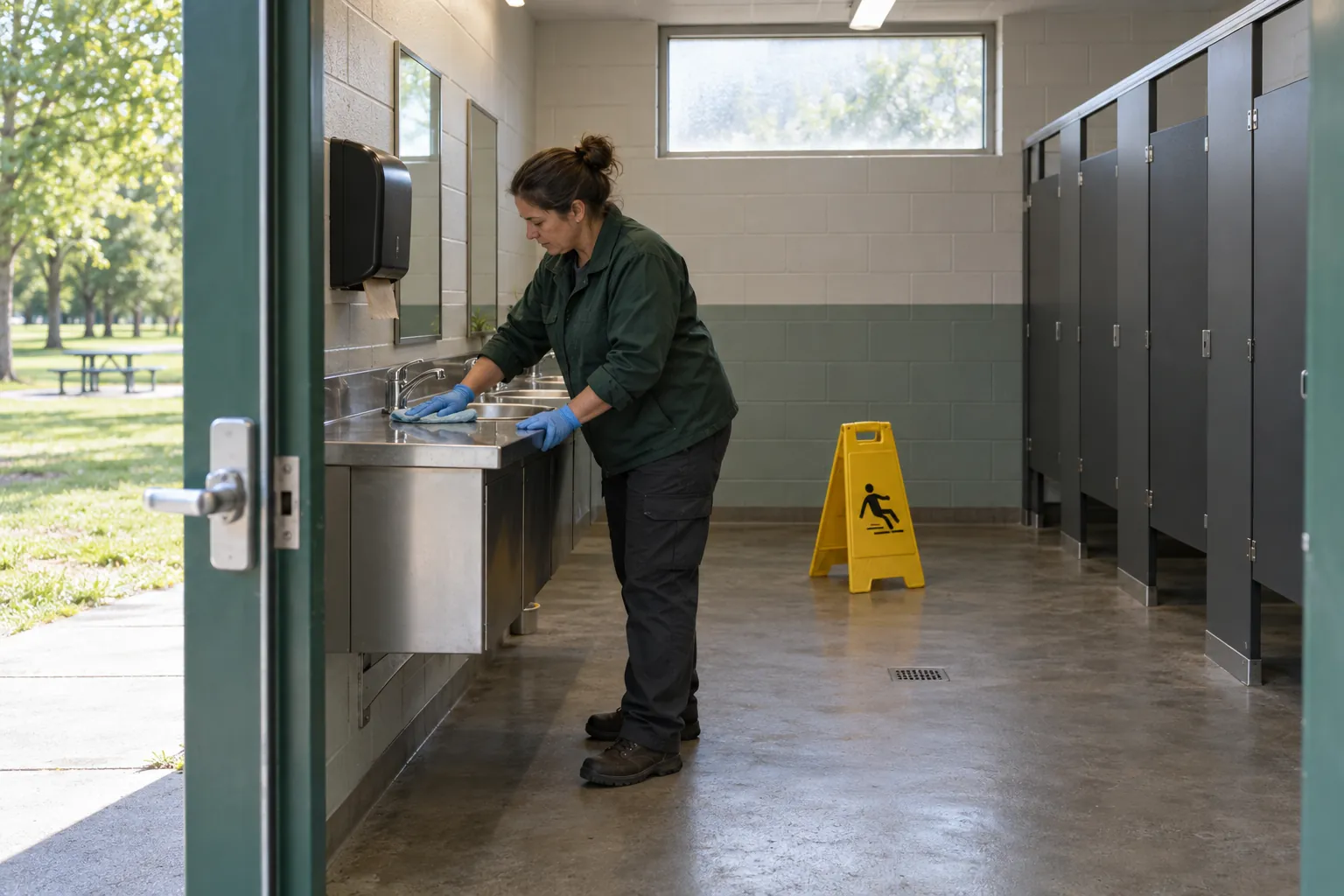 CleaningPublic washroom cleaning: frequencies, safety and accessibilityCleaning washrooms open to the public in Canada: parks, transit, malls and arenas, how often to visit at peak, needles and body fluids, and barrier-free stalls.
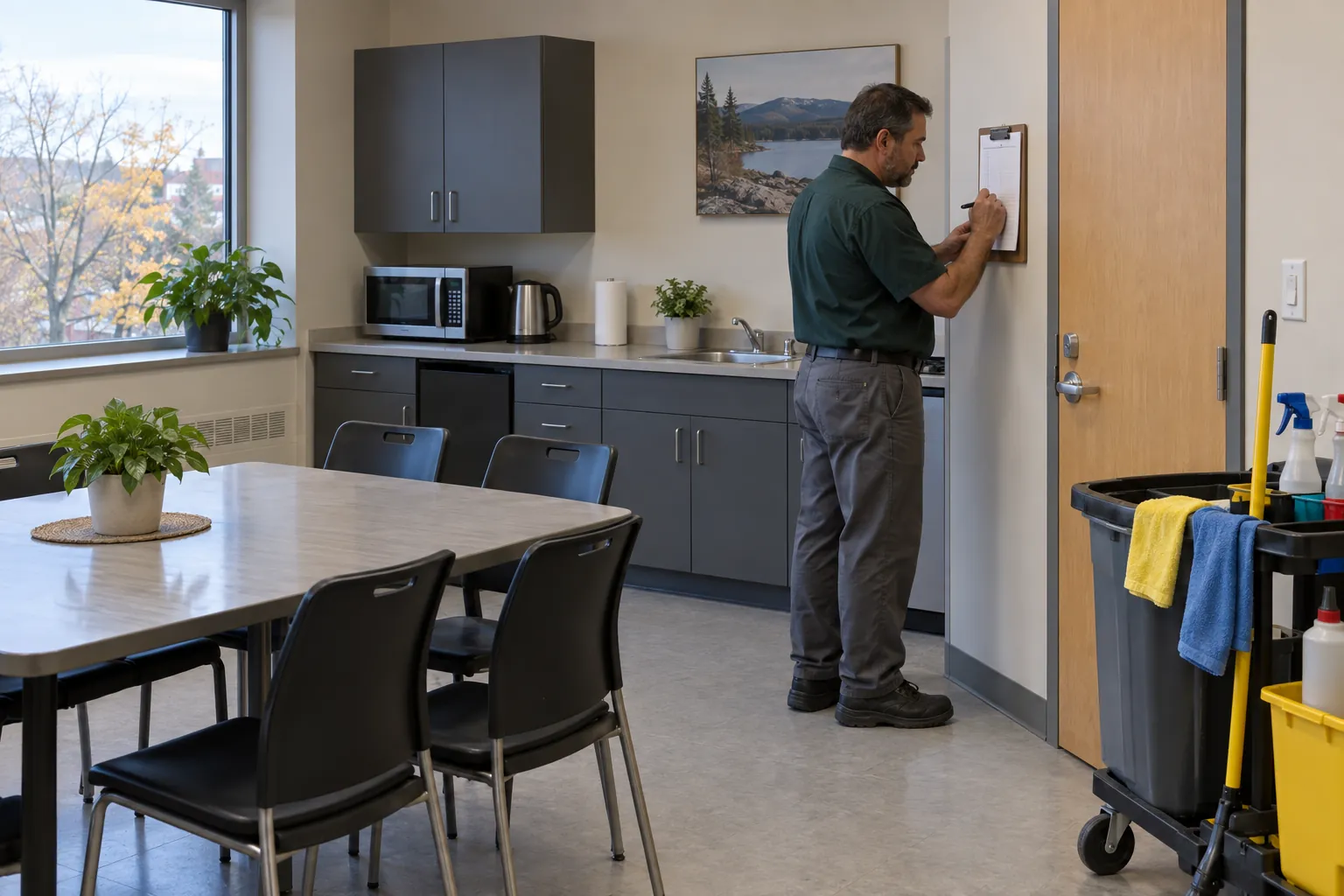 CleaningCleaning log sheet: what to record, who fills it in, and what the law in Canada asks forWhat a cleaning log sheet should record, where Canadian workplaces use one, what Ontario and federal rules require, and how to keep a log people believe.
 CleaningJanitorial quality control: how to inspect, correct and show the standard heldHow janitorial quality control works in Canada: QA versus QC, inspections, sampling, corrective action, CIMS, the PIDAC audit model and records that hold up.
 CleaningJanitorial scope of work: what it should say, and how to show it is metWhat a janitorial scope of work should contain in Canada: areas, tasks, frequencies, standards, winter care, WHMIS and products, and how to show the work was done.