Cleaning
Cleaning KPIs: what to measure in a janitorial contract, and how to know the figures are true
Cleaning KPIs (key performance indicators) are the few measurable figures, such as inspection scores, scheduled checks completed, deficiency correction times and repeat complaints, that show whether a cleaning contract is delivering the agreed standard.
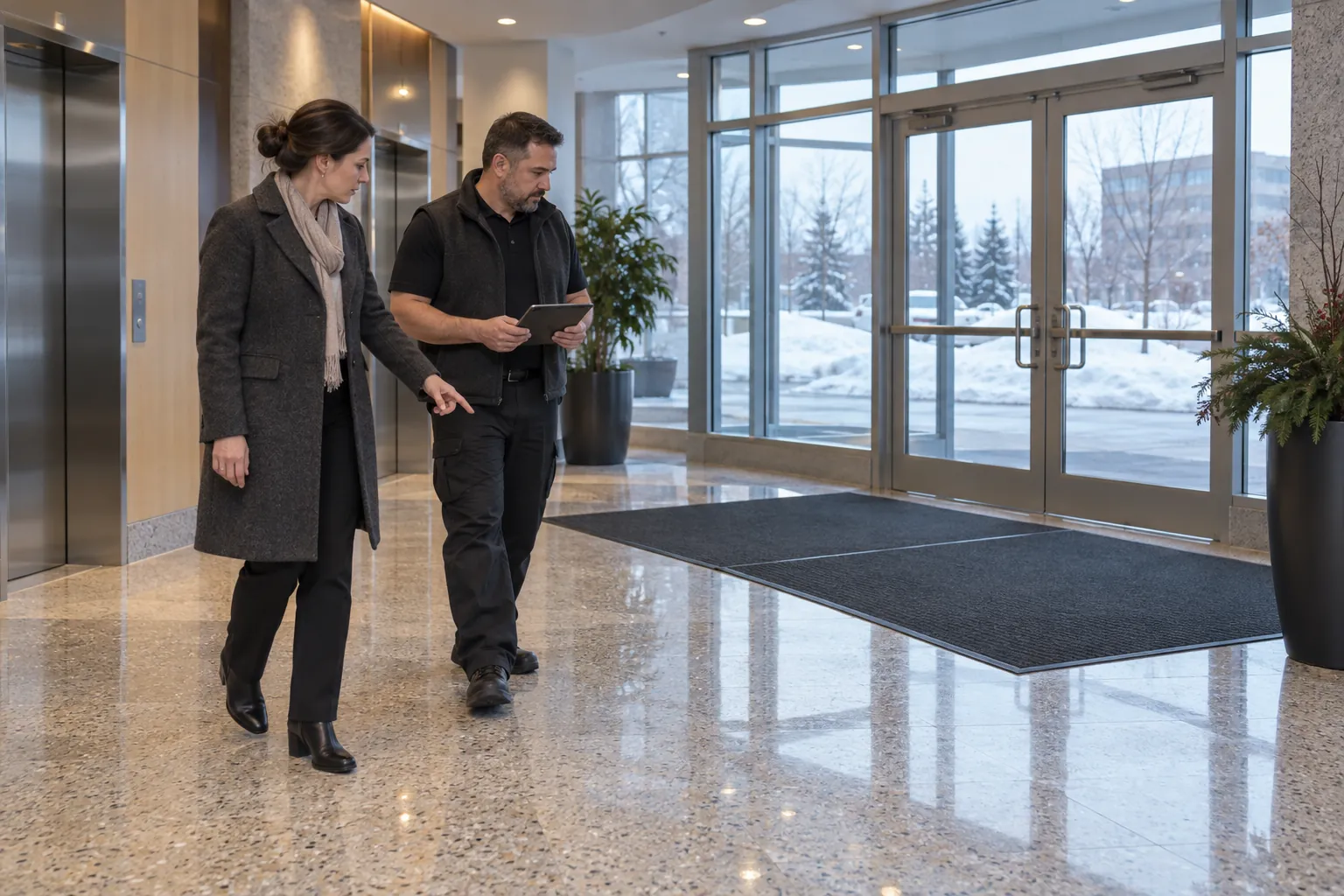
They are how a property or facility manager and a janitorial contractor agree whether the contract is working. Chosen well, a handful of them show whether the building is clean, whether the agreed service was delivered and whether deficiencies are being corrected. Chosen badly, they produce a green dashboard and a stream of complaints. This guide covers which KPIs to use in a Canadian building, how to define and measure them, and how to report them.
01
What cleaning KPIs are, and the rules behind them in Canada
A key performance indicator (KPI) is a measurable figure that shows whether a service is meeting an agreed standard. It turns a judgment such as "the cleaning is fine" into data both sides can compare month to month. In a commercial janitorial contract the KPIs usually sit in the service level agreement or the performance schedule of the contract, each with a definition, a target, a measurement period and a source of evidence. They are reviewed at regular meetings between the property or facility manager and the contractor's account manager.
No law sets cleaning KPIs for an ordinary workplace, and in Canada the duties behind them are mostly provincial. Each province and territory makes its own occupational health and safety law; federal law covers only federally regulated work such as banks, airports, telecoms and interprovincial transport. Name the province in the contract and check its own act and regulations.
For federally regulated workplaces, Part IX (Sanitation) of the Canada Occupational Health and Safety Regulations says every employer shall maintain each personal service room and food preparation area "in a clean and sanitary condition" (section 9.2), and that each personal service room "shall be cleaned at least once every day that it is used" (section 9.4). The regulations define a personal service room as a change room, toilet room, shower room, lunch room, living space, sleeping quarters or a combination of them. A daily clean of those rooms is the legal floor, and a KPI can be set above it, never below.
Health care shows the method most clearly. Public Health Ontario's Provincial Infectious Diseases Advisory Committee (PIDAC) says in its Best Practices for Environmental Cleaning for Prevention and Control of Infections in All Health Care Settings (3rd edition, revised November 2025) that "a quality control program that includes regular assessments of cleaning and cleanliness is required", and that audit and feedback results must be presented to environmental services leadership and the infection control or quality and safety committee. Its recommendations apply whether cleaning is done in-house or contracted out. Outside health care, most KPI frameworks follow the same logic on a smaller scale: measure what matters most where the risk is highest.
The industry's own management standard is ISSA's Cleaning Industry Management Standard (CIMS), open to building service contractors and in-house service providers, with certification after an on-site assessment by an independent assessor. Certification says something about how a contractor is managed; the KPIs for a particular building are still yours to agree.
02
The cleaning KPIs worth measuring
Five to ten KPIs is usually enough for a janitorial contract. Fewer and something important goes unmeasured; more and nobody reads them. The ones worth tracking on almost any site are these:
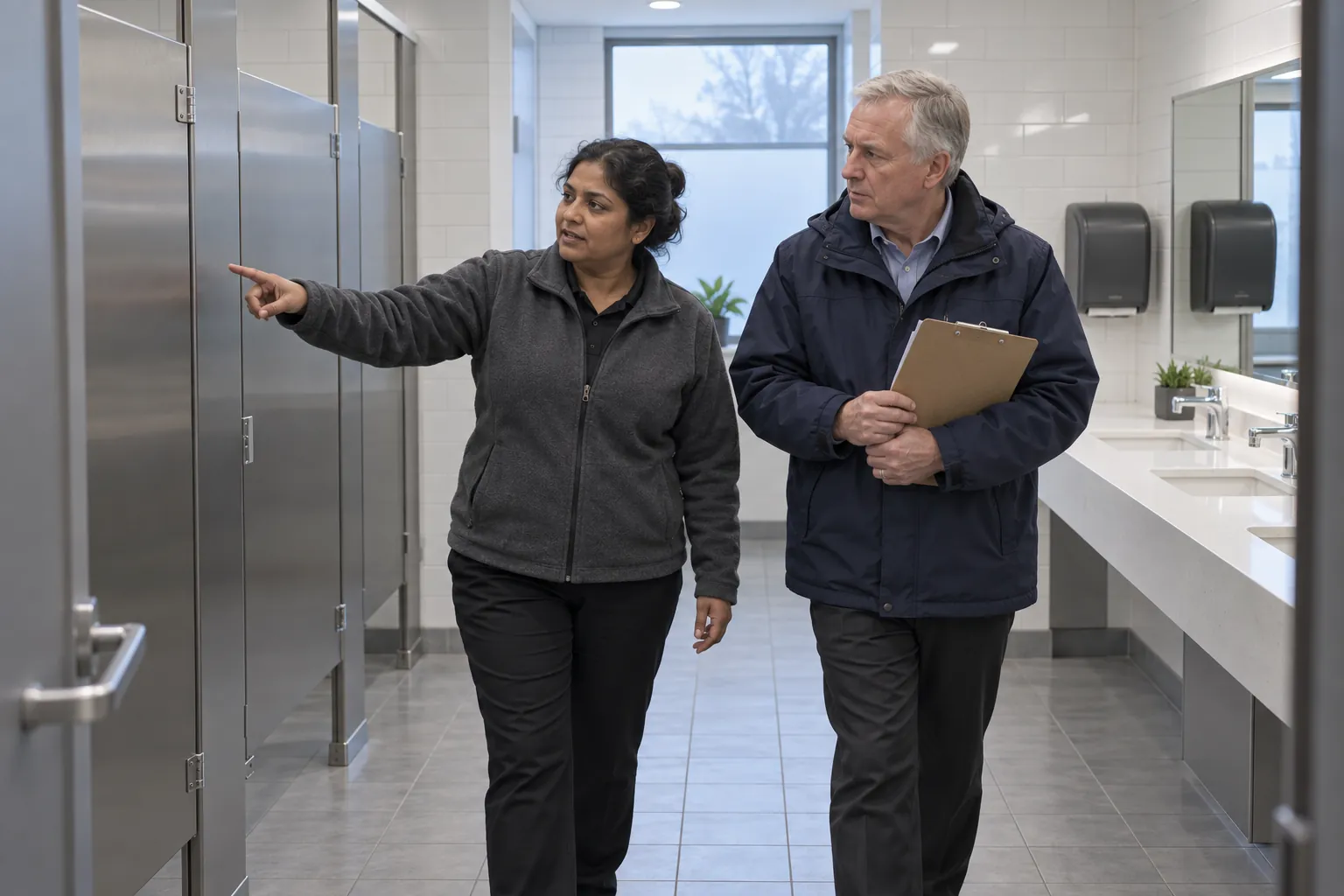
- Cleaning quality: scores from quality control inspections, as the percentage of inspected items that meet the standard, by area type. This is the KPI most owners start with, and the one most open to argument unless the inspection method is agreed.
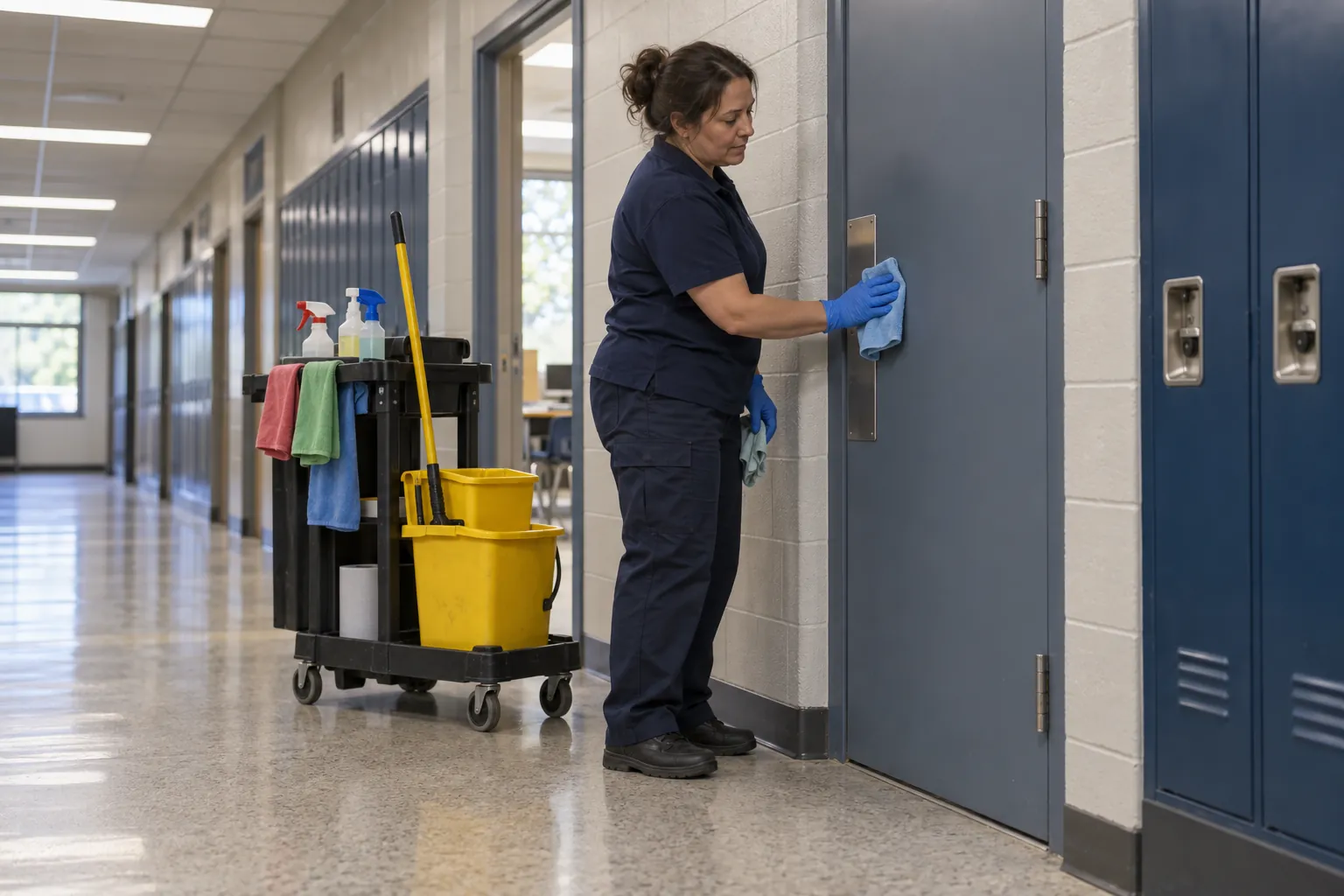
- Task completion: scheduled tasks and checks completed against those planned, for example washroom checks during the day as a share of those scheduled. It measures whether the agreed service was delivered at all.
- Deficiency response and correction time: how quickly a reported problem is attended to and how quickly it is corrected, by priority. A spill in a lobby needs minutes; a stained carpet can wait for the next extraction.
- Complaints and repeat deficiencies: the number of complaints per period, and how many concern a problem already raised. Repeat deficiencies are often more telling than the total.
- Periodic work completed: floor care (strip and wax, scrub and recoat, burnishing, carpet extraction), high dusting, interior glass and deep cleans delivered against the periodic schedule. Our floor care program guide covers the cycle.
- Staffing and coverage: contracted hours delivered, and whether absences were covered. A contract short of hours will fail every other KPI eventually.
- Training: crew members with current site orientation, WHMIS and equipment training.
- Health and safety: injuries, near misses and slips on the contract, and how each was followed up.
- Occupant satisfaction: a short periodic survey of tenants, staff or the owner's team, used alongside the other measures rather than instead of them.
- Statutory records kept: in an Ontario workplace, the washroom cleaning record up to date at every washroom the contract covers.
Owners sometimes also track cost per square foot, or square feet cleaned per hour. Both help at tender or in planning labour, but they measure cost and productivity, not cleaning performance, and belong in a different report. A cleaning business also tracks its own operating figures, such as labour and cleaning products as a share of revenue, customer retention and its callback rate; they matter to the contractor's margin, but they are not what the building owner is buying.
Specialist contracts add their own measures, such as environmental marking or ATP results in health care. The principle is the same: pick the few figures that show whether this building is safe, clean and served as agreed.
03
Defining each KPI and setting the target
Every KPI needs a written definition that both sides agree before the contract starts, ideally as a schedule to the scope of work. For each one, set out:
- What is measured, precisely. "Washroom checks completed" needs to say whether a late check counts, and how late.
- The source of the data: inspection forms, check records, the property management work order log, the crew schedule.
- Who measures it, and whether the owner verifies it. A contractor marking its own work needs some independent check, such as joint inspections with the property manager.
- The period: weekly, monthly or quarterly.
- The target, and the level below which it counts as a failure.
- What happens on a failure: a corrective action, a performance improvement plan, or a holdback or credit if the contract provides for one.
Set targets from a baseline, not from ambition. The first month of a new contract, or the last three months of an existing one, shows what the building actually achieves, and that is the benchmark to improve from. A target of 100% on anything measured by human inspection will be missed, and a contract that fails a KPI every month soon stops taking it seriously. A target nobody ever misses is not measuring anything.
Weight the KPIs to the building. A school cares about washrooms after recess and classrooms before the bell; an office tower cares about the lobby and elevators first thing; a long-term care home cares about resident rooms and high-touch surfaces above all. The same set of KPIs can carry different targets in different areas.
Allow for the Canadian winter. Salt, sand and slush tracked in at the door put entrances, vestibules and lobbies under far more strain, and a single annual target for them will be missed every January and met easily every July. Set seasonal frequencies and a winter target for them. Snow and ice outside is usually a separate contract, and the KPIs should say so.
Involve the crew. Custodians and supervisors know where the building works against them, and KPIs they understand and can see do more than targets in a monthly email.
04
Measuring quality honestly, and reporting it
A quality score is only as good as the inspection behind it. The Canadian Centre for Occupational Health and Safety's guidance on effective workplace inspections fits a cleaning inspection well: record the area inspected, the date and time frame and who inspected; list each item found; assign a responsible person and "a definite correction due date"; note whether each action is open, on hold or closed; and "use older reports to identify trends". Its page on workplace housekeeping makes the same point from the other side: housekeeping order is "maintained" not "achieved", and inspection "is the only way to check for deficiencies in the program".
PIDAC's best practices describe the measurement methods in the most detail, and several transfer beyond health care:
- Visual assessment with a standard checklist, reported as the proportion of items or surfaces inspected that were clean. If the same items are checked repeatedly, the result can serve as a quality indicator, provided its limits are understood: a surface that looks clean can still be contaminated.
- Performance observation, a trained supervisor watching routine work. It is labour intensive and people may work differently when watched, but it is where training gaps show.
- Environmental marking: a set of surfaces (PIDAC suggests 15) is marked before cleaning and checked after, giving a cleaning rate per area and per surface. The program should be known in advance, but not which rooms will be marked, and results should be used for training and constructive feedback, not punishment, or the scores will be gamed.
- ATP testing, which measures organic material left on a surface and is used mainly in health care and food service.
- Satisfaction surveys, which show how occupants perceive cleanliness but may not reflect how clean surfaces really are.
Most facilities use several methods together, because each has different strengths. Janitorial KPIs are then typically reported monthly, in a short report or dashboard reviewed with the contractor. A useful report shows:
- each KPI against its target, with a simple red, yellow or green status;
- the trend over several months, because quality over time matters more than any single figure;
- the reasons behind any failure, and the corrective action taken;
- open actions, who owns them and whether any are overdue;
- anything that keeps recurring, and what is being done about it.
Monthly is often too slow on its own. A missed clean on the 3rd reported on the 30th has already become a tenant complaint. Many property managers also want a short daily or weekly summary of what was done, what was missed and what is still open, so problems surface while they can still be corrected.
05
When KPIs look green and the building is not clean
Every experienced property manager has seen a janitorial contract with good KPI results and unhappy tenants. The usual causes are:
- Measuring only inputs. Tasks completed, with no check on the result, reward visiting a room rather than cleaning it.
- Measuring only outputs. An inspection score from a small, predictable sample says little about the rooms nobody inspected, or about the washroom at 2 p.m. rather than 9 a.m.
- Closing actions without fixing them. An inspection flags a deficiency, an action is raised, someone marks it complete, and the same deficiency appears next month. Track repeat deficiencies, not only closed actions.
- Too many KPIs. Thirty indicators on a dashboard mean the three that matter get lost.
- Self-reported data nobody checks. A contractor's own figures, never verified, drift upward.
- Scores used as a stick. PIDAC warns that marking audits used in a punitive or secretive way can give misleading results, because staff learn to clean the marked surfaces only. The same happens with any KPI that feels like a trap.
- Stale targets. KPIs set for how a building was used three years ago measure a building that no longer exists. Review them at least once a year, and whenever the use changes.
The answer is balance: quality and delivery, contractor-measured and owner-verified, monthly trend and daily detail. Together they measure cleaning performance rather than activity, and show whether the contract is really working.
06
Where the delivery data fails, and what SiteClara does about it
Of all cleaning KPIs, task completion usually rests on the weakest evidence. The figure in the monthly report is assembled from check sheets on the back of washroom doors and supervisors' notes, often initialled in advance or all at once at the end of the shift, so it cannot show when a check was done or by whom, and a missed check is rarely recorded as missed.
SiteClara records the checks at the location. A printed QR poster, with an optional NFC tag behind it, sits at each place a check is scheduled. The crew scan or tap with their own phone, with no app to install, see the checks due there, and mark each one done or say what stopped them. The time and the named person are recorded as it happens, with a photo when one is asked for, and an issue found there goes onto the team's list of jobs until someone closes it.
The supervisor sees what is due, done and missed, and records the reason a check was missed. Each day they review the totals and photos, add a note and approve a report that goes to the nominated property manager or client contacts the next morning, showing what was reported, what was completed, what is still open and how scheduled checks went, for example 12 of 12 completed. That gives the task completion and open-deficiency figures a daily source recorded at the time, rather than reconstructed for the monthly meeting.
07
Questions people ask
What are some good cleaning KPI examples?
Good examples are figures both sides can check: the percentage of inspected items that meet the standard, scheduled checks completed against those planned, deficiencies corrected within the agreed time, and repeat complaints. For measured cleaning quality, PIDAC's Best Practices for Environmental Cleaning for Prevention and Control of Infections in All Health Care Settings sets out a worked quality indicator: identify 15 specific surfaces or items to be marked each time cleaning is assessed, count those where the marker was removed, and report the number of surfaces cleaned as a percentage of the total tested. In its sample audit, 5 surfaces cleaned out of 15 gives a monthly cleaning rate of 33%. The same results can be broken down by surface, to show which ones are missed most often.
What are the 5 key performance indicators?
There is no official list of five, for cleaning or anything else; the right set depends on the building and the contract. A useful rule comes from CCOHS's fact sheet Leading and Lagging Indicators: lagging indicators are "a record of what has happened", such as injuries and incidents, while leading indicators are proactive measures such as the percentage of workers with health and safety training and the frequency of safety audits, and "using lagging and leading indicators together will help provide a clearer picture of what is and is not working". For a janitorial contract, five that mix the two are cleaning quality, task completion, deficiency correction time, repeat complaints and crew training.
08
Further reading, and a list to take away
Read your own province's occupational health and safety act and regulations first; in Ontario, Maintaining clean washroom facilities for workers, and for federally regulated workplaces, Part IX of the Canada Occupational Health and Safety Regulations. The chapter on assessing cleanliness in PIDAC's Best Practices for Environmental Cleaning is worth reading outside health care too, and our hospital environmental cleaning guide goes further. CCOHS publishes effective workplace inspections and workplace housekeeping.
Before you agree or review a set of cleaning KPIs, check that:
- there are only as many as you will use, usually five to ten, and each one matters to this building;
- they measure delivery as well as quality;
- each has a written definition, data source, owner, period and target;
- targets come from a baseline, not from ambition, with winter targets for entrances where the season demands them;
- some of the data is verified by the owner, for example through joint inspections;
- repeat deficiencies are tracked, not only closed actions;
- any record the province requires, such as Ontario's washroom cleaning record, is covered;
- there is a daily or weekly view of delivery as well as the monthly report;
- they are reviewed at least once a year.
Sources
Every document this guide quotes or links to, in the order it first cites them.
- Canada Occupational Health and Safety Regulations laws-lois.justice.gc.ca
- Maintaining clean washroom facilities for workers ontario.ca
- Best Practices for Environmental Cleaning for Prevention and Control of Infections in All Health Care Settings publichealthontario.ca
- Cleaning Industry Management Standard (CIMS) cims.issa.com
- Effective workplace inspections ccohs.ca
- Workplace housekeeping ccohs.ca
- Leading and Lagging Indicators ccohs.ca
Related guides
 CleaningJanitorial service level agreement: what to include, and how to show it is metWhat a janitorial or cleaning service level agreement should contain in Canada: service levels, response times, holdbacks, escalation and proof of delivery.
 CleaningJanitorial quality control: how to inspect, correct and show the standard heldHow janitorial quality control works in Canada: QA versus QC, inspections, sampling, corrective action, CIMS, the PIDAC audit model and records that hold up.
 CleaningJanitorial scope of work: what it should say, and how to show it is metWhat a janitorial scope of work should contain in Canada: areas, tasks, frequencies, standards, winter care, WHMIS and products, and how to show the work was done.
 CleaningJanitorial supervisor duties: what the role involves in Canada, and what good looks likeWhat a janitorial or cleaning supervisor does in Canada: the main duties, a typical shift, the legal duties of a supervisor, WHMIS, checking the work and reporting.