Security patrols
School security in Canada: who is responsible, what to check, and how to show it was done
School security is the access rules, physical measures, supervision and routine checks that protect students, staff and school property from threats, unauthorized entry and emergencies.
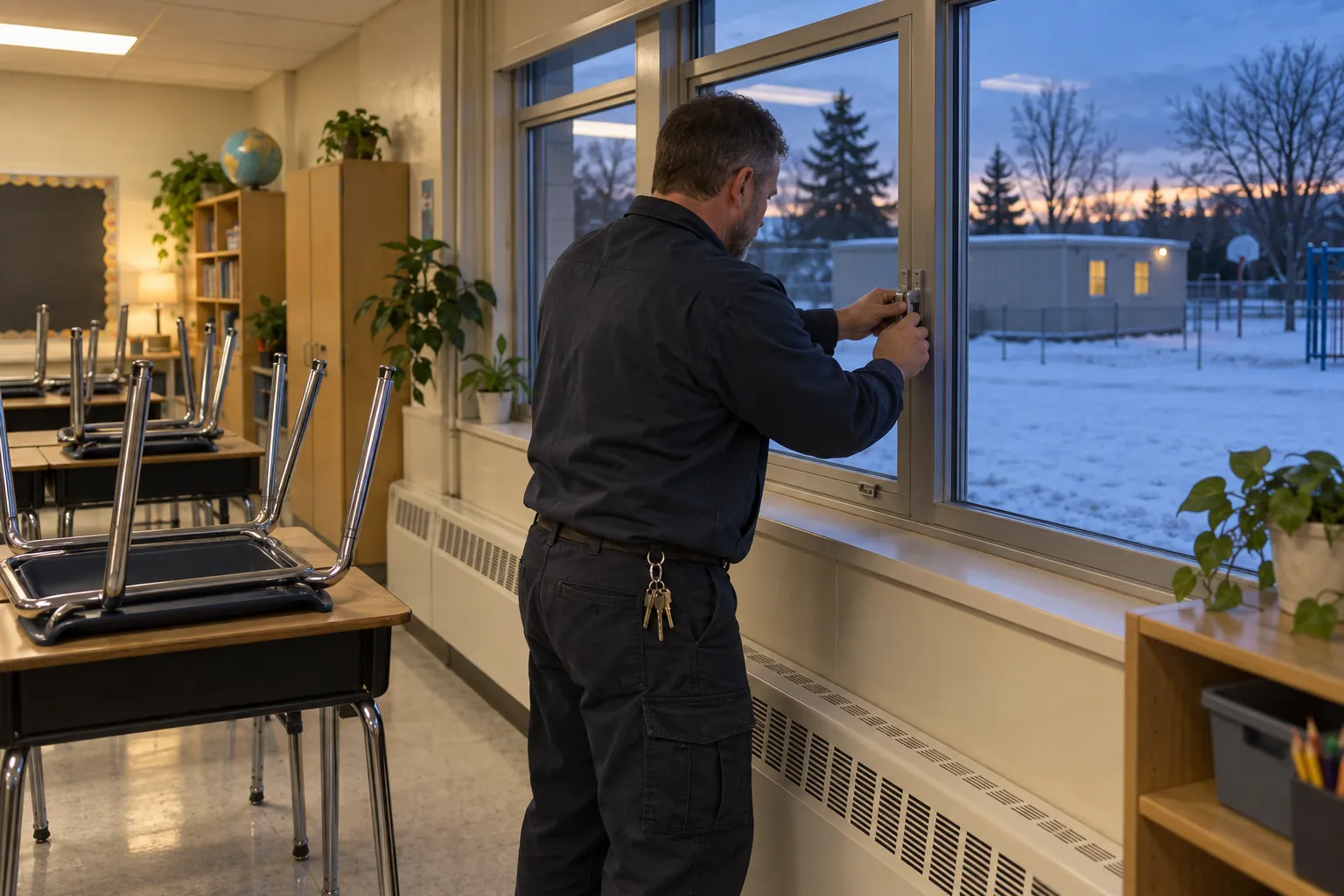
In Canada it is set province by province, and most of it sits with the school board, the principal and the custodial staff rather than with a security company. This guide explains what the Education Acts in Ontario, British Columbia and Alberta say about access to school premises and a safe environment, how workplace violence and fire code duties fit alongside them, the routine checks a school's security depends on, and how those checks can be recorded so the board can see they happened.
01
Who is responsible for school security, and under which law
There is no single Canadian school security act. Education is provincial, so each province's Education Act or School Act says who manages schools and their property, who may be on school premises, and what the board must provide. Workplace safety, fire safety and security guard licensing sit in separate provincial statutes. A school security program is where those pieces meet, and the board's own policies fill in the practice. This guide quotes Ontario most, because its rules on access are the most detailed, and adds British Columbia and Alberta where they differ.
In Ontario, the Education Act, R.S.O. 1990, c. E.2 gives the duties to the board and the principal. Section 170 requires every board to keep school buildings and premises in proper repair and "protect the property of the board". Section 265 makes it the principal's duty "to maintain proper order and discipline in the school" and to give "assiduous attention" to school property and "the condition and appearance of the school buildings and grounds". Under R.R.O. 1990, Reg. 298 (Operation of Schools), the principal must "provide for the supervision of pupils during the period of time during each school day when the school buildings and playgrounds are open to pupils".
Access is covered directly. Section 305 says "no person shall enter or remain on school premises unless he or she is authorized by regulation to be there on that day or at that time", and lets the principal direct a person to leave. The detail is in O. Reg. 474/00, Access to School Premises. Since November 2025, section 170.0.2 also requires boards to work with local police services, including giving them access to school premises in the circumstances the regulations prescribe.
Other provinces put it differently. In British Columbia, section 74 of the School Act, RSBC 1996, c. 412 makes a board "responsible for the management of the schools in its school district and for the custody, maintenance and safekeeping of all property owned or leased by the board". In Alberta, section 33 of the Education Act, SA 2012, c. E-0.3 requires a board to ensure that each student and each staff member "is provided with a welcoming, caring, respectful and safe learning environment", and section 256 says no person shall "loiter or trespass in a school building or on property owned by a board" or "conduct themselves in a manner detrimental to the safe operations of a school". Every other province and territory has its own act; read yours.
02
What school security covers in practice
School security is less about guards and cameras than about a building open to hundreds of people by day and closed to everyone at night. The work is shared by the principal and vice-principals, office staff, teachers on supervision duty, the head custodian or head caretaker and the custodial team, and the board's facilities and safety departments. Contract security mostly covers alarm response, mobile patrols, special events and vacant buildings. School safety is the wider duty to children and staff; security is the part of it that controls who is in the building and what state the building is in, and it looks much the same in an elementary school as in a secondary one. The usual areas are:
- Access and visitors: which doors are open and when, sign-in at the office, visitor badges, and asking someone to leave.
- The building envelope: exterior doors, windows, roof hatches, portables, gates, fences and exterior lighting.
- Keys and access cards: who holds master keys and fobs, and what happens when one is lost.
- Supervision: the playground, entrances at arrival and dismissal, and the bus loop.
- Emergency procedures: fire drills under the fire code, and the board's procedures for other emergencies, such as lockdown and hold and secure.
- Opening and closing: the custodian's morning walk-through, and the lock-up, alarm and check that nobody is left inside.
- Community use: permits for gym and field use, and who opens and closes for them.
- Property and vandalism: graffiti, broken glass, damaged fences and fire hazards around the building.
- Staff safety: the workplace violence program, and procedures for people who work alone.
Cameras and access control are tools on the list, not the list. In British Columbia, section 74.01 of the School Act lets a board install video surveillance only with the prior approval of the school's parents' advisory council, and requires an annual review of whether each camera is accomplishing its purpose. A camera nobody watches does not lock a door.
03
Access to school premises and visitor control
Ontario's O. Reg. 474/00 permits these people on school premises "when the premises are being used for a purpose authorized by the board": enrolled pupils, their parents or guardians, people employed or retained by the board, and "a person who is otherwise on the premises for a lawful purpose", plus anyone invited to an event, class or meeting, or invited for a particular purpose by the principal, a vice-principal or another person authorized by board policy. Two limits matter day to day:
- being permitted on the premises "does not entitle a person to have access to all areas of the school premises", so a parent at the office is not entitled to walk the corridors;
- a person is not permitted to remain "if a policy of the board requires the person to report his or her presence on the premises in a specified manner and the person fails to do so", which is the legal basis for the familiar sign at the front door asking all visitors to report to the office.
A person is also not permitted to remain if their presence is "detrimental to the safety or well-being of a person on the premises", in the judgment of the principal, a vice-principal or another person the board has authorized, and the board may lock the premises when they are not in authorized use.
In practice, visitor control in most Canadian schools means:
- one main entrance during the school day, with other exterior doors closed and latched from outside but usable as exits;
- a buzzer, camera or sightline from the office at that entrance;
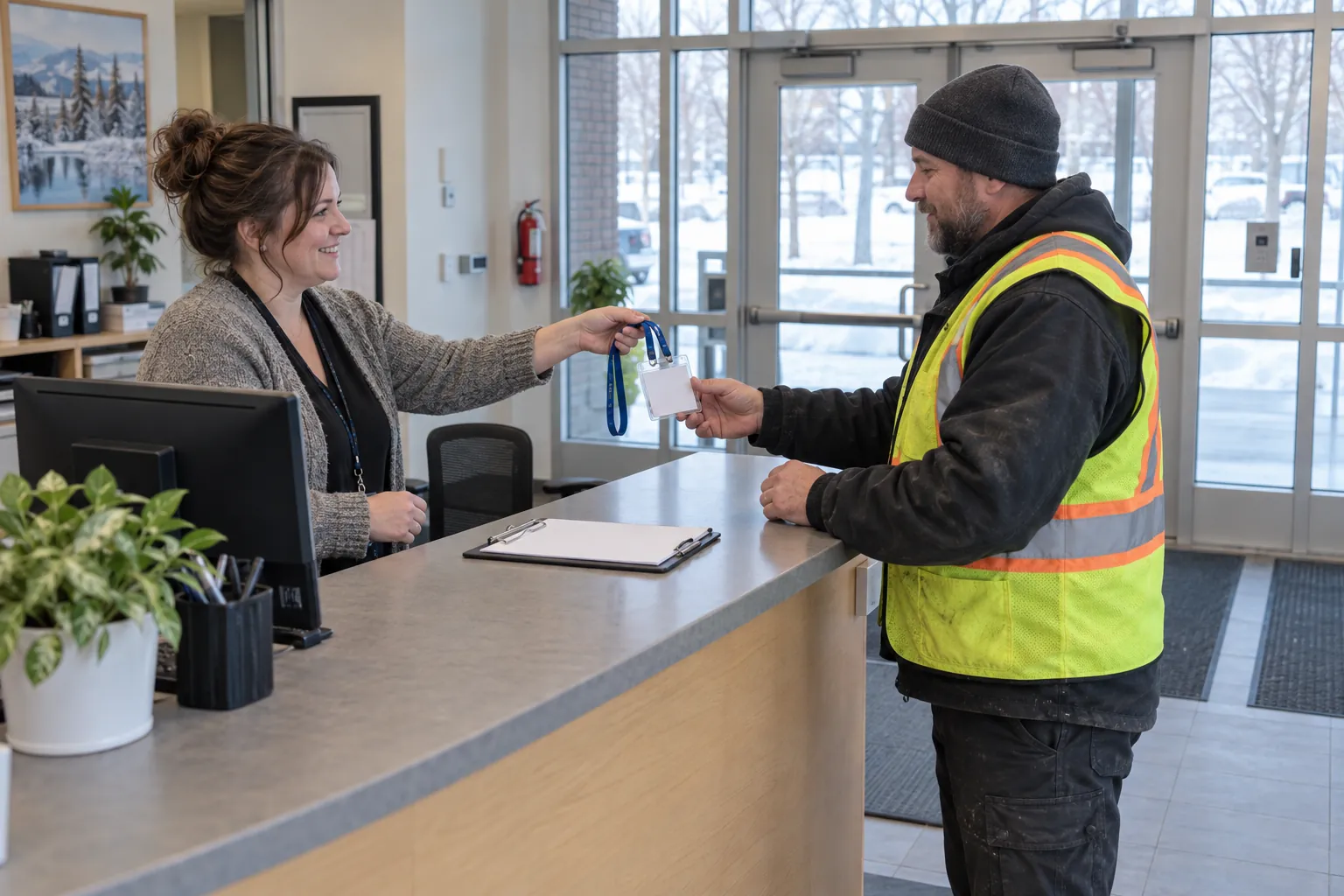
- every visitor and contractor signing in at the office, stating their purpose and wearing a badge, and signing out;
- staff greeting or redirecting any adult without a badge, and calling the office rather than confronting anyone.
Locking and exits must work together. Under the Ontario Fire Code, O. Reg. 213/07, locking, latching and other fastening devices on every exit door must, unless otherwise approved, let the door be "readily opened from the inside with no more than one releasing operation and without requiring keys, special devices or specialized knowledge of the door opening mechanism". A school secured by chaining exit doors or wedging them shut has swapped one risk for a worse one. Special locking on exits is for the fire official and the board's facilities department, not improvisation on site.
Anyone guarding or patrolling a school for pay needs a licence. Ontario's Private Security and Investigative Services Act, 2005 defines a security guard as "a person who performs work, for remuneration, that consists primarily of guarding or patrolling for the purpose of protecting persons or property", and no person may act as one without the appropriate licence. A contract patrol company does that work; a custodian locking up as part of a wider job generally does not. Other provinces have their own licensing acts.
04
The routine security checks, and how often
Most of a school's security depends on ordinary checks done at the same points every day. Boards set their own lists and frequencies in custodial standards and security procedures; the list below is a common starting point, to be adjusted for the building, the board's policy and the fire safety plan.
- Morning, before students arrive: disarm the alarm and note overnight events; walk the exterior for broken glass, forced doors, graffiti, needles or debris in play areas; unlock the designated entrances only.
- During the day: confirm secondary exterior doors are closed and latched after recess and dismissal, and exits and exit routes are clear.
- Evening: check that permit groups stay in the areas their permit covers, and the building is cleared when they leave.
- Lock-up: walk every floor and wing from the far end towards your exit, checking classrooms, washrooms, change rooms, the gym and storage for anyone inside; close windows; check each exterior door has latched; arm the alarm last. A door that will not latch is a fault to report before you leave, not a tick.
- Weekly: exterior lighting, fences and gates, roof hatches, key cabinets, locks and door closers.
- After a break: a full walk-through before staff return, since vandalism and leaks are often found then.
The fire code overlaps with security. In Ontario, O. Reg. 213/07 says combustible materials "shall not be accumulated in or around a building in such quantity or such location as to create a fire hazard", which covers the recycling bins against the back wall that invite arson, and electrical equipment vaults must be "kept locked so that unauthorized persons will not have access to them". A school must hold a total evacuation fire drill at least three times in each of the fall and spring terms, and keep a record of every drill for at least 12 months.
Other emergency drills are set partly by the province and partly by the board. Reg. 298 says a board "may provide for the holding of drills in respect of emergencies other than those occasioned by fire", requires every principal to hold at least one emergency drill, and says everyone in the building takes part. Lockdown drills have a provincial minimum: under the Ministry of Education's Provincial Model for a Local Police/School Board Protocol, "each school shall conduct a minimum of two lockdown drills during each school year". Anything beyond that, and how drills are recorded, is set in board procedures.
05
Staff safety, who does what, and what good evidence looks like
A school is a workplace. In Ontario, the Occupational Health and Safety Act requires every employer to have a workplace violence policy, to assess "the risks of workplace violence that may arise from the nature of the workplace, the type of work or the conditions of work", and to maintain a program with "measures and procedures for summoning immediate assistance when workplace violence occurs or is likely to occur". The Canadian Centre for Occupational Health and Safety's guidance on violence in the workplace notes that all Canadian jurisdictions have legislation on harassment and violence, and lists controls such as access cards and "adequate exterior lighting around the workplace and near entrances".
Custodians often open and close schools alone. CCOHS's guidance on working alone recommends a check-in procedure with a named contact, an agreed frequency, a written log and a plan for a missed check-in. Nobody should be sent to investigate an alarm or an intruder alone: at lock-up, the custodian checks and reports, and does not confront.
Write the responsibilities down, so nobody assumes someone else did it:
- The principal sets local routines within board policy and decides who may remain on the premises.
- Office staff run the visitor sign-in and badges.
- Teachers and educational assistants supervise pupils as assigned, including entrances, the yard and the bus loop.
- The head custodian opens and locks up, checks the building and grounds, and reports damage and faults.
- The board's facilities and safety staff own locks, alarms, cameras, security procedures and patrol contracts.
- A contract security company, where used, patrols to its post orders and reports what it finds.
Good evidence is simple: each check tied to a place, a named person and a time, done when it was due. "Lock-up, 10:40 p.m., J. Singh, north gym door would not latch, reported to maintenance" is a record. A tick on a weekly sheet cannot show whether each door was checked or the sheet was filled in on Friday. A fault should be recorded when found, reported to whoever fixes it and tracked until fixed. Ontario's Policy/Program Memorandum 128, the Provincial Code of Conduct, applies to everyone on school property, visitors included, and aims to "promote the safety of people in the schools"; acting on it depends on the same reliable record.
06
Where school security records fail, and where SiteClara fits
The lock-up sheet on the custodian's clipboard is filled in at the end of the night, or the week. Nobody can tell whether the portables were checked at 10 p.m. or ticked from the office. A door that would not latch is written on the sheet and stays there, because the note never reached board maintenance. When a cover custodian works a PD day or the summer, nobody knows which checks were missed, and the principal sees the sheet only if they go looking.
SiteClara records the checks where they happen. A printed QR poster, with an optional NFC tag behind it, goes at each checkpoint: the main entrance, the exterior doors on each wing, the portables, the gym, the alarm panel. Whoever does the round scans the code or taps the tag on their own phone, with no app to install, sees the checks due there and marks them done, or explains what stopped them, such as a door that would not latch. The time and the named person are recorded as it happens, with a photo when the check asks for one. A fault found on the round goes onto the team's list of jobs until someone closes it, and a supervisor can escalate it to the building's manager to answer.
The supervisor sees what was due, done and missed, records the reason a check was missed, adds a note and approves the daily report, which goes to nominated contacts, such as the principal or the board's facilities manager, at 8 a.m. the next morning, showing how the checks went, what was reported and what is still open.
07
Questions people ask
What are some ideas for school security?
Start with the building and the routine rather than new equipment. The Canadian Centre for Occupational Health and Safety's guidance on violence in the workplace lists design controls that suit a school: "minimizing the number of entrances to your workplace", "using coded cards or keys to control access to the building or certain areas within the building", "using adequate exterior lighting around the workplace and near entrances" and "strategically placing fences to control access to the workplace", alongside staff training in de-escalation and emergency response. Each of those only works if someone checks it: the doors latch, the lights come on and the gates are closed.
Can a school install security cameras?
Yes, within limits. In British Columbia the terms are set in the law. Section 74.01 of the School Act, RSBC 1996, c. 412 lets a board install and operate a video surveillance camera in a school facility or on school land to protect the safety of individuals, their belongings or school property, "with the prior approval of the parents' advisory council for the school", and requires the board to review each year whether the surveillance is achieving that purpose. Neither rule applies to a camera installed temporarily for a specific investigative purpose. Elsewhere it is generally a matter of board policy and provincial privacy law, so check yours.
What training does a school security guard need?
The training for any licensed security guard. In Ontario, the government's page on security guard and private investigator basic training says the basic training course "must be at least 40 hours long, including certification in emergency first aid and cardiopulmonary resuscitation (CPR)", and a new guard must then pass the required test before applying for a licence. Someone who already holds a valid first aid and CPR certificate from an instructor certified by St. John Ambulance or the Workplace Safety and Insurance Board may skip that part of the course. Other provinces set their own training through their licensing acts.
08
Further reading, and a list to take away
In Ontario, start with the Education Act (sections 170, 265 and 305), O. Reg. 474/00, Reg. 298, the Ontario Fire Code and the Occupational Health and Safety Act. In British Columbia, read the School Act, sections 74 and 74.01; in Alberta, the Education Act, sections 33 and 256. Everywhere, read your board's policies and CCOHS's guidance.
When reviewing a school's security routine, check that:
- the board's access and visitor policy is posted at the entrances and followed at the office;
- one main entrance is used during the day, and every other exterior door closes, latches and opens freely from inside;
- the morning, daytime and lock-up checks are written down, with the points to check and the order;
- cover custodians, permit groups and holiday periods have the same list;
- fire drills are held and recorded as the fire code requires, lockdown drills at least as often as the province requires (twice a school year in Ontario), and other drills as board procedures require;
- custodians and others who work alone have a check-in procedure and know not to confront anyone;
- faults found on a check are reported, tracked and closed, not left on a sheet;
- someone other than the person doing the checks reviews the record regularly.
Sources
Every document this guide quotes or links to, in the order it first cites them.
- Education Act, R.S.O. 1990, c. E.2 ontario.ca
- R.R.O. 1990, Reg. 298 (Operation of Schools) ontario.ca
- O. Reg. 474/00, Access to School Premises ontario.ca
- School Act, RSBC 1996, c. 412 bclaws.gov.bc.ca
- Education Act, SA 2012, c. E-0.3 kings-printer.alberta.ca
- Ontario Fire Code, O. Reg. 213/07 ontario.ca
- Private Security and Investigative Services Act, 2005 ontario.ca
- Provincial Model for a Local Police/School Board Protocol ontario.ca
- Occupational Health and Safety Act ontario.ca
- Guidance on violence in the workplace ccohs.ca
- Guidance on working alone ccohs.ca
- Policy/Program Memorandum 128 ontario.ca
- Security guard and private investigator basic training ontario.ca
Related guides
 Security patrolsBuilding security checklist: what to check, how often, and how to show it was doneA building security checklist for Canadian workplaces: doors, locks, fobs, lighting, CCTV, alarms and exits, how often to check them, and how to keep a record.
 Security patrolsGuard tour systems in Canada: how they work, what they prove, and how to choose oneHow guard tour systems record security patrols in Canada – wands, RFID, NFC, QR codes, GPS apps – what the data shows, and what to check before choosing one.
 Security patrolsSecurity guard duties and responsibilities: what the role involves in Canada, and how it is checkedSecurity guard duties in Canada: provincial licences, patrols, access control, incidents and the notebook, the limits of the role, and how the work is checked.
 Premises and facilities managementHead custodian duties: the school custodian's role, routine checks and recordsWhat a school head custodian or head caretaker does in Canada: the duties, daily and weekly checks, water flushing, fire drills, snow, safety and the records.