Premises and facilities management
Head custodian duties: the school custodian's role, routine checks and records
A head custodian, or head caretaker in some boards, leads a school's custodial team: opening and securing the building, organizing the cleaning, carrying out and recording the routine safety checks, reporting repairs and supervising the other custodians.
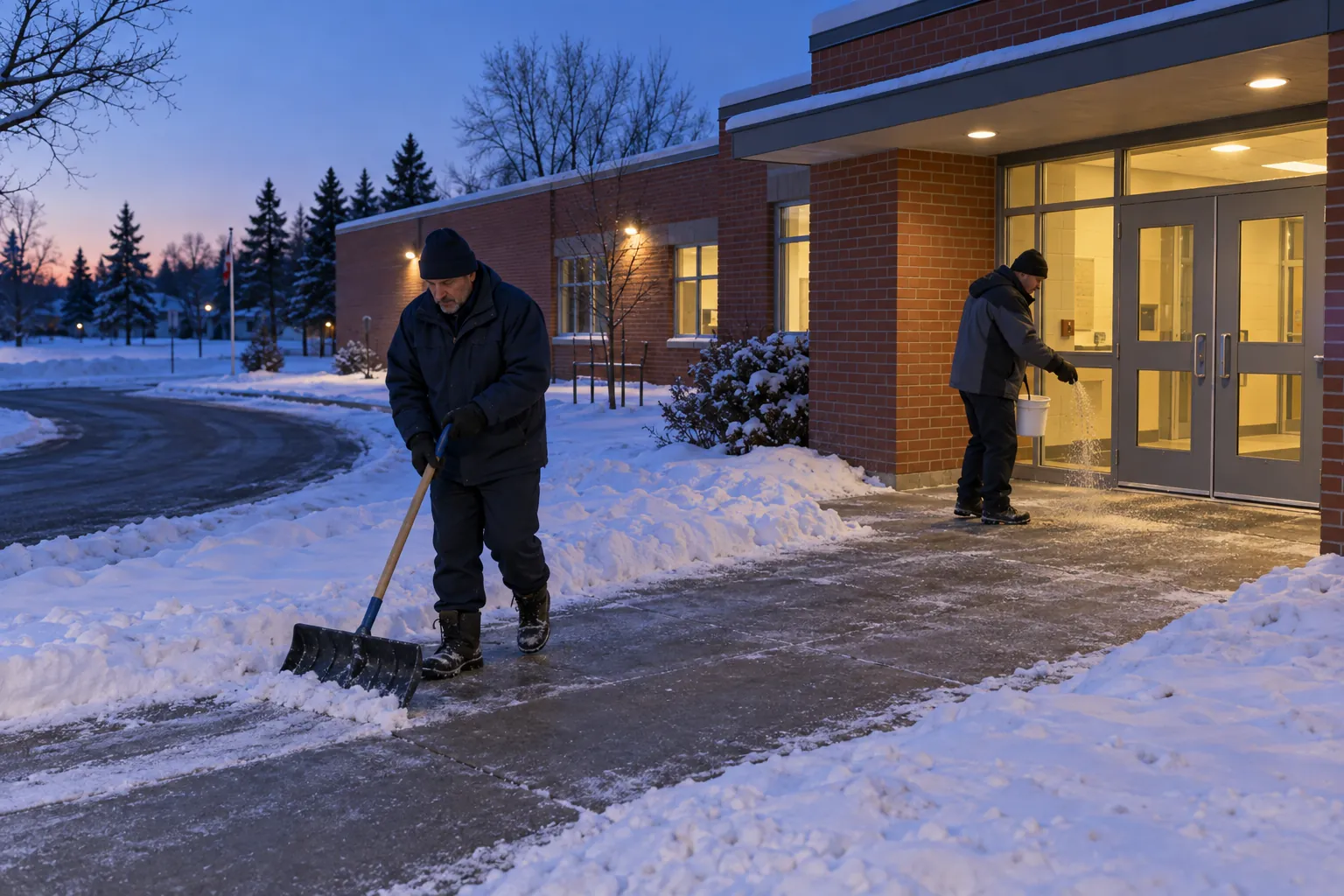
They are often the first person in the school each morning and the one who sees it secured at night. This guide sets out what the role covers in a Canadian school, the routine checks most custodial teams carry out and how often, what the law in Ontario asks of the board, the principal and the custodian's supervisor, and how the work can be recorded so the school can show it was done.
01
What a head custodian is responsible for, and who holds the duty
A school custodian looks after the building so that the school can open safely and cleanly every day. Titles vary from board to board: custodian, caretaker, head custodian or head caretaker, chief custodian, and in some boards building operator. In a small elementary school one custodian may open up, clean, fix and lock up. A large secondary school usually has a head custodian leading day and evening crews, reporting to the principal for the running of the school and to the board's facility services for the building.
The head custodian carries a lot of practical responsibility but is rarely the legal duty holder. Education is provincial, so each province has its own Education Act or School Act, and in Ontario the duty sits with the board. Section 170 of Ontario's Education Act requires every board to "keep the school buildings and premises in proper repair and in a proper sanitary condition, provide suitable furniture and equipment and keep it in proper repair, and protect the property of the board". Section 265 then gives the principal the duty "to give assiduous attention to the health and comfort of the pupils, to the cleanliness, temperature and ventilation of the school" and "to the condition and appearance of the school buildings and grounds".
The principal's duties go further in Ontario Regulation 298 (Operation of Schools – General), section 11(3)(l): the principal must "inspect the school premises at least weekly and report forthwith to the board" any repairs that are required and "any lack of attention on the part of the building maintenance staff of the school". In practice, the head custodian is the person who walks that weekly inspection with the principal, knows what needs repair and puts in the work orders.
That distinction matters when writing a job description. A head custodian can be responsible for flushing the plumbing each morning and recording it; they are not personally responsible for the board's asbestos management or the school's fire safety plan unless the board has given them that task in writing.
02
The main duties of a school head custodian
Board job descriptions for head custodians and head caretakers usually cover the same ground:
- Opening and securing the building: unlocking and locking doors, disarming and arming the alarm, holding keys, answering alarm call-outs out of hours where the board requires it, and checking doors, windows and gates at the end of the day.
- Cleaning: organizing the day and evening crews, setting routines for classrooms, washrooms, gyms and change rooms, floor care over the summer, and dealing with spills, vomit and accidents during the school day.
- Health and safety checks: routine checks of exits, fire equipment, drinking water, lighting and the grounds, recorded as the board's procedures require, with problems reported to the principal or facility services.
- Heating, ventilation and building systems: checking that the boiler or heating plant and ventilation are running, reading gauges and meters, and reporting faults. In boards where the head custodian holds an operating engineer's certificate, the plant duties are set out separately.
- Minor maintenance: changing lamps and ceiling tiles, adjusting doors, clearing drains and small repairs within the custodian's training, and reporting anything larger for trades or a contractor.
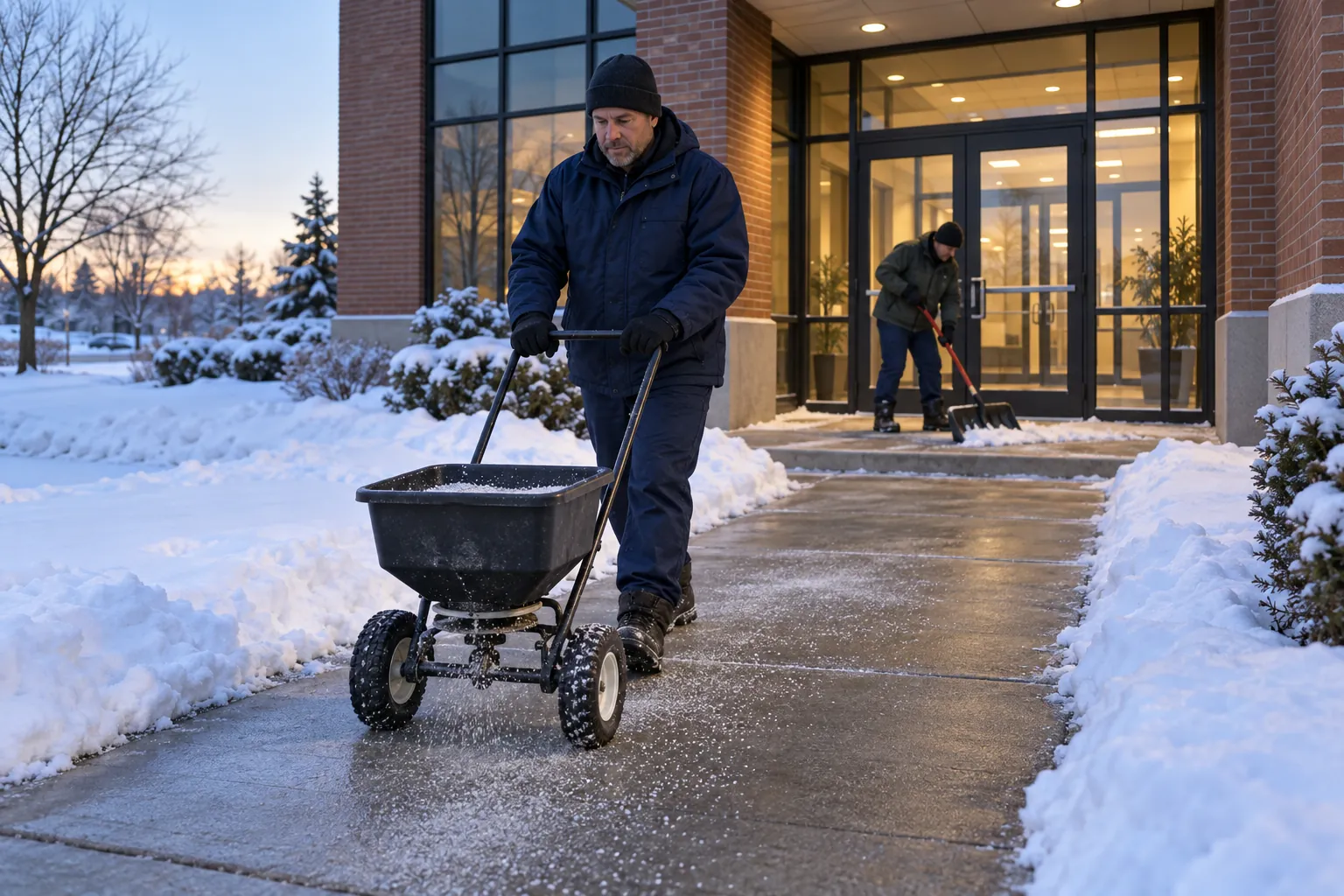
- Grounds and winter: picking up litter, playground and yard checks, snow clearing and salting at doors, ramps and walkways before the buses arrive.
- Contractors and deliveries: letting contractors in, making sure they have seen the asbestos record before they drill or cut, signing them in and out, and receiving deliveries.
- Emergencies: floods, power failures, break-ins and heating failures, and supporting fire drills, lockdowns and hold-and-secure procedures.
A good job description says which of these the head custodian does personally, which they supervise, and which they only report, and who they report to for what: the principal for the daily running of the school, the board's custodial or area supervisor for standards, staffing and the building. The collective agreement often sets shifts and the division of work, so the two need to agree.
03
The routine checks, and how often
Much of a custodian's week is routine. The exact list comes from the board's procedures and the building's own documents, but a typical Ontario school includes:
- Every school day, before opening: a walk of the exterior and the yard for broken glass, needles, graffiti or damage; doors, exits and corridors clear; heating on; washrooms stocked and working; and, in winter, walkways, steps and bus loops cleared and salted.
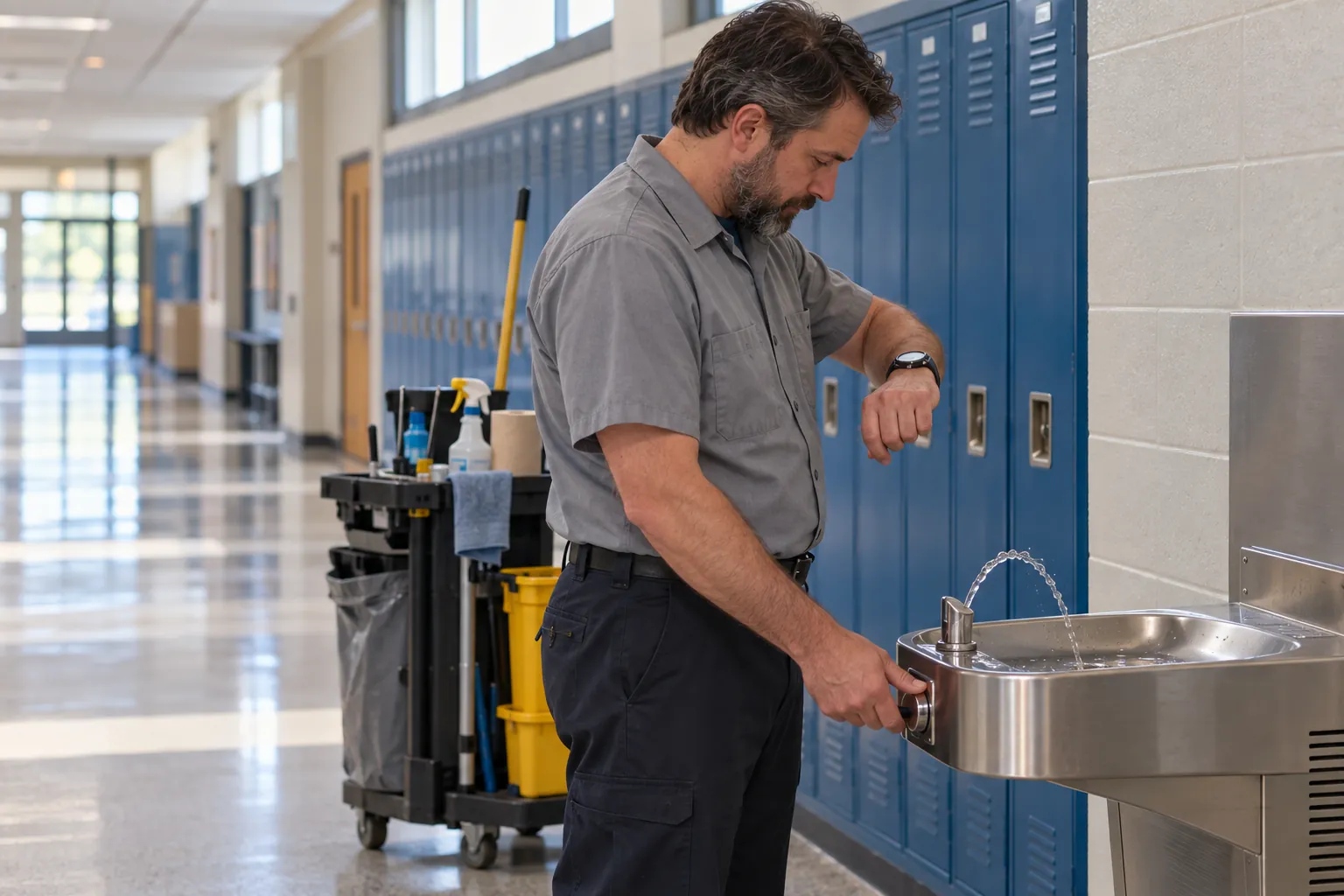
- Drinking water flushing: under Ontario Regulation 243/07 (Schools, Private Schools and Child Care Centres), made under the Safe Drinking Water Act, 2002, the plumbing must be flushed on the first day the school is open each week, and every day it is open where the regulation's daily flushing conditions apply, which turn on plumbing installed before 1 January 1990 and on past lead results. The flushing must be completed before the school opens: the cold water runs for at least five minutes at the last tap on each branch, then for at least 10 seconds at each fountain and drinking tap, subject to the regulation's exceptions.
- Monthly: portable fire extinguishers inspected, as the Ontario Fire Code (O. Reg. 213/07) requires in Article 6.2.7.2; see our guide to the monthly fire extinguisher inspection. Emergency lighting and other fire protection checks follow the Fire Code and the school's fire safety plan; see emergency lighting testing.
- Each term: the Fire Code, Article 2.8.3.2, requires at least three total evacuation fire drills during the fall term and three during the spring term in a school in session, with its own rule for summer sessions. The drills are usually led by the principal; the custodian often checks the doors, the panel and the alarm reset. See our guide to fire drill requirements.
- Yearly, and with contractors: letting in the contractors who service the fire alarm, sprinklers, emergency lighting, extinguishers, backflow preventers and boilers, and keeping their reports where they can be found.
Where a building has asbestos-containing material, Ontario Regulation 278/05 (Designated Substance – Asbestos on Construction Projects and in Buildings and Repair Operations) requires the owner, here the board, to keep a record of it on the premises, update that record at least once in each 12-month period, and inspect the material "at reasonable intervals" to determine its condition. The custodian is often the person who sees damaged ceiling tiles or pipe insulation first, so knowing where the record is and reporting a change at once is part of the job, even when the inspection itself belongs to someone else.
04
Safety, supervision and working alone
A head custodian who directs other custodians is, in law, very likely a supervisor. Ontario's Occupational Health and Safety Act defines a supervisor as "a person who has charge of a workplace or authority over a worker". Section 27 then requires a supervisor to ensure that workers work in the manner and with the protective devices, measures and procedures the Act and regulations require, to advise a worker of "any potential or actual danger" the supervisor is aware of, and to "take every precaution reasonable in the circumstances for the protection of a worker". Under Ontario Regulation 297/13 (Occupational Health and Safety Awareness and Training), a supervisor must complete basic awareness training within one week of starting work as a supervisor.
Workers have their own duty under section 28 of the Act: to report to their employer or supervisor a defect in equipment or "the existence of any hazard of which he or she knows". In a school that report often reaches the head custodian first, from a custodian, a teacher or an education assistant. School boards have joint health and safety committees, and a designated member must inspect the physical condition of the workplace at least once a month or, where that is not practical, inspect all of it at least once a year, with at least a part inspected each month on a schedule set by the committee; see our guide to the JHSC workplace inspection.
The hazards are familiar. The Canadian Centre for Occupational Health and Safety (CCOHS) guidance on sanitation and infection control for cleaning staff lists blood and body fluids, discarded needles and cleaning products that need WHMIS training. Add ladders, stacked chairs, floor machines, snow and ice, and the plant room.
Custodians often work alone, early in the morning, in the evening and through the summer. Ontario has no working alone regulation of its own, so the general duty applies, but other provinces are specific: in British Columbia, section 4.21 of the WorkSafeBC Occupational Health and Safety Regulation, Part 4 requires a written procedure for checking a worker's well-being, with a designated person making contact at set intervals, the results recorded, and a check at the end of the shift. The CCOHS guidance on working alone sets out what a check-in procedure should cover wherever you are.
School staff work around children every day. In Ontario, Ontario Regulation 521/01 (Collection of Personal Information) requires every board to collect a police record check for every employee and for every service provider who comes into direct contact with pupils on a regular basis, contract cleaners included.
05
What a good custodial record looks like
A head custodian spends much of the day doing things that leave no trace unless they are written down. Some records are required outright. Ontario Regulation 243/07, sections 3(4) and 4(4), require a record of "the date, time and location of every flushing" and "the name of the person who performed the flushing" (section 3 for weekly flushing, section 4 for daily), and section 9 requires those records to be kept for at least six years. Under section 25.3 of the Occupational Health and Safety Act and Ontario Regulation 480/24, in force since 1 January 2026, an employer must keep records of the cleaning of the washroom facilities it provides for workers, which can be met by posting the date and time of the two most recent cleanings at or near the washroom, or electronically; see our washroom cleaning checklist.
Winter is where a record is most often wanted after the event. Ontario's Occupiers' Liability Act requires an occupier to take reasonable care to see that people on the premises are reasonably safe, and since 2021 section 6.1 requires written notice of a claim for injury from snow or ice within 60 days, including the date, time and location. A board answering that notice will ask what was done at that door on that morning; see our guide to the snow removal log.
Whatever the check, a good record:
- Is made at the time, with the date and time the check was done, not the day it was due.
- Names who did it, which matters when the head custodian is on vacation and a spare custodian covers.
- Shows what was found: "north doors, ice at the threshold, salted 7:10 a.m." rather than a tick.
- Shows what happened next: a work order raised, to whom, and when it was closed.
- Explains gaps: a missed check with a reason, such as a snow day closure or a contractor visit, is more credible than a year without a gap.
- Can be found: flushing, fire and asbestos records kept where the principal, facility services and a visiting inspector can see them.
Boards usually supply a custodial log book or forms, and the school should use them. What goes wrong is the gap between the form and the work: checks done and not written down, or written up in a batch on Friday afternoon.
06
Where the custodial record fails, and what SiteClara does about it
The head custodian's day is interrupted by everything: a flooded washroom, a delivery, a child who has been sick in the hallway. Paper logs are filled in later from memory, and a missed flushing or extinguisher check is found at the next inspection, not the next morning.
SiteClara puts a printed QR poster at each location, such as the fire alarm panel, the boiler room, the last tap on each branch and each washroom, with an optional NFC tag behind it. The custodian scans the code or taps the tag on their own phone, with no app to install, sees the scheduled checks due there, and marks each one done or explains what stopped them, with a photo when one helps. A fault found on a check, or reported by a member of staff, goes onto the team's list of open jobs, grouped by building and floor, until someone closes it.
The head custodian, as supervisor, sees what is due, done and missed, records the reason a check was missed, and approves a daily report. It goes to the principal or the board's facility services contact at 8 a.m. the next morning, showing what was reported, what was completed, what is still open and how scheduled checks went.
07
Questions people ask
What are the responsibilities of a head custodian?
Leading the custodial team and keeping the building clean, safe and working. The Government of Canada's National Occupational Classification 2021, unit group 62024 (Cleaning supervisors) lists head custodian and head caretaker among its example titles, and its main duties include supervising and coordinating the work of cleaners and janitors, inspecting sites or facilities to ensure established safety and cleanliness standards are met, recommending or arranging repair work and other services, hiring and training cleaning staff and preparing the work schedule. In a school, the board's job description adds opening and securing the building, the routine safety checks and the records they need.
Is a head custodian a boss?
A head custodian is a supervisor rather than a senior manager: they direct the custodians on their crew, and answer to the principal for the running of the school and to the board for the building. In Ontario, the Occupational Health and Safety Act defines a supervisor as "a person who has charge of a workplace or authority over a worker", so a head custodian who directs other custodians very likely carries a supervisor's duties under section 27, including taking every precaution reasonable in the circumstances for the protection of a worker.
What's the difference between a custodian and a janitor?
Mostly the title. The National Occupational Classification 2021, unit group 65312 (Janitors, caretakers and heavy-duty cleaners) puts janitor, building custodian, school custodian and school janitor in the same occupation, one that cleans and maintains the interior and exterior of buildings and their grounds, from washrooms and floors to snow and ice on the walkways. Which word a school uses comes from its board's own job titles.
What is another job title for a custodian?
Caretaker and janitor are the usual alternatives. The National Occupational Classification 2021, unit group 65312 lists building custodian, school custodian, school janitor and building caretaker among its example titles, and in unit group 62024 (Cleaning supervisors) head custodian sits beside head caretaker and head janitor.
08
Further reading, and a list to take away
In Ontario, start with the Education Act and O. Reg. 298 for the board and the principal, O. Reg. 243/07 for flushing, the Ontario Fire Code for extinguishers and drills, O. Reg. 278/05 for asbestos, and the Occupational Health and Safety Act for supervisors and washroom records. CCOHS publishes plain-language guidance on cleaning staff and working alone. Elsewhere, read your own province's Education or School Act, occupational health and safety regulation and fire code, and your board's custodial standards.
When writing or reviewing a head custodian job description, check that it:
- names who the head custodian reports to, for what, and what they can authorize;
- separates duties done personally from those supervised or only reported;
- lists the routine checks and their frequencies, from the board's standards and the building's own documents;
- says who flushes the plumbing when the head custodian is away, and where the record is kept;
- covers contractors, the asbestos record and police record checks on site;
- includes supervisor training, WHMIS and the training the checks need, with refresher dates;
- addresses working alone, out-of-hours call-outs and snow days;
- says where each check is recorded and who reviews the record.
Sources
Every document this guide quotes or links to, in the order it first cites them.
- Education Act ontario.ca
- Ontario Regulation 298 (Operation of Schools – General) ontario.ca
- Ontario Regulation 243/07 (Schools, Private Schools and Child Care Centres) ontario.ca
- Ontario Fire Code (O. Reg. 213/07) ontario.ca
- Ontario Regulation 278/05 (Designated Substance – Asbestos on Construction Projects and in Buildings and Repair Operations) ontario.ca
- Occupational Health and Safety Act ontario.ca
- Ontario Regulation 297/13 (Occupational Health and Safety Awareness and Training) ontario.ca
- Sanitation and infection control for cleaning staff ccohs.ca
- WorkSafeBC Occupational Health and Safety Regulation, Part 4 worksafebc.com
- Working alone ccohs.ca
- Ontario Regulation 521/01 (Collection of Personal Information) ontario.ca
- Ontario Regulation 480/24 ontario.ca
- Occupiers' Liability Act ontario.ca
- National Occupational Classification 2021, unit group 62024 (Cleaning supervisors) noc.esdc.gc.ca
- National Occupational Classification 2021, unit group 65312 (Janitors, caretakers and heavy-duty cleaners) noc.esdc.gc.ca
Related guides
 CleaningSchool cleaning checklist: what custodians clean, how often, and how to show it was doneA school cleaning checklist for Canadian schools: classrooms, washrooms, hallways, gym and entrances, with daily, weekly and summer tasks and how to record them.
 CleaningJanitorial supervisor duties: what the role involves in Canada, and what good looks likeWhat a janitorial or cleaning supervisor does in Canada: the main duties, a typical shift, the legal duties of a supervisor, WHMIS, checking the work and reporting.
 Premises and facilities managementSnow removal log: what to record, when, and why it mattersWhat a snow removal log should record, when to make entries, who keeps it, and how Ontario's 60-day notice rule for snow and ice claims makes the log count.
 Fire and water checksFire drill requirements in Canada: how often, who takes part, and what to recordHow often fire drills must be held in Canada under the National Fire Code and Ontario Fire Code, who takes part, and what a fire drill record should show.