Premises and facilities management
Snow removal log: what to record, when, and why it matters
A snow removal log is a written or digital record of when a property's walkways, entrances, steps and parking lot were checked, plowed, shovelled and salted, and by whom.
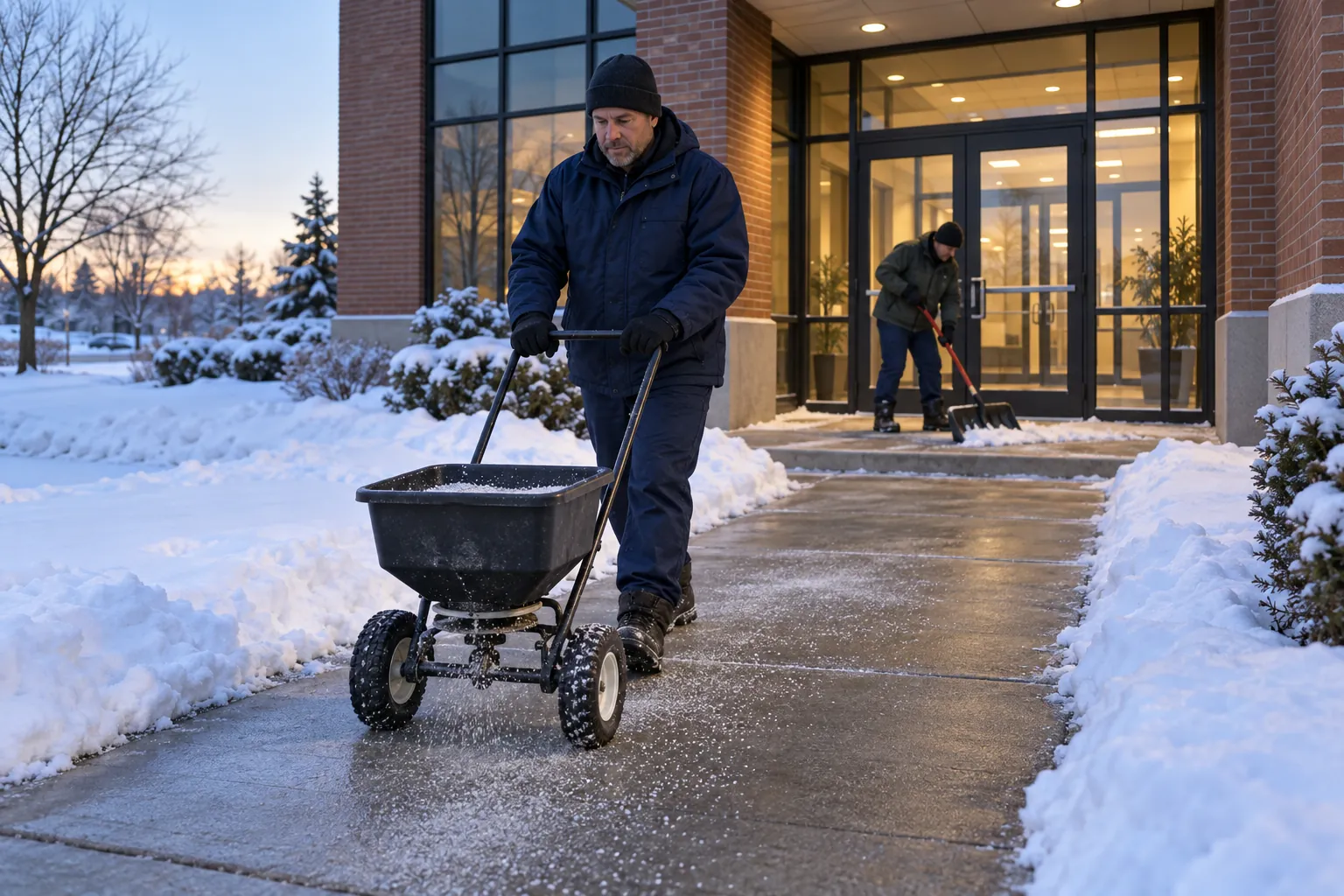
On the morning after a storm it is paperwork. Eighteen months later, when a claim arrives about a fall by the east doors, it is often the only thing that can show what was actually done. This guide covers what the law in Ontario asks of occupiers and snow contractors, what a useful log records, when entries should be made, who keeps it, and how to make sure it tells the truth.
01
What the law asks of occupiers and snow contractors
No statute in Canada says, in so many words, "keep a snow removal log". The log exists because of the duties around it, and in Ontario those duties are unusually clear, so this guide uses Ontario as its main example.
Under section 3 of Ontario's Occupiers' Liability Act, an occupier must take such care as is reasonable "to see that persons entering on the premises ... are reasonably safe while on the premises". An occupier includes anyone with "responsibility for and control over the condition of premises", and there can be more than one: a landlord, a tenant and a property management company can all be occupiers of the same front steps.
Section 6 matters to anyone who hires a snow contractor. An occupier is not liable for a contractor's negligence if it "had acted reasonably in entrusting the work to the independent contractor" and took the steps it reasonably ought "in order to be satisfied that the contractor was competent and that the work had been properly done". A log, kept and checked, is how an occupier shows the second part.
The notice rule changes what a log is for. Within 60 days of a fall you may receive a notice naming a date, a time and a place, and your log is what answers, for that spot and hour: when was it last checked, what was done, by whom, in what conditions. The claim may follow much later; Ontario's Limitations Act, 2002 sets a basic limitation period ending on "the second anniversary of the day on which the claim was discovered".
Workplace law adds a separate duty. Section 11 of Ontario's Industrial Establishments regulation (R.R.O. 1990, Reg. 851) requires that a floor or other surface used by any worker be "kept free of ... accumulations of refuse, snow or ice". Under the Occupational Health and Safety Act, an industrial establishment includes an office building, factory, arena, shop or office and the land around it, so staff entrances, loading docks and employee parking are covered.
The Ontario Fire Code (O. Reg. 213/07) adds three winter duties in Division B: exterior passageways, exterior stairways and fire escapes in occupied buildings "kept free of snow and ice accumulations" (Article 2.7.1.8), hydrants "maintained free of snow and ice accumulations" (6.6.4.2), and fire department sprinkler and standpipe connections "maintained free of obstructions for use at all times" (2.5.1.2). A snow bank pushed across an exit door is a Fire Code problem as well as a slip hazard.
City bylaws then set deadlines for the public sidewalk, and they vary. The City of Toronto's sidewalk clearing page says the City clears public sidewalks when 2 cm or more has fallen, that residents and businesses clear their own sidewalk within 12 hours of a smaller snowfall ending, and that owners clear private property, "including driveways, parking spaces, steps, ramps and landings", within 24 hours. The City of Calgary's sidewalk clearing page points to section 67 of its Street Bylaw and a 24-hour limit. Check your own municipality; a portfolio may be working to several deadlines on the same day.
02
What a snow removal log should record
A snow removal log is only useful if it can answer a question about one place at one time. A template that reduces it to a date, a checkmark and a signature answers nothing. A useful entry records:
- The location, named the way everyone on site names it: "main entrance steps", "east exit and path to lot", "loading dock ramp", "accessible stalls, row A", ideally numbered on a site plan.
- The date and the time the work or check was done, not the time the entry was written up.
- Conditions: snowing, freezing rain, clear and cold, melting; approximate accumulation in centimetres; the temperature if you have it.
- What was done: plowed, shovelled, blown, scraped to bare surface, salted, sanded, applied ice melt, laid or changed entrance mats, put out warning signs or closed an area.
- Who did it: the person's name, and the company if it was a contractor.
- What could not be done, and why: a car parked over the ramp, a plow broken down, an area closed instead of cleared. An honest gap is far more defensible than a blank.
- Checks with no action needed: "checked 06:10, clear and dry, no action" is a valuable entry. It shows someone looked.
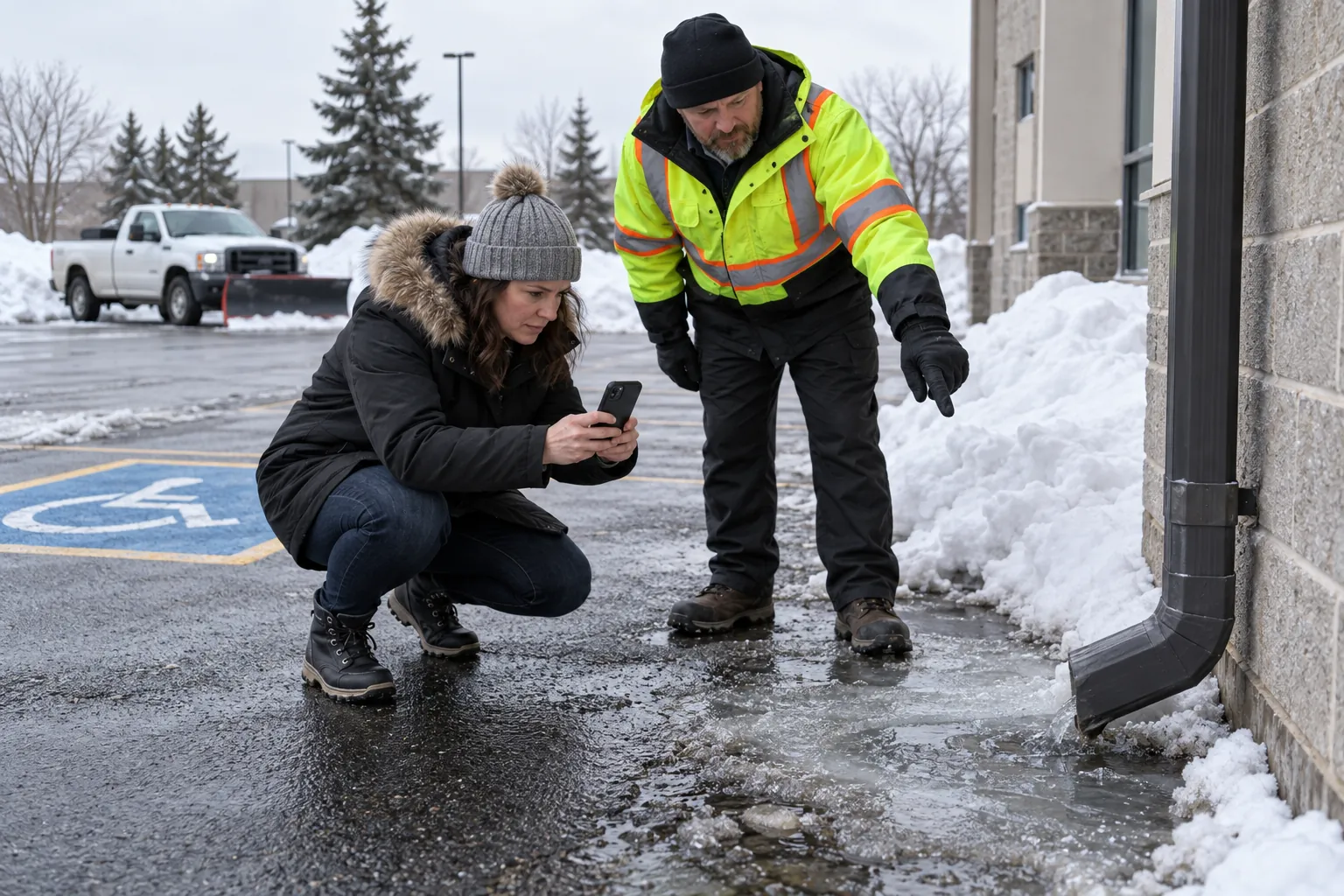
- Hazards found: a downspout draining across the walkway, meltwater pooling, a failed light over the lot. Refrozen meltwater causes falls on days with no snow at all.
- A photograph where it matters: the main entrance after clearing, a problem area, anything unusual.
Keep contractor and in-house entries together. A contractor may salt the lot at 03:00 and the custodians shovel the steps at 07:00; a claim is usually about the gap between them.
03
When to make entries: triggers, rounds and freeze-thaw
Most snow logs fail on timing rather than content. Entries cluster around the big storms, and the icy mornings after a thaw go unrecorded. Build the schedule around the conditions that cause falls, not only around snowfall:
- Before: when a storm or freezing rain is forecast, record the pre-treatment (anti-icing or salting) and the check that materials, shovels and mats are ready.
- During: for a long storm, record each pass at the priority areas. The contract usually sets a trigger depth, in centimetres, at which the contractor must mobilize; record when the trigger was reached and when the crew arrived.
- After: record the clean-up once snowfall ends, against the municipal deadline for the public sidewalk and your own standard for the private areas.
- Before opening: a walk of the entrances, steps, ramps and main paths before staff and the public arrive, every winter morning, whether or not it snowed overnight.
- Freeze-thaw: when daytime melting is followed by a hard frost, a late afternoon or evening check of the places where meltwater runs and refreezes.
- On report: when anyone reports an icy spot, record the report, the time it was dealt with and what was done.
Prioritize: fire exits and exterior stairways (Fire Code), main entrances and accessible routes, accessible parking and the paths from it, loading docks and staff entrances, then the general lot. Use the same area names in the log. The CCOHS fact sheet on parking lot fall prevention recommends clearing ice or snow "as soon as possible", keeping sand, salt, shovels or brooms available, clearing debris from drains and grates, keeping the lighting in good repair, and inspecting parking lots "on a regular basis".
Ontario's Minimum Maintenance Standards for Municipal Highways (O. Reg. 239/02) bind municipalities, not private owners, but their method for sidewalks is the one a private log needs: monitor the weather, patrol when snow or ice is likely, act within a set time. A private log needs the same, plus a record that shows it was done.
04
Who does what: occupier, contractor, custodial staff
Snow removal on a commercial or institutional property is usually shared, and the log has to reflect the sharing honestly.
- The occupier (the owner, the property manager, or both) sets the standard, hires and supervises the contractor, and keeps the complete record. Under section 6 of the Occupiers' Liability Act, the occupier's protection when a contractor is negligent depends on having acted reasonably in choosing and checking the contractor.
- The snow contractor plows and salts the areas in the contract, keeps its own service records (often from GPS on the trucks), and should hand them over promptly, ideally after every event and at least at the end of each month.
- Custodial or building operations staff usually handle what the plow cannot reach: steps, landings, the area immediately outside the doors, the entrance mats and the vestibule floor inside. Their work is part of the log.
- Security, on a site with overnight guards, can record patrol checks of the entrances and lot, and report icy areas before the morning rush.
Write the split into the contract and the site plan: which areas belong to the contractor, which to building staff, and the time standard for each. The strip between the plowed lot and the bottom step is easy to leave to nobody.
Because an occupier that receives a section 6.1 notice must pass a copy to other occupiers and to its snow contractor, the property manager needs a current list, each season, of the occupiers and snow contractors, with addresses for service.
Anyone using a snow blower should follow the manufacturer's instructions; the CCOHS fact sheet on snow blowers warns never to clear a clog by hand, because "fingers have been amputated when the blade has rotated unexpectedly".
05
What good evidence looks like, and how to check it
When a log is tested, by an insurer, a lawyer or a court, the questions are the same: was it written at the time, is it specific, does it agree with the other records, and does anything look filled in afterwards?
- Made at the time: each entry written when the work was done, not in a batch at the end of the shift or the week.
- Specific: named areas and actual times, not "all walks salted, a.m.".
- Consistent: contractor records, in-house entries, weather data and any photographs tell the same story.
- Complete: no blank days in the season, including the ones with nothing to do.
- Signed off: a supervisor or property manager reviews the log regularly, notes gaps and follows them up with the contractor or the team.
- Kept: stored safely for at least as long as a claim might arrive. Given Ontario's two-year basic limitation period, keep snow logs for longer than that; ask your insurer and your lawyer how long they want.
Checking the contractor is part of the job. Section 6 asks whether the occupier took reasonable steps to be satisfied the work had been properly done: someone walking the property after an event, comparing it with the contractor's record, and putting any shortfall in writing the same day. A photograph of the main entrance at 07:30 is a simple, strong check.
When someone falls, record it as an incident, with the exact location, time, conditions and a photograph, and keep that day's snow log with it. If a section 6.1 notice arrives, pass it on as the Act requires and give your insurer both.
06
Where snow removal records fail, and what SiteClara does about it
Snow logs fail in familiar ways. The clipboard by the loading dock is filled in at the end of the week from memory, every entry reading "salted, all areas, 6 a.m." in the same handwriting. The contractor's records sit in a portal nobody looks at until a claim arrives. The ice by the east door is mentioned to whoever is passing, and nobody can later say when it was dealt with. The quiet mornings after a thaw leave no trace at all.
SiteClara records work at the location. A printed QR poster, with an optional NFC tag behind it, sits at each place where checks are scheduled, such as the main entrance, a fire exit, the loading dock or the accessible parking area. Staff scan or tap on their own phone, with no app to install, and mark the check done at that place, with a photo when one is asked for. The time, the place and the named person are recorded automatically, so the entry is made on the spot rather than written up later. If something stopped the work, such as a car parked over the ramp, they say so, and the reason is recorded against that check.
Anyone on the team can report a problem at a location, such as ice under a downspout, with a photo; it stays on the team's list of jobs until someone closes it. Checks can be scheduled, such as a pre-opening walk of the entrances, and a missed one shows as missed. The supervisor adds a note and approves a daily report that goes to nominated management or client contacts the next morning, showing what was checked, what was reported and what is still open.
07
Where to read more, and a list to take away
In Ontario, read sections 1, 3, 6 and 6.1 of the Occupiers' Liability Act, section 11 of the Industrial Establishments regulation, and Articles 2.5.1.2, 2.7.1.8 and 6.6.4.2 of Division B of the Ontario Fire Code. For your municipal deadline, go to your city's own bylaw or winter maintenance page. For practical fall prevention, start with the CCOHS fact sheet on parking lots. Outside Ontario, check your province's occupiers' liability law (in Quebec, the Civil Code), its occupational health and safety regulation and its fire code, and ask your insurer what it expects a winter log to show.
Before the first snowfall, check that:
- every area to be cleared has a name and is marked on a site plan, with fire exits, exterior stairways, hydrants and fire department connections included;
- the contract says which areas the contractor covers, the trigger depth, the response time and how and when its records reach you;
- the areas the contractor does not cover, such as steps, landings and door fronts, are assigned to named in-house staff;
- there is a pre-opening check every winter morning, and a freeze-thaw check when the weather calls for it;
- each entry records the place, the time, the conditions, what was done and who did it, including checks with no action needed;
- anyone can report an icy spot, and the report stays open until it is dealt with;
- a supervisor reviews the log and checks the contractor's work after each event;
- you have a current list of occupiers and snow contractors to pass on any section 6.1 notice;
- the logs are stored safely for as long as your insurer and lawyer advise.
Sources
Every document this guide quotes or links to, in the order it first cites them.
- Occupiers' Liability Act ontario.ca
- Occupiers' Liability Amendment Act, 2020 (Bill 118) ola.org
- Limitations Act, 2002 ontario.ca
- Industrial Establishments regulation (R.R.O. 1990, Reg. 851) ontario.ca
- Occupational Health and Safety Act ontario.ca
- Ontario Fire Code (O. Reg. 213/07) ontario.ca
- City of Toronto's sidewalk clearing page toronto.ca
- City of Calgary's sidewalk clearing page calgary.ca
- CCOHS fact sheet on parking lot fall prevention ccohs.ca
- Minimum Maintenance Standards for Municipal Highways (O. Reg. 239/02) ontario.ca
- CCOHS fact sheet on snow blowers ccohs.ca
Related guides
 Premises and facilities managementSlips, trips and falls: how to prevent them in the buildings you look afterPreventing slips, trips and falls in Canadian buildings: Ontario, BC, Alberta and federal rules, wet floors, winter entrances, stairs and the records to keep.
 Premises and facilities managementWinterization checklist: getting a building ready for a Canadian winterA winterization checklist for Canadian buildings: the freeze checks the fire code asks for, heating, plumbing, roofs, grounds, outdoor staff and the records to keep.
 Premises and facilities managementProperty manager duties in Canada: licensing, legal duties and the daily recordWhat a property manager does in Canada: provincial licensing, the owner's duties under occupiers', tenancy and fire law, the daily work and the records.
 Premises and facilities managementFacility manager duties in Canada: what the role covers, and how to show it is doneWhat a facility manager does in Canada: the owner, employer and supervisor duties under provincial OHS and fire law, contractors, and the records that show it.