Premises and facilities management
Eyewash station requirements: what the law asks, and how to keep them working
In Canada, an employer must provide an eyewash station wherever a worker's eyes could be exposed to a hazardous chemical, and the ANSI Z358.1 standard that most employers follow puts it within 10 seconds of the hazard, with 15 minutes of hands-free, tepid flushing fluid.
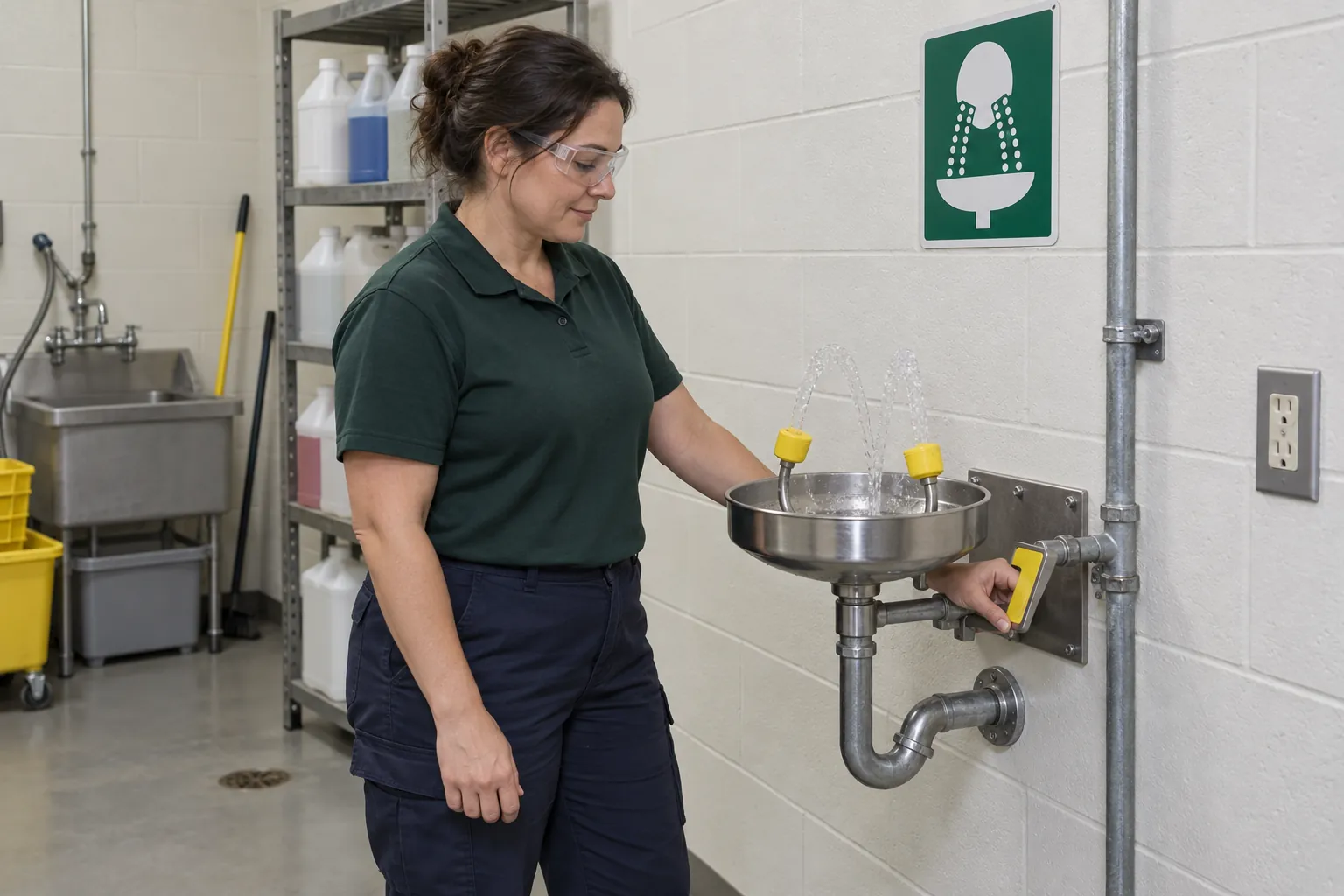
The duty comes from the province or, for federally regulated work, from the federal regulations, and none of them sets out a full design standard, which is why the American standard fills the gap. A station is only useful if it works the first time somebody needs it, blinded and in pain, with a chemical in their eyes. This guide sets out what the rules ask for, where a building needs a station, how often to flush and inspect it, and what a record of those checks should show.
01
Are eyewash stations required in Canada?
Yes, wherever a worker could get a harmful chemical in the eyes or on the skin, but there is no single national rule and no Canadian design standard. For most workplaces the rules are provincial; the federal rules cover only federally regulated work, such as banks, airports and interprovincial transport. The Canadian Centre for Occupational Health and Safety puts the gap plainly in its fact sheet on emergency showers and eyewash stations: "Currently, there is no Canadian standard for the design or placement of eyewash stations or emergency showers." It adds that ANSI Z358.1-2014 (R2020), Emergency Eyewash and Shower Equipment, "is generally used as a guide."
Ontario. The duty sits in section 124 of R.R.O. 1990, Reg. 851: Industrial Establishments, made under the Occupational Health and Safety Act. Where a worker is required to work with, or is likely to be exposed to, a hazardous biological or chemical agent that could cause injury to the eye or skin, the employer "shall provide as many of the following as are needed for adequate emergency treatment": eye wash facilities, emergency showers, and antidotes, flushing fluids or washes. It must be marked with a sign or label, placed conspicuously near where the agent is kept or used, readily accessible, and carry instructions for its use. The Act defines an industrial establishment as "an office building, factory, arena, shop or office, other than an office located in a private residence", and the land and buildings that go with it, so the regulation reaches ordinary commercial buildings, not only plants.
Alberta. Section 24 of Part 4 of the Occupational Health and Safety Code says that if a worker is present where chemicals harmful to the eyes or skin are used, "the employer must ensure that the worker has immediate access at the work site to emergency baths, showers, eye wash equipment or other equipment appropriate for the potential level of exposure."
British Columbia. British Columbia sets out detailed rules in sections 5.85 to 5.96 of the Occupational Health and Safety Regulation, Part 5. They require facilities "within a work area where a worker's eyes or skin may be exposed to harmful or corrosive materials or other materials which may burn or irritate", chosen and located by risk level, signed, tested monthly and protected from freezing.
Federally regulated workplaces. Section 16.8 of the Canada Occupational Health and Safety Regulations (SOR/86-304) says that if a hazard for skin or eye injury from a hazardous substance exists, the employer shall ensure that shower facilities to wash the skin and eye wash facilities to irrigate the eyes are provided for immediate use by employees, with portable equipment where that is not feasible.
Quebec, the other provinces and the territories have their own regulations. The pattern is the same: a station where the hazard is, reachable at once and working, with the engineering detail left to the standard and the manufacturer.
02
Where a building needs an eyewash station
The trigger is the chemical and the task, not the type of building. The starting point is the safety data sheet: section 4, first aid measures, says whether the product calls for eye flushing, the WHMIS label carries the pictograms and hazard statements, and the SDS gives the hazard classification. B.C.'s Table 5-2 is a useful yardstick even outside B.C. It classes as high risk work with corrosives that could cause irreversible damage, and gives as examples "Maintenance of ammonia refrigeration equipment or chlorine bleaching or disinfection equipment, handling corrosive materials such as corrosive cleaning products or chemical reagents where there is a high risk of skin or eye contact, filling chemical storage batteries." Moderate risk includes "handling irritant materials such as cleaning products or chemical reagents where there is a moderate risk of skin or eye contact." Low risk covers "using detergents" and similar mild irritants.
In an ordinary office, school, shopping centre or apartment building, the places worth assessing are these:
- Janitor's closets and chemical dilution rooms, where custodians decant or dilute concentrated cleaners, degreasers, strippers and descalers. A dispensing system reduces the risk of a chemical splash but does not remove it.
- Battery charging areas for floor scrubbers, pallet trucks and other equipment with flooded lead-acid batteries that are topped up by hand.
- Pool and spa chemical rooms in recreation centres, hotels and condominium amenity spaces.
- Mechanical rooms with boiler and cooling tower water treatment, where chemicals are added or drums changed.
- Maintenance shops with solvents, paint strippers and parts washers.
- School science labs, art rooms and technology shops, and any laboratory space in an office building.
The assessment decides what goes in each room: an eyewash, a combination shower and eyewash, or a drench hose as a supplement. CCOHS advises that the selection "should match the hazard". Write the decision and the reason down.
In a building with several employers, work out whose station it is. The property manager may own the unit in the mechanical room while the janitorial contractor's workers are the ones using the chemicals. The contract or the building's procedures should say who flushes each station, who inspects it and who fixes it.
03
What a compliant eyewash station looks like
These figures are CCOHS's summary of the ANSI standard, Z358.1-2014 (R2020). They are not law in most provinces, but they describe a station that works.
- Reach in 10 seconds. ANSI recommends a person be able to reach the equipment in 10 seconds. ANSI notes the average person can walk 16 to 17 metres in that time, and CCOHS adds that the rule may be tightened where a highly corrosive chemical is used.
- Same floor, clear path. On the same level as the hazard, with no stairs, doorways or obstacles on the way, in a well-lit spot where workers can easily see it.
- Fifteen minutes of flow. An eyewash delivers fluid to both eyes at once at not less than 1.5 litres a minute for 15 minutes; an eye and face wash needs 11.4 litres a minute. The unit sits between 83.8 and 134.6 cm (33 to 53 inches) from the floor and at least 15.3 cm (6 inches) from the wall or nearest obstruction.
- Tepid water. ANSI defines tepid as between 16 and 38°C. Colder water makes people stop flushing early; CCOHS reports that indoor plumbed water in cold climates can be 2 to 7°C.
- Hands free, in one motion. The valve opens in less than a second and stays open without a hand on it, so the user can hold their eyelids open. Dust covers come off as the unit is activated, without a separate motion.
- Signed and explained. A highly visible sign, ideally a symbol that needs no language to understand, with written instructions posted beside the unit.
- Training before it is needed. CCOHS says all workers require instruction in the proper use and location of the stations "before any emergencies occur", including a hands-on drill on finding them and instruction in removing contact lenses. "It is critical that flushing an exposure begins as quickly as possible."
B.C. writes some of this into law. Its Table 5-3 requires a tempered, continuous flow eyewash with a minimum duration of 15 minutes for high and moderate risk work, and the regulation defines tempered as 15 to 30°C. For high risk, the eyewash must be "within 5 seconds walking distance of the hazard area, but no further than 6 m (20 ft)"; for moderate risk, within 10 seconds and no further than 30 metres. Section 5.96 requires a valve that, once activated, keeps the flow going "without requiring the use of the operator's hands", and section 5.87 that access is not blocked by material or equipment.
04
How often to flush, test and inspect
There are three layers of check, and a well-run building does all three.
- Weekly activation. CCOHS, following ANSI, says one person in the work area should be designated to inspect and activate each emergency shower, eyewash station, combination unit and drench hose weekly. The weekly run "will help make sure that there is flushing fluid available, as well as clear the supply line of sediments and minimize microbial contamination caused by 'still' or sitting water." Run it long enough for the water to come through clear.
- Monthly full flow test in B.C. Section 5.93(2) of the B.C. regulation makes this law: "a plumbed emergency eyewash or shower facility is full flow tested at least once per month, for a sufficient length of time to completely flush the branch of the water line supplying the eyewash." WorkSafeBC's guideline adds that plumbed units must be tested after installation and monthly thereafter, and that portable units must be protected from contamination and refilled regularly with fresh solution. A weekly activation at full flow that clears the branch line satisfies both.
- Annual inspection. ANSI recommends a complete inspection each year, checking for valve leakage, clogged openings and lines and the adequacy of the fluid volume, and CCOHS says a work record of these inspections should be kept.
Self-contained units follow the manufacturer's instructions for checking and changing the fluid; CCOHS notes that changing it frequently and cleaning the units regularly "can prevent the inadvertent use of contaminated fluid", and that the expiry date of the fluid should be printed on the unit and checked regularly. At each weekly check, the person doing it should be able to answer these questions:
- Can the station be seen and reached, with nothing in front of it and the sign in place?
- Are the dust covers on, and do they come off when the valve opens?
- Does the valve open in one motion and stay open by itself?
- Does water reach both nozzles evenly, running clear, and comfortably tepid?
- For a self-contained unit, is it full, sealed and in date?
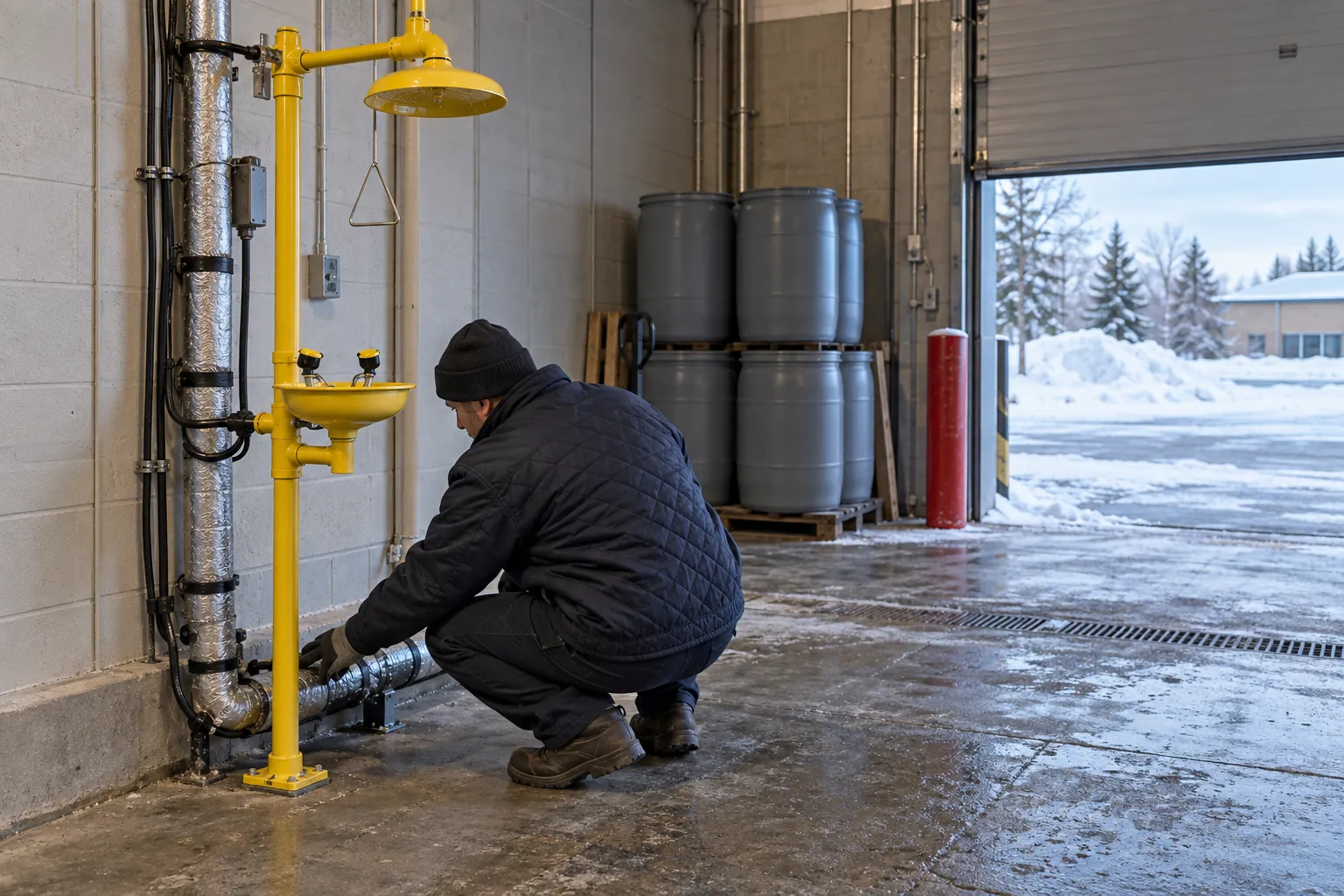
Outdoor and unheated stations need thought in a Canadian winter. B.C.'s section 5.95 requires the facility and its supply piping to be protected against freezing, and WorkSafeBC's guideline lists measures such as heat tracing. In a parkade, loading dock or unheated mechanical room, check the freeze protection as part of the weekly visit.
If a station fails, CCOHS says the workers in the area "should be properly warned and protected" until it is fixed.
05
What the record of eyewash checks should show
No province prescribes a form, but the guidance is consistent about what a record is for. CCOHS says the person doing the weekly activation "should keep a signed, dated record". WorkSafeBC's guideline G5.93 goes further: "It is good practice to maintain records of testing, inspection, and maintenance of plumbed and non-plumbed eyewash facilities. These records could be in the form of a log book, preventative maintenance cards, tagging, or other similar method and should include the date and time of the test, any defects noted, and corrective action taken."
A useful record for each station shows:
- which station it was, by a location someone else can find: floor, room and unit, not just "the eyewash";
- the date and time of each activation or test, and who did it;
- the result: flow good, water clear, temperature acceptable, access clear, sign in place;
- anything wrong, described in plain words, and what was done about it, by whom and when;
- for a self-contained unit, the fluid or cartridge expiry date and when it was changed;
- the annual inspection, with the name of the person or company who did it.
The record is also evidence for the joint health and safety committee's workplace inspections and for an inspector who asks how you know the station works. A tag on the unit tells you about the last check; a log that runs week by week shows the pattern, and the pattern is what proves the routine is real. Keep the risk assessment with it, and revisit it whenever the chemicals change, as they often do when a janitorial contract changes hands.
06
Where the eyewash record fails, and what SiteClara does about it
Eyewash stations rarely fail because nobody installed one. They fail on the record. The tag has a row of weekly initials in the same pen, filled in the day before the audit. The station in the janitor's closet is behind a floor machine parked there in the fall. The custodian who noticed rusty water told whoever was at the security desk, and nobody passed it on. None of this shows until somebody needs the water.
SiteClara records checks where they happen. A printed QR poster, with an optional NFC tag behind it, sits beside each station. The person doing the weekly flush, whether a custodian, a building operator or a guard on a round, scans or taps with their own phone, with no app to install, sees the checks due at that location and marks each one done, or explains what stopped them. The time and the named person are recorded as it happens, with a photo when one is asked for, such as the water running clear or the expiry date on a cartridge. A problem found there, such as a stiff valve, a missing cover or a blocked approach, goes onto the team's list of jobs until someone closes it.
The supervisor sees what was due, what was done and what was missed at each location, and records the reason for anything missed. Each day they review the record, add a note and approve a report that goes to nominated managers the next morning, so the property manager or employer can see every station flushed, week by week, rather than taking a tag on trust.
07
Questions people ask
What makes an eyewash station required?
A risk of exposure to a hazardous substance that could injure the eyes. Section 16.8 of the Canada Occupational Health and Safety Regulations, which covers federally regulated workplaces, puts it this way: "if a hazard for skin or eye injury from a hazardous substance exists in the workplace, the employer shall ensure that shower facilities to wash the skin and eye wash facilities to irrigate the eyes are provided for immediate use by employees." The provincial rules use similar triggers, and the product's safety data sheet tells you whether it is one.
What are the standard requirements for an eyewash station?
Canada has no design standard of its own, so the benchmark is ANSI Z358.1. The CCOHS fact sheet on emergency showers and eyewash stations summarizes it: a station should deliver fluid "to both eyes simultaneously at a volume flow rate of not less than 1.5 litres/minute (0.4 gallons/minute) for 15 minutes", and should be reachable in 10 seconds, the time in which, ANSI notes, "the average person can walk 16 to 17 metres (55 feet)".
What does an eyewash station inspection check?
Two things, on two timescales. Weekly, according to the CCOHS fact sheet on emergency showers and eyewash stations, "one person in the work area should be designated responsible for inspecting and operating (activating)" each eyewash, shower, combination unit and drench hose. Once a year, a fuller inspection "should check for such problems as valve leakage, clogged openings and lines, and adequacy of the fluid volume."
Is there a substitute for an eyewash station?
Not a full one. The CCOHS fact sheet on emergency showers and eyewash stations says that "eyewash bottles or personal eyewash units supplement plumbed and self-contained stations but in no way can replace them." In federally regulated work, subsection 16.8(2) of the Canada Occupational Health and Safety Regulations allows portable equipment only where fixed facilities are not feasible.
What are the OSHA requirements for eyewash stations?
OSHA's rules apply to workplaces in the United States, not in Canada, but they are often quoted. OSHA standard 29 CFR 1910.151, Medical services and first aid says: "Where the eyes or body of any person may be exposed to injurious corrosive materials, suitable facilities for quick drenching or flushing of the eyes and body shall be provided within the work area for immediate emergency use." As in Canada, the design detail comes from ANSI Z358.1.
08
Where to read more, and a checklist to take away
The primary sources, all on the owners' own sites:
- CCOHS, OSH Answers: Emergency Showers and Eyewash Stations, which summarizes ANSI Z358.1-2014 (R2020) for Canadian readers.
- R.R.O. 1990, Reg. 851: Industrial Establishments, section 124, under the Occupational Health and Safety Act (Ontario).
- Alberta OHS Code, Part 4, section 24.
- B.C. OHS Regulation, Part 5, sections 5.85 to 5.96 with Tables 5-2 and 5-3, and WorkSafeBC OHS Guidelines, Part 5, G5.85 to G5.95.
- Canada Occupational Health and Safety Regulations, section 16.8 (federally regulated workplaces).
- ANSI/ISEA Z358.1, American National Standard for Emergency Eyewash and Shower Equipment, from the International Safety Equipment Association.
Eyewash stations, in short:
- Confirm which jurisdiction regulates each employer in the building.
- From the safety data sheets, list every room where chemicals can harm the eyes or skin, and assess the risk.
- Place each station within 10 seconds of the hazard on a clear, level path (closer for B.C.'s high risk work), with tepid water, a hands-free valve, a sign and instructions.
- Agree in writing who flushes, inspects and repairs each station.
- Activate every station weekly until the water runs clear; in B.C., full flow test plumbed units at least monthly.
- Check self-contained units' expiry dates, and have every station inspected annually.
- Record each check at the station, at the time, with the name, the result and anything put right.
Sources
Every document this guide quotes or links to, in the order it first cites them.
- Emergency showers and eyewash stations ccohs.ca
- R.R.O. 1990, Reg. 851: Industrial Establishments ontario.ca
- Occupational Health and Safety Act ontario.ca
- Part 4 of the Occupational Health and Safety Code search-ohs-laws.alberta.ca
- Occupational Health and Safety Regulation, Part 5 worksafebc.com
- Section 16.8 of the Canada Occupational Health and Safety Regulations laws-lois.justice.gc.ca
- OSHA standard 29 CFR 1910.151, Medical services and first aid osha.gov
- WorkSafeBC OHS Guidelines, Part 5 worksafebc.com
Related guides
 Premises and facilities managementFirst aid kit requirements: what the law asks, province by provinceWorkplace first aid kit requirements in Canada: Ontario's Regulation 1101, CSA Z1220-17 kits in Alberta and B.C., federal rules, and how often to inspect.
 Premises and facilities managementWorkplace inspection checklist: how a JHSC inspection should workA workplace inspection checklist for Canadian JHSCs and representatives: Ontario, BC, Alberta and federal rules, what to walk, how often and what to record.
 Premises and facilities managementPreventive maintenance checklist: what to include, how often, and how to show it was doneA preventive maintenance checklist for Canadian buildings: what the fire code and provincial law require, what to include, how often, and the records to keep.
 Premises and facilities managementAED inspection: the monthly check, the record, and what the law asksHow to inspect an AED in a Canadian building: what the monthly check covers, what Manitoba's law requires, registration, and a record you can rely on.