Premises and facilities management
First aid kit requirements: what the law asks, province by province
In Canada, every employer must provide a workplace first aid kit stocked to the list in the regulation that governs it, or to the CSA Z1220-17 standard where that is accepted or required, sized to the number of workers on a shift and kept complete and ready for use.
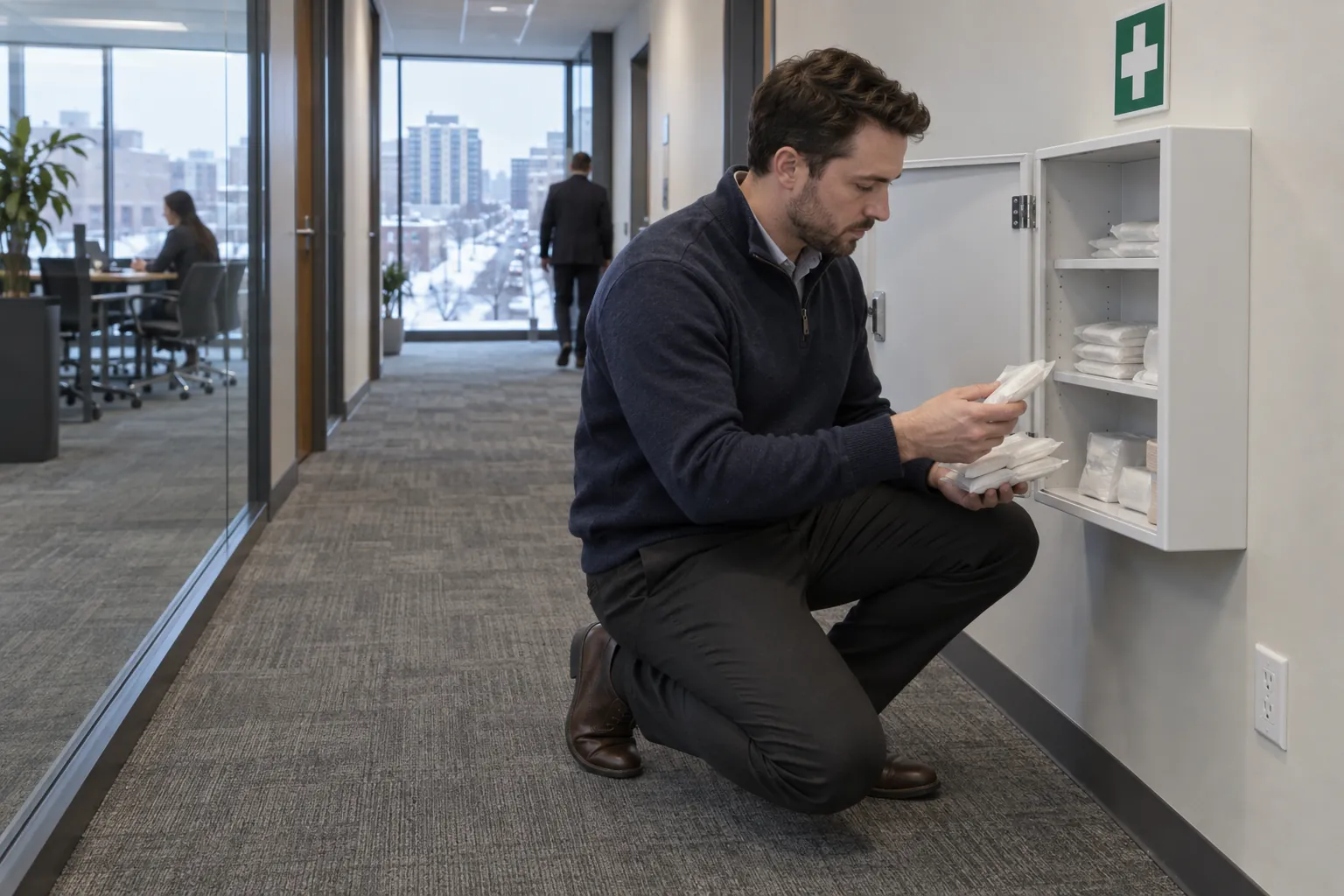
What goes in the kit, who must be trained and how often the kit is checked depend on who regulates the work. Ontario still works from a regulation unchanged since 1990; Alberta and British Columbia build on the CSA Z1220-17 standard; federally regulated workplaces have their own schedule. This guide sets out the requirements, the inspection each asks for, who is responsible in a building with several employers, and what a record of the checks should show.
01
Is a first aid kit required at work in Canada?
Yes, everywhere, but there is no single national rule. First aid is set by the jurisdiction that regulates the employer, and for most workplaces that is the province. The federal rules cover only federally regulated work, such as banks, airports, telecommunications and interprovincial transport, so start by working out which rules apply to you.
Ontario. First aid is not in the Occupational Health and Safety Act. It sits under the Workplace Safety and Insurance Act, 1997, in R.R.O. 1990, Reg. 1101: First Aid Requirements, administered by the Workplace Safety and Insurance Board (WSIB). The WSIB First Aid Program page says that all businesses covered by the Act must follow it, and that it applies to all employees, regardless of employment status, and to all workplaces, including off-site work locations. e-Laws shows the regulation with no amendments, and the WSIB confirms that its 2026 update to first aid training leaves it as it is: "Regulation 1101 is not changing at this time."
Alberta. Part 11 of the Occupational Health and Safety Code requires the prime contractor or, if there is none, the employer to provide first aiders, supplies, kits and, where needed, a first aid room in accordance with Schedule 2. Section 178(3) says each kit must be "equipped in accordance with CSA Standard Z1220-17, First aid kits for the workplace."
British Columbia. Sections 3.14 to 3.21 of the Occupational Health and Safety Regulation, Part 3, with Schedule 3-A, set the minimum kits, attendants and facilities, as amended from 1 November 2024.
Federally regulated workplaces. Section 16.7 of the Canada Occupational Health and Safety Regulations (SOR/86-304), in Part XVI, sets kit types A to D by the number of employees.
Quebec, the other provinces and the territories have their own regulations. The principle is the same everywhere: the employer pays for and maintains supplies suited to the number of workers and the hazards, keeps them within quick reach, has someone trained to use them, and checks them. Reg. 1101 puts the cost plainly in section 4: "The expense of furnishing and maintaining first aid appliances and services shall be borne by the employer."
02
Ontario: what Regulation 1101 asks for
Reg. 1101 is built around the first aid station, not just the kit, and the requirement rises with the number of workers on any one shift. Under section 1, a station holds a first aid box and a notice board displaying:
- the WSIB's "In Case of Injury" Poster (Form 82), which must be prominently displayed in every workplace the WSIB covers;
- the valid first aid certificates of the trained workers on duty; and
- an inspection card with spaces for the date of the most recent inspection of the box and the signature of the person who made it.
The station must be in the charge of a trained worker who works in its immediate vicinity, and easily accessible whenever work is in progress. The box must be large enough that each item is in plain view, and everything in it kept in good condition at all times. The rest depends on shift size:
- Five or fewer workers (section 8): a box with at least a current St. John Ambulance first aid manual, a card of safety pins, 12 adhesive dressings, 4 sterile gauze pads, 2 rolls of gauze bandage, 2 field dressings or bandage compresses, and a triangular bandage. The person in charge holds an Emergency First Aid certificate or equivalent.
- Six to 15 workers (section 9): a larger box, including 24 adhesive dressings, 12 gauze pads, 4 sterile surgical pads for pressure dressings, 6 triangular bandages, splint padding and a roll-up splint, with a Standard First Aid holder in charge.
- 16 to 199 workers (section 10): a still larger box, plus one stretcher and two blankets.
- 200 or more workers (section 11): a first aid room with running water, a curtained couch, a stretcher and a box for use at the scene, in the charge of a registered nurse or a Standard First Aid holder.
Section 12 adds that where one of the stations or the first aid room required for six or more workers is not easily accessible from part of the workplace, more are needed. In a large building that usually means one per floor or wing, not one at reception.
Two points from the WSIB are worth knowing. You need not assemble a kit to the 1990 list: "Businesses can also meet the requirements of Regulation 1101 by providing kits that meet CSA Z1220: First aid kits for the workplace standards." And since 22 June 2026 the WSIB program calls Emergency First Aid Basic First Aid and Standard First Aid Intermediate First Aid; the new certificates are equivalent for Reg. 1101, and older certificates stay valid until they expire.
03
CSA Z1220-17 kits, and the rules in Alberta, B.C. and federal workplaces
CSA Z1220-17, First aid kits for the workplace, is the Canadian standard for kit contents. It describes kits by type and size: a Type 1 personal kit, Type 2 basic kits in small, medium and large, and Type 3 intermediate kits. It is published by CSA Group, and the provinces that use it describe the kits in their own documents.
Alberta sets the kit by the hazard of the work, the workers on a shift and the travel time to a health care facility. The OHS Code, Schedule 2: First Aid defines low hazard work as work at administrative sites where the work is clerical or administrative, and at dispersal sites where workers are based or report before being taken to a work site, and medium hazard work as anything neither low nor high hazard. For low hazard work at a close site (up to 20 minutes), it asks for:
- 1 worker: a Type 1 personal kit;
- 2 to 9 workers: one basic first aider and a Type 2 basic small kit;
- 10 to 49 workers: one basic first aider and a Type 2 basic medium kit;
- 50 or more: more first aiders and a Type 2 basic large kit, with a designated first aid area from 100.
Cleaning, maintenance and security work is not clerical, so building crews should read the medium hazard table. Section 179 adds that kits must be kept clean, dry and serviceable, clearly identified, and signposted so workers know where they are and how to reach a first aider.
British Columbia sets the minimum in Schedule 3-A by the workers present, the workplace's class (whether an ambulance can reach it within 30 minutes and whether ambulance personnel can safely reach every work area) and its hazard rating. In a class 1 workplace with a low hazard rating, 2 to 9 workers need a personal kit, and 10 to 19 a basic kit and a basic first aid attendant. WorkSafeBC's OHS Guidelines, Part 3 (G3.16(1)) list each kit's contents and say they "are aligned with the Canadian Standards Association standard CSA Z1220-17": the basic kit, for example, includes 50 adhesive bandages, 24 gauze pads, an emergency blanket, an arterial bleed tourniquet and eye protection. Section 3.16 also requires a written first aid assessment, reviewed at least every 12 months, and section 3.17 a first aid drill at least once a year.
Federally regulated workplaces follow Schedule I to Part XVI: a Type A kit for 2 to 5 employees, and Type B or C for six or more, depending on the certificate the first aid attendant needs. Every kit includes a first aid record book. Section 16.3 requires a first aid attendant wherever six or more employees work at any time, and section 16.5 puts no employee in a multi-storey building more than two storeys from a first aid station.
04
How often to inspect a first aid kit, and what to check
The legal minimum varies, and it is a minimum, not a target:
- Ontario: section 6 of Reg. 1101 says employers "shall inspect first aid boxes and their contents at not less than quarter-yearly intervals" and mark each box's inspection card with the date and the inspector's signature.
- Federal: section 16.5(4) says the employer "shall inspect every first aid station regularly, at least monthly" and keep its contents clean, dry and serviceable.
- Alberta and British Columbia: no fixed interval, but kits must be kept clean, dry and ready for use or serviceable, which you cannot show without checking them on a schedule.
Monthly suits most buildings, with a quick look after any first aid is given; a kit at a loading dock or used by a large cleaning crew may need a weekly check. A useful inspection covers:
- Location and access: the kit is where the signs say, not locked away or buried behind stock.
- The station (Ontario): Form 82 displayed, the certificates on the board current and belonging to first aiders on that shift, the inspection card present.
- Contents: every item on the regulation's list, or the kit's CSA Z1220 contents list, in the right quantity.
- Condition and expiry: sterile packs sealed and dry, nothing soiled or expired, gloves not cracked or brittle.
- Nothing that should not be there: medications, creams, equipment nobody is trained to use.
- The record: the date, who checked, and what was replaced or reordered.
Restocking should not wait for the next inspection. Whoever uses the kit should report what was taken, and it should be replaced the same day. A kit that passed in July and was emptied in August does not meet the regulation in September.
05
Who is responsible in a building with several employers
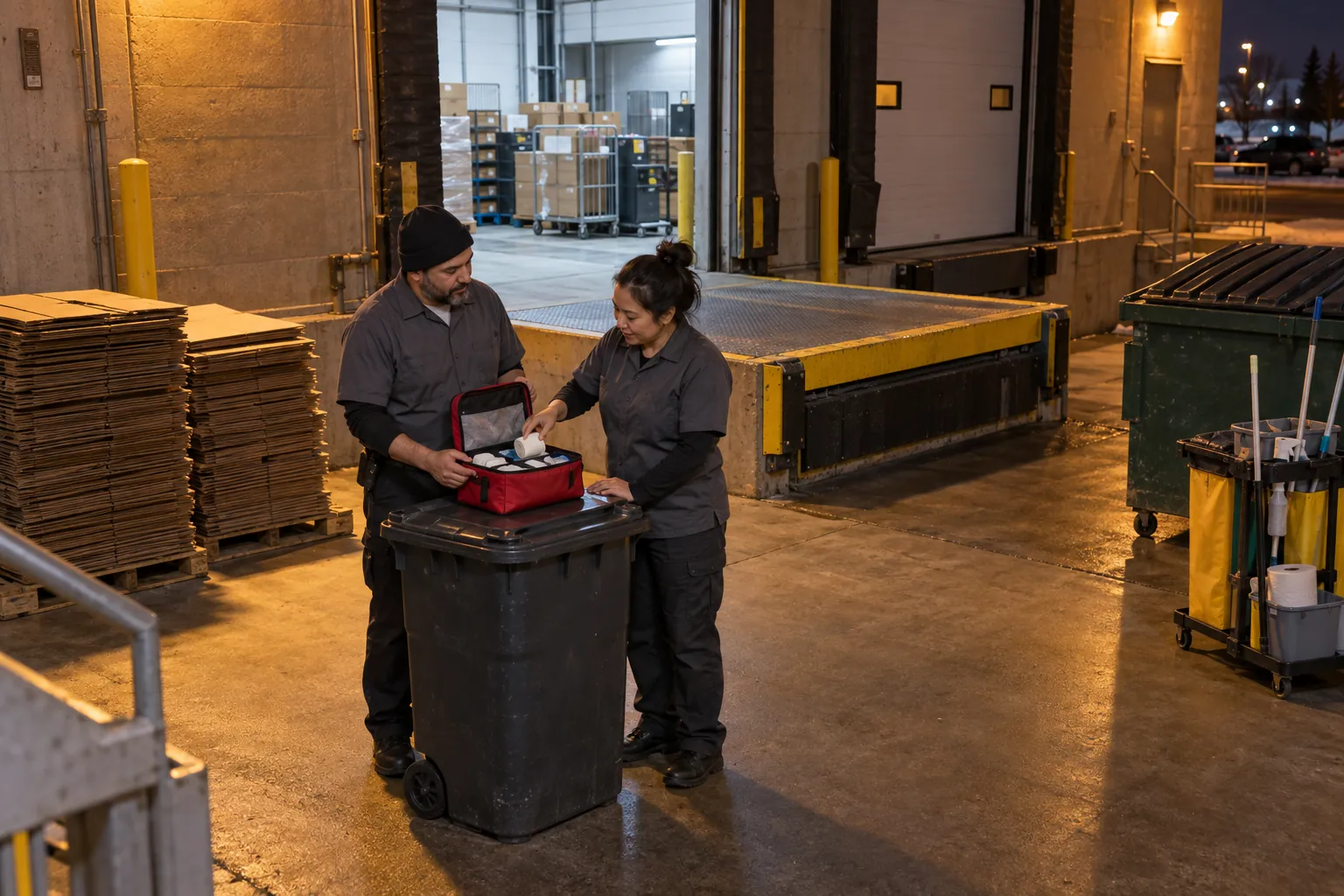
The duty sits with each employer for its own workers. In a multi-tenant office tower, a shopping centre or a condominium, the property management company provides for its staff, each tenant for its employees, and the janitorial or security contractor for its crews. A building kit in the lobby does not relieve a contractor of its duty, and a contractor's kit in a locked janitor's room is no use to a tenant's staff.
The WSIB says "The first aid requirements for employees working off-site are the same as for employees working on-site", and that every work crew must have adequate supplies and a trained first aider according to its size. A night cleaning crew in Ontario therefore needs its own station, or one it can use on every shift, with someone certified on duty. B.C. and Alberta treat a site with several employers differently. In B.C., when workers of two or more employers are at a workplace at the same time, section 3.20 makes the prime contractor responsible for the first aid assessment and for the kits, attendants and facilities for all of them. In Alberta, section 178(1) puts the duty on the prime contractor where there is one. Where there is not, section 178(4) lets the employers agree in writing to provide first aid together.
A few places deserve particular attention:
- Nights and weekends. Ontario counts workers on any one shift, and the WSIB says at least one person with a valid certificate must be on site at all times. A lone overnight security guard still needs a station and training.
- Large floors and several storeys. The WSIB suggests a first aider should be able to reach an injured person within two minutes.
- Vehicles. The WSIB says vehicles used for work, including personal vehicles, should have a kit, which covers patrol cars and maintenance vans.
- Chemical areas. Where there is a hazard of skin or eye injury from a hazardous substance, you may need an eyewash station as well as a kit.
The kit inspection record and the first aid record are different documents. When first aid is given, the regulations require a record of the injury and treatment: Ontario section 5 lists what it must capture, federal section 16.13 requires a signed entry kept for two years, and B.C. section 3.19 and Alberta section 183 require three years. Those records hold personal health information and are confidential. The inspection record only shows the kit was there, complete and not expired, which makes it a natural item for routine rounds and the JHSC workplace inspection.
06
Where the first aid kit record fails, and what SiteClara does about it
First aid kits rarely fail because nobody bought one. They fail on the record. The inspection card has four dates in a row in the same pen, one from a week the signer was on vacation. The third-floor kit moved when the office was reconfigured, and the card stayed with the old cabinet. The night crew used the last of the gauze in March, told whoever was at the desk, and nobody passed it on. The certificate on the board belongs to someone who left last year. None of this shows until somebody cuts a hand and opens the box.
SiteClara records checks where they happen. A printed QR poster, with an optional NFC tag behind it, sits beside each first aid station. The person doing the check, or a custodian or guard passing on a round, scans or taps with their own phone, with no app to install, sees the checks due at that location and marks each one done, or explains what stopped them. The time and the named person are recorded as it happens, with a photo when one is asked for, such as the open kit or the station board. A problem found there, such as missing supplies, an expired item or a kit that is not where the sign says, goes onto the team's list of jobs until someone closes it.
The supervisor sees what was due, what was done and what was missed at each location, and records the reason for anything missed. Each day they review the record, add a note and approve a report that goes to nominated managers the next morning, so the property manager or employer can see each station checked, location by location, rather than taking the card on trust.
07
Questions people ask
What are the legal requirements for first aid in Canada?
There is no single national law. Each province and territory sets first aid requirements for the workplaces it regulates, and the federal rules cover federally regulated work. They also decide where first aid attendants are needed: section 16.3 of the Canada Occupational Health and Safety Regulations requires one wherever six or more employees are working at any time, or two or more at a remote workplace. Everywhere, the employer provides the kits, the trained people and the checks.
What are the basic requirements for a first aid kit?
It must hold at least the minimum contents the governing regulation lists for the number of workers, or meet CSA Z1220-17 where that is accepted. The WSIB First Aid Program page says a kit "must contain at least the minimum requirements as listed in Regulation 1101, based on your number of employees", that kits meeting CSA Z1220 also satisfy the regulation, and that over-the-counter medications cannot be included, because they could cause an allergic reaction or mask how serious an injury is and delay medical care. In addition, the employer must provide the first aid equipment, facilities and trained people that go with it.
What are 10 items in a first aid kit?
The smallest federal kit is a good example. Schedule II to Part XVI of the Canada Occupational Health and Safety Regulations lists the Type A kit, for 2 to 5 employees, as 12 adhesive strips, a 10-pack of antiseptic swabs, 2 triangular bandages, a compress dressing, 4 sterile and 10 non-sterile gauze dressings, 2 self-adhering gauze bandages, adhesive tape, bandage scissors, splinter forceps, 4 disposable gloves, a pocket emergency blanket, a resuscitation mask with a one-way valve and a first aid record book. Types B and C, for six or more employees, hold larger quantities, and Type C adds items such as super shears, combination dressings and waterproof bags.
What's in a first aid kit checklist?
Two things: the kit's contents list, from the regulation or the CSA Z1220-17 kit, and the station around it. In Ontario, the WSIB First Aid Program page says each station should include a first aid kit, the "In Case of Injury" poster (Form 82), a first aid inspection card and a list of the first aiders in that area, and that section 6 of Regulation 1101 requires kits and supplies to be checked at least four times a year.
08
Where to read more, and a checklist to take away
The primary sources, all on the owners' own sites:
- R.R.O. 1990, Reg. 1101: First Aid Requirements and the WSIB First Aid Program questions and answers (Ontario).
- Alberta OHS Code, Part 11: First Aid and Schedule 2: First Aid.
- B.C. OHS Regulation, Part 3 and Schedule 3-A, with WorkSafeBC OHS Guidelines, Part 3 for kit contents.
- Canada Occupational Health and Safety Regulations, section 16.5 and Part XVI's schedules (federally regulated workplaces).
- CSA Z1220-17, First aid kits for the workplace, from CSA Group.
First aid kits, in short:
- Confirm which jurisdiction regulates each employer in the building.
- Count the workers on the largest shift, not the headcount.
- Choose kits to the regulation's list or to CSA Z1220-17, and add what your hazards call for.
- Place stations within quick reach on every floor that needs one, never locked away, and marked with a sign, with a kit in each vehicle used for work.
- In Ontario, post Form 82, the first aiders' certificates and an inspection card at each station.
- Have a trained first aider, certified through a recognized first aid course, on duty on every shift, including nights and weekends.
- Inspect at least as often as the rules say (quarterly in Ontario, monthly federally); monthly is a sensible default elsewhere.
- Record each inspection at the station, at the time, with the name, date and anything replaced, and restock after every use.
- Keep first aid treatment records separately and confidentially, for as long as your jurisdiction requires.
Sources
Every document this guide quotes or links to, in the order it first cites them.
- R.R.O. 1990, Reg. 1101: First Aid Requirements ontario.ca
- WSIB First Aid Program page wsib.ca
- Part 11 of the Occupational Health and Safety Code search-ohs-laws.alberta.ca
- Occupational Health and Safety Regulation, Part 3 worksafebc.com
- Section 16.7 of the Canada Occupational Health and Safety Regulations laws-lois.justice.gc.ca
- "In Case of Injury" Poster (Form 82) wsib.ca
- OHS Code, Schedule 2: First Aid search-ohs-laws.alberta.ca
- OHS Guidelines, Part 3 worksafebc.com
- Section 16.3 of the Canada Occupational Health and Safety Regulations laws-lois.justice.gc.ca
- Schedule II to Part XVI of the Canada Occupational Health and Safety Regulations laws-lois.justice.gc.ca
- Canada Occupational Health and Safety Regulations, section 16.5 laws-lois.justice.gc.ca
Related guides
 Premises and facilities managementAED inspection: the monthly check, the record, and what the law asksHow to inspect an AED in a Canadian building: what the monthly check covers, what Manitoba's law requires, registration, and a record you can rely on.
 Premises and facilities managementEyewash station requirements: what the law asks, and how to keep them workingEyewash station requirements in Canada: Ontario, Alberta, B.C. and federal rules, the ANSI Z358.1 benchmark, weekly and monthly flushing, and what to record.
 Premises and facilities managementWorkplace inspection checklist: how a JHSC inspection should workA workplace inspection checklist for Canadian JHSCs and representatives: Ontario, BC, Alberta and federal rules, what to walk, how often and what to record.
 Premises and facilities managementBuilding compliance checklist: the legal picture for a Canadian buildingA building compliance checklist for Canadian commercial buildings: fire code, OHS, asbestos, elevators, boilers, accessibility and energy, who holds each duty.