Fire and water checks
Cooling tower requirements in Ireland: keeping the water under control, and showing that it is
A cooling tower cools water by letting part of it evaporate into a stream of air, and in Ireland the employer or person in control of the workplace where one runs must assess its legionella risk and prevent or control it, a duty that comes from general health and safety law rather than a law written for cooling towers.
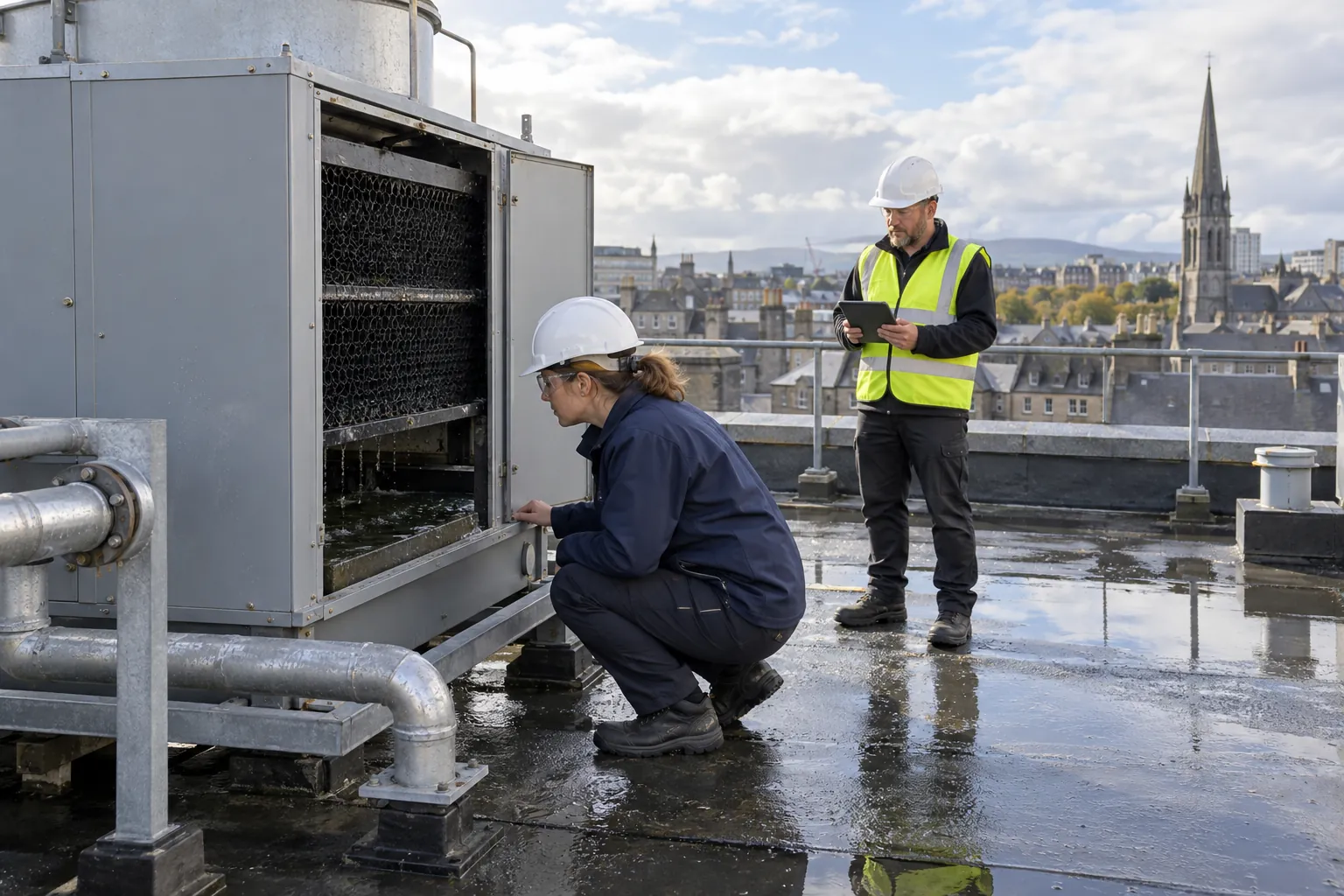
Often on the roof of a hotel, an office block or a food plant, it is one of the few pieces of building plant designed to throw water into the air, which is why the national guidelines count cooling towers among high-risk sites. This guide sets out what Irish law and the national guidelines expect of the people responsible for one: the written scheme, the treatment, cleaning and sampling, who does each job, and what makes the record worth having.
01
The duty behind cooling tower requirements in Ireland
The Health and Safety Authority's information sheet Legionella Control in Water Cooling Towers (January 2014) describes evaporative cooling towers as equipment that removes heat from water in industrial process cooling, refrigeration and some air conditioning, found "from food or pharmaceutical processing plants to hotels or offices". They run at temperatures where Legionella can grow, and they "deliberately require the creation of sprays and aerosols, which can be dispersed over a wide area if not controlled properly". Those at risk include members of the public nearby, and employees doing cleaning or maintenance may be at increased risk.
Ireland has no statute written only for cooling towers. The National Guidelines for the Control of Legionellosis in Ireland, 2009, from the HSE's Health Protection Surveillance Centre (HPSC), recommended that government consider "a system of statutory notification by the owner/occupier of high-risk sites e.g. cooling towers". The duty comes from general health and safety law:
- The Safety, Health and Welfare at Work Act 2005: section 8 (the employer's general duty, including plant that is safe and without risk to health), section 12 (people at the place of work who are not employees), section 15 (a person in control of a non-domestic place of work, including one obliged by contract or tenancy to maintain it), section 19 (a written risk assessment), section 20 (the safety statement) and section 21 (co-operation between employers sharing a place of work).
- The Safety, Health and Welfare at Work (Biological Agents) Regulations 2013 (S.I. No. 572 of 2013): regulation 7 requires a written assessment of the risk of exposure, and regulation 8 training before the work starts. The HSA's Biological Agents Code of Practice 2020 lists Legionella spp. as a group 2 biological agent.
- The Safety, Health and Welfare at Work (General Application) Regulations 2007 (S.I. No. 299 of 2007), whose rules on the maintenance of work equipment the information sheet cites. As made, regulation 30 requires periodic inspection of work equipment exposed to deterioration, special inspections after events including "prolonged inactivity", and results kept for five years; regulation 31 requires adequate maintenance and "a maintenance log for any machine" kept up to date. The Regulations have been amended since, so check the current text.
The information sheet sums up what an employer with a cooling tower should have: a written site-specific risk assessment, adequate control measures, information, training and instruction for employees, commissioning and regular maintenance, supervision, and appropriate records. The HPSC guidelines hold the technical detail. Their cooling tower tables are adapted from the UK's Approved Code of Practice L8 and they predate the 2013 Regulations, so check any statute they name against the Irish Statute Book; British guidance is background, not Irish law.
02
What the requirements cover in practice
The HPSC guidelines insist the system is considered as a whole, "not for example the cooling tower in isolation", including pipework, pumps, feed tanks and heat exchangers, and the dead legs and intermittently used parts that "go unnoticed". The risk assessment and written scheme for a tower usually cover:
- The tower: the pond, the pack (the fill the water runs over), sprays and troughs, fans, any immersion heater, and the drift eliminators, which the HSA calls "an important element of the design" because they limit the aerosol discharged.
- The water treatment programme: biocides, their dose and contact time, corrosion and scale inhibitors, the blowdown that keeps dissolved solids in check, and the dosing and control equipment.
- The make-up water and the tanks that feed the tower.
- Where the tower sits: the guidelines list the position of building air intakes relative to cooling tower exhausts as a factor to assess.
- How the plant runs: commissioning and recommissioning, shutdown, warning systems, maintenance, and operating cycles "including when the system plant is in use or idle".
- The people: who is responsible, who does each task, and what each contractor is engaged to do.
The written scheme contains an up-to-date schematic including parts temporarily out of use, a description of correct and safe operation, the checks that show it is working and how often, and the remedial action if it is not. For the treatment it sets the control parameters and their tolerances, and the "remedial measures to be taken in case the control limits are exceeded including lines of communication".
03
How often: monitoring, cleaning and sampling
The risk assessment sets the regime for your plant and may ask for more. The HPSC guidelines give typical frequencies in Checklist 2 and Table 7, and action levels in Table 8, all taken from UK guidance:
- Weekly, in the cooling water: conductivity, oxidising biocide, pH and microbiological activity. The operating characteristics of the distribution network, such as pumps, are also monitored at least weekly.
- Monthly, in the cooling water: hardness, chloride, inhibitor level and the concentration factor; in the make-up water, hardness, chloride and conductivity.
- Monthly to three-monthly, according to risk: the control function, conductivity sensor calibration, blowdown, water distribution, and the condition of sprays, eliminators, pack, pond, heater and fans.
- Quarterly: alkalinity, sulphate, suspended solids, iron and temperature, and sampling for Legionella.
- Six-monthly: clean and disinfect the tower, make-up tanks and associated systems, including all wetted surfaces, descaling as necessary, with packs removed and cleaned where practicable.
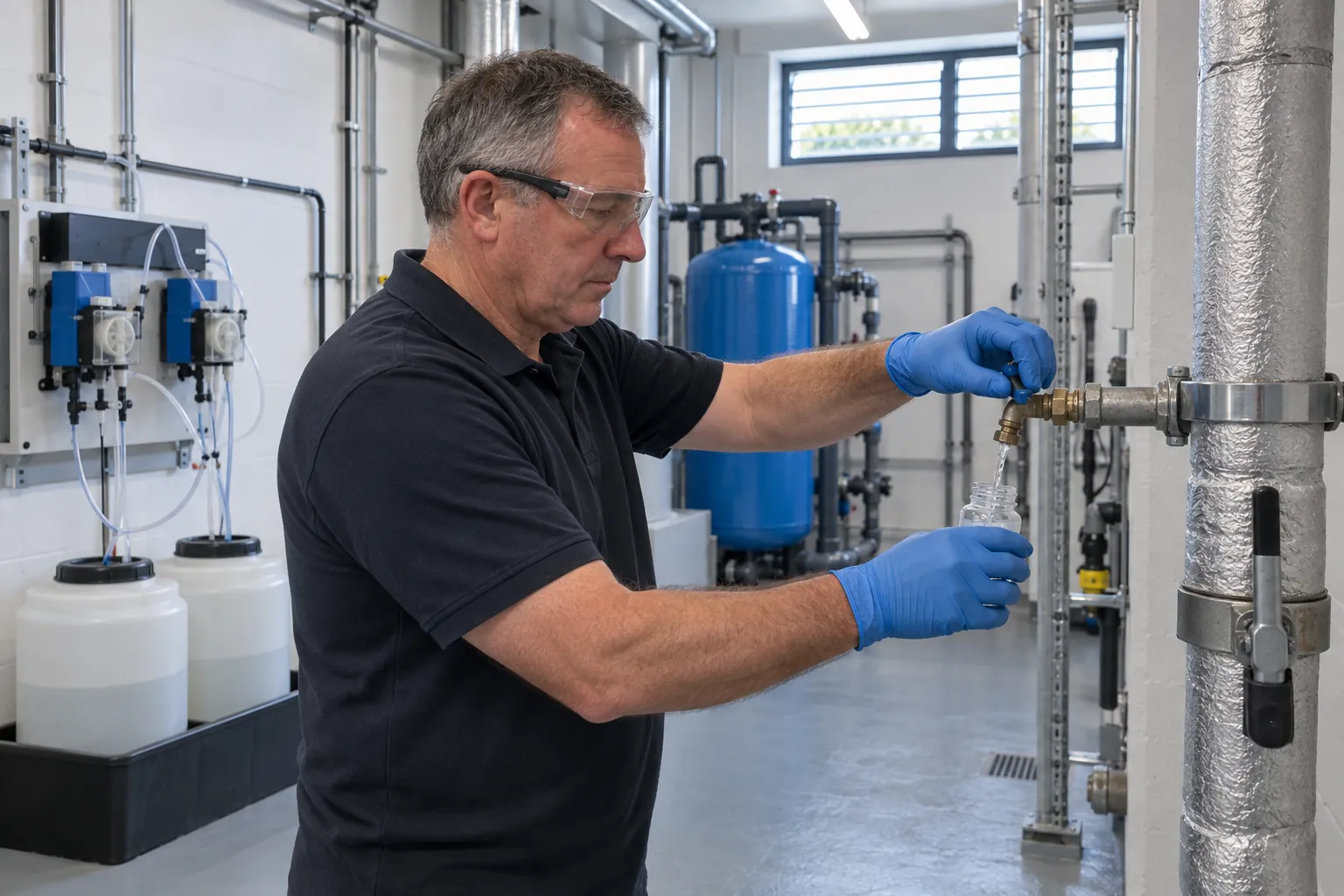
Section 6.9.2 asks for Legionella sampling "at least quarterly", from the tower's water reservoir following ISO 11731, and more often during commissioning or when showing a system is back under control. A clean result proves less than it seems: "Failure to detect Legionella bacteria should not lead to the relaxation of control measures and monitoring." Table 8 pairs each band of results with an action:
- Aerobic count 10,000 cfu/ml or less; Legionella 100 cfu/litre or less: system under control.
- Aerobic count above 10,000 and up to 100,000 cfu/ml; Legionella above 100 and up to 1,000 cfu/litre: review the programme and the risk assessment for remedial actions, and confirm the count by immediate re-sampling.
- Aerobic count above 100,000 cfu/ml; Legionella above 1,000 cfu/litre: re-sample immediately, shot dose with a suitable biocide as a precaution, and review the risk assessment and control measures.
The risk assessment is reviewed at least annually, and sooner after changes to the system or its use, checks showing the controls are failing, or a case of legionnaires' disease associated with it. A competent person independent of those running the regime audits the programme at least every two years.
04
Who does what
The HPSC guidelines expect whoever carries the corporate or statutory obligation to appoint a responsible person: a manager or director, or someone of similar authority, who knows the installation well enough to see the controls carried out. For medium- to high-risk water systems (the guidelines count cooling towers among "high-risk sites") they should have specific training with refreshers, recorded. They or an authorised deputy should be contactable at all times, and emergency call-out contacts "should be clearly displayed at access points to all automatically or remotely controlled water systems", usually the plant room door or roof access.
Around the responsible person the work is shared:
- A competent risk assessor, ideally independent of those who implement the control measures, water treatment and cleaning.
- A water treatment company, which usually services the dosing equipment and does the testing. The guidelines accept testing by a service provider "provided that they are trained to do so and properly supervised", with results interpreted by a competent person and remedial work done promptly.
- A cleaning and disinfection contractor for the six-monthly clean. Table 13 of the guidelines sets the minimum protective equipment for chemical disinfection and mechanical cleaning of cooling towers, including a half-face mask with a P2 filter and filters against biocides, waterproof overalls, impervious gloves and eye protection.
- The site's engineers, maintenance technicians or facilities team, who do the visual checks between contractor visits and are first to see a stopped dosing pump or a loose eliminator.
Each contractor's contract should say what they do and to whom they report, and a contractor who notices something affecting Legionella control should pass it on "even if the piece of equipment, etc. is outside the scope of their contract". Employing them "does not absolve the duty of the holder of responsibility". The HSA's information sheet adds that exposed employees need to understand the risk assessment, the risks to health and the "need to report any failures in control measures".
In a multi-let office or shopping centre the cooling plant usually belongs to the landlord. The HSA's guidance on legionellosis says employers sharing a workplace and, where applicable, landlords must agree who does the overall risk assessment and each check, record it in the Legionella control plan, and pass the relevant parts to each employer for their safety statement. Where a managing agent runs the building, the plan should still name who does what.
05
What a good cooling tower record shows
Section 5.1.3 of the HPSC guidelines makes the responsible person answerable for the records: the people responsible for each task, schematics, the current state of operation (in use or not, and whether drained down), the risk assessment findings, the written scheme, the results of every check, inspection and test with its date, a log of contractors' visits, remedial work and when it was completed, cleaning and disinfection certificates, the chemical and microbiological results, and training records. "All test and inspection records must be kept for five years", signed by the people who did the work.
The guidelines also show how a record is read when something goes wrong. In an outbreak investigation, owners of high-risk plant are asked for their documentation, and the log books are examined for equipment changes, changes in water source, significant changes in routine ("intensification in cooling tower use should have been matched by increased disinfection"), sudden pressure drops, and the dosing history.
For each routine visit, a useful entry carries:
- The plant item, named as in the written scheme, so that "Tower 2, east roof" means one unit.
- The date and time, written at the time, and the name of the person, with their company if a contractor.
- The readings, in their units against the scheme's tolerances, not a tick marked "OK".
- What they saw: pond, pack, eliminators, sprays, dosing unit.
- Whether the plant was running, on standby or drained down.
- What happened when something was out of limits: who was told, what was done, and the re-test result.
- Checks not done, with the reason: no roof access in high wind, a visit moved, plant isolated for repair.
Most cooling tower records live in three places: the water treatment company's reports, the laboratory's certificates and the site's plant room log. They should agree, and an out-of-limit result should be traceable to a named, dated action in the site log.
06
Where the record fails, and what SiteClara does about it
Cooling tower failures are rarely failures of chemistry. They are a weekly visit that slipped to fortnightly when the site engineer left, a high count in a contractor's report that sat in an inbox, a dosing drum that ran dry over a bank holiday weekend, a standby tower restarted with nobody noting it had been idle. The service reports are usually complete; the site's side of the story is what goes missing, and nobody sees the gap until an auditor asks.
SiteClara puts a printed QR poster, with an NFC tag behind it if staff should tap, at the places in the written scheme where the site's own checks happen: the plant room door, the roof access, the dosing station. Staff scan or tap with their own phone and see the checks due at that location. They mark each one done, or explain what stopped them, with a photo when one is asked for, such as the dosing unit or the pond. The time and the person are recorded as it happens.
The supervisor sees which checks are due, done and missed, and can record why one was missed. A problem found on a check, such as a loose drift eliminator or a tripped pump, is reported there and stays on the team's list of jobs until someone closes it, and can be escalated to the building manager. Each day the supervisor approves a report that goes to nominated management or client contacts the next morning, showing how the scheduled checks went.
07
Questions people ask
What is the purpose of a cooling tower?
To get rid of unwanted heat. Section 5.2.2 of the National Guidelines for the Control of Legionellosis in Ireland, 2009 calls evaporative cooling "an energy efficient means to reject unwanted heat from an air conditioning, refrigeration or process cooling system". In an open circuit tower the warm water is filmed over a fill pack (the packing) with a large surface area, air flows through it, and the part that evaporates leaves the rest cooler. In a closed circuit tower the fluid being cooled stays inside a heat exchanger, and a secondary recirculating system distributes water continuously over it.
Why do some buildings have cooling towers?
Because their air conditioning, refrigeration or process plant has heat to lose. The HSA's information sheet Legionella Control in Water Cooling Towers finds them in workplaces "from food or pharmaceutical processing plants to hotels or offices", and notes that towers can be open or closed circuit, induced or forced draught, with the air flowing against or across the water.
What are the downsides of using a cooling tower?
The main one is legionella. The HSA's information sheet Legionella Control in Water Cooling Towers says towers run at 20 to 45°C, where Legionella can grow, and "deliberately require the creation of sprays and aerosols, which can be dispersed over a wide area if not controlled properly", reaching members of the public as well as staff. The sheet says exposure can be avoided through the design of the equipment, with high efficiency drift eliminators, and through water treatment and cleanliness, but that means ongoing work for as long as the tower is in operation: under the National Guidelines for the Control of Legionellosis in Ireland, 2009, weekly monitoring, quarterly sampling and a clean and disinfection every six months.
08
Further reading, and a list to take away
Start with the HSA's four-page Legionella Control in Water Cooling Towers and the HSA's legionellosis page. The National Guidelines for the Control of Legionellosis in Ireland, 2009 give the detail: section 5.1 for the scheme, records and audit, 5.2.2 for cooling towers, 6.9.2 for sampling and 7.4 for protective equipment. For the hot and cold water in the same building, see legionella checks.
For a cooling tower in your building, make sure that:
- every tower and evaporative condenser, including standby units, is on the asset register and schematic;
- a competent person's written risk assessment is current and reviewed at least annually;
- a trained responsible person and deputy are named, with call-out contacts displayed at the plant;
- the scheme sets the limits and who is told when one is exceeded;
- the water treatment contract says what is done, how often and to whom it is reported;
- Legionella samples are taken at least quarterly and read against the action levels;
- the tower and make-up tanks are cleaned and disinfected six-monthly, with the certificate kept;
- idle periods, drain-downs and restarts are written down with dates;
- missed checks carry a reason, not a blank;
- records are kept for five years and the contractor's reports and site log agree;
- the programme is independently audited at least every two years.
Sources
Every document this guide quotes or links to, in the order it first cites them.
- Legionella Control in Water Cooling Towers hsa.ie
- National Guidelines for the Control of Legionellosis in Ireland, 2009 hpsc.ie
- Safety, Health and Welfare at Work Act 2005 irishstatutebook.ie
- Safety, Health and Welfare at Work (Biological Agents) Regulations 2013 irishstatutebook.ie
- Biological Agents Code of Practice 2020 hsa.ie
- Safety, Health and Welfare at Work (General Application) Regulations 2007 irishstatutebook.ie
- HSA's guidance on legionellosis hsa.ie
Related guides
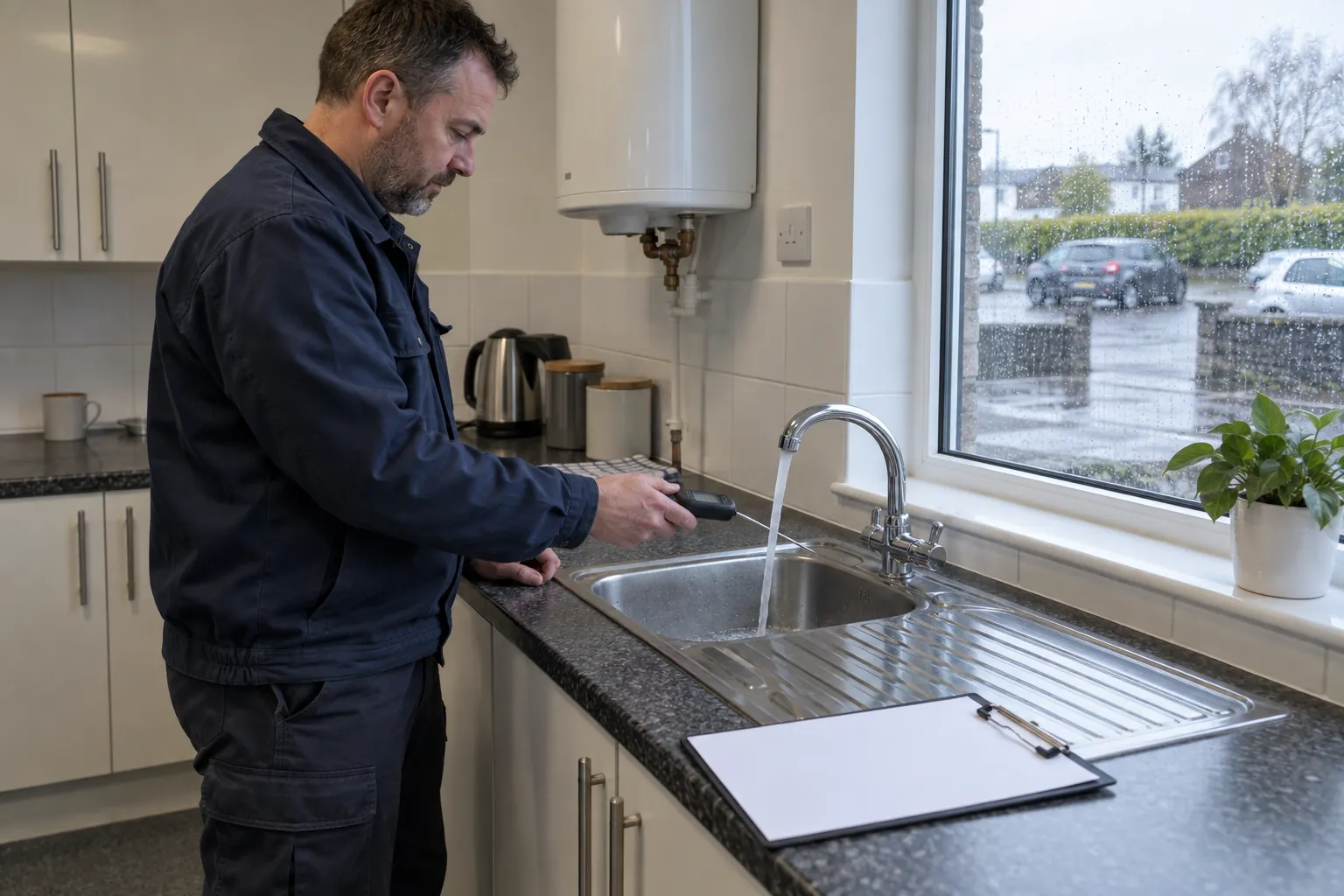 Fire and water checksLegionella checks in Ireland: the routine that keeps the water safe, and the record that shows itRoutine legionella checks in Irish buildings under the HPSC guidelines and HSA guidance: weekly flushing, monthly temperatures, who does them and what to record.
 Premises and facilities managementSafety statement: what the 2005 Act requires, and how to show it is followedWhat a safety statement must contain under section 20 of the Safety, Health and Welfare at Work Act 2005, who needs one, when to review it and how to show it works.
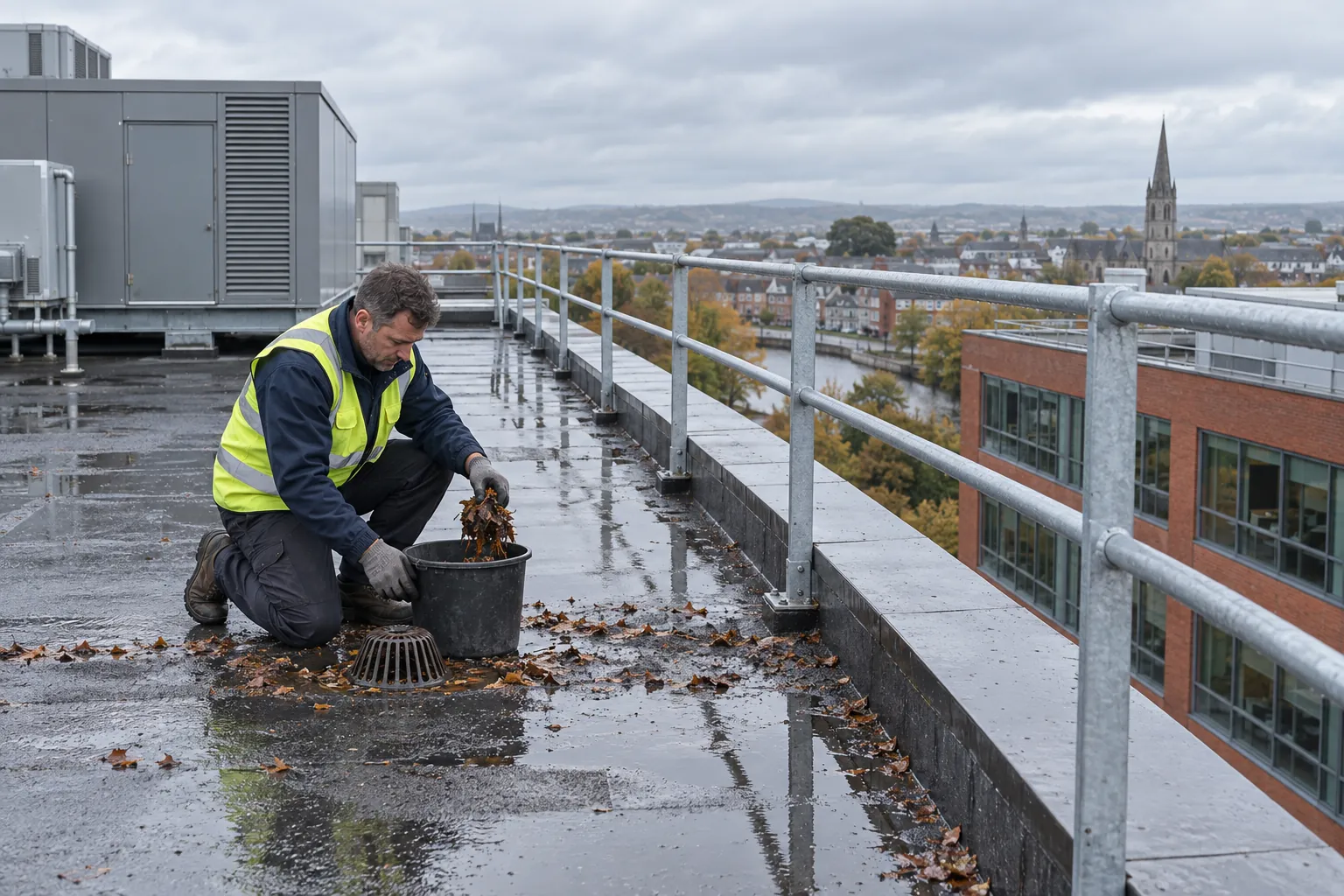 Premises and facilities managementBuilding maintenance checklist: what to check in an Irish building, how often, and who byA building maintenance checklist for non-domestic buildings in Ireland: daily to annual checks under the 2005 Act, the 2007 Regulations and the Fire Services Acts.
 Premises and facilities managementBuilding compliance checklist: the statutory picture for a building in IrelandBuilding compliance checklist for non-domestic buildings in Ireland: fire, electrical, gas, water, asbestos, lifts, energy and access, who holds each duty and when.