Fire and water checks
Legionella checks in Ireland: the routine that keeps the water safe, and the record that shows it
Legionella is a type of bacteria that multiplies in warm, stagnant water and causes Legionnaires' disease, a form of pneumonia people catch by breathing in fine droplets of contaminated water from a shower, a tap or a cooling tower.
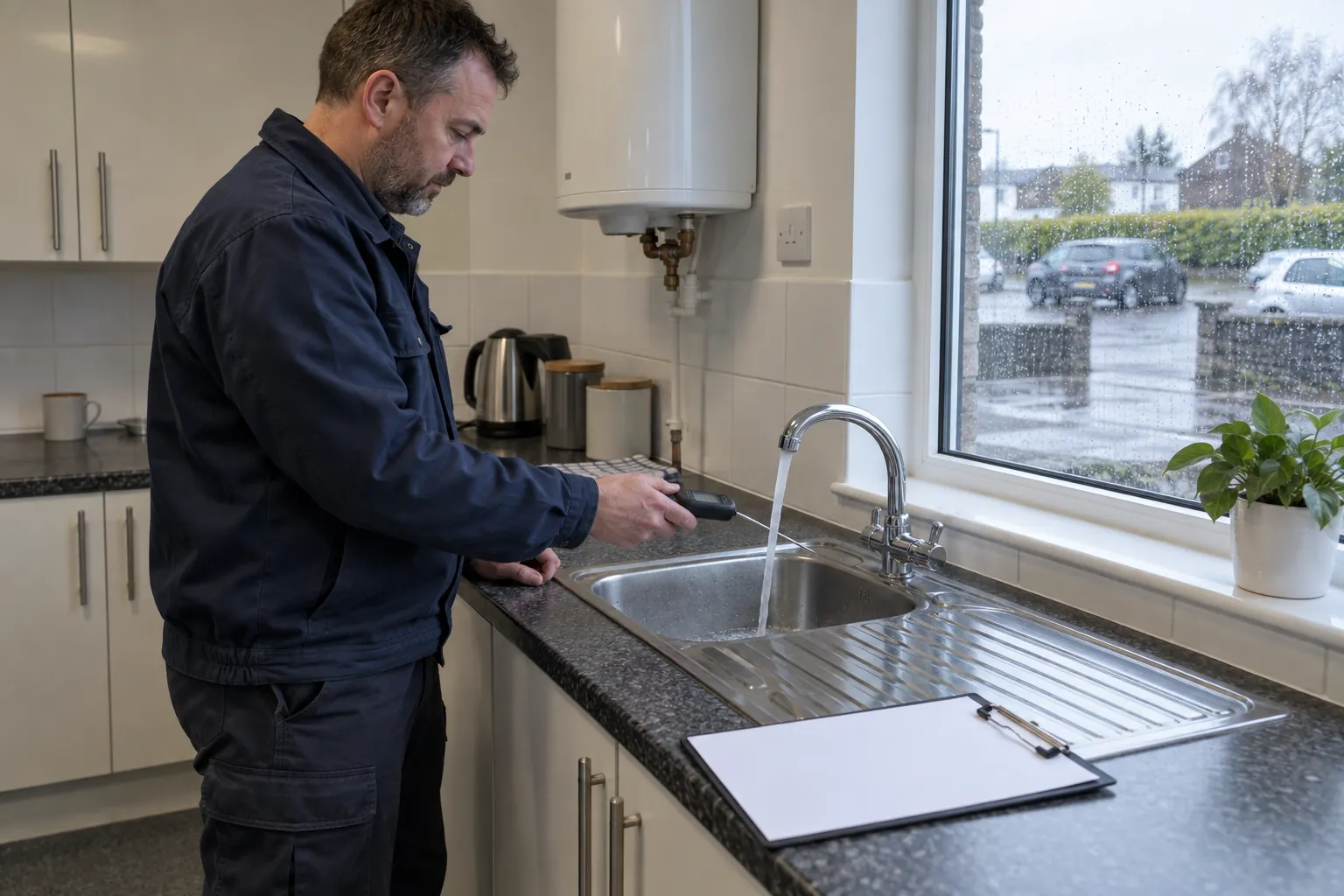
Controlling it in an Irish building is mostly routine. Somebody runs the shower in the changing room nobody uses, holds a thermometer under the tap furthest from the calorifier and writes down the number. This guide covers those routine checks in hot and cold water systems, the Irish law and guidance behind them, who usually does them, and what makes the record worth keeping.
01
The duty behind legionella checks in Ireland
Legionellosis is the collective name for the illnesses caused by Legionella bacteria, the most serious of which is Legionnaires' disease, a form of pneumonia. People are infected by breathing in small droplets of contaminated water, from a shower, a spray tap or a cooling tower. The Health and Safety Authority (HSA) lists those more at risk as including workers over 40, smokers, and people with weakened immune systems or chronic disease. Legionellosis is also a notifiable disease in Ireland, so a case is notified to the Medical Officer of Health in the regional department of public health, who investigates the source.
There is no Irish statute written only about legionella. The duty comes from general health and safety law, applied to water systems:
- The Safety, Health and Welfare at Work Act 2005 requires every employer to identify hazards, hold a written risk assessment (section 19) and prepare a safety statement based on it (section 20). Section 12 extends the employer's duty to people at the place of work who are not employees, and section 15 places duties on a person who has control of a non-domestic place of work, including one who is obliged by contract or tenancy to maintain or repair it. Section 21 requires employers who share a place of work to co-operate and co-ordinate.
- The Safety, Health and Welfare at Work (Biological Agents) Regulations 2013 (S.I. No. 572 of 2013) apply wherever exposure to a biological agent, deliberate or incidental, has occurred or may occur. Regulation 7 requires a written risk assessment of that exposure, and regulation 8 requires information and training for the employees concerned. The 2013 Regulations revoked the 1994 Regulations and their 1998 amendment, and the HSA now cites them together with the 2020 amending Regulations and a Code of Practice, all listed on the HSA's biological agents legislation and Code of Practice page.
The HSA's guidance on legionellosis puts the practical duty plainly. As an employer or person in control of a place of work you must identify and assess sources of risk, prepare a scheme (a Legionella control plan) for preventing or controlling it, implement and manage the scheme, appoint a person to be managerially responsible, and keep records and check that what has been done is effective.
The technical detail is in the National Guidelines for the Control of Legionellosis in Ireland, 2009, published by the Health Protection Surveillance Centre (HPSC) and referred to by the HSA. Their chapters on risk assessment and on prevention and control are to be read alongside the UK's Approved Code of Practice L8, and their chapter on legislation predates the 2013 Regulations, so check the law against the Irish Statute Book. Their frequencies and temperatures remain the Irish reference point for the routine.
This guide is about the routine checks that follow a risk assessment and control plan. The assessment itself belongs to a competent person, and cooling towers and evaporative condensers have a regime of their own, covered in cooling tower requirements.
02
What routine legionella checks cover
The HPSC guidelines call temperature control the preferred strategy for hot and cold water systems: keep cold water below 20°C and keep hot water hot. Flushing keeps water from standing. Legionella multiplies in stagnant water between about 20°C and 45°C, where sludge, scale, rust and biofilm give it food and shelter. The routine checks test whether those conditions are being avoided. In an office, school, hotel, nursing home or leisure centre they usually include:
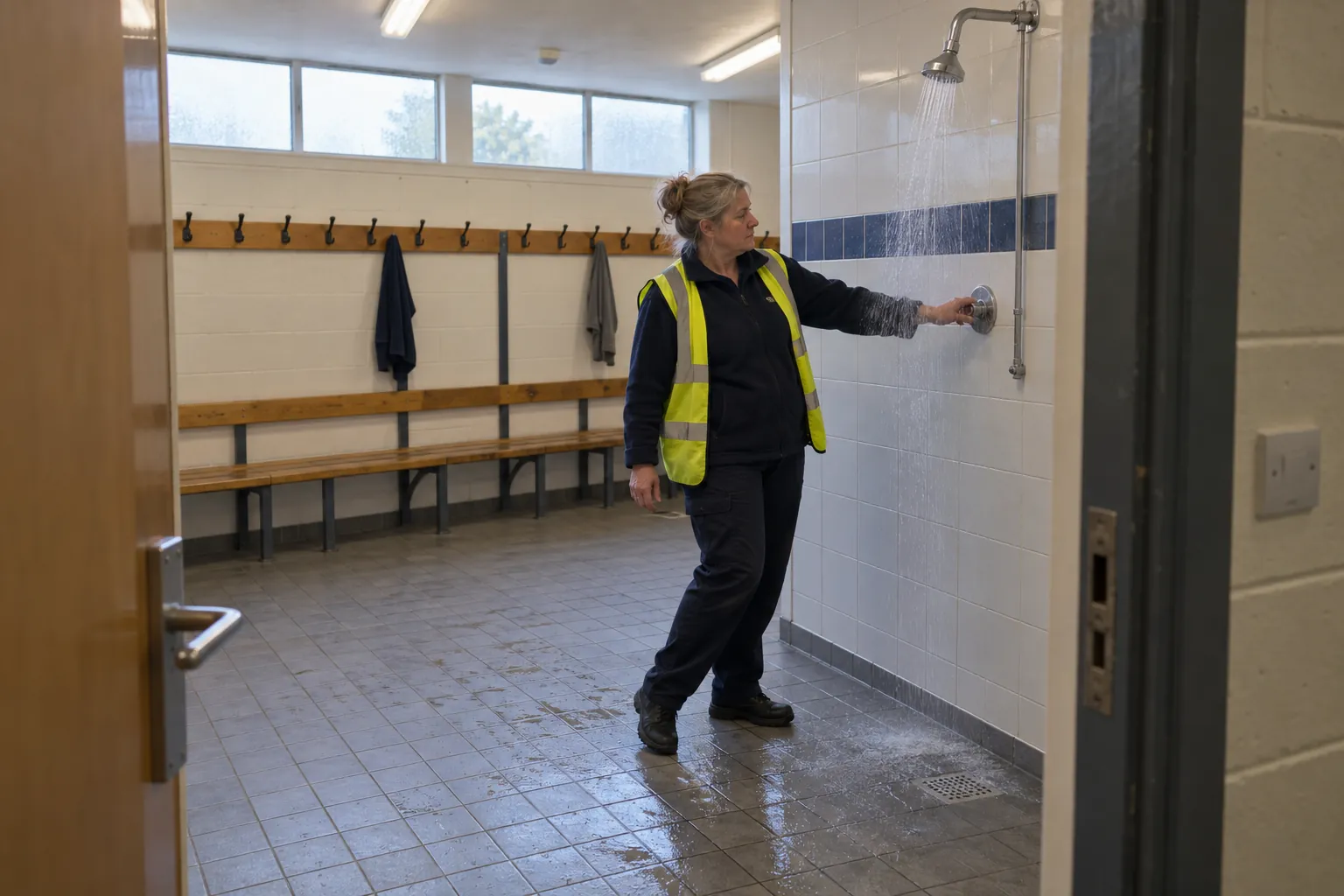
- Flushing little-used outlets: taps and showers that are not used every week are run through so that water does not stand in the pipework. Outlets in daily use do not need flushing.
- Sentinel tap temperatures: on a recirculating hot water system, the first and last taps on the loop; on a cold system, the nearest and furthest taps from the storage tank; and any other tap the risk assessment picks out as a particular risk.
- Calorifier temperatures: the water leaving the calorifier and the water returning to it.
- Thermostatic mixing valves (TMVs), where fitted, checked on a sentinel basis and serviced.
- Cold water storage tanks and incoming mains water: temperature, condition, and whether the tank is covered, screened and clean.
- Showerheads and hoses: dismantled, cleaned and descaled.
- Parts of the system out of use: a closed wing, a floor between tenants, a school over the summer, drained down or purged safely before use.
The HSA's Legionella risk assessment template No. 32, part of its guidance for schools, lists what a control plan contains: a description of the system and its safe operation, an up-to-date schematic, the checks to be carried out, by whom, when and with what records, and the remedial action if the system is out of specification.
03
How often, and to what temperature
Your Legionella control plan sets the frequencies for your building, and a risk assessment may ask for more than the minimum, especially where vulnerable people are present. The HPSC guidelines give the usual routine for a hot and cold water system under temperature control:
- Weekly: flush intermittently used outlets at full flow, raising the flow gradually to limit spray. In healthcare settings the guidelines set a minimum of three minutes cold and three minutes hot for showers and taps. Where weekly flushing is difficult, the outlet is flushed and purged to drain before use. The operating characteristics of the distribution system, such as pumps, are monitored at least weekly.
- Monthly: check the sentinel taps, the water supplied to TMVs on a sentinel basis, and the flow and return temperatures at the calorifier.
- Quarterly: dismantle, clean and descale showerheads and hoses, or more often if needed.
- Six-monthly: check the incoming cold water temperature, at least once in winter and once in summer, most conveniently at the ball valve outlet to the cold water storage tank.
- Annually: check a representative number of taps on a rotation, visually inspect the inside of calorifiers for scale and sludge, and inspect cold water storage tanks and carry out remedial work where needed. The guidelines also say every TMV must be cleaned and maintained at least once in every calendar year.
The standards the checks are measured against are:
- Hot water stored at 60°C, leaving the calorifier at 60°C or more and returning at 50°C or more.
- Hot taps reaching at least 50°C within one minute of running.
- Cold taps below 20°C after running for up to two minutes, and incoming cold water preferably below 20°C at all times.
A reading outside those limits is not a pass with a comment beside it. It means the risk is not controlled at that outlet, and the plan should say who is told and what happens next. The HPSC guidelines add that if regular flushing is having no effect on the levels of Legionella, all the existing control procedures need to be reviewed and amended if necessary.
04
Who carries out the checks
The HPSC guidelines expect whoever carries the corporate or statutory duty, the employer or the chief executive of a larger organisation, to appoint a responsible person with day-to-day responsibility for legionella control. They should be a manager or have similar authority, with enough knowledge of the system to make sure the control measures are carried out, and for medium- or high-risk systems they should have attended specific training, with refresher courses recorded. A deputy should be contactable when they are not. In a large building that is often the facilities or estates manager; in a smaller one, the premises manager or the owner.
The responsible person does not take every reading. The work is usually shared:
- Caretakers, cleaners and general operatives often do the weekly flushing, because they are in those rooms anyway. It is a simple task as long as they know which outlets, for how long, and what to report, such as discoloured water or a hot tap that never gets hot.
- A trained member of the facilities or maintenance team usually takes the monthly sentinel and calorifier temperatures, with a calibrated thermometer and a set route.
- A water hygiene contractor usually does tank inspections and cleaning, calorifier work, TMV servicing and any sampling. The HPSC guidelines say a contractor's contract should state what they are to do and to whom they report, that they should pass on anything they notice that affects legionella control even outside their contract, and that employing them does not remove the duty holder's responsibility.
Shared buildings are where the checks most often fall between two stools. The HSA's guidance says that employers sharing a workplace, and landlords where applicable, must agree who is responsible for the overall risk assessment and who does the checks in the control plan, such as flushing showers or taking temperatures in each tenant's area, and record that in the overall Legionella control plan. The relevant parts go into each employer's own safety statement. In an apartment development with shared plant, the same question applies to the owners' management company, which controls the common parts, and to the managing agent it appoints: who owns each check should be written down, not assumed.
Sampling for Legionella is not normally part of the routine for a hot and cold water system supplied with drinking water; the HPSC guidelines suggest it where control has been inadequate, or to show that control is being achieved.
05
What a good record of legionella checks shows
The HPSC guidelines make the responsible person answerable for keeping the records up to date. They list, among other things, the names and positions of the people responsible for each task, schematics of the system, the significant findings of the risk assessment, the written scheme and how it is being implemented, the results of every monitoring check, inspection and test with its date, a log of contractors' visits, remedial work and when it was completed, and training records. All test and inspection records must be kept for five years, and each record should be signed or otherwise authenticated by the person who did the work.
For the routine checks, a useful record carries:
- The outlet or plant item, named the same way as in the control plan and the schematic, so that "sentinel hot, second floor east" means one tap.
- The date and time the check was done, written at the time.
- The name of the person who did it.
- The reading, in degrees, not a tick. A column of ticks beside "above 50°C" hides a system drifting from 58°C to 51°C over a winter.
- For flushing, which outlets were run and for how long, where the plan sets a time.
- What happened when a check failed: who was told, what was done and the reading after the fix.
- Missed checks, with the reason: a locked room, a closed wing, a caretaker on leave.
The HPSC guidelines call for the risk assessment to be reviewed at least annually and when the system or the building's use changes, and for an independent competent person to audit the programme at least every two years. Both rely on the routine record.
The flushing record is usually the weakest part. It is a weekly job done in rooms nobody else visits, and a sheet showing every shower flushed every Monday for a year in the same pen is not easily believed. The temperatures often sit in a plant room log book and the tank work in the contractor's reports; all three should tell the same story.
06
Where the record fails, and what SiteClara does about it
Most failures in the routine are not failures of knowledge. They are a weekly flush that stopped when the caretaker changed, a sentinel check skipped in August because the school was closed, a hot tap reading 44°C written down and never passed on. On paper nobody sees the gap until somebody reads the log book.
SiteClara puts a printed QR poster, with an NFC tag behind it if staff should tap, at the locations in the control plan: the shower in the unused changing room, the sentinel taps, the plant room door. Staff scan or tap with their own phone and see the checks due at that location. They mark each one done, or explain what stopped them, with a photo when one is asked for, such as the thermometer in the stream. The time and the person are recorded as it happens.
The supervisor sees which checks are due, done and missed, and can record why one was missed. A problem found on a check, such as a tap that will not run hot, is reported there and stays on the team's list of jobs until someone closes it, and can be escalated to the building manager. Each day the supervisor approves a report that goes to nominated management or client contacts the next morning, showing how the scheduled checks went.
07
Questions people ask
What is Legionella and how do you get it?
Legionella is a group of bacteria that cause Legionnaires' disease. The HPSC's Legionnaires' disease factsheet for the general public says people become infected "when they breathe in aerosols (tiny droplets of water) which have been contaminated with Legionella bacteria", and that there is no evidence of spread from person to person. Most cases occur in people over 40, and men, smokers, people with excessive alcohol intake and people with chronic illnesses are more at risk. The same factsheet says the disease can be prevented by the proper design and maintenance of water systems.
How do you know if you have Legionella?
From the symptoms and a laboratory test, not by guessing. The HPSC's Legionnaires' disease factsheet for the general public says the illness usually starts like flu, with fever, tiredness, headache and muscle pains, followed by a dry cough and breathing difficulties, usually 2 to 10 days after infection. Pontiac fever is a milder form, with flu-like symptoms and no pneumonia, and several antibiotics are effective in treating the disease. The hotel checklist in the National Guidelines for the Control of Legionellosis in Ireland, 2009 adds that it may progress to severe pneumonia, that accurate diagnosis requires specific laboratory tests, and that any guest who falls ill should be referred to a doctor at once.
Where is Legionella most likely to be found?
In man-made water systems that are not well maintained. The HPSC's Legionnaires' disease factsheet for the general public names warm, stagnant water such as that in air conditioning cooling towers, certain plumbing systems (especially showers), spa pools, decorative fountains, sprinklers and nebulisers. The National Guidelines for the Control of Legionellosis in Ireland, 2009 say the bacteria are found naturally in rivers, lakes and moist soil, usually in low numbers, and that high numbers occur in inadequately maintained man-made water systems. In an ordinary building that means little-used showers and taps, stored water and hot water that is not hot enough, which is where the routine checks above are aimed.
What causes Legionella in water?
Warm water, standing water and something to shelter in. The National Guidelines for the Control of Legionellosis in Ireland, 2009 say water temperatures in the range 20°C to 45°C favour growth of the bacteria, and that sediment, sludge, scale and biofilm are thought to play an important role in their persistence. Water left standing in pipework at an outlet nobody uses is where those conditions meet, which is why weekly flushing and monthly temperature checks are the core of the routine.
What kills Legionella in water?
Mainly heat. The National Guidelines for the Control of Legionellosis in Ireland, 2009 say the bacteria do not appear to multiply below 20°C and are killed within a few minutes at temperatures above 60°C, though they may remain dormant in cool water and multiply when it warms. Chlorine levels in mains drinking water are often too low to kill Legionella living in biofilm, and chlorination of water supplies does not guarantee elimination. Temperature control is the recommended strategy, and in some buildings, such as large healthcare facilities, chlorine dioxide or silver/copper ionisation is often used as an additional means of control.
08
Further reading, and a list to take away
Start with the HSA's legionellosis page, which sets out the duty for employers and people in control of workplaces. The National Guidelines for the Control of Legionellosis in Ireland, 2009 give the technical detail, and the HPSC's legionellosis guidance page lists the 2015 guidelines for water systems in healthcare facilities and checklists for hotels and other accommodation, leisure centres and hostels. The law is on the Irish Statute Book.
For the routine checks in your building, make sure that:
- there is a current written risk assessment and Legionella control plan, and you know who wrote them and when they are next reviewed;
- a responsible person and a deputy are named, and everyone doing checks knows who they are;
- in a shared building, the plan says which employer, landlord or management company does each check;
- every little-used outlet is listed, and someone owns the weekly flush for each one;
- sentinel taps are identified and their temperatures are recorded as readings, not ticks;
- a failed reading has a written next step and a named person to tell;
- missed checks are recorded with a reason, not left blank;
- the system is purged safely before a building or wing reopens after a closure;
- test and inspection records are kept for five years.
Sources
Every document this guide quotes or links to, in the order it first cites them.
- Safety, Health and Welfare at Work Act 2005 irishstatutebook.ie
- Safety, Health and Welfare at Work (Biological Agents) Regulations 2013 irishstatutebook.ie
- HSA's biological agents legislation and Code of Practice page hsa.ie
- HSA's guidance on legionellosis hsa.ie
- National Guidelines for the Control of Legionellosis in Ireland, 2009 hpsc.ie
- Legionella risk assessment template No. 32 hsa.ie
- HPSC's Legionnaires' disease factsheet for the general public hpsc.ie
- HPSC's legionellosis guidance page hpsc.ie
Related guides
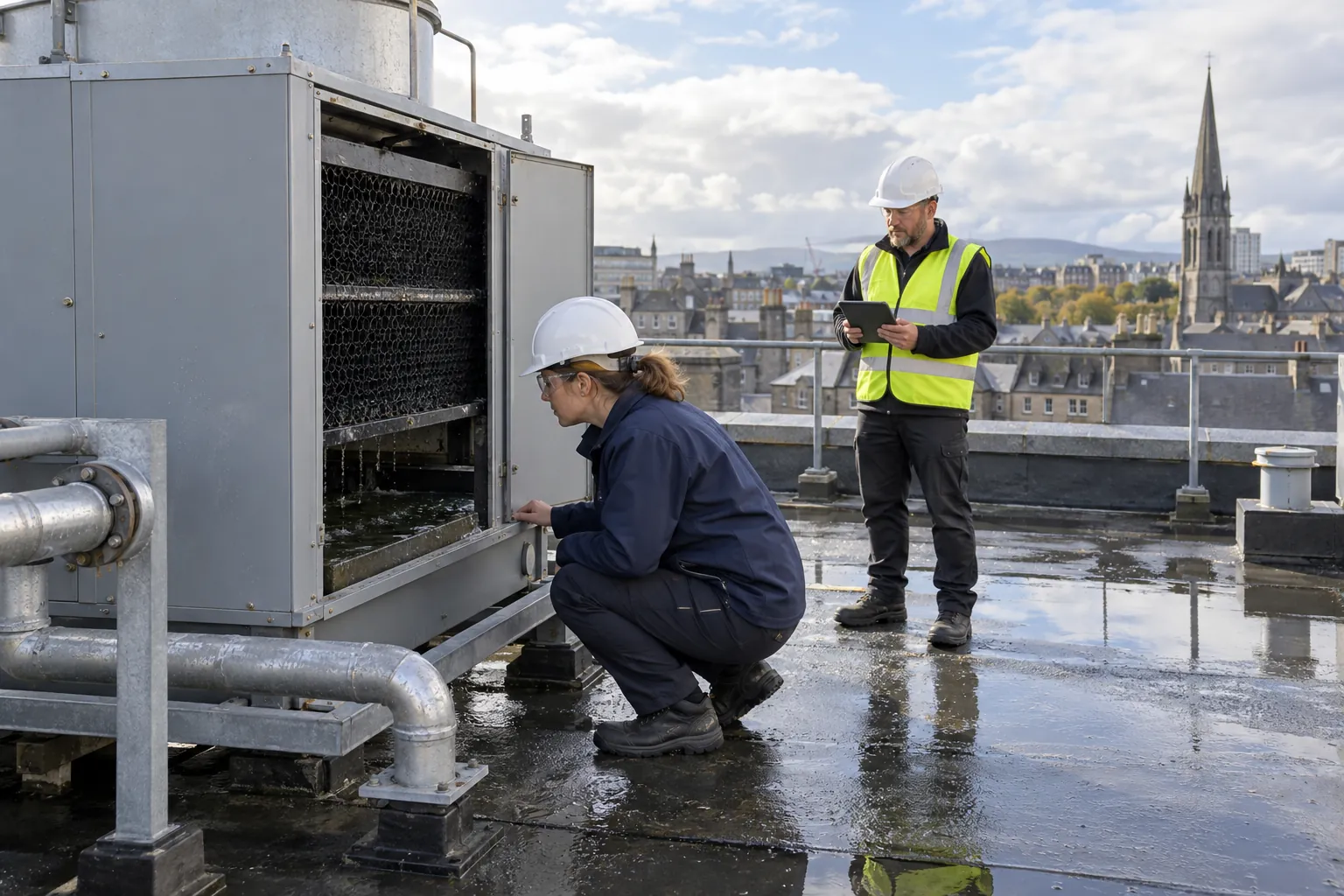 Fire and water checksCooling tower requirements in Ireland: keeping the water under control, and showing that it isWhat Irish law and the HPSC guidelines expect of a cooling tower: the risk assessment, water treatment, cleaning, sampling, who does what and the records to keep.
 Premises and facilities managementCaretaker duties in Ireland: what the job involves, and how to show it was doneCaretaker duties in Irish schools, parish halls, offices and apartment developments: the law behind the job, the daily and weekly checks, lone working and records.
 Premises and facilities managementSafety statement: what the 2005 Act requires, and how to show it is followedWhat a safety statement must contain under section 20 of the Safety, Health and Welfare at Work Act 2005, who needs one, when to review it and how to show it works.
 Premises and facilities managementBuilding maintenance checklist: what to check in an Irish building, how often, and who byA building maintenance checklist for non-domestic buildings in Ireland: daily to annual checks under the 2005 Act, the 2007 Regulations and the Fire Services Acts.