Premises and facilities management
Building compliance checklist: the statutory picture for a building in Ireland
A building compliance checklist is the list of statutory requirements that come with owning, controlling or working in a non-domestic building in Ireland, with who holds each duty, how often the work is done and where the evidence is kept.

There is no single building compliance law: the duties cover fire safety under the Fire Services Acts, safety and health under the 2005 Act and the General Application Regulations, electrical and gas installations, legionella, asbestos, lifts, energy ratings, access and building control. The sections below take each duty in turn, with the usual frequencies and the records a fire officer or HSA inspector will ask to see.
01
Who is responsible for building compliance in Ireland
There is no single building compliance Act in Ireland. Each duty comes from its own legislation and falls on its own duty holder, which is why compliance gaps usually sit between people rather than within one role. The main duty holders are:
- The employer, under section 8 of the Safety, Health and Welfare at Work Act 2005, whose duty extends to "the design, provision and maintenance" of the place of work "in a condition that is safe and without risk to health", its means of access and egress, and its plant and machinery.
- Anyone in control of a non-domestic place of work used by people other than their own employees, under section 15 of the 2005 Act, including anyone obliged by contract, tenancy or licence to maintain or repair it, to the extent of that obligation.
- The person having control for fire safety, under section 18(2) of the Fire Services Act 1981 (as amended by section 29 of the Licensing of Indoor Events Act 2003). The Department's Fire Safety Guide (section 3, Figure 1) says this may be the owner, occupier, landlord, tenant, an owners' management company, a property services company, a facilities manager or a caretaker, alone or sharing the role, "depending on tenancy agreements and/or other arrangements".
- Employers who share a building, who under section 21 of the 2005 Act must co-operate, co-ordinate and inform each other of risks, "including by the exchange of safety statements or relevant extracts therefrom".
- The building owner, for new buildings, extensions, material alterations and material changes of use under the Building Control Acts 1990 to 2014, where "responsibility for compliance rests at all times with the owner" and with any builder or designer the owner engages.
In an apartment block, the common areas belong to the owners' management company (OMC), set up under the Multi-Unit Developments Act 2011. The Citizens Information page on management companies lists them, from roofs, stairs and lifts to tanks and boilers serving more than one unit. An OMC often appoints a property management agent, who acts for it; the OMC remains the owner.
In a let building, the lease decides who maintains what, but it cannot remove a legal duty. The Fire Safety Guide for Building Owners and Operators (Department of Housing, Local Government and Heritage, August 2023) says that where fire duties are shared, the allocation of responsibility "should be clear to all parties involved" and the lease "should clearly identify where responsibility lies". A checklist earns its keep when it names, for every item, who holds the duty, who does the work and who keeps the certificate.
02
The building compliance checklist at a glance
For a typical non-domestic property in Ireland, such as an office, school, shop, hotel or the common parts of an apartment block, the statutory checklist covers:
- Risk assessment and safety statement, under sections 19 and 20 of the 2005 Act, kept under review.
- Fire safety: measures and procedures applied at all times under section 18(2), with the alarm and emergency lighting systems, fire doors, extinguishers and any sprinklers, risers or smoke control checked and serviced, and a fire safety register.
- Electrical installation: inspected and tested by a competent person, with a report.
- Gas installation: periodic inspection and testing by a competent person.
- Water hygiene: a legionella risk assessment, a control plan, a responsible person and records.
- Asbestos: a management survey in older buildings, and a refurbishment or demolition survey before intrusive work.
- Lifts and work equipment: thorough examination of lifts and hoists, and inspection of other equipment that deteriorates.
- Workplace and welfare: clear escape routes, clean sanitary facilities, first aid, and accident reporting to the Health and Safety Authority (HSA).
- Energy: a Building Energy Rating (BER) on sale or letting, and a BER or Display Energy Certificate displayed in a building over 500 m² frequently visited by the public (over 250 m² when a public body occupies it).
- Access and building control: a Fire Safety Certificate, Disability Access Certificate, Commencement Notice and Certificate of Compliance on Completion for the works that need them, and accessible buildings for public bodies.
Use it as a template rather than a complete list: a commercial kitchen, a pool or a cooling tower brings more. Your risk assessment, the relevant Irish Standard and your competent contractors set the actual frequencies.
03
Fire safety compliance
Section 18 applies to premises used for sleeping accommodation (other than a house occupied as a single dwelling), treatment or care, entertainment or instruction, teaching or research, public access and, since 2003, any workplace. Section 18(2) makes it the duty of every person having control to "take all reasonable measures to guard against the outbreak of fire", provide "reasonable fire safety measures" and "appropriate fire safety procedures", and "ensure that the fire safety measures and procedures ... are applied at all times". The fire authority enforces it through its authorised officers.
Workplaces carry parallel duties. Section 11 of the 2005 Act requires emergency plans for "first aid, fire-fighting and the evacuation of employees and any other individual present". Regulation 12 of the Safety, Health and Welfare at Work (General Application) Regulations 2007 requires emergency routes and exits "kept clear at all times" and emergency doors that can be "easily and immediately opened"; regulation 13 requires fire detection and fire-fighting equipment to be "inspected and maintained as frequently as necessary" and "serviced by a competent person as frequently as necessary".
The Department's Fire Safety Guide turns this into a schedule (its Table 2), split between checks by a designated person and work by a competent person:
- Escape routes: daily, for obstructions, exit doors that open readily and fire doors kept closed. See fire door inspection.
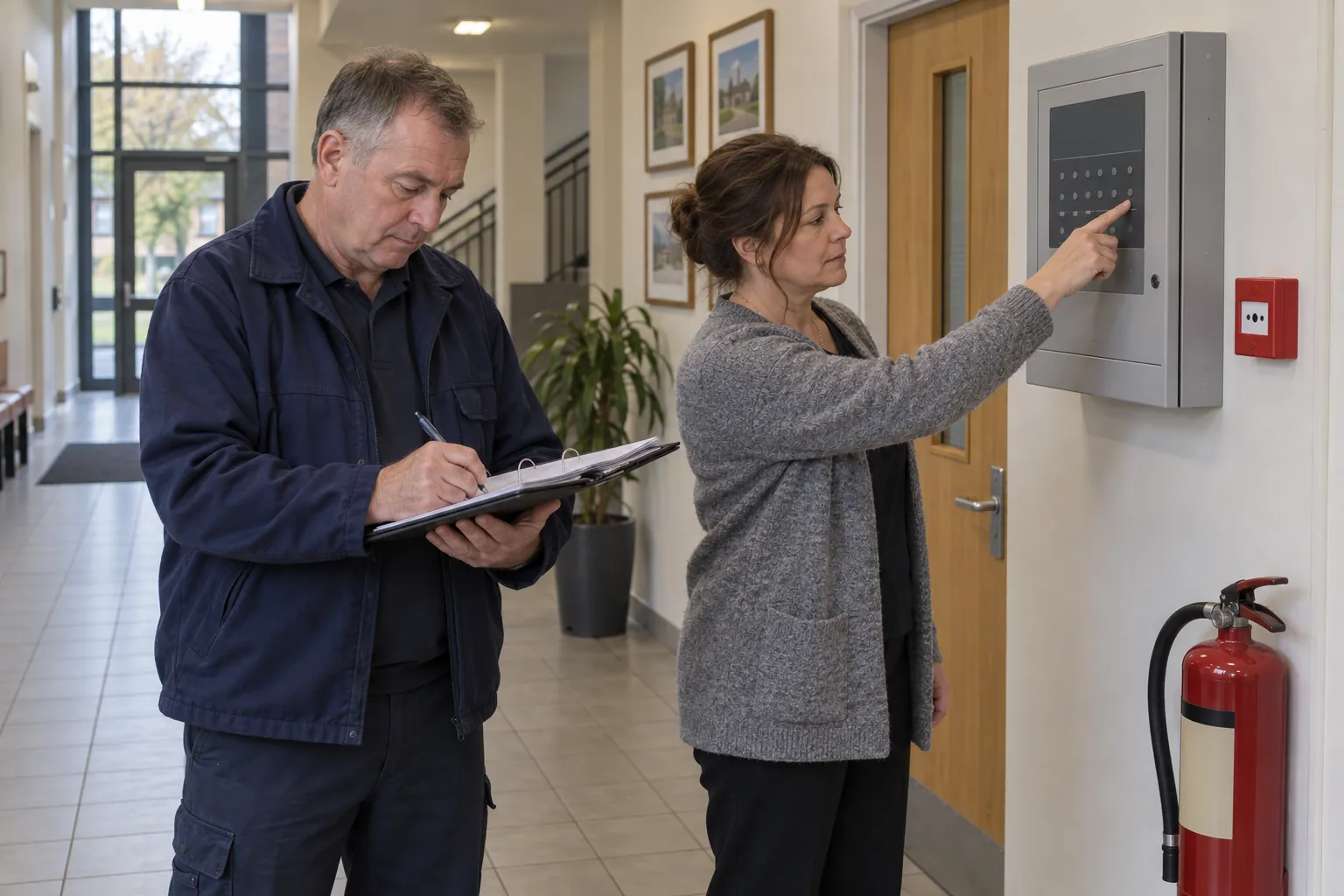
- Fire alarm: a daily check that the panel shows normal or that any fault is logged and acted on; a weekly test recording the trigger device used, in line with I.S. 3218; and servicing by a competent person with a certificate. See fire alarm testing.
- Emergency lighting: daily and weekly checks under I.S. 3217, the weekly check covering at least a quarter of the system so all of it is checked every four weeks; a quarterly inspection with a report; and a full-duration test each year. See emergency lighting testing.
- Door hold-open devices: released daily and tested monthly, with the result recorded.
- Extinguishers and hose reels: every location checked monthly; extinguishers maintained under I.S. 291 at intervals not exceeding 12 months (plus or minus one), hose reels annually. See fire extinguisher checks.
- Sprinklers, smoke control and hydrants: weekly to half-yearly work on commercial sprinklers under I.S. EN 12845; smoke control simulated weekly and fully tested yearly; private hydrants maintained at least twice a year.
All of it belongs in the fire safety register, which the guide says "should be kept on the premises at all times, be kept up-to-date, and should be available for inspection by an authorised officer of the fire authority".
04
Electrical, gas, water, asbestos and lifts
- Electrical installation: under regulation 89 of the 2007 Regulations, a new installation or major alteration must be inspected and tested by a competent person on completion, with a report. For existing installations, the General Application (Amendment) Regulations 2007 substituted a test "by a competent person in an appropriate manner" either "from time to time where required having regard to the nature, location and use of the installation" or when an inspector requires, with a report. Defects must be "rectified promptly". The Department's guide points to I.S. 10101, the National Rules for Electrical Installations.
- Gas: the Fire Safety Guide says gas installations "should be subject to periodic inspection and testing by a competent person", naming I.S. 820 for non-domestic installations. Record each inspection and the next date due.
- Water hygiene: the HSA's page on legionellosis says an employer or person in control must assess the sources of risk, prepare a Legionella control plan, appoint a responsible person, and "keep records and check that what has been done is effective". In shared buildings, employers and landlords must agree who does the risk assessment and who does checks such as flushing showers and temperatures. The detail is in the HPSC's National Guidelines for the Control of Legionellosis in Ireland, 2009. See legionella checks.
- Asbestos: the Exposure to Asbestos Regulations 2006 to 2025, with a 2025 Code of Practice, apply to all workplaces (see the HSA's asbestos legislation page). The HSA's page on asbestos surveys describes a management survey, "to manage asbestos-containing materials during the normal occupation and use of premises", and a refurbishment or demolition survey before upgrading or demolition work. Sampling and analysis "must only be undertaken by a competent person or company".
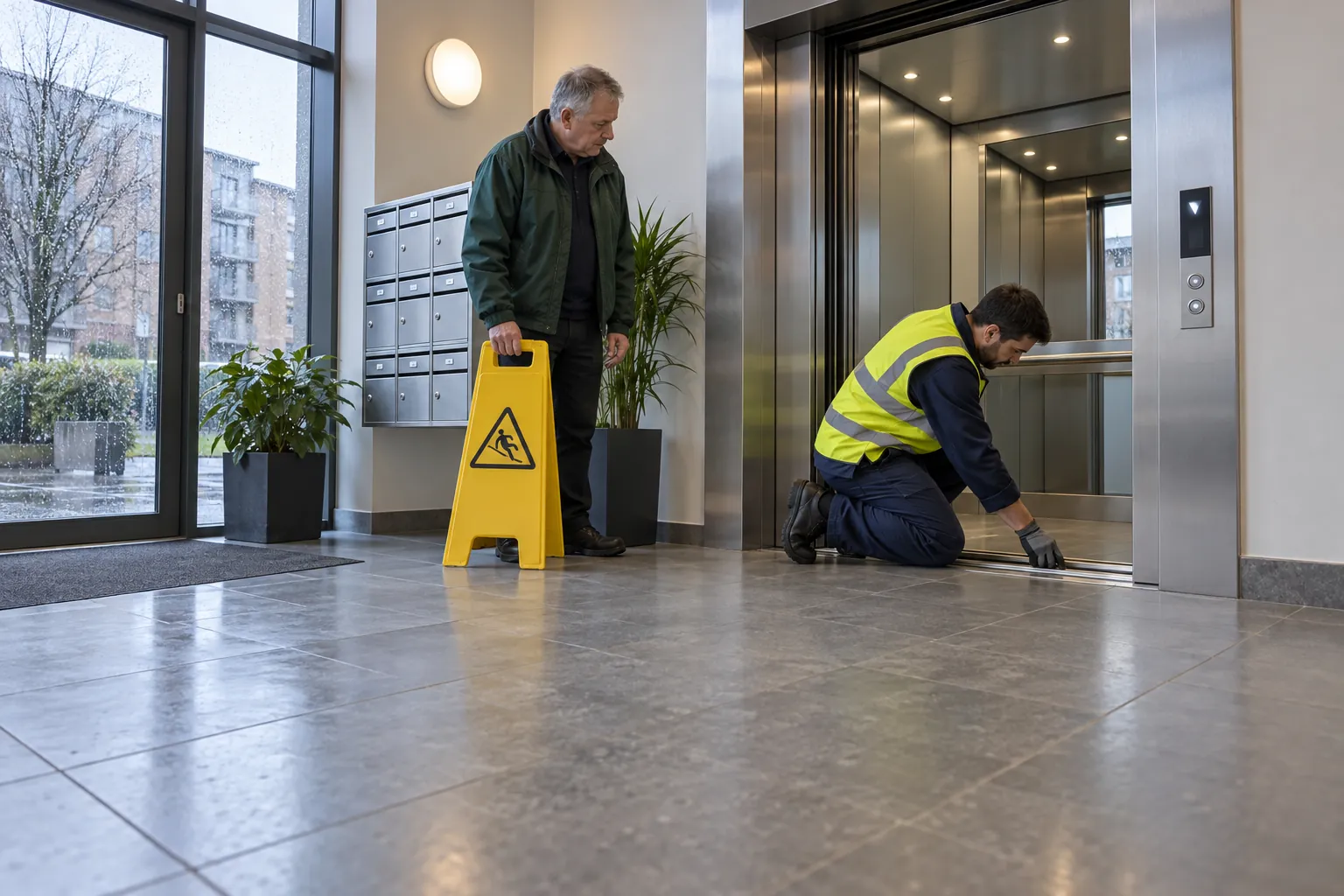
- Lifts and hoists: under regulation 52 and Schedule 1, Part B of the 2007 Regulations, a hoist or lift must be thoroughly examined by a competent person at least every six months, as must a patient hoist and suspended access equipment. That report is separate from routine lift maintenance. Escalators and platform lifts for level changes of 1.2 metres or less fall under regulation 30 instead.
- Other work equipment: regulation 30 requires periodic inspection of equipment exposed to deterioration, with results "recorded and kept available for 5 years"; regulation 31 requires "a maintenance log for any machine".
05
Welfare, energy, access, and where the evidence lives
Workplace basics. Regulation 20 requires sanitary and washing facilities to be provided, maintained and kept "in a clean state". An accident that leaves an employee unable to do their normal work "for more than three consecutive days, excluding the day of the accident" must be reported to the HSA, within ten working days for a non-fatal accident; see the HSA's accident and dangerous occurrence reporting page. It all belongs in the safety statement, which under section 20 of the 2005 Act names the hazards, the measures, the emergency plans and the people responsible; the HSA's safety statement and risk assessment FAQ says it must be brought to all employees' attention at least annually.
Energy. Under the European Union (Energy Performance of Buildings) Regulations 2012, a building offered for sale or letting needs a BER certificate, valid for up to ten years unless a material change invalidates it. A building over 500 m² frequently visited by the public must display a BER or Display Energy Certificate, and over 250 m² when occupied by a public body. A simplified A0 to G scale applies to non-residential BERs from 24 May 2026, and existing certificates stay valid (see the Department's press release on the simplified non-residential BER scale).
Access and building control. The Department's building control page sets out the process for new buildings and material alterations: a Commencement Notice before work starts, a Certificate of Compliance on Completion before occupation, and, for commercial buildings and apartment blocks, a Fire Safety Certificate and a Disability Access Certificate. It is "an offence to occupy or use a building without" them where required. Planning permission is a separate consent: as Donegal County Council's building control page puts it, the two systems "operate under separate and independent codes of legislation", and a building with planning permission may still fail the Building Regulations. For public bodies, section 25 of the Disability Act 2005 requires public buildings to be, "as far as practicable, accessible to persons with disabilities".
Where the evidence lives. The usual failing is not missing evidence but evidence nobody can find when the fire officer or an HSA inspector asks. A good arrangement has:
- a compliance register listing each item, its duty holder, frequency, date last done and date next due;
- certificates and reports filed against the building and plant, with the competent person's name and qualification;
- the fire safety register on the premises, and lift, electrical and legionella records to hand;
- building control certificates and past works' manuals kept together;
- for an OMC, planned maintenance reflected in the annual report to members, which must cover planned expenditure on maintenance and repair and the sinking fund;
- every defect tracked until it is put right, not just filed.
06
Where the record fails, and what SiteClara does about it
Annual certificates tend to be well kept, because a contractor issues them and someone chases the renewal. The weak point is the routine in between: the daily walk of the escape routes, the weekly alarm test, the monthly extinguisher round, the flushing of little-used showers. Those are the checks a fire officer asks about, and the ones most often written up after the event: a month of weekly tests in one pen, a sheet on the plant room door ticked before the shift began, a fault told to whoever was passing.
SiteClara records those routine checks where they happen. A printed QR poster at each location, with an NFC tag behind it if you want staff to tap, lets a caretaker, cleaner or security officer scan or tap with their own phone, with no app to install, see the checks due there and mark each one done or explain what stopped them, with a photo when one is asked for. The named person and the time are recorded as it happens. A problem found, such as a blocked final exit, goes onto the team's list of jobs until someone closes it, and a supervisor can escalate it to the building manager. The supervisor sees what was due, done and missed, records why anything was missed, and each day approves a report that goes to nominated managers or client contacts, such as the property management agent, at 8am the next morning.
07
Questions people ask
What is the checklist for building inspection?
It depends on the inspection. For new buildings and works under building control, it is the Inspection Plan: the Department's Building Control page says a preliminary Inspection Plan goes in with the Commencement Notice, and the Inspection Plan "as implemented" is lodged with the Certificate of Compliance on Completion; the Code of Practice for Inspecting and Certifying Buildings and Works sets out the detail. Authorised officers of the building control authority can also "scrutinise proposals and inspect works in progress". For a building in use, a fire officer inspects against the routine checks and servicing set out under fire safety compliance above, recorded in the fire safety register.
What are the compliance documents?
For building control, the Department's Building Control page lists them: a Commencement Notice signed by the owner, in most cases with a statutory Design Certificate, the forms assigning the Builder and the Assigned Certifier, and a preliminary Inspection Plan; a Statutory Certificate of Compliance on Completion, "together with relevant compliance documentation and the Inspection Plan as implemented", lodged before the building is occupied or used; and, for commercial buildings and apartment blocks, a Fire Safety Certificate and a Disability Access Certificate. They are uploaded through the Building Control Management System (BCMS). Once the building is in use, the compliance documents are its running records: the safety statement, the fire safety register and each competent person's certificates and reports.
How much does a certificate of compliance cost in Ireland?
The regulations set no fee for lodging the Certificate of Compliance on Completion itself. The Building Control Regulations 1997 (Law Reform Commission revised edition) set fees, in articles 23 and 24 and the Fifth Schedule, for the other steps: a Commencement Notice is €30 (€30 a building where one notice covers several buildings that need no Fire Safety Certificate), to a maximum of €3,800; a Fire Safety Certificate for a new building or extension is €125 or €2.90 a square metre of floor area being provided, whichever is greater, to a maximum of €12,500; and a Disability Access Certificate is €800 a building, or €500 when applied for before work starts alongside a Fire Safety Certificate. The real cost of the certificate is the Assigned Certifier's fee for inspecting and certifying the works, agreed privately, which no regulation sets.
08
Further reading, and a list to take away
Start with the Department's Fire Safety Guide (section 3 on persons having control, 5.6 on the register, 8 on the maintenance schedule), the HSA's guidance on safety statements, legionella and asbestos, and the Irish Standards from the National Standards Authority of Ireland. Your local fire authority can give advice under section 18(4).
To check your building is compliant:
- every item has a named duty holder, checked against the lease, the OMC's arrangements and any management agreement;
- a current risk assessment, safety statement, legionella control plan and, for an older building, asbestos survey exist;
- the fire safety register is on the premises and records the daily, weekly and monthly checks as well as the services;
- each competent person's inspections have a date last done and next due, including the lift every six months;
- certificates and reports can be found within minutes;
- defects from each report are tracked until they are put right;
- someone reviews the whole register at least quarterly, and whenever the building or its use changes.
Sources
Every document this guide quotes or links to, in the order it first cites them.
- Section 8 of the Safety, Health and Welfare at Work Act 2005 irishstatutebook.ie
- Section 15 of the 2005 Act irishstatutebook.ie
- Section 18(2) of the Fire Services Act 1981 irishstatutebook.ie
- Section 29 of the Licensing of Indoor Events Act 2003 irishstatutebook.ie
- Section 21 of the 2005 Act irishstatutebook.ie
- Citizens Information page on management companies citizensinformation.ie
- Fire Safety Guide for Building Owners and Operators gov.ie
- Section 11 of the 2005 Act irishstatutebook.ie
- Safety, Health and Welfare at Work (General Application) Regulations 2007 irishstatutebook.ie
- General Application (Amendment) Regulations 2007 irishstatutebook.ie
- Legionellosis hsa.ie
- National Guidelines for the Control of Legionellosis in Ireland, 2009 hpsc.ie
- The HSA's asbestos legislation page hsa.ie
- Asbestos surveys hsa.ie
- Accident and dangerous occurrence reporting hsa.ie
- Section 20 of the 2005 Act irishstatutebook.ie
- Safety statement and risk assessment FAQ hsa.ie
- European Union (Energy Performance of Buildings) Regulations 2012 irishstatutebook.ie
- The Department's press release on the simplified non-residential BER scale gov.ie
- Building control gov.ie
- Donegal County Council's building control page donegalcoco.ie
- Section 25 of the Disability Act 2005 irishstatutebook.ie
- Building Control Regulations 1997 (Law Reform Commission revised edition) revisedacts.lawreform.ie
Related guides
 Premises and facilities managementBuilding maintenance checklist: what to check in an Irish building, how often, and who byA building maintenance checklist for non-domestic buildings in Ireland: daily to annual checks under the 2005 Act, the 2007 Regulations and the Fire Services Acts.
 Fire and water checksFire safety register: what to record, who keeps it and how to make it credibleWhat a fire safety register should hold under section 18(2) of the Fire Services Acts, the routine checks behind it, who keeps it, and what makes it credible.
 Premises and facilities managementSafety statement: what the 2005 Act requires, and how to show it is followedWhat a safety statement must contain under section 20 of the Safety, Health and Welfare at Work Act 2005, who needs one, when to review it and how to show it works.
 Premises and facilities managementHealth and safety inspection checklist: what to walk, what to record, and what the HSA looks forA workplace health and safety inspection in Ireland: the 2005 Act and 2007 Regulations, what to walk, how often, recording actions, and what an HSA inspector asks.